The Trip to Echo Spring: On Writers and Drinking by Olivia Laing

Laing’s poetic ruminations on the alcoholism of six authors will charm readers of travel writing, biography and literary criticism.

echo spring
Olivia Laing’s The Trip to Echo Spring studies six authors whose lives meet at the juncture of creativity and alcoholism. While Laing (who walked along the river where Virginia Woolf killed herself for her previous book, To the River) acknowledges she had many alcoholic writers to choose from, the half dozen she selected justify and reward her nuanced attentions. Though F. Scott Fitzgerald, Ernest Hemingway and Tennessee Williams have been studied to the point of exhaustion, John Cheever, Raymond Carver and John Berryman have been less comprehensively examined.

Laing’s exploration of these extraordinary men’s lives has many facets. The Trip to Echo Spring, named for the bourbon favored by the maudlin Brick in Williams’ Cat on a Hot Tin Roof, is partly literary criticism–and no lightweight in that department, showing serious attention to her subjects’ works. Meanwhile, the level of biographical detail reveals Laing’s interest in their intersections with one another in life as well as literature. There are hints of travelogue as well, as Laing crisscrosses North America to visit the crucial locations in these writers’ lives, from Hemingway’s Key West to Fitzgerald and Berryman’s St. Paul, Minn., to Port Angeles, Wash., where Raymond Carver finished his life.

The common themes Laing finds in the cities and the bars where these men drank themselves into misery, death, and art include swimming, fluidity and the cleansing properties of sea and stream. She delves into the biology and psychology of of alcoholism, with several forays into Alcoholics Anonymous, and finally touches on her own upbringing as the child of alcoholics. While she focuses on the relationship between writing and drinking, another key part of her journey is personal–but her own history with drunks is only gradually revealed and never takes center stage.

These disparate elements come together elegantly in Laing’s quietly contemplative prose. She is sensitive to the struggles of these tortured men (among them several suicides) and deeply appreciative of their accomplishments, but also clear-headed about their shortcomings and their abusive treatment of others as well as themselves. A lovely piece of writing in its own right, The Trip to Echo Spring is a fine tribute to artists as well as a lament for their addiction.


This review originally ran in the November 20, 2013 issue of Shelf Awareness for the Book Trade. To subscribe, click here.


Rating: 8 bottles.

book beginnings on Friday: The Norman Maclean Reader

Thanks to Rose City Reader for hosting this meme. To participate, share the first line or two of the book you are currently reading and, if you feel so moved, let us know what your first impressions were based on that first line.

maclean

For this book beginning, we are treated to a previously unpublished chapter from Maclean’s abandoned book about George Armstrong Custer and the Battle of Little Bighorn.

It was in the year – even in the season of year – marking the 80th anniversary of the Battle of the Little Big Horn that Major Edward S. Luce retired as Superintendent of the Custer Battlefield National Monument. He and the Hill have long been closely connected.

Even in those few words, I recognize Maclean and his attention to detail and his interest. As I’ve just read in the introduction, Maclean’s obsession with the Mann Gulch Fire (see Young Men and Fire) is at least matched by his obsession with Custer; but his high standards and (argues the editor who wrote the introduction) his proximity to the subject caused him to leave this book behind.

I am super-extra-excited to have more Maclean to dig into. Let’s have it.

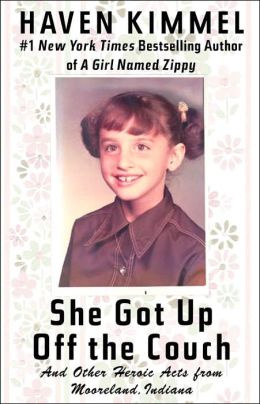
She Got Up Off the Couch by Haven Kimmel

couchHavel Kimmel aka Henrietta Krinkle, you are still my favorite.

This book follows A Girl Named Zippy, and I adore Kimmel’s explanation in her Preface: that she would definitely never write a sequel to Zippy, but that people kept on asking her if her mother ever got up off the couch; and here we are. This is an extension of that first memoir, then, with the focus being not on the girl called Zippy (Haven Kimmel herself) but on her mother, who in that first volume was a somewhat shapeless woman who mostly inhabited the couch and read a lot, talked on the phone, watched television, and didn’t worry too much about her children. This is told not unlovingly, but as fact. Zippy’s childhood is on balance awfully joyful and fun, and although a critical adult’s eye might point out lots of points of minor neglect, she clearly loves her family very much. This tone is continued in She Got Up Off the Couch. The family and each of its members is still, realistically, flawed, but lovable and well-loved. Kimmel’s brother is now mostly absent, with a family of his own; her sister marries and has two babies; her father finds work as a sheriff’s deputy (or similar job title); but her mother’s is the great change of this second memoir. This was, what, the late 1970’s I suppose, in a tiny Indiana town of a few hundred people. Zippy’s dad, Bob Jarvis, holds the keys: her mother Delonda doesn’t know how to drive. This will work as a fine metaphor (and indeed is part of the literal action), as Delonda calls a phone number on a television commercial to look into going to college. She wrangles a ride into the next town over for an entrance exam, which places her out of fully 40 hours of college credits. Under Bob’s clear disapproval – he says of the woman who takes Delonda to her test, “time was, a woman wouldn’t have gotten in a man’s marriage that way” – she persists in attending classes, studying, reading, talking to new people, and in 23 months, graduates summa cum laude – and continues on to graduate school. Eventually she earns a Master’s degree in English and becomes a high school teacher. This is all a stunning change. Along the way, to get to school and back, she learns how to drive and purchases a vehicle that is, in itself, a good joke.

She Got Up Off the Couch also follows the format of A Girl Named Zippy: chapters jump around, more as connected anecdotes than as clear narrative. Each chapter stands alone admirably as a hilarious or heartfelt – usually both – nugget of tears, joy, preadolescent confusion, and filial love. [In fact, as soon as I finish writing this review I’m off to read my favorite chapter out loud to Husband, if he’ll let me, while he smokes a brisket in the backyard. If you’re curious, it’s called “Treasure,” and is about a hippie college student hiking cross-country who camps out in the Jarvis backyard for a few days. It’s hilarious and heart-wrenching.] It’s a great structure, this anecdotal style. If I ever write my own mother’s biography, which I keep dreaming about, I have something similar in mind. Yes, there are odd characters that the reader of just one chapter would wrinkle her forehead at; but this is true of the whole book, too. Zippy has had an odd and happy life, and that’s exactly why we enjoy reading about it.

Zippy herself, naturally, also grows and changes in this book. Delonda is our star and makes the most life-changing journey. Kimmel writes in her preface, “I will never do anything half so grand or important,” and I know exactly what she means: the decision of Delonda and other women of her time who broke out of where they were told they belonged have done something for the women of my generation that we are now saved from having to do, if that makes any sense. It is something I’ve long felt about my own mother. But I was saying that Zippy continues to grow up: we see more of her engaging and eccentric friends, Rose and Julie Ann, and we meet a new friend, Jeanne Ann. And when she gets a nephew and then a niece, Zippy becomes hopelessly devoted. The blizzard that sweeps through when her niece is long overdue and panics the family is, again, funny and riveting at the same time.

I’ve now read everything that Haven Kimmel has written except for every single one of her blog posts, and that one children’s book. I hope she is getting to work right now on another book – fiction or non, more Haven Kimmel, stat.

I love it. Funny, true, humble, real.


Rating: 9 cherry-red polyester suits.

did not finish: Bonhoeffer: Pastor, Martyr, Prophet, Spy by Eric Metaxas (audio)

bonhoefferI’ve gotten better at putting down books I’m not enjoying. As I keep repeating to myself & others, there are far too many excellent books in this world for me to ever read them all, so why would I spend my precious, limited reading time on less-than-excellent books? But I guess I’m still working on applying this same policy to audiobooks. They are fewer, and a little harder to get my hands on, so I find myself taking more chances with audiobooks. But somewhere between a third and halfway through Bonhoeffer, I gave up.

This is the biography of Dietrich Bonhoeffer, a German pastor and theologian who lost a brother in World War I and was more prescient than many during Hitler’s rise to power. He was already involved in “the church,” but as Hitler’s government worked to take over the German church establishment, Bonhoeffer became even more active. I didn’t get this far, but apparently he also acted as a spy (for the anti-Nazi Abwehr), and was involved in a plot to assassinate Hitler.

As a non-Christian, I thought I would be able to appreciate this as a work of history and biography. But I found myself too much irked by the unspoken premises: that Bonhoeffer, as a good Christian, was a good guy; that he could do no wrong; that the Christian church was inherently good. Christian readers of this book (who I can only assume are the majority, and its target audience) will naturally not be offended by these assumptions; but I am bothered by premises being treated as fact. Bonhoeffer comes off as a good and likeable man, and I may even miss him; but he’s presented as a totally good man, and I just can’t buy that about any human being. In other words, I don’t think Metaxas treats him objectively, and that tends to bother me a great deal in my reading. The religious bias, combined with copious quotations from the Bible, proved too much for me. In a shorter book, I would have hung in there: I made it 8-10 hours into its 22 hours! But I could go no farther.

I am happy to accept that Bonhoeffer was, on balance, a force for good against Hitler’s evil; but in a lengthy biography I would expect a little more objectivity, and would prefer a nonreligious starting point for study. I found his life interesting and would read another book about him. But not this one.


Rating: 2 sermons.

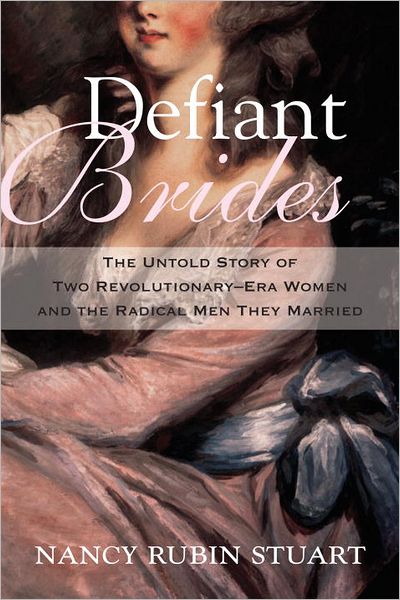
Defiant Brides: The Untold Story of Two Revolutionary-Era Women and the Radical Men They Married by Nancy Rubin Stuart

Parallel profiles of two wives on opposite sides of the American Revolution.

defiant

Margaret “Peggy” Shippen Arnold and Lucy Flucker Knox have traditionally been treated as historical footnotes in relation to their more famous husbands, Benedict Arnold and Henry Knox. Nancy Rubin Stuart (The Muse of the Revolution) remedies this neglect in Defiant Brides, a double biography that examines these two women as individuals as well as influential players in the American Revolution.

Peggy was a beautiful blonde belle of Philadelphia society, from a family that favored the British. Lucy was from a well-to-do, firmly Loyalist Boston family. The Shippens reluctantly admitted the political expediency of Peggy’s marriage to military hero Benedict Arnold; the Fluckers disowned Lucy for the sin of matrimony with patriot Henry Knox. Lucy supported her husband’s military and political careers in relative poverty and socialized with George and Martha Washington, even as she fretted over Knox’s long absences and missed the opulence of her youth. Peggy staunchly championed her husband through his treason and banishment and their subsequent financial difficulties in England and Canada; her part in Arnold’s betrayal at West Point, and her own possible role as a spy, remain controversial.

Stuart’s thoughtful research and consideration brings each woman forward into her own spotlight, reflecting on the flaws and strengths that Peggy and Lucy brought to their marriages and to the events of their time. Defiant Brides is an effortless read and a fresh perspective on the American Revolution, featuring two women who defied their parents to marry into a conflict that shaped a nation.


This review originally ran as a *starred review* in the April 23, 2013 issue of Shelf Awareness for Readers. To subscribe, click here, and you’ll receive two issues per week of book reviews and other bookish fun!


Rating: 7 degrees of loyalty.

What The World’s Strongest Librarian is Reading

Following up on my review of Josh Hanagarne’s new book, The World’s Strongest Librarian, and my interview of the man himself: this section didn’t get printed in Shelf Awareness but I thought my readers might be interested. I certainly was! For one thing, The Black Count is on my list.

So, from our interview conversation: What the World’ Strongest Librarian is Reading.


Josh says, “I read a book almost every day. Because I can’t sleep. It’s really hard for me to go to sleep with the tics, so that’s one of the silver linings, that I get to read so much. I shouldn’t say I read a book every day, but I finish a book almost every day. I read everything from juvenile books to big giant books that I’ll finish after eight days of reading.”

What good books have you read lately?

Truth in Advertising by John Kenney. It has never been this fun to be cynical. Kenney was an insider in advertising and copyrighting in New York, and it is just the most brutal look at the superficial world of advertising, and the storytelling – I really want everybody to go read it.

The Black Count: Glory, Revolution, Betrayal, and the Real Count of Monte Cristo by Tom Reiss is about Alexander Dumas’ father, who was the basis for The Count of Monte Cristo. He was a black man during the Napoleonic campaigns, and he rose to great power in a time when the world and the military were definitely ruled by whites. He winds up being imprisoned for something like 20 years, and the whole time he’s in prison his jailer is trying to poison him. Then it turns into this incredible story, if anything more swashbuckling and gigantic than The Three Musketeers or The Count of Monte Cristo. It’s a crash course in the Napoleonic campaigns that doesn’t feel like a history book. It’s just a wonderful book, the wildest adventure story.

I have been rereading Mark Twain, which I always am.

I just read a University Press book, Conversations with David Foster Wallace, that was quite good. Very theory-intensive, which I don’t enjoy so much anymore, but really good since I’m a fan of Wallace’s.

I just read The Liar’s Club by Mary Karr again.

And, The Twits by Roald Dahl. I just read that with Max. Max is finally old enough to want Roald Dahl. And that has made me happier than anything.”


See more of Josh’s book reviews and related and unrelated writings at his blog, The World’s Strongest Librarian.

Maximum Shelf author interview: Josh Hanagarne

Following yesterday’s review of Josh Hanagarne’s new book, The World’s Strongest Librarian, here’s my interview with the man himself.


Josh Hanagarne: The World’s Strongest Librarian Writes

Josh Hanagarne is from Moab, Utah, and lives with his wife, Janette, and son, Max, in Salt Lake City, where he works at the beautiful main branch of the SLC Public Library. His memoir, The World’s Strongest Librarian, touches on the bizarrely various pieces of his life: his struggles with Tourette Syndrome; his journey to becoming a husband and a father; his love affair with books and libraries that would eventually lead to a career; an obsession with the gym that became a penchant for tearing phone books and full decks of cards; and a less-than-smooth lifelong relationship with the Mormon Church, where he still finds family and friends but less faith than he once held.

worldsstrongest

Your book includes a lot of personal and painful history that belongs not only to you but to your wife and family as well. What was the process for sharing those personal details?

It was hard. During the first draft I didn’t think too much about how people were going to react. When I started going through on the second draft, I started showing things to Janette or to my mom and asking, is this accurate? Is this something you’re okay with having in here? Sometimes it was, sometimes it wasn’t. Whenever anybody was mildly uncomfortable with something, I just took it out–nothing of real consequence. I guess when you write a memoir, you choose which periods of your life you’re going to represent, and then you choose which episodes best represent those periods. If you’re a normal person, sometimes that means you’ll look good and sometimes it means you’ll look bad. So that wasn’t fun, but it was honest, I think, without being tedious and self-flagellating.

I’ve always used humor kind of in self-defense, because I knew if I could make people laugh I could make them focus on something other than my tics. I think this book is kind of sad, and I think a lot of humor is rooted in something sad. I believe Kurt Vonnegut and Mark Twain both talked towards the ends of their lives about having various forms of irony fatigue, because humor was mainly a self-defensive tool for them. I think in any book where you get to pick and choose what you put in, the sadder stuff’s going to get sadder, and the funny stuff’s probably going to get funnier.

You’ve included Dewey classification numbers under each chapter heading. Do you think this resonates with the general population, or mostly just librarians?

I don’t know. I think most people, even if they don’t get it, will probably be intrigued. Some people have pointed out that they don’t all work out exactly the way capital-“L” Librarians think they should, to which I will just say, the numbers do exactly what I want them to do. I think it’s eye-catching. I didn’t necessarily think of it as being gimmicky, because it really does tie in thematically with each chapter. What I really like about it is that you can kind of see what’s coming and yet sometimes not have any clue how one thing will lead to the next.

Tell us about the process of writing this book: When did you write? Were you still working at the library?

This is probably going to disappoint a lot of aspiring writers who put off writing until they have hours of free time every day, but I don’t think I ever sat down and wrote for more than 15 minutes at a time. I just can’t; the tics won’t let me. I wrote whenever I could. I’d guess I rarely wrote more than half an hour total in a day. I do write really fast. I found out that, at least now, I’m the sort of writer who has to make a gigantic mess and then clean it up, because if I start trying to anticipate all the editorial questions on the fly, I just freeze up and I don’t get anything done. So I wrote a lot more to get to this book than I probably could have, if I were another writer. I wrote the first draft totally on my own and then I sent it to my editor, and things had just been going so well that I kind of assumed, yeah, my first draft is surely anyone else’s fourth or fifth. Then my editor sent it back and said, you’ve got to get rid of 120 pages. We can’t even talk yet. Fix this. Which was a great lesson to learn, and not an easy one. But editing was really kind of fun, because Megan [Newman] is really the right editor for me. I think it took three total drafts between us, but about eight on my part. I learned that it takes a hideous amount of work to appear spontaneous. But it was a lot of fun. The shortest way to answer your question is: I wrote every day, I only wrote for a few minutes at a time, and I just kept going. A big part of it is being willing to show up.

Was the writing process cathartic for you?

If this book hadn’t come about, I think I’d probably still be going through the motions in church, trying not to make waves. The ideas I’ve gotten from church have everything to do with my relationship to my body, and the explanations I thought I owed for my life. In writing the book, I realized, I’m actually going to have to deal with this. So I got into the sticky situation of writing a book about how much I love my family and yet gently distancing myself from the church, knowing that that would be painful for my family. That was the biggest catharsis: realizing that I was going to have to deal with that shift in faith. Spending so much time thinking about that, and trying to word it correctly, is what taught me what I actually do think about it all.

Would you say that you had a message or even a cause to communicate with this book, related to Tourette’s, or libraries, or anything else?

I’m not much of a crusader. But when I go speak to groups of people with disabilities, or their parents, or special educators, the reaction I get is so humbling and overwhelming. If people I speak to are actually getting out of this story what they tell me they are, I knew I really needed to do this book as well as I can. So that it can go be me in all the places I can’t be. There’s definitely no downside to spreading the word about Tourette’s. This story seems to inspire some people without me ever needing to claim I can inspire anyone. As far as libraries, obviously this whole book is my love letter to books and libraries. That’s not necessarily what I intended, but for me to write about myself honestly, that’s the only thing that could have happened.

What do you most want people to know about you that’s not in your book?

To entertain my son occasionally in the morning when I put my pants on, I will hold them up at about waist height and I will try to jump into my pants. So I jump all the way up in the air and tuck my knees in and if I do it right, my feet come through the pants and I’m dressed. And if it goes wrong it goes really badly wrong. And about one of every 10 times I can put my pants on this way. Once in a while. You know, one out of 10 might be optimistic.


This interview originally ran on April 9, 2013 as a Shelf Awareness special issue. To subscribe, click here, and you’ll receive two issues per week of book reviews and other bookish fun!

Maximum Shelf: The World’s Strongest Librarian by Josh Hanagarne

Maximum Shelf is the weekly Shelf Awareness feature focusing on an upcoming title we love and believe will be a great handselling opportunity for booksellers everywhere. The features are written by our editors and reviewers and the publisher has helped support the issue.

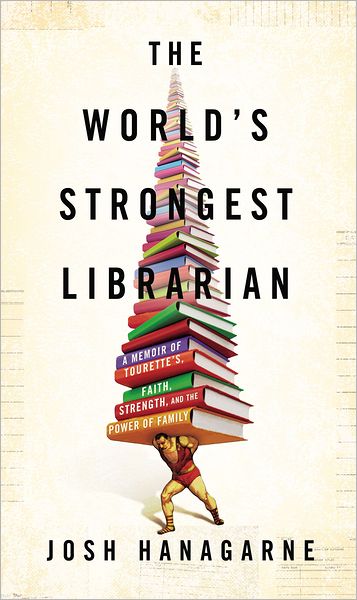
My editor recently asked me if I’d like to put together my first Maximum Shelf for them, and said she had just the book in mind for me: The World’s Strongest Librarian: A Memoir of Tourette’s, Faith, Strength, and the Power of Family, by Josh Hanagarne. (My father found this a hilarious expression of what my editor thinks of me. I’ll let you work that one out. I haven’t.) I was thrilled; and I loved the book. Because this would make for an extra long blog post, I’ve split the Max Shelf issue into two posts for you, so please enjoy my review today and my interview with the gracious & funny Josh tomorrow.


worldsstrongest

Josh Hanagarne, blogger at The World’s Strongest Librarian, “might be the only person whose first three-hundred-pound bench press was accompanied by the Recorded Books production of Don Quixote.” This is just one of his remarkable singularities. A gentle giant who tears phone books for fun, at 6’7″ he tends to catch the eye at the Salt Lake City Public Library, even when his Tourette Syndrome is not acting up. His memoir explores these contradictions and oddities, and his remarkable journey from idyllic childhood to painfully jerky young adulthood to a contented family and work life.

Hanagarne had a happy childhood, beloved by his mother, an incorrigible prankster and devout Mormon, and his devoted, irreverent bear of a father. He grew up in libraries, a passionate bookworm disturbed only by the tics that began in first grade but would go undiagnosed until high school (although his father suspected Tourette’s from the beginning). By young adulthood, they were not only embarrassing but violent and debilitating. He would eventually suffer a hernia from the force of his involuntary shouting tics, and his larger movements resulted in injury to himself and chaos in his immediate surroundings. After high school he spent years trying numerous cures, in and out of college, working various jobs and struggling with depression. Lifting weights at the gym stilled the tics somewhat, and for a while he got regular Botox injections in his vocal cords to quiet the shouts and whoops. During that time he met and married a lovely Mormon folklorist named Janette. For the first eight months of marriage, he couldn’t speak to her above a whisper.

Although deeply in love, the atmosphere of Josh and Janette’s story early in their marriage remains clouded. For years they try to get pregnant. Janette suffers two miscarriages and they are harshly rejected by the Mormon Church as adoptive parents. Josh continues to tussle with Tourette’s. For a short time, he finds a position as assistant special educator quite satisfying, not least because his tics become unremarkable in a room full of special needs. But he soon leaves that job, because he seeks challenge: crucially, he aspires to overcome Tourette’s, to beat his tics into submission. Pondering what might present the greatest challenge to a man who can’t keep quiet, Josh is drawn to the quietest place he knows, a place that has always offered succor and delight. He gets a job as a clerk in the library and begins a master’s program in library science. And a key piece of marital bliss is finally achieved when Janette delivers a healthy baby boy named Max.

Josh continues to battle Tourette’s in the gym, discovers kettlebell lifting along the way, and makes a new friend in Adam Glass, a former Air Force tech sergeant and strongman: he bends wrenches and horseshoes and tears decks of cards and phone books. Josh’s story takes an inspiring turn as the twitchy librarian and the foul-mouthed strongman gradually develop a friendship; as Adam helps Josh build strength, together they also begin to understand and subdue the tics. He finds Adam a little strange, and the explanation for his social awkwardness is also what makes him the perfect mentor for overcoming Tourette’s: Adam is autistic.

The adult Josh Hanagarne who relates his story is content and stable, happily married, thrilled to be a father to four-year-old Max, and working full-time at the Salt Lake City Public Library. As he relates his stranger-than-fiction story, he intersperses present-day anecdotes from a workplace that he wryly notes is rife with strange and occasionally smelly patrons and events. He muses eloquently and powerfully about the role of libraries in society, and their future possibilities. Throughout his life and this book, Josh struggles with his Mormon faith, as he sets off on the expected mission and faces myriad challenges in school, work, marriage and parenthood. In telling a story about family, church and Tourette Syndrome, he always circles back to libraries and to books, in many charming literary references. And always central to Josh’s story is his love of family. From his loving parents and exceptionally close siblings through the clear delight Josh finds in marriage and fatherhood, he stresses the inestimable gift of a loving family.

Josh’s memoir is thoughtful, heartfelt, often hilarious– and unsparingly honest. He is not proud of every moment in his own past, but he shares nonetheless. The image of the man today who wrote this book and who works in a large branch of a public library in a large city is that of a serious yet funny, mature, loving family man, and this image is only partly at odds with the earlier, less secure young man we come to know in these pages. The younger Josh was unsure and unstable, and the author is more comfortable in his own skin. But both have tics, and stories to tell.


This review originally ran on April 9, 2013 as a Shelf Awareness special issue. To subscribe, click here, and you’ll receive two issues per week of book reviews and other bookish fun!


Rating: 9 minutes of calm.

Tomorrow: I interview The World’s Strongest Librarian.

Vera Gran: The Accused by Agata Tuszyńska, trans. by Charles Ruas

The unanswered questions surrounding the life of a lounge singer in the ghettos of Warsaw, as seen through the gauze of memory.

veragran

Vera Gran was a wildly popular Jewish lounge singer in the Warsaw Ghetto during World War II. In 2007, she died in an apartment in Paris–filthy, claustrophobic, paranoid and hateful. For decades, despite being found innocent by several tribunals, she had faced accusations of collaboration with the Gestapo.

Agata Tuszyńska was 19 when her mother, also a survivor of the Warsaw Ghetto, first told her she was Jewish. In her approach to a profoundly sad and traumatized old woman, Tuszyńska seeks the truth but realizes it cannot be pinned down. Vera Gran: The Accused is not a biography, but a shifting portrait of Gran, the Ghetto and survivors’ guilt; it is a contemplation of what we will do (and should do) to survive. Readers unfamiliar with Vera Gran may be more familiar with Wladyslaw Szpilman, the subject of Roman Polanski’s award-winning film The Pianist: Szpilman was Gran’s piano accompanist, but he cut her out of his memoir–later becoming one of her most vocal accusers. The nature of memory and memoir, the power of the stories we tell when those stories outlast memory of the events themselves, becomes a central theme in Tuszyńska’s book.

Charles Ruas’s translation from the French is subtly poetic and adds to the quiet tones of Tuszyńska’s musing as well as Gran’s anger. It is this atmosphere, along with the unknowable questions surrounding Gran, that makes Vera Gran: The Accused a remarkable and memorable contemplation.


This review originally ran in the March 1, 2013 issue of Shelf Awareness for Readers. To subscribe, click here, and you’ll receive two issues per week of book reviews and other bookish fun!


Rating: 6 changed stories.

book beginnings on Friday: The World’s Strongest Librarian by Josh Hanagarne

Thanks to Rose City Reader for hosting this meme. To participate, share the first line or two of the book you are currently reading and, if you feel so moved, let us know what your first impressions were based on that first line.

worldsstrongest

I have discovered a strange and wonderful new book: a memoir by a Mormon strongman librarian with Tourette’s Syndrome.

Today the library was hot, humid, and smelly. It was like working inside a giant pair of glass underpants without any leg holes to escape through. The building moved. It breathed. It seethed with bodies and thoughts moving in and out of people’s heads. Mostly out.

To me, this beginning establishes the author’s voice, which will be evocative as well as irreverent. One of Hanagarne’s strengths is that he communicates often serious content with a wry twist that sometimes had me giggle out loud. Aside from which, the opening setting of this book is a library, and I am a sucker for that, as I bet are some of you.

I’m sorry to tell you that this book won’t be out until May! But be sure to look out for it then.

This quotation comes from an uncorrected advance proof and is subject to change.