Teaser Tuesdays: Racing Through the Dark by David Millar

Teaser Tuesdays is a weekly bookish meme, hosted by MizB of Should Be Reading. Anyone can play along! Just open your current read to a random page and share a few sentences. Be careful not to include spoilers!

David Millar is a veteran professional bike racer who has raced in all the biggest events – the Vuelta, the Giro, the Olympics, and the Tour de France where he’s worn the yellow leader’s jersey. This memoir tells the story of his childhood discovery of the sport he loves, his journey upwards through the professional ranks, and his eventual bust for doping – and then his comeback to the sport, as a “clean” racer. It’s an emotional and unfortunately relevant topic for any fan of professional road racing. Here’s a teaser for you.

After winning Denmark, it would have been reasonable for me to think that I didn’t have to go to Italy, that if I worked hard and put my head down and believed in myself, I could win the Vuelta prologue – clean.

Perhaps if I’d had people – somebody – around me whom I could have talked to about it, then that might have been the conclusion I’d have come to and I’d have canceled the trip to Tuscany.

This is an example of the problem Millar describes as a lack of support for those racers trying to stay clean. He stops short of blaming his decision to dope on pressure from the sport or his team; in fact, he receives very little direct pressure. But the culture surrounding him, so nonchalantly accepting of doping, as he portrays it, makes it difficult for him to resist at a certain point, and no one supports his attempt to stay clean. There is definitely a discussion point here about the meaning and power of peer pressure, alongside the ever-looming question of “clean” competition vs. doping in sports and cycling in particular… I will say for now that Millar never struck me as making excuses. Review to come after this book’s US publication date. [Note: this book has been out in the UK for almost a year. US pub is this June.]

This quotation comes from an uncorrected advance proof and is subject to change.

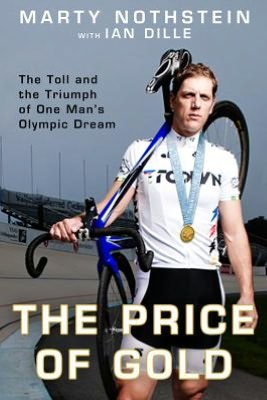
Teaser Tuesdays: The Price of Gold by Marty Nothstein and Ian Dille

Teaser Tuesdays is a weekly bookish meme, hosted by MizB of Should Be Reading. Anyone can play along! Just open your current read to a random page and share a few sentences. Be careful not to include spoilers!

In The Price of Gold, Marty Nothstein, generally accepted to be the most accomplished American track (cycling) sprinter of the modern era, joins Ian Dille, Austin(TX)-based cyclist and journalist, to tell the story of his journey to greatness and Olympic gold, and what it cost him. I am enjoying this immensely: it kept my heart rate raised just about the entire time! Here’s a teaser for you:

“Never wear sandals to a bike race,” Whitehead chastises Gil one time. “You always bring sneakers. You never know when we’ll need to fight our way out of here.” These are the bike racers I aim to emulate.

I like this one because it’s a characteristic portrayal of what makes Nothstein, and really all track sprinters, sort of controversial: the aggression. I find it fascinating stuff. Look for my review a little closer to this book’s June publication date.

This quotation comes from an uncorrected advance proof and is subject to change.

Critical Wit Podcast interview: Ian Dille, coauthor of The Price of Gold

Another author interview posted over at Critical Wit Podcast the other day. In this episode, I interview Ian Dille, coauthor with Marty Nothstein of The Price of Gold: The Toll and Triumph of One Man’s Olympic Dream. Nothstein holds two Olympic medals – one gold – and is one of the most highly decorated athletes of all time in the match sprint event in track cycling. That is, racing bicycles on a banked track called a velodrome. This is a sport I have competed in myself, which made the book especially exciting for me; Marty’s name was well-known around the Houston track where I’ve spent a good deal of time. And Ian is a Texas bike racer as well as a journalist, so I was enthused at the chance to chat with him, too. Don’t forget to check out his website here. And now the interview!

me

Ian

two-wheeled thoughts: Elizabeth Howard West

two-wheeled thoughts

When man invented the bicycle he reached the peak of his attainments. Here was a machine of precision and balance for the convenience of man. And (unlike subsequent inventions for man’s convenience) the more he used it, the fitter his body became. Here, for once, was a product of man’s brain that was entirely beneficial to those who used it, and of no harm or irritation to others. Progress should have stopped when man invented the bicycle.

–Elizabeth West, Hovel in the Hills

Aside from the unfortunate use of “man” to mean “people,” what a lovely and true statement she makes.

did not finish: The Bar Mitzvah and the Beast by Matt Biers-Ariel

I tried to read this on my trip to Ireland and gave up. Just a few brief notes as to why.

Backstory: the author’s son, at twelve, states that he will not be having a bar mitzvah because he is an atheist. The author still wants him to have a coming-of-age event, and suggest a cycling trip cross-country. Mom, Dad and both sons (the younger is 8 and will ride on the back of his dad’s tandem) start planning, and undertake a cause to attach to the trip: they will ride to Washington, D.C. gathering signatures on a petition to do something about global warming. My interest, of course, is in the cycling angle.

But Biers-Ariel failed to make me care about his admittedly heartfelt and well-meaning journey. The hope for anti-global-warming legislation is sympathetic, but a bit naive. Prosaic prose, simplified concepts, and jokes that fell flat wore on me; I read 53 pages, didn’t care what happened next, and was annoyed by author’s voice, but I wish him well. Did the family make it? You’ll have to read the book to find out for yourself.

A Walk (Ride) About Town: the convent with the barbed wire (Houston)

A Walk About Town is hosted by Natalie over at Coffee and a Book Chick.

This past weekend (3/24-25) was a truly lovely one in Houston, and we have been starved for good weather recently: it almost didn’t rain at all in 2011, so we’ve been seeing drought, dead trees, and wildfires; and in the first few months of 2012 it has done almost nothing but rain. We skipped winter (it stayed above 60 degrees most of the time) and fear another hot summer. But! This past weekend was a dream: sunny, light breeze, upper 70’s. Okay, it got well into the 80’s, but I’m not complaining.

So of course on Saturday Husband and I were riding our bikes around town. It was a nice day for exploring, and we were on our usual route east of town. I normally do this ride in the dark, in the early morning or evening, and it’s always a treat to see it in daylight. This was finally the day to explore something I’d been curious about for some time. We ride by a large piece of property that is all overgrown vegetation and fenced with barbed wire at the top, angled inward, as if they’re trying to keep someone or something in rather than out. I’ve been told it’s a convent, which seems like an odd place to employ inward-facing barbed wire. We rode around until we found an open gate, and entered.

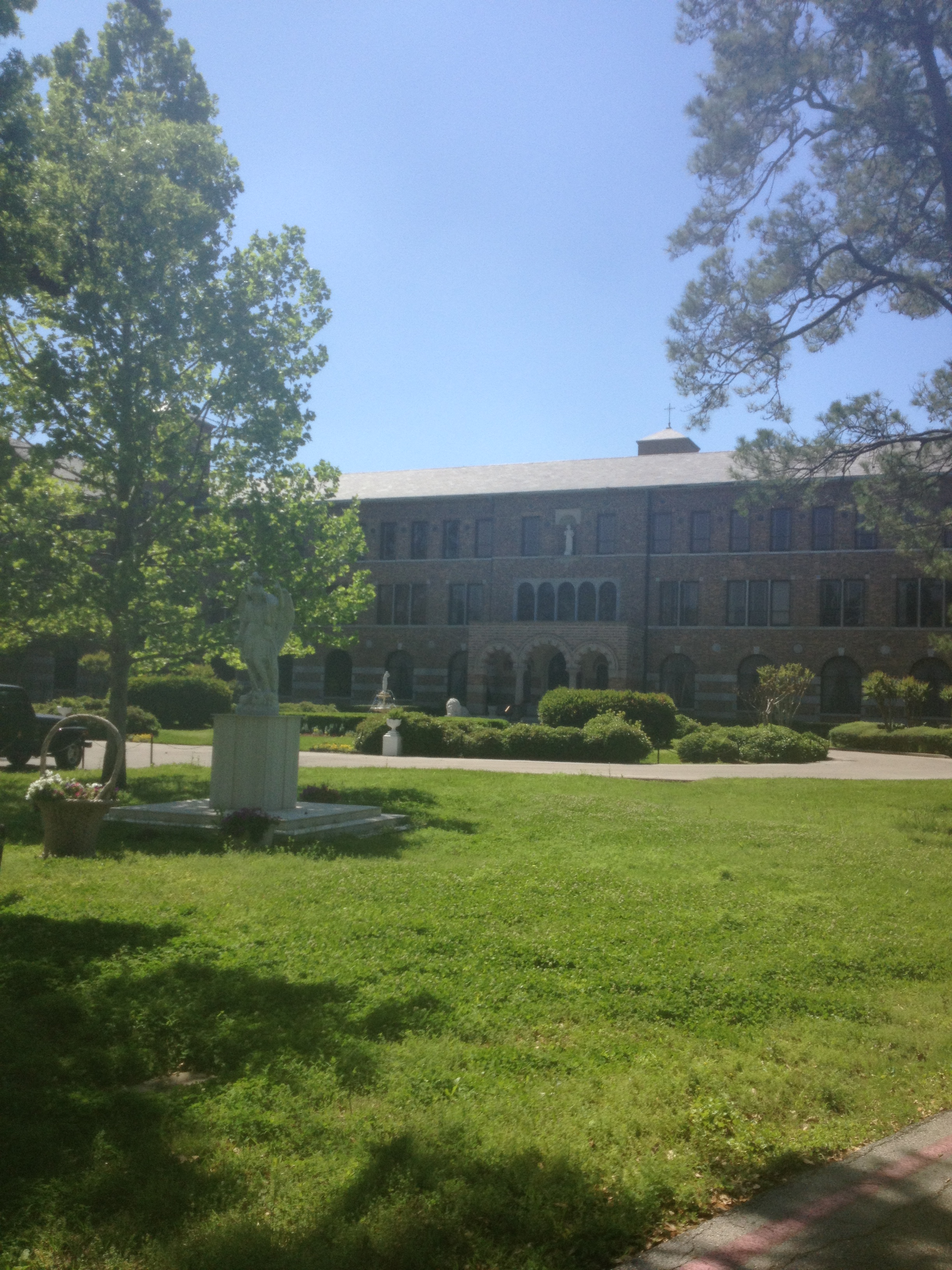
This turns out to be the Villa de Matel, run by the Sisters of Charity. It is even larger than I thought, and beautiful! We took some pictures with Husband’s iPhone; this magical device often takes the best pictures we get on our vacations and whatnot, but it didn’t do so well on this day in the sunshine. Maybe it’s better indoors? At any rate, I am sharing the pictures even though they’re not professional or ideal. What do you want, we were on our bicycles.

This was our view as we entered: big beautiful building, statues, fountains, and greenery. It was dreamy.

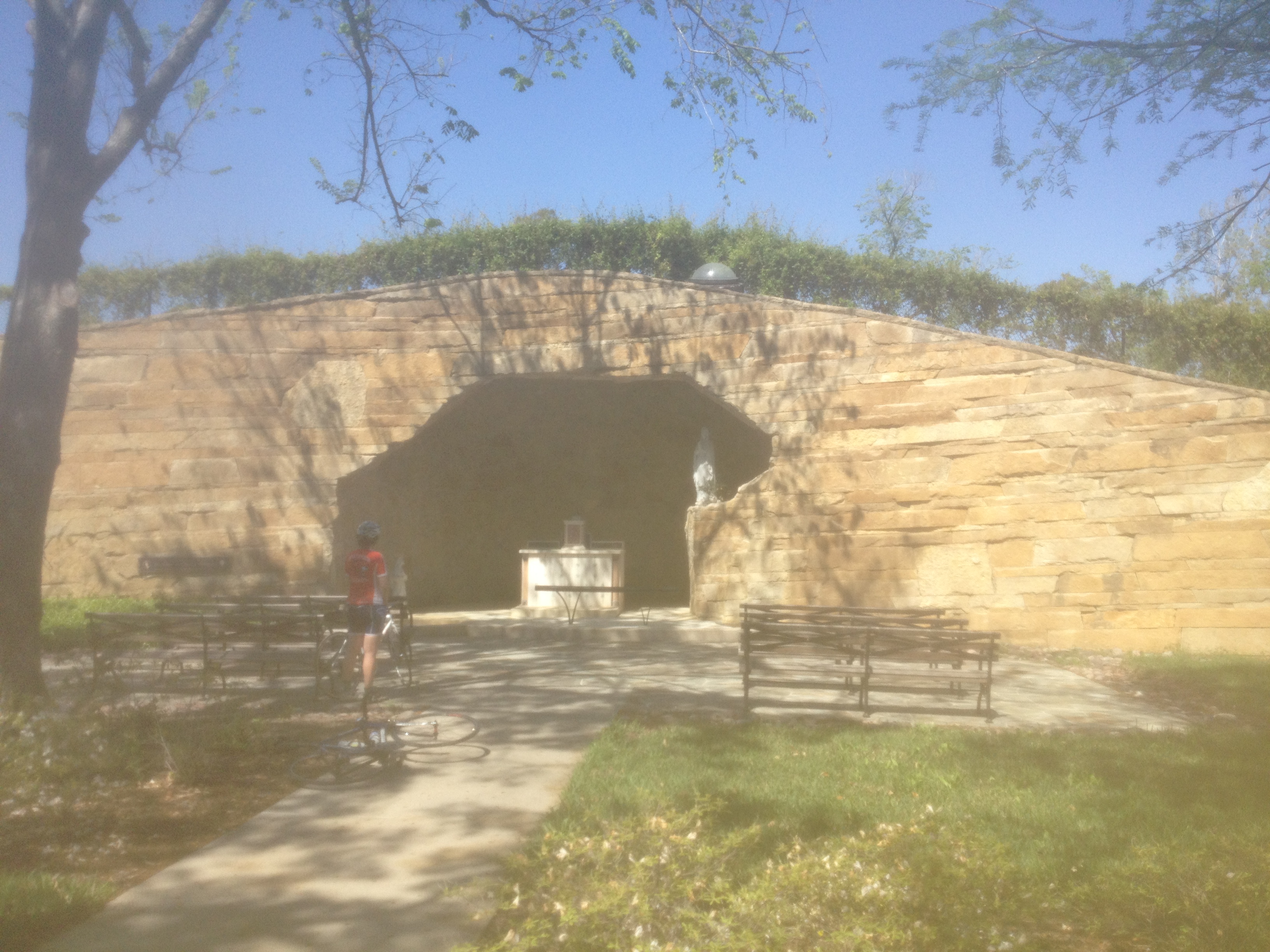
A lovely little grotto with trickling fountain, alter, seating, and a skylight above a statue of the Virgin so that presumably under ideal conditions she’s lit up from above. (That’s me in red.)

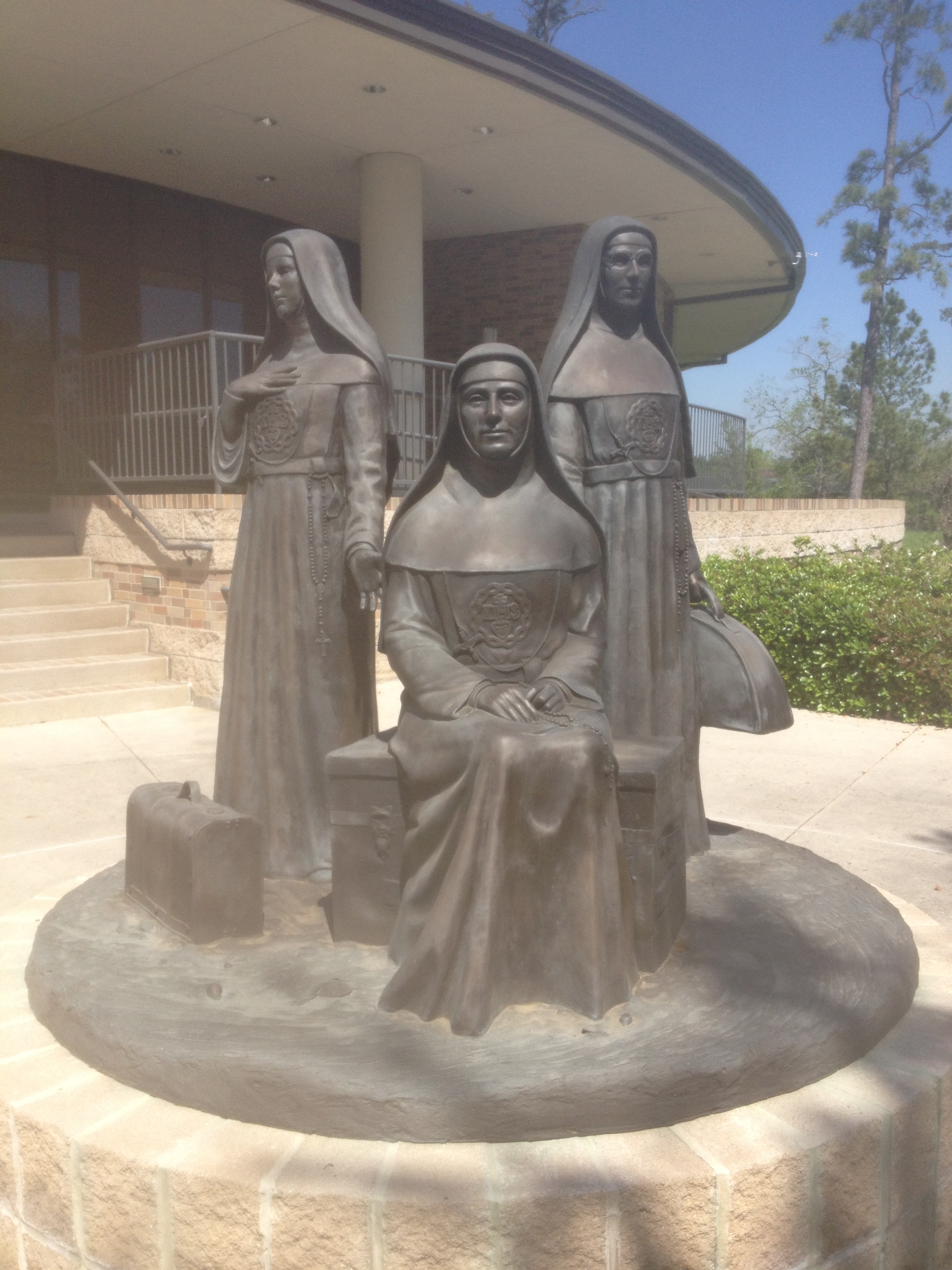
No plaque here, but I liked the statue. Three nuns. Acting as nurses? (The bag on the right looks like a medical bag.)

The grounds were really highlighted by the sunshine, and so green!

There was more. I wish we’d gotten more, and better pictures. There was a little neighborhood of residences; there was a swimming pool, and various buildings and facilities including a conference center. And the side that we normally ride by, all overgrown, is a natural area with a footpath. The sign entering the footpath was funny and I wish I’d gotten a picture of it: to paraphrase, “beware! uneven ground – water occasionally pools – watch out for wildlife including armadillos, possums, raccoons and snakes!” The entire grounds were beautiful, and as I said, at their best in the greenery and sunshine. The buildings were lovely. And it was – perhaps as you’d expect – peaceful and quiet, its own little world. I’m glad we took the time to explore.

Discovered anything new in your hometown lately?


Be advised: I’m out of town, so you’re viewing pre-scheduled posts until April 9. I love your comments and will respond when I return! But I’ll be out of touch for a bit. Thanks for stopping by!

two-wheeled thoughts: Edward Abbey on bicycles, or anything non-motorized

two-wheeled thoughts

A man on foot, on horseback or on a bicycle will see more, feel more, enjoy more in one mile than the motorized tourist can in a hundred miles.

–Edward Abbey, Desert Solitaire

I will give him the benefit of the doubt and assume he means a woman, too. I’m just relieved to see that Abbey acknowledges us two-wheeled, human-powered vehicles as part of the solution. 🙂

two-wheeled thoughts: Willie Weir on portaging

two-wheeled thoughts

A bicycle is freedom when you’re riding it; it’s a millstone when you’re not.

–Willie Weir, “Back Roads and Back Waters,” India section, Spokesongs

Portaging one’s bicycle is always a drag. Then again, some of us choose to race cyclocross. 🙂

two-wheeled thoughts: Willie Weir on dining

two-wheeled thoughts

As a cyclist I try to avoid places with cute French names. These inevitably are dining establishments. Touring cyclists seldom dine, they feed.

–Willie Weir, “Beauties and the Beast,” South Africa section, Spokesongs

Remember, a cycle-tourist travels by bicycle; in this case, Willie is a self-supported tourist, meaning he carries all his gear and fuel and supplies on his bike. In other words, he needs calories. This two-wheeled thought comes from a funny little story involving a “dining establishment” in which he doesn’t feel he belongs.

two-wheeled thoughts: H.G. Wells

two-wheeled thoughts

When I see an adult on a bicycle, I do not despair for the future of the human race.

–H.G. Wells

A classic.