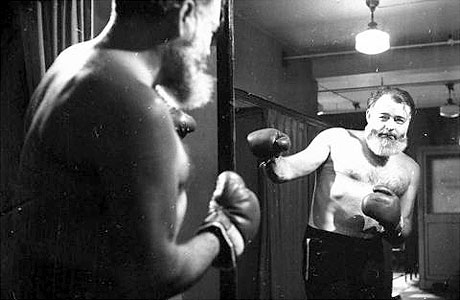
hemingWay of the Day: on nightlife

Nightlife is a funny thing. There seems to be no reason or rule that controls it. You cannot find it when you want it. And you cannot get away from it when you don’t want it. It is a European product.

from “European Nightlife: A Disease,” The Toronto Star Weekly, 15 December 1923

So true, Papa, so true! I feel like I’ve spent all my life either trying to find the party or to escape it. (Is that a metaphor for something?) This article was a charming little assessment of the nightlife scenes in a handful of European cities – not a travel guide or anything, since it’s so dated (!), but a snapshot in time of one man’s experience, at least, and well presented, and funny.

hemingWay of the Day: on Clemenceau

There is nothing deader than a dead tiger and Georges Clemenceau was a very great tiger. Therefore Georges Clemenceau is very dead.

from “Clemenceau Politically Dead,” The Toronto Daily Star, 18th February 1922

I found this one in On Paris, a brief collection of Hemingway’s early journalism from the time when he lived in the City of Light. I’m struck by his simple, yet funny, wording, which makes a point about Clemenceau’s special brand of deadness in an interesting way, that may take a moment to sink it. I find it very typical of Hemingway, and I love (about this, and about all of On Paris) that his distinctive voice was present, if unpolished, very early on.

the Sharon Kay Penman corpus

Sharon Kay Penman is probably my very favorite author of historical fiction. Her books are generally quite long (the exception is the shorter books in her mystery series starring Justin de Quincy), and so effortlessly create whole worlds that I just love to fall into. I turn to her books when I’m looking for a comfortable, engrossing read that won’t be over in a day or two! I’m slowly working my way through all her work; I’ve only read a few so far but have collected most of them. In chronological order, they are…

Standalone:
The Sunne In Splendour (1982) – reading now

The Welsh Trilogy
Here Be Dragons (1985) – own it (edit: read it)
Falls The Shadow (1988) – own it
The Reckoning (1991) – this was my first Penman, and I reread it several times before branching out, I loved it so much. Now I guess it’s time to go back and read the first two in this trilogy!

The Henry II Trilogy
When Christ And His Saints Slept (1995) – loved it
Time And Chance (2002) – own it
Devil’s Brood (2008) – own it
Lionheart (2011) – have it in the library

The Justin de Quincy Mysteries
The Queen’s Man (1996) – enjoyed it
Cruel As The Grave (1998)
Dragon’s Lair (2003)
Prince of Darkness (2005)

The other aspect of Penman’s work (which I’ve discussed before) is that she does meticulous research. I consider her to be an excellent example of a responsible author of historical fiction; the author’s notes at the back of each of her books details where history ends and where fiction begins, so that the responsible reader can be careful about how much she takes away from these books as fact. I definitely recommend her work.

shrine to Papa

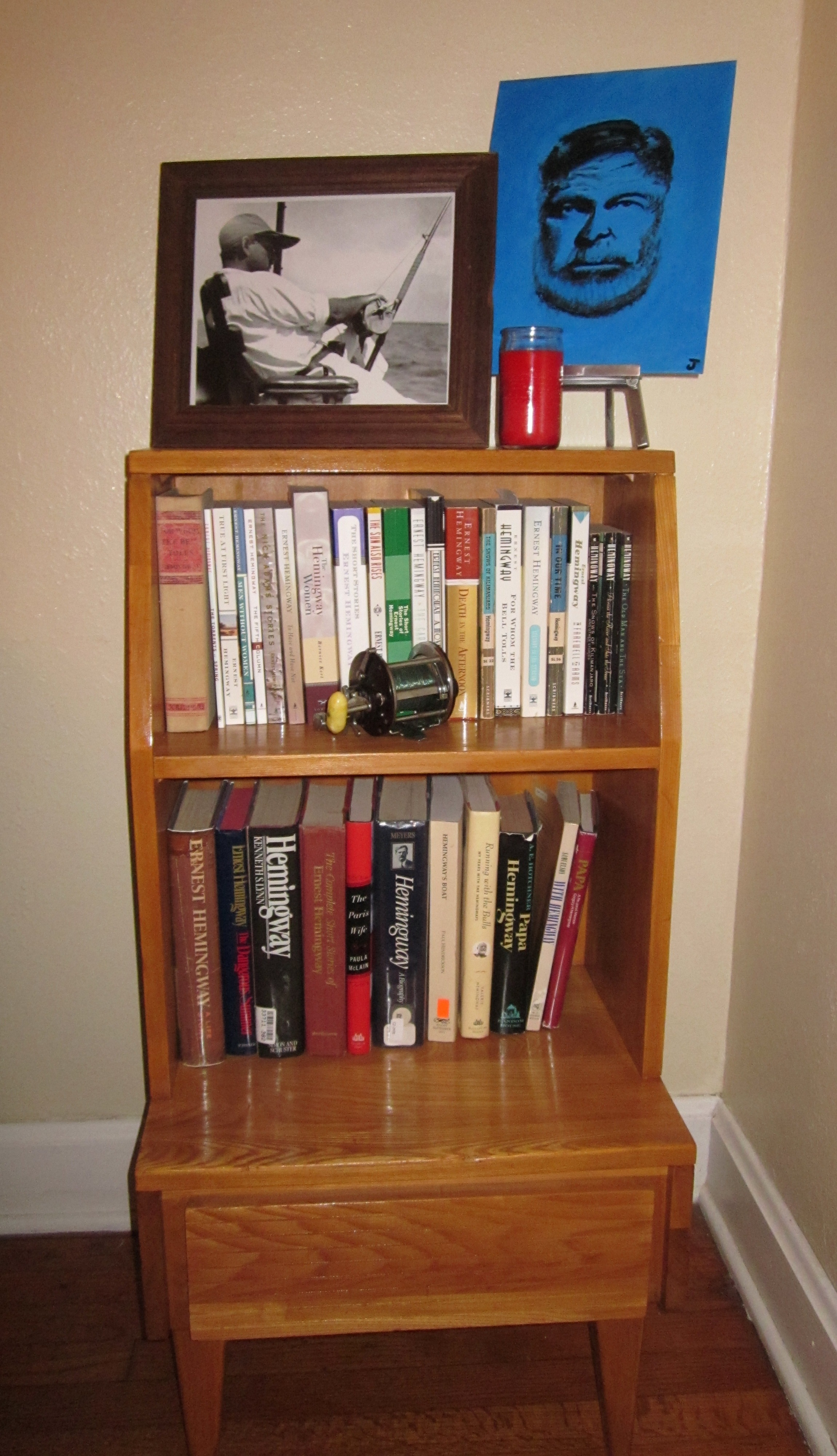
I’ve been working on this little project for a month or so now, and it’s finally ready for its photo shoot.

First of all, I have limited bookshelf space (I’m sure you’re shocked). When I read Paul Hendrickson’s Hemingway’s Boat recently, I enjoyed being immersed again in one of my favorite literary and historical figures. It had been a little while since I’d read any Hemingway (or anything about Hemingway), and it was like coming home: it was comforting and comfortable to return to a subject I know and love. It also inspired me to make some purchases.

First, I decided I wanted a smallish bookshelf to dedicate to the Hemingway theme. I thought maybe it could hold all my books by Hemingway, and about him, and also the works of his friend or those authors I’ve picked up directly because of a Hemingway connection (Stein, Fitzgerald, de Maupassant, Beryl Markham). I cleared it with Husband and he even agreed to come shopping with me. It took a little looking, but I ended up with this charming piece.
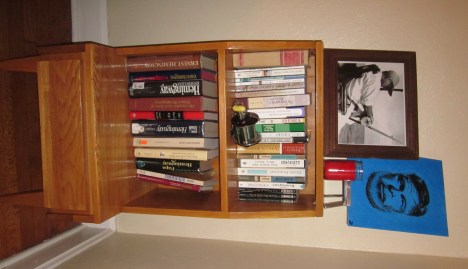

I was prepared to do some decorating…


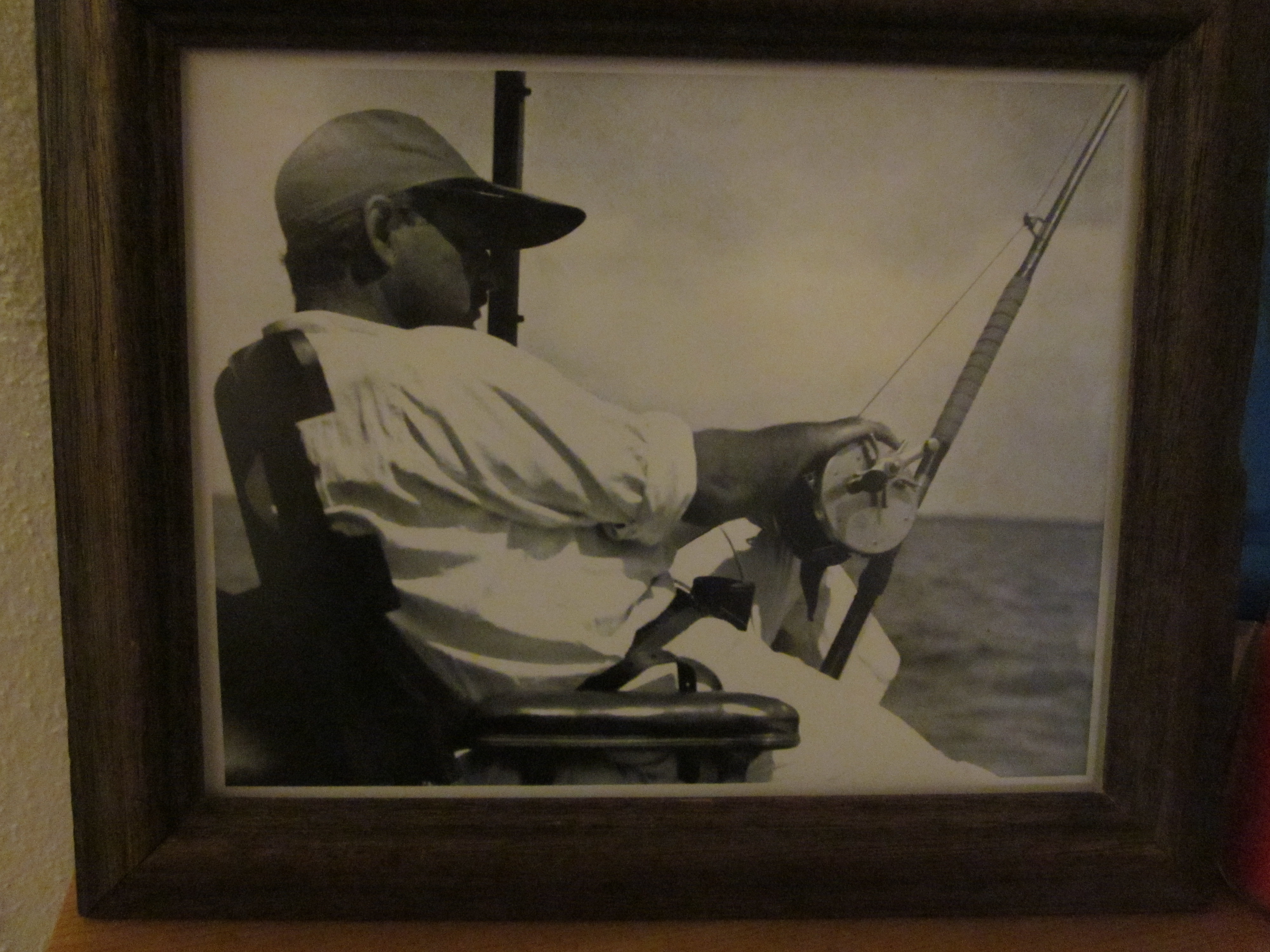
I bought this print from the Hemingway House in Key West, and took a second shopping trip to find a beat-up real-wood frame for it. Again Hemingway’s Boat gets credit: I was taken by this picture in my reading of the book, which to my memory is the first time I had ever seen it. I like that it shows him in his non-writing leisure time, in pursuit of an activity he loved, and I like that he’s wearing his glasses in it, which he was not in the habit of always doing. Sorry it’s not a better picture of the picture…


And don’t laugh at me, but this is my own portrait of Papa, a copy of the famous Karsh portrait.


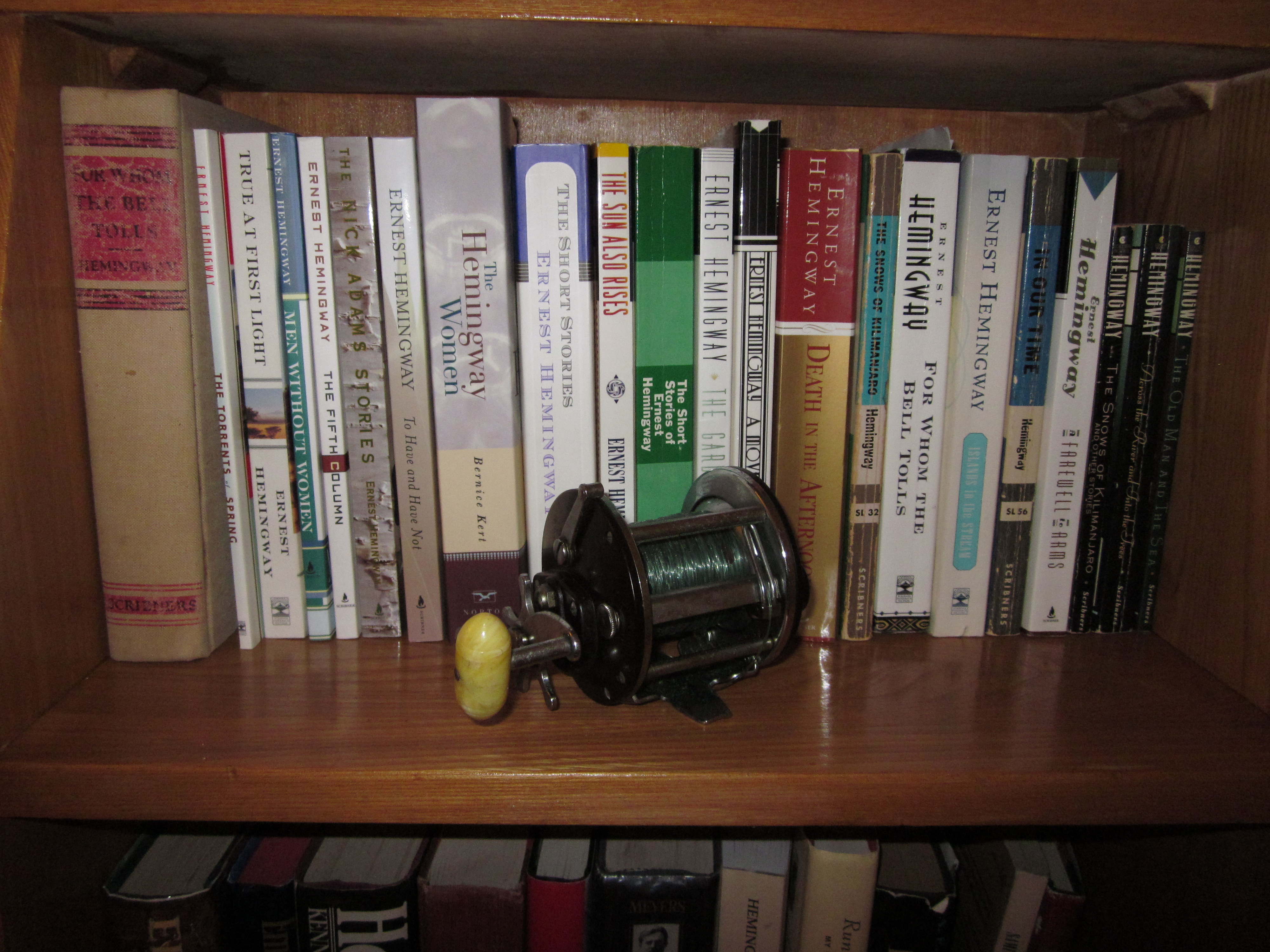
Top shelf, with antique fishing reel donated by Husband. (It’s not specifically accurate to Papa’s fishing, we don’t think, but it sets the mood, if you will.)


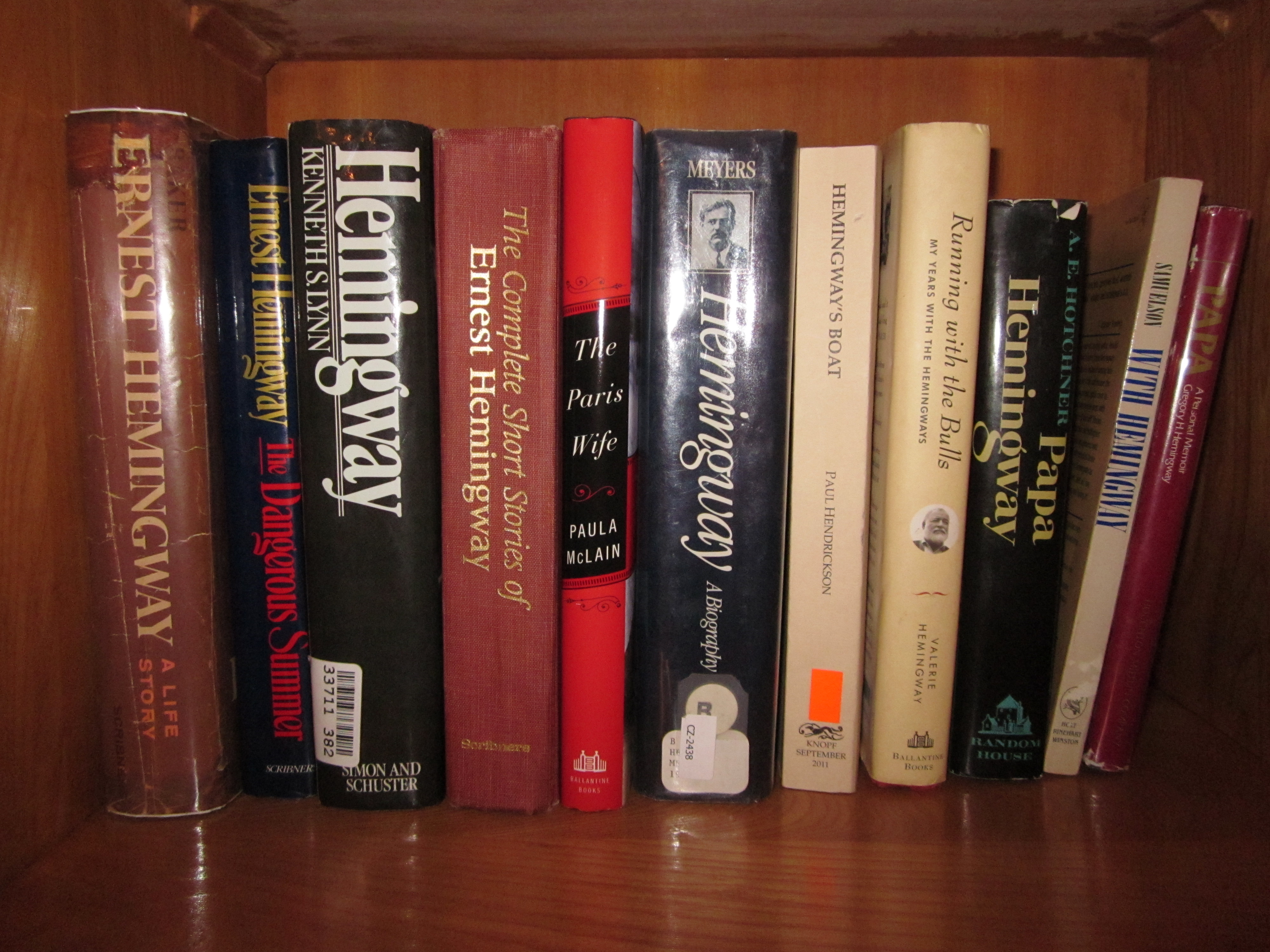
Bottom shelf, with four new purchases inspired by my reading of Hemingway’s Boat. They are the four on the right: memoirs of life with Hemingway by his son Gregory (Gigi), by Arnold Samuelson (“the Maestro”), by longtime friend A.E. Hotchner, and by Valerie Hemingway, Gregory’s ex-wife (who was originally a secretary or assistant to Papa). I have not read these books yet…

As you might see, I ran out of room for the friends, so Stein et al reside on the “regular” shelves again. And there’s not much room for the collection to grow, on my Hemingway shelves. But I’m very pleased with my end result: a special space that honors my favorite author on his own. As for growth, I suppose these shelves will begin to look like the rest of them, with books stacked in front of or on top of other books. It’s all organic.

Do you have a special space or special shelves reserved for a particular author, genre, subject, or other beloved group of books?

hemingWay of the Day: with love


According to Paul Hendrickson in his meticulously researched Hemingway’s Boat which I respect and admire very much, Hemingway wrote to Sara Murphy (an old friend from the Paris days) in December of 1935 of his concerns on aging… his work habits… and a recent hunting trip with his son Patrick. The part I like the best (and which strangely echoes Gertrude Stein) is his closing,

with very much love much love and love also with love.

I love you too, Papa.

hemingWay of the Day: on writing


From Flavorwire’s “Weird Writing habits of Famous Authors”:

“Hemingway famously said he wrote 500 words a day, mostly in the mornings, to avoid the heat. Though a prolific writer, he also knew when to stop. In a letter to F. Scott Fitzgerald in 1934, he wrote,

I write one page of masterpiece to ninety-one pages of shit. I try to put the shit in the wastebasket.

I have also reproduced for you the picture Flavorwire used to accompany this quotation. I like. Thank you Flavorwire.

hemingWay of the Day: on cooking trout


This one was chosen as a fine example of how Hem can make me, at least, taste and smell what he writes about. Also, he makes my mouth water.

The Swiss, too, have a wonderful way of cooking trout. They boil them in a liquor made of wine vinegar, bay leaves, and a dash of red pepper. Not too much of any of the ingredients in the boiling water, and cook until the trout turns blue. It preserves the true trout flavor better than almost any way of cooking. The meat stays firm and pink and delicate. Then they serve them with drawn butter. They drink the clear Sion wine when they eat them.

It is not a well-known dish at the hotels. You have to go back in the country to get trout cooked that way. You come up from the stream to a chalet and ask them if they know how to cook blue trout. If they don’t you walk on a way. If they do, you sit down on the porch with the goats and the children and wait. Your nose will tell you when the trout are boiling. Then after a little while you will hear a pop. That is the Sion being uncorked. Then the woman of the chalet will comes to the door and say, “It is prepared, Monsieur.”

Then you can go away and I will do the rest myself.

from “Trout Fishing in Europe,” printed in The Toronto Star Weekly, November 17, 1923

hemingWay of the Day: author insults

Thanks to Shelf Awareness for this interesting item today.

Recently, Flavorwire gave us The 30 Harshest Author-on-Author Insults in History. It might be worth your time to go check them all out, but I had to share with you a few of my favorites.

Numbers 15 and 14 are a back-and-forth:

15. William Faulkner on Ernest Hemingway:
“He has never been known to use a word that might send a reader to the dictionary.”

14. Ernest Hemingway on William Faulkner:
“Poor Faulkner. Does he really think big emotions come from big words?”

…to which I give an lol. My meager attempt to appreciate Faulkner was pathetic, but I blame him entirely – or maybe my choice to try The Sound and the Fury first, I don’t know. I *may* give him another try someday. If I do, it will definitely be a different title. It should go without saying that I side with Hemingway on this one, in terms of the end-result-value of their work – although it is also true, I have never used a dictionary in my readings of Hem. (I do use a dictionary when I read sometimes, though.)

I also liked this one:

9. Truman Capote on Jack Kerouac:
“That’s not writing, that’s typing.”

I think this is in the same spirit as #15, above. And again, I loved On the Road and so disagree; but the witty jab makes me smile, all the same.

There are some other clever ones there, too. I encourage you to go poke around and tell me, which ones made you smile? Or get angry? Or feel justified?

reading, or writing, swimmingly

Yum, yum! I love it! Flavorwire gives us Literary Greats In Their Bathing Suits! Go take a look if you like authors OR the beach. My personal favorites, of course, are Hem (no, not looking too sexy in this picture but I’m still excited) and the Fitzgeralds – but also, did you know Hunter S. Thompson looked so good in a bathing suit?? Who’s your favorite?

hemingWay of the Day: on bicycles

It is by riding a bicycle that you learn the contours of a country best, since you have to sweat up the hills and can coast down them. Thus you remember them as they actually are, while in a motorcar only a high hill impresses you, and you have no such accurate remembrance of country you have driven through as you gain by riding a bicycle.

from Battle for Paris, printed in Collier’s on September 30, 1944