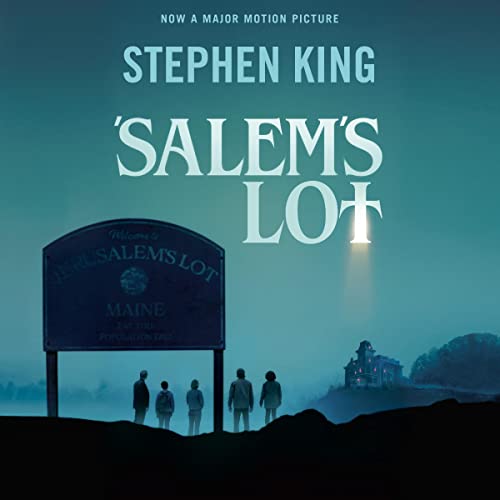
Salem’s Lot by Stephen King (audio)

It took me a while to get to this one, but I am very pleased to be back in the Stephen King universe. Salem’s Lot is classic horror. King doesn’t get everything right (and this was published in 1975), but there’s not much question that he’s a supremely great writer. His stories are very easy to take in and get lost in. I enjoyed this very much, and I’ll keep working my way through his extensive catalog.

I won’t spend too much time on plot; you can find that elsewhere. My audio version opens with a short foreword or introduction which King reads himself, and it made me feel so good about what I was headed into. In his own voice, I heard the style and easy sentences of a master, and heard him discussing reading and writing as lifetime loves. He describes reading Dracula as a young boy, and then a bunch of secondhand E.C. Comics, and reimagining the vampire story for a contemporary U.S. of A. He confesses that Salem’s Lot, only his second novel, is dated, but he still counts it among his favorites. “Carrie, the book which came before it, seems almost fey by comparison. There is more confidence here, more willingness to be funny.” It only made me more excited about the story to come. Ron McLarty reads the novel itself, and very well I think: I have no comment on his reading either way, which is a good sign.

In Salem’s Lot, the moderately successful novelist Ben Mears returns to the Maine town where he spent just a few years as a boy, but where he had an indelibly frightening experience in a moody old mansion where a famous recluse had hung himself. He meets a nice girl, and settles in to a room in a boarding house to work on a spooky fourth novel. To a mild, idyllic backdrop, Ben courts the girl, Susan Norton, and makes new friends. But the town of Jerusalem’s Lot (or Salem’s Lot, or simply The Lot) isn’t done with mysterious, creepy figures. Ben’s not the only newcomer in town. A beloved dog is found impaled on a cemetery fence. Two young brothers disappear in the night, and one death follows another. A small but tough motley crew forms up: Ben, the writer; Susan, the young woman; Matt, an aging high school English teacher; Mark, a middle-school boy new to town; Father Callahan, the town’s Catholic priest, who will figure in the Dark Tower series; and Dr. Jimmy Cody. Together they will fight an ancient evil. The novel’s prologue serves as a teaser, with an unnamed man and boy on a cross-country trip. This action actually falls chronologically at the end of the book, just before its epilogue–sending me immediately back to the beginning when I finished listening to it.

King absolutely excels at realism, exquisite detail, and a combination of quaint small-town living (as sordid as sweet, but very true to life) with horror. He’s got a social conscience perhaps ahead of his time. His characters feel accurate, and everything flows very naturally; his sentences are that very special kind of smooth and easy that appears effortless but is actually extremely rare and difficult to achieve. It’s masterful and I’m a little bit in awe. On the other hand, there was one element that got under my skin. To protect plot spoilers, I’ll discuss it here briefly in white text (highlight to read): I really liked Susan Norton’s character, and was invested in her development not only as character but as strong young woman coming into control of her own destiny. She was the first of our powerful little team to fall to the big bad vampire, and I quite resented how that worked; after I’d come to see her as a proper strong woman and major player, it felt like she got thrown away like the cheap girl character in a pulpy horror story. Jimmy Cody later falls, too, but I was left with the sense that Susan didn’t get the treatment she deserved. I was left with the taste of misogyny in my mouth and felt sad about it. I respect Stephen King’s efforts, and find him better (in the lyrics of the Drive-By Truckers, who were talking about somebody entirely different) “at worst, no worse than most white men of his generation, north or south”… but it still made me sad. I’ll also recall again that in his introduction he acknowledged that this novel is dated. I hope this is part of what he meant, and that we’re still getting better now.

This issue, for me, was worth noting but did not fatally poison the experience. It’s an outstanding horror novel, and it’s sticking with me, and King is a marvel. I sort of want to go back and read the entire Dark Tower series over again (ha), but there’s so much more King out there, too. I do recommend. There’s not much perfect in this world.


Rating: 8 ice cream sodas.

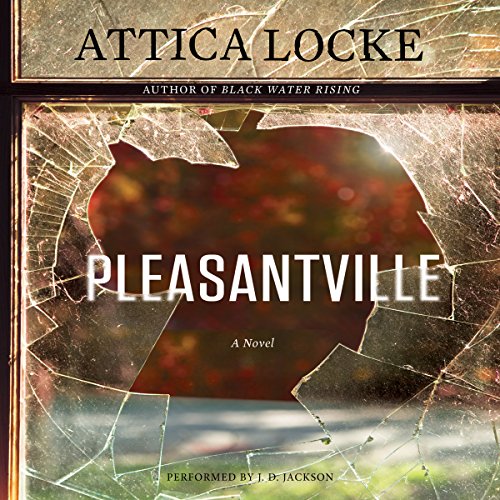
Pleasantville by Attica Locke (audio)

Attica Locke is a very strong mystery writer. I was utterly absorbed by her characters, who felt perfectly real to me, such that I worried about them when I stepped away from the book. It’s a fully-fledged world. I will say that I was a good reader for this one, too, because it’s set in my hometown of Houston, and Locke’s Houston is extremely detailed and true to the original. I loved this aspect of it as much as any other, and that won’t be quite such a nostalgic, moving experience for just any reader; but the strong sense of place and that level of detail will certainly work for anyone who appreciates those strengths.

The plot of Pleasantville is quite complex, again quite detailed, and operates at the intersection of crime, criminal and civil law, and politics, in a particular milieu. This is both a great strength and a potential liability: it asks of the reader a fair degree of attention. If you bring that to this book, you will be amply rewarded. I am still a bit reeling from it, and my admiration of Locke is solidified.

It’s 1996, and a hotly contested mayoral election in Houston is expected to hinge – as they often or always do – on the neighborhood of Pleasantville, an early-established haven for middle-class African Americans 50 years earlier and a continuing close-knit community. Then a teenaged girl disappears off the streets of Pleasantville on election night, and the criminal case clashes strangely with the political drama, and both threaten to swallow whole the man we meet on the first pages: lawyer Jay Porter, whose office has just been burglarized. Porter is still reeling from the loss of his wife to cancer a year earlier. His teenaged daughter and grade-school son are struggling in their own ways. His law practice is on its final legs. He specializes in class-action suits handling issues of environmental racism, like one at work in Pleasantville; he does not want a criminal defense case, but the most powerful players in Pleasantville have other ideas.

There are so many compelling characters in this story that my head almost spins, but it’s all woven together incredibly well, keeping me both engaged and on track (if I put in a bit of effort myself – and I’m happy to). I’m very much still thinking about Jay Porter and hoping his daughter Ellie comes through okay; I can’t wait to get more from Locke. Whew.


Rating: 8 blocks.

The First Fifteen Lives of Harry August by Claire North (audio)

I am doing the unfortunate thing where I’ve waited too long since I listened to this one. In my defense, it was a whirlwind two-week road trip that allowed me to listen to several (!) audiobooks.

Another recommendation by Liz, this one’s pretty mind-bending. Harry August narrates the story of his lives himself, beginning with the first time, when he lived unremarkably. He was born in a train station washroom in 1919, and was then adopted but didn’t know it; his adoptive mother died when he was young, and his adoptive father remained distant; he served in World War II and then returned to the estate where his father had served as a sort of maintenance man, which role Harry takes over until his own death in old age. Ho hum. Then… it all starts over again. In his second life, he does not handle well the knowledge that this has all happened once before. In his third life, he uses what he knows of the war (for example) to his advantage, staying away from high-casualty battles and the like. With each life, he gains a little better understanding of what he’s experiencing. But he struggles to make meaning of it all, even as he meets others like himself: ouroborans, they call themselves, or kalachakras. Until, that is, he meets one man in particular, a fellow ouroboran who will become perhaps his greatest friend and nemesis.

I’ve already said too much, and will let you discover Harry’s many lives and acquaintances for yourself from here.

It’s quite a thought-provoking concept, and a new twist on time travel and the tricky question of the butterfly effect. (Would you kill Hitler? What if he’s only replaced by something worse?) The novel is not plot-driven, precisely, and it’s not character-driven at all. Harry has remarkable drive to learn, understand, and explain; this intrigues me about him, but he’s a bit short on actual personality (and has more of it than anyone else in the book). So, a concept-driven novel, which is a change. I found it perfectly absorbing, one to get lost in, and to occasionally pause and ponder. I will say, there weren’t characters I liked, and that can make it a little tough to hook in. I was very intrigued, but often bemused too.

The audiobook was a strong production on the whole. Peter Kenny does a wide range of voices, which are often pleasing, but I must say his American accents are not convincing.

It will be interested to see how this one sticks with me.


Rating: 7 beakers.

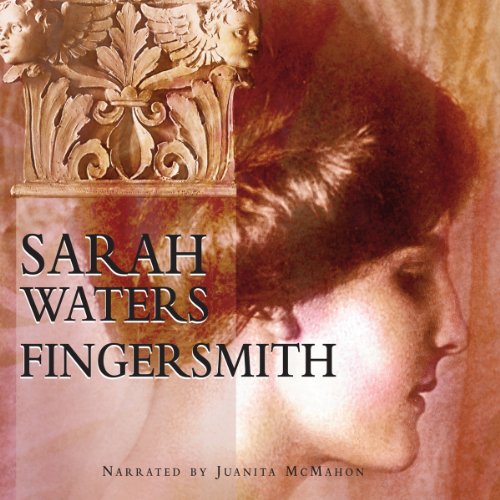
Fingersmith by Sarah Waters (audio)

I got this title off some list of bests somewhere, and queued it up behind In the Woods on the return trip from Texas. It was a delightful, weird, engrossing adventure. I am going to be careful and vague with this one, as it hinges on big reveals that I don’t wish to spoil.

Set in Victorian London, Fingersmith begins with the first-person narration of Sue Trinder, an orphan who has been raised by a household of ‘honest thieves’ and a mother figure, Mrs. Sucksby. Sue and her comrades are fingersmiths, or pickpockets (and they partake in other crimes and cons, mostly of the property reassignment category). One day Sue is invited into a masterful heist: she will pose as lady’s maid to an innocent, sheltered woman of just her own age, the also-orphaned Maud Lilly, to aid in a fellow crook’s seduction of the lady. He will then marry her, steal her fortune, and have her locked away in a madhouse (which is sinfully easy to do to women, in those times and into quite recent history). Sue has never been a lady’s maid before, so she has much to learn about the job, but off she goes. The plot proceeds, but Sue’s loyalties become split, as it turns out she rather likes her mistress.

This is just the very beginning of the complications. But then! Part two! The first-person perspective shifts, which I did not see coming. And everything the reader thought she knew about this story gets turned on its head. I will stop writing about plot now, but it continued to surprise me, repeatedly, and Waters gets full marks for this feat. Also, I was not expecting erotica, which popped up a few times to (again) surprise me and was remarkably well done. Fingersmith is absolutely a plot to get thoroughly lost in; really great road trip fodder. I did feel in the middle that it dragged on a bit longer than it needed to – especially when the victim of this or that plot must wallow in her misfortune. I could take much less of the wallowing. But eventually we stepped out of that puddle, and the story continued to twist and turn; I was riveted right until the end, and was sorry to be done. Masterfully plotted; do recommend.


Rating: 8 ink stains.

In the Woods by Tana French (audio)

Loading up on audiobooks for the big drive to Texas and back, I made an unusual call: I chose to reread a book, or rather to listen to one I’d read years before. Life is mostly too short for rereads, but: 1, I love Tana French and have read everything of hers already. 2, I found this one on a best-of list of some sort, I think specifically referring to the audiobook (or else it’s just that I discovered late that she is especially good on audio, because of the Irish accents). 3, I am that lucky mystery fan who forgets plots and can therefore enjoy them again and anyway 4, I read this one of hers first and (mostly importantly) before I had this blog. So, off on the big drive with this excellent book…

…which it turns out I had forgotten wholly, because the plot scarcely felt familiar at all past the introductory scenes. First, a prologue flashback: in 1984, in a Dublin suburb, three 12-year-old best friends don’t come home when called for tea. Two of them, a boy and a girl, will never be seen again. The third, Adam, is found with his broken fingernails dug into a tree’s bark, with blood in his shoes but unharmed. He is catatonic and unable to help the police with their investigations. He goes away to boarding school; his family moves away; and then the reader discovers that he is the novel’s narrator, now a grown murder detective who goes by the name Rob Ryan (having taken his middle name to avoid his rocky past). Hilariously, Rob believes that his career choice has nothing to do with his lost childhood best friends.

In the present, some twenty years later, the body of a murdered child turns up in the very same suburb, in the same woods (now much abbreviated by development, and under controversy as a freeway expansion runs up against an archeological dig). Ryan and his partner and best friend, Cassie Maddox, pull the case, despite being rather the young misfits of the department. Unbelievably, the murder squad does not know that Rob Ryan was once Adam Ryan, the very famous found boy of that old–and possibly connected–crime. Cassie is the only one, beside Rob’s parents (whom he feels he barely knows), who knows his identity.

In the Woods is an atmospheric, contemplatively-paced mystery novel in two timelines. As Ryan works on the present-day murder, he also probes at his own lost memories of that childhood trauma. It is also the story of relationships: Rob and Cassie share a very special bond, a very special friendship, which both resists and succumbs to stereotypes. I think it’s worth remarking that I do not actually like Rob Ryan, our narrator, protagonist, and therefore one might expect our hero. He isn’t that. Cassie is a compelling and likeable character, but since she is only seen through Ryan’s eyes (we get the story from him), I fear she never quite becomes fully known–not only in the way that none of us ever really knows anyone, but also because for all his adoration and attempts to understand her, she is finally a cipher for Ryan’s own issues. Perhaps what disappoints me most about him is that even after all his complexities and soul-searching, Ryan winds up predictable after all. I do not like him in the end.

The plot is however not predictable, even to this rereader. In fact, as I think about other Tana French books, it’s not actually the whodunit solution that I remember, but the atmosphere, the experience of being in the story as it unfolds. There were times when the pacing felt a bit off, when I felt we spent too much time wallowing, and that feels perhaps familiar from other T. French novels as well, but that’s a fairly minor quibble when I think about how real these characters felt. Also, the accents are completely wonderful on audio, which I think is the best way to do Tana French.

As I write this review, I’ve let too much time pass (because vacation), and already the denouement’s details are fading for me, but the relationships – between Ryan and Maddox, and other ones – still feel very near to me, the personalities and the conflicts. And I’ll always be back for more French.


Rating: 8 home-cooked meals.

The Late Show by Michael Connelly (audio)

We have another mediocre showing from Connelly here, I’m afraid. This one is a departure from the Bosch series: The Late Show features Detective Renee Ballard, who is also a renegade anti-establishment figure who gets shit on by the LAPD, but with an added woman-in-a-man’s-world angle. (She is also younger.) I was once more a little indifferent as to plot for most of the novel, but I was pleased with some significant twists and reveals in the final denouement, so that was nice. The narrator again felt awfully wooden – what is up with this trend? And why are there so few contractions? (I am instead of I’m, can not instead of can’t) …Connelly’s writing feels consistently awkward over the last many books. I wonder, is it him or is it me? I keep meaning to go back and read some early Bosch (in print!) and investigate this question, whether Connelly’s writing has become less good or I have become harder to please. But devoting that time feels like asking a lot at this point.

Ballard is appealing in some ways but doesn’t quite feel fully fleshed. She has interesting relationships with other cops, and an interesting backstory, referring to various traumas; but all of this feels told and not shown. I kept feeling like I was waiting for the story to ramp up, but instead it ended.

Maybe one more experiment with this formerly beloved author before I give up, with deep regrets.


Rating: 6 and a half black buttons.

Lee Child shorts: “Public Transportation” and “Wet with Rain” (audio)

“Public Transportation” was available from Audible as a standalone short (originally from the collection Phoenix Noir), and “Wet with Rain” comes from Exit Wounds: Nineteen Tales of Mystery from the Modern Masters of Crime. They were, I think, 13 and 28 minutes respectively, give or take. Just a few quick indulgences during a drive to the next county to my local bike shop.

Classic Child, so not much to report here, but in the best ways. “Public Transportation” offers a surprise twist and no serial characters. A cop is talking with a journalist about an old unsolved murder case; we get a fairly quick summary of the crime, the investigation (in hindsight, botched), and the problematic conclusion eventually settled on by the police department. “Wet with Rain” is also Reacher-free, but slightly more involved. We get a little less context, but eventually understand that two Americans with a certain agency have traveled to Ireland to run a secret operation, about which information is doled out slowly and out of order, so that we’re still putting things together even as they happen. Each of these stories represents a sort of puzzle – for the reader and for the players involved. Only one has a quick punch of a surprise; the other is more of a slow burn. And, again, neither involves our hero Reacher. But each serves as a good example of Child’s skill with intrigue, detail, and apparently effortless storytelling (which actually may be the hardest kind), as well as a certain dark side of human nature. I enjoyed both as quick jaunts, and would love to have access to more of the same: quick, punchy stories by authors I know I love. My lifestyle doesn’t support longer audiobooks these days. Look for more podcast reviews to come, I guess…

did not finish: Horns by Joe Hill (audio)

Horns is a horror novel by Joe Hill, son of the horror novel empire of the world, and author of Heart-Shaped Box and NOS4A2. So I had high hopes, and indeed was moving along smoothly enough, feeling engaged and interested, until about the halfway point of this audiobook’s 14 hours.

This is the story of Iggy Perrish, who wakes up at the beginning of the book with dim memories of the night before, and horns growing out of his temples. His (apparently perfect) girlfriend was brutally raped and murdered a year prior, and although Ig was never proven guilty or innocent, his community assumes his guilt; this, on top of his loss, has quite ruined his life. When the newly horned Ig encounters anyone at all, they go into a sort of trance of perfect honesty, mindlessly confessing their worst desires and asking his permission to act them out. He’s become sort of everyone’s personal demon. Then the story flashes back to when he first met the late girlfriend, ten years previous, when they were just kids; and occasionally forward, to later in their relationship; and back to the horned present, where adult Ig tries to figure out what to do with his horns and unwanted magical powers, and solve the mystery of his girlfriend’s murder.

This was intriguing, if often awful. It’s a horror novel. And I have a taste for the occasional horror novel, as evidenced by previous Hill and King novels I’ve enjoyed; I certainly have a high tolerance for graphic violence and horrific acts in fiction, as evidenced by the fiction I love by Connelly, Child, James Lee Burke and others. I was okay with Ig’s sad story right up until a scene involving a decapitated snake, bullying, and a nasty nickname. It’s weird what will turn me off. (I’ve noticed before that it’s often cruelty to animals.) But there was a moment, listening to this book, and hearing the bleating of the bullies, when I just really didn’t want to hear any more. So I turned it off.

Fred Berman’s narration was a solid performance, I guess, which is to say often off-putting in the way that this scene was off-putting – as Hill intended? I know that sounds like faint praise. Berman does different voices and accents that I found effective; the effect was not pleasant. I wonder if I would have tolerated this book better on the page.

No accounting for what works for me. I thought I had a stronger stomach for the awful than this! But Hill wins this round? Or loses? As ever, your mileage may vary.


Rating: think I’ll skip this one and leave it at ‘DNF.’

The Crossing by Michael Connelly (audio)

The first, good news is that this one went over better than my last Connelly effort, Two Kinds of Truth. I found the plot absorbing throughout. I repeat my criticism of Titus Welliver’s narration, though – I’d forgotten until I reread that earlier review, but I again find him uninflected or occasionally putting the emphasis in what feels like the wrong place in a phrase or sentence. I like him onscreen but not here.

Harry Bosch has been retired from the LAPD for a few months, having been pushed out against his will; his half-brother and lawyer Mickey Haller is suing the Department on his behalf, so the blood is generally bad. (To place us in time, Bosch’s daughter Maddie is finishing her senior year of high school and getting ready to go off to Chapman for college.) Haller then asks Bosch to do some investigation work for a client who Haller is sure is innocent of the murder he’s accused of. Bosch has a strong reaction to the idea: working for the defense would be crossing a line. Defense = bad. (I easily believe that many officers feel this way, so I don’t doubt the realism, but it rankles. The whole point of the adversarial court system is to push back against all charges, forcing their proof, and protecting against false convictions. No one is served by law enforcement’s insistence that it never ever gets anything wrong [even leaving aside purposeful wrongdoing].) Bosch does come around to the idea: if this accused client is innocent, that means there’s a murderer out there roaming free. This activates his sense of justice; plus he’s gotten pretty bored with his motorcycle rebuild project. We all know Bosch needs to be crime-solving. So he agrees to just take a look at the case for Haller. And we’re off and running.

For a little added plot interest and complication, the novel mostly follows Bosch, but also switches over to the bad guys here and there, so the reader has more information than he does (although far from all), which is a fun narrative device.

I like that the title has several meanings within the story. The narrator makes reference to a crossing between murder victim and murderer, where events get set in motion; a crossing over from public heterosexual lifestyle to same-sex relations; and the crossing over that most troubles Bosch throughout this story, as he moves into investigative work for the defense. There are a number of other crossing-the-line references, which might even be considered heavy-handed – I again feel that Connelly flirts with over-explaining – but in the case of the title’s role I ended up appreciating the multiple connections.

There’s something just a little stilted about the dialog and characters here, like Bosch’s (and I think Haller’s) avoidance of contractions, but I’m not even certain how much is Connelly and how much is Welliver. There was again a bit much explaining, especially between Haller and Bosch. I understand that it’s a trick, as the writer, to let your reader in on need-to-know information without having your (expert) characters explain in dialog. I just didn’t remember Connelly being as clumsy about it as I find him here.

That’s nit-picking, though. The plot and intrigue was sufficient to keep me engaged and generally distracted from minor quibbles. Neither Connelly’s best nor his worst work; a perfectly serviceable listen.


Rating: 7 references to Walmart.

The Searcher by Tana French (audio)

Tana French never disappoints. This 2020 novel (her latest to date) reminded me quite a bit of her second book, The Likeness (2008), which is still my favorite, I think. In line with all her work, The Searcher boasts intriguing characters with shadowy pasts; a very strong sense of place; and some of the most atmospheric writing I know. What most reminded me of The Likeness was a general, foreboding suspicion about the people around our protagonist, a low-level nagging sense that we’re not sure who everyone is really and what their motivations might be.

It’s still set in Ireland, now in a rural area of tiny villages, but in a departure from her past work, French’s protagonist is American. Cal Hooper is a recently retired detective from the Chicago Police Department, trying to renovate the dilapidated little farmhouse he bought from afar, not too hopeful of making new friends but amenable to the gifted-in-gab locals like his new neighbor Mart. He talks to his adult daughter about once a week. He misses his ex-wife. The reader has to wait to find out what these dim shapes, back in the States, exactly mean to Cal. Meanwhile, he’s getting cautiously adjusted to no longer looking over his shoulder for crime all the time, but somebody’s definitely been watching him – aside from the rooks in the tree out back, whom he rather appreciates – and it’s creeping him out. His peeping tom turns out to be a 13-year-old kid named Trey. What does Trey want, exactly? It will take Cal a certain amount of interview skills to find out. And what he discovers threatens to launch him back into the kind of crime investigation he’d hoped to leave behind.

There are many layers to absorb here. In its handling of gender, The Searcher subtly offers commentary or at least food for thought; the tensions of changing times in a rural setting (technology, employment options, young people moving away, the urban/rural divide, options by gender) are a minor but important focus. Moral ambiguities and the importance of having a “code” feature throughout – other reviewers have placed this novel at least partly within the Western genre. Another slight but important thread deals with police brutality and race in the United States, too, for currency. I appreciated the natural world as… more than backdrop. Events play out against a natural world that can be cruel but only in the ways of nature, with parallels that inform the human dramas. Those rooks, which (tellingly) open the book, provide a keystone for Cal’s experiences. Finally, this rural Ireland made me think repeatedly of small-town Appalachia where I’ve settled. And of course many Scots and Irish settled in Appalachia, so it’s not too strange to think of cultural threads crossing over. But it felt a bit uncanny, and comforting.

Roger Clark’s performance on this audio edition wound up feeling perfectly pitched, although it took me a while to get used to the American accent when I was expecting an Irish one, based on past experience with French. I think Clark performed the accents well all around. There was a brief howdy-partner backwoods bit that felt put upon to me, but I’m ascribing that momentary awkwardness to French and not Clark. I still love her work in this format.

This novel has lots to sink into for the discerning reader. And there’s a compelling plot regarding young Trey and the mystery Cal finds himself roped into, and all the fine work of suspense and mood that French does best. If this isn’t her finest novel yet, it’s right up there, and more multifaceted than most mysteries. Strongly recommend.


Rating: 8 rabbits.