The Perfect Storm by Sebastian Junger (audio)

In October 1991, a number of factors converged to create a storm of inconceivable strength off the Massachusetts coast. Vessels large and small struggled in its path, and a few didn’t make it out. Sebastian Junger follows a few of the men, women and boats involved in this remarkable work of nonfiction. He begins by introducing us to Bobby Shatford and his girlfriend Chris, and their town of Gloucester, Mass. Bobby and Chris wake up hungover – Bobby has a black eye – and drive around town, visiting with friends and Bobby’s mother Ethel, bartender at the Crow’s Nest, and making final arrangements for Bobby’s departure on the Andrea Gail, a small fishing boat with a crew of six. We then follow Bobby’s path and that of his fellow fishermen: the two men who get funny feelings and refuse to sail with the Andrea Gail, and the five who join him on her for an intended 4-week fishing trip. We track their fishing, the decisions made by their captain Billy Tyne, the radio communications between Tyne and other fishing boat captains. We watch the storm approach, checking in with meteorologists and getting quick lessons in storm formation, and we visit other boats as well, including the Satori, a 32-foot sailboat, and the Eishin Maru, a Japanese longliner, both fated to have complications and exciting moments. We also get to know two rescue crews, made up of Air National Guard pararescue jumpers and Coast Guard rescue swimmers. I won’t give too much away (although, all of this being a matter of historical record, it’s out there), but not all of the characters introduced survive the storm.

That’s about all I want to say about the events detailed here; you can find out more by reading the book yourself (or listening to the audio, as I did – more on that in a bit), which I highly recommend. And here’s why. This is an incredibly adrenaline-pumping adventure tale. There are sad endings for some of the men and women involved, yes, but there is also great heroism, amazing skin-of-your-teeth survival, drama, even a love story or two mixed in. The human interest, in other words, is huge. For excitement, really, could you ask for more than rescue swimmers jumping out of a helicopter into the storm of the century to rescue men and women from sinking ships or from the open ocean? I submit that you could not.

In addition, the story is told in a unique way. Junger jumps subjects throughout: we meet a few characters in Gloucester, then we review the fishing history of the town of Gloucester, then we study up on commercial fishing for a bit, back to the characters… eventually we get lessons in meteorology, the physics of boat building, wave formation, and what exactly happens when a person drowns. As I wrote before, Junger is fairly strict and journalistic in following the facts. Where parts of the story he tells are unknown, he doesn’t claim to know, but he does interview people who have been through similar scenarios and survived; so we get an educated estimation of what the players might have been through, while making nothing up. It’s a method I respect; I found it both dramatic and fully-wrought, and reliable.

The audiobook I listened to is excellent, too. Read by Richard M. Davidson, it has all the taut, tense action it needs without ever feeling over-dramatized. And as a bonus, it includes a recording of the author speaking about the making of the book. This flows like his-side-only of an interview; I imagined someone in between asking specific question. Like the foreword, I found this a substantial addition. At the time of the storm, in 1991, Junger was working as a high climber, taking trees down for a tree company, and selling freelance magazine articles for a living. The storm inspired him, and he wrote a chapter about it, initially for a book he conceived about various dangerous jobs: the commercial fishermen of Gloucester would have been joined by loggers, smokejumpers, forest-fire fighters and the like. But his agent landed him a deal for a whole book about “the perfect storm” – whereupon Junger became anxious. How would he fill a whole book with just the storm? he wondered. (I loved hearing the author, in his own voice, discuss his nerves! And the whole process, really.) So he decided to follow all the sub-plots and related topics he could, to flesh it out, and this is why we are treated to the lessons in weather, boats, the fishing industry, etc. What struck me about this is that it is a rather Moby-Dick method, and ironically, while that classic work of fiction is notoriously difficult to read (come on, even its fans admit this, right?), this work of nonfiction – even though readers often fear nonfiction will be dry or cumbersome – flowed delightfully and effortlessly. Those subplots mightily enriched the whole. Even the questions left unanswered, about the fates of those who disappeared and whose remains were never found, Junger turns to advantage. As he says, because he investigated the experiences of others who lived through similar situations, we get a richer, more layered story than had he interviewed a sole surviving fisherman.

Sorry for another long review! (Usually this means I really liked the book.) In a nutshell: moving, emotional, adrenalizing, scientific, faithful, thrilling! Check it out.


Rating: 8 swordfish.

EDIT: I also reviewed the movie, here.

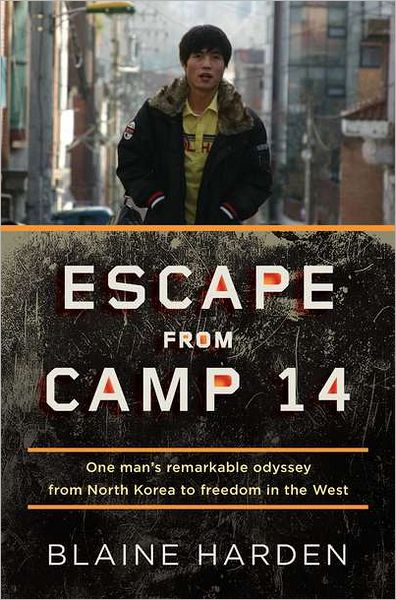
Escape From Camp 14 by Blaine Harden (audio)

Shin Dong-hyuk was born in 1982 inside Camp 14, one of North Korea’s no-exit political prison labor camps. He was raised in the camp, starving, ill, beaten, and forced to work for his life. His education was meager and consisted of the bare understanding of camp politics necessary to make him a compliant worker; he was trained from birth to snitch, to betray his classmates and relatives, to serve his masters. The concepts of love, kindness, trust, and familial relationships were unknown to him. At age 23, he escaped the camp and traveled on foot out of North Korea, into China, and would eventually make his way to South Korea and later, the United States. As far as we know, Shin is the only prisoner ever born in one of these camps to escape.

Blaine Harden is an experienced journalist, who covered North Korea for years, as well as other declining nations. He tells Shin’s story in a professional manner. Many of the details of Shin’s life, and camp life generally, cannot be confirmed or denied, because we have so few sources of information on the subject. (North Korea maintains that there are no such camps, although they are visible on satellite photographs.) Harden treats this information as a professional journalist, researching and confirming where possible, and giving his well-thought-out reasons for believing (or not) those details that are not confirmable. More difficultly, in this book, Shin recants an important fact about his life as he had claimed it for years. I felt that Harden made a reasoned case for believing the later story given. I was impressed with how he handled the problems of his source’s reliability, which I found an interesting issue. Additionally, Shin does not speak English, so Harden conducted his many interviews with interpreters; this of course raises new questions. When Harden says Shin chooses a certain word to describe a certain time in his life, I wonder who in fact chose that word. Naturally it was the interpreter who chose the word, and not knowing Korean, I can’t know how literal a translation it was, or whether there were several English words that might have been used. I don’t mean this as a criticism of Harden’s (or the interpreter’s) work; I just want to note that I’m always intrigued by the questions raised.

Shin states that Kim Jong-Il (and his successor) is worse than Hitler, because while Hitler tortured and killed his enemies, North Korea does so with its own people. This book makes that argument: the atrocities committed at these labor camps are appalling. It’s true, I was not well educated on North Korean conditions before I found this book. I suspect there are many of us who could learn a lot on this subject. I am not sure I can communicate to you here how shocking the details are – I’d really rather you go out and get a copy of this book – but I will tell you that no one is spared, no human dignities are allowed, there is murder and torture. These details are not spared, either, so be prepared for the graphic explanation of the torture Shin endured leading up to his mother’s execution. It’s not an easy book; but I do think it’s important that we know, so still I recommend it.

Shin’s story is mind-boggling. It is perhaps too obvious to state, but he had terrible luck to be born in the camp, and terrible things happened to him there; but his escape began a run of rather astonishing good luck. Harden puts the escape, and Shin’s overland journey (as well as many other parts of this story) in perspective by interjecting the accounts of other escaped prisoners and scholars on the subject. In this case, he describes the political climate at the time of Shin’s escape, showing how much luck it took for him to make it out of the country as he did. His good luck, though, mostly applies to his physical escape. Not surprisingly, his mental, emotional, psychological escape is still underway. As Harden points out at the beginning, most survivors of the Nazi death camps, the Soviet labor camps, and other centers of atrocities tell a story that has three parts: a relatively good life before capture; horrors on the inside; and then attempts at recovery after escape or release. Shin’s story is fundamentally different. Having been raised for 23 years on the inside, from birth, his release was to a world unknown. The trauma he is still trying to repair is staggering, unimaginable to the rest of us. Apparently Shin is like many North Korean defectors in being inclined to refuse psychological treatment – related to difficulties with trust – and his road has never been an easy one. His story as told here does end with a modicum of hope. But he is still struggling.

Again, this is a deeply disturbing book to read (or in my case, listen to), but I think it’s important to know what Shin and other North Koreans are going through. Please look out for Escape from Camp 14. I recommend the audiobook, which Harden reads himself. His delivery is matter-of-fact but that serves his story well.


Rating: 8 grains of rice.

Teaser Tuesdays: The Perfect Storm by Sebastian Junger

Teaser Tuesdays is a weekly bookish meme, hosted by MizB of Should Be Reading. Anyone can play along! Just open your current read to a random page and share a few sentences. Be careful not to include spoilers!

I’m listening to Sebastian Junger’s The Perfect Storm on audiobook, read by Richard M. Davidson. I find it quite interesting so far. Some of the passages I’m enjoying the most describe life in the small fishing town of Gloucester, Massachusetts, and I’ve chosen a teaser for you today that depicts the role one special bar plays in the lives of fishermen.

Fishermen who don’t have bank accounts cash paychecks at the Crow’s Nest (it helps if they owe the bar money), and fishermen who don’t have mailing addresses can have things sent right to the bar. This puts them at a distinct advantage over the IRS, a lawyer, or an ex-wife. The bartender, of course, takes messages, screens calls, and might even lie. The pay phone at the door has the same number as the house phone, and when it rings, customer signal to Ethel whether they’re in or not.

A proper home away from home, hm?

What are you reading this week?

book beginnings on Friday: Escape From Camp 14 by Blaine Harden

Thanks to Rose City Reader for hosting this meme. To participate, share the first line or two of the book you are currently reading and, if you feel so moved, let us know what your first impressions were based on that first line.

Happy Friday! I have a book to share with you today that is not so happy, though. Journalist Blaine Harden narrates this audiobook himself, which I find to be a fine choice. I’ll let the book beginning introduce you:

Nine years after his mother’s hanging, Shin squirmed through an electric fence and ran off through the snow. It was January 2, 2005. Before then, no one born in a North Korean political prison camp had ever escaped. As far as can be determined, Shin is still the only one to do it.

And this is the story of Shin Dong-hyuk. So far I am discovering my own very poor knowledge of North Korea, and marveling at the atrocities. But it looks to be a great book, and an important one in that we could all stand to be better educated about North Korean human rights abuses. So, happy Friday indeed.

What are you reading this weekend?

preview chapter: Doctor Sleep by Stephen King (audio)

As noted yesterday, there is a teaser chapter at the end of Stephen King’s The Wind Through the Keyhole for his upcoming book, Doctor Sleep. I am giving this one chapter its own post here because it grabbed me hard. Good job, Mr. King, you have me salivating for a book that’s not out til 2013. Thanks.

Doctor Sleep will be a sequel to King’s huge 1977 hit, The Shining, upon which was based the 1980 Stanley Kubrick / Jack Nicholson movie by the same name. I have neither read nor watched The Shining, but after listening to King’s reading of the first chapter of Doctor Sleep, I will. I have a copy of the audiobook (sadly, not read by King) on its way to me now. I got the storyline of both the book and the movie, and the differences between the two, off Wikipedia. I won’t regurgitate what I read; if you too need the background, go read up (bookmovie).

Doctor Sleep opens with Danny Torrance seeing dead people again, a few years after the death of his father and other frightening events at the Overlook Hotel. Dick Hallorann comes to town to help him deal with the trauma and the apparently very real risk of the ghosts (are they ghosts? these decaying corpses?) doing him bodily harm. Dick arms young Danny with a tool to protect himself, but the chapter ends with a sort of “and then they were safe… or were they?” moment. Oh the suspense!

Here I am pimping Stephen King, I suppose, and I don’t think he needs my help. But just the one chapter held my interest so thoroughly that it began to eclipse the wonderful Wind Through the Keyhole that I had just finished. I am impressed, am I intrigued, I am seeking out more Stephen King. Check him out.

The Wind Through the Keyhole by Stephen King (audio)

Edit – Update! I’ve just linked up to The Stephen King Project blog, where we’re being encouraged to read King (or listen!) and share our reviews. Thanks Natalie for the reminder. I didn’t join on purpose with a plan or anything, but I’m happy to be here now. …and back to the book review.

My word, this is lovely. I have never been disappointed in Stephen King, but this is definitely my favorite of those I’ve read. The Wind Through the Keyhole is part of the Dark Tower series, to which I am new, and therefore I appreciates the introductory remarks, in which King notes that it is not necessary to have read others in the series, but it would help to know a few facts about MidWorld, which he then relates. It’s true: I didn’t have any trouble following the action or keeping track of the rules of this alternate world.

King employs the story-within-a-story format here, and puts it inside another story for good measure. I got so immersed in the innermost story, about young Tim and his frightening journey into the forest in the starkblast, that when it ended I expected the book to end! I suppose it might have been jarring to then return to the story of young Bill and the skinman (which is in turn being told to the characters of the outermost story), but it wasn’t. I was just relieved that there was more to hear.

Stephen King reads this audiobook himself, and does it beautifully. I have listened to a handful of author-narrated audiobooks, and they have all been great. The actors, or professional narrators, are often wonderful as well, but some of these authors do amazing jobs too. Barbara Kingsolver’s reading of The Lacuna was extremely impressive, because of all the different accents necessary. It makes me marvel that a person can be such a talented artist in two different media! But I’m getting off track. Stephen King does a great narration, everything felt very real, and I was comforted knowing that the names of his imaginary lands and people were pronounced just as the author imagined them in his head.

So what is this book about? It opens with Roland Deschain and his traveling companions, chatting on the road to who-knows-where (presumably this is part of a larger storyline that I would know if I were reading the series). A particularly strange and threatening storm called a starkblast is coming, and they seek shelter, and find themselves up all night in the howling wind; so Roland agrees to tell them a story. This is where we leave the outermost story and enter the middle-layer story.

Roland is a young man and a novice gunslinger. I quote Stephen King’s foreward: a gunslinger is “one of a small band that tries to keep order in an increasingly lawless world. If you think of the gunslingers of Gilead as a strange combination of knights errant and territorial marshals in the Old West, you’ll be close to the mark.” He has just lost his mother – killed her, in fact, in an obviously traumatic incident that is only alluded to in this book – when he takes a trip with fellow youngster gunslinger, Jamie, to solve a mysterious series of bloody murders in a small mining town. It is theorized that the murders are being committed by a skinman, a shapeshifter. Roland befriends a young boy, Bill, who has witnessed his father’s murder, takes pity on him, and sits down to tell him a story Roland’s mother used to tell him when he was a little boy. This is the innermost story, and it is called – what do you know – The Wind in the Keyhole.

Once upon a time, in an ironwood-logging town called Tree, Big Ross is killed by a dragon in the woods. His partner, Big Kells, marries Ross’s widow Nell, and becomes stepfather to the boy Tim. Tim’s story is an adventure and sort of a dark and frightening fairy tale. He finds out a sinister secret about his stepfather and takes a journey deep into the treacherous forest where his father was killed; he encounters strange creatures, dragons, fairies, tigers, good magic and bad magic. This innermost story is the one we spend the most time with, and is set in a marvelous otherworldly world, fully developed, filled with creatures and characters and conventions and rules, fascinating and glorious and strange and scary, but also rather sweet.

Roland concludes the telling of The Wind Through the Keyhole to Bill, and then concludes the telling of Bill’s story to his companions, so that we close the stories we’ve opened and finish back with the elder Roland and his companions weathering the starkblast. There is a sense of circularity, and completeness.

The outermost story, of Roland and his fellow travelers, is engaging and also set in another world (MidWorld) I found interesting and would like to hear more about. The middle-layer story, of the young Roland seeking the skinman, involves some good old-fashioned detective skills and has a satisfying conclusion. But the story of young Tim and his quest through the forest was clearly the star. I was entranced, and sorry it was over. I shall be searching out more King, without a doubt! And I appreciated his narration, as I said earlier; I hope he’ll continue to narrate his audiobooks.

Stay tuned: tomorrow I’ll tell you about the teaser chapter for an upcoming book that was included at the end of this one.


Rating: 7 puppy dogs.

The Red Queen by Philippa Gregory (audio)

Ah, Philippa Gregory, my choice “fluffy” historical fiction author. A slightly guilty pleasure, yes.

In a nutshell, this is the (fictionalized) life story of Lady Margaret Beaufort. She is a very pious young girl, married off against her wishes first to Edmund Tudor, who widows her before she gives birth to his son at the age of 13, and then to Henry Stafford. After she’s widowed a second time, she makes her own marriage of politics, not love, to Thomas Stanley. The Tudors’ fortunes have shifted, and her son has been raised by his paternal uncle Jasper, as the House of York holds the English crown. Margaret works to promote her own son’s claim to the throne through various machinations and deceptions, pretending service to the York King Richard III and his Queen Anne. Richard is defeated on the battlefield and her son does finally take the throne himself as King Henry VII. The story is told in Margaret’s voice in first person, aside from a few passages of third-person narration towards the end, describing battles and events that (presumably) Margaret could not have described as she would not have been present.

I found Margaret unlikeable. This does not necessarily preclude me liking the book. She was self-consciously pious to the point of being self-righteous and often hypocritical: as in, “my piety is so great and God loves me so that I am deserving of the highest of honors, you should make me an abbess although I am only 13 years old,” etc. She demanded a life that was unavailable to girls or young women of her time and of her social standing; this struck me as anachronistic. I am certainly fuzzy on my historical accuracy for 15th century England! But I suspect it is unlikely that this young lady, nearly from the cradle, as it were, would be demanding such an unknown level of independence and control over her own destiny. On the other hand, perhaps the point about the young Margaret is just this: that she was odd, demanded unusual or unheard of honors. After all, the book opens with her having visions of herself as Joan of Arc. She certainly saw herself differently. So, my criticism here is qualified. And it didn’t particularly take away from my enjoyment of the book; it’s something I noted, as I continued to listen with interest in what would happen next. Did I like Margaret? Not for a moment. But I enjoyed and was held captive by her story.

There were weaknesses. The political intrigue aspects tended to be painted with a broad brush, in the fairly lazy literary convention of having a character recite the action in a monologue with explication that would not realistically be necessary if she were really making this speech. In other words, an info dump in the voice of a character. [Late in the book, we do get some passages of narration in a third-person-omniscient voice. Unfortunately, this didn’t improve things for me, particularly in this audio format, because a different reader took over; I found it a little jarring. But maybe by that point I was becoming difficult to please.] I felt that the book was most concerned with Margaret’s feelings and internal action, and it was occasionally necessary to fill us in on why so-and-so is riding into battle with so-and-so, and Gregory did it as quickly and easily as possible. This stands out in contrast to a historical fiction author I really like, Sharon Kay Penman, who takes her historical accuracy very seriously and takes the time to spell it all out very meticulously while keeping her characters very lifelike. Now, Penman and Gregory create very different reading experiences, and readers – entirely validly – are likely to prefer one or the other, and both are okay. Gregory’s books are fast-paced, emotional, hopefully riveting, and lighter on historical accuracy. Penman’s are longer, rather denser, accurate, and engrossing in that they bring the world in which they are set fully to life. One is not “better,” but they are different.

A few character developments felt rushed and unexplained to me. There is a certain man with whom Margaret suddenly shares a seeming bond of love, but I missed the progression of feelings; they were just there and then suddenly… staring into each other’s eyes and making declarations (or worse, references to an unspoken but understood shared feeling). And again, Margaret’s loyalty to and passion for her Tudor line came out of nowhere for me. When the book began, her mind was focused on God; and a little later she is full of loyalty to the Lancasters and rebuking those whose loyalty wavered. Again, I seem to have missed the part where she discovered the strong tie she felt to her relatives.

And yet I remained intrigued and kept reading. I was occasionally exasperated, but overall my experience was overwhelmingly one of enjoyment. Verdict? I am more a Sharon Kay Penman reader than a Philippa Gregory reader! I seem to be left feeling like I need to do a little research when I finish a Gregory book. But they’re good fun. And I haven’t found any audiobooks of Penman’s work yet!


Rating: 4 haughty sniffs.

book beginnings on Friday: The Red Queen by Philippa Gregory

Thanks to Rose City Reader for hosting this meme. To participate, share the first line or two of the book you are currently reading and, if you feel so moved, let us know what your first impressions were based on that first line.

This is a bit of a guilty pleasure for me, but in the lighter area of historical fiction: Philippa Gregory! We begin…

The light of the open sky is brilliant after the darkness of the inner rooms. I blink and hear the roar of many voices. But this is not my army calling for me, this whisper growing to a rumble is not their roar of attack, the drumming of their swords on shields.

I am intrigued so far.

And what are you reading this weekend?

Bossypants by Tina Fey (audio)

This book has been out for a little over a year. What took me so long? Thank you, fellow bloggers who raved about this book, for finally getting it into my ears. As others have said before, get the audiobook! It does make it slightly cumbersome to go find your pdf file to see the pictures she refers to; but it’s so worth it to hear her make her jokes herself.

Tina Fey is a funny lady. This I knew, and I looked forward to the laughs, which are there in abundance. But what I hadn’t entirely expected was the more serious handling of issues like a woman’s place in male-dominated industries – which was silly of me, because Tina Fey does address issues. She tells stories about her own upbringing, her youth, her discovery of acting and comedy, her time spent at SNL, the creation of 30 Rock, her honeymoon, motherhood, and more. She is always classy in her discussion of other celebrities or folks from the industry: any criticisms are well packaged in understanding and explanation, while she mostly praises her colleagues in glowing and meaningful terms. She doesn’t just call everyone talented and charming – she gives thought-out, complex, positive evaluations. And any time she has dirt on someone, she leaves that someone entirely cloaked in anonymity (“the letters from their names are sprinkled randomly through this chapter”). I never got the impression she was being less than honest, because she still made her criticisms, but she was always respectful of the people she has worked with, and that impressed me.

Tina analyzes the challenges that face a woman in a position like hers, breaking into a field that (in her early days especially) was thought to be men’s work, and she does so fairly. For example, she writes (narrates) a funny and wise anecdote about the moment that she realized that she was experiencing, not institutional sexism, but a sheer male ignorance of menstruation and “feminine hygiene.” And she gives good advice.

She is also hilarious, and wise, about women’s fashion and body image, and the culture of Hollywood, modeling, and television. In the chapter entitled “Amazing, Gorgeous, Not Like That,” she describes a “typical” magazine photo shoot in great detail. I found the scenes regarding hair and makeup especially exotic, weird and different. I’m pretty far from a fashion photo shoot, myself.

This book was great fun and very funny, as you might expect; but as you might not have guessed right off (I didn’t), it also makes some good, serious points. There’s some well-stated feminism to be found here amid the good times. Highly recommended, and as many others have said before me, do get the audio version.


Rating: 7 pairs of Tina Fey glasses.

Loving Frank by Nancy Horan (audio)

I don’t know why I didn’t expect much of this book. Where did I get the idea that it was a fluffy love story? Not so. This is the fictional tale of Mamah Borthwick’s extramarital affair with architect Frank Lloyd Wright. Mamah really lived, and she really had an affair with FLW; but her story here is fictionalized. Another of those sticky questions of historical fiction: where is the boundary between fact and fict? Horan includes a nice author’s note at the end (probably my favorite way of handling this question) and gives some details about where she began using her imagination. History has not taken great note of Mamah Borthwick; most of the information available to her was about FLW.

This is a lovely story, well told. Several different threads are explored that I found interesting. Frank Lloyd Wright himself, and his art and architecture (subjects I had not explored previously) are outlined, along with his Oak Park celebrity and the birth of his “organic architecture.” Mamah is involved in the women’s movement, for suffrage and equal pay and general independence and equality. I especially loved the scenes where she picks up a book, and attends a lecture given, by the Swedish feminist author Ellen Key. Mamah is so moved, considers the topics so well – she is an intellectual and an artist herself, you see. She takes on a mid-life career translating Key’s work (again, this is true to history), and I found the depiction of translation, and Mamah’s own writing as well, to be a really rich part of her story. This is far from being a book about Frank Lloyd Wright. It is a book about love, and morals, and the dilemma of being married to one man and loving another. Mamah and Frank have nine children between them. Imagine that: nine children! There is also the issue of their reputations being irreparably damaged in the national media.

Frank and Mamah are fellow residents of Oak Park, Illinois (suburb of Chicago, and hometown of Ernest Hemingway, who was a small boy during the events of this book) when Mamah and her husband hire the local celebrity to build them a new home. There is chemistry immediately, although it takes a few years for the affair to begin. As their own marriages begin to fall apart, Mamah leaves Oak Park and takes her children with her to visit an old friend in Colorado, eventually leaving her children for her husband to collect, and meeting up with Frank for a tour in Europe. Their relationship blossoms and takes form as they travel, experiencing the world, getting to know one another more openly; it is here that Mamah meets Ellen Key, whose philosophies are hugely important in the couple’s worldview and feelings about their own actions. Frank has left a wife and six children; Mamah has left her children as well, and we can imagine how the world more than a century ago viewed a mother abandoning her children.

The two will eventually move to the Wisconsin valley that has been home to Frank’s family for generations, where he builds for Mamah the home called Taliesin. They are plagued by public disapproval, and the continuing unhappiness of various family members. But they also find the local community eventually supportive. And then there is the big event. Mamah’s story concludes with a shocking final episode that comes out of the history books, so let me say: if you don’t already know what happens, you might consider letting Horan surprise you. It is not a happy ending. But I feel that Horan handles it with great dignity.

I was reminded time and time again of another lovely work of historical fiction, Susan Vreeland’s Clara and Mr. Tiffany. These books are both about women who really lived but are marginalized in history, allowing two authors to write their stories, fictionalized, from research; both were involved (in different ways) with far more historically well-known men; both involve art and art appreciation; both are beautifully written, exploring emotions, and the issues of women’s role in art and in society at more or less the same time in history. I find myself noting these read-alike relationships, and sometimes worry that I may be seen as lowering one or the other of these books by comparing them to others, like I’m calling them less original. I am not. Both of these books are beautiful and original; just allow me to say that if you like one you may like the other.

I loved this book from start to finish. Horan, and narrator Joyce Bean, immersed me completely in the time and the many places of Mamah’s story. I cared very much about all the characters. The events of Frank and Mamah’s lives – bittersweet, shocking, loving, touching, tragic, hopeful, all of them – came fully to life. I really enjoyed getting to know these interesting people, even when they were not at their best. I am charmed, and impressed.


Rating: 8 translated lines.