Team of Rivals by Doris Kearns Goodwin (audio)

teamofrivalsMostly I read books first and then (maybe) watch the movie, later. This time I did it backwards: I recently saw the new movie Lincoln (with Daniel Day Lewis), and then began listening to this book on audio, on which the movie was based. Not that there’s any shortage of Lincoln histories out there; but this is the one Spielberg turned into film. So please forgive me if this review is a little heavy on comparisons to the movie…

Beginning with which, the movie begins on the eve of the battle to ratify the 13th amendment, but the book starts much earlier, with Lincoln struggling to get the Republican Party’s nomination for presidential candidate. We follow Lincoln through his nomination, his campaign, and the setting up of his cabinet. The title of the book, appropriately, describes its subject: not Lincoln himself so much (as in the movie), but his skillful political alignment of his rivals for the Republican nomination in his cabinet. We get to know these other characters much better in the book than we did in the movie (which was also appropriately titled. Its focus was different). As this book effectively communicates, one of Lincoln’s political strengths was in placing his rivals where their strong points could best play to his administration’s advantage, and where their animosity toward him could best be neutralized.

Just as with the movie, I worried a little about an overly patriotic, positive portrayal of Lincoln. As in the movie, he is depicted as being strongly concerned about the black man or woman’s natural right to liberty; and while this is a sentiment we applaud today, I am afraid it was not at the center of the Civil War or Lincoln’s personal priorities. In other words, it’s something we love to think about our lauded 16th president today, but it’s not entirely historically accurate. Along these lines, I noted repeatedly that Goodwin uses rather many superlatives, which decreased my confidence in her neutrality slightly.

These concerns aside, I enjoyed the story. Not only Lincoln and his wife and children, but the characters (along with their families) of Bates, Chase, and Seward are evoked, and it made this critical moment in my nation’s history come alive. It was an absolutely entertaining story to listen to; and Goodwin’s great reputation (she has a Pulitzer to her name) and the reasoned pace & structure give me confidence that this is a responsible piece of historical writing… but I still felt that there was some positive slant, as above.

The audio narration by Richard Thomas was everything it should have been. This is a fine book, very readable, which makes Lincoln’s White House history accessible and makes the story come alive. But it might not be hard-edged journalism, for what that’s worth.


Rating: 6 machinations.

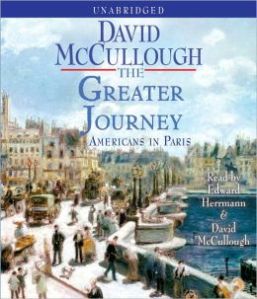
The Greater Journey: Americans in Paris by David McCullough (audio)

greaterjourneyThis is my first experience with the very well-respected David McCullough. “Americans in Paris” is a huge topic; but if anyone can do it justice, we’re told, McCullough might be that one. This feels like a quite comprehensive study of Americans in Paris in the 1800’s, complete with name-dropping and historical context. (I say “feels like” because I don’t have the historical knowledge myself to confirm or question McCullough’s comprehensiveness!)

McCullough follows Americans in Paris more or less chronologically, starting with the 1830’s and following through the end of the century. His subjects range over various disciplines and the story he tells seems to ramble, from art & literature, to medicine, to culture, war, and back to art. In the 1830’s we meet those who were among the first to make the journey, including Ralph Waldo Emerson, James Fenimore Cooper, Samuel Morse, and Oliver Wendell Holmes. A number of chapters are devoted to visual artists and writers, and the artistic superiority of France and the Continent which was only beginning to be challenged by Americans. Samuel Morse not only painted his masterpiece in Paris, but began work on what would become the telegraph; Harriet Beecher Stowe sought escape from the publicity following Uncle Tom’s Cabin; the first American female medical students studied there; and Charles Sumner’s observation of black students in Paris would lead him to a new understanding of black Americans’ abilities, and help him become one of our first abolitionist Congressmen. Rather fewer chapters* are devoted to the medicals, but I enjoyed very much McCullough’s descriptions of the École de Médecine and the American students who studied there. At the time, France was the place to study medicine, and the personalities who taught it loomed large; their role in this section of the book was very entertaining to me. (Also, I thought of The Lady and Her Monsters as McCullough discussed the dissection of cadavers, and their sources.)

Moving forward a few decades, later waves of American visitors to Paris would more commonly bring their families with them to live a fuller life than that of the student or artist; and there would be many more of them. One of the strongest sections of The Greater Journey describes the Franco-Prussian War (1870-71), and the role of American ambassador Elihu Washburne. He was the only ambassador who stayed, and he saved innumerable Americans as well as Germans, helping them evacuate and generally organizing and supporting – literally, in many cases, as he fed & boarded a number of the displaced. He was well regarded for this work, above and beyond the call of duty. The Franco-Prussian War (which felt vaguely familiar to me from my recent readings of de Maupassant), is well told; and McCullough’s description the Paris Commune is evocative and powerful.

Another figure that receives personal attention is sculptor Augustus Saint-Gaudens, an Irish-American kid from a family of decidedly modest means who travels to Paris and becomes a world-renowned artist. You may know him for his bronze Robert Gould Shaw Memorial on Boston Common and his statue of William Tecumseh Sherman at a corner in New York’s Central Park. Saint-Gaudens’ life is examined from his youth through his old age and death; I found this study of an artist to be a very interesting sub-story within The Greater Journey. Likewise the life of Mary Cassatt, an American painter famous for Impressionism who was significantly shaped by Paris.

In other words, while McCullough seems almost to ramble amongst various people, disciplines, and issues, each of his individual subjects is well-treated and fascinating; and any seeming lack of structure is happily tolerated because all the stories are so enjoyable. It’s not really that the book lacks structure, only that following Parisian Americans chronologically takes us through all these twists and turns. The whole is highly readable and a good primer in French/American history in the 1800’s. For example, one consistent thread throughout is the close relationship shared by our two countries during this century, beginning with General Lafayette’s support of the American Revolution in 1776.

The Greater Journey is an interesting and enjoyable read, a good central place to learn a number of individual facts and anecdotes about Americans traveling and living in Paris in 1830-1900. I have the impression that McCullough’s research is good; I am charmed.

*I am not entirely clear on the proportions of the book devoted to each subject, because I listened to the audio and thus could not grab chunks of pages for visual comparison. It is a shortcoming of the audio format. You get only my impressions.


Rating: 7 croissants.

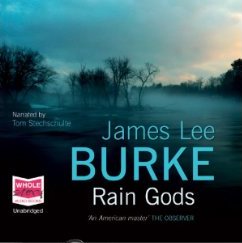
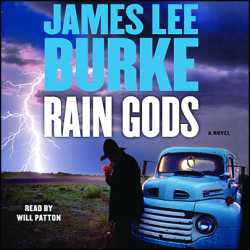
Rain Gods by James Lee Burke (audio)

raingodsJames Lee Burke is best known for his series of mysteries starring Detective Dave Robicheaux, who makes his home in New Iberia, Louisiana and whose adventures mostly take place there (or in New Orleans, or – in one case that I know of – in Montana). But he does write other books: I read a western a while back. Rain Gods is the first Burke I’ve read that stars Hackberry Holland, sheriff of a small Texas border town that I am pretty sure remains unnamed.

As the book opens, Hack has just discovered a shallow grave filled with illegal immigrants behind a church, and a young man named Pete Flores, a veteran of the war in Iraq, flees town with his girlfriend Vikki. They fear the team of professional criminals that were involved with the shooting, but the threads of the case are quickly so thoroughly intertwined that Pete himself doesn’t know who they’re running from. Between a New Orleans crime boss, a bumbling Texas strip club owner, a psychopathic hit man who thinks he’s the left hand of God, and a couple of young lackeys whose loyalties are yet to be tried, Hack and his deputy Pam Tibbs have their hands full in trying to solve the murder and protect Pete and Vikki. And they may still be working out the relationship they share, to boot.

As in any good mystery story, some subplots come out sooner than others. The man they call “Preacher,” who somehow thinks God is supportive of the mayhem he creates, is an enigma of pure evil; but he’s not the only one whose motives are unclear (or irrational). The romance that Pete and Vikki share is a welcome sweet note; and Hackberry’s storied past and accumulated guilt are a familiar but still satisfying facet. The fact that both Pete and Hack are still processing their experiences in war (Iraq and Korea, respectively) is a sobering note of reality that draws the two generations together effectively.

I don’t feel that Rain Gods is Burke’s finest work; I found it a little bit slow-paced. But it had all the hallmarks that I come to Burke for. Our hero is damaged and has committed great wrongs, but is essentially good. The setting is strongly evoked – and I liked it particularly, as the plot mostly takes place in West Texas borderlands, a location I’m fond of and fairly familiar with. And Preacher’s character is quite frightening – as he was intended to be.

The audio narration by Tom Stechschulte is excellent. I love the different voices he does – especially because there’s such a collection of characters featured here, with different accents and tones of voice that express emotions and pain and insanity. This audio format deserved a fine portrayal, and it got one.

I will be reading more James Lee Burke. But I may prioritize the Robicheaux novels.


Rating: 6 delusions.

Teaser Tuesdays: Rain Gods by James Lee Burke

Teaser Tuesdays is a weekly bookish meme, hosted by MizB of Should Be Reading. Anyone can play along! Just open your current read to a random page and share a few sentences. Be careful not to include spoilers!

raingods

James Lee Burke is always wonderful. Of all the attractive quotations to tease you with, I couldn’t resist this literary allusion…

Cassandra had been given knowledge of the future and simultaneously condemned to a lifetime of being disbelieved and rejected. The wearisome preoccupation of the elderly – namely, the conviction that they had already seen the show but could never pass on the lessons they had learned from it – was not unlike Cassandra’s burden, except the anger and bitterness of old people was not the stuff of Homeric epics.

…especially when fused with wistful musings on age and its trials.

What are you reading this week?

The Adventures of Sam Spade (audio)

Here’s an interesting one for you. I had to do a little research to figure out exactly what I have here, and I’m still unclear on a few issues. Please pardon my rather lengthy introductory remarks.

Sam Spade is a character created by Dashiell Hammett in The Maltese Falcon, which I have not read but very much want to. Dashiell Hammett shares some early pulp-classic mystery genre credit with Raymond Chandler, who I have read (just a little) and enjoyed; also, Hammett was partner to Lillian Hellman for some 30 years. “The Adventures of Sam Spade” was a radio series in the 1940’s through 1951, based on Hammett’s character, but I think that Hammett was uninvolved (or marginally involved) in the radio version. His name (says Wikipedia) was removed from the show when his association with the Communist Party became known.

This three-cd set presents six episodes of the radio show, “digitally remastered” and “including never-before-released episodes” – I take it to mean these are original recordings, then, although I haven’t been able to confirm that in my (casual) online research. They do include advertisements for Wildroot Creme Oil, a hair product that was the show’s sponsor. These advertisements are initially somewhat charming in being period pieces, but they are many, and like any advertisement, they get old. Again, this speaks to the authentic feel of the production.

So what about the stories? The six episodes are… “The Insomnia Caper” (1948), “Sam and the Psyche” (1946), “Love Letter” (1949), “The Overjord Caper” (1949), “The Bow Window Caper” (1947), and “The Charogagogmanchogagogchabuna-mungamog Caper” (1949). Howard Duff plays Sam Spade and Lurene Tuttle plays his secretary Effie. These are radio shows rather than your average audiobook, so they include sound effects – gunshots, breaking glass, revving engines, traffic noise – and not just reading of the stories; rather than a single narrator doing voices for different characters, various actors play each character. This is classic pulp stuff, and it’s great fun. There is a definite element of tongue-in-cheek (at least that’s my reading, I can’t speak to the original intent, and the 1940’s are pretty remote to me, but surely…?) in Sam’s character: he is the exemplar of the wise-cracking, hard-boiled, tough-guy detective.

Each story tends to involve a person hiring Sam as a PI, often against Sam’s own wishes: in “Love Letter”, he gets a love letter from a woman he doesn’t know and heads to the assigned meeting point to find himself immediately involved in a situation he’d rather have avoided. His clients are as dodgy as any other character in the story; and there is often a woman who tries to seduce (or seduces) Sam, as a means of distracting him from a plot. Howard Duff’s gruff playing of the role is a large part of the effective mood of these stories.

While the plot of each is formulaic and somewhat forgettable, and the characters are rather stock, that needn’t detract from the fun of these stories. Formulas are often successful and that’s why they’re repeated (think about Agatha Christie). As a regular listener to audiobooks, this radio format that came with multiple actors and sound effects was a refreshing change. The Adventures of Sam Spade is a little simplistic, and definitely easy listening, but great fun, and different from the usual fare.


Rating: 6 double crosses.

The Man Called Cash: The Life, Love, and Faith of an American Legend by Steve Turner (audio)

How could a biography of Johnny Cash not be extraordinary? (Well, the question of whether we seek out biographies of interesting people, versus interesting biographies of any old people, is another blog post.) I was excited to start this one. But warning, folks: it hits hard, and early. The first chapter is about the death of June Carter Cash after 35 years of marriage to the Man in Black, and I cried.

Johnny Cash is truly larger-than-life, as a celebrity and a public figure as well as in his music career. I’m a fan, but not a scholar of Cash’s life: prior to this book, what I knew of him was general cultural knowledge, or gleaned from his songs and the movie Walk the Line (which I enjoyed). So now I know a great deal more.

He was born in Arkansas and grew up in a town called Dyess (which Cash jokingly refers to as a socialist experiment – it was designed under FDR’s New Deal) in the midst of the Great Depression, and after high school, joined the Air Force and served in Germany; he returned to the South to marry a girl named Vivian whom he had met just weeks before shipping out. Cash and Vivian would have four daughters.

His music career came about in an interesting way. Cash had always been passionate about music, from childhood; his mother shared and inspired this love. He was not particularly gifted as a singer, and he was a mediocre guitar player who mostly learned from his Air Force buddies; but his songwriting did impress his peers from the beginning. Back in the southern US, he teamed up with a few coworkers of his brother’s, and formed Johnny Cash and the Tennessee Two, recorded his first single apparently on the strength of will alone, and… things took off from there. Names like Carl Perkins, Sam Phillips, and Elvis Presley figure in the early years of his career.

The shape of his musical career surprised me the most in the story of Cash’s life. He was always an innovator: he played an integral role in the birth of rock-n-roll; he blended styles and approached subject matter previously deemed inappropriate; and even in the final years before his death broke new ground. But I never realized how sort of unguided and hesitant those innovations were. He needed musicians, producers, and sound engineers around him to help shape his creativity. I say none of this to take away from the genius of Johnny Cash: he was unique, and his art remains unparalleled. I just hadn’t realized that he didn’t do what he did in a vacuum, that he had no great image or plan for his work, that he didn’t see the bigger picture himself. He needed help for that.

On tour in the 1960’s, Cash became close to fellow musical artist June Carter; they carried on an affair until Cash’s divorce from Vivian. During the same period, he struggled with methamphetamine addiction, and June wouldn’t marry him until he was clean, which turned out to be 1968. The drug use came and went for many years, but his marriage to June was steady. They had one child together, John Carter Cash.

I enjoyed learning about Johnny Cash. As it turned out, for me, this book’s greatest strength was its subject: rather than being an excellent biography, it detailed an excellent life. One minor gripe I have is in its handling of Cash’s religious life. Now, let it be said, Christianity played a huge role in Cash’s life: he was devout as a young man; struggled with his faith during the years of drug abuse and adultery; found a stronger religious foundation in his years of happy marriage to June; made a great deal of religious music and spoke publicly of his faith; and in many ways led a truly Christian life in terms of charity, compassion, and standing up for the disadvantaged. Handling Cash’s religious life is obligatory in any biography of the man. However, this biography approaches it from a certain perspective: it takes for granted that Christianity is good, and any strayings from the church are bad. See mentions of Billy Graham as an absolutely virtuous figure; praise of June Carter Cash for her total devotion to her husband (with religious references); and straightforward use of “light” and “dark” or “good times and bad” in reference to Cash’s more and less religious periods.

Author Steve Turner never takes on a voice of his own in his book; and I think that, if he were going to take a religious position as he has, that he should have spoken to that in his own voice. Does that make sense? To write as a Christian is not to write from a journalistically neutral place. The fact is that not all Turner’s readers are Christians; and he has done them a disservice in failing to zoom out to a neutral position from which to view his subject. I feel it would have been more honest to acknowledge a personal perspective.

The Christian leaning did not ruin this book for me; but I noticed it. And in noticing it, I was distracted from the fascinating story Turner had to tell. I guess I should have taken warning from the subtitle of the book: The Man Called Cash: The Life, Love, and Faith of an American Legend. Ah well. Silly me: I thought faith could be covered from a faith-neutral perspective. My final judgment on this question is that if you’re seeking a neutral and non-faith-based reading of Johnny Cash’s life, you should seek elsewhere. There are far too many biographies of this enormous figure to settle for one with such a bias.

Similarly, Turner’s perspective assumes that Cash was basically a good man. His mistakes, his “sins” if you will, his lapses, are all forgiven in advance. Turner turns a fundamentally uncritical eye on his subject. This bothered me far less than the Christian angle; in fact I noticed it far less, for the vital fact that I am a Cash fan who was sympathetic to the assumption that he was a force of good. But that doesn’t make it any less an error of journalistic neutrality. Again, there are different ways to skin this horse. Christians may appreciate this reading; fans may appreciate this reading. Those seeking a neutral and critical examination of Cash’s life should seek elsewhere. The Man Called Cash is a fan’s biography.

How about the narration? Rex Linn reads this book for us, and his deep voice and southern vowel sounds evoke Cash, which is pleasant. But he doesn’t do different voices for different characters at all; and some of the pauses between phrases are disjointed. I got the feeling that there may be some sloppy audio-editing involved. It was fine, but not the finest audio narration I’ve encountered, by a long shot.

I have made three criticisms here: two on the biased perspective of the author as a Christian and as a fan of Cash, and one on the audio reading. I feel these are worth noting. But I still enjoyed the book, again, mainly for the strength of Cash’s life. I recommend it with qualifications. If the issues I’ve outlined here bother you, by all means look for another Cash biographer as there are plenty! But this one does the job, too.

I’ll end with a strength. As I said, the book opens with the death of June Carter Cash in 2003. Her final weeks and those following her death are detailed finely; we get to know the Cash family as affected by losing its matriarch, and it is a beautiful and thorough and moving introduction. Its emotional impact opens the story forcefully. From here, we rewind to Cash’s origins, and then follow his life chronologically; when we come back to June’s death again, we can pass over it more quickly, having studied it earlier, and focus more on its impact on Cash himself. I found this structure very effective and powerful, and I am impressed by Turner’s planning in this regard.

Final verdict: obviously mixed. Draw your own conclusions.


Rating: 5 hit singles.

The Shining by Stephen King (audio)

Another masterpiece by Stephen King! Probably my favorite yet. Spellbinding.

I suspect the storyline of The Shining is familiar to us all, so I will sketch it very briefly. Jack Torrance is a recovering alcoholic; his family has been made unstable, financially and otherwise, by his drinking. He takes a job at the Overlook Hotel in the Colorado mountains as winter caretaker, which involves moving his wife Wendy and son Danny in for some 6 months, for most of which they will be snowbound and cut off from the world. Danny has a unique gift for seeing things: the past, the future, dead people. The Overlook has a uniquely grotesque history.

The Shining is a masterful book in several ways. Perhaps the most obvious is the atmosphere: King’s pacing, building of tension as the story unfolds, and foreshadowing, are precisely designed to spook his reader. Danny’s gift – his “shine” – provides the perfect vehicle for this foreshadowing. The character development is finely done as well. Jack is a conflicted character; he loves his wife and son and wants to do well by them, but he battles inner demons, particularly alcoholism, and this internal conflict is well done. He feels like a real person. Wendy, too, struggles with what’s right for her family; she has considered leaving Jack before and continues to deliberate. And Danny is a sweet child, not inappropriately aged (the way gifted children sometimes are in fiction) – at least not to my limited childless knowledge. He can see more than he can understand.

The hotel has a will of its own and is a character unto itself. Place, or building, as willful force of evil is a device we’ve encountered before, Rebecca being one of the best examples. The Overlook is another. I love how Jack’s research into the hotel’s history seems to feed its power to harass him. I love that the Overlook preys on Jack’s weaknesses. It is truly, deeply creepy in the most delicious way.

And while we’re discussing characters – how about my very favorite, the hotel’s summertime cook, Dick Hallorann? Hallorann befriends Danny, shares his strange gift (although it shines more strongly in Danny), puts the name “the shining” to it for him, and comes to the family’s aid late in the book. Dick is a lovely, colorful character, full of personality and, again, very human conflicts. I like him very much.

The Overlook Hotel’s evil finds an outlet through Jack Torrance. His struggle with alcoholism and growing cabin fever make him a good target; but it remains clear that Jack is an essentially good man. Even in the worst of times, he experiences some personal growth. Wendy, too, learns about her son and their relationship is left looking stronger than ever as the story comes to a close.

I found this book exciting; suspenseful; rich; engaging; filled with people I cared about. Oh, and the audio! Campbell Scott’s narration is divine. I loved his voices for all the characters, and he contributed significantly to the atmosphere which is probably The Shining‘s finest quality. If you haven’t enjoyed this book yet, I strongly recommend that you get the audio book read by Campbell Scott if at all possible! This has been one of my most enjoyable audio reads this year to date.


Rating: 8 roque mallets.

Movie review to come. Briefly: not as good as the book (who’s surprised?), and really only vaguely related to it. EDIT: movie review here.

book beginnings on Friday: The Shining by Stephen King

Thanks to Rose City Reader for hosting this meme. To participate, share the first line or two of the book you are currently reading and, if you feel so moved, let us know what your first impressions were based on that first line.

Ooh, I’m excited about this one! Remember when I listened to that first chapter of his future release, Doctor Sleep? That’s the sequel to The Shining, due in 2013, and I loved it. So now I’m back to reading the first one. I’ve never seen the movie, either, although I’ve seen some images from it (Jack Nicholson’s face through that busted-up door is rather iconic) and have a vague impression. This audio version, read by Campbell Scott, came recommended (by Natalie), so here we go. It begins:

Jack Torrance thought: Officious little prick.

Ullman stood five-five, and when he moved, it was with the prissy speed that seems to be the exclusive domain of all small plump men.

I think that is fine imagery. I’m loving this book so far, and yes, Scott’s reading does seem to be letting me inside the head of the disturbing (disturbed?) Jack Torrance. Husband is pleased that I’m reading this book, too, although he was disappointed to hear that I will probably not be done with it by Halloween – he wants to watch the movie then, but I think November will have to do just as well.

Rules of Civility by Amor Towles (audio)

I have one to proselytize for, friends. Rules of Civility will certainly make the list of the greatest books I discovered in 2012.

The book opens with the story’s narrator, Katey, and her husband Val at an art opening in 1966. A few pages set the scene and the style of this book – and oh, the style! – before we’re whisked back into Katey’s reminiscences, beginning just a few hours before the new year of 1938 will be rung in. She and her best-friend-and-roommate, Eve, are out on the town, and they meet a man who buys them champagne for the toast at midnight. And then we follow Katey through the year.

Katey’s life changes a great deal in 1938, in all its aspects: career, home life, relationships, love, aspirations, her understanding of herself and of her world. I don’t want to mention any more of the plot, because I found such joy in discovering its twists myself, and you should too.

This book has many strengths. Its story is interesting: a single year, 1938, in the life of an ambitious young woman in New York City. And there are such surprises that I dropped my chin on my chest more than once. But the plot alone would not have made the book what it is. The characters are strong as well: Katey is pretty fabulous, as are a number of others. But neither is this the shining facet that draws the eye. I think the real victory is in the writing. You may have noticed (and I hope you’ve forgiven me) that I used not one but three teasers to whet your interest (here and here). It’s very evocative: I could see, hear, smell the New York City described; and further, I felt all the emotions Towles wrote. Driving to and from work and listening to this story (and Rebecca Lowman’s masterful, perfect narration), I arrived at my destination confident and optimistic, hopeful for the future, downcast, flabbergasted, or whatever that chapter called for. It was one of those very rare books that engaged me completely, made me lie awake at night worrying, wishing for certain events to transpire, caring deeply about fictional characters. It was amazing. And of course I have no great understanding of 1938 New York City; but Towles (and Lowman) have me utterly convinced that it sounded and looked and smelled and tasted exactly as described here.

And while I’m praising the writing, the style with which Katey’s voice comes alive, I must praise the reading of this audio version as well. Lowman has a frank, languid tone that feels precisely right for Katey; I love that she slows down. Her pacing is sometimes indolent and sometimes despairing, but it always adds to the sense of nostalgia in the beautiful piece of art that is Rules of Civility.

Oh, and it’s worth adding too that Katey is a reader, and literary references abound, which enriches the overall effect considerably for me and perhaps for you too.

Without having given away much plot, then, I assure you that the setting, the sense of style, and the writing on display in Rules of Civility are all remarkable. This will definitely be one of the best books I read this year, and the audio version is superb. Run out and get a copy.


Rating: 9 martinis.

Let’s Pretend This Never Happened by Jenny Lawson (audio)

I was already a fan of The Bloggess, Jenny Lawson’s blog-alias. And her local connection (she’s Texas, with some time logged in a Houston suburb) didn’t hurt, either. Well, now having listened to her book as an audio read by the lovely Jenny herself, I can even more wholeheartedly recommend her to you.

Jenny has a quirky, crass sense of humor: she is fond of the word “vagina” and curses a fair amount. These things do not bother me, but fair warning. She combines that style, however, with an occasional earnestness that is endearing and captivating. This is her “mostly true memoir” (which I think is a great way to speak of memoir, in general! my impression is this one is as “true” as most), and therefore it’s the story of her childhood, growing up, marriage, and family life with husband Victor and daughter Hailey, including moving around the state. One emphasis is the crazy upbringing she experienced in a tiny tiny Texas town with an eccentric taxidermist father (whose idea of a loving welcome is tossing a baby bobcat at her new boyfriend) and long-suffering mother. Another is the mental illness Jenny suffers from, including generalized anxiety disorder and post-traumatic stress. (Disclaimer: I have no print version of this book at hand and am going by memory. But I am fairly confident in my memory.)

Her handling of these subjects is on the one hand hilarious, outlandish, and obscene, and on the other, as mentioned earlier, serious and thoughtful. For someone who suffers fairly debilitating bouts of depression and mental illness, Jenny is surprisingly positive in her interpretation of her own experiences. Presumably her feelings in the moment are often much less cheery; but in the format of this book, where she got to think it through and get it right, her philosophies are refreshing, graceful, helpful, optimistic. She comes across in the end as damaged, yes, but also hopeful, wise, and fun. I want to be her friend. In other words, I give Jenny, her book, and her website my ringing endorsement! Oh, and do check out the audio version if you can. She reads it herself (and sings all the chapter titles), there’s a blooper reel at the end (really just a bunch of off-color ramblings), and I always like to get things in the author’s own voice if possible – in a memoir most of all. In fact, I will pay her the compliment of putting Let’s Pretend This Never Happened up next to Tina Fey’s Bossypants, also read by the author and also hilarious. Go check out Jenny Lawson because she is unique and bizarre in the best possible way.


Rating: 8 self-reflections.