Through the Woods by Emily Carroll

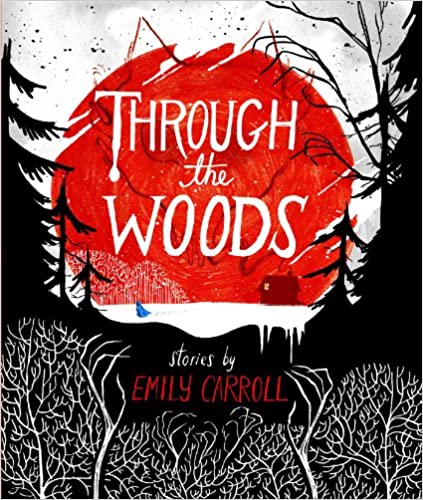
This was a delightful quick read: five spooky stories, with brief introduction and conclusion to bookend. Carroll’s illustration style is lovely – I almost want to say simple, but deceptively so, for sure. She communicates a lot of emotion. I am reminded of the graphic versions of Gaiman’s work. I loved the woman “with starry eyes,” and indeed there were tiny little stars in her pupils.

These tales are deliciously unnerving, creepy, and enigmatic – it’s not always clear that there is something to be scared of in the end, but there sure might be. There’s a lot of question of who to trust, of things that go bump in the night and come out of the woods (as “most strange things do”). Friendships and familial relationships are perhaps less stable and trustworthy than they first appear. There might be monsters, after all. Houses and spaces hold nasty potential. I’ve decided to call these stories dark fairy tales; they definitely recall that style and the traditional setting (and at least one is a clear reference).

This is the kind of horror that is just deeply fun, and in this graphic format, even sumptuous. There are multiple spreads that I could see hanging on the wall. I love the idea of keeping this around for quick, easy, luxurious, high-impact reads. Carroll deserves her accolades. I’d buy another volume of this work in a minute.


Rating: 8 teeth.

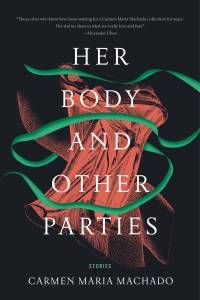
Her Body and Other Parties by Carmen Maria Machado

The stories in Carmen Maria Machado’s debut Her Body and Other Parties are both highly varied – in length, form, and style – and also absolutely related. They each handle gender in our real world, including issues of body image, sexuality, violence, lust, and family structures, but frequently do so by calling in supernatural forces, post-apocalypses, fairy tales or other fictional reference points. These are narratives to get completely lost and absorbed in, not necessarily pleasant reading, but compelling.

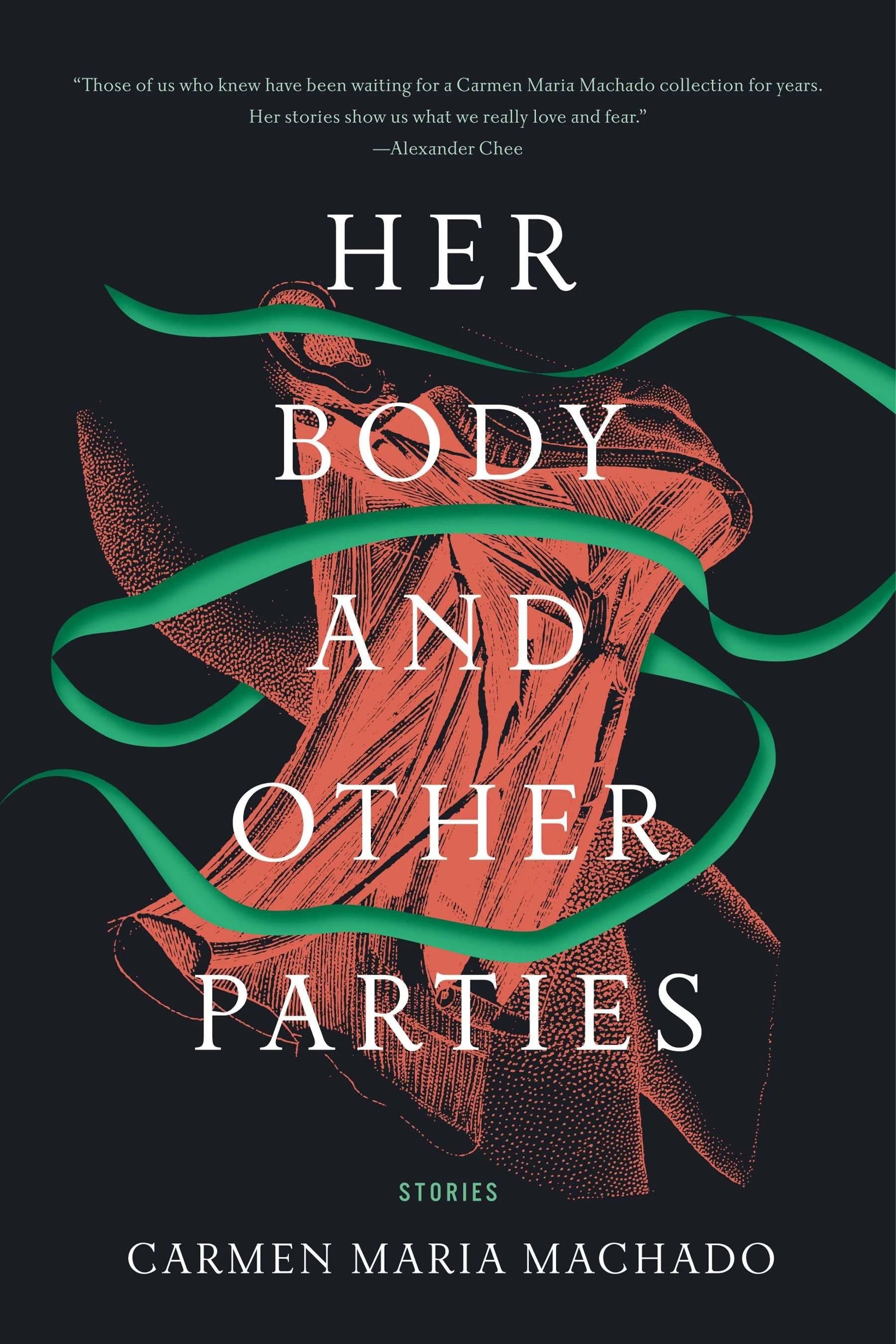
“The Husband Stitch” starts the collection off, and is why I own it: my friend Vince teaches it and I’ve heard him talk about it several times. It is a quite discomfiting story of a woman’s life from girlhood on, including her marriage and motherhood to a boy. It’s about gender expectations, and it feels true to our world, which is why it’s so uncomfortable. It also makes reference to the classic urban myth/horror story about the girl with the green ribbon around her neck – remember that one?

“Inventory” lists the narrator’s partners, of different genders, over the years, until the reader understands that in her world there has been a global pandemic that has all but wiped out the human population. (This was published in 2017, but yes, it feels creepily familiar, like The Stand.) I think it counts as what Suzanne Paola calls a life-rolled-up. I like it very much, in this case, the spooky outer world that it shows at an off-angle while ostensibly focusing on sexual/romantic relationships.

“Mothers” sees a woman showing up on her former lover’s doorstep with a baby, which she deposits, saying “She’s yours.” The trick is that the partner is also a woman, who has imagined their life together as mothers many times, but simultaneously comforted herself that it wasn’t possible for them to make a baby. This central riddle is never solved; by the end, it doesn’t feel like it matters. It’s an interesting thought experiment. The passage about “the major and minor arcana of our little religion” pleased me greatly.

“Especially Heinous,” the longest story in this collection, I felt was the weakest of the collection. I like both the form and the frame: subtitled “272 Views of Law & Order: SVU,” it offers very short synopses of 272 episodes of that show, seasons 1-12. I have watched this show some; as a person mostly ignorant of pop culture references like this, it was gratifying to know the subtext. But it didn’t really work out for me. This alternate version of Benson and Stabler have themselves an alternate version, Henson and Abler, sort of evil doppelgängers who muck up their cases and relationships. It’s otherworldly, paranormal, and weird (none of which I shy away from!) but somehow didn’t come together. Maybe the large number of short pieces didn’t hold together for this many pages. I definitely got bogged down here and reading became a bit of a task.

But then things came right back together again. “Real Women Have Bodies” sees a world with another, different epidemic, in which women sort of… fade out, and become invisible. But where do they go? Our female protagonist works in a high-end dress shop, and finds herself in a relationship with another woman, and both wind up in a position to witness the ways in which women change and are disregarded. (No metaphor here, I’m sure.) It’s lovely and haunting, which could be said about the whole collection.

“Eight Bites” is another perfectly apt observation of the world, in which a woman gets gastric bypass surgery – the last of her sisters to do so – and thereby horrifies and enrages her daughter, who rejects the societal bullying that gets us here in the first place.

“The Resident” features a writer heading to an artists’ residency where she struggles to relate to others, eventually finding herself humiliated – again. This story has a neat trick at its conclusion.

And finally, “Difficult at Parties” (a phrase that echoes from an earlier story) depicts the aftermath of a trauma. Not for the first time, this story is so realistic and painful that it is hard to read, but also spellbinding and crystalline.

NPR‘s Annalisa Quinn states that this book is “full of outlandish myths that somehow catch at familiar, unspoken truths about being women in the world that more straightforward or realist writing wouldn’t.” I’m glad I read that line; it helps me to think about this kind of writing – fabulist realism, perhaps – as defamiliarization. Making our very own familiar world strange helps us to see it more clearly.

I’ll be thinking about these stories for some time. Machado has a gift. Keep your eyes open for her later memoir, In the Dream House. Also, thanks Vince for the recommendation.


Rating: 8 dresses.

Better Off Dead by Lee Child and Andrew Child

Once could have been a fluke, but twice is solid. The Andrew Child continuation of the Lee Child empire will be okay.

Pretty classic building blocks here. Reacher’s just walking down a road in borderland Arizona when he comes across an unusual scene: an apparent car crash that isn’t what it looks like. (I won’t mention the opening chapter, which contains tricks of another sort.) Reacher tropes: a small town in the grips of an evil it wishes it could shake, but the locals don’t have the juice to deal with forces this great. Our hero stumbles into it, and feels sympathy for certain involved parties (and if one of them happens to be an attractive, super-competent woman of about his age, more’s the pity). Also, cue the timely issue of veteran suicide rates. There are some solid fight scenes and more trickery than I’m used to, actually, in terms of the plot itself: I appreciate this. Look, Reacher novels are familiar, even formulaic, but in the best ways, and in ways that still keep me page-turning and generally manage to surprise me. I was sure I saw the whodunit coming in this one and I was wrong. This remains a comfort read (despite the blood and guts); it’s like coming home. And I am just so terribly relieved that the Andrew Child continuation of the franchise seems to be going swimmingly.

Promotional copy claims that this one “will be the riskiest job of Reacher’s life,” to which I say, come on, have y’all read the previous 25 Reacher novels? It’s okay. I can’t wait for the next riskiest job of his life! Keep ’em coming.


Rating: 7 condoms.

1000 Perfect Weekends by National Geographic

1000 Perfect Weekends is a beautiful, photo-packed offering from National Geographic, sure to expand anyone’s bucket list. Destinations are grouped into 18 chapters, including beaches, mountains, cities, small towns, wildlife and nature themes, family-friendliness and off-grid options. Explore “kayaks like floating La-Z-Boy recliners” on the Delaware River, coffee tours in Panama and a bee farm in the Philippines, alongside references to UNESCO sites, architecture, dining, adventures and a delightful ode to libraries in the chapter on “Historical Explorations.” Entries are short, punchy and accompanied by mouthwatering photographs and frequent, inspiring top-10 lists (sporting events, theme parks, spas). Adrenaline-fueled, enabled and accessible, pet-friendly: there is a perfect weekend for everyone in this tantalizing book, an obvious choice for the frequent flier and the armchair traveler alike.


This review originally ran in the November 2, 2021 gift issue of Shelf Awareness for Readers. To subscribe, click here, and you’ll receive two issues per week of book reviews and other bookish fun.


Rating: 6 Instagram moments.

Hollow Kingdom by Kira Jane Buxton

I cannot recommend this to you enough: find something that you believe in, right down deep in the depths of your silvery plumage, and then throw your heart at it, blood and valves and veins and all. Because I did this, the world, though brambled and frothing at the mouth, looked more vibrant; blues were bluer, and even the fetid puddles that collected under rusting cars tasted as sweet as summer wine.

I have so much to say about this book, but in trying to avoid spoilers I think much of it should remain unsaid here.

Hollow Kingdom is set in contemporary Seattle, and its protagonist and most-of-the-time narrator is a domesticated crow. (Chapters do alternate perspectives, so we get a handful of other voices – very colorful ones that make enormous contributions, and come from all over the world. But our star keeps the mic for the majority of these pages.) His name is S.T., which is short for Shit Turd (naturally), and he has enjoyed a good life with his human, Big Jim, and a bloodhound named Dennis with a deathly fear of windshield wipers and alpacas. The book begins “after,” however, and S.T. is here to tell us what happened to Big Jim and his neighbors: we meet the beloved human only in past tense. He got sick and started acting strangely (more strangely than usual), and then his eyeball fell out, and then things went from bad to worse. Eventually S.T. is forced to venture out of the home and into the wider world, where he’ll have to interact with wild crows, for whom he feels mostly contempt, as well as many other forms of nature, likewise distasteful. And he takes Dennis with him, although he feels a similar disdain for the (not so bright) dog, at least at first. S.T. mostly knows the outside world from television and the opinionated Big Jim. And now he’s up against the worst of times with his limited knowledge and his distrust of the natural world – which may be all that’s left.

Among many remarkable features of this unusual novel, I enjoyed S.T.’s voice: salty, foul-mouthed, neurotic, loyal, loving, admiring of humans (whom he calls MoFos – Big Jim’s influence again) and their inventions, sarcastic, self-deprecating and hilarious. He hates penguins (“hambeast-bellied egg timers”) and says of Dennis, “Man’s best friend indeed. More like man’s neediest parasite that would trade you for a bull-penis dog chewy at the drop of a hat.” Squirrels are “five-star sexual deviants” (borne out by later events). The other voices that occasionally interweave with S.T.’s chapters are equally singular, apt, and surprising: there is a Scottish cow named Angus, a young camel in Dubai, and an irascible, tyrannical cat right there in Seattle, among others. (Genghis Cat thinks of his humans as Mediocre Servants, or “dildo-nosed potatoes.”) A very large part of S.T.’s ongoing struggle is wrapped up in his confusions about identity: unmistakably crow, he believes himself to be an honorary MoFo, meant to be human but trapped in black feathers; in the new world, though, he’s going to have to make new allegiances with those who look more like himself. His relationship with Dennis likewise evolves: he begins scornful of the bloodhound’s apparently lesser intellect, but their partnership deepens in tough times, and he discovers that even if Dennis does not talk like the crow does (and as most animals in this world do), he may have a lot to offer. The lessons abound, but Hollow Kingdom never loses its joyful, wacky ridiculousness, even as it gains in wisdom and profundity. Sounds like a hell of a thing, right? This is an unusual and startling book from the first pages, and keeps on surprising to the end.

I also marveled at how many notes I made as I read. I generally make a few notes, but this tight-packed bookmark with overflow onto the other side is rare.

Many of those notes I will not be sharing here because I’m avoiding spoilers. But I can point out that S.T. has a vocabulary: I had to look up formicary, synanthropic, fuliginous, voltaic, collacine, pedipalp, myotonic, and chatoyant. I also loved his use of so many collective nouns: clowder of cats, murmuration of starlings, collacine of maggots, quarrel of sparrows, and of course the constant reference to S.T.’s own murder (of crows) – these are just a few. I’m a big fan of collective nouns.

Hollow Kingdom approaches a few commonly-occurring incidents in literature (which I am still not naming here) with truly fresh eyes. The voice of a domesticated crow navigating an identity crisis in the context of a wider-world crisis is new and inventive. This book is filled with tragedy, but is simultaneously hilarious, hopeful, even joyful.

Trust, it turned out, was a very beautiful and fragile thing with a taste like wild raspberries and experienced only by the very brave.

There are Big Thoughts alongside toilet humor, and commentary on the importance of relationships even in the most bizarrely changing world imaginable. Lots to love. Buxton has a rare and fascinating mind and I love the weird voices she’s created here; I’ll definitely look for more from her.


Rating: 8 Cheetos.

When Me and God Were Little by Mads Nygaard, trans. by Steve Schein

A rocky childhood on the Danish North Sea is rendered in weird but apt terms by an extraordinary young narrator.

Mads Nygaard’s When Me and God Were Little, translated by Steve Schein, is a stark portrayal of a hardscrabble childhood in a blue-collar, small town in Denmark, on the coast of the North Sea. Its narrator is seven-year-old Karl Gustav (who would rather be called Big Ox), and his distinctive point of view is filled with preposterous details that make perfect sense to him. “In our town you couldn’t drown barefoot,” he begins, and yet his big brother, Alexander, has managed to do just that, permanently upsetting Karl Gustav’s worldview.

His father is a drunk, but owns his own business building houses, and “Our house was so big that Mom still hadn’t gotten around to vacuuming all the rooms.” “Dad weighed 250 pounds and it was all muscle, except for the hair,” but then Dad goes to jail (something about the papers in his file drawers; the young narrator isn’t concerned with the details), so Karl Gustav and his mother move into a county-owned house in a new town. Unperturbed, the child carries on obsessing over soccer (he plays alone over four fields through the winter) and terrorizing his teachers. Years pass, very few friends come and go, and readers follow Karl Gustav’s experiments with porn, disastrous employment, grifting, a doomed love affair with another damaged young person and a developing relationship with his father. The loss of his brother will always loom large, for Alexander was a hero: “He just smiled, knowing everything.” But other losses accrue, as Karl Gustav learns more about the wide, perplexing world. By the book’s end, the narrator is a teenager, perhaps still ungainly, but wiser for the trials he’s seen.

This is an unusual novel, its narrator’s voice colorful, unpolished and unforgettable in Schein’s gruff translation. It is Karl Gustav’s singular perspective that makes When Me and God Were Little the memorable, bizarre, poignant adventure that it is. It’s absurd and often fantastic, as this narrator delivers an earnestly nonsensical account of events that readers know to be impossible. And yet it rings true, because what is childhood if not nonsensical? Karl Gustav is all bluster and pain, bluffing in the face of forces bigger than he is. His story is gritty, messy but real, and there are no happy endings on this harsh coastline. The novel is filled with cigarettes and swagger and masturbation literal and figurative, often unbeautiful but somehow still lovely in its authentic, unvarnished view of a difficult coming-of-age.


This review originally ran in the October 29, 2021 issue of Shelf Awareness for the Book Trade. To subscribe, click here.


Rating: 6 hedgehogs.

Snow, Glass, Apples by Neil Gaiman and Colleen Doran

This quick read combines Snow White (the classic fairy tale) with still more horror, in graphic novel form, with story by Neil Gaiman and beautiful, intricate illustrations by Colleen Doran in the style of Harry Clarke. Gaiman’s version subverts the classic tale to star an evil stepdaughter, and moves away from a children’s story (to the extent that these fairy tales ever are that to begin with!), with sex as well as scariness. Doran’s art is jewel-toned, detailed, evocative, and yes, sexy and scary by turns. The book is hard-covered, slim and gorgeous; I enjoyed every minute on a chilly rainy evening, and again the next day, skimming for both plot details and visual ones. Gaiman’s storytelling (down to word choice) is exquisite, and Doran’s work (which I was not familiar with) is equally so. Again, it is a short book, but a beautiful one which I will revisit. Think of it as a gift option for the fans of dark fairy tales in your life! Sinister and delicious.


Rating: 8 bridges.

Dark Night by Paige Shelton

Piles of intrigue and secrets populate a remote town in Alaska, where an amateur sleuth hopes to reinvent herself, in book three of this cozy mystery series.

Dark Night, book three in Paige Shelton’s Alaska Wild series, continues the adventures of thriller writer Beth Rivers in the insular small town of Benedict, Alaska. Like Thin Ice and Cold Wind, this installment offers intrigue in a low-gore, cozy package.

Beth is known to the rest of the world under her pseudonym, Elizabeth Fairchild, but after an abduction and skin-of-the-teeth escape, she’s retreated to this remote hamlet to live quietly and anonymously: only the local police chief knows who she really is. With winter closing in and a few friends kept at arm’s distance, Beth tries to heal from the trauma and go on with her writing, hoping to hear that her abductor will eventually be caught. Instead, her mother turns up unexpectedly. Mill Rivers is a loose cannon, on the run from the law herself–and she may be Beth’s best hope at finding peace and finally feeling safe again. A local murder, of course, spices things up. Between Beth’s reluctant romantic interest in the comically named Tex Southern, the propensity of Benedict’s residents to keep their secrets, an ill-mannered, unwanted census taker and yet another fugitive in town, mother and daughter will have their hands full solving mysteries large and small.

Beth’s relationship with local law enforcement (and Benedict’s unconventional boundaries in this regard) allow her to act as an unofficial investigator. Mill is a force to be reckoned with in every way: another amateur detective, but with a violent streak, she still seeks her husband (Beth’s father), who has been missing for decades. The librarian is a special-ops dark horse, and the local dog sledder and tow truck driver may have a checkered history of his own. Beth is a by-choice tenant at a halfway house for female felons; the list of eccentrics lengthens from here. Benedict is the town where people go to keep their secrets, but Beth may have to open up if she’s going to learn the truth of her own past.

Shelton’s plot is twistier than a path through the dark Alaska woods. Her characters may be bumbling, but they are generally well-meaning, except when they are revealed as decidedly otherwise. Suspicions shift and suspense builds in this novel of discovery, growth, relationship building and investigatory hijinks. As a bonus, Dark Night ends with a lead-in to the next episode: Beth Rivers’s trajectory will surely extend and continue to complicate as she deepens her roots in the captivating town of Benedict.


This review originally ran in the October 25, 2021 issue of Shelf Awareness for the Book Trade. To subscribe, click here.


Rating: 6 cheese-foraging adventures.

A Flicker in the Dark by Stacy Willingham

Disclosure: I was sent an advanced review copy of this book in exchange for my honest review.


Chloe Davis was twelve years old the summer that six teenaged girls went missing from her small hometown of Breaux Bridge, Louisiana. She found that the place she felt the safest was not so safe after all, when her father was arrested and pled guilty to six murders. As the twentieth anniversary of that summer approaches, we meet Chloe at age thirty-two. She is a clinical psychologist in Baton Rouge, recently engaged, and barely holding it together (she has a prescription pill problem, for one thing, abetted by Louisiana’s unusual system that allows psychologists to prescribe drugs). When a local teenager goes missing, and then another, she begins to lose the plot (no pun intended) while conducting her own highly amateur investigation.

I wanted to like it (not least because this book was originally assigned as a review for Shelf Awareness), but this thriller was not terribly successful for me. The writing was a little tired (Southern accent compared to molasses), and the characters frustratingly ill-suited to their professions: for a psychologist, Chloe is remarkably inexpert in human behavior; the police detective can’t stop interrupting his interview subject. I kind of lost it when the undergrad student said she’ll get her doctorate next, and then, hopefully, her master’s! (To be fair, let’s remember I got an advanced review copy – I surely hope this will be corrected before the final publication. But really.)

I finished it, but wish I hadn’t.


Rating: 4 red herrings.

Once More Upon a Time by Roshani Chokshi

Once upon a time, there lived twelve reasonably attractive princesses who, when lined up together, caused such a sight that the world agreed to call them beautiful. And so they were.

Prince Ambrose and Princess Imelda fall in love at her sister’s wedding; her father, being thrifty, asks them to wed the very next day to save on expenses. He gives them a kingdom called Love’s Keep, which will thrive and prosper only as long as its rulers remain in love. Naturally, then, Imelda falls ill; a convenient witch offers to save her life if Ambrose agrees that they will give up their love for each other, thereby damning both Love’s Keep and their marriage. This story begins when Ambrose and Imelda must leave Love’s Keep, that barren land. Before they part ways forever (unclear on why they every wound up together in the first place), a different witch (at least I think it was a different witch?) appears and offers them a quest. The point of the quest is not for them to fall in love again, but stranger things have happened on quests. The estranged king and queen, then, set off through strange lands, to have adventures and meet wild beasts, cannibals, and a horse cloak that thinks it’s a horse. What will they find, and lose?

I am much intrigued by this deceptive little tale, which seems simple on its surface but (as so often!) contains depths. Both prince and princess have some hangups, some baggage, some triggers. Both have put up defensive mechanisms that limit their access to joy and love, and this is not the usual material of prince-and-princess fairy-tale romances, but it is the material of real life. I love that this princess has a trigger about the objects that have been used in her past as a means to exert control, to tie her to the earth. And in a classic miscommunication, her prince’s attempt to use that very mechanism to free her will be misinterpreted – as can happen when we establish less-than-rational associations. There is a question built in throughout as to where love comes from, and whether it can be regained once lost. What is really the obstacle to the success of the relationship and of Love’s Keep? Imelda fears that even in her joy,

This feeling will trap you. There is no freedom in this.

Is love a trap? Can one be safe in love?

Ambrose knew there was no trust in love.

Love made no promise to stay, to put down roots.

Later,

Ambrose knew there was no trust in love.

But there was no love in trusting that truth either.

As ever (and echoing that recent read, Everything, Everything), these things only work if you take a risk that they won’t.

You think it’s lust, but it’s not. It’s bravery. To close distances. To take the raw, beating part of you and hold it up to the light.

A romance, yes, but a far more pragmatic one than fairy tales tend to be. At only 133 pages, it’s an easy and absolutely joyful read. Also, please note that Imelda goes around saving Ambrose’s tail more than vice versa. I’d never heard of Roshani Chokshi but will have to find more.


Rating: 8 apples, naturally.