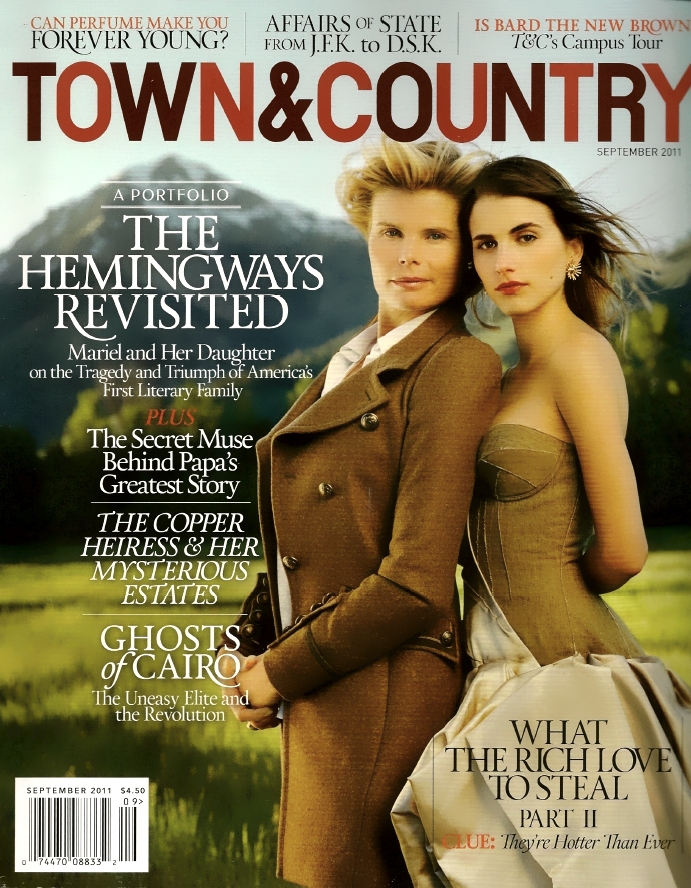
HemingWay of the Day: in Town & Country (I know, weird, huh?)


Well, unfortunately it doesn’t seem to be available on the interwebs at all. You have to go find a physical print copy of the September issue of Town & Country magazine to read these articles. But keep your eyes open for one, because it might be worth it! There are two Hemingway-related articles: the first is available in part (and with some lovely pictures) at Mariel Hemingway’s blog – that’s Papa’s granddaughter. It basically catches us up with the current generation: Mariel, a successful Hollywood actor, and the fate of her two sisters who haven’t done as well; and then Mariel’s daughters, Dree and Langley. Town & Country’s focus is clearly on the beautiful people (Mariel and Langley; Dree is only mentioned) and the beautiful house: the Hemingway estate in Ketchum, Idaho. Yes, that’s where Papa died. The short story is, these beautiful ladies seem to have overcome their family legacy of depression, angst, and suicide. Good for them.
The second article is even more worthwhile, though. It contains an excerpt from Paul Hendrickson’s new book, Hemingway’s Boat, which you may have noticed I am mad for (main review here). I don’t have any kind of electronic version of it. 😦 Sorry. If you see a Town & Country (September issue – with the younger Hemingway women on the cover, at right), check it out. Or better yet, go get a copy of the recently published Hemingway’s Boat! (You will get much more Papa that way.)

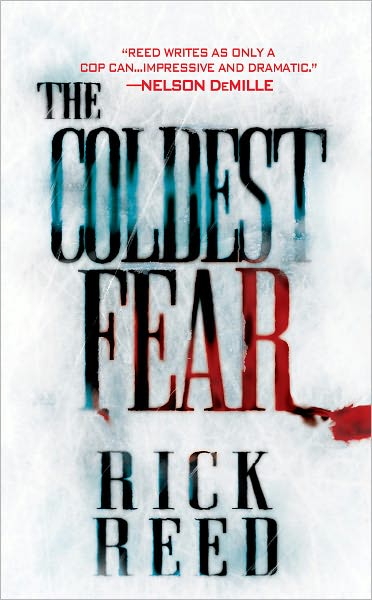
The Coldest Fear by Rick Reed

A fast-paced crime thriller involving a serial killer; likable, witty detectives; and a mess of body parts.

Rick Reed, former police detective and author of the true crime Blood Trail, brings back Detective Jack Murphy from his first novel The Cruelest Cut in this suspenseful ride. A woman’s body is found mutilated and missing parts in a bathtub at the Marriot in Evansville, Indiana; mere hours later, Jack is looking at her right hand, arranged alongside the similarly abused body of a young mother in the projects. The bodies stack up quickly as Jack and his partner struggle to keep up with their own investigation. A local newspaper reporter scoops them at every turn, and his source just might be their serial killer. They’re taken out to a small town with a two-man police department, and then an FBI profiler is brought in, as the case quickly spins into mammoth proportions and spans jurisdictions.

Reed lends his professional expertise to this thriller in which the vantage point shifts from Jack’s criminal investigation to the perspective of the killer, providing a unique reading experience. The murderer remains nameless, but we get glimpses into what drives him and what makes him hesitate. When his identity is finally revealed, the shock is not lessened, but the journey gets an interesting twist from the shifting viewpoint.

Reed’s second crime thriller delivers with fast-paced suspense, twists and turns, the humor of several witty detectives and that rarity of fiction, a likeable FBI agent. Gruesome serial killings are balanced by banter, the sweet if harried relationship between Jack and his parole officer girlfriend, and an ending with a note of hope.


This review originally ran in the September 16, 2011 issue of Shelf Awareness for Readers. To subscribe, click here, and you’ll receive two issues per week of book reviews and other bookish fun!

Challenge Update: Where Are You Reading?

Well, you might recall from my last challenge update that I COMPLETED (yay!) two of the three challenges I took on for 2011, and with months to spare, too. Now that the year is drawing nearer to its close, it’s time to concentrate on the last and most difficult one: Where Are You Reading? Sheila at One Person’s Journey Through a World of Books has assigned this one. My job is to read a book set in each of the 50 states, plus bonus points for foreign locations. (Take a look at my map to see where I’ve been.)

So. At this point I’ve completed 24 of the 50 states (plus the District of Columbia!), and it’s time to start picking and choosing those remaining. They are:

  • Alabama
  • Alaska
  • Arizona
  • Arkansas
  • Delaware
  • Hawaii
  • Idaho
  • Kentucky
  • Louisiana
  • Maryland
  • Mississippi
  • Montana
  • Nevada
  • New Hampshire
  • North Carolina
  • North Dakota
  • Ohio
  • Oklahoma
  • Pennsylvania
  • Rhode Island
  • Tennessee
  • Utah
  • Vermont
  • Virginia
  • West Virginia
  • Wisconsin

Here we are, kids: I need your help! Please to recommend me some books! Do you have a book (or an author of several books) who writes in one of these states that you can recommend to me? I would greatly appreciate it. For example, if you were looking for Louisiana I would GUSH over James Lee Burke to you. But Virginia? Beats me. Help a girl out!

Do you think I’m going to make it?

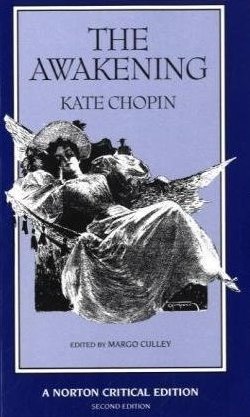
Virtual Read-Out: The Awakening by Kate Chopin

Today I’m “reading out” from Kate Chopin’s 1899 novel The Awakening, in honor of Banned Books Week. [Learn more about the Virtual Read-Out.] Sources vary as to the banning of this book, but ALA does list it on their list of banned classics. Its themes include the struggle of women to escape society’s intentions for us; the main character comes to hold some very unpopular views about the place of marriage, love, and childrearing in her own life. Here is my video read-out!

Thanks, Husband, for playing videographer. 🙂

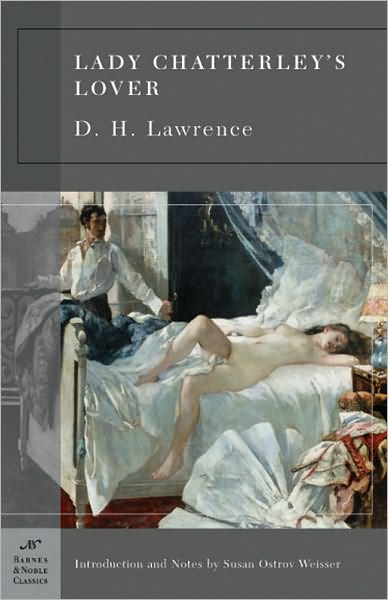
book beginnings on Friday: Lady Chatterley’s Lover by D. H. Lawrence


Thanks to Katy at A Few More Pages for hosting this meme. To participate, share the first line or two of the book you are currently reading and, if you feel so moved, let us know what your first impressions were based on that first line.

I really enjoyed this classic with The Reputation. I actually had not intended for it to coincide so neatly with Banned Books Week, but it sure did! The back of my B&N edition claims that while it was “quickly banned in England and the United States as pornographic, [it is] sexually tame by today’s standards.” I have to say that it makes my eyes widen here and there, though! I’m not offended; I find it fascinating stuff. But I wouldn’t call it entirely tame. Just tame relative to the 1920’s, is all.

Enough, already. Here’s your beginning:

Ours is essentially a tragic age, so we refuse to take it tragically. The cataclysm has happened, we are among the ruins, we start to build up new little habits, to have new little hopes.

Rather obviously, the tragedy referred to is the first World War, which left England missing the bulk of an entire generation of men, those left behind largely broken and scarred. This fact is centrally important to the action of the book; Lady Chatterley’s husband is lame and impotent as a result of the war, her marital options drastically limited by it. Everyone’s life is irrevocably effected by the missing men.

My review of Lady Chatterley’s Lover posted a few days ago, here.

What are you all reading this weekend?

Booking Through Thursday: reading aloud

Ack, sorry folks, I know I’m filling us right up with posts this week!! But I couldn’t resist today’s BTT topic, because it brings back such memories.

Booking Through Thursday asks,

1. What do you think of reading aloud/being read to? Does it bring back memories of your childhood? Your children’s childhood?

2. Does this affect the way you feel about audio books?

3. Do you now have times when you read aloud or are read to?

1. I can remember being read aloud to, barely; my parents took that parental duty very seriously, which I think is the obvious beginning of my lifelong love of reading. I also went to a sort of experimental preschool where, among other things, they taped me reading aloud; hearing some of those tapes a little later in life was awfully funny. The little-me voice reading aloud and critiquing and imagining and adding onto what I read was very interesting. I believe my parents and I took turns reading chapters aloud to each other when I was old enough for “chapter books.” (I also know I had to be made to turn the lights off and stop reading to go to sleep.)

2. Audiobooks? I don’t think I’d much made that connection, although obviously that’s what an audiobook is: somebody reading aloud to me. Interesting. I had some trouble getting into the audio format, but did finally catch onto it this year, finding my commute time to be a good way to get some more reading in. Did my early-life reading aloud (and being read to) affect my current appreciation of audiobooks? I don’t know, but I do appreciate them!

3. Not much, but yes: Husband doesn’t really read much (until I pushed the audiobooks upon him! oh joy!), but I so wanted him to enjoy The Old Man and the Sea that I read it aloud to him on one long car trip. (To Eldorado, maybe? I don’t remember.) He did appreciate it. I have an interest, too, in sharing the Odyssey with my friend Gala by reading aloud – since it was originally an orally recited “book,” it seems like such the perfect way to enjoy it. We’ve talked about it but never gotten it together; perhaps it’s finally time? And, while I’m thinking of Gala, I remember The Lincoln-Douglas Debates which I was to read for class in college (as an undergrad political science major). I was having trouble with it, and finally teamed up with Gala’s son, my best friend, and we read them aloud to one another, taking turns, like I did with my parents when I was small. This way we got to debate and discuss as we went, and the topics came alive to me, which of course helped me in class.

I do think that reading aloud is very important for little kids – that’s where you get to begin to instill a love of reading! – and for adults, as well. It allows a different kind of connecting to the book; sharing the experience with another person means discussion and greater involvement, and generally greater enjoyment. I think there’s an obvious application for study, but also for pleasurable reading of fiction or whatever you like. Yes please to read aloud!

Banned and Challenged Classics


I love lists of books. I especially love to note which books I’ve read, and which I want to read, on other people’s lists of best books, classic books, Books Everyone Should Read, and suchlike. This book is both timely (hello, Banned Books Week) and fun because it combines two concepts that make me interested in a book: that somebody is calling it a Classic, and that somebody thought it was too racy or thoughtful for people (especially little kids) to read. (This usually recommends a book to me, or at least piques my interest. I’m not weird, am I?)

So here are Banned and Challenged Classics according to the American Library Association. Again, my notations are:

Bold = I’ve read it
Italicized = I’ve started the book, but never finished
Neither = I haven’t picked it up.

1. The Great Gatsby, by F. Scott Fitzgerald
2. The Catcher in the Rye, by J.D. Salinger
3. The Grapes of Wrath, by John Steinbeck
4. To Kill a Mockingbird, by Harper Lee
5. The Color Purple, by Alice Walker
6. Ulysses, by James Joyce
7. Beloved, by Toni Morrison
8. The Lord of the Flies, by William Golding
9. 1984, by George Orwell
11. Lolita, by Vladmir Nabokov
12. Of Mice and Men, by John Steinbeck
15. Catch-22, by Joseph Heller
16. Brave New World, by Aldous Huxley
17. Animal Farm, by George Orwell
18. The Sun Also Rises, by Ernest Hemingway
19. As I Lay Dying, by William Faulkner
20. A Farewell to Arms, by Ernest Hemingway
23. Their Eyes Were Watching God, by Zora Neale Hurston
24. Invisible Man, by Ralph Ellison
25. Song of Solomon, by Toni Morrison
26. Gone with the Wind, by Margaret Mitchell
27. Native Son, by Richard Wright
28. One Flew Over the Cuckoo’s Nest, by Ken Kesey
29. Slaughterhouse-Five, by Kurt Vonnegut
30. For Whom the Bell Tolls, by Ernest Hemingway
33. The Call of the Wild, by Jack London
36. Go Tell it on the Mountain, by James Baldwin
38. All the King’s Men, by Robert Penn Warren
40. The Lord of the Rings, by J.R.R. Tolkien
45. The Jungle, by Upton Sinclair
48. Lady Chatterley’s Lover, by D.H. Lawrence
49. A Clockwork Orange, by Anthony Burgess
50. The Awakening, by Kate Chopin
53. In Cold Blood, by Truman Capote
55. The Satanic Verses, by Salman Rushdie
57. Sophie’s Choice, by William Styron
64. Sons and Lovers, by D.H. Lawrence
66. Cat’s Cradle, by Kurt Vonnegut
67. A Separate Peace, by John Knowles
73. Naked Lunch, by William S. Burroughs
74. Brideshead Revisited, by Evelyn Waugh
75. Women in Love, by D.H. Lawrence
80. The Naked and the Dead, by Norman Mailer
84. Tropic of Cancer, by Henry Miller
88. An American Tragedy, by Theodore Dreiser
97. Rabbit, Run, by John Updike

See, this is interesting: I think I have my highest percentage-read on this book, than of any of the lists I’ve reviewed here so far. (That, and a number of them make My List.) My personal reaction to this list is… wow, these are really excellent books. What a shame that anyone has tried to limit access to them. (And then there’s The Satanic Verses, which I really couldn’t get into. And Faulkner? Ugh, I couldn’t make any headway; although I was trying The Sound and the Fury, which I’ve since heard is not the best first-read.) That, and who the heck challenged The Call of the Wild??

Which books have you read off this list? Which ones are you itching to read? Any you aren’t attracted to?

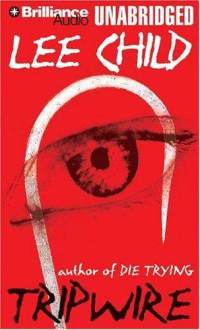
Tripwire by Lee Child (audio)


Y’all, I just have to tell you something as an aside: I suspect I’m pretty unique in this, because I know so many strict series-in-order readers, but I LOVE reading out of order. Is there something wrong with me? I love the fun feeling of knowing something the in-order reader won’t. Rather than ruining the surprise (which, honestly, I don’t think I can remember happening to me ever!) I often find it enhancing things; it’s like a whole new fun, knowing what’s coming, especially in that moment of realization. In Tripwire, for instance: I will try to do this nonspoilerarily, but there is a character we meet for the first time, who I pretty quickly recognized as a character from a later book I’ve read. So I had this moment of OH! she will be THIS later, and now I have a new angle from which to watch the action unfold: I’m looking for hints of what I know is to come. No, I don’t want to know who the bad guy is right from the start. But that’s not the kind of thing I find spoiled by a series out of order. Perhaps this is because often, in mystery series, we don’t see the same bad guy in book after book. Or if we do, it’s not the FACT that he’s the bad guy that drives the later book – it’s finding him. So, no spoiler. See? Flipping to the end would spoil the book; reading the book after the book often does not. On the other hand, though: knowing that there are more Reacher books after 61 Hours definitely does spoil the question of whether or not he survives. I guess the only way to be cliff-hanged on that one was if you read it when it came out and before the next in the series…

I’m sorry. Back to Tripwire. Ahem. I loved this book… I seem to say this every time… this is one of my favorites of the series. It opens in Key West, which is fun because we were just there recently. I love the idea of Reacher digging swimming pools (by hand!!) and getting even more muscled, gaining weight, and getting a tan while he’s at it. I also love that he’s drinking lots of water. I’m a fan of water, too, and like Reacher I like mine at room temp, not cold. I’ve digressed again. So we open in Key West but then quickly move up north to New York City, where Reacher is reunited with a friend from his past. Again I’m working to avoid spoilers here, but the relationship, past and present, was extra special to me because it continues to develop Reacher’s character, and is especially poignant in exposing his strong emotions and vulnerability. What makes Reacher so loveable is that he is a Rambo superhero type, yes, and also very clever, but also vulnerable. There are humorous moments. Will the house have… closets?? (Go read it, you’ll understand.) And of course the mystery is clever and complex and kept me guessing. I love Reacher’s deductions, like in dealing with decades-old skeletal remains – this puzzle dates back to the Vietnam War – and I love how it ends, with a new chapter in Reacher’s life.

I recently bothered you with a rundown of my reading of Reacher to date. While putting together that list, I realized that they fall into two categories for me: memorable, and not so much so. I’ve enjoyed every single Reacher I’ve read, but some I LOVE and continue to mull over after the fact, and some, in compiling my list, I had to reference to even see what they were about. (The titles are not always descriptive of the action of the book.) Are you curious? Below, see those I have read and loved, those I have read and mostly forgotten, and those I have not yet read. (For links to my reviews, see this post.)

1. Killing Floor
2. Die Trying
3. Tripwire
4. Running Blind
5. Echo Burning
6. Without Fail
7. Persuader
8. The Enemy
9. One Shot
10. The Hard Way
11. Bad Luck and Trouble
12. Nothing to Lose
13. Gone Tomorrow
14. 61 Hours
15. Worth Dying For
16. The Affair
and the short story, The Second Son.

Tripwire ranks up there. I fear my Reacher reviews are getting repetitive for you. Excellent as usual. Continuing on with Without Fail next. What are YOU reading?

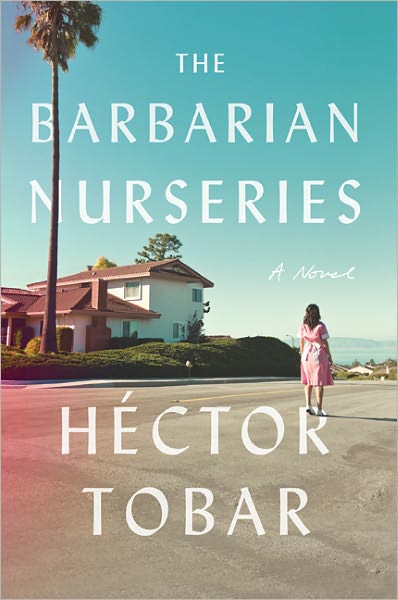
The Barbarian Nurseries by Héctor Tobar

A deceptively quiet story, with swift currents running deep beneath its surface, considers the fate of an unprepared Mexican housekeeper in Orange County left to care for her employers’ young children.

Pulitzer Prize-winning journalist Héctor Tobar‘s second novel tackles the ambitious goal of characterizing Southern California’s multicultural schizophrenia and achieves it admirably.

Araceli is quietly comfortable in her role as housemaid to the Torres-Thompson household in Orange County, one of three Mexican domestics; but when the gardener and nanny are suddenly dismissed, she is puzzled to find herself expected to care of three children she considers strangers. Worse, she wakes up one morning to find both her employers gone with their baby–leaving her alone in the house with two young boys. In desperation, she sets off with them on a daunting trek through diverse and unfamiliar Los Angeles to try to find their estranged paternal grandfather.

Tobar creates an intriguing juxtaposition of cultures, as the Torres-Thompson children are thrust into a huge, unfamiliar, multiethnic city. Most observations are from Araceli’s perplexed, amused, lyrically bilingual perspective. At other times, we look through the boys’ eyes, with all the wonder of the new, including evidence of poverty they’ve never before encountered. The older boy (age 11), in particular, has a unique way of clinically interpreting new experiences through books he’s read, imbuing the world with fantasy. The adventure with the boys is a comedy of errors–Araceli becomes suddenly famous as a symbol of racial politics, and her fate depends upon forces outside her control.

The Barbarian Nurseries is a beautifully written, contemplative and thought-provoking view into Southern California’s diversity and contradictions, as well as a fascinating and well-presented story.


This review originally ran in the September 27, 2011 issue of Shelf Awareness for Readers. To subscribe, click here, and you’ll receive two issues per week of book reviews and other bookish fun!


Y’all! One of the best books I’ve read this year! Rush out there and get it!!

Great Gone With the Wind Readalong, part 4

Just a reminder, folks: today Part 4 of our Readalong is up for discussion at The Heroine’s Bookshelf. Please do stop by!