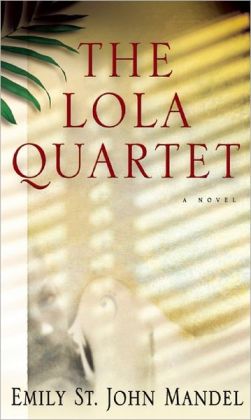
The Lola Quartet by Emily St. John Mandel

lola quartetAnna is seventeen, with a baby, and she’s on the run. Ten years later, Gavin’s life is falling apart: he loses his job and his New York City apartment, and returns to small-town Florida with his tail between his legs. As he tries to patch a life back together, he also searches for a piece of his past that’s gone missing: an old girlfriend who disappeared, and a daughter he never knew he had. To solve the mystery and unravel the intrigue that has followed them into the present, Gavin will have to reconnect with the members of the Lola Quartet, his old jazz group from high school.

The Lola Quartet is told from several different perspectives in disjointed chronology, like Station Eleven, although its circumstances are less imaginative: Gavin and his former band members inhabit the same world that we do. The characters are all fully-developed and interesting people, with complexities and inner conflicts, and the story keeps us moving right along; this is a difficult book to put down. The thread of music that runs through the book – as a down-and-out jazz musician obsesses, and the gifted are said to “have the music” – is another sparkling element that brings these people to life. The Florida that Mandel evokes is hypnotic in its humidity and quiet threats. I found it an interesting twist that Gavin is a boy from Florida who can’t handle the heat.

This is not the masterpiece that Station Eleven is, although it’s a very enjoyable read. There were a few plot twists that I felt could have used a little more explaining, or else been left out. The character who compels all those around her, for whom everyone else makes sacrifices, didn’t show the kind of charisma I would think necessary to draw those loyalties; and I know sometimes these things are just inexplicable, but I still would have appreciated a little more expression of her magnetism. But the setting and the characters are as real as can be; the story has momentum and suspense; The Lola Quartet is a novel to lose yourself in.


Rating: 7 photographs.

“Landspeak” by Robert Macfarlane

Here is another that I cannot improve upon by commenting. Words and places, beautifully composed? I am sold. I’ve heard a lot about Robert Macfarlane but this short piece is all of his writing that I’ve actually read. Clearly I’ll need to find more.

Please enjoy


The Savage Professor by Robert Roper

This dark thriller has an intelligent side, and pleases on several levels as the bodies pile up everywhere this professor goes.

savage

The Savage Professor, by Robert Roper, is a complex, scientifically minded whodunit. The professor is Anthony Landau, a formerly prominent epidemiologist settling into obscurity in the hills of Berkeley, California. He has enjoyed escapades and conquests over the years, both professional and in the bedroom. When a series of murdered women starts turning up awfully close to home, he is challenged in new ways.

…Click here to read the full review.


This review was published in the Summer 2015 issue of ForeWord Reviews.
IMG_4538


My rating: 7 balloons.

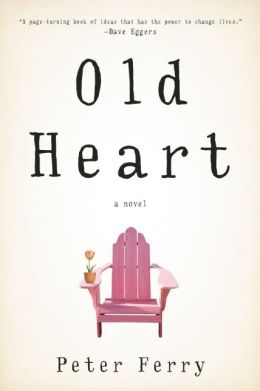
Old Heart by Peter Ferry

A sweet, tender story of a decades-old, dreamed-of romance and the less elegant realities of aging.

old heart

Peter Ferry (Travel Writing) crafts a wise and delicate novel of aging, love and autonomy in Old Heart.

Tom Johnson is an old man. He has been widowed, and thereby freed from a troubled marriage, for a number of years. His adult children have begun pressuring him to sell the house in Illinois and move into a home. The motives of his son the gambling addict are suspicious; his daughter’s are likely pure. His eldest child, who had Down syndrome, was Tom’s best friend, but his death has given Tom the opportunity to pursue an old mystery. And so Tom plots to run away, leaving no clues behind save a note for his family: “I am not coming back.” He then travels to the Netherlands to track down a Dutch woman he knew during World War II, with whom he had “invented love.” He knows the chances of finding Sarah alive are poor, but he is driven nonetheless. “This is my life, whatever is left of it,” he writes in the note to his children.

The half-hidden narrator of Old Heart is Tom’s granddaughter Nora, a graduate student who had just begun recording the story of Tom’s return from the war and the beginning of his long-lived but unhappy marriage. When Tom makes his escape, Nora is the only one he takes into his confidence, and she relates parts of his story from her perspective. In other chapters, he chronicles his personal history–the parts where he meets and loves Sarah–in long letters to Nora. Throughout, the question of Tom’s mental competence looms over his narrative.

Of course, upon his arrival in the town where he knew Sarah, Tom does not find what he hoped he would; what he finds instead is far more complicated. In the winding path he travels–from Illinois to Eindhoven, and from dream to reality–Tom instead learns a lot about what he wants, what he has the right to expect from his life and where he’s come from. And despite his age, he continues to grow, and finds a chance to love.

Old Heart is earnest and, yes, occasionally sentimental, but also pensive and eventually enlightened. It is at once a romance, a meditation on the complications of end-of-life independence and the responsibilities of family, and a lovely personal history. In a slim, unassuming read, Ferry opens intriguing questions and introduces his reader to complex and deeply likable characters. The result is delightfully warm and universally appealing.


This review originally ran in the June 4, 2015 issue of Shelf Awareness for the Book Trade. To subscribe, click here.


Rating: 8 decisions.

Station Eleven by Emily St. John Mandel (audio)

station eleven

Wow. The entirety of this book is every bit as good as it seemed when I wrote about it some time ago. I am reeling, very sorry that it is finished, and will want to track down more of Emily St. John Mandel’s work as soon as I can. Thanks again, Liz, for the great recommendation as always.

Station Eleven has two settings, dually in a dystopian or post-apocalyptic future world, and with flashbacks to the world of here and now. The story begins with the beginning of the collapse, when during a stage production of King Lear the lead actor dies of a heart attack onstage. The audience member who tried to save him leaves the theatre, stunned, as a highly virulent and fast-acting flu virus sweeps through his home city of Toronto; warned by a friend who is an ER doctor, he stocks up on supplies and holes up with his brother in the brother’s apartment. His brother lives on the 22nd floor and is in a wheelchair, so they do not evacuate the city.

Flash forward 15 or 20 years, and now we follow a group called the Traveling Symphony, incompletely named because they also specialize in Shakespeare productions. The world has changed: almost the entire human population of every continent died of the flu, with only small bands of people left and little technology. There is no more electricity, no more fossil fuel, no more computers. Small communities have formed but are insular and suspicious, and sometimes violent; life is hard. The Traveling Symphony brings some light to this regretful world – art is still beautiful – but the symphony members are not exempt from the hardships; they carry weapons, deal with uncertainty every day.

The story is told in disjointed chronology, jumping back and forth between the pre-collapse world and the world after. Each of these two timelines runs chronologically, but we alternate between the two. The third world is that of Station Eleven, a fictional creation of one of our characters that also bears on the real world both before and after the flu epidemic.

Perspective shifts as well between several characters, some of whom we follow both before and after the collapse – if they survive. They have aged 15-20 years in that time, which presents some interesting possibilities and points of view. It also ramps up the suspense and tension: what happened to this person or that, did she live, does he ever find his loved ones again, and do they see any consequences for their actions? Mandel is expert at teasing us with these questions, and I heartily second Liz’s feeling that this book ends too soon: I too want more.

Mandel exhibits genius in the details of all three of the worlds in this story. Her characters are outstanding: nuanced and complex people with strengths and flaws that we can mostly learn to love but never worship. The struggles of these characters ask questions of the reader: what kinds of behavior are justified by hard times? What technologies would be hardest to live without, and is there anything to be gained by going “back to basics” or back to a less technological era that we often regard as “simpler”? What is the value of art; what do we want out of it? What is the meaning of friendship? If computers and cars and airplanes and iPhones suddenly went away, should we teach the next generation about them or let that history go silent?

As a novel-reading (listening) experience, I thought Station Eleven was nearly as good as it gets: entertaining, aesthetically pleasing, thought-provoking, stimulating, colorful, well-written, compelling. As a cultural critique, I found it useful as well, although as I contemplate global collapse in its various forms and our strategies related to it, I want to think about forms of collapse that are rather more our fault than this is. That’s a little awkward; what I mean is, the flu in this story is sort of an act of god, a thing that happens to us, but I think it would be useful to think about economic, environmental, societal collapse due to human hubris and poor decision-making. The flu could be a version thereof, less directly. Still, its results are instructive or at least stimulating.

The narration on this audio production by Kirsten Potter is very fine. I told my parents partway through that there were two readers, a man and a woman, but that was wrong; between listenings, I clearly got confused, due to Potter’s fine acting of male and female perspectives throughout.

Mandel is a nuanced writer with a keen imagination. I can’t wait to discover more of her work and recommend this novel highly.


Rating: 9 knife tattoos.

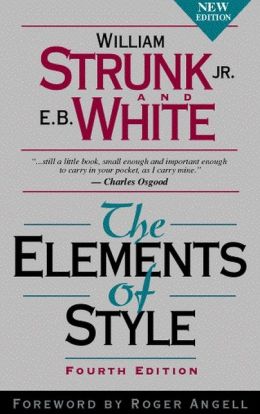
The Elements of Style (fourth edition) by William Strunk and E.B. White

Who can confidently say what ignites the mind? Who knows why certain notes in music are capable of stirring the listener deeply, though the same notes slightly rearranged are impotent? These are high mysteries, and this chapter is a mystery story, thinly disguised.
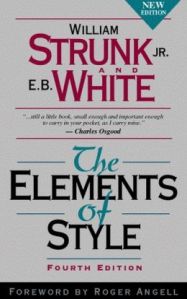
styleI am fairly confident I was asked to use this book in school at some point; but I am quite sure I never read it cover to cover before this. And I’m afraid I can’t recall where I saw it recommended. But I’m very glad I checked it out from my local library, and I think I will go ahead and buy a copy too.

I read the fourth edition, which has four authors. Roger Angell writes the foreword, describing his stepfather E.B. White’s working style. White wrote the introduction for the 1979 edition. The original text was by William Strunk, unaccompanied; Strunk’s student White reworked his professor’s text after the latter’s death, adding a few paragraphs and updating some of the references. An afterword by Charles Osgood wraps things up in the style of the whole book and his three colleagues: brief, succinct, and sparkling.

This is a shockingly enjoyable little book considering that it is “just” a style guide that offers advice about… the overuse of adjectives (especially in dialog), passive voice, brevity, clarity, and the joining of dependent and independent clauses. The Strunk-and-White text is what it exhorts us to be: brief, clear, humble but stylish. I was absolutely charmed throughout.

This is a very small book. Even with its four authors in this edition, it requires the glossary and index to clear 100 pages, and is pocket-sized. However, even being so tiny, it was the first book I’ve read in a long time that required two separate quarter-page bookmarks that I filled with my notes. Thus this long review. Strunk would almost certainly wish for greater brevity, but I’ve included lots of quotations for you to enjoy.

The Elements of Style got me reflecting. I think it’s beautiful that there is such a thing as style in writing; I think it’s lovely that a place like Shelf Awareness needs and has a “house style,” a set of decisions made in advance and for consistency about how we will all write (or, more so, be edited). I love that writing allows for variation within the realm of strict correctness, and that even though this complicates things it also allows for added artistry in what is truly the art of communication.

I thought of my high school English teacher more than once as Strunk discussed style, vs. the clear-cut rules of grammar. Mrs. Smith agreed that we should all learn the (rather more boring) proper, correct, and formal way to write before we began experimenting; the breaking of rules is for the gifted who have earned that right by putting in their time with less exciting work. I will never forget her fine example (and think of her every time I encounter it): Hemingway writes in The Sun Also Rises that Robert Cohn “was married by” the first woman who came along, and this use of the passive voice is both purposeful and effective. Until her students become the next Hemingway, however, Mrs. Smith instructed that we should strive for active over passive verbs. This is the same principle with which Strunk writes,

“But,” you may ask, “what if it comes natural to me to experiment rather than conform? What if I am a pioneer, or even a genius?” Answer: then be one. But do not forget that what may seem like pioneering may be merely evasion, or laziness – the disinclination to submit to discipline. Writing good standard English is no cinch, and before you have managed it you will have encountered enough rough country to satisfy even the most adventurous spirit.

Let me continue: I marked no end of droll phrasings and thought I’d share a few.

White shares a memory of his Professor Strunk:

He felt it was worse to be irresolute than to be wrong. I remember a day in class when he leaned far forward, in his characteristic pose – the pose of a man about to impart a secret – and croaked, “If you don’t know how to pronounce a word, say it loud! If you don’t know how to pronounce a word, say it loud!”

(Strunk was so economical with his words, White tells us, that he had to re-lengthen his speech by repetitions.)

Flammable. An oddity, chiefly useful in saving lives. The common word meaning “combustible” is inflammable. But some people are thrown off by the in- and think inflammable means “not combustible.” For this reason, trucks carrying gasoline or explosives are now marked FLAMMABLE. Unless you are operating such a truck and hence are concerned with the safety of children and illiterates, use inflammable.

Or, on the question of shall vs. will:

A swimmer in distress cries, “I shall drown; no one will save me!” A suicide puts it the other way: “I will drown; no one shall save me!” In relaxed speech, however, the words shall and will are seldom used precisely; our ear guides us or fails to guide us, as the case may be, and we are quite likely to drown when we want to survive and survive when we want to drown.

This is not the only time he considers grammar a matter of life and death.

Muddiness is not merely a disturber of prose, it is also a destroyer of life, of hope: death on the highway caused by a badly worded road sign, heartbreak among lovers caused by a misplaced phrase in a well-intentioned letter, anguish of a traveler expected to be met at a railroad station and not being met because of a slipshod telegram. Think of the tragedies that are rooted in ambiguity and be clear!

The tragedies, indeed! I love the tone. And how lovely are these thoughts about the art of writing in general:

Writing is, for most, laborious and slow. The mind travels faster than the pen; consequently, writing becomes a question of learning to make occasional wing shots, bringing down the bird of thought as it flashes by.

Or,

Writing is one way to go about thinking, and the practice and habit of writing not only drain the mind but supply it, too.

I think I will need to put that up on the bulletin board over my desk.

Some of Strunk’s usage preferences are either not ones I share, or are dated in their particulars and thus less helpful. But the bulk of the advice he gives is both correct and delightfully expressed. Also, it bears noting that his tips are meant to apply to more formal or academic writing; he repeatedly allows that certain forms (a love letter is one example he uses more than once, which is again charming) will take different usage.

As entertaining as The Elements of Style is to read, its utility is alive and well: I found a revelation in rule #11 on page 75, regarding verbs and adverbs in dialog. Something that has always bothered me in my reading, but that I couldn’t have articulated, has been made plain to me and now I will be able to criticize more clearly when I encounter it (and, I hope, avoid it in my own writing). Thank you, Professor Strunk.


Rating: 8 split infinitives.

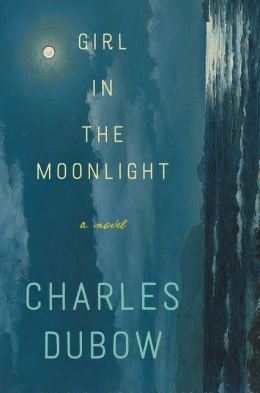
Girl in the Moonlight by Charles Dubow

A lifetime of love and lust, with a backdrop of fine art, vast wealth and high society.

moonlight

In Girl in the Moonlight by Charles Dubow (Indiscretion), Wylie Rose has known the Bonet siblings since he was 10, when he fell out of a tree and broke his arm at a party on their massive estate. He studies painting with the elder son, who becomes a dear friend; he admires the younger twins and the rest of the family, who are all brilliant, luminous, talented, beautiful and tremendously rich. But it is Cesca, two years older than Wylie, who hypnotizes him, and ruins him for any other woman or any other life than self-destructive devotion to her.

From a distance of decades, adult Wylie reflects on that life–always coming when Cesca called, from their first sexual encounter when he was a teen through her unpredictable comings and goings over the years, and the apparently mature and healthy relationships he throws aside for her in Manhattan, Paris and Barcelona. She seemingly can’t help her flirtations, manipulations and self-destructive behaviors. Wylie feels for her like “an exile misses his homeland or an old man misses his youth.”

Dubow’s writing is a bit uneven, but often inspired in its phrasing, evoking a mystical atmosphere around Cesca’s mesmerizing power and the rarefied world she travels in: extraordinary wealth, titles and estates around the world, artistic success and broken hearts. Wylie and Cesca see tempestuous years pass in struggling to define the magnetism they feel for one another, and readers will be spellbound by the process.


This review originally ran in the May 26, 2015 issue of Shelf Awareness for Readers. To subscribe, click here, and you’ll receive two issues per week of book reviews and other bookish fun!


Rating: 5 martinis.

Hyacinth Girls by Lauren Frankel

A tricky, smart riddle in novel form about bullying and family secrets.

hyacinth girls

Lauren Frankel’s debut novel, Hyacinth Girls, opens when Rebecca puts Callie’s face, along with a provocative question, on a billboard near the high school. A lengthy flashback explains why, in a gradual uncovering of the past. Callie is not Rebecca’s daughter but the daughter of her late best friend, Joyce. The happenings and drama of Callie’s middle and high school years are more troubling than the average teen experience, and have led to some terrible events that call for a billboard. But what exactly happened, and who is the perpetrator and who the victim, and why? These are questions that take the whole book to unravel, with roles reversing throughout. Rebecca’s voice alternates with Callie’s, but not until late in the book, when the reader’s impressions are already formed. The mixing up of clues and the struggle to sort out loyalties results in an unreliable narrator or two.

The story of Callie and her social circle eventually becomes entangled with that of Joyce and Rebecca, when they were childhood best friends. New and old traumas slowly, coyly come out: bullying, suicide, simple mistakes and basic meanness. Betrayals and lies populate the experiences of both generations. In revealing a complex web of family and community secrets, schoolyard bullies and the nature of trust, Frankel nudges her reader to ask questions like the one Rebecca puts on the billboard: Do you know your children?

Hyacinth Girls is a compelling and powerfully evocative novel of friendship and love, deceit and duplicity, and the rough terrain of being a teenage girl.


This review originally ran in the May 26, 2015 issue of Shelf Awareness for Readers. To subscribe, click here, and you’ll receive two issues per week of book reviews and other bookish fun!


Rating: 6 tattoos.

Teaser Tuesdays: Station Eleven by Emily St. John Mandel

Teaser Tuesdays is a weekly bookish meme, hosted by MizB of Should Be Reading.

station eleven

You’ll recall that I’m loving this audiobook. Here are the lines that made me snort the other day:

“I’m afraid I’ve no idea,” the tuba had said when Kirsten had asked him for confirmation a few years back. No one had any idea, it turned out. None of the older symphony members knew much about science, which was frankly maddening, given how much time these people had had to look things up on the internet before the world had ended.

Take note, people, we should all be spending more time looking things up on the internet in case of the world ending! (KIDDING – go ride your bike.)

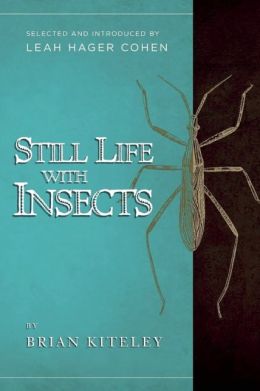
Still Life With Insects by Brian Kiteley

The subtle, sublime life of an amateur entomologist, in tiny glimpses.

insects

Leah Hager Cohen (No Book but the World) selected Brian Kiteley’s first novel, Still Life with Insects (originally published in 1989), for reprinting by Pharos Editions. In her introduction, Cohen gracefully outlines the strengths of this slim, quietly powerful book.

Elwyn Farmer is an amateur entomologist, forever wandering off to peer under dry leaves or dig in riverbanks. Still Life with Insects consists of his journal entries, spanning 40 years: from 1945, when his 43rd birthday has just been celebrated, to 1985, when his vision begins to fade. The entries record his quiet rejoicing in the ephemeral glory of the natural world, the beetles he collects and, through and around them, the details of his fragile life. Following several nervous breakdowns, he tells stories in which grandchildren and tragic death figure at an equal level with the Burying Beetle (Nicrophorus marginatus), or the Asian Stink Bug his family encounters in a Hungarian resort.

Although a bug collector’s field notes may not sound like an imaginative or exhilarating backdrop, Brian Kiteley’s distinctive style plays well to such a challenge. His greatest accomplishment is understatement. In a mere 103 pages, a sensitive, complex man becomes a brittle old man, fully experiencing the passing of time and life. The stories that fill these journal entries, sparse and widely spaced over decades, are necessarily mere vignettes, bare sketches. Still Life with Insects is a deceptively simple story, characterized by restraint, but with many layers of allegory available to the close reader.


This review originally ran as a *starred review* in the May 19, 2015 issue of Shelf Awareness for Readers. To subscribe, click here, and you’ll receive two issues per week of book reviews and other bookish fun!


Rating: 8 boxes.