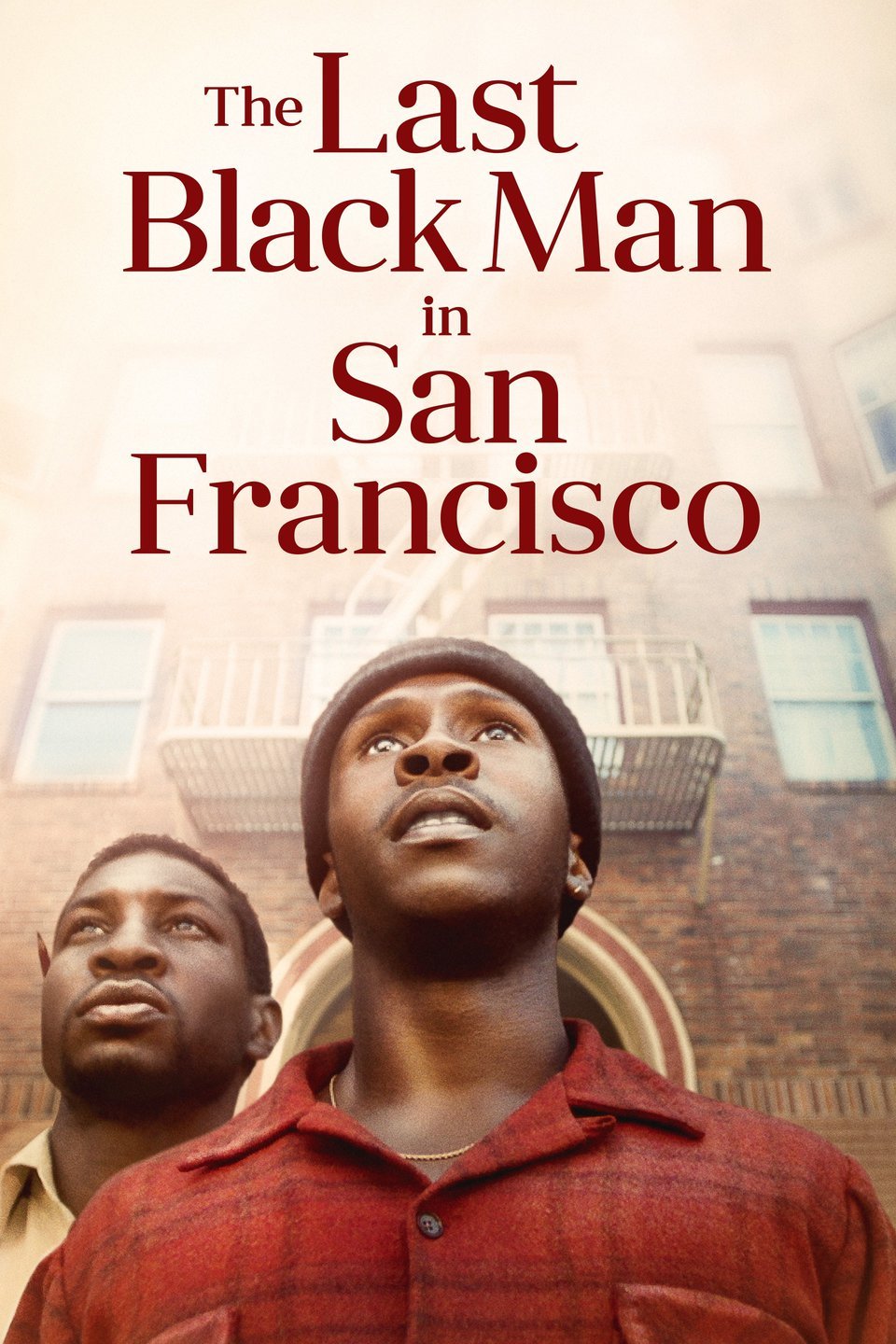
movie: The Last Black Man in San Francisco (2019)

Again thanks to my mother’s urging, I watched this introspective film online the other night. It was odd, slow-moving in that way that art films often are, but visually beautiful, thoughtful and poignant.

Jimmie Fails is a little bit obsessed with the family home – that is, the house that his family lost some years ago. He and his buddy Mont hang around and work on the house when they can get away with it – the white lady who lives in it now is apt to throw croissants when she catches Jimmie touching up the paint on the trim. Jimmie lives with Mont and his blind grandfather as sort of a charity case, in an outlying part of the city. A group of young men hang out on the sidewalk outside Mont’s house, talking shit as the pair comes and goes. There’s less action to this movie than there are scenes, even montages. Mont works at a fishmonger’s; we see him killing and wrapping catfish. Jimmie works at an old folks’ home. They wait on the bus. Jimmie rides a skateboard. The men on the sidewalk talk their shit. And Jimmie worries over the house.

Jimmie’s grandfather built this house – “the stairs, these windows, the columns, the archways, the witch hat, the balustrades, the fish scales, this balcony… all of it by Jimmie Fails the First with his own two hands.”
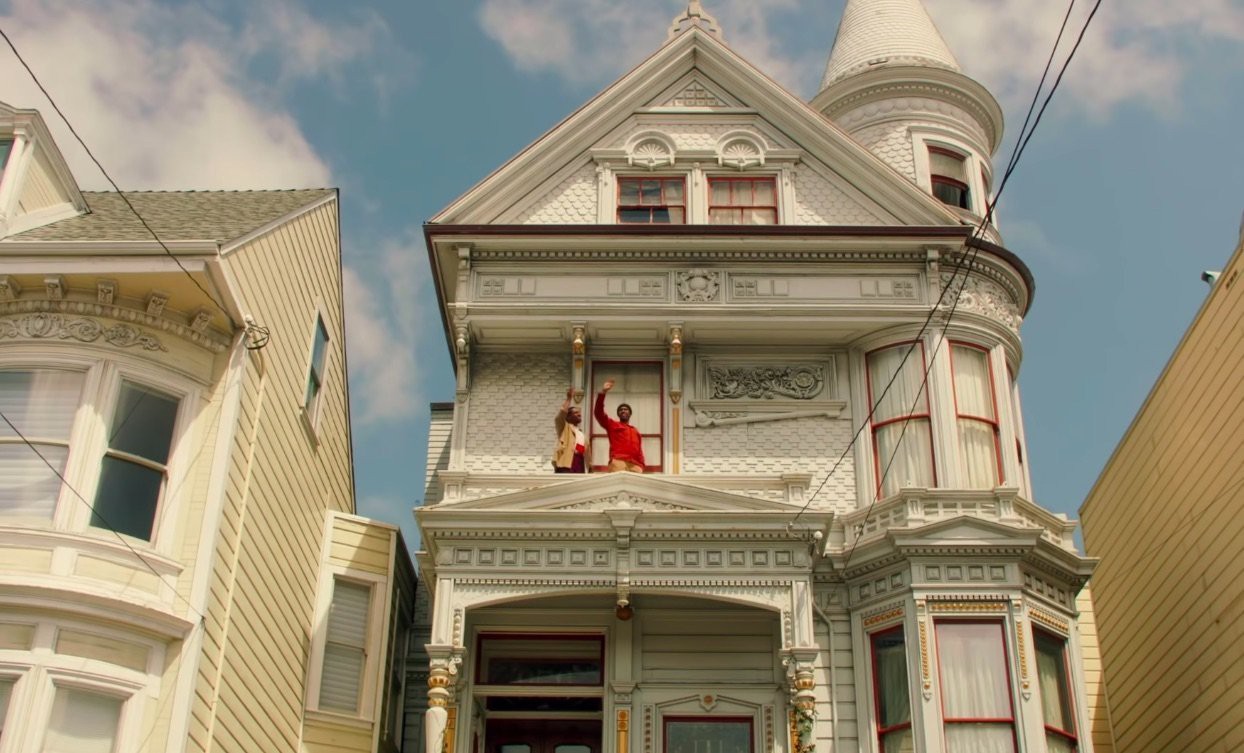
the house in question (click to enlarge)

And Jimmie’s determined to have it back. Accompanied by the eccentric (but who isn’t?), loyal Mont, he’ll get back there.

The Last Black Man in San Francisco showcases footage of the city and one completely extraordinary house (with a built-in organ in the front hallway, a hidden room behind a bookshelf, and all the flourishes), and takes time and attention with faces and personalities. Again, just visually, it’s a striking series of studies. See the white men in full haz-mat suits cleaning up sidewalks where Black children play among street preachers and those sidewalk loiterers, who form a Greek chorus of sorts… Jimmie and Mont spend as much time standing, sitting, riding, and musing as they spend in action, but their actions are momentous. Jimmie is driven, single-minded. Mont is an artist, a writer, and an unusual soul. When Jimmie asks why he’s lovingly drawing the sidewalk guys, who are basically bullies: “I shouldn’t get to appreciate them… ’cause they’re mean to me?”

Obviously, this movie is a commentary on race relations and on gentrification, the plague on San Francisco in particular but on many or all of the cities in this country. It’s about class and exploitation and how we value history, and family relationships. It’s also about friendship: the friendship between Jimmie and Mont is something really special.

I was fascinated to learn the backstory on this movie. Jimmie is played by the real Jimmie Fails, whose life story closely matches his character’s. (The house is not his family’s house, though.) Director Joe Talbot is his longtime best friend; together the two decided to tell this true story in fictionalized film form, and it’s genius. It also means that actor/character Jimmie has bared his soul in a pretty big way. Mont is played by Yale-trained Jonathan Majors, and I’ve seen indication in two different places that he both is and is not based on a real-life friend of Jimmie’s. Whatever the case, he’s an indispensable part of this story, as Jimmie’s foil, and partner both in musings and in action. His artistic inclinations move the plot along and allow for important commentary.

I’d say the only criticism to be made here is pacing, and that’s a qualified criticism; it’s just got that art-film thing where there’s plenty of space and time for ideas to expand, which is not for every viewer. But this movie is beautiful, thought-provoking, important, wise, and funny. I do recommend. Bonus points for SF lovers, of course; and for those of us with strong commitments to place, check out Jimmie’s line: “you don’t get to hate [the city] unless you love it.” Indeed.


Rating: 8 brush strokes.

National Theatre Live at Home presents Frankenstein (2011); and my weekly update

Last week’s NT Live release was 2011’s Frankenstein, which is viewable here until this Thursday night, when we get a chance to see Antony and Cleopatra.

Well, it had to happen: there had to be an NT Live production I was less taken by. I found less to revel in here than usual. I’m sure the acting was very fine, but it felt a little indulgent, in terms of theatricality. Opening scenes in which the Creature discovers himself and the world around him went on a little long for my patience. The pacing in general felt a bit draggy, and the themes of trying-to-be-god and man-is-monster not terribly uplifting… which might have been my feelings about the novel, too, actually. Benedict Cumberbatch and Jonny Lee Miller alternate playing the two lead roles, Victor Frankenstein and the Creature; this film version offers Cumberbatch as the Creature. Again, very good acting I’m sure, but I often felt a little impatient; I didn’t buy into the drama as I usually do. This production also included just a few musical sequences and the odd spot of comedy, both of which felt a bit out of place in a story that’s otherwise, well, quite serious. If you love Frankenstein, do check this out, of course, and I’d be interested in your take. This one was not so much for me. Ah, well. This week will be better.

In other news, since around the beginning of shelter-in-place orders, I’ve been having weekly literature talks (by phone) with the 8th-grade daughter of some friends of mine. We are heading into our seventh week together. L has mostly read short stories that I’ve also taught to my Short Fiction class (semester wrap-up coming later this week!), and our discussion follows what I’ve done in class; I’ve found her to be at least as ready as my college students (freshmen through seniors) to handle the elements of fiction and the real-world implications of the themes of these stories. It’s been an absolute pleasure – and now that my own semester has ended but my chats with L continue, I’m still more grateful for this small-scale opportunity for a little teaching, a little talking, a little contact with a lovely, clever young woman. Last week I asked her to assign me a reading, based on our recent discussion of dystopian fiction (following stories by Shirley Jackson, Ursula Le Guin, and Lidia Yuknavitch), so we discussed chapter 3 of The Hunger Games. And now I’m going to be reading that book. Good job, L.

In other news, I have been sorry to learn that my book review gig with Shelf Awareness will be moving to a digital reading format due to the pandemic and resulting difficulties with printing galleys and ARCs… it all makes perfect sense and there are far bigger issues to be sad about, but still I was sad to realize that all my reading-for-review will be moving away from hard-copy. My first e-reader arrived in the mail last week, and I’ve been loading my e-galleys and DRCs (that’s digital review copies, previously advanced review copies which were printed) onto it and doing my first reading. The Kindle Paperwhite is much smaller than I’d expected. But it’s pretty easy to use, once I got it set up, and the small, lightweight physicality of it is nice, I admit. I guess I’m torn between feeling grumpy about this new development, and committing myself to liking this, since it’s going to happen regardless. I’m trying hard to commit myself to liking it. And to be fair, nothing about the reading experience is hateful so far – although I definitely miss the feel of pages and the ability to take my notes on a bookmark and even underline passages on real paper. (I’m aware that the e-reader has highlighting & note-taking functions. It’s not the same; and it’s not nearly as easy.) Well, we’ll see, but I’m trying to get happily on board.

In other news, let’s see… I’ve enjoyed a few TV series online in the last two months (already!) of work-and-everything-else-from-home. I fell in love with Luther and then even more in love with The Wire – I may very well turn around and watch the latter again. I ripped through season six of Bosch, and was glad to see that my enjoyment of that series has not suffered from my recent disappointment with a Connelly novel on audiobook (that review to come).

Spring is off-and-on here in central West Virginia, and when it’s on, Hops and I walk miles and I ride my bike on the local trails, which have been mucky for weeks and weeks but are super fun nonetheless; I’ve also put in some trailbuilding & maintenance with my new friends here. Oh, that’s right: I’ve begun a new little project via a new Instagram account, wvwildlifewanderer, where I document the plants and animals (mostly plants, much easier to observe and photograph) that I see around here. I’m trying to learn how to recognize trees and flowers, which does not come easily to me, but it’s been a rewarding process so far.

What have you seen, onscreen or in the world, that intrigued you lately?

National Theatre Live at Home presents Twelfth Night (2017); and my weekly internet roundup

This week on NT Live at Home: Twelfth Night, viewable for free here until this Thursday night, when we lose Twelfth Night and gain Frankenstein (with Benedict Cumberbatch). Lucky us!

And you’ll be shocked to hear it’s another excellent one. This is a great play, and I love the casting and the acting here. Viola/Cesario and Sebastian are Black; Malvolio, Fabian and Feste the fool are women (Malvolia, Fabia and… I think just Fool); and the whole thing has been recast in, what, 1930s-ish trappings? There’s no modernization of the dialog, thankfully, just the visual effects. I love the gender play, and what could make more sense in a play where a woman dresses up as a man to woo another woman on behalf of another man, than to mess about with gender roles a bit more? Malvolia is as ridiculous as ever; the lesbian twist on her desire for her boss is only natural. I think this may be the best Malvolio I’ve seen (although he was memorable in that movie version). I think the best chemistry of the whole production was that between Viola/Cesario and Duke Orsino. Sebastian is hot, and I loved the moment with Orsino gets confused one more time at the end and kisses the wrong twin; but the Viola + Orsino scenes have something going on that no other prospective couple achieves.

This one also features another creative set design, circular and moveable-changeable. While not all reviewers loved the drag/fetish club scene, I thought it was great fun. Again they had me guffawing out loud and startling a sleeping old dog (sorry, Hops). I was all-around entertained. I think Twelfth Night might be one of Shakespeare’s most accessible plays to follow, and there is fun here for anyone, promise. I’d watch it again in a heartbeat and heartily recommend it all around, as usual for everything NT Live offers.


Rating: 8 hot tubs.

Continuing my new pandemic tradition of reviewing other cool stuff on the web: I was so pleased with this astonishing performance (via a link from Mark Doty, so thank you for that, sir) that I’ve watched it several times now. It’s tableaux vivants of Caravaggio paintings, performed to Mozart; but beyond the classical tableau vivant which is a stationary performance, these are shown in setup and takedown as a whole moving theatre. The addition of movement helps me to appreciate the physical strength of the players, making it athletic as well as dramatic as well as a visual art form – plus the music – really a revelation.

A couple of nights ago I “attended” a 50th anniversary show for KPFT, Houston’s Pacifica public radio station, and got to see performances by nearly three dozen artists with ties to my hometown, including a couple of old favorites and a few I didn’t know but was really drawn to. Hayes Carll made me cry unexpectedly. Other highlights included BettySoo, Ruthie Foster, Shinyribs, and Lisa Morales. I don’t think this is available anywhere now, but it was a real treat for me, and since then I’ve been spending some time on Carolyn Wonderland’s YouTube page.

Finally, and while we’re thinking about Shakespeare, I dug this Guardian article about the question of reading drama versus watching it performed onstage. I guess I’ve always assumed that theatre performances were the highest actualization of any piece of written drama – why write a play but to have it performed? But there are some good points here. I’ve certainly enjoyed reading drama, and while there’s a special place in my heart for the stage, it’s nice to be reminded that we can all bring Shakespeare (and others) home with us as well. The timely article is about bringing him home now when we can’t get out to the theatre, but of course, thank dog for NT Live! Yes, you can have it all!

I watched a great movie the other night too but that one gets its own review, of course. I think this is the week that pagesofjulia will have to return to thrice-weekly posts… so much goodness in the world, in terms of art and entertainment. Plenty of bad, too, but so much good.

National Theatre Live at Home presents Treasure Island (2015), and the other stuff I’m watching online

This week’s edition of NT Live at Home is another repeat for me, but one I was glad to be able to revisit. Treasure Island can be viewed here until Thursday, when we’ll get access to Twelfth Night. I’m looking forward to it!

This was the first NT Live show I ever saw, with my father, in Bellingham, WA at their outstanding Pickford Theatre. It’s as delightful as I remember. The talented Patsy Ferran plays Jim, who’s a girl in this version – I love a little gender-twist to a classic, and the empowerment that comes with it in a case like this. While it’s not such a big deal as to steal the show, she gets in a few lines about how girls can have adventures too. (Likewise, a few female crew members and pirates draw the odd remark – acknowledged, but not earth-shaking.) Ferran’s Jim is expressive and fun. Arthur Darvill’s Long John Silver is perfect: charming, and terrifying. I love the scene where his one-leggedness is revealed. And I like how they managed the one-leggedness onstage. I see in my original review that I was bothered by certain aspects of the adaptation from Robert Louis Stevenson’s novel; I am unbothered on this go-round, by more distance from reading the novel, for one thing, but also by appreciation for the theatre. Still impressed by the modular set! This is a great show.

Otherwise, this weekend I’ve been catching up on some of NPR’s excellent Tiny Desk Concerts: Bob Weir and Wolf Bros., Chika, Megan Thee Stallion, Rising Appalachia, Los Lobos, Sheryl Crow, Café Tacvba… and the odd Tiny Desk (Home) Concert, like one from Tank (from Tank and the Bangas). There are so many great ones to dig into.

I am also reading my way right through nearly 1,200 pages of The Stand and grading hundreds of pages of student essays.

Put NT Live on your schedule, if you haven’t already!

National Theatre Live at Home presents Jane Eyre (2015), and other online events

Week two of NT Live at Home! This was a repeat viewing for me – I saw Jane Eyre when it was a new production, and loved it. I was perfectly happy and grateful to see it again. And again, to remind you: this production is viewable for free but for a limited time, until the next show goes up on Thursday, so do go see it here asap. This week’s release will be Treasure Island, another outstanding production. Put it on your calendar!

So, Jane Eyre as repeat: still outstanding. I think I loved it even more this time around, although I see I originally rated it a 10, so I can’t do better than that! I am impressed all over again with the set – so simple, and yet used to convey so much movement and so many different sets; the movement of people, including the lovely, clever form of travel in a carriage left to the imagination but fully communicated by the actors; the use of actors as set (as a doorknob, for example) and (I still love this) the actor who plays a dog. And the bird. Each actor, excepting Jane herself, plays multiple roles, with few but meaningful costume changes, and yet they’re not a bit hard to keep straight. Minimalism is the thing all around: set, costuming, cast (in numbers only) are spare. But the acting is superb.

I had forgotten the musical numbers entirely! And while they contribute something (and are stunningly performed), they are not the most important element. What I remembered best about this play – minimalism and extraordinarily great acting – are still the best parts. I didn’t remember it being so passionate – I don’t remember Jane being so passionate, even when she was a child. As my mother would say, this character has an overdeveloped sense of justice. (I won’t say whom my mother has said that about!) That’s interesting, because in my interview with author Erin Blakemore, I recall she and I agreeing that Wuthering Heights is the novel of passion where Jane Eyre is the novel of reason – but this is surely a story of passion! at least in the stage version. Another new observation: on this go-round I badly want to reread the novel, which I haven’t read since high school. Maybe I can straighten all that out.

I was really stunned and deeply impressed with this re-viewing. Don’t miss it. My previous rating, 10 fires burning brightly, stands.

In other news, and continuing my feeling of overwhelm at all the lovely art & culture available online these days, I’ve seen some additional great stuff the last few days, including a Drive-By Truckers concert (from Pickathon 2017), a Jason Isbell & Amanda Shires jam session and fireside chat, and an author reading by Paul Lisicky and Carter Sickels at the Blue Stoop in Philly. (This was an event I’d originally planned to see in person – I had a dogsitter lined up and everything. But instead I got to attend with a whiskey in hand and dog in lap.)

This was the third time I’ve gotten to hear Paul’s voice in recent months. I interviewed him about his recent Later (that interview will be here on Friday), and I attended (online) another recent reading. He’s made me cry all three times; I don’t know what to tell you about that, but it’s a moving book and I’m a fan. Actually, Carter’s reading made me cry as well; they were both lovely, beautiful readings as well as beautiful books. (I haven’t read Carter’s, but I’ve since preordered it through Taylor Books.) There was some question of how new releases are reading, now, in the pandemic – because the books that are being released now of course date from before COVID ruled our lives. And while some have not profited by the change, sounding frivolous or tone-deaf in the new landscape, both of these books have aged well, if you will. Both are about sickness, which of course is creepy in its own way, but both have intelligent things to say about contagion, isolation, and how illness and death are in some ways confirmations of life.

having a whiskey with Paul Lisicky

Just last night I reveled in this Tank and the Bangas concert. There are concerts and plays coming out fast and thick – and I’m also reading three books at once and teaching a couple of college courses! Whatever else may be true in social isolation, bored I am not. I’ll say it again: the pandemic is a terrible thing. But there are some bright points of light in this darkness: art.

movie: Fantastic Fungi (2019)

Thanks, Mom, for making sure I took a look at this delightful documentary. In the age of work-from-home and social distancing, the days of the week have begun to run together, and I’ve decided to view something special each Friday night to mark the beginning of the weekend, lest I miss the occasion altogether. Fantastic Fungi kicks off my new tradition.

This film is visually stunning, and there are other benefits, but I think this might be the headline. Gorgeous! (Check out the trailer at the Fantastic Fungi website – you can also watch the whole movie from there for $5.) The sped-up/time-lapse film of mushrooms growing and spreading is mesmerizing, beautiful, and surprising: you may find that mushrooms come in far greater variety than you ever realized. And fungi, of course, of which mushrooms are only a subset.

Besides those magnificent visuals, there is plainly-stated science for laypeople – chiefly, the revelation that massive networks of mycelium make up part of the earth under our feet, wherever we go. The interconnectedness of fungi is one of their coolest features. Mushrooms have medicinal properties, make good food, and can be used to filter water; and we understand but the merest bit of them.

And then there is the magic of mushrooms. The film features a series of personalities, mycologists and mushroom-lovers, scientists and entrepreneurs, and of course there are some personalities in this part. When we get to the psychedelics, I’d say it gets a bit carried away and cult-like (and I say this as someone who is totally fine with y’all tripping on mushrooms if you want to, please understand). But there are some great points made about the weird prejudices we (the U.S.) hold as a country and as a society, the setbacks in research in this field, and the very cool recent research in the last 20 years into how psilocybin might could help cancer patients and those who suffer from depression and PTSD. Good information, but a bit mystical and awed. That said, this beautiful film would probably be enjoyable while eating the magic mushrooms, too.

The NYT calls it “informative and kooky,” and I think that’s about right. If you’re not already moderately mushroom-expert, this documentary will teach you something, and it will certainly stun and sooth your eyeballs. I rather agree with the reviewer that “I could have done without Brie Larson’s cutesy narration,” offering the fungi’s collective point of view. But cutesy is part of the shtick here. And I’m unconvinced by the idea that mushrooms will help us – with technology, of course – to save the world, but that’s a matter of my worldview, and your mileage, as usual, may vary. Worth $5 and 80 minutes of my life? Heck, yes. I’d love to have that time-lapse fungi playing on a loop, in fact. Enjoy.


Rating: 7 spores.

National Theatre Live at Home presents One Man, Two Guvnors (2011)

PSA: The amount of arts & culture that has become available online, in our homes, for free during this pandemic is glorious and frankly, overwhelming. (The pandemic is a horror, but let’s still recognize a boon when it occurs. And let’s please note the clear importance of the arts, and keep that lesson in mind ever after. Fund the arts! Support artists!) I am impressed and humbled and glad; also overwhelmed. But for me at least, the best thing to come along yet is this: National Theatre Live At Home. Every Thursday night for at least the next several weeks (and, I’d imagine, to continue beyond that), they’ll show one of their greatest productions on YouTube, free to stream until the following Thursday night. That means that the first free production, reviewed here, will stay available at this link until this Thursday night when we get a new one. Oh joy! Do take advantage. (And if you’re able, you might consider making a donation to support NT Live, too.)

One Man, Two Guvnors premiered at the National Theatre’s Lyttelton Theatre in 2011. The play is an adaptation of the commedia dell’arte Servant of Two Masters, resetting the plot in 1960s Brighton, England. It has many classic elements of comedic theatre, not to say Shakespeare: a woman disguises herself as her own twin brother (gender-bending); mistaken identities lead to heartbreak (love triangles and squares); abundant slapstick/physical humor; and the servant with two masters, which is reminiscent of the twin bosses and twin servants of The Comedy of Errors. I’ve said it before and I’ll say it again: it all brings me back around to Shakespeare. There’s also an actor playing a character who wants to be an actor (and thereby making fun of actors), and I’m always tickled by meta-humor like that.

Quick plot run-down: Francis Henshall has taken on two jobs at once, gofer for both gangster Roscoe Crabbe and upper-crusty Stanley Stubbers, and he has to keep them both unawares. Except Roscoe is really Rachel disguised as her twin, who is dead, murdered by Rachel’s boyfriend, who is Stanley. Roscoe is gay, but engaged to the daughter of another criminal type, Mr. Duck, even though said daughter would rather marry a (terrible) aspiring actor. Francis attempts to court Mr. Duck’s bookkeeper, but his chief concern is food: the chubby “man with two guvnors” hasn’t eaten all day and he’s famished. Key scenes include the one in which he must act as waiter to both “Roscoe” and Mr. Duck (in one room) and Stanley (in the other). This one involves a geriatric waiter-in-training and Francis’s scheme to waylay as much food as possible for himself. There’s another in which Francis’s good and bad angels (if you will) get into an altercation, so that he flails and rolls around the stage, a one-man fistfight. The ending I’ll just say is also typical of Shakespeare.

While I’ll confess this play started off a little slowly for me, it soon had me laughing so hard I cried, and at one point snorted beer on a sleeping dog who was most displeased. The acting was excellent: James Corden deserves the accolades he’s received for the role of Francis, which he fully embodies. Musical acts between scenes add to the period feel, in the style of early Beatles (whom Francis claims to have assisted in their founding); the musicians are joined by various cast members.

It’s also worth nothing that, not without its problems, this play engages in the odd bit of racism and plenty of sexism and even a rape joke – that last I would take right out. We make certain allowances for period drama, but I don’t think there’s any excuse for rape jokes.

One of the most remarkable elements of this play is that the fourth wall is thoroughly broken down; actors look to the audience for effect and pause mid-dialogue for laughter, which only increases it. Most importantly, there are several points at which audience members are solicited for sandwiches or dragged onstage to participate in the action. One such participant, “Christine Patterson,” gets quite deeply involved, and winds up, well, the brunt of some physical humor herself, shall we say. (I’m quite sure she was a plant, but the others, I’m unclear.) This was perhaps the best and cleverest bit of the whole thing. It was the Christine sequence that had me snorting beer.

I had a massively fun time watching Corden’s antics and the quite silly but thoroughly amusing plot of One Man, Two Guvnors. And for free! Thoroughly recommended (although future productions will be just fine without the rape joke).


Rating: 8 soup tureens.

wild times, and a reading

Posts have been continuing as normal here, but I just wanted to pause and acknowledge that the world is turning upside down and all is not “normal.” I’m safe, as much as anyone is these days I think, but I’m… disrupted and upset and frightened. The college where I teach held our last day of in-person classes on March 12, and then sent all students home from the dorms, took a few days’ break, and reopened with online classes on March 18. So, a semester and a half into my teaching career, I’ve been undertaking a new format. It’s been a bit hectic. I’m worried for my students. I’m readjusting to a life lived in my house, in my laptop, and in round-the-clock contact with Hops (he is thrilled).

just as long as we’re together

I am lucky and privileged to be as safe and secure as I am, which is not entirely, but better off than many. This post is not meant to be self-pitying. But I needed to pause, as I said, my usual programming to say: we are all topsy-turvy. If you still want book reviews, they will still be here twice a week. They do get a little harder to produce, though, I confess.

If you are like me and you’re luckier than most, think about what you can do to help. I like the Book Industry Charitable Foundation, which supports booksellers in times of crisis. We want independent booksellers to survive! I’m also looking into options like the Restaurant Workers’ Community Foundation and USBG National Charity Foundation for food & beverage service workers, whose work I so appreciate and who are mostly or entirely out of income just now. (Bars and restaurants have been closed in the state of West Virginia, and in many states and communities, and probably more will be closing; where they are allowed to be open, business is obviously slow.)

(I have loved some bars.)

If you can help someone else, do so. And obviously, please, isolate and take precautions – not just for yourself, but for others and for community.


And now, a reading. If you’re here, maybe, like me, you’ll appreciate a restorative by way of Paul Kingsnorth, whom I love. I find his truths to be beautifully expressed, painful, and exquisitely true. So “in the time of the great, strange plague,” here is “Finnegas” (h/t Pops for finding this). I find it comforting, and beautiful. “We should be saying: stories were the problem. We should be saying: no more stories, not from us.” (Shades of Savage Gods.) Read, and be safe. Book reviews will be back on Friday. Take care of each other. Thank you.

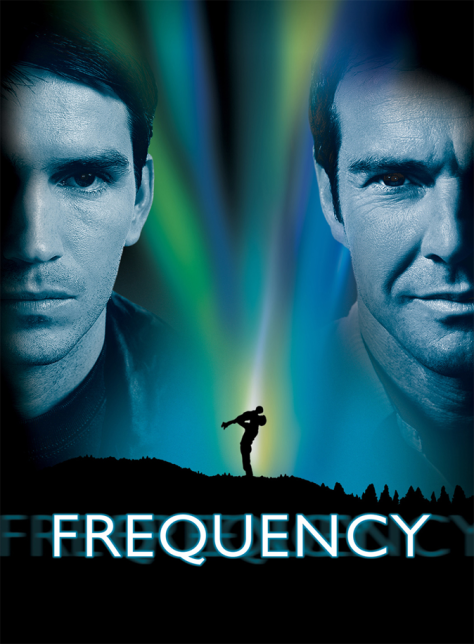
movie: Frequency (2000)

Another firefighter flick. (I can’t remember where I got this list.)

As the movie opens, Dennis Quaid is a hunky firefighter, Frank, in 1960s Queens. He has a good marriage with Julia, and a six-year-old son, John. Flash-forward some 30 years, and John (Jim Caviezel) has grown up to be a cop. He’s close to his mother. They both mourn his long-dead father.

Until the return of the rare (especially in NYC) aurora borealis, which shows up in both 1969 and 1999, coinciding with adult John’s discovery of his father’s old HAM radio. In a sci-fi twist, this allows Frank and adult John to talk to each other across the years. (There is mention of string theory and multiple dimensions to lend this mystery a touch of possibility.) It takes a bit of convincing, especially for Frank, to believe what’s happening, but the play-by-play John is able to give of the 1969 World Series (the Amazing Mets) clinches it. (That World Series will continue to signify throughout the movie.) You can guess what comes next: John is able to warn his father about the warehouse fire in which the latter dies. Now he doesn’t die. Hooray! Except… cue the butterfly effect.

Frank’s survival gives John a whole new set of memories in which his father was there for his adolescence and young adulthood. He’s kept the other memories, too: “I remember both. At the same time. It’s like waking up from a dream and you’re not sure what’s real. I remember you being here, but I also remember when you weren’t.” And now, of course, things start changing in John’s present. His girlfriend doesn’t know him. His mother is not at the phone number he has for her. John the homicide detective gets a new case that matches an old case, and the news just keeps getting worse. He and Frank, across the years and via nightly talks on the HAM radio, undertake to catch a serial killer, but as Frank points out, he’s a firefighter, not a cop. It’s possible that whatever they try will make things worse.

This movie is kind of sappy, but I quite loved it. Seeing the father and the son be open and emotional with each other was darling, actually, even if a bit cheesy. Frequency‘s plot is not unfamiliar (think elements of Back to the Future, Sixth Sense, Ghost, It’s a Wonderful Life), and it uses some fairly transparent tools to manipulate my emotions, but I’m here for it: with a little willing suspension of disbelief, the tension was convincing, and the plot twists intriguing. There’s a bad guy, and there are a couple of clear good guys, and enough disturbance to put them in danger along the way. Most importantly, there are compelling relationships, and maybe that’s key to my enjoyment here. I found a user review on IMDB that says it perfectly: “There have certainly been better action/suspense/serial killer movies (the action scenes weren’t amazing, the story has some holes, and I thought the ending was a little cheesy), but the heart of the film is the relationship between Frank and John. I bought into that relationship fully, and that’s why I liked this film as much as I did.” Well put, UnclePaul.

Solidly worth the time. Also Dennis Quaid is hunky.


Rating: 7 cigarettes.

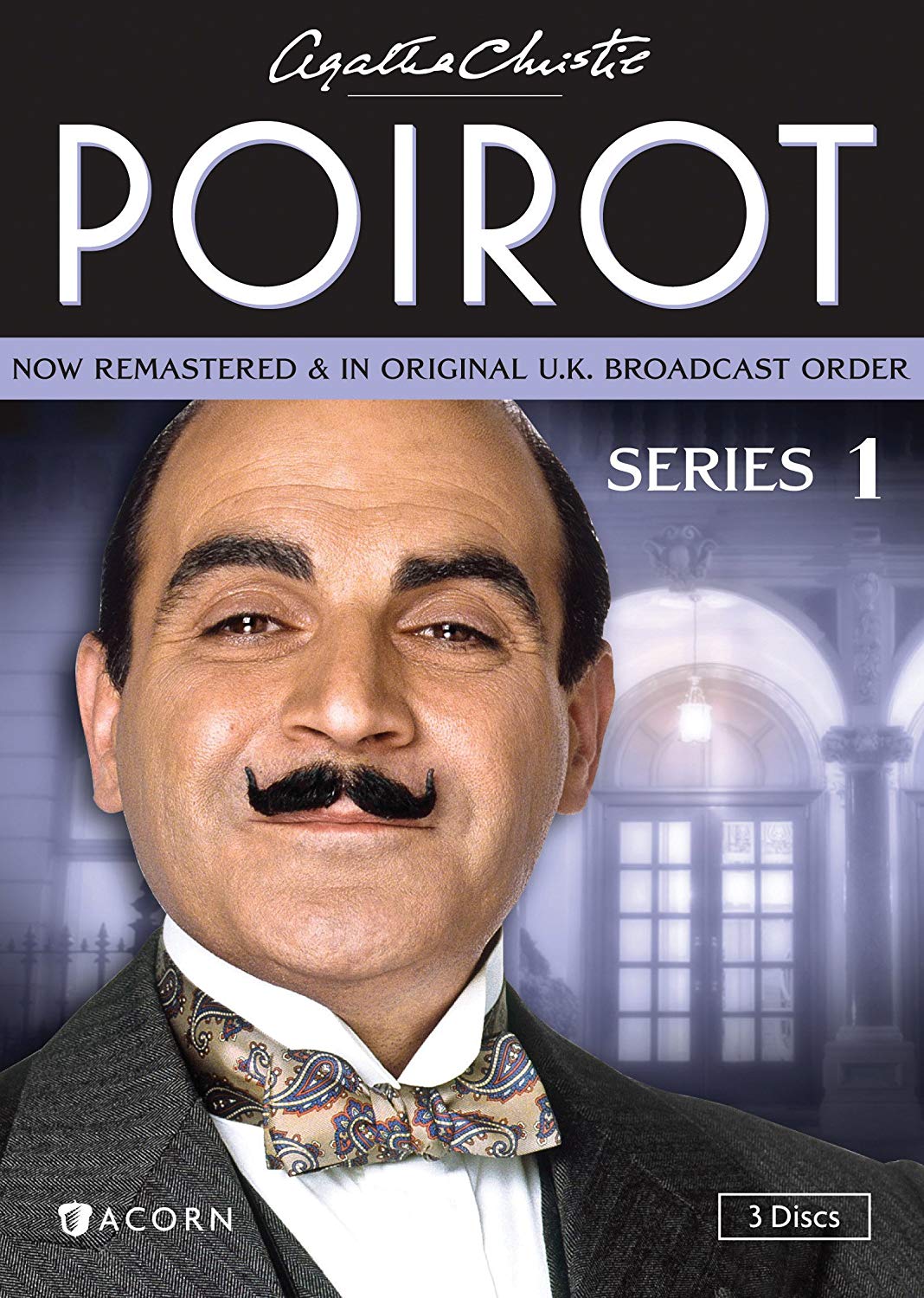
television: Agatha Christie’s Poirot

I have been thinking, again, about some wonderful memories that have helped to shape me. For starters, please go revisit this post, as I think about what a precious gift my Grammy gave me when she took me to see my first live Shakespeare production at a beautiful theatre in San Diego when I was ten. And just now, I’ve been remembering watching Poirot, perhaps Agatha Christie’s best-known detective, when I was a little girl with my mother. I recall vividly the art-deco entry sequence. I loved this show.

In my memory, this was an old show, but I see now that it began in 1987, when I was five years old. So by the time I was watching it it was not new releases, but still pretty recent. Well, I’ve just rediscovered the series thanks to a few different channels on Amazon Prime. There are now thirteen seasons, and thank goodness, because I can’t get enough.

The early seasons are what I remember from childhood. The tone is fairly lighthearted; the audience is invited to laugh gently at Poirot, who takes himself too seriously, and who is accompanied by the variously comic Miss Lemon (with her ridiculous hairstyle and her lovable passion for filing), Captain Hastings (“I say!”), and Scotland Yard’s over-serious Inspector Japp. This is the cast of characters I loved so much as a child, and I find them as remembered, but with more depth and nuance now that I’m a few years older. (Or maybe my memory just got vague.) It goes without saying that Poirot himself is played by David Suchet, my first Poirot and the only one I recognize; I have since encountered other iterations and they are all offensively wrong for the role in my eyes. What can I say; I’m loyal to my first experience? but I really think he is the portrayer. I am not alone. “Agatha Christie never saw David Suchet in the role but her grandson Mathew has commented: ‘Personally, I regret very much that she never saw David Suchet. I think that visually he is much the most convincing and perhaps he manages to convey to the viewer just enough of the irritation that we always associate with the perfectionist, to be convincing!'” (source)

note the twinkle in the eye and the little smile

I am sorry to say that after season eight, Miss Lemon, Captain Hastings, and Inspector Japp mysteriously disappear on us. Poirot is rather more alone from here, although he does gain (in season ten) a new butler, George, and a new friend, Ariadne Oliver, an irreverent mystery novelist who is always, always eating an apple. While Mrs. Oliver is good for a laugh or two, George does not provide much comic relief; neither of them replaces the original trio. The overall tone of the show has gotten less light, too. It feels a little bit, to me, as if the show has taken a step toward taking Poirot as seriously as he takes himself. I think the loss of tongue-in-cheek humor hurts. I love a good dark, grim, gritty mystery as much as anyone does, but having loved a slightly ridiculous Poirot I am less enamored of the darkly serious one. It is also somewhere in here that his Catholicism begins to play a role. I may misremember, but I feel like he used to be cynical about religion; now he is devout, always whispering over his beads. It’s not bad, but it’s different, and if my love for Poirot is much about nostalgia, I don’t like having my original version messed with.

we are getting more serious now

I’m very glad it keeps going, though. By the time I got to Murder on the Orient Express, near the end of season twelve, I was marveling at what wonderful storytelling Christie’s original was, for one thing, and at how glad I am to have this cinematic telling. The Catholicism is big in this one, and the darkness. Atmosphere, and the snowed-in backdrop, are very effectively done. It’s a grand story that I feel I’ve seen and read and heard in several formats by now, and this version does the whole thing justice. I’m so glad this production exists in the world; I feel lucky.

I am impressed to read that Suchet has played the entire Poirot canon by now! and “only slightly short of the target he had set himself of completing the entire canon before his 65th birthday.” (I’m using Wikipedia as a source; original interview here.) But I have the usual feeling of impending loss, as I finish season twelve and face the approaching end. Thank goodness there are so many stories in the world, yes? I hear Bosch is returning for a sixth season this spring…


Rating: 8 little gray cells, obviously.

I guess I rate television shows now too. What the heck.