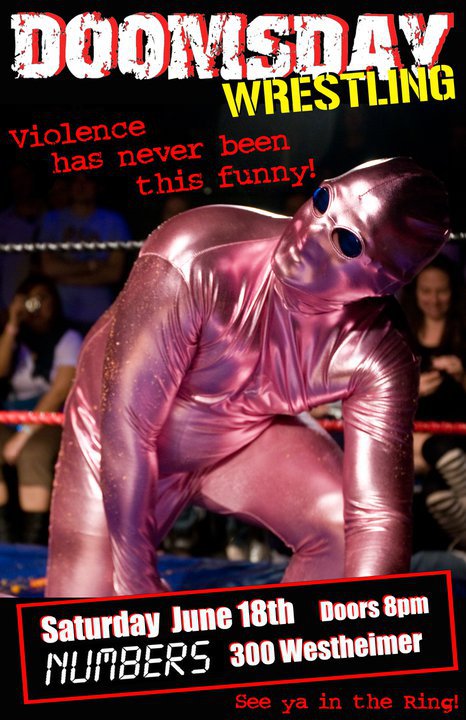
Doomsday Wrestling

Husband was out of town for the last Doomsday Wrestling event (the Spaghetti Supper Spectacular, back in March), which I attended with a friend (hi, Leach) in his absence. It was such a blast that he was very excited to escort me this time around.

These shows are a riot, I tell you. Doomsday Wrestling is a local (Houston) wrestling troupe, putting on shows sort of like your WWE pay-per-view events – except that these guys take themselves even less seriously. There is a heavier emphasis on comedy and a lighter emphasis on wrestling. There’s even a literary connection: I originally learned about the genius of Doomsday from a librarian friend, whose partner is a wrestler.

It’s pure fun. If you were ever a fan of televised wrestling (the funny costumed kind, not the truly athletic kind – that’s important), you will love this silliness. There are full-on, developed characters, with personalities, costumes, histories, relationships, and hopes & ambitions just like the rest of us. There’s a full-on story-line, just like at the WWE, with all the same soap-opera-style twists. But this is BETTER than the WWE, because it’s cheaper, it’s local, and you can get right up close to these guys and gals. You can even get a glossy 8×10 for them to sign, and take pictures with them and everything. Librarian-friend tells me her man gets recognized out on the town. How fun is that?

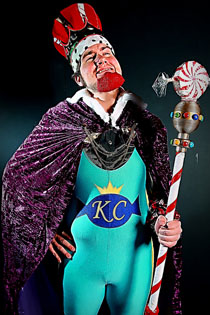
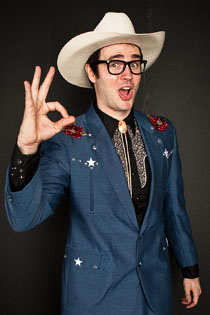
Look out for such crazy personalities as Lady Rabies, who foams at the mouth while in the ring, Lil Dickens, the amiable King Candy, and one of my very favorites, Hot Flash.

Lady Rabies

Lil Dickens

King Candy

Hot Flash

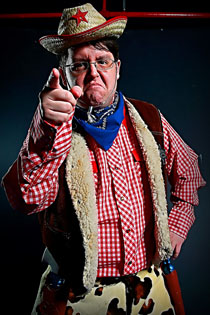
And don’t forget my favorite announcer, Tex Lonestar.

Tex Lonestar


Seriously, this is funny & fun stuff. Husband & I had a blast and feel sorry it’ll be so long til the next one!

hemingWay of the Day: author insults

Thanks to Shelf Awareness for this interesting item today.

Recently, Flavorwire gave us The 30 Harshest Author-on-Author Insults in History. It might be worth your time to go check them all out, but I had to share with you a few of my favorites.

Numbers 15 and 14 are a back-and-forth:

15. William Faulkner on Ernest Hemingway:
“He has never been known to use a word that might send a reader to the dictionary.”

14. Ernest Hemingway on William Faulkner:
“Poor Faulkner. Does he really think big emotions come from big words?”

…to which I give an lol. My meager attempt to appreciate Faulkner was pathetic, but I blame him entirely – or maybe my choice to try The Sound and the Fury first, I don’t know. I *may* give him another try someday. If I do, it will definitely be a different title. It should go without saying that I side with Hemingway on this one, in terms of the end-result-value of their work – although it is also true, I have never used a dictionary in my readings of Hem. (I do use a dictionary when I read sometimes, though.)

I also liked this one:

9. Truman Capote on Jack Kerouac:
“That’s not writing, that’s typing.”

I think this is in the same spirit as #15, above. And again, I loved On the Road and so disagree; but the witty jab makes me smile, all the same.

There are some other clever ones there, too. I encourage you to go poke around and tell me, which ones made you smile? Or get angry? Or feel justified?

ALL the Lee Child books! or, reading series in order. or, who’s your favorite?

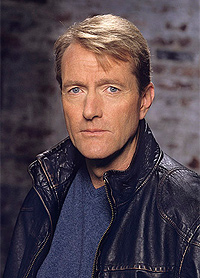
I’m not going to call it a “challenge” or anything, it’s just something I’m going to do, someday. Having finally caught up and read ALL the Michael Connelly books – for years my favorite genre author – I immediately fell off again, when he published The Fifth Witness. I have yet to read it. I’m content knowing it’s out there, and I’ll get around to it. For that matter, it will be out in paperback soon, all the better. I have a new genre man, and his name is Lee Child.

photo credit: his website

I’ve read 9 of his books in the last 8 months or so, and I’ve been raving about him, as I’m sure you’ve noticed. So I’ve decided that clearly he’s my next conquest: I’m going to read them all. I even got on his very nice, helpful website and found a nice checklist – isn’t he clever? (Or perhaps, his marketing team?) So now I know what I’m looking for, and even in what order.

Which brings up another point. Do you read series in order? I have a number of patrons who are paralyzed by the need to read series in order. If a certain book is checked out or unavailable, it halts their reading. I’ve never been one of those people. I read all the Connelly novels, and there’s a good chance, nary a one in the order intended. And that was fine with me. I haven’t been paying any attention to order with the Lee Child books, either, although I’m happy to know and all things being equal, will aim for chronological correctness. I just don’t feel strongly enough to go well out of my way, though. I find the character development over a series to be equally fascinating when viewed out of sequence. That way, I’m viewing the author’s artistry, as well as the fictional character’s growth. As a point of interest, you might notice that Child recommends that his books be read in the sequence in which they were written, which actually puts their timeline out of order. In other words, the 8th book he wrote in the Jack Reacher series is set well before the first. Interesting.

I’m in no hurry, I’m setting no timeline, and I’m not firm on the sequence; but I do know I want to read ALL these books. (It doesn’t hurt that the Husband enjoys these books, too!) Maybe next year it will be someone different – maybe a nonfiction author like Janet Malcolm or Erik Larson. Who knows? There are so many good authors out there, and we don’t always get around to reading a whole lot or all of their work as we might mean to when we first discover their talents. Sort of like Amy’s comment about taking Agatha Christie for granted. I know you can sympathize with me here! Who have you always wanted to read more of?

And what Lee Child will cross my desk next??

vocabulary lessons: The Devil in the White City

It’s time for more vocabulary lessons! The Devil in the White City offered a wealth of learning opportunities for me.

A shot tower is “a tower designed for the production of shot balls by freefall of molten lead, which is then caught in a water basin.” It’s used in a list of miscellaneous structures in a discussion of the design of the fairgrounds.

Virga is “an observable streak or shaft of precipitation that falls from a cloud but evaporates before reaching the ground,” as in “strong gusts of wind buffeted the train, and ghostly virga of ice followed it through the night” (page 78).

Grip-cars are defined in the book itself: they get their name “for the way their operators attached them to an ever-running cable under the street” (page 13). How interesting; I didn’t know about this kind of streetcar, and I looked for a picture:

(thanks to these guys for the photo.)

According to context clues (it’s used several times), I concluded that an alienist must be a period term for psychologist, and it looks like I was right.

And here’s one I really like: a sirocco is “a Mediterranean wind that comes from the Sahara and reaches hurricane speeds in North Africa and Southern Europe.” It’s used on page 113: “In the hearth at the north wall a large fire cracked and lisped, flushing the room with a dry sirocco that caused frozen skin to tingle.” What a neat word for such a specific concept.

Some of these felt vaguely like a review; but I still had to look up calumny: “a misrepresentation intended to harm another’s reputation” and meretricious: “tawdrily and falsely attractive.”

Mucid was entirely new to me, but creepily appropriate, almost an onomatopoeia. It means “Musty; moldy; slimy; mucous.”

In addition, I looked up a number of names, of celebrities of the times. Some I knew and needed to know better; some were unknown to me.

This book was rich with vocabulary-learning opportunities. Have you learned anything new from your reading lately?

please share an opinion: deckled edges

I’ll begin with some educational resources in case we’re not all up to speed.

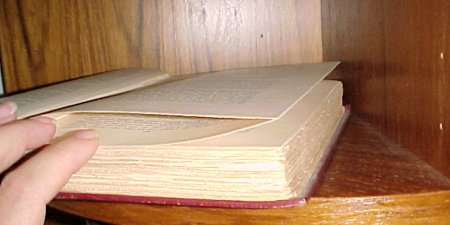
According to Merriam-Webster Online, a deckled edge is “the rough untrimmed edge of paper left by a deckle or produced artificially.” Way to use the word in its own definition, Merriam-Webster. There was a time in printing when a book would be printed on a long roll of paper which was then folded over and bound, leaving some pages folded closed, thusly:

The reader would then use a paper knife to cut the pages to read the book, leaving the pages rough and jagged-like.

Today, we mostly don’t make books like this any more. (I say “mostly” because surely there’s an obscure little press somewhere… who knows.) But many books, especially when they’re trying to be arty, are being machine-made with “deckled edges.” This mimics a historic printing method, presumably making the reader feel she’s been transported to another era.

Now, there are plenty of discussions of this method and its virtue as art or its flaw as pretension. I don’t have a horse in that race. I’m not impressed by the art or offended by the pretension. Well, I guess if you pressed me, I’d say new things made to look old are a little silly in many cases. But that’s not my gripe.

My gripe is with utility. I’m a booklover, but I love them for what’s inside them, not so much for the container. I mean, I DO love books – books themselves – I’m not going to be an e-reader convert anytime soon! But to me a book is a book: mainly a vehicle to get those words inside my head. And the deckled edges make it difficult to turn pages and difficult to turn back to a specific page I have in my notes. This is getting between my head and those words! I am frustrated! Please, no more deckled edges!

(This rant has been fermenting inside my head for I don’t know how long, but this post was finally stirred up by the two paperback copies of Zora Neale Hurston’s Their Eyes Were Watching God I had to choose between. One had underlining and margin notes. The other had deckled edges [and was otherwise beautiful]. What to do? What to do? What would YOU have done?)

Does anybody else have a frustration with this? Or, do I blaspheme? Please emote. (And vote in my poll.)

reading, or writing, swimmingly

Yum, yum! I love it! Flavorwire gives us Literary Greats In Their Bathing Suits! Go take a look if you like authors OR the beach. My personal favorites, of course, are Hem (no, not looking too sexy in this picture but I’m still excited) and the Fitzgeralds – but also, did you know Hunter S. Thompson looked so good in a bathing suit?? Who’s your favorite?

guest review: movie: Midnight in Paris, from Mom (2011)


A new guest reviewer! I asked my mother to share her thoughts about the movie we saw together, initially thinking she could help me develop my own review; but I think she merits her own post here.

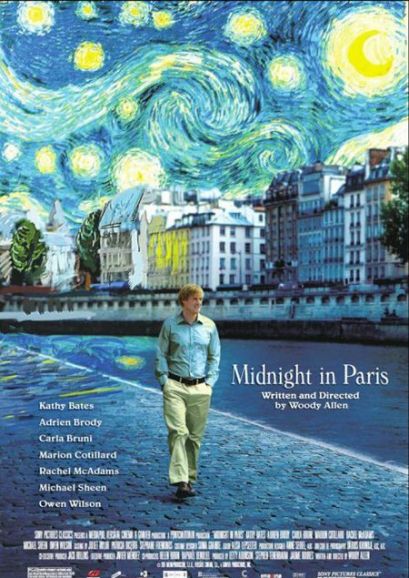
Paris is sweet and softly lit in the late hours of the 1920’s, but the hard truth of the present is clear. The plot of Midnight in Paris concerns a trip to Paris by our hero with his fiancé and her parents – a family of snobby rich American tourists who don’t like Paris most of the time – like when it rains – and focus mostly on shopping. The story has our hack Hollywood writer dreaming of the pure Paris artistic air and following the path of Hemingway or Fitzgerald. He wanders the streets at midnight, and gets in a taxi to the twenties.

Woody Allen’s twenties Paris is a spectacle. It’s a fun romp, and adorable. What fun it must be to put together the words of the great Americans who were there in the bars and Gertrude Stein’s salon. He throws out the lines and the audience laps it up, especially the fun poked at Papa.* We share the lives of these artists who didn’t know where they were going, didn’t know that they lived in the Golden Age, and it’s our lovely secret. It’s also the secret of our hero, who is clearly the alternative Woody Allen. He tries to milk his opportunities, getting advice from Stein, schmoozing with the Fitzgeralds, and romancing Picasso’s girl. He even considers staying, but we’re a bit hopeful that he might grow up.

Salvador Dali is a grand character, super-mustachioed and enigmatic. Hemingway is larger than life – but isn’t that what he really was? Cole Porter appears, and Zelda and Scott Fitzgerald are all that they must have been, gay, charming, and ready to dash off at a whim, probably into the abyss. Luis Buñuel gets a film concept from his own future, through our hero/fan. Gertrude Stein rules her salon and there is no doubt that she’s the regent.

It was never going to work out for the couple, and if this is a spoiler, you’re missing the gorilla in the bedroom. It’s a little silly that this innocent was ever attracted to the scolding fiancé we see. The plot is obvious, but we’re here for the fun. Paris is every artist’s dream and muse; we love those dreamers who sucked up life when it was at its best. There’s a carpe diem moral here, and idealism waiting to be tested. Also just good looking.

*I think this is a poke at me, too. I was eating up Papa’s lines – yes ridiculous, but true to life! I may take him too seriously. 🙂

Thanks Mom, you did it beautifully.

Dewey vs. the card catalog

I just need to interrupt our regularly scheduled programming to clear up what appears to be a common misconception.

I have this shirt.

Pretty rad, right? It totally draws conversation, and has resulted in me meeting a few very cool fellow librarians when out on the town, too. (Hi, Rob & Shannon!) But it also tends to expose people’s misunderstandings about what’s pictured there.

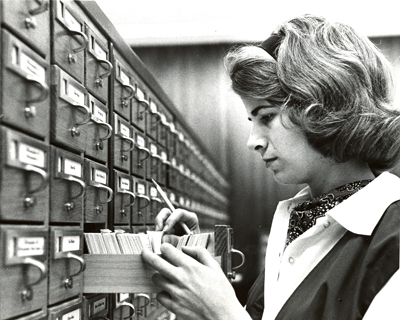
The picture in that image above is of a card catalog, y’all. It’s a card filing system, and it contains (or contained) cards, on which were printed information about items in a library’s collection. The joke on the t-shirt – “never forget” – is a reference to the fact that card catalogs are pretty much dead. Gone. We now have electronic catalogs that have the same library function: to find what books we have by title, author, and more bibliographic attributes, as well as by subject. Card catalogs. Gone.

But I keep hearing people mention Dewey when they see this shirt. There is no Dewey on this shirt, folks. Let me help.

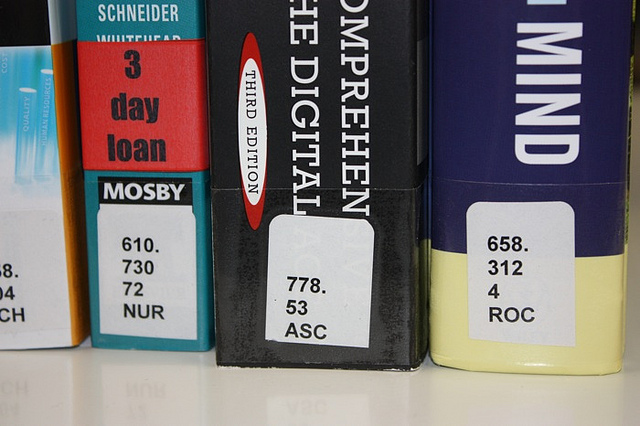
The Dewey decimal system is a classification system, meaning a way of classifying books (or other items) by subject, and coding subjects, in this case, by a series of numbers. We group books together by subject, so that if you find the one book you want, you can find a bunch of other similar books parked next to it on the shelf. In this way, 796.63 stands for “Mountain biking (All-terrain cycling).” 636.76 stands for toy dogs, including the chihuahua. This classification system does not need cards, or a card catalog. It is alive and well in many libraries today, including the one I work in. We use an electronic catalog, not a card catalog, but Dewey, all the same. My books on true crime [homicide] sit happily together at 364.152. Right now. Dewey. Not Gone.

See the difference?

If your eyes aren’t glazed over yet, I’ll tell you that when I couldn’t find a print copy anywhere of Irrepressible Reformer: a biography of Melvil Dewey, I started reading it through Google Books. (This book’s Dewey number, by the way, is 020.92. You’re welcome.) I didn’t get to finish, because Google Books offers only a preview, which turned out to be something like 100 pages, if memory serves. But I read enough to tell you that Dewey, creator of the system, was a fascinating character. He was a reformer and an innovator of a number of systems, not only classification of books but library practices generally, the metric system, spelling, higher education, and library schools. He’s also a pretty controversial figure, having used very questionable business practices and even in the most generous of light, taken advantage of his benefactors. (For example, he set up various organizations and bureaus in pursuit of his various causes, but they all shared one money pool, so that donors to one cause often ended up funding an entirely different one.) As part of his crusade for simplified spellings (thru for through, etc.), he changed his name from Melville Louis Dewey to Melvil Dui. That Melvil was an interesting guy.

All right, hope you’re still with me. Let’s review. Card catalog:

A physical thing. Large. Heavy. Cumbersome. Mostly dead and gone. [Also, I want to own one of these very badly.]

Dewey:

A system of categorizing and organizing books. The catalog that leads a person to a book using Dewey can be electronic, and today, almost certainly is. Not dead and gone. [Although if you tempt me I may tell you about the Library of Congress‘s alternative classification system…]

movie: Midnight in Paris (2011)

EDIT: You can check out my mother’s review too here.


I saw this one weeks ago; I don’t know what’s taken me so long. Maybe I was up too far past my bedtime in order to see it, and lost it in my dreams. It was a lovely night out with my mother (while Pops is off traveling the world) and a really delightful movie; we both enjoyed it very much.

You’ve heard of this one. It’s the Woody Allen movie in which Owen Wilson takes on the Woody-role, a young man named Gil, traveling in Paris on business, who wants to sink into 1920’s Paris and finally write his novel. His materialistic and unsympathetic (in both senses) fiancé, Inez, thinks this is ridiculous; she wants him to hurry up and get back to making oodles of money writing the Hollywood scripts that he feels are soul-killing. Amid his dreaming about the perfection of interwar Paris, with its meeting of literary and artistic minds, Gil finds himself actually transported there via vintage Peugeot. He plays and parties with Hemingway and the Fitzgeralds, gets his manuscript reviewed by Gertrude Stein, and takes on Pablo Picasso as a romantic competitor – among a flurry of other storybook meetings.

Corey Stoll as Hemingway

I bet you can guess what got me in the door for this one. That’s right, Hemingway. I’m so easy. 🙂 Really, though, it was a remarkable little journey through time and space. The introductions to various famous artists were thrilling; the romantic mood was dreamy. After putting in our time with the obnoxious fiancé, we get to see Gil find romantic satisfaction in the end – it’s a classic romantic comedy in that sense, but it’s so much more. It’s a poignant statement about nostalgia, with each generation or era longing for another. And it’s a charming jaunt, a who’s who of 1920’s artists. For me, it was something of a wake-up call, too, to the fact that my knowledge of this era is built around my Hemingway obsession: I knew the famous names more or less only as they relate to Papa, sigh. I should be better educated. Oh, and I thought the Fitzgeralds were rendered very truthfully (to the best of my knowledge) and really very charmingly, in their own insane and endearing way.

Overall a dreamy and very pleasant adventure. If more movies made me feel this way, I would go to more movies.

Texas

Katie’s post last week really grabbed me. She wrote about her relationship with her home state of Texas: the love, the shame, the pride, what she does and doesn’t miss. I identified so strongly with her feelings that I wanted to share, too. I won’t try to top her very poetic tribute, but I will give a different perspective on my home environment than I did a few months ago.


I’ve lived in Houston, Texas all my life. I take pride and interest in being a somewhat unique creature: both a Southern, and a big-city girl. I have tried to leave a few times but never made the leap, and part of me still really wants to. (For one thing, I feel like we should probably all leave our hometowns at some point, in the interest of personal growth.) But Houston would be hard to top: I’d want another very big, very international city, along the lines of New York City, London, Athens, San Francisco, or Amsterdam, but each of these comes with a cost of living several times that of my hometown. Plus, the miserable, unbearable, humid Houston heat is what I’m acclimated to; colder winters than ours (which would be most of them) terrify me. And all of this times-two, because Husband is also a native Houstonian, who’s never left, and he’s even older and has deeper roots.

I didn’t come to this comfort with my home naturally or without some struggle, though. In high school all I could think of was getting out. (This is a typical symptom of being in high school, I think.) I was so sure that I wanted to leave Houston, and Texas. I shopped colleges all over the country. During this time I had an interesting experience: I was in Mexico with a group of kids from all over, and had asked to borrow something from a girl not from Texas that she didn’t have on hand. I said “thanks anyway,” to which she snapped, “you don’t have to be nasty about it. I just don’t have one.” I was shocked because I really meant… thanks anyway; thanks for checking; no worries. This tiny little moment opened my eyes to the idea that maybe there was something to this “Southern manners” concept. It was just a little thing, but in my 17-year-old mind it made an impression. For various reasons I ended up going to the University of Houston, and by the time I graduated I had no thoughts of leaving.

Several years later, when I got ready to go to grad school, I shopped schools, and places to live, again. This was, if anything, an even more enlightening process, probably because I was a few years older with a fuller sense of myself and what I wanted from the world. I had done some traveling all over the country, and had decided I definitely like a Southern pace and sensibility. The Pacific Northwest and New England are lovely places to visit, but I couldn’t imagine them ever feeling like home. Plus, the cold! I was all settled on North Carolina when, oops, I got engaged (not to mention changing my degree plan) and stayed in Houston, again.

I still get frustrated. It’s literally 100 degrees outside as often as not right now, and the humidity is often over 80%. You will absolutely sweat between the house and the car. On work days, I get up to ride my bicycle before the sun comes up, so I don’t have to do it in the evenings. As a cyclist, this city can be frustrating; urban sprawl, car culture, climate, and drivers’ inexperience with cyclists conspire to make it a deathtrap. And as a mountain biker, I’m thankful for the awesome trails all over this state, but also well aware of the superior options in many, many other locations. (We have a subscription to Bike magazine, which is a constant tease. On the other hand, we can plan vacations around their annual Trails issue…) And Katie was right-on when she referenced the religion-politics axis. For those who don’t know, Houston is a blue (Dem) city in a red (Rep) state, and my politics float left of blue. There are probably friendlier places for me, idealogically.

But being aware of shortcomings doesn’t mean you can’t still feel love. If I’ve had a complicated relationship with Houston, and Texas, over the years, is it possible that makes my love more complex and deeply felt? Because I love that we can ride bikes here year-round, and wear t-shirts on Christmas morning pretty regularly. I prefer to keep snow a novelty, thanks very much (hi Katie, definitely true here too!). I love it when the Husband’s mild southern accent sneaks out, and I guess the Drive-by Truckers are one of my favorite bands because they sing about “the duality of the Southern thang.” In other words, yes, we birthed the Bushes. Sorry, world. Some wrongs have been done in the South, but I’m not sure we have the world monopoly on racism, segregation, hate, or violence – or even ignorance. Let me borrow some more Truckers lyrics: “You know racism is a worldwide problem and has been since the beginning of recorded history, and it ain’t just white and black, either. But thanks to George Wallace, it’s always a little more convenient to play it with a Southern accent.”

Unlike Katie, I haven’t left yet, although I’d still like to. If and when I do, though, I may very well end up coming back. I can’t imagine anywhere else becoming truly home. If it does, it might have to be the Carolinas or Tennessee. Like Katie, I do say y’all, and I expect I always will. I don’t wear cowboy boots but I can appreciate them on my buddy Jimmy. I adore Mexican food, and I just don’t believe I could get it in Oregon the way I can here. It may not be perfect, but this is my home, and I’m proud of it.