Ireland: final days in Dublin

(Days 1-3 here; day 4 here; days 5-7 here; days 7-8 here)


We drove into Dublin on day eight, Friday night, which was also Good Friday. PSA: They don’t sell alcohol in Dublin on Christmas Day or Good Friday. This was a significant piece of information to have missed, since pubs were pretty much the reason we were interested in the city of Dublin. I was frustrated. Let’s move on to day nine, shall we?

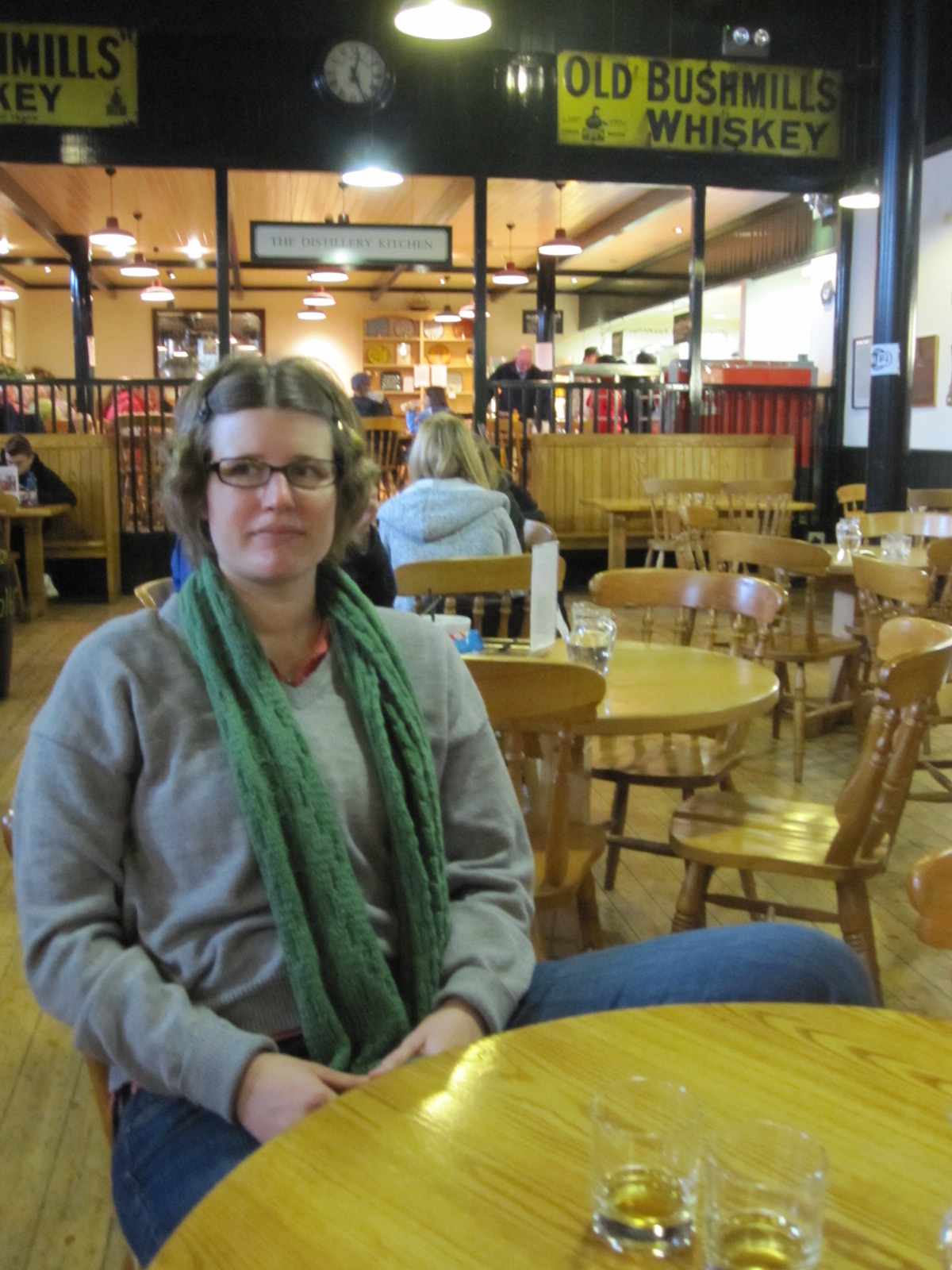
Day nine: Saturday morning. Breakfast at the Queen of Tarts (yum!) before heading out to the Guinness Storehouse. This is the longtime site of Guinness brewing in Dublin, and the adjoining property still brews beer; the Storehouse itself, where the public can buy tours, is no longer a working brewery, but a museum of brewing and (more so) of Guinness the brand. This was not entirely what I had in mind going in; perhaps in a different state of mind I would have been more interested in the museum setting, but at this point we were not sure we were actually going to get the full day in Dublin (for reasons relating to our flight arrangements) and having missed out on any chance to drink on “Dry Friday” the night before, I was frustrated. We drank our pint of Guinness, toured around some, and headed out to probably my favorite pub of the trip: the historic Brazen Head, oldest pub in Dublin, attached to the old city wall; Barrett tells me this is one of the pubs (just outside the wall) that used to lodge those travelers who hadn’t made it in before the gates closed (or those foreigners not allowed in). A lovely place. We saw a few pubs and took a nap before the evening’s big event:

the Dublin Literary Pub Crawl. Barrett had been on it before but liked it enough to repeat with us, especially considering my literary inclinations. It turned out to be perhaps a little drier and more literary than Husband was promised but he maintained his good spirits. This crawl is led by actors who perform selections from the great works (ahem Ulysses) and sing songs as well as imparting local lore and showing us around local landmarks (Trinity College) as well as pubs. I haven’t actually read much of the big Irish names, so it was less a familiar review of literary knowledge for me than it might have been, but still it was a good time. And as a bonus, towards the end we made friends with a German couple and an English one, and stayed out too late for our early morning flight the next day… whew! Home on Easter Sunday to prep for the week to come.

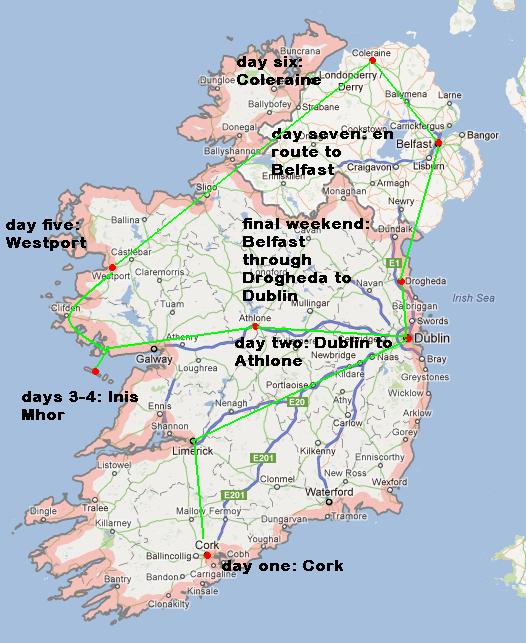
I made a map to indicate our travels


Weather-wise, we were so very lucky! We saw more sun than anything else; minimal precipitation, and what we did see was fleeting and light, more a novelty than an annoyance.

Highlights:
Oh boy! Inis Mhor in general… Westport as a town… Dunluce Castle… Belfast taxi tour of the murals… Saturday night in Dublin. Good times with good old friends and loved ones. Coming home to our little dogs.

Here’s hoping you make it to Ireland soon, too!

Ireland: days 7-8

(Days 1-3 here; day 4 here; days 5-7 here)


Ahem, continuing day seven: after finishing up at the Giant’s Causeway, it was getting lateish and we headed into Belfast for the evening, centering around the historic Crown Bar (or Crown Liquor Saloon), a CAMRA pub and masterpiece of ornate, garish Victorian decor – it’s almost a bit much, but it’s authentic. They still light the place with gas, even. We got our own little “snug” (like a booth with a door that closes so you can plot against the Brits) after a very good dinner upstairs at their dining room. We closed down the Crown and then the later-closing bar next door and then the latest-closing bar at our hotel, making for a successful evening.

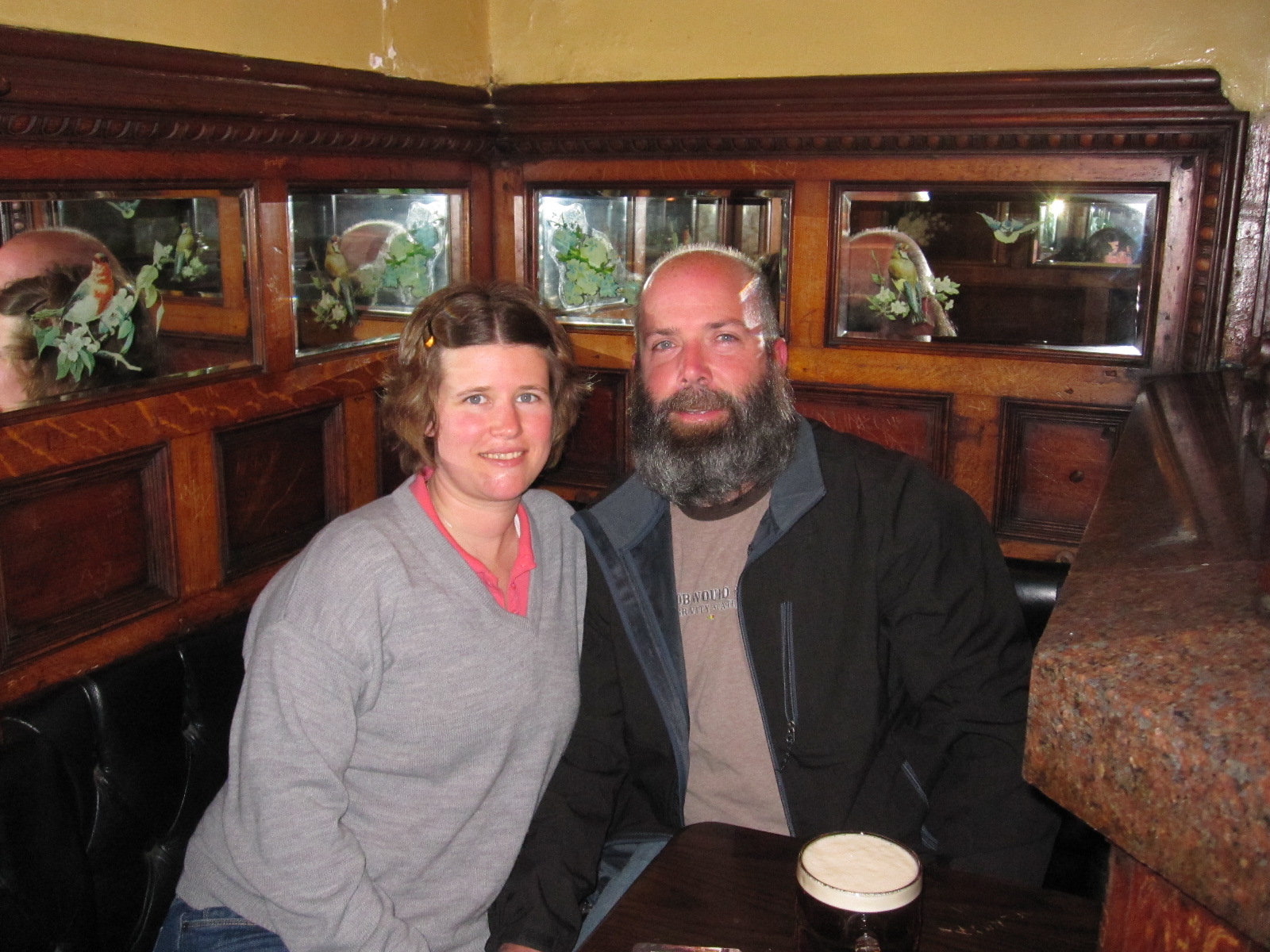
in our snug at the Crown


Day eight, is it now? Which makes it a Friday again. We wake in Belfast and begin by chasing the Titanic, whose 100th anniversary calls for a full-on festival in this city that built and launched the doomed ship. Titanic festivities turn out to be expensive and sold out, but we view the area before chasing down one of the “black taxi tours” of the political murals that we’ve been told about. These murals were most prevalent in the 1980’s during the “troubles” (which I still find to be an odd and understated euphemism), and our cabbie John estimates only 20% remain today, but that was still lots of them. Barrett first vetted cabbies until he found one sufficiently middle-aged, native, and informed, and we spent a few hours driving around with him, viewing murals, hearing his (plentiful and fascinating and heartwrenching) stories, and generally interviewing him on the political turmoil of Northern Ireland from the 80’s through the present. Thanks, John, for one of the real treats of our whole week; you really brought Belfast to life. Most visceral, perhaps, was the still-standing wall at the “Peace Line” (or lane, I never was sure) where they used to lock down at night to keep the Catholic and Protestant neighborhoods safely segregated.

at the Peace Line (l-r): John, Barrett, me


We had a roadside picnic lunch on our drive down into Dublin.

meat. cheese. mustard. bread. strawberries. beer!


The next stop was in the town of Drogheda, where Husband’s maternal roots are based – going back a number of generations, yes, but the family name is recognizably… Droghedian? We wanted to get a picture of him at a city limit sign, at least, and ended up enjoying a walk through the main drag of this quaint, historic, larger-than-expected town dominated (it seemed) by shops selling either meats or sweets. Present company approved. 🙂

And Dublin gets its own post. Stay tuned!

Ireland: days 5-7

(Days 1-3 here; day 4 here)


Day five: back to the airport, the mainland, and our rented car.

Final glimpse


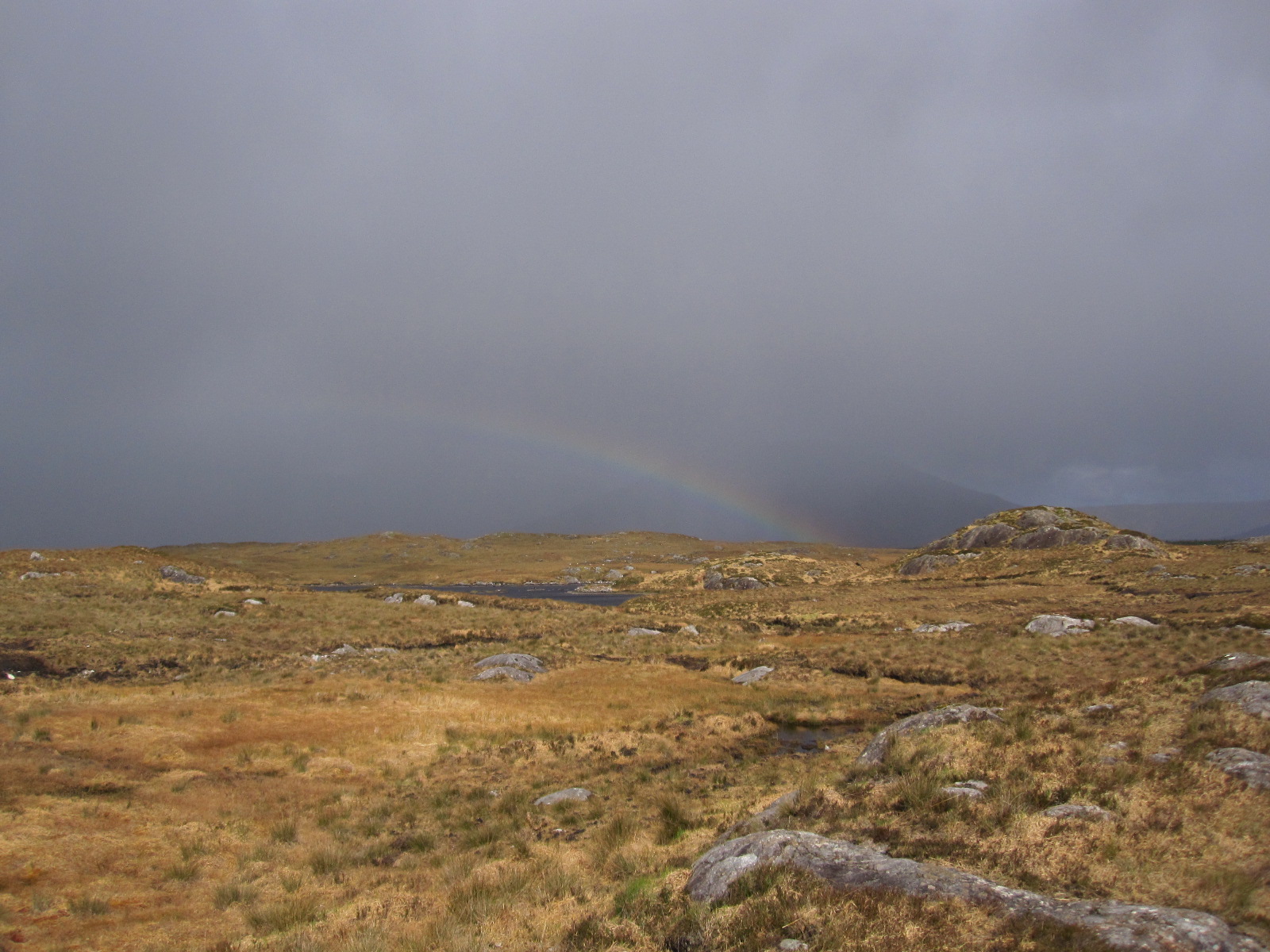
We were headed north, with Northern Ireland our ultimate goal but some time to play around with in the short term. This was our loveliest drive: we saw strange veils of mist, light rain, heavy rain, sleet, bright sunshine, and a rainbow, all for periods of five minutes at a time and quickly shifting; and the scenery was to die for.


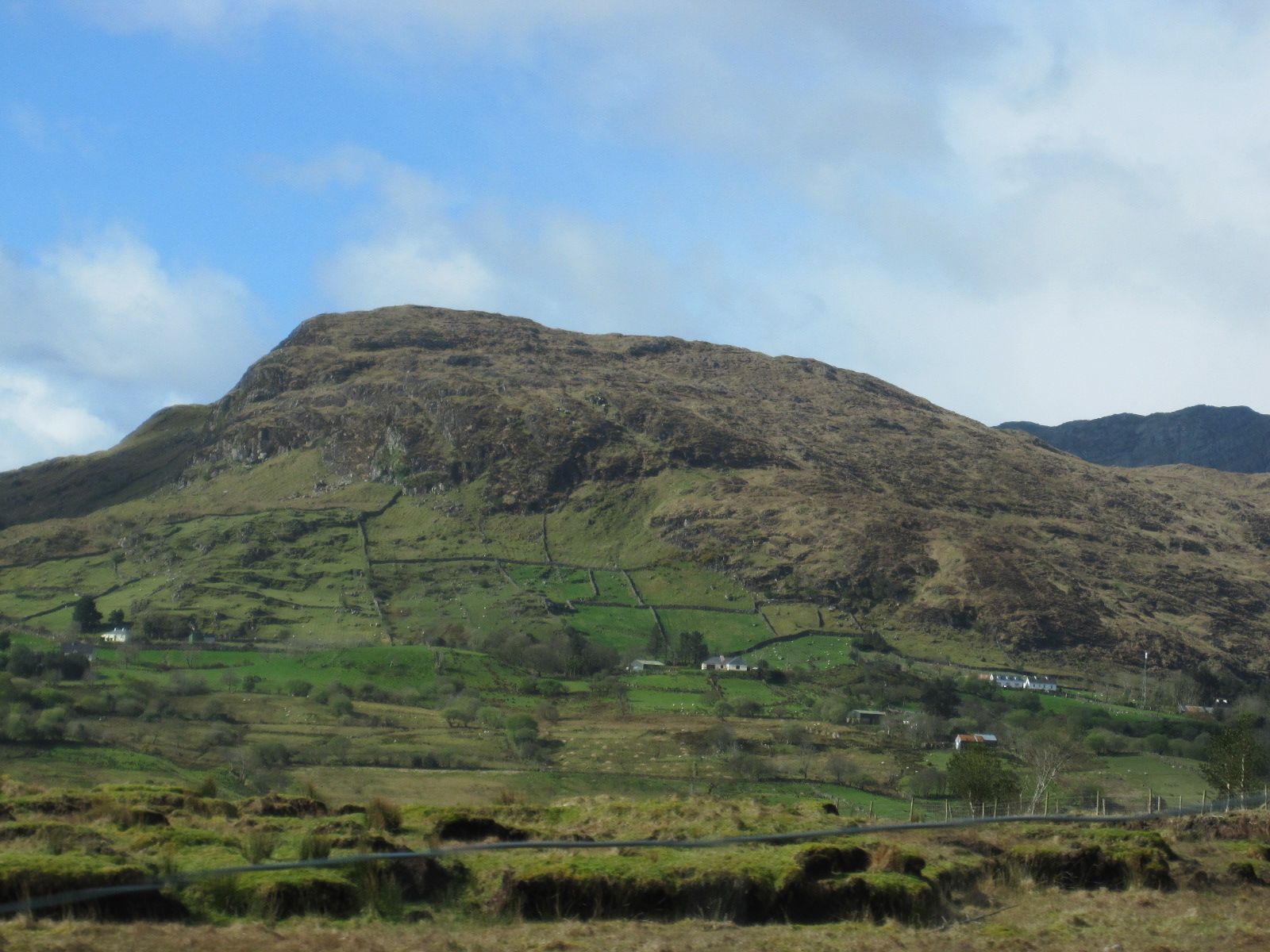
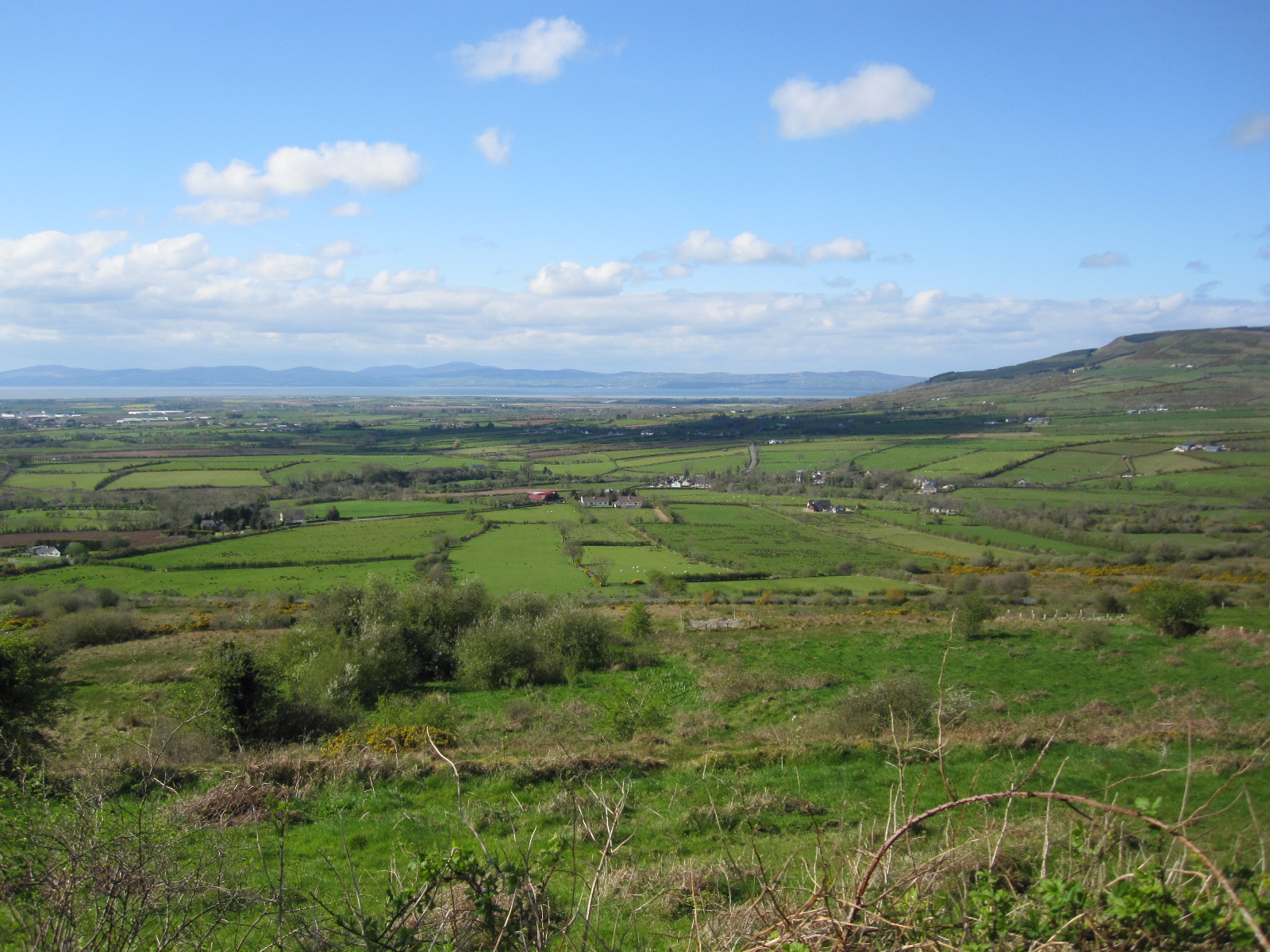
I was terrified on those narrow twisty roads (and driving on the “wrong” side!) but it was beautiful, too. Coniferous forests opening up into wide seascapes and such vibrant colors: deep, bright blue lakes, brown mountains, and such shades of green. Oh, and the little lambs! Sheep everywhere, but I was most enamored of those little babies staggering on spindly little legs.

We found ourselves in the town of Westport, looking for lunch and possibly more at Matt Molloy’s Bar – that’s Matt Molloy of the Chieftains. Lunch, pints, a walk around this dreamy little town, and we needed to stay the night; we got another B&B, visited several pubs, had our first “hot whiskey” (that turns out to be a hot toddy) and a nap and headed back to Molloy’s for the promised evening’s entertainment: traditional Irish music. This started with our being serenaded by a classic Irish bard, who knew a song for every subject imaginable and filled the bar with his rich voice. It was a great night.

Day six: got up for a little shopping in Westport, which had several outdoors shops where we picked up some hiking gear for our trip to New Mexico later this summer, and hit the road, northbound. This was our longest day’s drive, ending in Coleraine in North Ireland, where Barrett had a pub picked out for us. I shall briefly say that the pub was a disappointment and move on to –

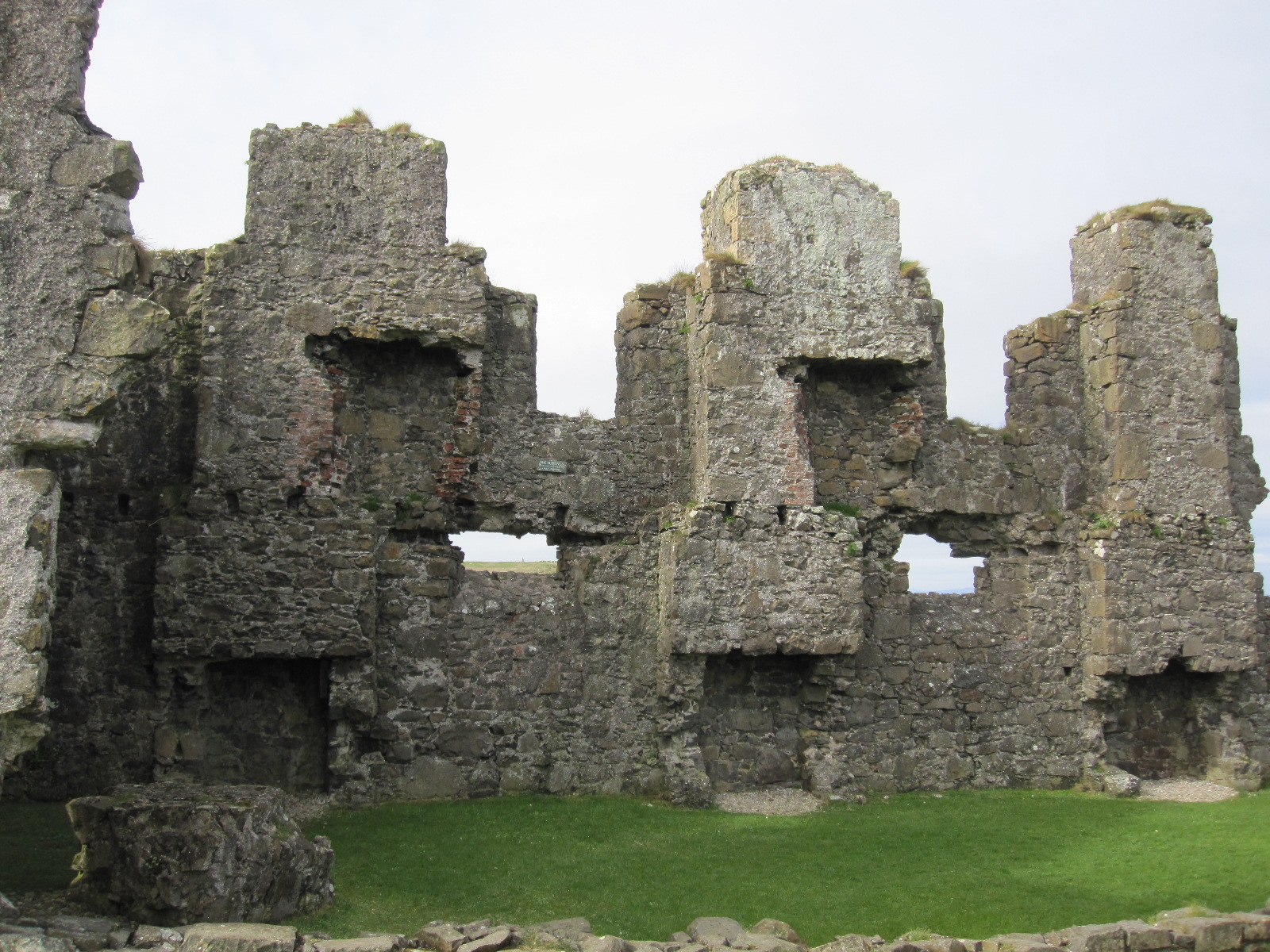
Day seven: Left Coleraine on a beautiful, mild morning for some sights: first stop goes to Husband’s credit when he spotted a sign at the last minute for Dunluce Castle, which turned out to be one of my favorite stops of the whole trip. Most of what stands today dates from the 16th and 17th centuries, but there is a room cut into the rock that they say is some 700 years earlier than that – ! – so it was really interesting to see all the layers, if you will, of civilization at this spot. It occupies a point jutting out over the ocean, and indeed part of the castle fell into the ocean in 1639, which marked the beginning of the end of its inhabitance. This site had by far the best pamphlets, guidance, visitor’s center, infrastructure in general to help me imagine what life was like here and comprehend the significance of this site in local and national history. It was a gem!

Dunluce Castle


1600's lodging for second-rate guests in the outer courtyard; you can imagine individual rooms, each with its own fireplace and window.


I like it here.


Next we drove into the town of Bushmills – that’s right, you guessed it, we toured the Old Bushmills Distillery and learned about their whiskey! I’ve been on maybe a couple dozen brewery tours, but this was my first distillery. Our young tour guide was very new and didn’t give us the best tour, but at least we got inside. I’m not so much a whiskey person, and confirmed that fact again, but they make some pretty good lasagna in their lunchroom.

whiskey


Next stop: the Giant’s Causeway, a series of geological formations along the very northern tip of Ireland that, in local myth, make up part of the causeway bridging from Ireland to Scotland so that two giants could do battle. I am running out of pictures but there are plenty on the internet for you! Great views, interesting rocks, a nice long walk making for a nice long day. I almost got to squeeze a lamb but then I didn’t. This is getting to be a nice long post, too, so I’ll finish up the evening in our next installment…

Ireland: day 4

(Days 1-3 here) This was a full and busy day with several pictures, so it gets it own post.


Day four: Happy to wake up on Inis Mhor with a big day planned. Hitched a ride into town to rent bicycles and buy picnic lunch ingredients, and headed out of town towards the opposite end of the island for Dún Dúchathair, or the Black Fort, another ancient ruin. Where Dun Aengus has an improved path up to it and signage, and a road nearby, the Black Fort is quite remote; we had to leave our bikes quite far away and hike and clamber over rock walls and rough surfaces to get to it, but it was breathtaking. And I spotted a pair of what turned out to basking sharks – very exciting!

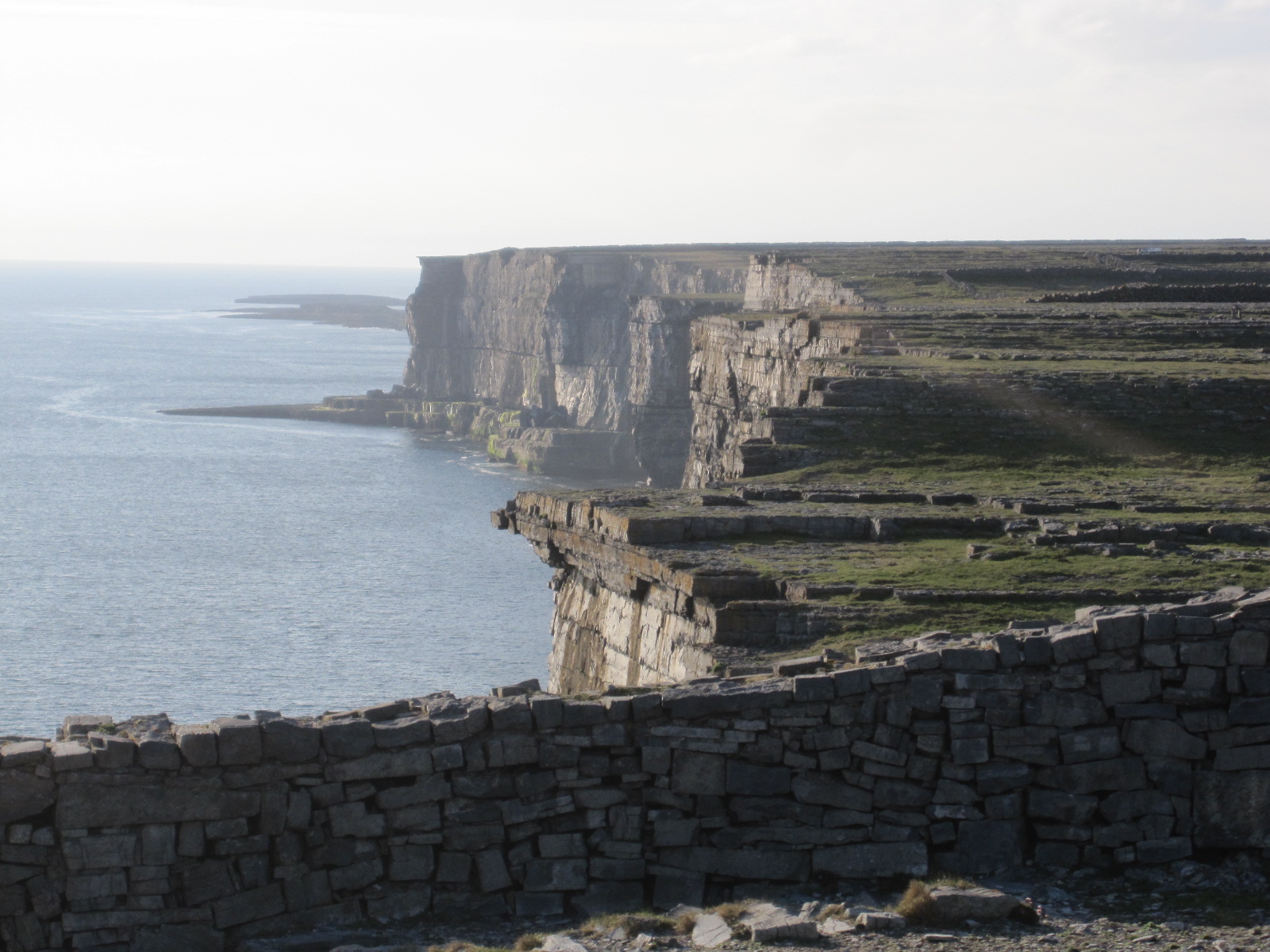
views along the dramatic coastline cliffs


Husband and I, aww


Castle defense at the Black Fort: these rocks provided defense from cavalry or, heck, from any kind of fast approach; they've been stood on end and make picking one's way across very difficult.


could somebody please tell me what makes these rocks take such clean straight lines?


"beehive huts" or rooms at the Black Fort inside the 20-foot-thick walls


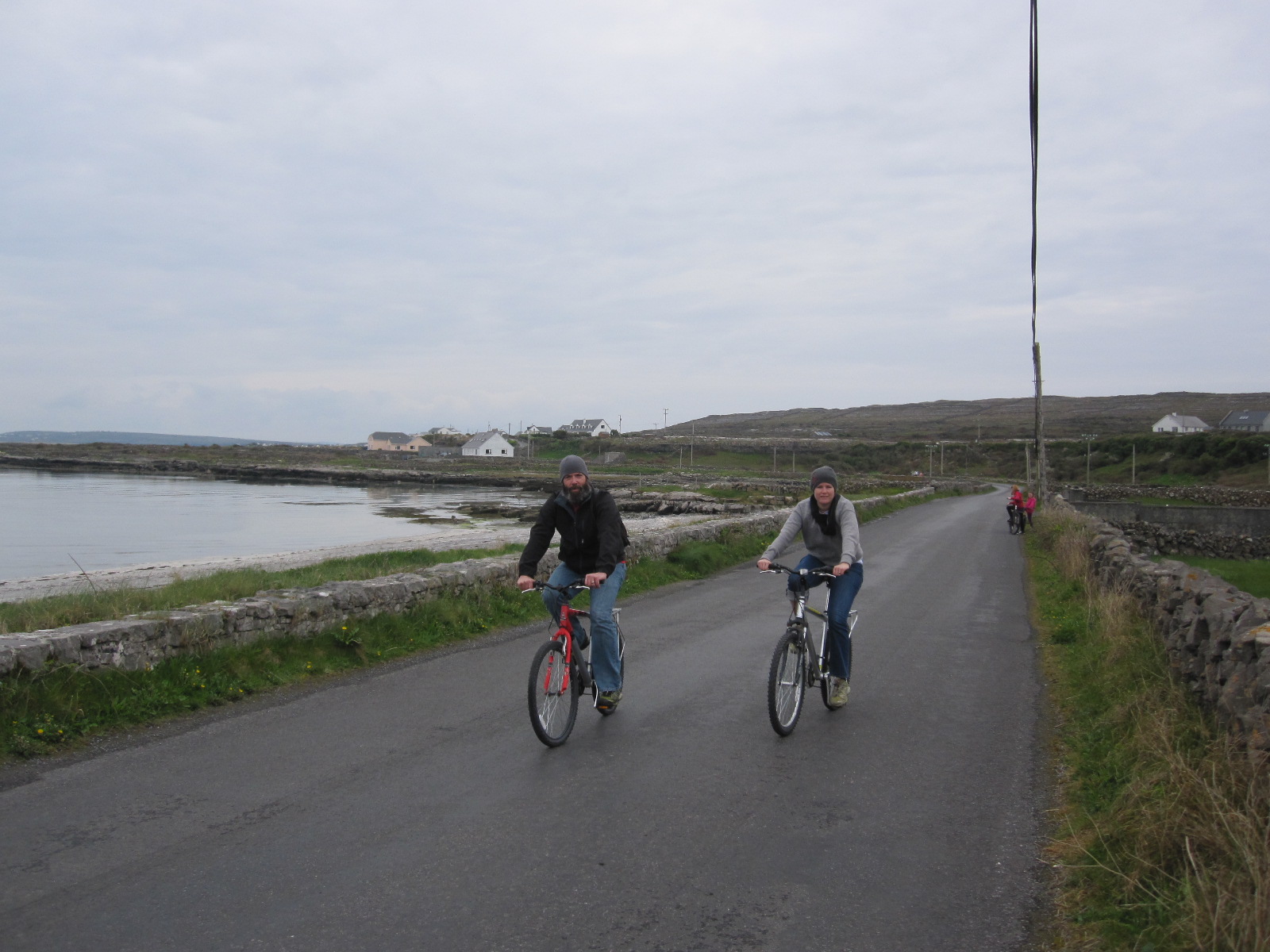
Husband and I, riding


Our ride then took us back towards our hotel to visit the Worm Hole, a strange naturally occurring rectangular pool viewable from above where we hiked on the cliffs. Barrett got a flat tire, and it was a comedy of errors, but we got back to turn the bikes in, buy sweaters from the Aran Sweater Market, and settle in for – that’s right – dinner and pints at the American Bar (which is not associated with any Americans). Then a local volunteered to drive us home and gave us a hefty box of crabmeat caught that day, which improved his cab fare considerably. Treasa set us up with a makeshift crab hammer, we bought a box of beer, and the night was filled with revelry.

Handsome Husband: lovely end to a long day.


To be continued.

Ireland: days 1-3

I want to share some of my trip with you here, including pictures, and figure it will take a few installments to do so. If you’re bored and looking for books, bear with me; we’ll be back to books tomorrow. For more Ireland stories, stay tuned over the next week or so.


Day one: Flew into Cork on Friday afternoon because of difficulties getting into Dublin as intended. Luckily, though, our date with Barrett (in Dublin) wasn’t until Saturday noonish; so we flew to Cork on a whim and thought we’d make the best of it! We got a charming little B&B, Killarney House, right near the University College of Cork and visited the recommended (by my neighbor on the airplane, a native of Cork) pub called Mutton Lane Inn.

the UCC's very pretty campus


There we had our first pints of Beamish (started on Guinness at the airport in London) and began a relaxing and fairly uneventful evening. We had dinner at Market Lane (only fair, despite being the “top pick” in my guidebook, which gets it own review) and more pints and settled in with the intention of taking a train into Dublin the next morning to meet Barrett.

Mutton Lane Inn


Day two: Drastically overslept our intended train. Luckily they run all day, and also luckily, it turned out that Barrett (when we finally got a hold of him) had also overslept; but we missed the Saturday morning “English Market” we had intended to visit to get straight on a train. Left Cork feeling like we could happily have spent more time there.

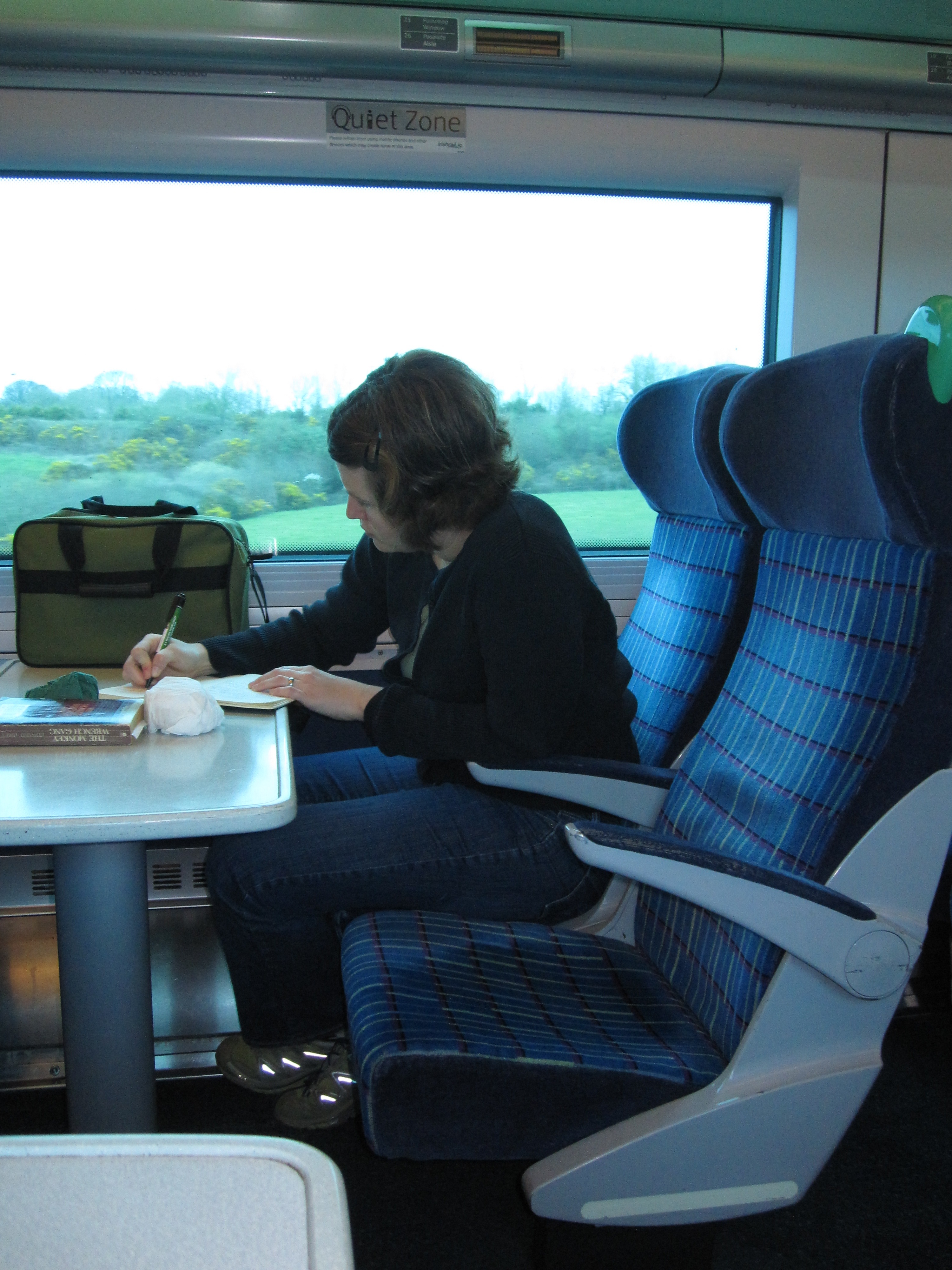
Taking notes on the train for you!


Train into Dublin and found Barrett waiting at the station – whew! Major point scored there. Picked up the rental car (they gave away the one B wanted because we were so late, sigh) and left the city immediately, planning to see it at the end of the week before flying home. Drove into the town of Athlone for the night to drink at Sean’s Bar, purportedly the oldest in Ireland, with a fire in the fireplace – lovely, if cramped, which is a theme of Europe in general in my experience. (When you’re pleased, you call it “cozy.”) Lebanese dinner and more pints and an early bedtime for me, at another very nice B&B called the Bastion; the boys went out late and I shall say no more about that.

Day three: Sunday, yes? It’s already getting hazy. Left Athlone for Clonmacnoise, a monastic site marking the roots of Irish Catholicism. Had a nice walk around in truly perfect weather and intermittent sunshine at this very special place.

Husband (in blue) and Barrett outside Clonmacnoise (those are the ruins of a later church in the background)


inside the monastery grounds themselves


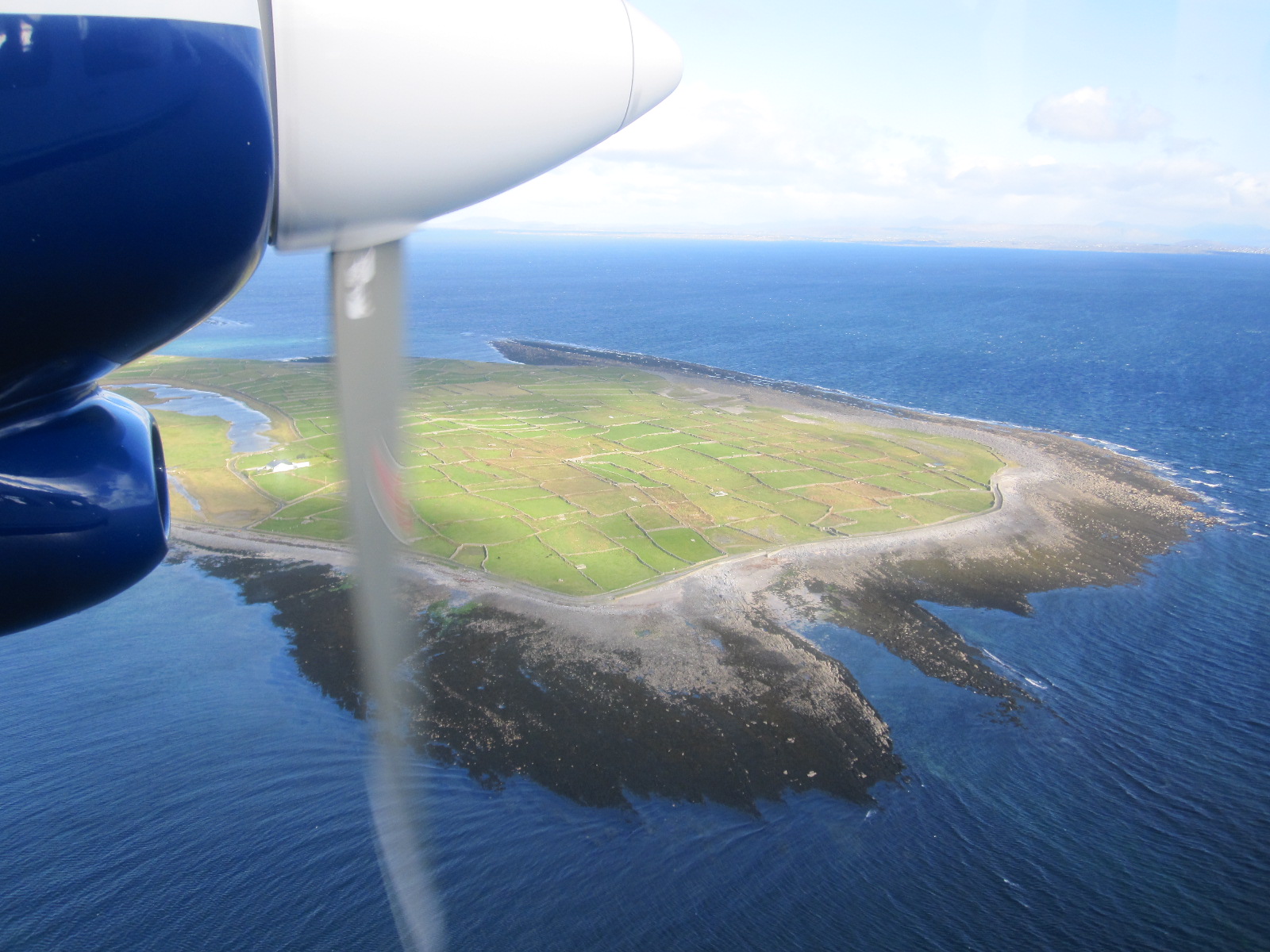
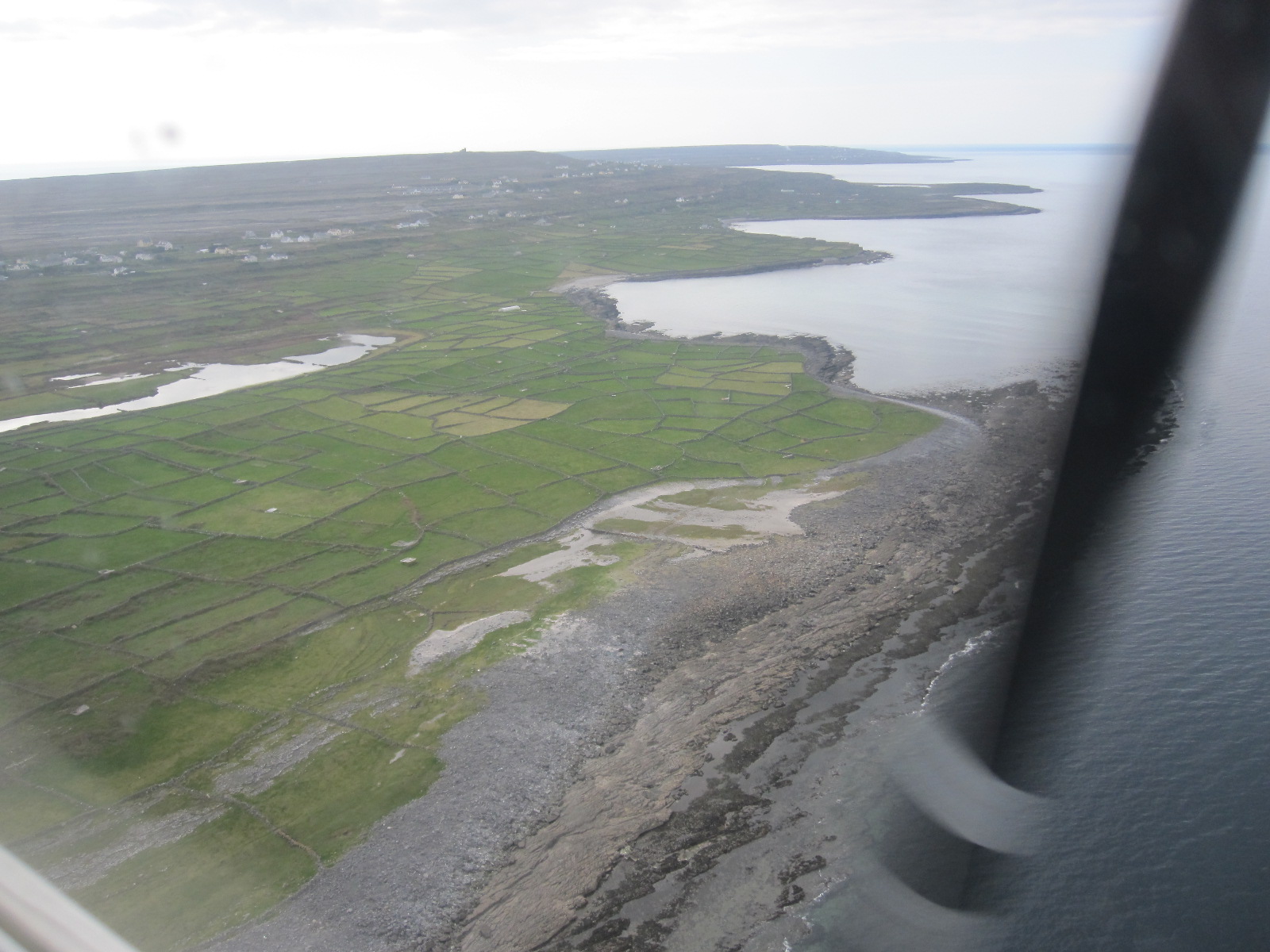
Then on to Connemara airport to board an eight-seat airplane. That flight was really something! We could have taken a ferry, of course, but this was an experience – great views, a wonderful way to approach the unique little world of Inis Mhor, the largest of the Aran Islands.

from the air


This may have been our favorite part of the whole trip. According to Barrett – who has been to Ireland, and Inis Mhor, before, but I have no idea how far to trust him – hi Barrett! – these islands had no soil on them when they were first settled, but only rock. Early islanders created soil by mixing seaweed with crushed seashells, eventually supplemented (I imagine) by plant and animal wastes. This soil, which now supports vegetation across the very green islands, is in danger of blowing away in the wind if not for the stone walls that form a tight network. Settlers had to move rocks to clear space for their fields; conveniently, these rocks now form the walls that keep the soil there.

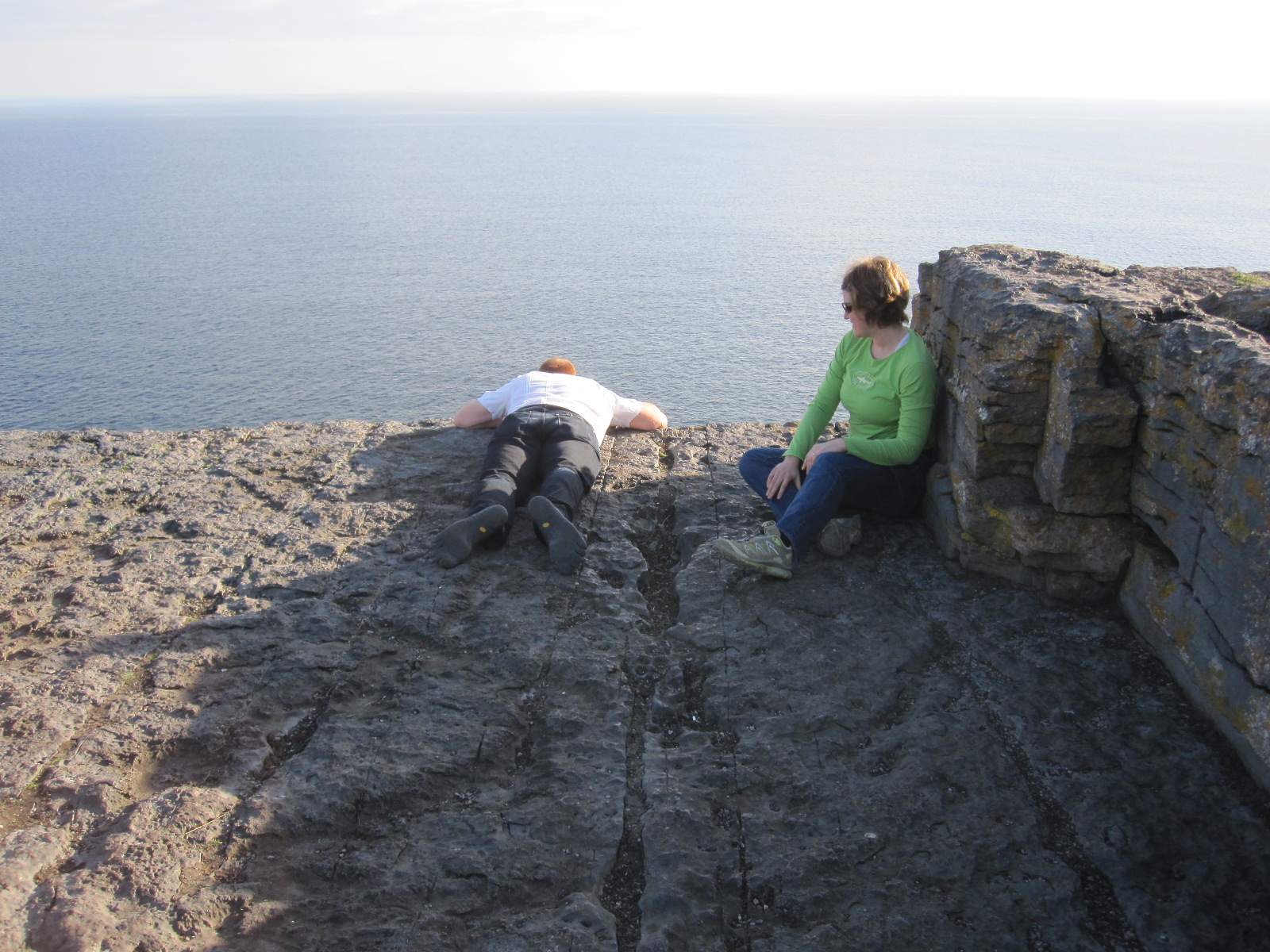
We checked into our B&B for the night – another dream, called Kilmurvey House, with the lovely Treasa hosting – and headed out for an evening hike to Dun Aengus. This Iron-Age fortress is perched dramatically on a cliff very near our B&B, but at the other end of the island from the little town of Kilronan. The cliffs are dramatic, and I am not so good with heights!

Barrett looking down; me keeping a safe distance

Then into town to Ti Joe Wattys for dinner and pints, courtesy of our B&B host’s shuttle service.


Stay tuned for the rest of the Ireland trip, to come.


Edit: See day 4, days 5-7, and days 7-8 now up.

on mountain lions

This is my memory of what happened.

In August of 1990 I was just past my 8th birthday, backpacking with my parents in the White River National Forest in Colorado. We made camp for the evening; it was still daylight. We were in a low, fairly clear area, with the land rising up around us; the grass was tall and golden-brown. I had wandered off by myself, I don’t remember why, and was wandering back toward camp when I looked up into the eyes of a creature I didn’t recognize. It was the size of our family dog, Eile, a Weimaraner. But its face was that of a cat. It was golden-brown, like the grass. It had paused mid-stride to gaze back at me. We were maybe 10-15 feet apart, and we both stopped and looked at each other for a few seconds. I wanted to make the moment last. I was always excited to see wildlife when we camped and backpacked; I remember being enchanted by marmots. Then the big cat walked off and I went back to camp. I told my father I had seen a new animal, and he asked me to describe it, and I told him the same description I’ve given here: the size of our dog, with the face of a cat, golden-brown. He was very excited and told me that I’d seen a mountain lion. I knew what a lion was and told him that wasn’t right, but later he found a picture of this different kind of lion, with no mane, and I recognized it. Yes, I’d seen a mountain lion. I remember my father being thrilled, but there was some note of alarm, too; I’d made it out of the experience fine, so there was no sense in being frightened (I think he told me that now that it knew we were there, it would stay away from us), but you might not send your eight-year-old off on such an encounter knowingly. I felt no fear, of course, not knowing anything but that this creature resembled my pets back home. Nothing scary about that. I’ve wondered if it simply wasn’t hungry, or if it recognized my innocence, my fearless curiosity, my lack of intention to do it any harm.

The above is my memory more than 20 years later, of course, and it may be faulty. It’s even possible that I remember the story as family lore rather than remembering the incident itself; but I don’t think that’s the case. I can picture the cat, and the dry grassy field.

Do my parents remember this experience the same way? It’s been a long time, and I was small. In fact, I had to look up the when-and-where using Pops’s travel log (thanks so much, Pops, for keeping one!). I was surprised at the date; I thought I was smaller than 8 when this happened. To which Pops says, “eight is still pretty small!”

They’ve shared their memories for us here.

Mom:

My memory is such that I doubt if I was there. I either remember the telling of the tale, or I remember telling the tale. The one thing that seems authentic is a flash of astonishment on your face. Maybe I saw you seeing something – and later heard what Hank actually saw, the mountain lion.

Dad:

I have a “clear” memory of it, which probably has a 50% chance of being accurate.

I don’t remember Karen being there so it will be interesting to see what she says. You and I were on a hike – who knows how far from our backpack-camp given your age. We were walking up over a slight rise when you made some exclamation – I don’t remember what. By the time I looked where you were looking, all I saw was a flash of tawny brown disappearing over the hill and/or into the brush. We were in relatively open, scrubby terrain – not in the woods. This was definitely mountain lion habitat – not bobcat or such.

I asked you to describe what you had seen, and it’s based on your description plus my furtive glimpse that I concluded it was a mountain lion. I remember not having any doubt, and emphasizing to you what a special observation it was. I have and would describe this to others as your sighting, not mine; without your description, I would not have been so sure. I might have reasoned that I probably just saw a deer (no tail flash tho’) or a coyote (no bushy tail tho’).

and then:

You thought you were ALONE?!!! Wow; that’s hutzpah – and how very irresponsible of your parents if true!

All of this came back to me recently in reading a few collections of Edward Abbey’s essays. In an essay entitled “Freedom and Wilderness, Wilderness and Freedom” (oft-quoted and reprinted; my version comes from The Journey Home), he describes his one encounter with a mountain lion. When he became aware of its presence, he was exhilarated, having wanted to meet a lion all his life (something I’d read in earlier essays). He felt fear, but also:

I felt what I always feel when I meet a large animal face to face in the wild: I felt a kind of affection and the crazy desire to communicate, to make some kind of emotional, even physical contact with the animal.

He tried to shake its hand. And if that sounds crazy, I ask you to go find a copy of this essay and read it all the way through. It’s only 11 pages long. And by the time he wants to shake this lion’s hand, I propose that you might be with him, searching for communion. I certainly was.

Abbey only had the one encounter, and in earlier essays I’ve read, he laments that fact; he waited for and sought that one encounter all his life. It makes me feel that much luckier that I got to see one, too.

Aside from the beauty and grace and rarity of the mountain lion, there’s a question growing out of this blog post about the nature of memory. That, too, reminds me of some recent reading: you may have noticed me raving lately about A Difficult Woman, the Lillian Hellman biography by Alice Kessler-Williams which – among many other things – examines the themes of memory and truth in Hellman’s life. I believe that our memories are fluid and unreliable. It may be that there is no absolutely true memory; it is my experience that people consistently share different memories of the same event. That being said, I think my father probably has it right; we were probably together. It seems more likely (because why would you let your 8-year-old wander around alone in mountain lion country), and I’m inclined to trust his memory which was then mature over mine which was then young… also, inflating my own role to a solo encounter feels like something a child’s memory might do. But it’s interesting to see these different memories, don’t you think?


Be advised: I’m out of town, so you’re viewing pre-scheduled posts until April 9. I love your comments and will respond when I return! But I’ll be out of touch for a bit. Thanks for stopping by!

musing on Edward Abbey

I’ve been thinking a lot about Edward Abbey recently, as you know. I’m currently reading his Down the River, a collection of essays, as well as Cahalan’s biography, Edward Abbey: A Life, so I’m a little immersed. My fascination with him is recent, and I have a long way to go in studying him, but that’s the exciting thing about discovering an author you love, especially when that author was prolific enough to keep you busy for a while, which Abbey was. (I guess it would be even better if he were alive and still writing.) I’ve read only four (Down the River makes five) of his 25 books (I’m using this bibliography), and I’m already holding a second book about him, his friend Peacock’s memoir Walking It Off. It’s exciting to know there’s that much more to read by and about him. Heck, I haven’t read everything I want to read by and about Hemingway yet, and I’ve spent years studying him.

I’m contemplating why I’m so interested in him. I love his writing, of course. But there are other authors whose writing I admire whom I fail to get interested in as individuals. Authors of fiction often are able to stay separated from their work, of course, unless their fiction becomes very autobiographical – which was true of both Abbey and Hemingway. The fact that he writes nonfiction, and autobiographical fiction, makes Abbey the man play a significant role in my reading of him, obviously. And Abbey is fascinating because he’s sympathetic, yes – meaning I agree with many of his politics and values and emotional reactions to the world – but he’s also fascinating because he’s nuanced, complex, contradictory, and not 100% sympathetic. The most fascinating figures, to me, are those that we cannot wholeheartedly and completely endorse. Hemingway, Hefner, Harry Hughes (I haven’t read it yet, but one of my favorite library patrons has been raving about the apparently fascinating and weird biography of Hughes we have here), Lillian Hellman whose new biography by Alice Kessler-Harris I found so wonderful, and my oldest, best friend, are all complex personalities, very different from one another, but somehow similar in their contradictions.

Of course, the more I read about Abbey, the more I see how similar he is to my longtime favorite, Ernest Hemingway. They were married four and fives times, respectively. Hemingway left each of his first three wives for the next; the fourth he left in death. Abbey left wives 1, 2 and 4 for 2, 3 and 5; his third wife died, and he left the fifth in death. Both were serially unfaithful. Both authors were aware that they had a gift, struggled with their writing which they took very seriously, rewriting repeatedly, working very hard on their craft; and both struggled with some form of depression and angst in the process. As perhaps is evidenced by their plentiful relations with the opposite sex, both were very charismatic men. Their writing styles bear a resemblance, as do their outward projections of themselves as masculine, hearty, strong, skilled with their hands. The biggest difference, the one that glares off the page at me as I read Abbey’s biography (which I’m not finished with yet, so take me with salt!) is the circumstances of their deaths. According to Wikipedia – since I’m not jumping ahead in my book – Abbey died from “complications from surgery; he suffered four days of esophageal hemorrhaging, due to esophageal varices, a recurrent problem with one group of veins.” This is a far cry from Hemingway’s demise, from a self-inflicted double-barreled shotgun blast to the forehead. I can’t tell you how relieved I am to be focused on a literary hero whose life, for all its tragedies, excludes the unique tragedy of suicide.

I’m very much enjoying getting immersed in the life of this prickly, unique, humorous and passionate man whose work I very much admire. And I’m struck by the fact that all those adjectives could apply to my first literary obsession, Papa. Who have you been stuck on lately, and why?

best of 2012 to date: first quarter

Hey friends, I just couldn’t resist sharing this with you, even though neither review is up yet (!) and one book isn’t even published yet (!!) – I have just finished reading two amazing books, one fiction, one nonfiction, and they’re definitely the best two of the year so far. You know how I know? When I can’t stop talking about them to anyone who will listen, even when they are suspected of being not interested. (Husband is so patient with me!) So what are they? …

Fiction choice of the first quarter of 2012:

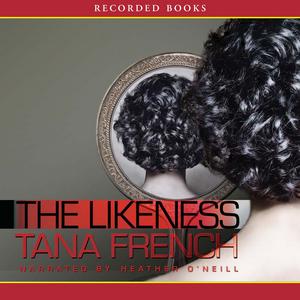
Tana French’s The Likeness. I listened to the audio version, narrated by Heather O’Neill, and highly recommend it. My early review has actually posted already, here. The final review will come this week.

Nonfiction choice of the first quarter of 2012:

Alice Kessler-Harris’s A Difficult Woman: The Challenging Life and Times of Lillian Hellman. I read an advanced review copy; the publication date is April 24, so get ready! My review will be published just about then, at Shelf Awareness, and of course I’ll share it here when it is. It was a really engrossing biography of a truly fascinating, contradictory woman, who inspired a full continuum of strong reactions amongst everyone who knew her, and Kessler-Harris presents her so thoroughly with such full context that she had me enthralled – and looking for further reading.

That’s it: my two big recommendations of the year to date.

What have you read this year that’s amazing?

“fact vs. artistic license”

Thanks to Pops for today’s prompt (and post title). He sent me this article, from the New York Times. I hope that link works! If it doesn’t, it’s called “The Fact-Checker Versus the Fabulist”, written by Gideon Lewis-Kraus, published February 21, 2012, so hopefully you can find it online. In a nutshell, it discusses the following situation:

“Hi, John. I’m Jim Fingal. I’m the intern who’s been assigned to fact-check your article about Las Vegas, and I’ve discovered a small discrepancy between the number of strip clubs you’re claiming there are in Las Vegas and the number that’s given in your supporting documents.” To which [John] D’Agata responded: “Hi, Jim. I think maybe there’s some sort of miscommunication, because the ‘article,’ as you call it, is fine. It shouldn’t need a fact-checker; at least that was my understanding with the editor I’ve been working with. I have taken some liberties in the essay here and there, but none of them are harmful.”

The article under discussion, called “What Happens There,” is purportedly nonfiction, but takes liberties, as its author says, with the facts. Lewis-Kraus discusses what it means to take liberties with fact in nonfiction writing. D’Agata makes a case for the higher purpose of “art” taking precedent over facts. I think we can probably agree that this concept, taken to an extreme, is bad for nonfiction. But the fact (heh) is that much nonfiction, arguably most nonfiction, even more arguably, perhaps, all nonfiction leaves some room for concern over absolute truth. I mean, come on, truth is relative, in the eye of the beholder, and always subject to some argument.

Pops expresses concern over

the view of any given writer that s/he is creating art or entertainment, and therefore an obsession with extreme fact-checking just gets in the way (100% fact checking is exhausting & distracting from the writing process) – and it doesn’t matter because readers understand artistic license. It hadn’t occurred to me that writers could so knowingly & sincerely take this approach with eyes wide open.

And indeed, the attitude of D’Agata as expressed in Lewis-Kraus’s article is alarming. He seems pretty cavalier about the importance of facts (and fact-checking). But I was already aware of the blurry lines, even within “nonfiction”, between fact and… liberties. How do we tell the difference between pure fact and all the nuances that then follow, along a continuum, between pure fact and pure fiction? It’s an interesting and concerning issue. I’m not bothered by fiction, nor am I bothered by the many hybrids, but I think understanding what it is that we’re reading is important. If a reader forms a world-view based on a book, it’s pretty important that that reader be clear on where fact ends and personal opinion, interpretation, or imagination begins.

So how do we tell? Ideally, fiction is easy to identify. It’s in the realm of nonfiction – which label tends to be liberally applied – that we can get into trouble. Memoirs are famously vague in terms of fact, and I think that many readers are aware of that vagueness, but I’m sure many aren’t. And there is likely to be a very large portion of what we think of as nonfiction – that is published as such – that has some questionable areas of “fact.” Who polices these things? In theory, publishers do, at least to avoid embarrassment a la James Frey or Greg Mortenson. But how much of your life savings would you bet that every detail in that latest personal narrative is factually truthful?

We could impose a ratings system, I guess. But even if we were prepared to deal with the censorship threat implied, who would do the fact-checking and rating? The authors themselves? Editors? Publishers? A newly established institution subject to corruption and favoritism, and imposing a new cost on publishing? No, that’s not going to work.

I think the best solution – as is often the case – is to be responsible consumers of nonfiction. Reading authors’ notes, afterwords, acknowledgements, introductions, and footnotes should, in theory, assuming thorough and honest authors, give us an accurate idea of how much fact and how much author impression we’re getting. I love Sharon Kay Penman for her detailed author’s notes, in which she makes clear what is researched fact, what is educated extrapolation, and what is fiction. If all authors of historical fiction and nonfiction followed her lead, I would feel safer. But in practice, we’re pretty far from this standard.

I’ve blogged about this concept before, and I still don’t have an answer. And yet I still love to read historical fiction, and I read a lot of nonfiction, too. I’m sure I’m a more informed consumer than many; but I’m a long way from perfect. What advice would you give to me, or any reader of nonfiction and historical fiction, in keeping our facts straight? Is there anything we can do? Does the slippery slope of fiction vs. non bother you too?


A few authors’ notes:

Though this is not a work of fiction, it has some fictionalizing in it. Its facts are factual and the things it says happened did happen. But I have not scrupled to dramatize historical matter and thereby to shape its emphases as I see them, or occasionally to change living names and transpose existing places and garble contemporary incidents. Some of the characters, including at times the one I call myself, are composite. People are people, and if you put some of them down the way they are, they likely wouldn’t be happy. I don’t blame them. Nevertheless, even those parts are true in a fictional sense. As true as I could make them. —Goodbye to a River, by John Graves

The Edward Abbey of my books is largely a fictional creation: the true adventures of an imaginary person. The real Edward Abbey? I think I hardly know him. A shy, retiring, very timid fellow, obviously. Somewhat of a recluse, emerging rarely from his fictional den only when lured by money, vice, the prospect of applause. –Edward Abbey, from his journals, as quoted in The Life of Edward Abbey, by James M. Cahalan

What reactions do you have to these statements? Do these ambiguities about fact or “truth” compromise the integrity of the “nonfiction” works in question, or is their integrity somehow solidified by these explanations? Have you seen any interesting authors’ notes or statements of nonfictionality to share with us?

library visit: the Julia Ideson building; and Some Recollections of a Western Ranchman by William French

My journey began thusly: having decided to visit the Gila National Forest with Husband this summer, I was doing some research on the website (above) relating to our trip: camping, weather, trails, maps, sights to see, what to expect. I was very pleased to find a suggested reading list (scroll to the bottom). Like many avid readers, I often like to do some reading relating to a place I plan to visit.

This reading list consists of some travel books, the Leopold which I was already interested in, and others that I either began searching for or decided I didn’t need. And then there was this one: Some Recollections of a Western Ranchman, by William French. I took a look at my local library’s catalog, without much luck; and then I looked on Amazon and figured out why: this book is long out of print, with used copies running well upwards of $100. Well, I don’t think I want the book that badly; I don’t really know if I want it at all. But I’m interested, because the Houston Public Library does house a copy in the Texas Room at the Houston Metropolitan Resource Center at the Julia Ideson Building.

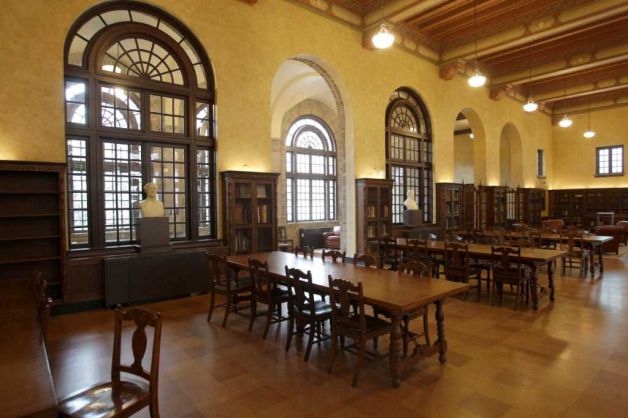
This had me intrigued enough to pay a visit. I hadn’t been to the Ideson Building in a few years, since I was a library student and toured with my mother. It’s a lovely space. For 50 years, from 1926 to 1976, this building served as Houston’s central library; its namesake was Houston’s head librarian from 1904-1945. In 1976, the Jones Building was opened on the same block, and today that’s our main library, and the one I grew up with; it’s some 5-6 stories tall, and I grew up with the children’s library in the basement, although now it gets a sunnier treatment (following a recent renovation). The Jones Building is, in my opinion, a fine library in its own right, but the Ideson Building is really lovely. Please do go check out some beautiful photographs (and renderings) provided by The Julia Ideson Library Preservation Partners. You can read more about the building and very recently completed and so well-deserved renovation here.


So what of the book? Well, I entered the Texas Room, which bibliophiles would recognize as a classic reading room in the days before Kindle. I was asked to lock my purse in a locker – no pens, water bottles, or theft opportunities allowed! – and then I waited in this lovely space while a librarian fetched the book I wanted from the closed stacks. There were accountant-style lamps on the tables, but I sat near a window and didn’t need one. I was given William French’s Recollections, in two volumes, bound in what I assume was a custom book box, and I gave it a look.

lovely reading room


As it turns out, the book itself was not the most impressive part of this visit. I spent a little time with it, and encountered a few funny or poignant anecdotes. But each volume being some 300 pages long, I knew I wasn’t interested in making the commitment with a book I couldn’t carry around myself. It is a memoir by a Dublin-born man who traveled to the American Southwest in the late 1800’s and had adventures there, and I read about ranching, local politics, tracking and hunting bears, frontier weddings, and more; apparently French was a friend to the Wild Bunch including Butch Cassidy, which is part of what has made his memoir of some enduring interest. (Not so much enduring interest, however, that this book is still in print.) I think it has some entertainment value, but is not so well-written or sensational to make for popular reading; clearly it has historical value to the time and place it represents, which is why it’s on the Gila’s list of suggested reading. How it ended up in the Texas Room is a little mysterious, as the librarian I asked said that the collection mostly covers not Texas, but more specifically Houston-related resources; I asked how this book (which mostly covers New Mexico) ended up there, and she guessed that perhaps its donor was somehow related to Houston. No worries, of course; I’m glad this hard-to-find book was available to me to touch and read in such a lovely setting.