selected quotations from Walden, with a qualification

Henry David Thoreau’s Walden is a highly quotable and oft-quoted book. I found myself marking passages rather more often than usual, sometimes because I was charmed and wanted to share a line with you later, and sometimes because I noted the origin of a maxim I was familiar with, whose author I hadn’t known before. I’ve already reviewed Walden, and now I want to share a selection of quotations with you too. But first, a qualification.

A friend & coworker sent me this article, which chiefly makes the point that Thoreau was a very complicated man who wore many hats (figuratively. who knows, maybe literally as well). The author notes the danger of quoting Thoreau: so many people know him through his reputation and these handpicked quotations, while rather few have read his work; and his work being so many things at once, so contradictory, handpicked quotations can be a dangerous tool. In other words, many of us may be thrown off by the quotations alone without reading the work. I’ve now read Walden, but the man was so terrifically prolific that I am hardly any closer to knowing Thoreau than I was before! So, fair warning. But I will now share my quotations just the same.

In order of their appearance (page numbers come from my pocket-sized red Barnes & Noble Collector’s Library edition). The book opens:

When I wrote the following pages, or rather the bulk of them, I lived alone, in the woods, a mile from any neighbour, in a house which I had built myself, on the shore of Walden Pond, in Concord, Massachusetts, and earned my living by the labour of my hands only. I lived there two years and two months. At present I am a sojourner in civilised life again. (7)

The mass of men lead lives of quiet desperation. What is called resignation is confirmed desperation. From the desperate city you go into the desperate country, and have to console yourself with the bravery of minks and muskrats. (12)

I say, beware of all enterprises that require new clothes, and not rather a new wearer of clothes. (28)

I had three pieces of limestone on my desk, but I was terrified to find that they required to be dusted daily, when the furniture of my mind was all undusted still, and threw them out the window in disgust. (42)

…a man is rich in proportion to the number of things which he can afford to let alone. (88)

I went to the woods because I wished to live deliberately, to front only the essential facts of life, and see if I could not learn what it had to teach, and not, when I came to die, discover that I had not lived. (98)

I wanted to live deep and suck out all the marrow of life, to live so sturdily and Spartan-like as to put to rout all that was not life, to cut a broad swath and shave close, to drive life into a corner, and reduce it to its lowest terms, and, if it proved to be mean, why then to get the whole and genuine meanness of it, and publish its meanness to the world; or if it were sublime, to know it by experience, and be able to give a true account of it in my next excursion. (98)

Simplicity, simplicity, simplicity! I say, let your affairs be as two or three, and not a hundred or a thousand; instead of a million count half a dozen, and keep your accounts on your thumb-nail. (98)

My house never pleased my eye so much after it was plastered, though I was obliged to confess that it was more comfortable. (256)

The stove not only took up room and scented the house, but it concealed the fire, and I felt as if I had lost a companion. You can always see a face in the fire. (269)

Our village life would stagnate if it were not for the unexplored forests and meadows which surround it. We need the tonic of wildness – to wade sometimes in marshes where the bittern and the meadow-hen lurk, and hear the booming of the snipe; to smell the whispering sedge where only some wilder and more solitary fowl builds her nest, and the mink crawls with its belly close to the ground. At the same time that we are earnest to explore and learn all things, we require that all things be mysterious and unexplorable, that land and sea be infinitely wild, unsurveyed and unfathomed by us because unfathomable. We can never have enough of nature. (334)

I will not try to improve upon this. Good day.

movie: The Shining (1980)

The 1977 novel by Stephen King which I just reviewed was made into a movie by Stanley Kubrick in 1980. Husband and I planned to watch it on Halloween (as I’d just finished the book) but we couldn’t even wait that long.

I struggle to retain a little perspective as I write this review. I loved the book very much. Movies made from books are often disappointing, and I keep reminding myself, this is not because they are less good, only different. The format requires that they compress the action, often curtailing development of characters and plot, to fit into two hours or so. Interior thoughts and motivations are often lost (see recent discussion). None of which means that movies can’t be good; they just can’t be books.

As you’re already gathering, this movie disappointed me in that it wasn’t just like the book. In fact, they have relatively little in common. Both are about the Torrance family: Jack, Wendy, and Danny. Jack is still a recovering alcoholic, still takes the caretaker job at the Overlook Hotel. Dick Hallorann still befriends Danny, although their friendship is much less profound. My first great let-down was in Hallorann: I found him sort of bumbling in the movie, less developed, certainly less capable and fun, less someone I want to hang out with. For that matter, my earliest warning was in the character of Ullman, the hotel manager: a real creep in the book, he was an oily but not exceptionally unpleasant nonentity in the movie… I guess these are the sacrifices we make to time restraints. And of course, the monsters are reduced in number and in detail, again presumably because of the time limitations. Most damningly, a certain key character meets an entirely different ending in the movie, which I have a hard time forgiving. I have to keep reminding myself, these are different stories.

But the real departure from book to movie, it seems to me, is in the source of the evil. As I noted, in the book, Jack is an essentially good – flawed, but human – man, husband, and father. The Overlook Hotel is an evil entity that preys upon his weaknesses and takes him over. Jack as man is redeemed somewhat. In the movie, though, Jack goes insane and tries to kill his wife and child. No redemption there.

But how was the movie as just a movie, without these unrealistic comparisons to the book? Okay, I’m trying. As a movie it was indeed spooky. It created atmosphere. The scenes with Danny riding his Big Wheel through the halls alone were powerful. For that matter, the images were all powerful – and absolutely iconic today. (I could have identified all of the images in this post for you before I saw the movie. And I am a pop culture dunce.) Stanley Kubrick did his Stanley Kubrick thing. I think it would have been an enjoyable and impactful movie experience, had I seen it first. Clearly, however, the book ruined me for it. Which is so often the case. However, I also think that the movie would have ruined me for the book. Scatman Crothers’ portrayal of Hallorann was not at all what I’d pictured, and I like my conception of him better. So there’s a conundrum. If you have to pick one format, kids, I recommend the book.


Rating: 5 advantages taken.

movie: Night of the Living Dead (1968)

In case you haven’t been around here much, I’m not a big movie watcher. I didn’t watch a lot of tv as a kid; am not real strong on pop culture; and horror movies were never my top choice. Also, my parents hadn’t yet met in 1968. So this movie was altogether new to me when Husband and I sat down on Halloween and watched Night of the Living Dead, the original 1968 black and white movie in which a group of strangers gathers in a farmhouse to defend themselves against …we would now call them zombies, although that term isn’t used in the film. In the film, they’re called ‘ghouls.’

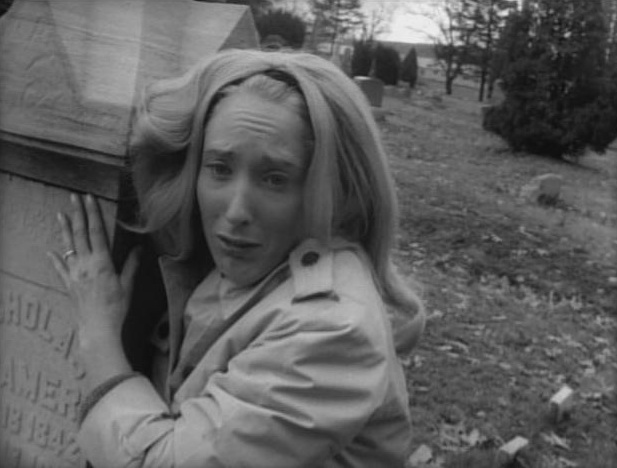
Barbra


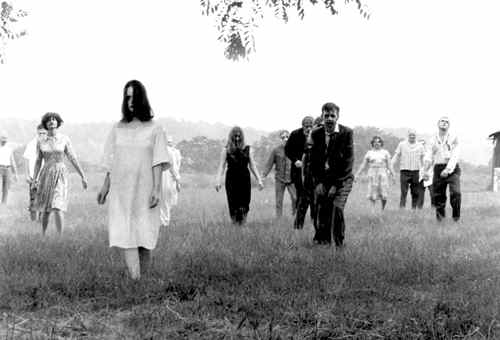
In the opening scene, Barbra and her brother Johnny are visiting their father’s grave (and Johnny’s being a real pill about it, by the way) when a ghoul approaches and… goodbye Johnny. Barbra runs to a farmhouse, chased by the undead, and holes up, soon to be joined by a stranger named Ben. Ben keeps his calm and has a plan to board up and defend the farmhouse, while Barbra becomes hysterical and then catatonic. It turns out that they have company: another group of frightened (living) people were already hiding in the basement. There’s a young couple, and an older married couple with an injured daughter. The movie covers just the one night, in which the zombies, I mean ghouls, mill about outside and the people inside make plans to escape. The radio and television inform them that there is an epidemic of ghouls ravaging the country, killing people and eating them.

‘ghouls’


Cinematographically, this film struck me favorably. I am no student of this art form, especially in black and white, but the few black and white films I’ve seen have impressed me with their use of light and shadow – necessarily, since that’s the big visual contrast they have to work with. Certain aspects of the movie were woefully dated: pacing is always the first I notice with older movies, since we have such short attention spans these days; the dialog felt stilted and abrupt; the acting was overly dramatic; and can I just gripe about Barbra for a moment? What a worthless weak female figure, and how disgusting is that? I imagine her portrayal took some heat in 1968, too! But just as I started to scoff at these faults, I’d jump in my seat. Despite the dated aspects, that fine use of light & dark and the suspense, the surprises, and let me say, the terror of the undead eating people is still scary. I can see why this movie was a hit and why it still draws a following. I can see why some consider it a classic.

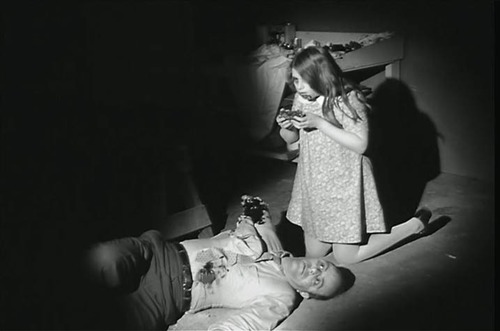
yep. still scary


I do have one final complaint, relating to how the movie ends. I won’t articulate it here, in case you want to go discover it yourself. I will only say, I have a certain James Dean movie in mind, which did it better.

I enjoyed this movie far more than I expected to at about 20 minutes in. Touché, old movies. Happy Halloween.


Rating: 6 groans ‘n’ moans.

footnotes, endnotes, othernotes

I teased you recently, in my review of On a Farther Shore (the new Rachel Carson biography by William Souder) with some thoughts on Notes. You may notice that this is my third post concerning Souder’s book. It has been rather thought-provoking, which is always nice.

Authors of nonfiction should cite their sources. I don’t think there’s much disagreement on this point. But to the question of how they should do it, there are several answers. The most common use a superscript number or other symbol in the text to refer the reader to more information elsewhere. Footnotes reside at the “foot” of the page, and endnotes are collected at the end of a chapter or a book. (I don’t read e-books, but surely there’s a clever way to imbed notes in the text in the form of little hyperlinks so that the reader can reference the note on the spot if she so chooses, which sounds convenient and reasonable [except that she’d have to be reading an e-book, so there’s a compromise].) The content of notes is often bibliographical, giving credit to the author’s source for a piece of information, but can also allow the author to further discuss a point, like a long parenthetical outside of the text itself.

There are pros and cons to footnotes and endnotes. Footnotes take up space on the page, and may be annoying to readers who don’t care about them. Endnotes can be inconveniently remote, for readers who do care – I’ve been known to use two bookmarks, one for where I’m reading in the main text and one for where I’m reading in the endnotes, so that I can quickly find the next note I’m directed to. I guess the main question, then, is whether the reader cares about the content of the notes in the first place. I suspect I’m fairly typical in that I am more likely to care about notes that offer further thoughts on the main text, than notes that only cite sources.

William Souder, in On a Farther Shore, uses endnotes, gathered all together in one long section (75 pages) at the end of the main text. At a glance, they appeared to be works cited, and I was going to leave it at that. Normally at the end of a nonfiction read, I look at the Acknowledgements, Notes, and sundry further thoughts, and read as much of it as attracts my attention (often most of it). In this case, I found that I had been wrong about the notes: most of them were citations, but there were some parenthetical-style remarks by Souder, describing his experience in researching the book (descendents of Carson and her friend Dorothy Freeman hosted him at their homes on the ocean; he wrote a chapter at Carson’s own desk) or expanding upon the text of the book. This was valuable! For example, I learned in a note that “in the 1950’s and 60’s it was common for doctors to discuss a cancer diagnosis with a woman’s husband and not with the patient herself – a disturbing practice that left the unmarried Carson in the dark about her condition.” (Souder notes in the main text that Carson’s ignorance about her condition and treatment options was all the more ironic and tragic because, as a scientist, she was more capable than the average man of understanding that information and using it to make decisions about her care.) This shocking detail seems important to me! I’m glad I came across it by accident – after which I read the notes through, and found other tidbits of value. For example, Souder emerges as a person with feelings and personal impressions only in his notes.

My point here is that I almost missed the notes that were valuable to me because I misunderstood their content. This isn’t necessarily an argument for footnotes over endnotes; but at least I might wish that Souder had made it a little more clear that there’s more than citations in that exhaustive 75 pages of notes at the back of his book. Keep your eyes open, kids.

What are your feelings about footnotes, endnotes, or othernotes?

biographies of parallel lives: Rachel Carson and Marie Tharp; and beyond

Remember when I raved about Soundings, the biography of the woman who mapped the ocean floor? I was enchanted in part by the style in which author Hali Felt evoked her subject, Marie Tharp, as a personality as well as a historical figure. I was also fascinated by the unique persona of Tharp herself, and her role as a woman in science in the 1940’s, 50’s, and 60’s.

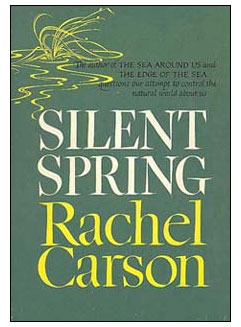
And now I’m very pleased to have picked up a new biography entitled On a Farther Shore, by William Souder, about Rachel Carson, for the 50th anniversary of the publication of her groundbreaking book. Silent Spring exposed the tragic truth, that the widely used pesticide DDT was killing not only bugs, but birds and myriad other wildlife, and even humans. Carson is credited with playing a major role in the birth of the environmentalist movement.

These two biographies employ very different styles. Felt is a visible character in the story she tells, of Tharp’s life through the lens of Felt’s research experience, while Souder’s work so far tracks like a traditional biography, with the author invisible. But their subjects share a few obvious similarities. Both were women on the margins of scientific communities that weren’t entirely prepared to let them in, and they were more or less contemporaries (Tharp was born 13 years later than Carson). Both challenged the gender barrier and accepted understandings of their fields. I recognized these parallels when I began reading On a Farther Shore.

But I wasn’t prepared for the confluences and coincidences that came fast and thick in the opening chapters. (I’m only about 50 pages in, so this is far from a final review of Souder’s work. Although I do like it so far!) For one thing, forgive my ignorance: I knew about Silent Spring (I read it when I was a kid), but had not known that prior to that most famous of her books, Carson had been a well-loved and bestselling author of literary writings about the ocean. So, number one: both women were fascinated with the sea. And then came a comparison of Silent Spring, with its unprecedented exposure of an industry that would later be legislated and regulated largely because of the book itself, to one of my all time favorites: Upton Sinclair’s The Jungle. Next I learned that Carson grew up scarcely an hour’s drive away from where Edward Abbey would grow up 20 years her junior. That is a hell of a coincidence.

As I joyfully made these connections (which I know will continue, because our world is all interconnected), I mused. I remember feeling, in middle school, even in high school, that certain subjects were “work,” were chores, weren’t fun, didn’t feel like they were teaching me things I’d need to know or care to know later in life. I liked English but had less use for history. And I also remember when this changed for me, and when learning for its own sake became something I felt passionately about. The light-bulb moment was related to the interconnectedness of all things. That history, biology, political science, and literature were all the same story; that nothing happens in a vacuum, just as Gertrude Stein, mentor and friend to my main man Ernest Hemingway, was a student at the Marine Biological Laboratory in Woods Hole, Massachusetts just a few decades ahead of Rachel Carson. I don’t know about the rest of you, but learning that the world is interdisciplinary and that contemporary figureheads from a variety of textbooks lived in the same world – that Einstein’s life work and philosophy was deeply influenced by his observation of German militarism culminating in Hitler’s rise to power, that the reclusive Harper Lee and the effervescent Truman Capote were buddies, that Mark Twain and the much-younger Helen Keller were close – has been the turning point for me in appreciating so much more reading and learning than I did even 10 years ago.

Recognizing these connections has led to myriad new directions in my own reading. Some of them have been in fiction (I’ve read Gertrude Stein because of her relationship with Hemingway), and many have been nonfiction. In general, I would definitely credit this larger observation with my ever-growing appreciation of nonfiction. I’m sometimes saddened to hear from people who don’t like nonfiction, because they’re missing so much. I suspect they just haven’t met the right style of nonfiction yet; but maybe, too, they haven’t had that light-bulb moment that did it for me.

Does anybody else share this feeling that everything being connected make the world a fascinating place? Has it influenced your reading habits?

movie: We Need to Talk About Kevin (2011)

I just happened across this movie the other day. I really enjoyed the book by Lionel Shriver – pre-blog, sorry, but I’ll recap here very briefly. The book is an epistolary novel, meaning it comes to us in the form of a series of letters from Eva to her husband Franklin. Their family has clearly suffered a tragedy of sorts, which goes unnamed until the very end, and the source of that tragedy, equally clearly, is their son Kevin. Eva is trying to process her difficulty with Kevin, and to figure out where the blame for what’s wrong with him lies. Was it in him from the start? Or was she a bad mother, and turned him bad? She felt the evil in him while he was still in the womb – or maybe she was just a non-nurturing mother. To me, that was the overarching question of the book: where did the badness come from? And it’s an interesting question. At the risk of sounding creepy, I guess I also found it kind of refreshing to see a presentation of motherhood that wasn’t all roses, sunshine, and easy bonding. Not all readers, or bloggers, enjoyed the book (by a long shot!), but I did. And I found its big reveal surprising. Important tip: if you want to enjoy the book, don’t let anybody spoil it for you! (No spoilers here.)

So, the movie. I was interested in two things: how well would the movie communicate the profound creepiness of Kevin the little boy? And how would the epistolary format difficulty be overcome? As in the case of book-to-movie The Lovely Bones, which in book form is narrated from heaven, the voice of Eva in her letters is difficult to translate into movie form unless you’re going to have Eva’s character voiceover the whole thing, which doesn’t sound appealing. (Qualifier: I only read and never watched The Lovely Bones. Apparently the film met with mixed reviews.)

As to the first question, they made Kevin creepy as hell, which was perfect. His manipulation of one parent while showing his dark side to the other reminded me of that terrifying woman-child in Orphan (shudder). I thought the toddler Kevin was great; before he started speaking, he would glower at his mother until I thought surely he was going to blurt obscenities. But this is just a little boy!

Eva with little Kevin


And as to the second question, how to translate the epistolary format, the film took an arty, quiet, disjointed approach. There may be a technical term for this style – I am so very far from being a film buff. It reminded me of Punch Drunk Love, that outlier of Adam Sandler’s ouvre, which is far less tragic than this one, but what can I say, I don’t see a lot of movies. The chronology jumped around. And this raised a whole new question for me, one I can’t answer. Is the final big reveal as surprising in the movie as it is in the book? Since I knew it going in, I can’t say.

Throughout, the movie relies heavily on the repetition of one highly (screamingly) symbolic color, red, and is extremely quiet. Dialogue is very sparse. It drags along a little, but that might be part of the arty nature of it. (Short attention spans, beware.) It expresses terror in a whisper – an awfully effective technique. It communicated the same discomfort, questions, and alarm that the book did, and like the book, it’s not for everyone. But I think this film does what it set out to do.

revisiting the question of history vs. historical fiction

The value of fiction, the pitfalls and dangers of historical fiction, and the concept of the proper way to read historical fiction, are topics I’ve discussed here from time to time. [See bottom of post for links.] I like to read nonfiction, and I like to read historical fiction, and I find it interesting to ponder that deceptive and elusive line where fact meets fiction. Even within “nonfiction,” in fact, I think it’s important to question the boundaries. [Just the other day, in my review of Blaine Harden’s Escape From Camp 14, I mused over the hidden impact of the interpreter to Harden’s interviews of his subject.] Memoir is famously a genre of nonfiction where that line is blurred and amorphous; often the narrator/memoirist is the only one who can confirm what s/he writes, and as we all know, memory is a faulty beast. The relatively new genre of “narrative nonfiction” to me refers to nonfiction that is written with a more literary voice, and is usually more readable to a general audience that tends to balk at nonfiction; but some have suggested that it is less reliable and factual than traditional (drier) nonfiction. I enjoy the entire range of work – from historical fiction to memoir and creative nonfiction to textbook-style, heavily cited, academic writings – and mean to disparage no one here; I just find it interesting to poke and prod at the distinctions.

I always appreciate it when an author addresses the issue head-on. [See Sharon Kay Penman’s author’s notes at the back of her books. She does a lovely job.] And so I was intrigued by the foreword to Sebastian Junger’s The Perfect Storm. Here is the first paragraph:

Recreating the last days of six men who disappeared at sea presented some obvious problems for me. On the one hand, I wanted to write a completely factual book that would stand on its own as a piece of journalism. On the other hand, I didn’t want the narrative to asphyxiate under a mass of technical detail and conjecture. I toyed with the idea of fictionalizing minor parts of the story – conversations, personal thoughts, day-to-day routines – to make it more readable, but that risked diminishing the value of whatever facts I was able to determine. In the end I wound up sticking strictly to the facts, but in as wide-ranging a way as possible. If I didn’t know exactly what happened aboard the doomed boat, for example, I would interview people who had been through similar situations, and survived. Their experiences, I felt, would provide a fairly good description of what the six men on the Andrea Gail had gone through, and said, and perhaps even felt.

From here he indicates which dialogue he has confirmed from recorded interviews (in quotation marks), what dialogue has been reconstructed from the memories of those involved (without quotation marks), and where radio conversations have been recalled from memory (in italics). While I appreciate the effort, I should note, these guidelines did me little good in listening to the audiobook! That’s all right, though. I’m comfortable knowing that Junger paid such close attention and stuck to self-imposed guidelines. Knowing that, until I have a research paper to write on this subject, I am content to let the line between confirmed & merely recalled blur in my mind.

Most importantly, I appreciate that Junger acknowledged the challenge here, and I acknowledge it back at him: recreating a real-life experience at which he was not present does present some concerns, and I respect his plan here. Moreover, I think it turned out really well. His narrative telling of the events leading up to the “perfect storm” (recreated largely through interviews with the surviving players) flowed very nicely. He frequently interjects bits of local or regional history, or the accounts of people with unrelated but similar experiences, as mentioned above. In this way, the structure of this story is similar to that of Escape from Camp 14. I feel that it worked well in both cases: narrative storyline interrupted by backstory that expanded my understanding. And I was confident in my storyteller, thanks in part to his helpful and brief foreword.

I guess the point of this post is just to nod my head to the question of fact meeting up with conjecture, in various genres of writing, and mention one way of dealing with it. Is this something you think about as you read?


If you’re interested, here are a few past posts where I’ve contemplated this issue.

bonus midday post: on dogs. (and, I have a new author friend.)

I have been a little bit conflicted & confused as to how to tell this story. My new author friend values his privacy highly, and I respect that. I think I’m going to leave him anonymous for the purpose of telling this story. Close readers (rabid followers of this blog & my life, as if there were such people, ha) will be able to figure out his identity, to which I say, okay.

Husband and I got to take a trip this year to see & do lots of amazing, beautiful things, including meet a man who had previously been an email-friend, an author whose book I have admired (still admire) greatly. We’ll call him, um, Larry. Our correspondence had been friendly & stimulating, but there remained the chance that we would fail to hit it off, that there would be awkwardness. However, we did in fact hit it off – all three of us, Husband, Larry and I – and had a great few days of conversation, food, drink, views, and enjoying the world. Larry invited us to meet his wife and their friends; I got to play with his dog. He cooked us dinner – twice! – and welcomed us into his home. It was really something. I’m honored to be treated with such friendly familiarity. And while part of that feeling, of being honored, comes from my admiration of the book this guy wrote, it’s more about simply humanity: that I connected with another human being over the tastes and passions and interests we share. And he gave me a book to read off his bookshelf at home, which is kind of cool. 🙂

When Thomas posted his latest Bits and Bobs post, I guess I was in a lazy blog-reading mood, because I confess I reacted more or less thusly: “books, books, hm… books… gratuitous photos, what? gardens, hm… LUCY!!” More dog is always (always!) appreciated. And that reminded me of an anecdote told by, um, Larry: when his editor was looking over the book, he sent Larry a postcard that said, “less wife – more dog.” Larry’s wife was of course (good-naturedly) a little miffed with the editor! I thought the level of wife in the book was fine – I like the wife – but I think I got what the editor was serving up there: more dog is always appreciated. So, “Larry,” carry on, I love the dog! Thomas, I can handle all the Lucy you care to publish! Here’s to dogs.

my two little dogs after a four-day weekend at the beach: dog tired.

movie: Hemingway and Gellhorn (2012)

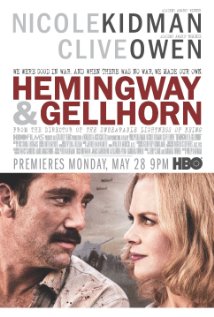
Many thanks to my gracious in-laws for DVR-ing this HBO special so that I could watch it later on. You know this was a high priority for me! We had a lovely evening, the four of us, enjoying this newly released film about Hemingway’s time with his third wife (the shortest of his marriages), Martha Gellhorn. Gellhorn met Papa in Key West while he was married to Pauline; their romance developed as they shared a common career as war correspondents. His marriage to Pauline ended just a few weeks before he married Gellhorn. While married to Martha, Hemingway wrote For Whom the Bell Tolls. During their barely four years of marriage, professional rivalry posed one of the couple’s greatest difficulties. Hem was not accustomed to having a woman challenge him in his area of expertise, and he handled it badly. They parted less than amicably, with Gellhorn doing the leaving (an unusual experience for the famous writer).

This film did an admirable job of covering this relationship. With just a few qualifying remarks, I can say I really enjoyed it.

The movie opens with Hem & Martha’s meeting in the famous Key West bar, Sloppy Joe’s. I was concerned, early on, because of the overly dramatic dialogue; Hemingway, I kept thinking, would never write dialogue like this. It was theatrical; every line could have ended a chapter (or served for a movie trailer clip). It was overwrought. But as soon as we met Pauline, I started to feel more at home. Pauline was exactly as I picture her. She played the hypocritical righteousness of the spurned wife perfectly. (Keep in mind, as Pauline demands that Hem be a faithful husband, that she stole him from his first wife, arguably in an even more shameful manner than Martha’s, since Pauline befriended Hadley en route to the husband-thievery.)

And it got better from there. I have to give Nicole Kidman credit: I wasn’t sure I could stomach her, not being a big fan; but she was great. Her acting was good and she communicated the Martha Gellhorn I know from the history books: spunky, competitive, impatient with Papa’s neediness and intolerant of his philandering (yes, there’s some hypocrisy again), an inexperienced journalist early in their relationship but later a real professional, and later still, dismissive of history’s desire to relegate her to (a famous quotation, used in the movie) “a footnote to someone else’s life.” (Hint: Hemingway is “someone else.”)

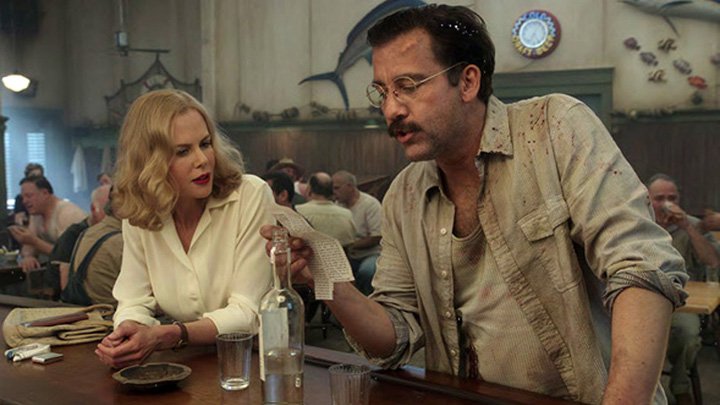
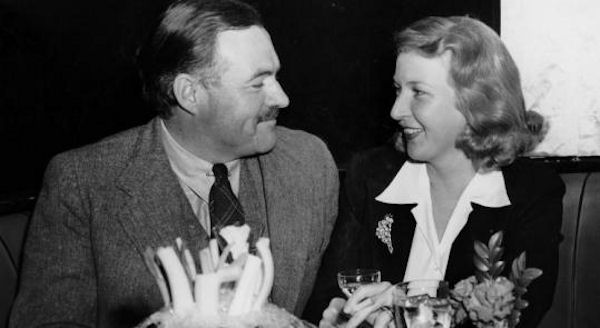
Clive Owen was acceptable as Hemingway, but I couldn’t feel him as Papa. Hey, I’m willing to allow that perhaps my own attachment to the character is strong enough to have created impossibly high standards. (Owens’s acting was perfectly fine, though. My father-in-law commented that Hemingway was a real drunken braggart asshole! To which I say, yes! He was authentically portrayed, as well!) I will say that I think Hemingway himself was handsomer than Owens, where Kidman has the opposite problem: she was, if anything, too beautiful, too glamorous, to be Gellhorn. Gellhorn was a lovely lady, don’t get me wrong, but Kidman is a knockout. See for yourself:

Clive Owen as Ernest Hemingway & Nicole Kidman as Martha Gellhorn

the real Hemingway & Gellhorn


While we’re discussing actors, I thought Parker Posey made a surprisingly perfect Mary Welsh. Who’d have thought? If you had told me who would play her role, I would never have believe she could pull it off – for one thing, look old enough! – but she was actually exactly the right person for that role. Casting director, I apologize for my skepticism.

I think the film’s strongest moments were definitely in Spain. The chronology goes: couple meets in Key West (overwrought dialogue abounds); they travel to Spain (lovely cinematography as well as great acting, great images, and – take note – fairly graphic sex); couple moves to Cuba and purchases the Finca Vigia, relationship starts falling apart; Gellhorn continues to pursue wars around the world, and the film loses just a little bit of its magic. Particularly when she visits Dachau and then Auschwitz and comments on the effect of those horrors on her psyche, I felt that it was handled too cursorily. Perhaps a film should not enter Dachau without investing the time, energy, and emotion that it deserves? That was a strange 30-second sideplot; it felt a little disjointed to me. By all means tell us about Dachau if it belongs in your story; but in that case take a minute to do it right. …This is really just a quibble, though.

Final scenes included Hemingway’s great descent into depression and craziness, and finally, his suicide. I had mixed feelings. If this is the story of Hemingway and Gellhorn, I’m not sure his demise really plays into it. But it was necessary, I suppose, to make sense of Gellhorn’s final remarks about his death 30 years past. Hemingway and Gellhorn’s deteriorating relationship felt accurately portrayed, and I liked the frame of an elder Gellhorn reminiscing the rest of the story for us, then going off back into battle. That part was accurate, too.

I wondered many times whether I was seeing real, authentic, historic footage of various scenes from the various wars depicted. I feel confident that at least *some* were authentic; but I doubt my own ability to draw the line. This is high praise.

I think one of the things it is easy to misunderstand, when watching a movie about Hemingway (this is true of Gellhorn, too), is that his life really was that wild, adventurous, exciting, dangerous, and filled with big names. He really did bully John Dos Passos that unrelentingly, and they really were friends (sort of, in the way men could be friends with Hemingway) through it all. The most outrageous parts of this film were perhaps the truest parts.

Recommended!

best of 2012 to date: second quarter

As we enter the sixth month of the year, I want to share with you my favorite books of 2012 so far. Consider these my strong recommendations. I review a lot of books here at pagesofjulia (I’ve read 61 books so far this year! although some of those reviews are yet to come, they will all be reviewed), but I do not recommend all of them, as you know.

Two sections here: first, I have four books that I’ve loved and encourage you to check out. And then, some general notes about what I’m enjoying, in broad categories.

The four best books of 2012 so far come in an even mix. Two audiobooks, two in print; two brand-new, two a few years old. (None older than ten years here, but see the second section below.) Three fiction, one non. In the order I discovered them:

  • A Difficult Woman, a new (April 2012) biography of Lillian Hellman by Alice Kessler-Harris. Hellman was a controversial and contradictory figure, multi-faceted and fascinating, and I love Kessler-Harris’s handling of her complicated life, which touched upon so many areas of politics and art; K-H presents H as a sort of representation of the United States in the twentieth century. This book made me want to do huge amounts of further reading!
  • The Likeness (two-part review) was Tana French’s first novel, and my favorite of her three (though I enjoyed them all). Cassie Maddox, a Dublin detective, goes undercover as a dead girl, who was posing as a fictional person, one of Cassie’s earlier undercover personas, to try to catch this mystery girl’s killer. She infiltrates an incredibly close group of cohabitating students, almost a family, and fuses into their world alarmingly well. I listened to the audio version and adored all the accents.
  • The Lacuna I listened to as an audiobook, read by the author, Barbara Kingsolver, and I recommend this format as well as the book itself. It is the (fictional) story of a man who is raised back-and-forth between the United States (where his father lives) and Mexico (where his mother is from), spending his formative years in Mexico City employed by the household of Diego Rivera, Frida Kahlo, and for a time, Leon Trotsky. This is a fascinating book about people, some famous, some not, and the McCarthyist period in the US. Kingsolver performs the voices and accents beautifully.
  • The Song of Achilles is Madeline Miller’s first novel, and what a feat! This is the story of Patroclus, a minor character in Homer’s Iliad. Here he becomes protagonist and narrator, telling the story of his upbringing and lifelong close friendship with Achilles (eventually his lover), and the ten years they spend at Troy making war. Very moving.

EDIT: Check out last night’s announcement of this year’s Orange Prize winner: Madeline Miller, for The Song of Achilles! I have good taste. 🙂 If you look closely at past years’ winners, you will see another of my top four as well!


SECOND EDIT: Also check out my interview with Madeline Miller, which was such fun!


Section the second:

After choosing the above four individual books (no difficulty really, as each jumped out at me decisively), I wanted to share a few areas I’ve been reading in with great enjoyment. For one thing, you have probably noticed (if you follow me) that I’ve recently (re)discovered Edward Abbey and other nature writers. I can’t choose one book by Ed Abbey to especially recommend. So far in 2012, I have loved all of his that I’ve read, and the two “further reading” books he’s inspired. They are:

  • Fire on the Mountain, a lovely novel (based on history) by EA about an old man holding out when the government tries to take his ranch from him to use as a missile range, and the grandson who stays to fight it out with him.
  • The Journey Home is a collection of EA’s essays and journalism, every single one a gem, and similar to
  • Down the River, another collection, with a river theme.
  • The Monkey Wrench Gang is EA’s best-known novel, about a gang of social misfits practicing sabotage against industry & government when they threaten nature. Wild and wacky.
  • Edward Abbey: A Life is a biography of EA by James Cahalan, and I found it well-done, on top of the obvious attraction of its subject being totally engrossing.
  • Walking It Off is a memoir by Doug Peacock (EA’s close friend, and inspiration for the hero of The Monkey-Wrench Gang) of his life as a war veteran and untamed eco-defender, and as EA’s buddy.

Along these sames lines, I found Aldo Leopold’s A Sand County Almanac lovely, beautiful, inspirational, educational, and an important part of my study of Abbey and his ilk.

And finally, I have to mention my consistent favorite guy, Ernest Hemingway. In this case, the standout book is by his son Gregory. Papa: A Personal Memoir, is heartrending and sensitive, and a uniquely loving portrait of EH.

I have been long-winded as usual. In a nutshell: the four titles up top, and any Edward Abbey or Ernest Hemingway (or select related readings), deserve your attention this year!

What have YOU read so far in 2012 that has blown you away?