vocabulary lessons: The World’s Strongest Librarian

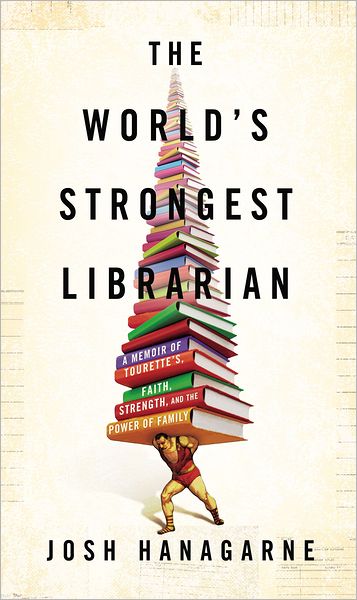
worldsstrongestLeave it to an author as well-read as Josh Hanagarne to stump me several times over! I keep a piece of scratch paper as a bookmark, one sheet faithfully dedicated to each book, for keeping notes: page numbers for referral or quotation, words to look up, thoughts that belong in my review. If I have to look up more than 1-3 words in a book of standard length, that book often finds its way into a “vocabulary lessons” post. Here are the words that I learned from The World’s Strongest Librarian.

revenant: “one that returns after death or a long absence.” As used, a great way to poke fun at the ultra-serious character in question.

elided: “to suppress or alter (as a vowel or syllable) by elision” (a prime example of the crime of using the word in its own definition! shame on you, Merriam-Webster) or “to strike out (as a written word).” Not to be confused, I suppose, with redact, a term I was more familiar with and which did come up as a “related word.”

D and C: a most unpleasant-sounding surgery performed for, in this case, a very sad condition.

fontanelle: that soft spot on a baby’s head that you have to be careful of until the skull zips up properly. I am not a person well-versed in babies, in case you couldn’t tell. Used here in a metaphoric sense which I found quite effective, and topical.

Bonus: I went out the other night for beers with a girlfriend who also works in health care, and she dropped one on me that I’d never heard before. Because I’m a logophile, I had to go look it up right away! Lisa says that perseverate is word mostly used in health care; and the definition, to “repeat a response after the cessation of the original stimulus,” does fit with Lisa’s specialty in treating neurological conditions. There you go – learn something every day, even at the local pub. Thanks Lisa!

Sorry to say, folks, that The World’s Strongest Librarian will not be released for some time (May 2, last I saw). But in the meantime, you can check out Josh’s blog.

And if you’re interested – you can see a few more “vocabulary lessons” posts here.

movie: The First Time (2012)

More airplane movie-watching here, and I’m a little embarrassed, because it’s “just” a teeny-bopper romantic comedy. But I am here to report to you on my reading & movie-watching, and I am faithfully reporting.

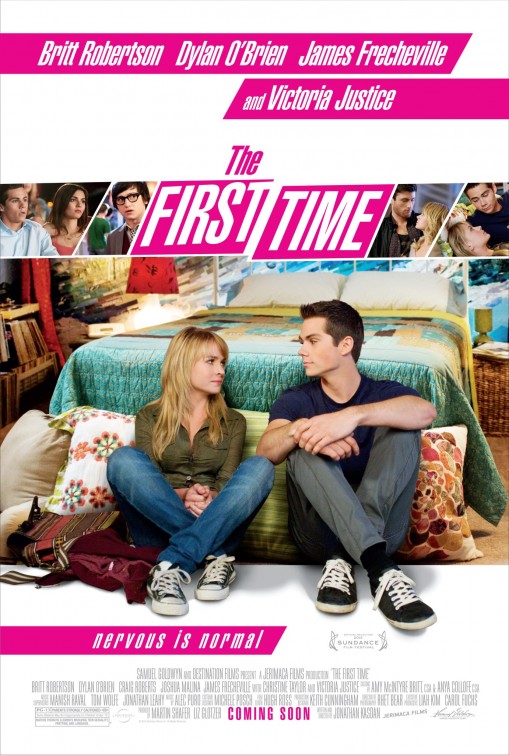
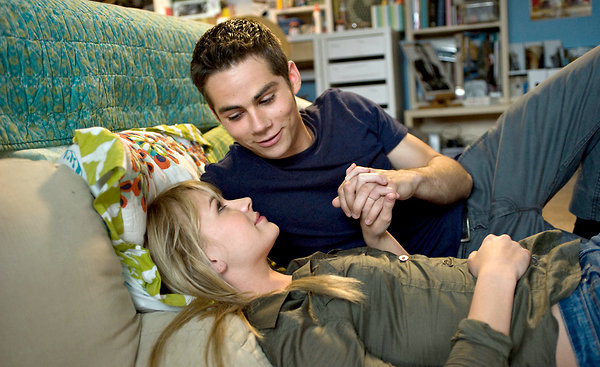
firsttimeThe First Time is a new (2012) movie about two teens. Dave has been pining for his “just a friend” Jane, and is working on getting up the courage to say something to her, but viewers will note that he is firmly in the friend zone with her and things don’t look good. Aubrey has an older (out of high school) boyfriend, but he’s a self-centered, immature jerk who doesn’t seem to notice her creative side. They meet at a party and are clearly drawn to each other. They do some dating. And they have sex. For the first time.

It’s rather pat, and mostly something I’ve seen before, but it’s very sweet. And its teenage interactions are pretty accurate, actually. I couldn’t decide if the philosophizing was accurately teenaged in its grandiosity, or just overdone, but I suspect it might have been fairly authentic, too. I doubt I have any teen readers who will let me know. 🙂 It was only airplane fodder, but I have to admit, I enjoyed it. And I found myself thinking about those cute kids a day or two later, so touché, teeny-bopper romantic comedy, you have gotten inside my head.


Finally, I can definitely understand the kids getting excited over those two darling actors! This is exactly the kind of thing that would have captured my heart in middle school – I would have crushed on that actor (his name is Dylan O’Brien, as it turns out). Better than it might have been.


Rating: 5 nervous glances.

movie: Gentlemen Prefer Blondes (1953)

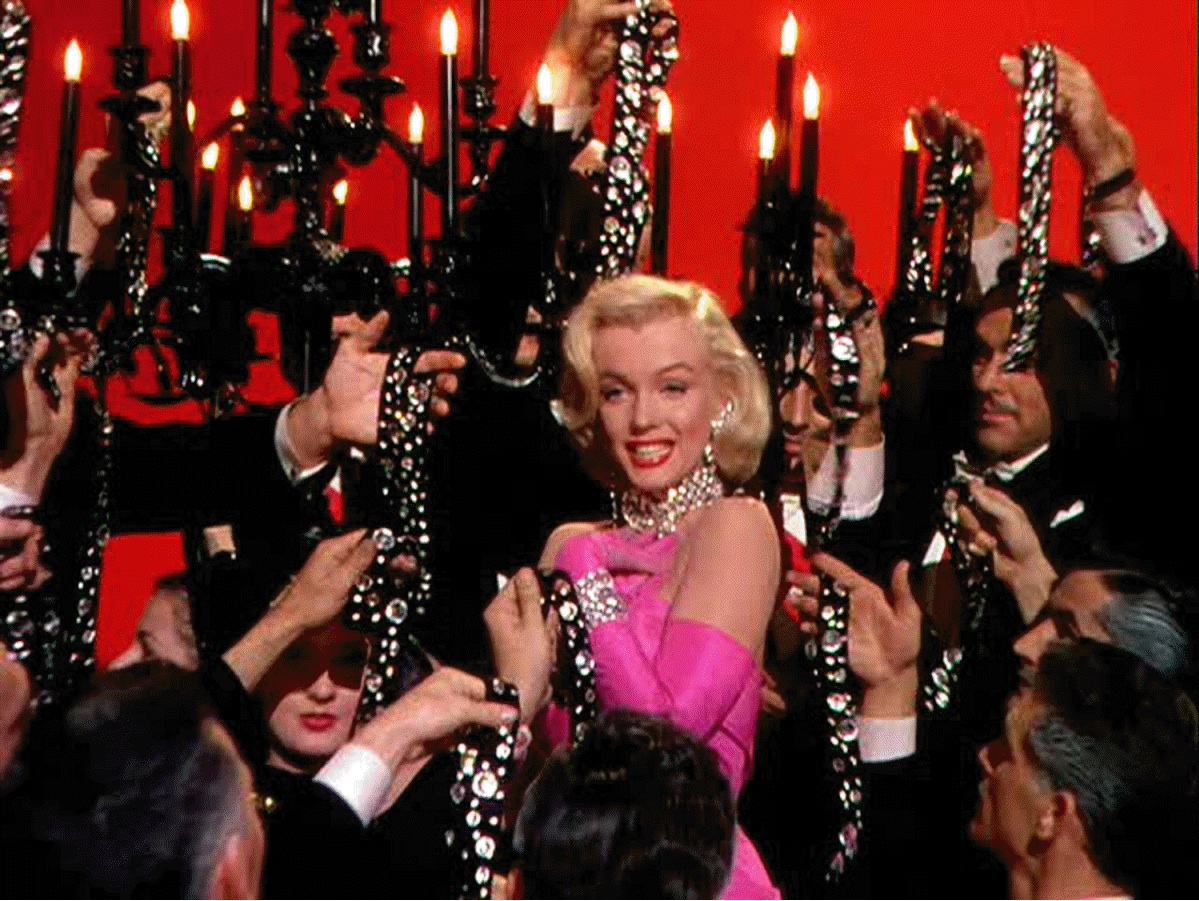
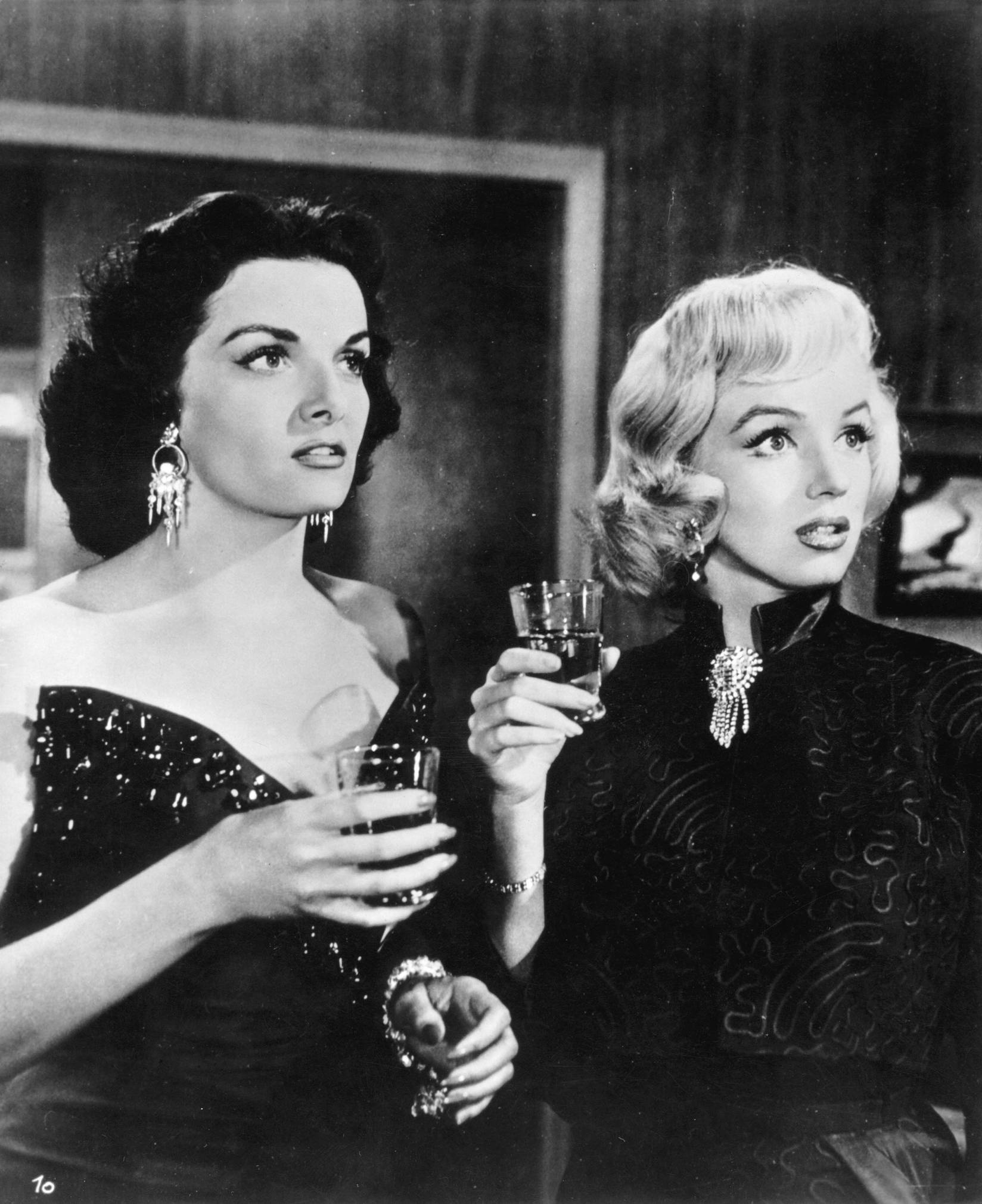
Another classic for you that I found on the airplane: Gentlemen Prefer Blondes, starring Marilyn Monroe and Jane Russell! I had never seen either in a movie before (isn’t that shameful?). And aren’t they both fabulous. I confess, though, I came in rooting for Jane, as the title made her the underdog from the start. [Full disclosure: I was born a blonde and am gradually darkening towards brunette as I age. Does that make me neutral?]

I almost don’t want to bother with a plot synopsis here, as I felt the plot really wasn’t the point, but okay. Jane & Marilyn (I have lost track of their characters’ names) are showgirls. Marilyn is quite a ditzy blonde, and concerned with marrying a man with lots and lots of money. Jane likes to have a good time and wants a man who wants the same, money be damned. Marilyn has a fiancé who is requisitely wealthy, and they intend to marry in France, but his father prevents him from sailing, because he objects to the gold-digging Marilyn; thus Marilyn & Jane sail together. The action of the movie takes place on the ship, where Jane meets a man she might be able to settle down with, and Marilyn meets the owner of a diamond mine and goes bonkers over that possibility. (Enter the song, “Diamonds are a Girl’s Best Friend.” I am rather offended.) From there on it’s all spoilers. But again, the plot isn’t important.


There is mischief and chicanery. This is a comedy, as it turns out, not only an exhibition of the fabulous Jane and the fabulous Marilyn – who do rock every scene in classic, visual splendor. The high-jinks are fun and the slapstick is quite charming. And it’s a musical as well, although there is far less singing than there might be. I was surprised and pleased to note that there is some objectification of the men – how progressive! And they are some nice looking men, too.

I found this film to be more of a fun visual spectacle with great slapstick than such a great story. But there’s no question it was enjoyable – and classic.


Rating: 6 glittery diamonds (naturally).

movie: A Streetcar Named Desire (1951)

On my recent very very long overseas flight, I watched several movies. Thanks Husband for spotting this classic for me! As you may know, A Streetcar Named Desire was a play by Tennessee Williams, published in 1947. I have not read the play, although I studied his Glass Menagerie in high school and appreciated it. Now that I’ve seen the movie, I want very much to read the original, and I would love to see one of TW’s plays performed one day. This film was released in 1951, directed by Elia Kazan, and stars Vivien Leigh and Marlon Brando – wow! [Also in high school, I studied Kazan’s On the Waterfront, alongside Arthur Miller’s The Crucible. Guess what the connection there was.]

You can get a plot synopsis anywhere, so I’ll be brief and spoiler-free. Blanche DuBois shows up at her sister Stella’s apartment in New Orleans from the plantation back in Laurel, Mississippi. She tells Stella that the plantation has been lost and she needs to stay a while. While Blanche is a delicate, swooning southern belle, and Stella a tougher urban woman, Stella’s husband Stanley is all muscle and sensuality. He has no patience with Blanche’s needy weakness, and her presence throws the small household out of balance, just as Stella is expecting a child. There is conflict. I’m stopping there.


This is a masterfully put together film. I positively adored the black and white French Quarter setting: although more than 50 years old now, it was instantly recognizable. I could almost smell the booze and feel the humid heat. Vivian Leigh, Marlon Brando, and Kim Hunter (Stella) are all so perfect, picturesque, and work as archetypes of the characters they play. Kazan is a master of the use of light and dark. Blanche undergoes a metamorphosis of sorts when moving from shadow to light – there is a dramatic scene dealing with the issue. And while I’m on dramatic scenes, the style here is highly melodramatic, with Blanche being the perfect example of what that means: fluttering hands, shrieks and gasps and exclamations, “OH! I just don’t know how I can take it…”, all of which are perfect for her damaged-southern-belle role. And perhaps this adds to the melodrama, but clothes sure do tear easy in this movie. I gave up counting the clothing that got ripped in the action.

Here’s a quick discussion with spoilers. Highlight the following white text to read: I was a little maddened by not knowing whether Stanley raped Blanche in that fade-to-black scene. So I looked it up. Wikipedia tells me that it is indeed only “implied” in Williams’s original. They certainly carried the implication into the film. I think he did rape her. I also learned from Wikipedia that Blanche’s husband had a homosexual affair prior to his suicide, which I had not gathered from the movie; and sure enough, it is later stated in the article that this detail is left out of the film, because of the Hays code. This is unsurprising in context, as I recall from high school that Kazan was a good, government-compliant filmmaker.

Tennessee Williams is absolutely recognizable to me from The Glass Menagerie: he likes his damaged and increasingly crazy southern belles, and their gentlemen callers, doesn’t he? I felt I’d seen Vivien Leigh deliver her closing line before: “I have always depended on the kindness of strangers.” But I’m sure I hadn’t. Maybe it’s just that famous.


As a piece of excellent directing and acting by all three leads (and isn’t Brando smoking hot), and as a fine production of a very fine play, I give this one a near-perfect rating and recommend it as a classic film.


Rating: 9 fluttering eyelids.

movie: Inglourious Basterds (2009)

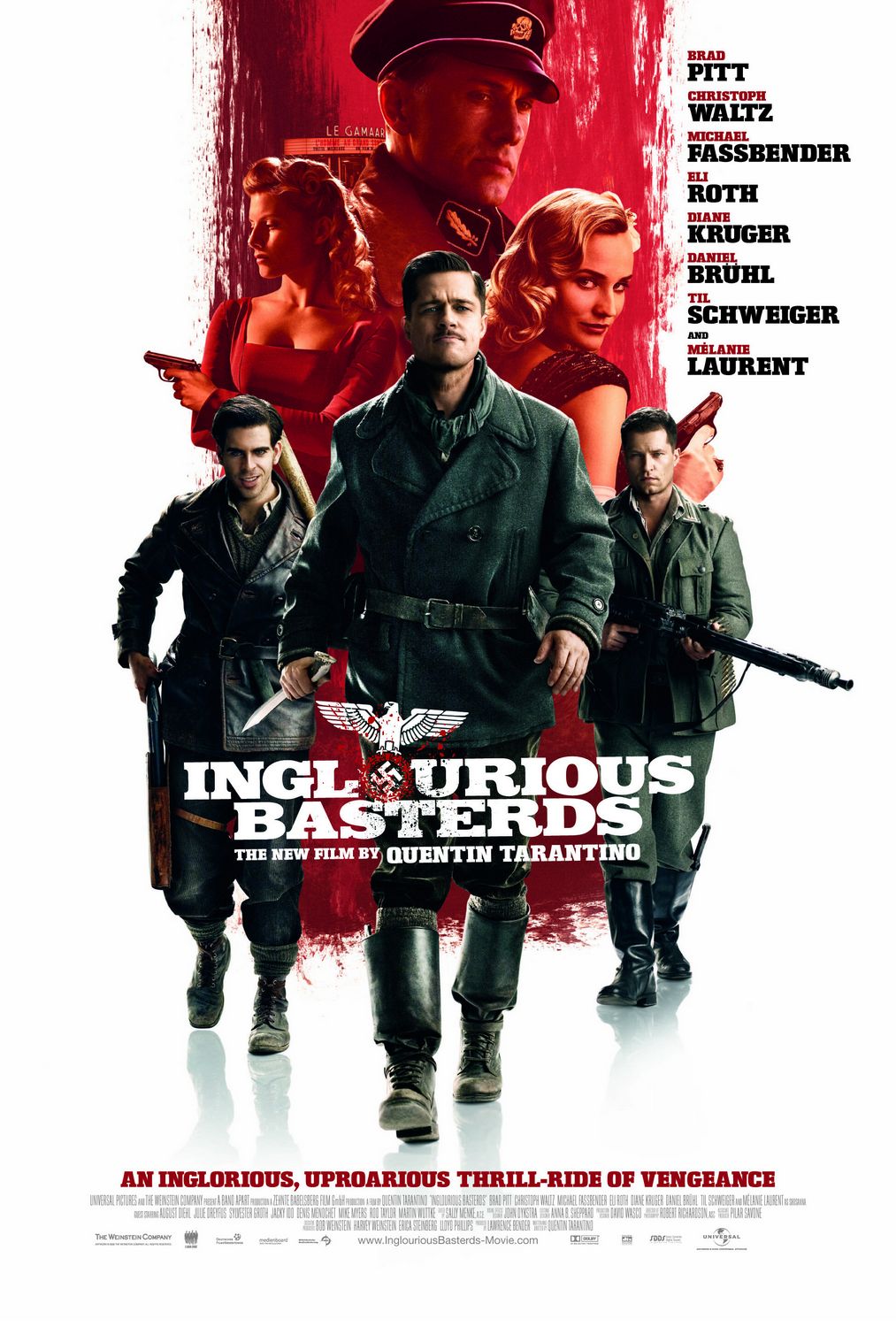
inglouriousYes, spellcheck, that is how you spell this movie title.

It’s movie week here at pagesofjulia, isn’t it? Funny how that happens. Inglourious Basterds is another Tarantino film, from 2009, an alternate-history of World War II starring Brad Pitt as the heavily-Southern-accented leader of an American military team called the “Basterds,” and Christoph Waltz (who was positively outstanding in Django Unchained) as an S.S. leader named Landa. In this telling, the Basterds put together a plot to kill Hitler; but they’re racing a young Jewish woman named Shosanna (played beautifully by the lovely Mélanie Laurent), whose family was killed several years earlier by the “Jew Hunter” Landa. Shosanna is being courted by a young Nazi war hero, but her hatred (obviously) still burns hot, and she takes advantage of an unlooked-for opportunity to plan her own assassination of Hitler & the Nazi leadership.

In my opinion, this is not Tarantino’s best work. There are the requisite bloody scenes and over-the-top clever dialogue – the latter normally a fantastical element I enjoy, but here it kind of fell flat for me. Shosanna’s character is lovely and I felt that she could have been a little better explored. Landa’s character was also eye-catchingly evil. Maybe I just don’t like Brad Pitt, but the Basterds were less interesting than they should have been; maybe a little more character development there. The two parallel plots to kill Hitler could also have been more deeply mapped out for me. The whole thing lacked depth and interest for me, especially compared with Tarantino’s fine work in other films. [My favorites include Pulp Fiction, Natural Born Killers, and my personal favorite, True Romance, which Tarantino wrote but did not direct. Both Kill Bill‘s were great, and Django Unchained was outstanding as well.]

Perhaps I am not entirely sold on the beauty of a farcical WWII history in Tarantino style. Why would that be, when I appreciated the Tarantino treatment of slavery so much? I don’t know. I credit incomplete character development and a storyline that tried to accomplish too much without delving deeply enough into any of its plots. Sadly, not up to Tarantino’s standards in my book.


Rating: 4 scalpings.

On the plus side, I’m celebrating today’s over-Hallmarked, under-romantic holiday with Tarantino, and that makes me feel good. Happy Valentine’s Day!

movie: Lonely are the Brave (1962)

Here’s another movie I made a point to find after reading the book. Very few of Edward Abbey’s books have made it into film. His most famous novel, The Monkey-Wrench Gang, has been optioned repeatedly but appears doomed to never grace the silver screen, owing (I think rather obviously) to its anti-establishment themes: no Hollywood mogul would involve himself in something so sacrilegious. But The Brave Cowboy was made into a movie starring Kirk Douglas in 1962. Here he is fighting a one-armed man with one arm behind his back in a raunchy saloon:

fighting

The movie is faithful to the book’s plot only in its actions, and not in its motives. The cowboy Jack does ride into town on his horse with the intention of busting his old buddy Paul out of jail; he does kiss Paul’s wife in the process; he does end up in the mountains fighting an archetypal battle against the sheriff and his men, complete with military technologies and sweeping vistas.

vista

It is, in short, a fine Western. What the movie version left out, however, is Jack and Paul’s past together as political protesters. There’s no mention of what Paul’s doing in jail in the first place (dodging the draft, and refusing to take conscientious-objector status), let alone their history in anarchist organizations and their shared hatred of The Man. That would be a little too much even for our Western hero, presumably: better that he be nostalgic about the days of horse and rider herding sheep, and not specifically interested in taking down the federal government. Can’t say I’m surprised. My final gripe would be that the sheriff, Morey, was not cast nearly as fat and bumbling as he reads in the book. At least they left in the taking down of the helicopter; that was fun.

This movie is a simplified and sanitized version of the better book upon which it was based; but that’s what I mostly expect from movies made from books. Some of the dialog seems to have materialized out of thin air, most definitely in the case of Jack’s monologue about being a loner – I suspect Abbey could have rendered such a scene much finer (and funnier) if he’d wanted it in his story in the first place. But it was still a fun romp alongside an Abbey-like hero, just dumbed down. I don’t regret my 90 minutes, but it sure is nice to dream about a proper movie made of The Monkey-Wrench Gang or the like. Sigh. Not a bad film, but not too terribly close to its literary origin.


Rating: 5 stoic grins.

Closing credits: thanks to my neighbor Adrian for helping me find this not-easy-to-find movie. You get a 10-star rating, Adrian!

movie: Carrie (1976)

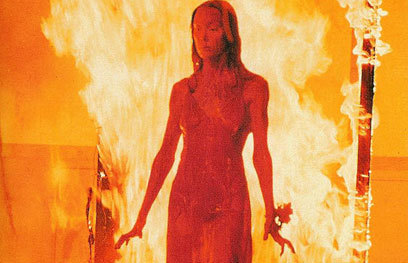
You will recall that I recently read Stephen King’s Carrie, and was very impressed. I then made it a point to watch the classic 1976 movie starring Cissy Spacek.

classic shot from the final scenes.

classic shot from the final scenes.

The movie is reasonably faithful to the book in terms of simple plot. Carrie gets her period, is abused by the girls at school, is asked to the prom by popular Tommy whose popular girlfriend Sue has put him up to it (for mostly altruistic motives), is abused at prom, goes red in the face and uses her recently discovered special powers to get hers back.

But the book lost a lot in its translation to film. For one thing, the structure of the book was part of what made the total package so striking; and we necessarily lost a huge majority of the interior thoughts shared in the original. We lost important pieces of Carrie’s family history (the stones falling on her house were left out entirely) and of Chris and Billy’s evil machinations. Also, wasn’t Margaret White entirely too pretty on screen??

I thought the movie did capture the creepiness factor fairly well, although I was not much frightened by the movie, maybe because I already knew everything that was going to happen and felt less a sense of dread than I would have if it had all come as a surprise. (Although I’m easily frightened by movies. So, maybe take a half point off for not frightening me.) I will say one thing, and this is a spoiler if you haven’t seen the film, so highlight the following white text if you want to read: the final scene, where Sue takes flowers to Carrie’s grave (or home site?) and Carrie reaches up and grabs her wrist “from beyond” – that wasn’t in the book and I swear I jumped a foot when that hand appeared. Holy smokes, I was frightened. But I don’t know where that even fits in the story crafted by Stephen King, so again, I’m not giving full points for this.

Final conclusion: a fine movie, entertaining, but hardly worthy of the book it was based on. What else is new?


Rating: 5 cruel high school girls.

just for fun: authors and their drinks

port-logoI just couldn’t help but share this mouthwatering article with you here. “Combined Measures: Great Writers & Their Drinks” features just five authors, but unlike some such articles I’ve come across, 100% of those featured authors are ones whose work I like; and all five drinks, as well, whet my palate. You will note that my favorite, Hemingway, is present (as he ever will be, where alcohol is discussed). I am tempted to try some of these myself… particularly the accompaniment to Kerouac’s cocktail, discussed on page one.

Enjoy. 🙂

And do share: which author, or drink, do you fancy?

article from TIME magazine: “Best, Worst Learning Tips” by Annie Murphy Paul

I do all sorts of reading, as you may have noticed here. I read fiction, some of it quick and easy reading (thrillers), for fun and the enjoyment of being caught up in the story; I read classic fiction for appreciation of the art form. I read nonfiction for the sake of learning more about my world, in so many diverse areas, because I love learning new things. I read books so that I can write book review for Shelf Awareness (although only the sort of books that I already enjoy reading). I read travel guides to help me plan trips. I read other people’s book blogs (although I am woefully behind on this) because I like hearing what they (you) have to say. I also read health information in my job as a medical librarian, in an effort to serve my patrons/patients with the best information available.

It’s been a little while since I’ve been in school formally, pursuing a specific degree; but I take short training courses here and there, and I am always aspiring to further schooling. If I had all the time and money in the world, you can bet I’d be a student again.

The advice implicit in the article linked below seems to be aimed primarily at students; but I believe that if we stop to consider, we all read because we want to learn something from our reading material (even if it’s just whodunit).

A friend of mine who works in higher education posted this to facebook – and I hope he won’t mind me quoting him: he called it “a very nice empirical discussion of learning strategies, something not all that common in the education literature.” (Thanks, David!) And here you are: “Highlighting Is a Waste of Time: The Best and Worst Learning Techniques” from TIME magazine. I thought it contained some good ideas for students or learners of any type. Of especial interest to me was the conclusion in the title: that highlighting is a waste of time (not least because it’s distracting to the reader). I couldn’t agree more! My high school English program actually graded us on our highlighting (we had to turn in our books for perusal). Sigh.

What’s your reading style? Are there any tips or conclusions in this article that surprise you or that you especially applaud?

movie: Rosemary’s Baby (1968)

I meant to watch Lonely Are the Brave, the movie based on the Ed Abbey novel The Brave Cowboy that I read recently. But I couldn’t find it on my neighbor’s Netflix. So we watched Rosemary’s Baby, instead. Also based on a book, but one I haven’t read, this is a 1968 horror movie directed by Roman Polanski and starring Mia Farrow.

Rosemary (Farrow) and her husband Guy move into an apartment in New York City with big rooms and a strange history; in fact the whole building is known for odd and eerie happenings, including the suicide of a young woman Rosemary meets once when she moves in. Rosemary is trying to become pregnant. Guy makes friends with the rather nosy, creepy older couple that lives down the hall, the Castevets. After a strange night when it seems that Rosemary has been drugged, she does become pregnant, and she’s thrilled; but the experience is mostly pain & suffering. The Castevets set her up with an obstetrician who prescribes herbal drinks mixed by Mrs. Castevet, and doesn’t take seriously Rosemary’s extreme pain. And when the baby is born… well. If you want the spoilers, they’re out there on the internet.

photo credit

Rosemary is frightened. (photo credit)


Despite its age, which sometimes weakens the effect of movies like this one which rely upon emotional impact (when they seem dated, silly, or have poor special effects), Rosemary’s Baby succeeded in freaking me out. It was noticeably dated, of course, in terms of Rosemary’s outfits, the decor of the apartment, and the somewhat revolting gender roles in Rosemary and Guy’s marriage. Funnily, it reminded me of The Shining, made fuller 12 years later in 1980: the opening scene has Rosemary & Guy being shown around the apartment they will rent, full of a sense of foreboding, and recalled the scene in The Shining when Jack Torrance and family are shown around the Overlook Hotel. This datedness was rather charming, though, and any connection I felt to The Shining could only do it good. And the creepy factor was fully there. Neighbor Gracie and I both wished they had shown a particular frightening item at the end of the movie, which we only see through Rosemary’s horrified reaction; but with the special effects available at the time it would have been poorly done, which is clearly why Polanski refrained, for the best.

A quick dip into a disturbing story, well done, even after 45 years.


Rating: 7 mystery herbs.