movie: Walking Tall (1973)

walking tallIn this movie, Buford Pusser returns home, after a stint in the Marines and a career as a wrestler, to McNairy County, Tennessee with his wife and two children. The town has changed since he’s been away. Almost immediately, he gets beaten nearly to death at a bar where he busted the house cheating at craps. The sheriff wants nothing to do with the case, and tells him to drop it. Buford returns to the juke joint to beat the crap out of his attackers in turn; represents himself at trial for assault charges, and wins; and then goes on to run for sheriff, and win.

As the spunky new sheriff, Buford is determined to run the gambling, prostitution and illegal stills out of his home county. Corruption runs so high, however, that he is nearly a one-man crusade. He has a staff of deputies, a few of whom are loyal. But it’s uphill work.

This plot is based on a true story, and here I’ll confess that my interest is not in this movie in its own right. Instead, I am fascinated by the larger debate this movie is a part of: the legend and history of Sheriff Buford Pusser, in its various representations. I first heard of Pusser and Walking Tall in a couple of Drive-by Truckers songs. (Regular readers may recall this is my favorite band.) In “The Buford Stick,” I heard the perspective that Buford Pusser was a crooked sheriff and a bully, messing around with a system that had worked just fine before he came along, thank you. Or, from the lead-in to “The Boys From Alabama”:

We’re gonna take you up to McNairy County, Tennessee
Back in the days when Sheriff Buford Pusser ran things around there
Sheriff Buford Pusser was tryin’ to clean up McNairy County, Tennessee
From all them boot leggers that was bringin’ crime and corruption
And illegal liquor into his little dry county
And for his troubles he got ambushed, and his wife was murdered, and his house got blown up
And they made a movie about it called “Walkin’ Tall”
This is the other side of that story

And that’s what I knew about the movie.

One of the many things I love about the Truckers is that they are unafraid to look at the complexity of the real world, its ugliness, and they don’t turn to the easy out of choosing sides: they are neither consistently pro-establishment nor anti-authority, because it’s not that clear-cut, is it. In the case of Sheriff Buford Pusser, with these two songs, they experiment with the perspective of McNairy County’s criminal element – or, to put it another way, “a hardworking man with a family to feed.” In other songs and other cases drawn from real life, the Truckers continue to question corruption in positions of authority.

The movie shows Pusser in an on-balance-positive light; among other things, he pushes (not always gracefully) for civil rights for the black residents of McNairy County. But even in this portrayal, there are disturbing glimpses: he is not a fan of rights for the (alleged!) criminals he pursues, and I didn’t enjoy the scene when he is arresting a prostitute and slaps her ass. This history, like so many in life, was probably pretty complicated, with good guys and bad guys on both side of the law – or, good and bad within each guy.

I love this stuff: layers, ambiguity, and especially the intersection of art (movies, songs) and deeply serious real life. This is probably a great example of the interdisciplinary nature of life. (Even a teaching opportunity!) Literature and other creative, fictional forms comment on life, which responds to literature.

So I found the viewing experience engrossing, for reasons outside the movie itself. The movie itself is fine, and interesting; it certainly paints a picture of a time and place. And I think even without a backstory that it should provoke some consideration: like, just how “good” are the good guys? A social study, to be sure. I’d recommend this for any number of audiences.


Rating: 8 routine matters.

movie: Dirty Harry (1971)

I watched this movie because of a tiny mention of it in the description of a seminar I was preparing to attend. It was totally unnecessary as prep but what the heck, it was an excuse to see a classic I’d never seen before.

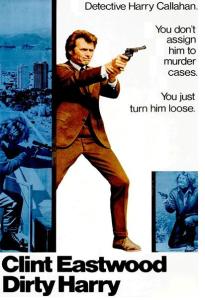
dirty harryWell, heck. I’m sure I’m supposed to admire this one, and I can certainly acknowledge that it must have looked much different in 1971. 1971. Do you realize that was 45 years ago? Golly. How old was Clint Eastwood in 1971? (He was 41 years old in 1971.)

This one is too well-known and much-written-about for me to waste many words on plot summation. “Dirty Harry” is Inspector Harry Callahan of the San Francisco Police Department, and he is investigating a crazed killer who calls himself Scorpio. Harry is a curmudgeonly fellow who is unhappy to be paired with the new, “young” cop Chico (who doesn’t look any younger than Harry to me).

So, in a different era, this movie must have had a very different effect on audiences. Some old films seem to hold up better than others. Here, I just found too much to pick at. How does $200,000 in tens and twenties fit into a little handbag? How did the doctor know to call in about the guy with the knife wound? (Presumably they put out an APB, but off-screen?) And with Harry being such an experienced investigator and all, it didn’t really ring true for me that he got his first lesson in evidence admissibility, legal searches, etc. in that lawyer’s office on this case. Maybe I’ve seen too many police procedurals. Finally, Harry’s classic line about how many bullets are left in the gun and do you feel lucky, punk? really fell short for me considering that other guns seemed to have unlimited bullets in them (as others also caught). Husband joked, “what are these, Walking Dead guns?” Ha.

More broadly, the killer Scorpio’s motivations, or the nature of his psychopathy, are never made clear. Again, maybe I’ve seen too many more modern shows. Harry’s general “dirty” attitude likewise receives no explanation or backstory. It’s just a shoot-em-up, and for pure shock effect, the 45 years that have passed since filming have done this film no favors. Perhaps if I had the nostalgia to attach me…

Sorry, fans.


Rating: 5 bullets.

movie: Stand by Me (1986)

Some months from now, you will see my review of Stephen King’s The Body, by Aaron Burch. One of the Bookmarked series, this slim book combines personal essay with literary appreciation – or in this case, film appreciation. Stand by Me is a movie based on Stephen King’s novella “The Body,” out of Different Seasons (a collection that also included “Rita Hayworth and the Shawshank Redemption”). For this reason, I put the book down halfway through to see this movie for the first time.

stand by meReleased in 1986, set in flashbacks to 1959, Stand by Me stars River Phoenix, Wil Wheaton, Corey Feldman and Jerry O’Connell as four childhood friends. Over a weekend, they hike through the woods to view the dead body of a boy their age, learning along the way about friendship and loss. It is a coming-of-age story.

I think I can see Burch’s attachment to this film, but it had a different effect on me, coming to it in adulthood. The emotional tones are there: sweet friendship, the pain of helpless childhood and loss at any time of life, nostalgia. I get them all, but I can see from here how they work; I didn’t get bowled over as Burch did. It is undeniably a sweet and sad story, though.

I marveled at how loving these boys are: lots of hugging, arms around one another, extended eye contact, explicit words of comfort. Have we gotten more homophobic as a culture since these days? I can’t see little boys loving each other this earnestly and physically today, which is sad. Maybe I’m wrong. I hope I am.

I enjoyed the humor, the pathos and the loving friendships. It was worth my time – especially in being able to appreciate Burch’s story. But I’m afraid it doesn’t have the same effect on an adult today that it did on a kid in the 1980’s, and I regret that. I’m also interested in “The Body” now (of course).

A worthwhile snapshot in time, but not one that reads the same now, unsurprisingly.


Rating: 7 cigarettes.

movie: Genius (2016)

I have had a book on my shelf for years called Max Perkins: Editor of Genius, by A. Scott Berg. I haven’t gotten around to reading it yet, sadly. But you know I was thrilled to see this movie come out. Genius is based on the book: it’s about Max Perkins of Charles Scribner’s Sons publishing house, who shepherded the careers of Ernest Hemingway, F. Scott Fitzgerald and Thomas Wolfe, among many others.

geniusThis movie is about Perkins’s relationship with Thomas Wolfe (although Fitzgerald and Hemingway make brief appearances). I knew almost nothing about Wolfe when I came to the film, and my impressions of Perkins were hazy, based on what I know of Fitzgerald and Hemingway: I understood him to be a decent, humble, kind man, well-suited to handle such stormy personalities and expert at doing so. He is known to be both a very fine editor and a very fine guardian and guide to the difficult men who were his three most famous writers.

These impressions were held up by the film. Perkins (Colin Firth) is quiet and modest and professional. Thomas Wolfe (Jude Law) is wild: noisy, passionate, emotive. Talented, but unrestrained in several senses. He sought a father and Perkins sought a son, and their relationship is characterized as such. Together they produced Look Homeward, Angel and Of Time and the River.

Wolfe’s lover and patron Aline Bernstein, played by Nicole Kidman, is an especially tragic character. The couple’s threats and fights add pathos and drama to that already provided by Perkins’s conflicts with his own wife (he is perhaps overly committed to his work) and the fiery, explosive talent Wolfe sprays across his life and Perkins’s offices. The acting is great – to be expected from such a cast.

Following closely on my viewing of Papa, I saw parallels. Literary talents can be oh so dramatic, and their lives can be woeful, tragic and (again) dramatic. I enjoyed both movies very much, but I confess they often hit the same emotional notes. This strikes me as accurate; but I can see where a viewer less invested than I am could perhaps get a little weary. These are the risks of loving characters like Hemingway and Thomas Wolfe.

For fans of these writers, their work and their community, not to be missed. Very fine acting & production and a fine film all around.


Rating: 8 marks.

movie: Papa: Hemingway in Cuba (2015)

YARI-PAOS-01_27x40_031816.inddI’m afraid I’m quite late in writing this review: it has been at least a month since I saw this movie at a local theatre. I was really hoping for a reprise so I could take Husband to see it, and see it a second time for myself, but no luck. I recall my impressions, though, and will share them here.

The story is that of a young Miami reporter who idolizes Hemingway. In the film he is Ed Myers; in real life he was Denne Bart Peticlerc, who wrote the screenplay. Myers, played by Giovanni Ribisi (who I really like), writes Hemingway an adoring letter which he does not mean to send. His girlfriend sends it on, which results in a phone call from Papa himself, and an invitation to visit the Finca Vigía, the Hemingway home in Havana. A friendship develops between Myers, Hemingway and Hemingway’s 4th wife Mary.

This is also the first U.S./Hollywood filming to take place in Cuba since the 1959 revolution, an interesting factoid and one that should cue us to look closely at setting and extras.

Papa: Hemingway in Cuba has been criticized. Some reviewers find it lacking in background introduction to Hemingway’s story (no problem for this viewer, but okay, noted), or poorly acted, or melodramatic. I enjoyed the movie quite a bit, but I’ll allow that my fascination (not to say obsession) with the subject may have helped.

It is hard to watch Hemingway and Mary fight, and watch Hemingway struggle with depression and mental illness. It is melodramatic; but so, I think, was his life. It was actually rather painful to see it portrayed, but I do think it’s a pretty accurate portrayal. There were some hilarious as well as pathos-ridden, and very apt, scenes involving Hemingway’s performances in life–because his life was a performance–and Myers’s obvious discomfort. I was occasionally uncomfortable, too. I think Hemingway had that effect on people.

Adrian Sparks plays Papa, rather uncannily, I’d say.

The backdrop was most interesting, especially when I think about how filming took place. There were a few wide-angle shots of streets filled with gleaming, colorful 1950’s American cars: I imagine it took a little looking to find such mint-condition specimens (shot in 2014 but to match a late-50’s setting), but of course these are the cars still largely piloting Havana today. I wondered about the extras, such as musicians playing in bars. How were they hired? How did they approach this project? What a weird, meta-meditation on the persistent issues with U.S.-Cuban relations today. All of which does belong in any story about Hemingway.

In a nod to the Chicago Sun-Times review linked above, I will recommend this movie to viewers with a certain familiarity with the Hemingway story. And be prepared for sad, disturbing scenes. But the one presupposes the other: Hemingway’s life was indeed filled with scenes like these.


Rating: 7 skinny dips.

iDiOM Theater presents Hamlet

My third visit to iDiOM Theater, and I would love to be able to say it won’t be my last. It will be my last, because I’m moving away; but I have seen nothing but outstanding performances (one, two) here, and it will be a loss.

hamlet2Confession: I’m not sure I’ve seen Hamlet performed before, and I’m not sure I’ve read it, although I think I did, in high school. The story feels familiar, of course, but I could have gotten that through osmosis. Because I haven’t seen many Hamlets, I’ll defer to my parents, who have seen a number of them, including two or three in a single recent summer: they agree that this is the best Hamlet they’ve ever seen.
From the theatre’s website:

While retaining Shakespeare’s language, director Heather Dyer has abridged Shakespeare’s text to focus on Hamlet’s “struggle as a lost young man whose foundation has been completely shattered” and reducing the emphasis on the international political machinations between Denmark and Norway, giving prominence to the emotional conflict and relationships within the Hamlet family and court. (This edit also reduces the running time to more like two-and-a-half hours instead of the typical four.)

This works very well: two-and-a-half is probably long enough for most of us, and it was dynamic throughout. I’m typically more stimulated by interpersonal and emotional stories than international political ones, myself. The website also makes reference to modern set and costuming, but I have to say that these were quite invisible: both were so modest as to entirely disappear, and by that I mean that the incredibly fine acting outshone everything else. (This is a good thing.) Wonderful things can be done with set and costuming, certainly, but I really think these should be bonuses, not at all requisite to awesome theatre.

The lead is played by Matthew Kennedy, and he was spellbinding. The monologues are at the heart of this work, of course, and he pulled them off perfectly: dramatic but not overly or falsely so, and with all the facial elasticity to make it real. The acting was all-around very good. I enjoyed Ophelia (Nan Tilghman) and Polonius (Jeff Braswell) especially – Braswell’s Polonius was delightfully hilarious, taking full advantage of the script. What a play! I had forgotten (or maybe never fully appreciated) how good this play was, not that I’m surprised; Shakespeare’s genius is timeless. This has all the tragedy and the comedy.

iDiOM continues to please with a tiny, intimate theatre* and professional-level acting that is also, discernibly, community-based. A few actors fumbled a few lines. I can handle it. Hell, I may find time to go see this play a second time. That should be review enough. Congratulations again, iDiOM.


Rating: 9 facial expressions.

See the theatre’s website for details on the new space: this is the last play in the tiny, intimate one I’ve enjoyed. I’m sure new space will bring new wonders for this talented group, though.

movie: Being Flynn (2012)

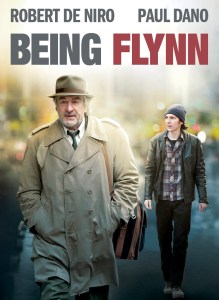
being flynnI’m super glad I got to watch this movie version of a book I recently admired, Another Bullshit Night in Suck City. First of all, let me say that Being Flynn captured the book better than most adaptations do. Not perfect, of course, and not exactly the same, but they never are because books aren’t movies.

This one was an interesting experiment, though, because the book involved so much theatre – meaning scenes that were constructed like scenes from a play or movie. Being Flynn took perhaps less advantage of that feature of the book than might be expected. But then again, what works as theatre-on-the-page doesn’t necessarily translate to Hollywood movie-making. Let’s see if I can explain myself…

Another Bullshit Night in Suck City (a title the New York Times finds “too pungent and profane” to print, whew!) is made up of a collage of different forms. One chapter is a list; one chapter is a long, stream-of-consciousness prose poem; another is a stageplay. Some are “straight” prose but with attention paid to setting and framing, and the drama of performance. Certainly, in the life of Jonathan Flynn, performance is a central question: he doesn’t want his audience to perceive him as homeless, as a loser; he is always reminding whoever will listen that he’s a great writer, and it seems he believes it, himself. The formal play of the book does not translate well to the screen, in part because moviegoers aren’t interested in playfulness in print. The differences between the two media are often at the heart of why books don’t adapt well into movies, or why book lovers resent the film’s adaptation.

Here, the movie wisely relinquishes some of the book’s form, and goes instead for story and feeling. Roger Ebert and the Times review linked above agree that the film ends with ambivalence, fails to commit to an outcome; but they seem to find this a negative, where I found it simply faithfulness to the true story that the book and film are both based on. Jonathan Flynn’s life was ambivalence and ambiguity, and that life wasn’t yet over when the film was produced. As Nick Flynn writes at the back of my copy of the book, “My father’s not dead yet, so there’s always still the chance the Nobel committee will call.” If the movie fails to wrap up, I say, that’s life. Til it wraps.

Robert De Niro as Jonathan Flynn worked out really well; I thought De Niro made a remarkably convincing crazy-or-genius homeless man. Paul Dano as Nick Flynn worked, for me, equally well. Ebert finds Dano “distant and mystifying,” but again, this feels true to the character as I came to know him through my reading. I wonder if it’s relevant that Ebert does not seem to have read the book (“by all accounts, the memoir is a powerful piece of work”). Maybe I just have a soft spot for Dano because I liked him so much in Little Miss Sunshine, and he looks so much like my good buddy Jerko.

I really enjoyed that the movie snuck in a scrap of that prose-poem chapter “same again” that I loved so much. I thought the spirit of the story and the noncommital, troubled, on-again-off-again nature of the father-son relationship was well portrayed. The question of whether the son is the father was perhaps a little heavy-handed in this version (as De Niro repeatedly yells “you are me!”), but it is one of the questions at the heart of the book. In short, this was a more faithful movie-based-on-book than I’d hoped for. I enjoyed it, but maybe my recent guided reading of the book helped me along.


Rating: 8 ice creams.

movie: Heartworn Highways (1976)

heartworn highwaysOh, man, what a treat. This 1976 documentary showed at the Pickford a few weeks ago, and Husband and I really enjoyed it.

We were not expecting such a departure from the documentary as I know it, which tends to splice in interviews, voice-overs, text captions to identify players, and the like. Instead, this was just 90 minutes of footage strung together. Which is not to say that it wasn’t artful; transitions felt natural and it was edited, of course, but there was no guide to the experience, which is different from what I’d imagined. So we were just bystanders to the action: Larry Jon Wilson records “Ohoopee River Bottomland” in the studio; Townes van Zandt takes the camera on a tour of his home in Austin and chats with Seymour Washington; David Allen Coe road-trips to the Tennessee State Pen and performs there; Gamble Rogers gives an outstanding spoken-word performance between songs at a bar; Charlie Daniels plays a high school gym; a teenaged-looking Steve Earle sings around a table with Guy Clark, Rodney Crowell and others. As you can just imagine, it’s all very atmospheric, alternately very funny and touching. Guy Clark’s “Texas Cooking” really got to me.

I had no idea Townes van Zandt was such a riot, and now I want to see Be Here to Love Me. This was great. If you’re a fan of “outlaw country” or regional flavor, check it out.


Rating: 8 holes.

National Theatre Live presents Les Liaisons Dangereuses (2016)

liaisons

I am so glad this is a text format and I don’t have to try to pronounce this title for you.

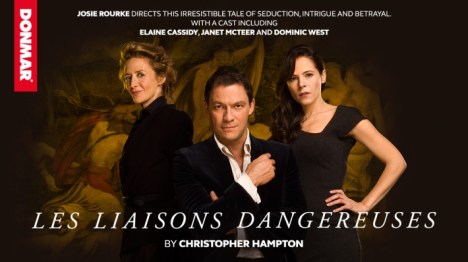
NT Live always does an amazing job, and Les Liaisons Dangereuses is no exception. The play by Christopher Hampton is based on the 1782 epistolary novel by Pierre Choderlos de Laclos, and I came in with little prior knowledge of either play or novel: I did see a certain 1999 Hollywood movie based on the same plot, which I’m a little embarrassed to admit, but that’s the background I had coming in. And actually, the feel of the thing was recognizable, although the sumptuous costuming of NT Live’s period-appropriate version was a decided improvement.

In brief: this is a very sexual and sexy play. I find the Pickford‘s plot summary too perfect not to simply repost here.

Former lovers, the Marquise de Merteuil and Vicomte de Valmont now compete in games of seduction and revenge. Merteuil incites Valmont to corrupt the innocent Cecile de Volanges before her wedding night but Valmont has targeted the peerlessly virtuous and beautiful Madame de Tourvel. While these merciless aristocrats toy with others’ hearts and reputations, their own may prove more fragile than they supposed.

It is a story of sex, power, gender politics, revenge and spite. I have said before that the NT Live screenings sometimes come with too much exposition – that is, speechifying before the play and during intermission – but in this case I enjoyed and benefited from the background. Playwright Hampton makes some interesting points about the original being a feminist novel; I saw this interpretation in his strong female star, who may not be always likeable but certainly knows her own mind, and works with great awareness against the confines of her society.

This is more than a simple soap opera of who slept with whom and who was angry about it. Although I think it works, and titillates, on that level, I found it rather more political than shallow. And visually gorgeous, and emotive, and affecting; and as always with NT Live, the acting was outstanding and the cinematography perfect. Sorry, I’m raving again. But again, catch some NT Live if you can!


Rating: 8 letters.

iDiOM Theater presents The Love of the Nightingale

nightingaleAnother perfectly lovely, intimate performance from iDiOM. (See an earlier one here.)

The Love of the Nightingale is a play by Timberlake Wertenbaker based on the Greek myth of Philomele. The iDiOM describes it as “a tale of sisterhood, betrayal, and revenge, in a poetic, beautiful, funny and modern retelling.” I’m not so sure about the modern part – it seems the play was written so that it could have been staged with or without modern dressings, but this version was fairly stripped down. There were a few moments of commentary on modern times by comparison to the tragedies of Philomele’s story. Essentially, it felt very Greek to me: deeply tragic, gory, inexorability revolving around a fatal flaw; willing and inevitable murdering of immediate family members. Wonderful stuff, if you’re in the mindset for a really dark storyline.

The acting was as wonderful as ever. These are extraordinary players, and I feel lucky to see them. Not that there weren’t a few faults: when the chorus speaks in unison (particularly the male chorus), they are not quite in unison, so their words are garbled; and the set’s steps and platforms, constructed of wood, squeaked and creaked loudly enough to obscure some of the actors’ speech. (Also, we found use of a ventriloquist-style dummy for the young child an odd choice. I think it would have been less distracting to just have an adult actor take the part.) As I’ve said before, though, these small imperfections just remind me that we are part of a small community watching incredibly talented but basically amateur performers do what they love.


Rating: 7 questions.