Colson Whitehead at Texas State University

I feel terribly lucky to have seen Colson Whitehead speak and read from The Underground Railroad at Texas State University’s Witliff Collections last month. He was being presented with the L.D. and LaVerne Harrell Clark Fiction Prize, an annual award in its second year through the English Department there. He won for The Underground Railroad, of course, but this is his eighth book (previously six novels and two nonfiction works).

Here’s where I admit that I’ve not read The Underground Railroad, nor any of Whitehead’s work. I’m ashamed! I’ve heard a lot about it, and it sounded appealing, and it’s won (ahem) the Pulitzer and the National Book Award as well as the Clark Prize. So I knew it was worth going; but I went in a bit blind. Now, I further admit that I did not wait on the long lines to buy Whitehead’s books or get one signed. But I bought one from Alibris as soon as I got home, and I look forward to reading it. I had no idea til this reading that it had such an element of magical realism to it. How strange and exciting!

So, early observations: Colson Whitehead is very funny and personable, and humble. One hopes for this in all our heroes, but one is often disappointed. I guess, though, writers tend to do better than other kinds of heroes/celebrities. Maybe because we spend so much time alone and doubting ourselves, and we’re so overjoyed when we are recognized. To this point, Colson took a question from (I think) a student who asked if he knew what a helluva book he’d written, before all the Pulitzers and whatnot started rolling in. Colson responded that the last 30 pages of the book are the best work he’s ever done. So, in a word, he thought it was good. But as he also pointed out, you never know if anyone else will agree.

I was astonished to learn that he conceived of this plot eighteen years ago, but waited til he had the writing chops, and the personal maturity level, wisdom, etc., to write it properly. He waited for fourteen years to begin. This… blew my mind.

He read from chapter one, in which the protagonist Cora is a slave on a Georgia plantation, in her late teens. I learned that the rest of the book follows Cora and another slave named Caesar as they escape north along the Underground Railroad, which in this imagining becomes a literal railroad; and each state they pass through becomes a different “state” in American reality. (I have the impression that this means different time periods and alternate versions of culture and policy. I believe he mentioned a state of Black utopia and a state of white supremacy. But don’t trust me; I haven’t read the book.) These ideas mesmerize me. I can’t wait to read it.

When he got ready to take questions, he said he would also welcome any tips the audience had to offer. This tickled me.

I learned more interesting trivia about the book and the writing process. When asked about his choice of a female protagonist, he said his last several were male and he wanted to mix it up; but also, that female slaves faced a different set of challenges than male ones, and he wanted to dig into that. He was asked about the structural element of interwoven chapters visiting with secondary characters, which is intriguing. And he commented that those secondary characters were “auditioning” with him, the author, vying for those positions; also an intriguing concept.

I also learned that Colson Whitehead as a writer is all over the damn place. He’s written fiction about John Henry; time travel; consumer culture; race relations; and zombies. He’s written nonfiction about the history of New York City; and the World Series of Poker. He says he believes in choosing the right tool for the job, be it realism or something on the spectrum of fantasy. His next book will be either science fiction set in the world of Star Wars; or a romance set at the beginning of the Russian Revolution, for which, as research, he’s been watching a lot of The Golden Girls. He does a mean impression of both C3PO and R2D2. This man, y’all.

I’ll be driving into San Marcos for more readings at Texas State, for sure.

San Diego’s Old Globe presents Uncle Vanya

I previewed this one for you a few weeks ago.

Uncle Vanya started slow but ended up enjoyable. The first half, pre-intermission, dragged a little; Grammy felt so, and I did, and I heard similar murmurings about us. I suspect the conversational model for this production (see that earlier post) contributed to this impression, as it indeed took more audience effort to engage with the actors and their lines. And here’s a major flaw in the model: we had read quite a bit about the quietness and the recommendation to use the offered assistive listening devices. We were greeted upon arrival with further cautions on this point. But then we were told that the device was incompatible with hearing aids. Grammy was told that she could take her hearing aids out to use the device, but that her hearing aids should be sufficient. Well, they weren’t. She pretty much missed the first half of the production. We set her up during intermission, and she caught the second half fine, but we did some pretty serious debriefing after the show about what she’d missed, so that she really got the overall story only after the fact. I’m very disappointed in this aspect. It’s a shame that after such effort was taken, we were so poorly served. An innovative production can only be appreciated to the extent that it can be taken in.

That said, the second half picked up in pace (and I found it much funnier), and Grammy could hear, and I observed that the crowd around me perked up. It’s really a fine play by Chekhov, only it requires a little patience. The acting was fine! And the theatre is a lovely space: small and intimate and atmospheric. There is something so special about a theatre in the round. (I spent the first half watching an elderly gentleman in the front row across from me sleeping. He woke up but good in the second half.)

In a classic sense, the plot of the play involves several formations of unrequited love; the resentments of family, class, income, and caregiving roles; and general frustrations about the shape of human lives: family, and our relationship with the natural world. There is a fair amount of humor, but the chief feeling is one of distress. Also classic is the sense that if only these people would talk to each other outright, much would be resolved; but if this is an exasperating tendency of fiction plots, that’s only because it’s an exasperating tendency of people in real life. In the end, I felt sympathy for most of the characters, despite their flaws. I thought the acting was wonderful, especially Vanya, and the doctor, and Sonya, and I thought the production over all was a good one–setting, props, theatre management–and I, at least, had no trouble hearing. But again, the failure to serve my Grammy with the much-discussed assistive listening devices is a crying shame. I enjoyed it, but certainly have some criticisms. As always, I feel very lucky to take in fine theatre in a beautiful city and with great company. Thanks, Grammy.


Rating: 7 glasses of vodka, naturally.

Quick list of LGBTQ reads

A graduate of my MFA program asked on a private forum,

Does anyone have suggestions of short stories, essays, and poems I could use in a Gender and Lit class that could introduce my students to LGBTQ lit and how it resists stereotypes and challenges the gender binary?

and I wanted to put together a quick list in response. But first, let me say: I think it’s interesting to consider who is qualified to answer this question. Part of me feels the need to disclose that I’m not a member of the LGBTQ community in the sense that I’m straight and cis-gendered. My colleagues & classmates who are members of this community by identity might have more authority in answering this request than I have. On the other hand, I hope that we can all recognize the reading that a) appears well-crafted and b) answers a certain need. I’m an LGBTQ ally. I try to recognize the nuances of (for example) stereotypes, as posed by the person who posted this request. I’m not perfect, but I’ve made an effort to be an informed reader of this and many other kinds of literature. Best efforts, then, with a stated sensitivity to the privilege with which I enter this work.

Here are the top nine books that I thought of. The original poster asked for shorter works, so my response is imperfect, but these are what I have to offer. (Two collections offer easy excerpting; more effort would be required to excerpt the longer full works, but it might be worth it.)

book list:

Others responded to this request with titles like Walk Till the Dogs Get Mean, a collection from Appalachia, and with some connections to my MFA program, edited by Adrian Blevins and Karen Salyer McElmurray–I own this book but haven’t cracked it yet, I’m afraid–and Andrea Gibson’s poem “Your Life.” Further:

Danez Smith and Qwo-Li Driskill and Ocean Vuong are poets that intermingled their race and their lgbt identity in their poems. Janet Mock. I mean technically a lot of the Harlem renaissance poets were always merging their otherness with their racial identity and their sexual identity. Such as Langston Hughes. Audrey Lorde’s Zami actually creates this almost mythos surrounding blackness and coming into this womanly identity and loving women. Leslie Feinburg is a bit heavy but ze is a prominent figure in the lgbt community. Allison Bechdel is a graphic novelist but graphic novels are still solid and easy to pick up on as a narrative.

Music is fun too! Rappers reclaim particular words and terms… Again still a bit heavy but Brockhampton and The Internet are fun and sometimes soft lyrical gay sounds. Where Mykki Blanco is… all weird trance-y edm bopping type sounds that scopes in on… the black lgbt club scene and their lingo and it’s just fun. I dunno if those are also lyrical structures to be explored. I think they are important but that’s just… how I perceive music as a social device. Especially in the black community.

And I just want to say, especially in response to that last post, that I think interdisciplinarity is a really important strategy in education. I think I would have been more engaged in high school if I’d better understood the ways in which science, art, literature, history, social movements, etc. happened in tandem, rather than in separate classrooms. Maybe it’s my interest in humans, but I think understanding that all these “subjects” are a part of human history and human experience, would have made each more interesting to me than they were at the time. Figuring out the interconnectedness on my own, later, was itself a fascinating process, but I might have been more excited about school at the time if interdiscplinarity had been made a bit more clear to me then. So, I support the inclusion of music in this class!

Well, that was a longer post than I intended; I hope it was helpful (to the original asker, or to anyone), and I’m very interested in what others may have to offer as well. Comment below!

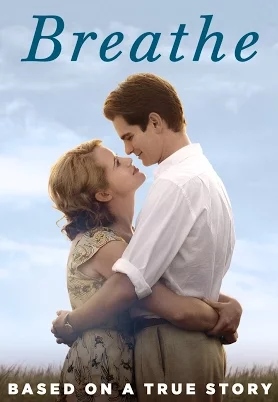
Breathe (2017)

Breathe is a lovely movie. If not the finest accomplishment of the art form, it was a very enjoyable, positive, uplifting story; and if that sounds sentimental, then guilty as charged, what do you want from me, I’m human. I appreciated knowing that it was a true story because I loved the background (nodding to the necessity for ADA legislation, for instance) of looking for hints of today in this version of yesterday. Disability rights matter to me. In the selfish way that our own experiences shape our concerns in the world, I have a bad knee; I had knee surgery some years ago and needed special accommodations a time or two, and my frustrations in meeting even my simple, and temporary, needs gave me a greater appreciation for the much bigger concerns of more profoundly and permanently challenged people.

This is a rather sentimental story, with a love story forming at least part of its heart. Robin and Diana meet and fall in love, and they marry around the time that he falls ill with a fever that ends in his total paralysis by polio: “you can’t even breathe for yourself.” He becomes depressed in the hospital (and who can blame him?!) but she won’t “let” him die, insists that he pursue his life anyway, and they have to break him out of the hospital against the wishes of its administration, in an era when polio patients were apparently, according to this film, basically imprisoned. What follows is a family of friends making their own way: building him a wheelchair that incorporates his breathing apparatus, dealing with the obvious calamity of the breathing apparatus failing, and gradually freeing him to travel the world. They attend a disability conference in Germany where they have to literally break the doorway out of a hotel room to fit his chair in (this is where I see promises of ADA). He lives a longer and fuller life than anyone thought possible, frees some of his co-polio-sufferers from the hospital/prison system, and dies at home with his family with him–in an assisted suicide, by the way, thereby touching on another medical-ethics hot button.

This film absolutely deals in emotions, and gets a wee bit saccharine; but it felt really good, I learned some things, and it was, well, sweet. I had a perfectly nice time watching this movie and I cried at the end and then felt better again. There are worse ways to spend an evening.


Rating: objectively, 7, but I give 8 dusty Spanish roads for emotional impact.

upcoming: San Diego’s Old Globe presents Uncle Vanya

For today, a little background information on a review that is to come.

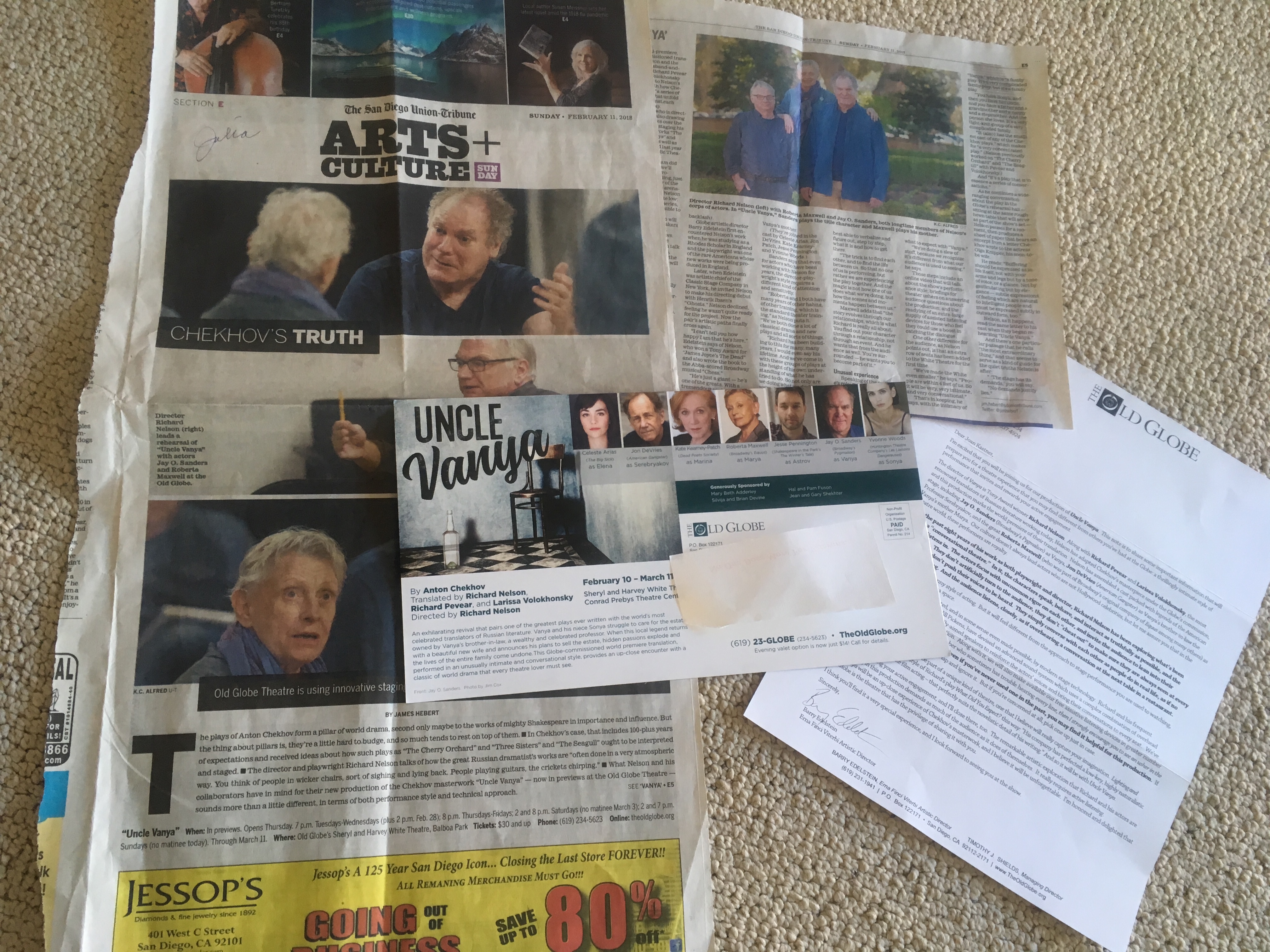
This week, I am so lucky to spend time with my Grammy in beautiful balmy southern California. Among other things, she takes me to such very fine events as this production. And clips all the relevant papers for me to peruse.

Grammy’s paperwork

This is such a different production that I wanted to do a post ahead of seeing the play, so that you get the same preview I did.

Much is being made of this play in advance. This translation of Chekhov’s Uncle Vanya by Richard Nelson, Richard Pevear, and Larissa Volokhonsky was commissioned by San Diego’s Old Globe Theatre, where I still remember seeing Shakespeare’s The Two Gentlemen of Verona with my Grammy and Pop when I was ten. (Lucky, lucky girl.) Pevear and Volokhonsky are today’s “pre-eminent latter-day translators of Russian translators” (from The San Diego Union-Tribune, and I certainly don’t know any better). The theatre installed an extra row of seats for the first time, so an already intimate space becomes still more so. And, stepping away from ingrained theatre traditions, according to a letter sent to my grandmother when she purchased the tickets:

Over the past eight years of his work as both playwright and director, Richard Nelson has been exploring what’s been dubbed a ‘conversational theatre.’ In it, the characters speak, behave, and interact as truthfully as possible, and the audience listens in. The actors focus with uncommon rigor on each other, and invite the audience to lean into their interactions. They don’t artificially turn to the audience, they don’t ‘cheat out’ to make sure they are always seen at every moment, they don’t push their voices to be heard. They simply converse with each other as people do in real life, as if no one were watching. And the audience listens, closely, as if overhearing a conversation at the next table in a restaurant.

Therefore, we are urged to pick up assistive listening devices, which are being provided in larger-than-ever numbers, to help us hear this quiet conversation. Director Nelson points out that Uncle Vanya is “a family play… a very complicated family play, but it’s a family play” with the smallest cast of any of Chekhov’s works.

Some years ago, I saw a play at Houston’s Alley Theatre that referenced this one, but other than that, this is my first experience with Chekhov, though his reputation of course precedes him. I’m really excited to see Chekhov performed at all, but this unusual production sounds especially interesting. It’s always such a treat–to see my Grammy, to see the Pacific Ocean (off her balconies!), and to see fine theatre in such a lovely little space as the Old Globe. I mark my gratitude here, then, and I’ll get you a review of the play in weeks to come!

more on Silverman’s Fearless Confessions

I’ve been asked by a reader to elucidate some points in my review of Fearless Confessions. I apologize for being less than clear. Y’all keep on asking your questions so I can do the communicating I want to do, improve my practice, and not frustrate my readers!

These are the lines in question as they appeared:

I was really excited by Silverman’s concepts of highlighting, with different color highlighters, different plot elements or characters in a memoirist’s story to serve different plots. Or her idea of erasing the parts that don’t serve whichever story is being told: where a fiction writer builds plot, a nonfictionist sculpts one by erasure. These metaphors worked really well for me, and are perhaps the best expressions I have read of concepts I’ve been trying to articulate and wrap myself around.

And the question read,

Who is doing the highlighting – an aspiring writer reading an established author? For understanding the craft in that writer’s style? And is ‘erasing the parts’ advice for that aspiring writer to edit a draft down to the desired essence?

Okay, I’ll try again. The highlighting is metaphoric, not literal, although the metaphor gets a little involved when we talk about the different color highlighters. The idea is this: let’s say I’ve been a competitive cyclist; been married and divorced; and worked in several male-dominated industries, with associated challenges. Let’s say I also studied library science in graduate school. If I’m writing a memoir about my divorce, I don’t necessarily need to weigh down or confuse the reader with all the other stuff. If we imagine my life story as one big, exhaustive text (that no one wants to read), and I’m crafting a memoir from it, I’m going to highlight the stuff that meets the needs of the book I have in mind to write. I’m going to highlight all the parts about marriage and divorce, obviously. And maybe some parts of riding bikes or working around men will also get highlighted, because they are relevant to the narrative about my divorce. But I don’t necessarily need the library science. When I get around to writing a memoir about my experience as a woman in the world, I’ll use the male-dominated industries stuff, and some of the bike racing (from when I raced against men), and maybe some of the library science (a female-dominated profession, with different issues) and some of the divorce. If we imagine my full and exhaustive life story as one big text, I’m using different color highlighters to go through and select the content that belongs in different memoirs. That’s the metaphor at play.

The erasure concept is related. If my life is a big, exhaustive text, and I’m writing an artful memoir of it, I’m not going to include every pair of shoes I ever wore, every friend I made and lost from pre-K on, every meal I can remember eating, every time anyone hurt my feelings. We all know that kind of exhaustive life story is… exhausting. Nobody wants to read that, although many a late-night drunk has offered it to many a bartender. As Silverman wrote it, the fiction writer gets to build a story out of her imagination. But a memoirist has to craft one by erasure, by taking out all the unnecessary details and bullshit of a life, until she is left with a beautifully crafted story.

How’d I do?

2017: A Year in Review

Note: I’m out of pocket during my residency period at school. I love your comments! But it may take me several days or a week or more to respond.


This is a traditional annual post; you can see my past few years in review here: 2016; 2015; 2014; 2013; 2012; 2011.

For the very *best* books I’ve read this year, see last Friday’s post, best of 2017.


This year was markedly different than any that have come before, because I’ve been a full-time graduate student in creative writing, and my program is fairly reading-heavy. Unsurprisingly, my reading habits have changed a fair amount.

The biggest change: I’m down by nearly half in terms of the number of books I read, at only 70 this year. (There were a handful of individual essays in addition to what I added to the big list of “books read,” but that list also includes a few individual essays.) Of those 70 books:

  • 76% were nonfiction (54% last year), plus a handful of poetry, for less than 20% fiction.
  • an even 50% were written by female authors (40% last year); 40% were by men (51% last year), with the remainder being collections by multiple authors, or variously unidentifiable.*
  • I normally analyze the novels I read by genre, but this is such a small sample size that I’ll just say there was a general smattering of historical fiction, misc. or contemporary fiction, fantasy, drama, and one lonely thriller–a far cry from previous years where thriller/mysteries have been a major component of my fiction reading.
  • I read NO audibooks this year (last year, only 5 books out of 121, but in previous years a significant number).
  • nearly 70% of my reading was assigned for school this year, which I think explains everything else I see here.
  • corollary: the same 70%, almost precisely, I purchased. Another 25% I was sent for review, and those few left over were either sent to me in .pdf form (for school), or already owned. This is a big change, again, from last year, when 80% of the books I read, I read for paid reviews.
  • again, the big one: I read 70 books this year, compared to 121 last year.

I am unsurprised that there are big changes, but I certainly hadn’t realizes how relatively few books I’d read this year. And to think it nearly made my brain explode all the same! I guess that’s just an indicator of how much brainpower (stress, angst, energy, time) went into writing–something not obvious to you, my faithful readers here, I’m afraid. I am ready to share very little of what I write for school with audiences outside that small trusted circle (my faculty advisor, a few classmates). It’s a tender time, and I appreciate your patience.

I’m glad that I’m doing better at reading male and female authors* in more-or-less equal numbers, and I’m glad to be reading a lot of nonfiction, although I confess at this point–overwhelmingly skewed in the nonfictional direction–I do miss the ease and joy of fiction. I also find novels so much easier to review (partly because of all that brainpower already working for school), and I’m going to try to keep that in mind when requesting books for review from the Shelf.

In 2018, I’m afraid we should all expect more of the same trends… I’m entering the third semester of my MFA program, which is the critical essay semester, which means critical writing about my reading, ad nauseum… we’ll see if I can pull it all off! It’s head-above-water time these days. In fact, it occurs to me as I write this that I may have to consider a further slackening of the pace here at pagesofjulia. I’m in the final year of school. How would you all feel about seeing me even less?

And what did 2017 hold for you, and what do you see looming ahead? I’m always glad to hear from you, even if I have little time to respond.

As 2017 closes, I wish us all calm, relaxed, pleasurable, entertaining, enlightening, and inspiring reading lives (maybe not all at once!) and I’m glad to have you here. Love.


*I need to work on this label for the sake of non-gender-conforming or non-gender-binary values, which I support, but I guess I’m still mulling over how to represent this while maintaining the point, which I think is to recognize that I’m not reading only dudes, or that I’m trying not to.

best of 2017: year’s end

Note: I’m out of pocket during my residency period at school. I love your comments! But it may take me several days or a week or more to respond.


My year-in-review post will be up next week, as usual. But first, also as usual, I want to share the list of my favorite things I read this year.

Not as usual: none were audiobooks, because I read no audiobooks this year. Few of these are new releases (they are marked with an asterisk*).

I gave a single rating of 10, late in the game, to an essay I’ve read over and over, and it keeps getting better every time. I still have not written about this essay. I still think you should go into it blind.

  • “The Fourth State of Matter,” Jo Ann Beard – nonfiction

I’ve refrained from going back and changing any ratings that I gave at the time; but I have split the books that I rated 9 into two groups, as I judge them now. This list is overwhelmingly nonfiction, since that is most of what I’ve been reading this year.

So. The top three which received ratings of 9, are:

The rest of my 9-ratings, all wonderful reads:

I gave plenty of 8s–too many, perhaps–and I’ve gone through and compiled you a slightly shorter list of my favorites from those books.

I hope this lengthy list gives you some good ideas for your own reading! What are some of the best books you’ve read this year?

Come back next week to see a further breakdown of my reading habits in 2017, what’s changed and what’s a surprise. Happy holidays and happy reading, friends.

movie: The Wild and Wonderful Whites of West Virginia (2009)

Note: I’m out of pocket during my residency period, beginning today with travel. I love your comments! But it may take me several days or a week or more to respond.


Sorry to follow last week’s negative review with another.

I’ve heard about The Wild and Wonderful Whites for years now, and I know a lot of people who appreciate it. When I started school in West Virginia, folks from other places mention this movie as a way to know the place. As I was watching all those other Appalachia/Southern movies for school, a friend borrowed it for me, as an optional add-on to my education, I guess.

I think it’s a shame that this movie represents the state. This documentary of the apparently legendary White family records their lifestyle: petty crime and violence, drug and alcohol abuse, no great contribution to society–excepting of course the cultural value of the tap dancing. I don’t know. The film itself presents (we assume) reality, with little or no editorializing. But the response to the film feels to me like glorifying or celebrating a lifestyle that includes a certain amount of tragedy. I’m not a prude; I appreciate partying, and I don’t judge making babies out of wedlock, or anything like that. But the matriarch crying at the drug use at her birthday party, and the pillhead whose baby is taken from her in the maternity ward, are sad stories. Why are we laughing and joking about this? Also, West Virginia doesn’t deserve this as its theme song.


Rating: 4 Xan-bars for filmography, I guess.

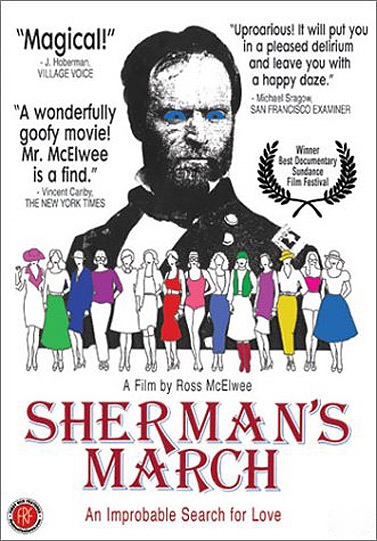
movie: Sherman’s March (1986)

Sherman’s March is the third movie assigned for that one seminar (see also The True Meaning of Pictures and Deliverance).

I don’t know. Perhaps it will be illuminated for me in seminar; but this movie didn’t hold much value for me. Ross gets a grant to make a documentary about the lasting impact of General Sherman’s march across the South during the Civil War. He sets out with camera in hand to visit his family and meet women, traveling the Carolinas and Georgia. His love life is suffering, and everyone he meets is either a potential partner or a matchmaker. He lolls about, bemoaning his single fate and feeling sorry for himself. He occasionally opines about General Sherman or visits a monument. Look for lines like, “Why aren’t you in love with me?” and “It doesn’t matter if you don’t know her, Ross.” (Two and a half hours of this.)

Woe is Ross. The end.


Rating: 3 hours of my day lost.