hemingWay of the Day: on nightlife

Nightlife is a funny thing. There seems to be no reason or rule that controls it. You cannot find it when you want it. And you cannot get away from it when you don’t want it. It is a European product.

from “European Nightlife: A Disease,” The Toronto Star Weekly, 15 December 1923

So true, Papa, so true! I feel like I’ve spent all my life either trying to find the party or to escape it. (Is that a metaphor for something?) This article was a charming little assessment of the nightlife scenes in a handful of European cities – not a travel guide or anything, since it’s so dated (!), but a snapshot in time of one man’s experience, at least, and well presented, and funny.

hemingWay of the Day: on Clemenceau

There is nothing deader than a dead tiger and Georges Clemenceau was a very great tiger. Therefore Georges Clemenceau is very dead.

from “Clemenceau Politically Dead,” The Toronto Daily Star, 18th February 1922

I found this one in On Paris, a brief collection of Hemingway’s early journalism from the time when he lived in the City of Light. I’m struck by his simple, yet funny, wording, which makes a point about Clemenceau’s special brand of deadness in an interesting way, that may take a moment to sink it. I find it very typical of Hemingway, and I love (about this, and about all of On Paris) that his distinctive voice was present, if unpolished, very early on.

hemingWay of the Day: last words

Thank you to Buzzfeed’s The Last Words of 25 Famous Dead Authors for today’s brief words from Papa. [Go click that link and read some others; there are a number of humorous, poignant last words up for your contemplation.]

Goodnight, my kitten.

Spoken to his fourth and last wife, Mary, before she retired; she would be awakened in the morning by the sound of gunshots and have the honor of finding his body, which frankly I think was an awfully mean thing to do to her.

Pagesofjulia is having a season of Hemingway around here. You might have noticed. Goodnight, Papa, we miss you.

HemingWay of the Day: in Town & Country (I know, weird, huh?)


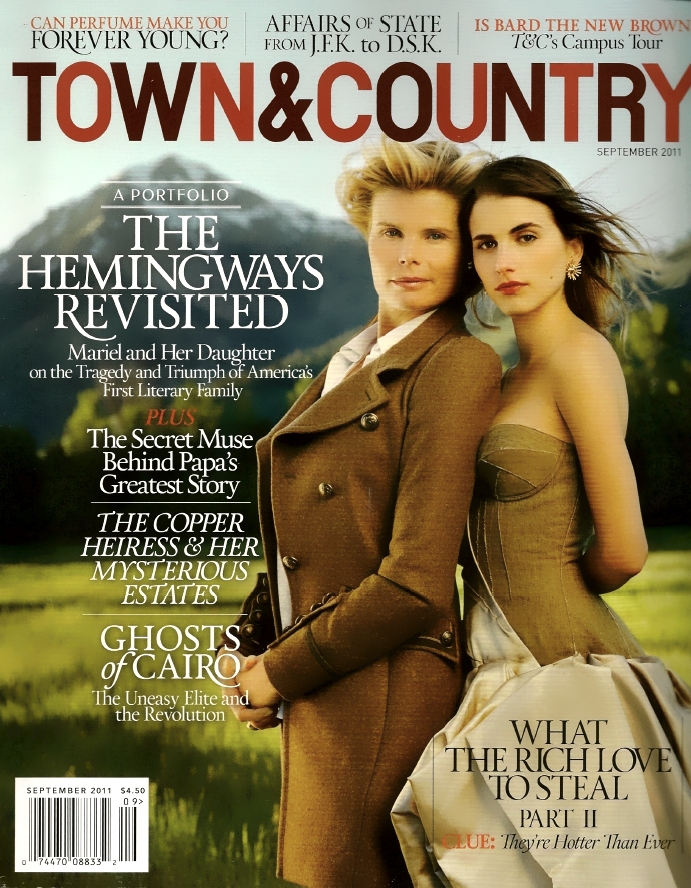
Well, unfortunately it doesn’t seem to be available on the interwebs at all. You have to go find a physical print copy of the September issue of Town & Country magazine to read these articles. But keep your eyes open for one, because it might be worth it! There are two Hemingway-related articles: the first is available in part (and with some lovely pictures) at Mariel Hemingway’s blog – that’s Papa’s granddaughter. It basically catches us up with the current generation: Mariel, a successful Hollywood actor, and the fate of her two sisters who haven’t done as well; and then Mariel’s daughters, Dree and Langley. Town & Country’s focus is clearly on the beautiful people (Mariel and Langley; Dree is only mentioned) and the beautiful house: the Hemingway estate in Ketchum, Idaho. Yes, that’s where Papa died. The short story is, these beautiful ladies seem to have overcome their family legacy of depression, angst, and suicide. Good for them.

The second article is even more worthwhile, though. It contains an excerpt from Paul Hendrickson’s new book, Hemingway’s Boat, which you may have noticed I am mad for (main review here). I don’t have any kind of electronic version of it. 😦 Sorry. If you see a Town & Country (September issue – with the younger Hemingway women on the cover, at right), check it out. Or better yet, go get a copy of the recently published Hemingway’s Boat! (You will get much more Papa that way.)

hemingWay of the Day: with love


According to Paul Hendrickson in his meticulously researched Hemingway’s Boat which I respect and admire very much, Hemingway wrote to Sara Murphy (an old friend from the Paris days) in December of 1935 of his concerns on aging… his work habits… and a recent hunting trip with his son Patrick. The part I like the best (and which strangely echoes Gertrude Stein) is his closing,

with very much love much love and love also with love.

I love you too, Papa.

hemingWay of the Day: on writing


From Flavorwire’s “Weird Writing habits of Famous Authors”:

“Hemingway famously said he wrote 500 words a day, mostly in the mornings, to avoid the heat. Though a prolific writer, he also knew when to stop. In a letter to F. Scott Fitzgerald in 1934, he wrote,

I write one page of masterpiece to ninety-one pages of shit. I try to put the shit in the wastebasket.

I have also reproduced for you the picture Flavorwire used to accompany this quotation. I like. Thank you Flavorwire.

hemingWay of the Day: on cooking trout


This one was chosen as a fine example of how Hem can make me, at least, taste and smell what he writes about. Also, he makes my mouth water.

The Swiss, too, have a wonderful way of cooking trout. They boil them in a liquor made of wine vinegar, bay leaves, and a dash of red pepper. Not too much of any of the ingredients in the boiling water, and cook until the trout turns blue. It preserves the true trout flavor better than almost any way of cooking. The meat stays firm and pink and delicate. Then they serve them with drawn butter. They drink the clear Sion wine when they eat them.

It is not a well-known dish at the hotels. You have to go back in the country to get trout cooked that way. You come up from the stream to a chalet and ask them if they know how to cook blue trout. If they don’t you walk on a way. If they do, you sit down on the porch with the goats and the children and wait. Your nose will tell you when the trout are boiling. Then after a little while you will hear a pop. That is the Sion being uncorked. Then the woman of the chalet will comes to the door and say, “It is prepared, Monsieur.”

Then you can go away and I will do the rest myself.

from “Trout Fishing in Europe,” printed in The Toronto Star Weekly, November 17, 1923

hemingWay of the Day: author insults

Thanks to Shelf Awareness for this interesting item today.

Recently, Flavorwire gave us The 30 Harshest Author-on-Author Insults in History. It might be worth your time to go check them all out, but I had to share with you a few of my favorites.

Numbers 15 and 14 are a back-and-forth:

15. William Faulkner on Ernest Hemingway:
“He has never been known to use a word that might send a reader to the dictionary.”

14. Ernest Hemingway on William Faulkner:
“Poor Faulkner. Does he really think big emotions come from big words?”

…to which I give an lol. My meager attempt to appreciate Faulkner was pathetic, but I blame him entirely – or maybe my choice to try The Sound and the Fury first, I don’t know. I *may* give him another try someday. If I do, it will definitely be a different title. It should go without saying that I side with Hemingway on this one, in terms of the end-result-value of their work – although it is also true, I have never used a dictionary in my readings of Hem. (I do use a dictionary when I read sometimes, though.)

I also liked this one:

9. Truman Capote on Jack Kerouac:
“That’s not writing, that’s typing.”

I think this is in the same spirit as #15, above. And again, I loved On the Road and so disagree; but the witty jab makes me smile, all the same.

There are some other clever ones there, too. I encourage you to go poke around and tell me, which ones made you smile? Or get angry? Or feel justified?

hemingWay of the Day: on bicycles

It is by riding a bicycle that you learn the contours of a country best, since you have to sweat up the hills and can coast down them. Thus you remember them as they actually are, while in a motorcar only a high hill impresses you, and you have no such accurate remembrance of country you have driven through as you gain by riding a bicycle.

from Battle for Paris, printed in Collier’s on September 30, 1944

hemingWay of the Day: on uniforms

The first time we [Hem with French guerrillas] had entered the town all but two were naked from the waist up, and the populace did not greet us with any degree of fervor. The second time I went in with them, everyone was uniformed and we were cheered considerably. The third time we went through the town the men were all helmeted and we were cheered wildly, kissed extensively and heavily champagned, and we made our headquarters in the Hotel du Grand Veneur, which had an excellent wine cellar.

from Battle for Paris, printed in Collier’s on September 30, 1944

I like this not only because of the evident power of uniform, but also because of that final aside that the Hotel had an excellent wine cellar. So much is implied by this brief phrase.