The Lost Girl by Sangu Mandanna

I am a creature, a girl, life stitched from nothing. I am eerie and frightful. And I’m stronger than all of them. I can’t allow any hunter, or Weaver, or betrayal to defeat me. Believing that is all I have. It’s all that might save me.

I have been a fan of Mandanna’s witchy book and this YA trilogy. I’m jumping back in time here to her debut novel, a YA sci fi with some romance elements, naturally enough a coming-of-age story, with some pretty neat philosophical questions. It’s quite good, but she’s gotten better since.

Eva is an echo, as opposed to a human: she was not born but made to order by the Weavers for a family who requested her. Echoes are sort of spares: Eva is based on her ‘other,’ or her original, a girl named Amarra who lives in Bangalore. Eva lives in a small English village where she is heavily guarded and tutored and trained in how to be Amarra. She reads what Amarra reads, consumes the same music and movies and foods, wears the same clothes. As far as possible from Bangalore to the English countryside, she is supposed to mimic Amarra, to be prepared to be Amarra if something should happen to the valued human girl. But something has gone awry with Eva: she has a personality of her own. She is not as agreeable as Amarra seems to be. She is strong-willed and stubborn, has interests that different from those of her other. She asks too many questions. Even to have taken a name of her own is a serious crime. [Can I just say how remarkable I find it that she’s taken the same name as in Peter Dickinson’s YA novel that I loved so much?!] And then, of course–this would be necessary for the story’s sake–Amarra dies. And Eva is up for the role of a lifetime, that for which she has been designed.

With obvious parallels to The New One, and a classic we’ll discuss shortly, The Lost Girl examines concepts that humanity has considered before; but that’s certainly not a criticism, nor am I alleging unoriginality. (This book predates The New One, for the record.) Rather, I guess I’m observing that the questions Mandanna is playing with here are of perennial interest. What power do we have to design the people or have the babies we want? Is it appropriate or moral to play with technology that would do so? (There are some efforts at work too in pursuit of immortality, that other perennial human preoccupation.) Eva literalizes the idea of a young person coming of age under the constraints of society or family’s expectations; but on some level every young person wrestles with similar bounds, and necessarily rebels against them. Is Amarra a better girl, or just a different one? Does Eva have a right to self-determination? Many people in their world see Eva as less-than, an abomination. What makes someone human, or a person, or deserving of respect? How do we combat prejudice that’s based on ignorance? How are we to navigate grief? (Hint: maybe not by having a copy of our beloved daughter made to spec, and then demanding she live up to impossible ideals.)

Eva is in a difficult spot. She has to be someone she’s not, both for the sake of her literal survival (echoes are destroyed if they can’t do their jobs) and because she genuinely wishes to comfort Amarra’s bereaved family, who seem like decent people. But she isn’t Amarra. And even dead, the ‘other’ looms large. “Maybe that’s what the dead do. They stay. They linger. Benign and sweet and painful. They don’t need us. They echo all by themselves.”

Mandanna, and the system of echoes, and Eva, are all clear on the reference to Frankenstein here. Echoes are firmly forbidden access to the book, which Eva rightly senses is because there’s something there. Who is the monster–the scientist or his creation? What if you let the Creature set his own path?

Eva’s first-person voice is spot on, the rules of this world are well established for most of the novel, the questions it asks are compelling and thoughtfully explored. The characters are complex and sympathetic, the stakes are high, the whole thing is absorbing. There is a romantic subplot, with tension between Amarra’s boyfriend and Eva’s potential (and obviously highly forbidden) love interest. It’s all really well done, and this novel was headed for a higher rating, but it gets a bit out of control towards the end. The action is a bit unwieldy and the rules of the world collapse a bit, for me, in terms of believability. A certain promise is asked to carry an awful lot of weight in the plot denouement, as if promises are more binding than we know them to be in our world, at least, and indeed it seems to come down to a villain keeping their word, which feels doubtful at best. In an invented world like this, Mandanna could have made a rule of some sort about how promises work–they could have been literally binding–but she didn’t, and the importance of the promise didn’t work for me. I suspect I’m seeing Mandanna’s evolution as an author here, and I’m not mad about it and will still be seeking out her work. My rating of 7 is still solid! But it looked even stronger for a while. I think this author has grown a great deal since her debut.

Great premise, and well done through most of the book; fell off a bit at the end. I am still a fan.


Rating: 7 scones.

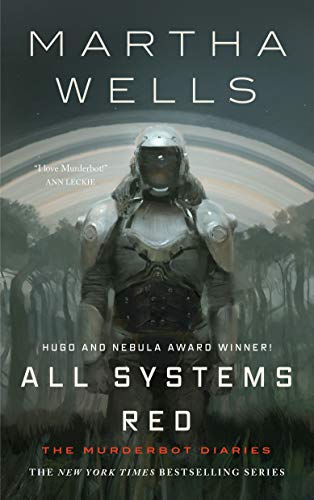
reread: All Systems Red by Martha Wells

I cannot believe I rated this a mere 7 on first go-round. That’s madness. It’s a brilliant book! I guess this is evidence of how slow I was to enter Murderbot’s world. Now that I’ve read seven Murderbot books, this one was far more accessible for me, and the rating has increased considerably. Liz listens to the audiobook version of this on repeat, and I get that now absolutely (although I’ve still never listened to the audio version).

This time I was all in from minute one, with a background understanding of the rules of Murderbot’s world, the constraints of being a construct, the confusions about what exactly it is, its lovably grumpy attitude toward humans and its preference for entertainment media. I think it’s a fairly unusual portrait of… this kind of life form… that an individual could be sort of lackadaisical, may I say even lazy, toward its *work* and genuinely want to be left alone to watch what you and I would call TV shows. In this first book, Murderbot is for the first time living and working with a group of humans who are open to its (if you will) humanity, and Murderbot does not know what to do with that. Some of the humans more than once call it “shy,” but that’s not entirely it; Murderbot is uncomfortable with being treated like a person that deserves respect and autonomy, because that’s a new experience. And this is compounded by its need to pretend its not such a person, because for its own safety it needs for no one to realize that it’s hacked its governor module and is operating according to its own wishes. So. “Yes, talk to Murderbot about its feelings. The idea was so painful I dropped to 97 percent efficiency. I’d rather climb back into Hostile One’s mouth.” (That voice is hysterically funny.)

I can’t get enough and am now in danger of ripping through the whole series all over again. I’m sure some readers (Liz?) accessed this much more easily on the first read, but boy, is this second one an improvement for this reader.


Rating: 9 little hoppers.

The Drowned by John Banville

A recluse discovers an abandoned car and winds up involved in a missing-person case with Strafford and Quirke, who are back at work in this novel of secrets and quiet desperation.

John Banville’s The Drowned transports readers to a dour small town on the 1950s Irish coast, where one tragedy after another makes a small cast of characters reconsider what they know and value in the world they inhabit. In his established style, Banville (The Singularities; Snow; Ancient Light; Holy Orders writing as Benjamin Black) offers a stark series of events in understated tones and with a handful of voices. These include Dublin Detective Inspector Strafford and the brilliant pathologist Quirke.

“He had lived alone for so long, so far away from the world and its endless swarms of people, that when he saw the strange thing standing at a slight list in the middle of the field below the house, for a second he didn’t know what it was.” It turns out to be a luxury motorcar, abandoned, engine still running. The loner who discovers it actively avoids human contact: “Yes, life, so-called, was a birthday party gone wild, with shouting and squabbling, and games he didn’t know the rules of, and one lot ganging up on the other, and knocking each other down and dancing in a ring like savages, the whole mad rampage going on in a haze of dust and noise and horrible, hot stinks.” He approaches, against his better judgment, and winds up involved in a missing-person case, which will draw Strafford to town, even as the detective wrestles with his own relationships: an estranged wife, a much younger girlfriend, and ever-complicating ties to Dr. Quirke. “We have one thing in common, at least,” Quirke quips to Strafford. “Death.” Death is an obvious theme, not only in the two characters’ professional lives but throughout Banville’s troubled setting.

Enriched by Banford’s attention to detail, the narrative grows more compelling in its telling by these and other characters, each suffering more or less alone even when they are married, partnered, or set next to immediate family. “The least of remembered things are the most affecting. That walk, the birdlike turn of her head, those trim ankles.” The Drowned is slow building, sedately paced, and grim, but wickedly absorbing. By the mystery’s denouement, some readers will have guessed the perpetrator’s identity, but it is less that identity and more the psychology of it that is Banville’s final blow. Through these intricacies and its murky sense of foreboding, this inexorable novel will continue to advance Banville’s considerable reputation.


This review originally ran in the July 29, 2024 issue of Shelf Awareness for the Book Trade. To subscribe, click here.


Rating: 7 barstools.

Heartless by H. G. Parry

From memory, I’m going to say the Peter Pan story was sweet and heartwarming, with some good healthy ideas in it about always retaining a lovably childlike (not childish!) spirit and the magic of believing. We fly through the stars and have adventures! We help each other. And even when we have to (sigh) grow up, we can access that magic again through the power of imagination.

Then there was the movie Hook, which had Robin Williams and was therefore great, and (again in my possibly faulty memory) more or less followed those themes. We all have to grow up, but it wouldn’t be healthy to lose all the joy of childhood.

This is not that version of Peter Pan.

H.G. Parry, who I fell for hard with The Magician’s Daughter, takes us on a more realistic and darker journey with Heartless. Now the protagonist is neither a Darling nor a Lost Boy nor Peter himself, but an orphaned child in a Dickensian sort of London named James, who gives himself the fanciful last name Hook when he gets a chance at self-invention. James is a born storyteller, a skill which endears him to the only boy at the orphanage James really cares about, a careless but compelling child named Peter. For Peter, James tells stories: ones his mother told him or read him, ones he’s read himself, ones he’s made up. For Peter he makes up the child-king Peter Pan and his sometimes-antagonist the pirate Captain Hook, who inhabit a magical (and made up) island called Neverland. These tales keep Peter at James’s bedside until the night that Peter leaps off the orphanage’s high roof and flies into the stars: “second to the right, and straight on till morning.” James wants to follow his best and only friend, the boy who did not so much as look back. But when James leaps, he falls to the stone courtyard below.

From here we follow James Hook (his new identity) and his friend Gwendolen Darling (who takes the identity of James’s younger brother, George Hook) in their adulthood. James is forever chasing after Peter. He will eventually find what he’s looking for and find also that it’s not what he was looking for at all. This brief book (141 pages) is Peter Pan, yes, but retold with a different protagonist at its sympathetic center and a decidedly sinister twist; fairies are not sweet but uncaring. Captain Hook, of all people, is the one we feel for. And we are centered on the power not only of imagination but of storytelling – and like all of them, this is a power that can be used for good or ill. “[The fairies] didn’t understand that stories weren’t meant to be lived in forever; they were meant to be shared, passed on, questioned, to mingle with a thousand other tales and poems and experiences and be changed by them. They didn’t understand that stories, too, needed to grow. He hadn’t understood himself until recently.”

A retelling of a classic with rather more realism (especially in the London setting) and more darkness, but also still sweet and wholesome, with Parry’s absolutely lovely style; I’m going back for more from her.


Rating: 8 leaves.

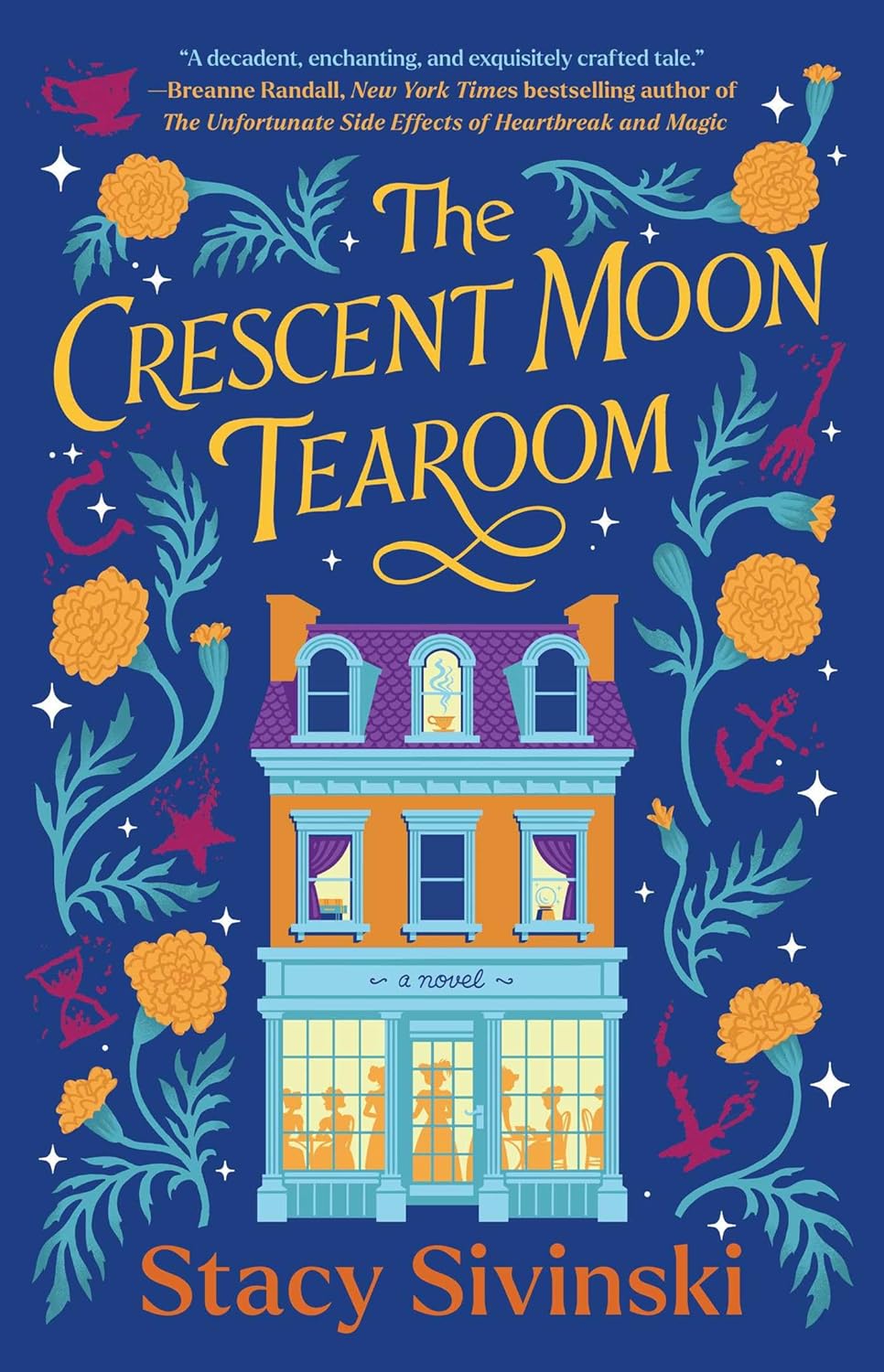
The Crescent Moon Tearoom by Stacy Sivinski

This entrancing debut stars triplet witches who can see the future, but must work together and individually to grasp their own.

Stacy Sivinski’s first novel, The Crescent Moon Tearoom, is a sweet, wise balm of a story about family, change, and coming into oneself.

The Quigley triplets, Anne, Violet, and Beatrix, have always been close. Their beloved mother was a powerful Diviner, able to read the future in various signs. Her daughters put the same skill to use in the Crescent Moon Tearoom, where the three young witches sell magical teas and delectable baked goods and tell fortunes to hordes of Chicago’s women and witches. The tearoom (run out of the family home, itself an endearing character with a will and magic of its own) does a booming business, but all is not well with the Quigley sisters. A challenge comes from the Council of Witches: the younger three must help three older witches discover their Tasks, which is a witch’s very reason for existence and is imperative to complete before a witch passes, or she’s “doomed to linger as a spirit for all eternity.” If they fail, the Council will close their shop. The events entwine with a potential curse on the sisters, threatening to undo everything the sisters love.

Although nearly identical in appearance, the Quigleys are quite different individuals. Their mother used to say, “Violet has her head in the clouds, and Beatrix’s nose is in a book. But [Anne’s] feet are always planted firmly on the ground.” While Violet (the family baker) is volatile and in constant, foot-tapping motion, Beatrix is shy and dreamy. Anne is the caretaker, the brewer of teas, and has secretly been holding back her own magical powers so as not to surpass her sisters. They “had been locked in their web of affection and dependence for so long now. Their bonds had taken shape during childhood and seemed to be coated in bronze.” As they struggle with the ominous Council’s extraordinary demands, their differences are highlighted, even as each sister finds opportunities for new growth.

Sivinski’s droll telling details the lovable Quigleys with all their quirk and charm, each with their own moving emotional arc. Chapters are headed with signs and symbols, as one might find in tea leaves at the bottom of a cup, with brief descriptions of their meaning: a fan suggests flirting with temptation; a bat foreshadows a fruitless endeavor. Each line captivates: “As seers, the Quigleys had long ago accepted that questioning what they saw in the remnants of their customers’ tea was about as useful as trying to wash cherry jelly out of a silk blouse.” With its sweetness, realistic challenges, and satisfying resolution, The Crescent Moon Tearoom is a rare pleasure. Readers will miss the Quigley sisters at this novel’s end.


This review originally ran in the July 26, 2024 issue of Shelf Awareness for the Book Trade. To subscribe, click here.


Rating: 8 petals.

Case Histories by Kate Atkinson

Unusually for me, I watched the television series first, and it is a striking series, and obviously colored my imaginings while reading this novel. It might have been desirable (for the usual reasons) to do it in the other order, but gosh, I think this is a rare case of each enriching the other. (Also, it has been long enough that I was still able to find surprises while reading. It pays to be forgetful if you read and reread mysteries.)

This is a brilliant novel. I love everything about it. It feels a touch genre-bendy, with the title and the three different cases intertwined, although it is of course not unheard of to see a PI or detective involved with multiple cases at once. Case Histories introduces three distinct mysteries before we meet Jackson Brodie, a retired military policeman and regular copper now working on his own. He has a grumpy receptionist, a recently remarried ex-wife, and an eight-year-old daughter he’s crazy about. He runs, off and on smokes cigarettes, and listens to moody American female country music stars (Emmylou Harris, Lucinda Williams, Allison Moorer). He’s from the north of England but now lives, and the novel is set, in Cambridge, a location with lots to contribute to the story. (I looked it up and confirmed my confusion about location: the TV series is set in Edinburgh. Also an impactful setting, but boy, they threw me off with that one. Cambridge does so much work here though! Was it too challenging to film there?) Jackson has enough to worry about with his divorce and entirely real dental problems–he’s become a regular with a heavy-breathing, magnetic dentist named Sharon, although it’s unclear if she is in on the sexual tension between them–but some earlier traumas are also at work upon our protagonist, that the reader will only find out about late in the book.

I called Jackson the protagonist and I do feel that way (although maybe, again, influenced by the TV show), but there are a few other issues percolating too. Mr. Wyre mourns his younger (and undeniably favorite daughter), murdered in his office while he was briefly away, several years ago. The crime remains unsolved. A woman with a shadowy past makes yet another fresh start. The Land sisters, Julia and Amelia, go through their father’s house after his death and find a clue in the long-ago disappearance of the youngest sister, Olivia. (They consider themselves the two remaining Land sisters of four, even though Sylvia is alive and well, in a convent.) Steve Spencer believes his wife is cheating on him. A wealthy, obnoxious elderly widow named Binky Rain is convinced someone is stealing her cats. A young homeless woman with yellow hair crosses paths repeatedly with multiple characters, asking “Can you help me?” All of these large and small worries, crimes, puzzles will become Jackson’s problem in one way or another. He is long-suffering (and the toothaches don’t help), a bit hapless, but good. His relationship with his daughter Marlee is very sweet.

I think one of the things I love about this book is the layers of personality that the main characters and even some of the less-central ones exhibit. Jackson’s dental troubles, the country music he prefers, his frustrations with his ex, his running (which I think played a larger role on television than it does here), fill him out. The Land sisters are both pathos-ridden and hysterically funny. Marlee is a gem. Jackson’s old buddy Howell remains mostly theoretical, off-screen, but appears for a brief, funny scene in the hospital, where Jackson concedes, “he supposed his daughter would be pretty safe on a sheep farm in the middle of nowhere, surrounded by Russian gangsters.” Case Histories is like that: off-kilter, random, funny, emotive in the still-waters sort of way, concerned with profound ills but also basically good folks. Steeped in the kinds of details that make these things work. I can’t wait to read more Jackson Brodie.


Rating: 9 sweets.

System Collapse by Martha Wells

Book 7 is, again, the most recent Murderbot book to date, but there are more on the way, we’re told, and thank goodness. This tip from Liz has been (yet again) a big winner. I took a big break between books 6 and 7 – pretty precisely three years, whew! but it wasn’t too bad to jump back in. I won’t say I recalled all the fine points of where we were and who the humans were, but I was close enough to follow along; I think I’m already a little liable, with sci fi in particular, to let some of the details of tech and even plot wash over me as I go with the general atmosphere, themes, and cleverness. The Murderbot Diaries are absolutely character-driven, with style (that is, chiefly, Murderbot’s unique, sarcastic voice and secretly-a-teddy-bear personality) carrying a good portion of the load as well. I’m way more here for Murderbot itself – its inner dialog, its anxieties and values and reluctant but absolute loyalties, its decision making and love for entertainment media – than anything that happens to it. Those events are only here to let Murderbot react and act and be its loveable self.

Murderbot is full of dryly funny observations about how inexplicable humans are. “Humans are great at imagining stuff. That’s why their media is so good.” “Not even humans know why humans do things.” It coins ‘argucussion’ for the argument/discussions its humans have. Upon conflict, one human says to Murderbot, “We should talk about this later,” and its internal narrative responds, “We probably should but we absolutely are not going to, not if I can help it.” Because Murderbot is as avoidant of its own emotions and trauma as any repressed, long-ignored, forced-to-be-self-reliant human. It is a very human SecUnit.

This edition, it is fair, may start a bit more mid-scene than usual even for Martha Wells (and this is a thing she does), and it’s been a while since I last knew where we were. Murderbot and its growing crew of beloved humans (it is reluctant to admit to this, of course, but we know it is true) and ART the sentient spaceship are in a tricky negotiation situation involving mistreated and rightfully suspicious colonists, evil corporation lackeys, and dangerous ancient aliens. There is action and fighting, and mysteriousness. Murderbot spends a fair amount of time pretending to be human, which is at least better than pretending to be a SecUnit that has not hacked its governor module (there’s a little bit of that as well). It has the opportunity to free other SecUnits, too, and that possibility and the other SecUnits’ reactions are promising for future books. I smell a sequel and I can’t wait.


Rating: 8 fictionalized documentaries!

Maximum Shelf: The Collaborators by Michael Idov

Maximum Shelf is the weekly Shelf Awareness feature focusing on an upcoming title we love and believe will be a great handselling opportunity for booksellers everywhere. The features are written by our editors and reviewers and the publisher has helped support the issue.

This review was published by Shelf Awareness on July 17, 2024.


“When the MiG-29 swung into view, barely 50 yards portside, passenger Anton Basmanny in seat 12A didn’t feel all that surprised. In fact, he even knew the reason it was there. He was the reason…. When you were the Kremlin’s least favorite blogger, a lot could happen.” Thus opens The Collaborators, a ripping gem of a novel by Michael Idov (Ground Up; Dressed Up for a Riot) that transports readers around the world–Minsk, Moscow, London, Berlin, Los Angeles, Portugal, Morocco, and more–and through a range of geopolitical and interpersonal intrigues. Propulsively paced, and containing as much humor, romance, philosophy, and whimsy as classic spy-thriller action, this brilliant novel will charm readers and linger long after its final pages.

After beginning with the plight of the Kremlin’s least favorite blogger on board a troubled flight to Riga, Idov’s narrative jumps to an American spy at work in that capital city. “At Yale, from where the CIA recruited him, Ari Falk had been an Army ROTC scholarship student… and a Slavic literature major: half meathead, half egghead. Add a Jewish name, desperate poverty, and tense foster-kid demeanor, and the result was so difficult to parse that most peers gave up without trying.” Falk likes Riga, but his job concerns him: he may be a bit too ethical, or even sentimental, for CIA work. “Falk felt like the farmer who adopted a new shelter cat each time a coyote ate the previous one. Once you subtracted the issue of intent, he ran a coyote-feeding program.” Falk is looking for Anton Basmanny, who has not arrived as expected.

Pages later, Idov introduces Maya Chou Obrandt, an aspiring actor, daughter to a Taiwanese-American mother and a Russian-American, self-made-billionaire financier father whose death by apparent suicide has just been announced on the news–but with no body, his fate remains unknown. Idle, frustrated, she sets off to search for her missing father. “As long as she was Maya Chou Obrandt, Girl Detective, she wasn’t Maya Chou Obrandt the twice-relapsed twenty-three-year-old addict, or Maya Chou Obrandt the corpse.” On their separate but intersecting missions, Maya and Falk meet by accident at a marina in Tangier, and team up as an unlikely duo: the disaffected CIA agent and the wayward heiress, who uncover decades-old plots beyond either’s imagining.

The Collaborators features short, punchy chunks of narrative switching close-third-person perspectives between a number of characters. Anton, Falk, and Maya are joined by a Russian bagman, a British open-source intelligence innovator with no poker face, and players from various espionage agencies, all lively with idiosyncrasies and multilingual dialog. But all are not what they seem, as identities shift and allegiances come into question: a teenaged Jewish boy at a refugee camp near Rome in the 1980s exhibits commercial acumen that attracts the attention of an American spy; a striking older couple fly business class but are untraceable; Russian agents across history and an aging CIA man intersect in unexpected ways. Not all the characters whom readers will meet, and even like, survive until the novel’s end, but Idov makes every loss and gut-punch count. The action opens in 2021, but events appearing as flashbacks from the Cold War through the 1980s and ’90s strongly influence that present. Idov spins a complex plot, spanning decades and much of the globe, but it proceeds at a lively pace: beware the late-night binge read.

Idov’s many strengths include line-by-line clever riposte (“stop looking at me like I’m a talking dog,” Maya tells Falk when the latter is indeed impressed by her reasoning) and the details that make his characters individual and often lovable (a band t-shirt, a love for bad tea). Readers with an interest in the geopolitical intrigue will certainly be drawn in by modern-day plots involving telecommunications, commerce, and machinations of power, but it is equally rewarding to sink into the dramas of love affairs cut short by espionage (one character’s sacrifice is labeled Faustian by another who may face a similar choice).

Although it does excel at certain features of the espionage thriller–car chases, shootouts, and double- and triple-crosses–The Collaborators is by no means a book for genre readers alone, or even primarily. There is much to love for anyone who appreciates an engaging story, and despite its plot-related strengths–compelling pacing, adrenaline-charged action sequences–the story at heart is character-driven. Characters espouse thought-provoking philosophies and go to great lengths to navigate romances challenged by international intrigue. Despite the body count, the novel often harbors a lovely, even feel-good tone.

Idov’s intelligent, emotive spy novel is funny and sweet, as well as blood-soaked; clever and riveting in its plot twists; and focused on idiosyncratic characters first and foremost. No special expertise in Russian intrigue is required, nor even a special interest in the espionage genre. Brilliant, entertaining, rocketing, and unforgettable, The Collaborators is not to be overlooked.


Rating: 8 glasses of tea.

Come back Friday for my interview with Idov.

Something in the Woods Loves You by Jarod K. Anderson

A profoundly depressed poet takes to the woods and delivers a lovely, moving memoir of nature writing and mental illness.

In his 40s, poet Jarod K. Anderson (Field Guide to the Haunted Forest; Love Notes from the Hollow Tree) left his job in academia to try to survive the debilitating depression he’d mostly hidden for decades. Early on in his memoir, he describes taking a walk in the woods, quietly observing nature as he had not in some time. He communes with a great blue heron and finds that there may be solace in a place where he’d forgotten to look.

Something in the Woods Loves You describes the slow and difficult process of seeking help and getting better, in increments, and with relapses. Anderson’s journey to wellness is not and perhaps never will be complete, but he does progress, and with a poet’s sensibility and attention to language and detail, this memoir relates not only his story but also philosophies and outlooks that will be helpful to many readers. While its subject matter is undeniably heavy, Something in the Woods Loves You is frequently light and positive.

There are notes of advice, but they’re always couched within Anderson’s personal experience, which he acknowledges will not be universal. The result is a memoir of the slow passage toward improved mental health, a deeply beautiful work of nature writing, and a treatise on the underestimated connections between the human and “natural” worlds. The setting is solidly grounded in Anderson’s home landscapes in Ohio (and, briefly, Tacoma, Wash.).

Organized in a seasonal cycle, Something in the Woods Loves You opens in winter: “A white page. An elm scribbled on a snow hill. Empty space making each syllable of life more vital…. Winter is the deep breath before a song.” In that stark season, not without effort, Anderson decides to seek help. In spring (“a gentle calamity of warmth and color”), he obtains access to antidepressant medication and, after a false start, finds a good fit in a counselor trained in cognitive behavioral therapy. In summer, the depression begins to lift. Fall brings a relapse, and the lesson that life will involve ups and downs.

Something in the Woods Loves You is also structured around 20 species, which include sugar maple, morel, eastern bluebird, lightning bug, raccoon, and human. “Fieldmouse” considers toxic masculinity in Western culture, including the unwillingness to ask for help. “Crow” contemplates a balance between science and magic. These are joined by many shining, glinting details, rendered in a poet’s prose under a careful eye: great blue herons “are a mix of shaggy and angular, a blade of yellow stone dressed in flowing robes stitched from overcast skies.” With these and other scintillating observations, Something in the Woods Loves You is revelatory.


This review originally ran in the July 16, 2024 issue of Shelf Awareness for the Book Trade. To subscribe, click here.


Rating: 8 seeds.

The Devil in Silver by Victor LaValle

Victor LaValle: I loved The Changeling, couldn’t make it very far into The Ecstatic, did okay with The Ballad of Black Tom. I have found The Devil in Silver quite intriguing and absorbing; I don’t guess I loved it as much as The Changeling, but it sure did take me on a trip, and I’ll be thinking about it for some time.

We begin:

They brought the big man in on a winter night when the moon looked as hazy as the heart of an ice cube.

The big man will turn out to be Pepper, and he’s being brought into the New Hyde mental hospital in Queens by a trio of detectives who couldn’t be bothered to process him into the actual jail, and instead have defaulted to a simpler drop-off scenario. This will have long-lasting consequences for Pepper, however. One of the quickest questions to arise in the reader’s mind: who among us would countenance this involuntary commitment process without coming across a little unhinged? If I am perhaps a little drunk, indignant, and arguing my absolute sanity, will I read as sane, or…? Tiniest spoiler alert ever: Pepper is not immediately released from New Hyde. However reluctantly, he makes friends (of a sort), although his assumption that they don’t need psych meds any more than he does will be tested.

Pepper is no hero, no wronged but upstanding citizen. He’s rather average, maybe a little of an underachiever or a slob, deeply unremarkable, but that’s the point – none of these qualities should have him locked up, drugged against his will, restrained to a bed for inhumane days at a time. The methods of the doctors and nurses on staff (no heroes among them, but like Pepper, regular human beings capable of small graces and big messes) aren’t the worst of what New Hyde has to offer, though. There appears to be a veritable devil housed in a secure room just down the hall. But is this antagonist truly what it appears? Just how sane is anybody? (Questions of the un/reliable narrator may arise.)

There are deeply compelling characters here, and profound pathos, crimes and forgiveness and oh so many questions. The story is fairly explicit about questioning systems: the hospital has purchased a software program for its ancient computer that is supposed to allow staff to digitize patient charts. But it bought the wrong program, instead winding up with one that is supposed to help homeowners trying to avoid foreclosure. Except that program isn’t really supposed to help homeowners, but just get them lost in a maze of paperwork until, oops, the foreclosure has gone through. “Most systems barely work, but those same systems cover their asses much more successfully.”

Pepper is our protagonist, and most chapters feature his close-third-person perspective, but select few center other characters – his friends among the patients, or the staff – and even beyond that (one memorably checks in with an enormous lone rat, and the philosophies of rats). Stories apparently pulled from the news blur the line between Pepper’s fictional world and our real one (see also LaValle’s author’s note, which I loved). Vincent Van Gogh plays an important role. This is a novel about mental illness, societal ills and broken/working systems, with horror and realism tangled up together. It’s hard to look away from, even in its most disturbing moments. LaValle is strong.


Rating: 8 butts.