Vanlife Diaries: Finding Freedom on the Open Road by Kathleen Morton, Jonny Dustow and Jared Melrose

Beautiful photos, enthusiastic essays and handy tips portray vanlife as desirable and attainable.

Kathleen Morton, Jonny Dustow and Jared Melrose are partners at the blog Vanlife Diaries, a community of and for nomadic types, where they promote relevant nonprofit organizations and meetups and other events, and vanlifers share their stories. A few years and a few hundred thousand followers later, Vanlife Diaries: Finding Freedom on the Open Road is available as a beautiful collection of photographs and essays, tips and tricks, celebrating this way of life and offering inspiration to those setting out.

Contents are organized by motivation to travel: for family, for love, for art, for nature and so on. Each section includes an essay by a featured vandweller, with helpful how-to pieces slotted throughout: guides to cooking in small spaces, traveling with pets, finding wifi and other finer points of life on the road. More than 200 accompanying photographs feature van set-ups and their human, canine and other inhabitants in breathtaking natural settings around the world. Even readers who thought they were immune to wanderlust can’t help but be swept away by such stunning images. And the more serious consumer of vanlife literature will be impressed by the balance of these impressive images with the kind of gritty, realistic details that rarely accompany Instagram versions of the trending lifestyle.

Vanlife Diaries is for anyone who’s ever considered nomadism as a means to reduce their carbon footprint, pursue nontraditional work or simply live more slowly and simply. With practical advice and inspirational full-color photos, this book has something to offer readers at every stage of the journey.


This review originally ran in the April 9, 2019 issue of Shelf Awareness for Readers. To subscribe, click here, and you’ll receive two issues per week of book reviews and other bookish news.


Rating: 6 cast-iron skillets.

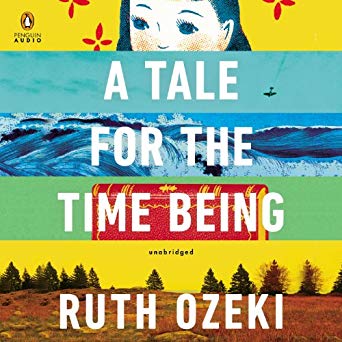
A Tale for the Time Being by Ruth Ozeki (audio)

A time being is someone who lives in time, and that means you, and me, and every one of us who is, or was, or ever will be.

My mother gave me this audiobook for my birthday. With her own print copy ready, we set out to read together. She had already very much enjoyed the audiobook. Now I’ve finished, and she hasn’t yet, so we haven’t done our final debrief together; but we have discussed as we’ve leapfrogged down the middle.

A Tale for the Time Being is unusual in a few delightful, fresh ways. The opening voice is that of Nao, a sixteen-year-old girl living in Tokyo. (In this time-obsessed novel, you can bet her name is a meaningful homonym.) Nao is Japanese but has lived most of her life in Sunnyvale, California, and the recent move to Tokyo has been very hard on her. She is the victim of criminal bullying at school, and has decided to end her life, but before she does, she wants to record the amazing life of her great-grandmother Jiko, a Buddhist nun and radical anarchist feminist. She sets out to do this in a diary. The diary is being read by Ruth, a novelist living on Canada’s west coast on a remote island with her husband Oliver and their cat, named Schrodinger but more commonly called Pest, or Pesto. (Ruth’s life matches that of author Ruth Ozeki suspiciously closely.) Ruth found the diary and a few other artifacts, well-wrapped in a barnacle-encrusted ziploc bag, on a beach near her home: the beach near Jap Ranch, as she calls it, her own Japanese heritage giving her the right and motivating her to remember the mistreatment of her people during World War II in these parts. (Oliver, who is of German heritage, cannot call it Jap Ranch.)

The story is told in alternating sections, in Ruth’s present and in Nao’s diary-recorded recent past, and then supplemented by other artifacts: documents found with the diary, and Ruth’s email correspondance as she begins searching for Nao in the present. There are several voices, then. And in several senses: there is the narrative first-person voice of Nao in her diary; Ruth’s perspective, told in third person; and then there are the voices as recorded in this audiobook. The author reads her book herself, which I love, and she does a lovely job of performing her set of characters. Oliver is stoic, a man of intellect and not emotion. Ruth is pensive; their neighbor Muriel is a bit nasal-y, and a bit annoying anyway. Nao is whimsical and impatient, sometimes immature and sometimes resignedly dour: a teenager indeed. The audio performance is absolutely perfect. It’s always comforting knowing we’re hearing the voices the author does.

The story expands and swells like a less well-packaged diary would have done in the ocean waters… We learn about Nao’s family, her depressed and defeated father, her no-nonsense mother, the deeply loveable Jiko, and more. It turns out that there is a thread of suicidal thoughts in her family: her father makes several suicide attempts, which they do not talk about; and his uncle, Nao’s great-uncle, died as a kamikaze pilot in WWII. Call that a reluctant suicide, perhaps. Three generations, then, dealing with tendencies to suicide in very different ways and originating in very different places. Meanwhile, Ruth’s family includes a now-dead mother who had Alzheimer’s but experienced a relatively sweet decline; Oliver is a decidedly quirky but, I felt, very likeable guy. He is a self-taught naturalist seeking to replant a preserve on their island so as to weather climate change. Even Pesto the cat plays an important role.

As the title indicates, this is a story about time, about moments, about whether we control the past or the future or even the present. As in the quotation that heads this review, the phrase “time being” takes on a new meaning here, in Nao’s dreamlike, imaginative ruminations. Ruth and Nao are both distant and very close together; the question of how far or near takes on a mystical quality, as Ruth worries if she is going crazy (or developing her mother’s disease – a worry I’ve seen in people I know too). Under Oliver’s wise guidance, even quantum physics comes into play late in the book, where I got quite lost but I think (hope) that I followed the ideas, the feeling of mystery and wonder.

Ruth Ozeki is a remarkable writer. This tale is multi-layered: mental health, the bendiness of time and space, linguistics (Japanese and English and also French, the bendiness of language, too), literature, and the love and personalities of animals… there is something here for everyone. For example, I thought of my father every time Oliver worries over the trees he’s planted in the preserve. Technically, the species he’s chosen violate the covenant of the trust because they are not native to the region; but he’s planted them for the climate-changing future, when species move north, and he’s put great thought into his choices, and the idea of destroying them is indeed heart-breaking. This issue is glancing within the book, but clearly opens up into something large and thought-provoking and timely – qualities that apply to every aspect of A Tale for the Time Being. Add to all of this Ozeki’s pitch-perfect performance, and I can scarcely recommend this audiobook highly enough.

And speaking of bendiness, consider the similarities between the author Ruth and the character Ruth. Of course I have 100 questions about their boundary lines. And what of Nao’s washed-up diary? What is its real-world equivalent? There are some mind-expanding puzzles here to be sure. It’s delicious.

Note: Ozeki (as herself) comments at the end that the print version includes footnotes, illustrations, annotations, and appendices. She appreciates the audio version very much for some reasons – she writes for musicality and sound, and loves its immediacy – and the print for others. Hopefully my mother, who is finishing the print version now, will have some thoughts to share with us about those differences. I suspect audio first, followed by print, is the right order.

If you love cats, trees, or people; if you’re interested in history and legacy, the power of words, or the questions posed by the passing of time – then this delightful, expansive novel is for you.


Rating: 9 crows.

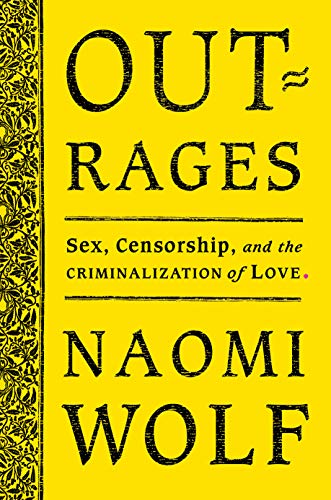
Outrages: Sex, Censorship, and the Criminalization of Love by Naomi Wolf

**Please see the bottom of this post for why this book will not be published after all…**


Naomi Wolf examines poetry as social resistance and its ability to free its readers and its writers, the origins of homophobia and the battle against censorship in this gripping and vital history.

With Outrages: Sex, Censorship, and the Criminalization of Love, Naomi Wolf tackles the history of legislation against homosexuality in the United Kingdom through the poetry, essays and life of a man her readers have probably never heard of: John Addington Symonds. This book harnesses the electric power of Walt Whitman’s Leaves of Grass, the righteous energy of first-wave feminism and the terror of criminalized identities, in a style accessible to general readers. As the fight for LGBTQ rights continues, this book is as relevant as it is compelling.

Symonds (1840-1893) had the bad luck to come of age as a gay man just as Great Britain’s legal system turned against men who loved men. He was a writer in a time of obscenity laws. And despite the grave danger–sodomy for a time was punishable by death–he kept writing. “This is one reason why Symonds’s story, in the context of the history of censorship and the history of homosexuality, is so remarkable. The man just would not be silenced.” On top of copious publications, Symonds left behind a trove of “secret poems,” and a memoir that would not be published until nearly 130 years after his death.

While Symonds is not Wolf’s central subject, he provides inspiration and continuity for a larger story, and his life provides the book’s timeline. It opens with Symonds’s youth and the 1855 publication of Leaves of Grass. Then it follows London’s war against literal filth (human excrement in the streets, cholera, typhus) and the invention of the crime of obscenity (framed in parallel to that other filth, with its infectious properties), legislation of female bodies and what Wolf calls the laboratory of empire: Britain tried out increasingly stringent policies in its colonies before bringing them home. Wolf maps out the relationship between feminists’ campaigns for marital and property rights and the new idea that male-male love was “disgusting” or “unnatural”: “When women targeted the sexually abusive practices of heterosexual men, the outcome was a backlash by the heterosexual male establishment,” or distraction techniques directed at gay men.

Meanwhile, writers and artists sought each other out clandestinely, using coded language and referring to the ancient Greeks, as censorship laws “had an immediate dampening effect on literature.” Finally, Wolf tracks what she sees as a generational progression: Whitman influencing Symonds and then Oscar Wilde, who served two years’ hard labor for “gross indecency.” The book ends with Symonds’s death and his legacy, the writings he published in his lifetime and those he left behind for a future society ready to receive them.

Wolf’s style is easy to read, and her research is authoritative: this book is in part adapted from more academic work on the subject, and some of the most captivating scenes involve primary sources in the archives. Outrages is not only an important history with lessons for the present, but also an engagingly told story. The instructive life of Symonds is for any reader who cares about history, civil rights or the power of poetry.


This review originally ran in the May 17, 2019 issue of Shelf Awareness for the Book Trade. To subscribe, click here.


Rating: 7 notations to OMIT.

…and, speaking of omissions! Between my review of this book and its publication, there has been some uproar. I decided to post this review as it originally ran, and then to include a few links for your further reading.

“Naomi Wolf’s Outrages Postponed, Recalled” (from Shelf Awareness)

“Naomi Wolf’s Career of Blunders Continues in ‘Outrages’” (from The New York Times)

As it turns out, this book will not be available anytime soon.

In a nutshell, Wolf was first caught in a simple error (live on BBC radio: you can listen here) that played an important role in her book; but as the Times writer goes on to say (quite a bit more vehemently than the BBC radio host, historian Matthew Sweet), Wolf has a history of playing fast and loose with the facts.

I’m taking this in as you are, folks. What a wild ride. Vigilance on all our parts; and it’s good to read the adjacent articles as they come out, especially if you’re going to allow a book to shape your worldview…

Appalachia North: A Memoir by Matthew Ferrence

Disclosure: Matt Ferrence was visiting faculty at this past winter’s residency at WVWC, and we really hit it off; I think he’s great, and he gifted me my copy of Blue Highways.


A shorter review now, with more to follow, because Still: the Journal has agreed to published my book review *and* an interview with Ferrence in their October issue. Hooray! For now, a teaser.

Building a literature based only on darkness is just another way to shackle ourselves to decline. Instead, we are who we are, and that’s the sound of red-winged blackbirds chirping in the blowing reeds alongside restoration wetlands, a dark plain bird with a hidden flash of brilliance, the real marker of hope.

You know I’m on an extended trip right now. I’ve been keeping track of birds, among other things. In the mid-east-coast area, I started to see red-winged blackbirds, which I don’t recall ever having seen before. They are a delight, that shock of bright red underlined by bright yellow on black-black background. I saw just a few, and then lots of them, diving and swooping and chattering at one another, plentiful as grackles. I looked them up, and see that they live where I’m from, too. How come I never saw a red-winged blackbird before?

This book is a little like that, for me. The recognition of something I didn’t know I needed, although it seems thoroughly obvious now I’ve seen it. And it’s from where I’m from, too. The synchronicities like this kept stacking up. Matt’s parents and my dad all love Wendell Berry, although his took it a step further and farmed on the farm they purchased when he was young, while we kept our city home even after purchasing a ranch when I was young. We’ve struggled with similar questions about where we’re from. My brain injury and his brain tumor are different, but also alike. Even the Facebook surveys we each put out about our home places, Pennsylvania or Northern Appalachia, and Texas. I can’t tell you how many times I scribbled “me too” in these margins. I don’t usually scribble anything in the margins at all, but when Matt sent me Blue Highways, I learned something.

Okay, then.

This book is that blend that I love best in nonfiction: both memoir and outward-looking examination of something larger than the self. Ferrence grew up on a farm in southwestern Pennsylvania. He didn’t know it yet, but he was born and raised in Northern Appalachia. At forty, he is diagnosed with a brain tumor. Appalachia is a much-maligned and little-understood region of this country, at least from the outside. Northern Appalachia is less understood, and (as Ferrence has it) exiled from both Appalachia and the U.S. He examines the geology and geography of sedimentary rock, mountains, and his own brain through many layers of metaphor. He pulls in plenty of outside voices: writers he admires (Abbey, Dillard, Sanders), and some he takes issue with. That’s another duality I deeply appreciate, that balance between one’s own voice and the voices that have informed it.

That’s all I want to say, in advance of Still‘s October issue – I will repost my longer review, and interview with Matt, when they’re available. For now, please know that this book caught me in that perfect place: both personally resonant in all the deepest ways, and an intellectual and artistic accomplishment I admire and would like to emulate. This is one of the most highly recommended books of 2019. And I don’t care who you are and where you’re from: you have something to learn from Appalachia North. Get out and get you a copy today. You’re welcome.


Rating: 9 collection points.

movie: The Lovely Bones (2019)

And then there was The Lovely Bones, which I’ll call a sleeper: we didn’t pick this movie out like we did Extremely Wicked, and in fact missed the first half hour or so. But it turned out to be an impressive one.

I read the book, by Alice Sebold, but some time ago, clearly pre-blog; I don’t remember it very well, and don’t remember it impressing me terribly, but it came back as the movie unfolded. I do remember some talk when the movie came out, of the challenge of the first-person narration by (very minor spoiler here) the ghost of a murdered girl. I remember not being impressed by this challenge: don’t you just use voiceover narration? I guess that’s pretty obvious – maybe too obvious – but it’s how it is handled here. And I have no complaints.

Fourteen-year-old Susie Salmon is brutally murdered by a neighbor: this is the part of the movie I missed, but it sounds like it’s all off-screen and implied rather than shown. She spends the bulk of the film in an in-between zone, neither living nor ready to move on; she wants her murder solved, and she misses her family, and she regrets never having had a first kiss. The killer neighbor cleans up well, and the Salmon family struggles to cope: Susie’s father obsesses over the case, her mother eventually leaves, and her younger sister will take matters into her own hands. There are lovely, ethereal scenes in the in-between, magical and visually stunning – I was reminded of A Wrinkle in Time‘s visuals. The killer is an easy man to hate (the friend I watched this movie with commented that that actor’s now typecast for life). The Salmon father, played by Mark Wahlburg (I confess a weakness for Mark Wahlburg), is easy to sympathize with even as he makes some less than wise choices. And the ending is strangely happy, for a movie with such disturbing content.

I’m deeply impressed by the cinematography, the revelation of information, and the visuals. When I saw that Peter Jackson directed, I thought, oh, of course. That’s why it’s so beautiful, at least. I’m also reading that the plot diverged heavily from the novel in a few points; but my dim recollection of the book felt very familiar here. Maybe it’s better that I let so much time pass between reading and viewing, because I’m always prickly about the way movies mess up the books. But here, the general familiarity felt faithful enough, and the film version was stunning.

I do recommend; and suspect I recommend the book as well.


Rating: 8 bouncy balls.

movie: Extremely Wicked, Shockingly Evil and Vile (2019)

A few days of wifi access have yielded a few movies, beginning with this one. From Sundance to Netflix comes Extremely Wicked, Shockingly Evil and Vile, a recent biopic about Ted Bundy.

Bundy was known to be a handsome guy, and here played by Zac Ephron, he comes off handsomer than in real life – I’d rate the real Bundy average, not remarkable, where Ephron is eye-catching. His long-term girlfriend Liz is played by Lily Collins. The movie is based on a book that the real-life Liz wrote: The Phantom Prince: My Life with Ted Bundy by Elizabeth Kendall (a pseudonym). The movie takes Liz’s perspective at times, but at times gets well away from her, as she distances herself from Bundy during his incarceration and trials, and the film follows the courtroom drama and Bundy’s developing relationship with Carol Anne (Kaya Scodelario).

I have mixed feeling about the way Bundy was portrayed. I think the idea may have been to show the extreme creepiness of how truly everyday a serial killer can be: this is the guy next door, with arguably better-than-average good looks but otherwise unremarkable. That’s what is showed here, and that’s what’s so scary, right? But in showing how everyday (and charming and handsome) Bundy was, the film skirts the edges of the strange fandom of the gushing young women attending Bundy’s murder trial: we’re getting a little into hero worship. And that’s even creepier. This may be the trouble with telling a story like Bundy’s at all. Maybe we should be less obsessed with serial killers in the first place…

I watched the movie, though, and I have to say it was entertaining, or at least mesmerizing. Ephron’s cute; Liz is compelling, and I feel her pain. I think she could probably have used some more screen time, and somewhere I read the reasonable criticism that her decision to get sober is covered in a mere montage scene, in which she wordlessly throws away half-empty liquor bottles. For such a major life event, and for the movie’s arguable heroine (spoilers aside, she wrote the book that gave us the film, for dog’s sake), I think she may deserve more. But an engaging evening’s viewing, sure.


Rating: 5 butterflies.

guest review: Sylvia Center for the Arts presents Orlando (2019), from Pops

From Pops, from Bellingham’s Sylvia Center (formerly the iDiOM).

Sylvia Center for the Arts presents Orlando, by Sarah Ruhl in 2003 and directed by WWU professor Rich Brown, with five players on a spare stage. Woolf and the story are still mostly inscrutable to me, but the players and staging are wonderful, with multiple vignettes easily adequate to carry the story and action. This production is creatively played with humor and energy as the narrative speeds through centuries, while centered on Orlando personally.

It is a very physical interpretation with much movement, often choreographed like dance; passage of time is depicted by the actors furtively running in circles or helter-skelter in the small stage area. They may use each other for props like tables and chairs; small props emerge on cue from pockets or capes. Some minor wardrobe changes occur in the flow of staging. Ship voyages are inventively evoked by actors’ bodies locked together and swaying with the waves.

Karlee Foster as the androgynous Orlando is perfect, physically as well as in body language and expression. She is ruffled, wild and spirited, but also ruminates over social conventions; all of which is belied by a tranquil and well-groomed promotional studio photo. The 3-man chorus is excellent, and not mere backdrop; they serve as continuous narrators but each also plays at least one woman’s part. The fifth player is an exotic Sasha, Orlando’s lifelong icon of youthful love. Her ‘Romanian’ accent is nearly overdone and perplexing, but her irresistible effect on Orlando is intently, comically obvious.

Suiting the tale, Orlando passionately kisses each of many characters (and all players) at least once – or more! Other, intimate couplings are openly implied with inventive, chaste staging devices, like backlit silhouettes or covering capes. And, always fun, there is a Shakespearean play-within-a-play – of Shakespeare’s own Julius Caesar! (the murder of Cassius) It was delightful, lively entertainment; kudos to the venue, the company and the small arts community that continues to display actors of such craft and energy.

What fun this sounds like! I remain unsure of Woolf, and remember Orlando as daunting (I believe from the 1992 film) (then again, I was 10 in 1992, what do you expect). But this stage performance sounds delightful. Maybe that’s just my feeling about (well-produced) theatre in general. I am jealous; I’m not seeing more theatre these days…

Thanks, Pops!

Oxford American, issue 99: Kentucky Music Issue (winter 2017)

You can see further details or purchase this issue here, and I do recommend it.

I’m amazed, again, at my enjoyment of this magazine, especially in its Southern Music issues, this one about Kentucky – and I was pleasantly surprised to see so many names I knew, both in contributing writers (a few associated with West Virginia Wesleyan) and in musicians. I shouldn’t put these mags off so long; I enjoy them so much.

I am reminded of past OA music issues, of course, and of The Poetics of American Song Lyrics. The liner notes, so to speak, in this music issue for the accompanying album of 27 tracks often expand into mini-essays not only describing the music but arguing for its place in history, its importance, its context… as when I read Poetics, I find myself recognizing something I’d been missing: music written of as the art form it can be. I haven’t found enough of this in the world, I guess. Also, of course, OA‘s concentration on the American South overlaps with my own concerns, and our musical tastes so far line up nicely too.

I am also astonished to see the same themes that plague my own mind and life keep recurring… it was one thing to find the theme of home-seeking in Matt Ferrence’s Appalachia North, which I am reading now, a book I chose for its relevance to my own obsessions. But the same themes turn up in Ruth Ozeki’s A Tale for the Time Being, which I’m listening to on audio now (birthday present from my mom, thanks Mom)… and the music of Kentucky often as not approaches them too. Look at Harry Dean Stanton explicating “Cancion Mixteca”:

I see it as, when you’re truly at home there’s no more suffering… crying to get back to where you come from.

Maybe this is what’s so haunting and impossible about our (apparently universal) yearning for home: that we’re trying to get to place with no suffering, where everything is resolved. Talk about setting yourself up to be disappointed.

Or this:

Inoculated with a love of and fascination with her homeplace, Rachel Grimes became a student of its history.

Again I’m thinking of Appalachia North, Matt Ferrence’s research-rich investigation of his own home: work I aspire to do for mine. Partly I self-select (consciously and not) to expose myself to the media that I am likely to appreciate, of course. But doesn’t it also seem like we encounter things in groups or bunches? A new topic is suddenly all around us. I remember the first time I heard of the concept of a murder ballad. It was from a woman from Kentucky (of course), a fellow student in my MFA program. I was intrigued by the concept; and suddenly murder ballads were all around me. Again from this Kentucky album & magazine: the murder ballad “Pretty Polly,” which I can’t say for sure isn’t the first one I ever heard, sung by Amanda Jo on the dorm steps at dusk in West Virginia’s July, backlit by fireflies.

Perhaps I most loved the brief notes on each song included with the cd that comes with this magazine, those succinct reasons why King Kong’s “Me Hungry,” Freakwater’s “My Old Drunk Friend,” and Sarah Ogan Gunning’s “I’m Going to Organize, Baby Mine” join Loretta Lynn, the Everly Brothers and Les McCann. Reading these paragraphs and listening to the songs and making my own observations about the music and meaning is always the most special treat of an OA music issue. But there was so much I loved here: Jason Howard*’s “If God Had a Name,” about Joan Osborne’s influence on his own life and spirituality (I love the song, too). Jeffrey A. Keith’s study of the Appalshop*. John Thomason on John Prine’s Paradise. Ashley Bloom’s lovely essay “Fire in My Bones” on religion and reclaiming her body. Crystal Wilkinson’s story “Cleo, Cleo Black as Coal,” a piercing piece of fiction to cleanse the palate, except it’s more flavorful than any palate cleanser. John Jeremiah Sullivan’s “Death Rattle” was a remarkable piece of investigation, even anthropology. And of course, Silas House*’s gorgeous feature, quoted below. So much astonishingly lovely writing, throughout.

Zandria F. Robinson’s feature, “Border Wars,” confounded me some; sometimes I didn’t know what her sentences meant, although they were always lovely. I found myself both nodding emphatically along, and also sometimes disagreeing. It was an engaging piece of writing, and I guess any differences I felt with her drive home the point about shifting borders and differing definitions, and how they can divide us. If I didn’t always agree, I certainly respected and admired.

David Ramsey’s “Tuned Up in the Spirit,” about the Old Regular Baptists and their line-called music, gave me a little trouble as well. It was a bit too many pages of religion (perhaps without quite enough music) for my tastes. And when he notes that the Old Regulars forbid woman from leading songs, preaching, or taking part in church business, and then moves right along, I think, only a man could brush past that.

Here are a few of the lines I marked, usually in noticing how they speak to my own home-seeking.

This faculty, to be attuned to one’s surroundings and the ways in which they’re unique, to be rooted in the local, to be of a certain place – no matter if one permanently leaves it, like Richard Hell, or stays forever, like Rachel Grimes – is an elemental theme running through [this issue].

From Deputy Editor Maxwell George’s introduction to “The Music of Kentucky.”

Ronni Lundy quotes Dwight Yoakum:

…you have to break the ties to be yourself, and then you see how much those ties meant to you, so you try to put them back. Only you can’t really do it. You can’t do either all the way. But that’s where the story is, right? That place in the middle, isn’t that where it’s art?

This quotation means a great deal to Lundy, too – it gives her the title of her piece on Yoakum, “That Place in the Middle.”

From House’s inspired essay “Watershed,” on the Phipps Family:

There are many Appalachias, but this one is much like most of the rural places in the region: a wound, a poem, a contradiction – none of them easily defined, all of them complex, taut with history and culture that most people never bother to study or understand before passing judgment. Like most places in American, it’s a place of poverty and wealth, of education and ignorance…

And of course, you know what I’m going to say next, that all of this is true of most places in America. A wound, a poem, a contradiction. (I wish I’d written that.)

John Jeremiah Sullivan writing about the jawbone as a musical instrument, and its roots in slavery:

Slaveholders could forbid them the guitar, the banjo, the fiddle, everything. They might even embargo wire and string. But it’s not as easy to take away denuded animal bones. And while those were ready to hand, so was rhythm. That’s how hard it is to kill music.

That’s how hard it is to kill art.

In other words, forget it.

Forget it. This stuff is gold. Get all the Oxford American music issues you can.


Rating: 9 stays out of a man’s shirt collar.

*Recognize these names? From Hillbilly.

The Plover by Brian Doyle (audio)

And no thinking on this trip, either, he said to the gull floating over the stern. No recriminations and ruminations. No logs and journals and literary pretensions neither. Thinking can only, like the boat, proceed forward.

Thank goodness for Brian Doyle. I had been in a bit of a blue funk and looked for something cheerful to pick me up; a Brian Doyle novel was just the thing, I thought, and I was right.

Based on Martin Marten and Mink River, I foolishly thought the plover in this story would be an actual plover – a bird. Ha! No, the Plover is a boat. (And to be fair, the protagonist of Mink River turned out to be a crow.) Classically, for Doyle, we open with epigraphs: from Robert Louis Stevenson, George Harrison, and Annie Dillard. (Perfect.) Then we plunge right in and meet our protagonist, an eccentric fellow (aren’t they all) named Declan O’Donnell. An Irishman (read here with an accent) who hails from the Oregon coast and a fractured family, he’s invested himself totally in a small trawler he calls the Plover for perfect reasons. He’s “edited” her by, among other things, fitting a small mast and sails; and he heads off from Oregon, intending “west and then west.”

Declan is explicitly trying to escape humankind and all their “emotional complications… expectations and illusions… analysis and explications.” But of course, he is immediately joined (page 1) by a gull, to whom he holds forth at length: we already suspect he enjoys having the company. And the comedy of the book is in all the passengers he takes on: the narrative tells us that the census reaches over one thousand, if we count barnacles, but it also at one point reaches seven human beings. Declan is in fact a more social creature than he aspires to be, and that’s the central storyline here: Macmillan’s blurb calls it “the story of a cold man melting,” and I think that’s not too far off, although I might amend to call it the melting of a man who tried to be cold. Declan has had some trauma in his life, and his reaction is to try and shut himself off. He fails, and that’s one of the joys of this book.

There are so many joys, although also much trauma. Declan’s best friend, Piko, is one of Doyle’s exuberant characters – “he had legally changed his name for a while to an adjective, he played the flügelhorn in a jazz band that deliberately played only such events as weddings between Lutherans and Presbyterians and baptisms of babies named for animals, and he had once flensed a whale by himself, over the course of three weeks, on the beach, living in a tiny blue tent about the high tide line. He was one of those guys who seemed electrified by everyone and everything, the kind of guy who totally lit up when he saw a sparrow-hawk helicoptering over a corn shock, the kind of guy who liked every kid he ever met and every kid liked him… But he had been wounded by a storm, this guy, his little daughter hit by a bus driver when she was five years old waiting for the kindergarten bus, and his light was dimmed.” Pippa, the daughter, cannot move except for a possibly meaningless fluttering of her hands; she cannot speak except to make possibly meaningless squeaks and coos that sound like bird sounds. But she has a rich inner life. (Spoiler: Piko and Pippa will become passengers and crew on the Plover.) Both Piko and Pippa are very Doylesque characters: peculiar, delightful, brimming, wounded. There are more of these in the book – a Doyle novel is made of such characters. Again: just what I needed.

So Declan explores the world, becoming increasingly reluctant to set foot on land. He cares for his boat and weathers storms. He picks up passengers and rails against their very presence, but still they come on. He and his growing crew-family have a conflict with another ship and its ill-intending captain, but everything comes out well in the end. As the small, green, red-sailed Plover swells in population, tensions rise, but so does the incidence of miracles. Doyle is unafraid to take his whimsical characters to the brink of death and then snatch them, in unlikely fashion, back. Once you’ve made peace with this inclination (and I have), it’s great fun.

Declan is a devoted reader of the Irish author and orator Edmund Burke, who is much quoted here, along with a reference or two to Robert Louis Stevenson (upon whom Doyle would base a later book). Through these outside voices, through Declan’s own and the wise voices of his friends and comrades (including one very quirky minister for fisheries and marine resources and foreign affairs), The Plover is a novel of philosophy as well as the story of one plucky little boat and its captain.

David Drummond’s reading feels perfect to me. I love the many different voices, accents, rhythms he plays. Pippa’s exuberance, Declan’s grumpy Irish lilt, the minister’s volubility and interesting speech patterns, and so much more. (Somebody should write a paper on the minister’s word coinages.) A good narrator makes all the difference, and I’m so glad we got a good one here.

Doyle’s usual strengths are all present. Characters and story are brimming and bubbling with good cheer even in the face of significant and imaginative tragedy. Sentences are often long, convoluted, and performative of their content. Details are numerous and precise and bizarre. Nothing has changed; this man is a near-perfect novelist, for this reader. I’m still so sad he’s gone.


Rating: 8 crucial silences between notes.

Author interview: Michele Filgate

Following my review of What My Mother and I Don’t Talk About, here’s Michele Filgate: One of the Most Important Things Writing Can Do.


Michele Filgate is a contributing editor at Literary Hub and a former board member of the National Book Critics Circle. She teaches creative nonfiction for the Sackett Street Writers’ Workshop, Catapult and Stanford Continuing Studies, and is the founder of the Red Ink literary series. Filgate is an M.F.A. student at New York University, where she is the recipient of the Stein Fellowship. What My Mother and I Don’t Talk About: Fifteen Writers Break the Silence is available from Simon & Schuster.

photo: Sylvie Rosokoff

You spent more than a decade working on the essay for Longreads that was the seed for this book.

I started writing this essay when I was an undergraduate at the University of New Hampshire, and I really thought I was writing about my stepfather abusing me. It took me many years to realize that what I was actually trying to write about was the fracture that abuse caused in my relationship with my mother. When you experience something traumatic, it can take many years to unpack. I finally had this breakthrough that the piece was really about my mother. I went to the Tin House summer workshop one year, where I studied with Jo Ann Beard, who is one of my biggest influences as a writer. Her instruction and my classmates in that workshop really helped me figure out how to put this piece together and how to make it work.

The essay came out in Longreads in October 2017, right when the Weinstein story broke and the #metoo movement took off. It was kind of wild to have the most painful thing I’ve ever written published right at a moment in our culture when we were revealing these stories that people had kept hidden for so long. It was a relief to feel like I was not alone.

How did it feel to publish such personal details?

It was terrifying at first. I did not tell my mom about the essay because our relationship was already so complicated. I didn’t want to hurt my mom; that was never my intention. And people who read the essay have told me they can read the love and longing, more than anger. It’s not about anger. It’s about wanting to have a relationship with my mom that I don’t have.

It was really scary to release this story that I’d been carrying with me for so many years in print. I felt nauseated, terrified, sad, anxious, all of those negative emotions… but as I kept hearing from strangers who read the piece–who had similar stories to tell–a funny thing happened. I started to feel a sense of relief, of unburdening myself. By putting this story out there I was able to help other people feel less alone, which I think is one of the most important things writing can do.

How did the anthology happen?

So many people responded to the title of my essay, “What My Mother and I Don’t Talk About,” that it just felt right to put together an anthology. Everyone–no matter how close they are with their mother, or if they’ve never even met their mother, or their mother is no longer alive–has something that they can’t talk about with their mother. I’d already been thinking of doing an anthology. Because of the essay going viral and having the response it did–it was shared by Lidia Yuknavitch, Anne Lamott, Rebecca Solnit, so many writers I admire on social media–I felt like, okay, there’s momentum here. I think this is a book.

Before I got a book deal, I reached out to writers I admire and asked them if they’d be willing to contribute original essays. Everything I’ve been doing in my career so far has led up to this point. I was an indy bookseller for many years; I ran events at RiverRun Bookstore in Portsmouth, N.H., McNally Jackson in Manhattan and Community Bookstore in Brooklyn; and then, after I left bookselling, I joined the board of the National Book Critics Circle. I’ve been a voracious reader and literary citizen for many years, and I have my own literary series, Red Ink, that’s dedicated to women writers. This was the kind of work I’d already been doing, making these connections, and so it was wonderful to be able to put together a book featuring so many writers I really respect.

What did you learn in the process of collecting, editing and organizing these essays?

It felt like such a privilege to be able to work with some of my favorite writers. I learned that this topic is not an easy one for anyone. Some writers I’d originally signed up for the book had to drop out. And some people realized they weren’t ready to write about their moms. It made me feel less alone, because this is a sensitive topic for so many people. That was kind of eye-opening to me. I’m not the only one who finds this a tricky thing to do. It was interesting to me that it’s even tricky for people who are close with their mothers. How do you capture someone you are so close to, and make it interesting for other people?

Is this a book with a cause?

Definitely, yes. If this can inspire people to have conversations with their moms that they haven’t been able to have, then I will feel like this book is worth it. And it’s already happened with one of the contributors in this book. Nayomi Munaweera wrote a piece about growing up with a mentally ill mother, and she sent it to her mom, and told her it was going to be coming out in a book. Her mother wrote back such a wonderful e-mail that we ended up including it as the postscript. So after her essay in the book is this really beautiful e-mail from her mom that demonstrates her love and how proud she is of Nayomi for writing this piece.

That right there is the cause for this book: breaking the silence, as the subtitle suggests. Silence can be toxic. I think this book will help a lot of people learn how to have those conversations in their own lives, or feel less alone.


This interview originally ran in the May 3, 2019 issue of Shelf Awareness for Readers. To subscribe, click here, and you’ll receive two issues per week of book reviews and other bookish news.