Maximum Shelf: The Book of V. by Anna Solomon

Maximum Shelf is the weekly Shelf Awareness feature focusing on an upcoming title we love and believe will be a great handselling opportunity for booksellers everywhere. The features are written by our editors and reviewers and the publisher has helped support the issue.

This review was published by Shelf Awareness on January 29, 2020.


The Book of V. by Pushcart Prize-winner Anna Solomon (The Little Bride; Leaving Lucy Pear) explores the lives of three women, apparently unconnected yet increasingly intertwined as the pages turn. The braided result is moving, surprising, so touchingly detailed and authentic as to seem more real than life.

In biblical times, a king of Persia takes a second wife. Solomon’s epigraph comes from Elizabeth Cady Stanton’s The Woman’s Bible: “I have always regretted that the historian allowed Vashti to drop out of sight so suddenly.” This first wife simply disappeared: “No one knows. She’s gone.” Solomon takes steps to correct the oversight of Vashti, but she is more concerned with the second wife–Esther, a Jewish orphan girl, chosen by the king as his replacement queen against her wishes.

Esther, meant to be homely and invisible, tried to shrink from the spotlight but somehow charmed the king despite herself. She casts a long shadow here, telling her own story–how she resisted the role of queen, and later used it to save her people–and then influencing several lives that come later.

Lily and her family live in Brooklyn in 2016. Lily gave up her academic career to stay home with her children: two girls who keep asking her to read the Esther book to them, even though she is thoroughly sick of it. Her husband works as deputy director of programs for Rwanda at a major humanitarian aid organization. It’s not that Lily misses academia, but she’s a little dissatisfied with the life she traded it in for. She is also a second wife.

And then there is Vivian, wife of a senator from Rhode Island in the 1970s. Vee is the daughter of a senator’s wife who was the daughter of a governor’s wife. In D.C., she is torn between the women in her consciousness-raising group–“with their circle-talk and their red wine and unmade faces”–and the other senators’ wives: “They are dazzling, these wives of politicians and company presidents, these tigresses who openly dislike and disagree with each other.” Vee is a little of each–and a little contrarian, driven to thwart both.

The title, The Book of V., refers to Vee, to Vashti and surely, to a part of the female anatomy. “This is what the women’s group women insist on calling it. Vagina, [Vee] thinks dutifully, though the word disgusts her.” Solomon shows a careful attention to words. “A blowhard, Esther called him, perhaps not with that word but with another that meant the same in that time and place.” Her writing is lovely, incandescent; paradoxically, it has that ability that fine writing often has to disappear into the background, so that readers seem to hear the characters directly without a writer’s mediation at all.

Readers follow Esther as she is thrown into a pageant (in several senses of the word) against her will, by an uncle who hopes she will solve problems bigger than herself, problems that have been plaguing the Jewish camp outside the city walls. Vee challenges her husband’s authority repeatedly, finally disobeying him in the same way that, legend has it, got Vashti banished or killed. Lily struggles with an attraction to another woman’s husband, just as her mother takes ill.

Chapters alternate among the perspectives of these three women. Individually stunning, their stories also intersect and meet in unforeseen ways. Though each takes center stage in turn, it requires all three to form the complete picture. They illuminate each other. The women’s relationships with men are very much at issue: Esther’s unkind king and his more powerful minister; Lily’s essentially good but somewhat boring husband; and Vee’s rather sadistic senator. They are joined by other male characters, sex symbols and brothers and abusers. But relationships between women are privileged. The Bechdel test–the idea that a book (1) should have at least two women in it, who (2) who talk to each other, about (3) something besides a man–is easily passed. Esther, Lily and Vee are joined by many interesting women: one of the maidens forced alongside Esther to compete for the king’s favor; Lily’s inscrutable mother; an old friend of Vee’s; a fellow Brooklyn mom who makes suspicious attempts to befriend Lily.

Each story is gripping in itself, and to balance them in alternation is a trick; it is to Solomon’s credit that the reader moves so smoothly among them, always sorry to step away but eager to return to the next woman, so that the pages fly by with unusual momentum. For a novel to offer such delightfully realized characters as well as such taut pacing is a fine accomplishment. The interweaving of the women’s lives is cleverly done, hinted at early on (as with references to Vee’s senator as royalty, or Lily’s daughters’ interest in Esther) with a light hand, and then growing as past secrets come to light.

With tense, deft plotting, memorable characters and writing that glows with each sentence, The Book of V. is a striking effort that will leave readers long inhabiting the worlds of Vee, Lily and Esther.


Rating: 8 zipper pulls.

Come back Wednesday for my interview with Anna Solomon.

Tiamat’s Wrath by James S. A. Corey (audio)

Tiamat’s Wrath is a terrific addition to the trilogy of trilogies that comprise The Expanse which, though never less than entertaining, have waxed and waned in their proximity to greatness since the publication of Leviathan’s Wake. (from Tor.com)

I concur: Tiamat’s Wrath is one of the better installments in an uneven but generally scintillating series. (Also, bonus at Tor.com: I learned a new word in the author bio. “Niall Alexander is the manager of an extra-curricular education centre, and also, increasingly occasionally, a reader and a writer. He lives with about a bazillion books, his better half and a certain sleekit wee beastie in the central belt of bonnie Scotland.” I love learning new words.)

Several decades after the end of Persepolis Rising, James Holden remains a prisoner of High Consul Winston Duarte, emperor of all the known worlds. Chrisjen Avasarala has recently died. Naomi lives in isolation in a shipping container, surrounded by tech, where she plays an important advisory role in the Resistance but rarely sees another human. Bobbie captains the captured ship Storm (also Resistance), with Alex as her pilot. Clarissa is no more (see previous book); Amos went on a high-stakes mission years ago, deep in enemy territory, and has never been heard from again. It’s a very somber opening.

Our beloved central characters are getting gray, but those living are still fighting, in their various ways, dispersed across galaxies. Aside from the core, we see Elvi Ocoye return (from Cibola Burn), performing on Duarte’s scientific team but having already, by the time this book begins, figured out she’s on the wrong team. And a new addition to the perspectives that tell this story is Teresa Duarte, the High Consul’s only child, at fourteen his protégé and, well, a teenager pushed to rebel.

A little hint here: it helps to have read The Churn before this book.

The science seems to matter a little more here than usual, or maybe it’s just that it makes more sense? At any rate, I was able (and motivated) to follow it more than I’ve been in a couple of books, and I found that rewarding. One relevant detail is that Duarte has been made immortal by protomolecule technology and with the help of sociopath Dr. Cortázar. But one thing about poorly understood technologies is that you don’t always know what you’ve signed up for.

My engagement with the science part of the science fiction helped me enjoy this book even a bit more than usual. But even more so, I think the plot and the action were at their best. And still more, separating our characters out into their own mini-stories (something that doesn’t always reengage fans, ahem, The Walking Dead) – with only Alex and Bobbie remaining a team – was a great choice here, in my opinion. We got to see each protagonist take on their own challenges, make their own choices, redefine their own values and belief systems. Naomi, in particular, had to expand her self-conception in the best of ways. I love love loved seeing everybody operate on their own, against a bare background if you will.

Our team – the Rocinante‘s crew, even if she’s in long-term storage – experiences surprising losses and surprising gains in this book. We are heading into the final novel of the series from here. I already feel a sense of loss that it will be over (although there are still several novellas and short stories for me to track down). But I also feel like the massive scale, physical, narrative, and moral, that have been undertaken by this series is being honored here in the penultimate installment, and that feels good. Boy, I’m exhausted just thinking about it.

Fan til the end here, me.


Rating: 8 whining dogs.

Maximum Shelf author interview: Jennifer Finney Boylan

Following Monday’s review of Good Boy, here’s Jennifer Boylan: We’re Here to Love Each Other.


Novelist, memoirist and short story writer Jennifer Finney Boylan is also a nationally known advocate for human rights. She is the inaugural Anna Quindlen Writer in Residence at Barnard College of Columbia University, and her column “Men and Women” appears on the op/ed page of the New York Times. Her 2003 memoir, She’s Not There: A Life in Two Genders, was the first bestselling work by a transgender American. From 2011 to 2018 she served on the board of directors of GLAAD and also provided counsel for the TV series Transparent and I Am Cait. She lives in New York City and in Belgrade Lakes, Maine, with her wife, Deedie. They have a son, Sean, and a daughter, Zai. Boylan’s memoir Good Boy: My Life in Seven Dogs, will be published by Celadon Books on April 21, 2020.

photo: Dan Haar

What inspired this book?

I think a lot of people, when they’re a little older, look back at their lives and wonder, how did I get here? It can be a challenge to connect who you’ve become with who you’ve been, for a transgender person like me. And yet it’s not a dilemma that’s unique to transgender people. I think we all seek to connect our pasts and our presents. When I look back, one of the constants in my life would be the dogs that I’ve had. And each of those dogs represents a particular phase of my life. There’s the dog I had in boyhood, there’s the dog I had when I was a nascent hippie, when I was a college boy, and then a young hipster, and a boyfriend and a husband and a father… it occurred to me it would be an interesting way to connect present to past, to talk about the dogs who were a constant over a very complex life.

How was writing Good Boy different from writing She’s Not There, more than 15 years ago?

With She’s Not There, it was all very new to me. Whereas at this point in my life, I’ve lived a third of my life as a woman, almost 20 years. She’s Not There is very much a book about transition. Good Boy in some ways is a book about dogs, but also about masculinity. About boyhood and manhood. It strikes me that a woman in late middle age who had a boyhood has a unique insight on what that experience was like. I have to be careful with this metaphor, because I don’t want to be insensitive, but I sometimes think that being a transgender person has something in common with immigration. I wasn’t born here in the land of women, but I do have my green card. I look back on boyhood and masculinity in the kind of way that my great-grandfather looked back on Ireland: a place remembered well but also a place you’re glad to have escaped from.

I’m able now to celebrate some of the joys of that life. It was a life I was delighted to escape, and I feel so lucky to have landed where I am. She’s Not There was a book of trouble–I was trying to solve a lot of problems over the course of my life with that book. I think I’m able to take a more generous look at masculinity, now that it’s so far in the past.

There is both pain and humor in your story. How do you balance those elements in storytelling?

I’ve always thought those two things come from the same well. Some of my favorite writing is the kind where you’re laughing one minute and in another you’re overwhelmed by a sense of sadness. American humor is funny–we think of humor as the lesser art form compared to tragedy. When was the last time that the winner of the Best Picture Oscar was a comedy? Was it Annie Hall, in ’76, ’77? The humor of fart jokes and frat boys is one thing, but the humor that comes from a life of trouble and absurdity is a much deeper form. I think that kind of writing and the literature of sadness comes from a very similar place.

It seems you and your family have sorted out the rules about sharing personal information. How do you negotiate that?

Well, I don’t know if we have it figured out. There are times when I just feel very sorry for them all, being stuck with me. One of the things that you learn in this book is that my older child came out as transgender a couple years ago, and that completely floored me. That’s not a story in which I come off very well, quite frankly. There are ways in which my own initial response to my child coming out as trans was not as generous as was my Republican evangelical Christian mother’s response to my coming out as trans 20 years before.

In the past I’ve written a lot about my children, and I’m sorry to say I think sometimes I’ve used the stories of their success in the world as kind of a way of proving to people that I am not that bad a person after all. And perhaps, in previous works, I might have waved that flag a little too vigorously. I did have my older child read the book. I had my wife read the book, to make sure everybody was okay with everything. But you still worry. I hope in the end that the people that I love and that love me have some respect for what I’m trying to do as a storyteller, and trust that what I’m doing essentially is done with love. My mother used to say, “It’s just as easy to tell nice stories. Why don’t you tell some nice stories instead?” I think if it were just as easy to tell nice stories I probably would. But the drive wheel of story is conflict. A true story that has conflict in it is going to be about people who at least at times are at loggerheads. You hope in the end that you show how people come to an understanding of themselves and each other, but it’s often a qualified resolution, and not everything being tied up neatly with a bow. There are some things that never get resolved.

Does this book have a moral or a lesson?

I think we all know that if we’re here for any reason at all, it’s to love one another. And yet it turns out that loving each other is not easy, and a lot of the time it’s something that we’re not good at. For men in particular, expressing love can be really difficult. For women, too, but my memory of masculinity is that a lot of serious things, and love not least, had to be expressed ironically or through understatement or through these long pregnant silences. And what dogs do is give us a way to express the love that’s in our hearts in a way that we don’t have to feel ashamed of. You can see the most serious, somber person in the world, and then they get a dog in their arms and suddenly they’re blubbering all over the place and kissing Bingo on the head. If there’s a message, it’s that we all should share the love that’s in our hearts, and if you find that difficult, get a dog.

A lot of times in this book, you’ll see a moment where I’m really messed up. My father is dying upstairs, or I’m out in the woods trying to figure out how am I ever going to get through transition, or I’m wondering how am I going to be a good parent to my daughter. And at those moments, the dogs are there. Lucy and Ranger and Brown. And they put their heads in your lap and you understand that you’re not alone. The message that they have for us is not that complex. Most dogs are not deep thinkers (unlike cats–cats are philosophers). Most dogs kind of know one thing. And that is that we’re here to love each other, and also maybe that it’s always good to have a snack.


This interview originally ran on January 22, 2020 as a Shelf Awareness special issue. To subscribe, click here, and you’ll receive two issues per week of book reviews and other bookish fun.

Maximum Shelf: Good Boy: My Life in Seven Dogs by Jennifer Finney Boylan

Maximum Shelf is the weekly Shelf Awareness feature focusing on an upcoming title we love and believe will be a great handselling opportunity for booksellers everywhere. The features are written by our editors and reviewers and the publisher has helped support the issue.

This review was published by Shelf Awareness on January 22, 2020.


Jennifer Finney Boylan tells her life story with both sweetness and fierceness in Good Boy: My Life in Seven Dogs. A coming-of-age story, a tale of finding and owning of self, and an elegy to a series of delightful and frustrating mutts, this is an occasionally heartbreaking but ultimately feel-good memoir about life and love.

Boylan’s 2003 memoir, She’s Not There, about her trans experience, was the first bestselling book by a transgender American author. Good Boy differs in several particulars: for one, there are dogs. “This is a book about dogs: the love we have for them, and the way that love helps us understand the people we have been.” It follows the path of Boylan’s life, from a confused and troubled boyhood through various teen and young adult phases, to dating and marriage, and finally to the decision to transition and the recent happy years as wife and mother to two young adults. Through these years and epochs, seven dogs in particular helped Boylan mark time and observe change, and learn to love.

First came Playboy, “a resentful hoodlum who loved no one except my father.” He chases and attacks motorcycles and is happy to raise a leg or squat indoors. “My father thought this was kind of funny, but then he was never the person who had to clean it up.” (That person was Boylan’s mother, and she would continue the unenviable task of cleaning up for several dog lifetimes to come.)

Then there was Penny, aka Sausage. What eventually turned out to be a thyroid problem caused this Dalmatian puppy to grow enormously fat, but the young Boylan (at this point known as Jimmy) carries her around “like an unusually heavy rag doll.” Boylan loves her, despite the dog’s indifference. “I figured, if I kept being sweet to Penny all the time, eventually her heart would open, and she would love me as I loved her. No one told me this is never how it works.”

Matt the Mutt humps everything and everyone, human and non, and knocks people down as they enter the house. Despite being neutered, Matt has lots of sex with Sausage, while James–now in college–mostly avoids it, even though he has opportunities with female classmates.

Next comes Brown, whose perfectly plain (if descriptive) name the Boylans hoped would match a personality boringly normal and sane, as none of their dogs had been to date. But all Brown wants to do is eat her own paws, and so she must spend her days in the Cone of Shame, meant to protect her from herself. “Was Brown not so unlike me, driven to the ends of the earth simply because she could not quite do the thing that she was destined to do?”

Alongside the lives of these dogs, young Boylan wrestles with deeply hidden anxieties–about how well he belongs in “his” body, in an all-boys school, in the world he’s been assigned. James’s mother is a martyr to dog poop, and his father battles cancer. On his deathbed, Boylan Sr. tells his son, “Be the man.” That, of course, is the task James most struggles with.

Boylan describes herself as a gender immigrant, as having a life divided into more or less equal thirds: boyhood, manhood, womanhood. (Boylan makes clear that while some trans people would not use such terms, she does see the earlier parts of her life as belonging to a person others perceived as a boy and, later, a man.) Good Boy is in part a contemplation of these themes: What does it mean to be a man? Is it tied to one’s ability to change the oil in the car, build things, woo women?

In adulthood, Boylan meets the woman she will marry, and they receive from their best man and childhood friend a dog that he can no longer care for. Alex is Boylan’s “guardian angel” and a “unique scholar,” apparently the first well-behaved dog to belong to a Boylan, but one who never gets over the loss of his first owner.

Happily married James adopts a “golden retriever” puppy that turns out to be anything but. This vaguely yellow mutt, Lucy, serves as witness to the beginnings of Boylan’s transition, finding herself and becoming Jenny. Initially distressed by the sight of her owner in dress, heels and wig, Lucy eventually counsels Jenny (in imagined dialogue) that, rather than losing everything, “Some things you will keep.”

Finally, Ranger is the dog of Boylan’s happy, settled life, a loyal black lab with a troublesome inability to avoid porcupines. In these later years, the author reflects on how well her conservative mother had handled her coming out, and Boylan herself must consider how to be the best mother she can be when one of her own children has news to share. Happily, well-adjusted Ranger is there to counsel the whole family as Boylan’s children grow up.

The mature woman who has penned Good Boy has much to reflect upon and lessons to share, many of them couched in the lives of good (and troubled) dogs. “There’d been this puppy I’d loved when I was eleven, but in time I’d turned my back on her, thrown my dog out of bed because her gelatinous sadness was a merciless chain tying me to the person I no longer wished to be.” Boylan’s dogs have taught her about love, and how its unconditional nature flows between humans and dogs. Good Boy is a story, first and foremost, about love, its many forms and the many directions in which we point it and receive it, and about how certain details, like gender, really matter very little in the end. If you have a family–and a dog–that love you, that’s the vital thing.


Rating: 6 cello suites.

Come back Wednesday for my interview with Jennifer Boylan.

White Feathers: The Nesting Lives of Tree Swallows by Bernd Heinrich

A seasoned naturalist turns his thorough gaze upon a much-studied bird and makes fresh observations in this quietly lovely account.

Bernd Heinrich (Mind of the Raven, Life Everlasting) is a celebrated naturalist and birdwatcher. In White Feathers: The Nesting Lives of Tree Swallows, he turns his attention to a little-understood feature of a much-studied species. Tree swallows are considered a “model” bird for research, but Heinrich finds nothing in the literature to explain the phenomenon that intrigues him: Why does the pair nesting outside his door line its nest with white feathers–the hardest kind to find in the remote Maine woods?

Over eight summers, Heinrich observes the tree swallows that come to nest outside his cabin, where he installs nest boxes for their use. He is up by dawn each morning in season, and often earlier, at three and four a.m., to track them in the dark by sound. He takes meticulous notes on many dozens of matings, landings and takeoffs, calls and nest visits. He daubs red paint on one female to keep her identity straight, and designs numerous small-scale experiments, for example offering black and white feathers on both black and white tarps and on the plain ground, to test for color preference versus simple contrast against background. Dozens of other bird species are mentioned along the way, but in these pages, Heinrich’s attention is singularly tied to a handful of individual tree swallows: blue-green males and their more drab female companions, and the quickly fledged young they rear in the clearing outside Heinrich’s cabin.

White Feathers is an unusual book, in that its focus is so complete. Filled with extremely detailed notes, it will be of greatest interest to other tree swallow enthusiasts. But Heinrich’s occasional, lovely comment on the art of observation will charm anyone concerned with paying close attention. “My patience was tested by the now constant assault of black flies, which started soon after sunrise. But I could not stop. Many dots are needed before you can connect them into a picture of what it is like to be a tree swallow”; Heinrich is obviously passionately driven to see that picture. “Expecting constantly scintillating observations is the best guarantee of tedium. To be successful as a naturalist requires the mindset of a beggar, eager and thankful for every crumb of information.”

Intimately involved with the tree swallows, Heinrich nonetheless does not anthropomorphize, but explains what he sees by way of evolution and other natural forces. In the end, he offers theories as to the titular question of white feathers, but he illuminates many other nuances of tree swallow life as well along the way. The joy of White Feathers is in its careful concentration, its patience and attention to detail and in the obvious joy its author takes in the nesting lives of an unassuming bird.


This review originally ran in the January 17, 2020 issue of Shelf Awareness for the Book Trade. To subscribe, click here.


Rating: 7 spotted eggs.

Gods of Risk by James S. A. Corey (audio)

Another novella in The Expanse series, this one only glancingly including one of our main characters. David Draper is sixteen years old, a gifted chemistry student working long hours in the lab waiting to find out what career/study path he’ll be placed on next. He’s also gotten himself involved with some less savory types, manufacturing illicit drugs in his spare lab time, for spending money but even more for the connections and sense of belonging. One connection he makes will end up getting him into a boatload of trouble, of course. And when things really get serious, surely you can guess who will be there: his Aunt Bobbie, who’s mostly been present in his life as an annoyance, hanging out in his house watching the news feed and lifting weights. (This novella falls between the timelines of Caliban’s War and Abaddon’s Gate.)

Gods of Risk is not one of Corey’s greatest works, but it’s an absorbing short tale, and it was amusing to see Bobbie through the eyes of someone who doesn’t know how to value her. I listened to the whole thing (read by Erik Davies, but less annoyingly than usual) on the way to and from a bike ride, in a single day, and it held my attention; it’s not much of a contribution to the larger world of The Expanse, but that’s okay. David is a convincing teenager, making poor choices and underestimating certain adults, worshiping the wrong gods, if you will; but his heart is essentially in the right place, as a (slightly over-sappy) final talk with Aunt Bobbie points out. This novella also gives us a bit more background into one of the Martian worlds. Worth the time? Of course! if you’re a completist series fan like me. I’m glad for every bit of this world that I can get, as I head into the eighth novel (for now, the last full-length edition in the series).


Rating: 7 issues with mass transit.

Verge by Lidia Yuknavitch

Dark stories about the disregarded misfits of the world force readers to look at “the in-between of things” and see beauty there, too.


Lidia Yuknavitch (The Book of Joan; The Chronology of Water) evokes a wide range of strong and subtle emotions with Verge: Stories, a collection dealing with “the spaces between things.” These stories are shocking, stark, pulsing; their power lies in their realism, even when the tone turns dreamy and approaches magical realism. Yuknavitch’s clear voice, with its unflinching demand that her readers recognize pain as well as beauty, is as precise and distinctive as ever.

“Verge” as a noun means an edge or border; as a verb, to approach (something) closely; be close or similar to. Here, Yuknavitch pushes readers to approach closely the uncomfortable edge of many subjects they may be accustomed to avoiding. Addicts, sex workers, traumatized children and adults, queer people, immigrants and other misfits are centered in narratives that some people might like to look away from, but shouldn’t, and in Yuknavitch’s compelling and often oddly lyric telling, readers can’t. She writes about the bright points in a dark world, and while the stories in Verge indeed lean decidedly toward the dark, those memorable points of light define them.

The earthshaking opening story, “The Pull,” features a swimmer whose “shoulders ache from not swimming” in wartime, one of two sisters “twinning themselves alive.” It feels as if set in a world far from the average everyday–until the final, heart-dropping line. Verge most frequently features female characters, but some male, including a couple of tender stories starring gay men. There are traumas–violent, sexual, emotional–and revenge, as well as quiet recoveries and acts of grace and mercy.

Other stories deal with children employed as black-market organ runners; men working at a fish processing plant in Seattle; a man seeking recovery both physical and psychological in an eye-opening cross-country drive. In “Shooting,” a woman’s want feels “like a mouth salivating… like the weight of an arm. Like the next sentence.” In “Street Walker,” a woman makes a telling slip in confusing one word for another. In “The Eleventh Commandment,” a strange girl protects an awkward, bullied boy using the power of story. In “Cosmos,” a janitor at a planetarium collects the detritus left behind by teenagers, building his own model world, until he finds himself perhaps overinvolved in his own work. In the longest story, “Cusp,” a young woman wishing to connect with her brother reaches out to the men in a newly constructed prison. In “Second Language,” “those bought-and-sold Eastern European girls are learning [something] besides English: They are learning to gut themselves open so that others will run.”

Disturbing and essential, these stories emphasize the forgotten, the pushed aside, the marginalized. Yuknavitch’s storytelling is urgent, raw and inspired, and if Verge is a love letter to those on the edge, it is equally important for all of us.


This review originally ran in the January 10, 2020 issue of Shelf Awareness for the Book Trade. To subscribe, click here.


Rating: 8 elevated tunnels made from cans and paper.

The Churn by James S. A. Corey (audio)

Holy smokes, this is the one I’ve been looking for through all these episodes in the world of The Expanse: Amos’s backstory! I’m super excited.

This audiobook was read not by Jefferson Mays but by that other guy, Erik Davies, whom you recall I did not appreciate in Cibola Burn. He did the same plodding job here, but it’s to the credit of The Churn that I didn’t even care. (Also, he got Amos’s voice right so that it was recognizable, even under – slight spoiler – a different name.)

We are back in Baltimore, and Amos (under a different name) is just “a boy,” although quite a big, strong one – a young man, I’d say, although if his age is ever given, I missed it. He’s got a new job in a criminal organization; he’s just feeling his way, although it’s clear from the start that his calm comfort with violence is already a feature. Also that amiable, puzzling smile. This is the origin story I’ve been wanting all along, although I still have some questions about his sex life.

“The Churn” refers to a cycle of violence where the security forces crack down on the criminal element; things get crazy for a while, but they’ll cycle back to the status quo. This “churn” is only different in that it offers Amos a vital choice that will propel him (pretty literally) into space, and start that other career that eventually leads him to the Rocinante. It also introduces Lydia, whose memory we see again in Nemesis Games. It reveals much, but never quite enough, because I love Amos.

I don’t want to give any more away here. If you are remotely a fan, make The Churn a top priority. Don’t wait.


Rating: 9 bites of ginger beef.

museums: MFAH and the Holocaust Museum

Over the winter break I traveled home to Texas, and had a wonderful time with all the friends, restaurants, events… and a couple of great museum visits. Just some quick notes here.

Museum of Fine Arts Houston (photo credit)

With an old friend, I visited the Museum of Fine Arts Houston to see the new Norman Rockwell exhibit there. I learned a lot about him. We all know Rockwell in some way – his better-known images are in the fiber of American culture. But (of course) there’s more story there than I knew. For instance, I hadn’t realized that after forty-some years, he left the Saturday Evening Post at least in part for moral reasons: they forbid portrayals of Black Americans outside of service roles. It was the 1960s, and he needed to depict what was happening in the real world, including the Civil Rights Movement. Look published his work in that later era, including “The Problem We All Live With” (you know this one, if not by name: it features Ruby Bridges walking to school in New Orleans, flanked by U.S. Marshals and backgrounded by ugly graffiti and a thrown tomato). I saw some striking paintings from that later career, including one of Lincoln, and several portrayals of multiculturalism and interracial camaraderie.

In the earlier Post era, especially, Rockwell is accused of being overly optimistic, of depicting an America that is homey and happy and quaint. (He’s even inspired an eponym.) I don’t think that’s entirely fair. Optimistic? Yes. But I think he was always portraying real life, even if his images had a hopeful slant to them. There is the element of the everyday, of skinned knees and half-peeled potatoes, that feels more authentic than sentimental, not that there’s an absence of the latter. Also, he likes strong girls and women, which I appreciate (think “Outside the Principal’s Office,” which I’m very sorry was not a part of this exhibit). The attention to detail and to the everyday and the modest is what seems to me to have carried him into the civil rights subjects of his later work.

In telling my father about the Willie Gillis series, he shared that my great-uncle (my father’s namesake), who died in WWII, had sent home a series of his own cartoons of military life. I was thrilled to get to see some of these that he scanned over for me, and he gave permission for me to share one here. Not every soldier was a Norman Rockwell, but many of them recorded their lives in the same way, including one of my own family that I never got to meet.

my great-uncle’s wartime art

Rockwell’s four paintings portraying the Four Freedoms were present in several iterations, and I got to read about how they each came to be; they even have the jacket that was used for the “Freedom of Speech” painting (worn by his model). At the end of the exhibit, a small room was filled with photographs taken as part of a recent project, “For Freedoms.” These images reimagine Rockwell’s originals – the same scenes, same poses – but populate them with more diverse faces and bodies. Click the link and spend a few minutes. With all that I found powerful about this exhibit, this final small room was the part that moved me most, and made me feel really good.

In short, I found the Rockwell exhibit intriguing and moving, and was glad to learn more about the man.


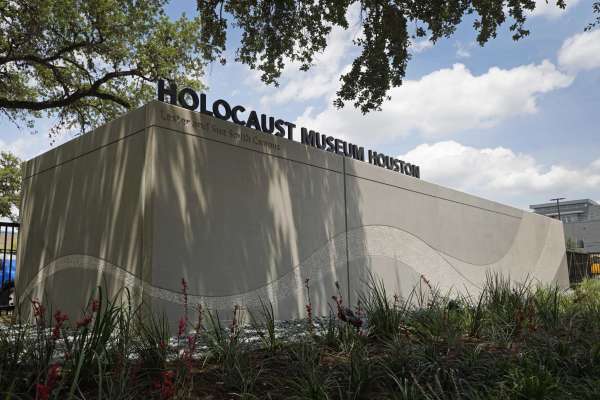
Holocaust Museum Houston (photo credit)

The next day, I took myself to Houston’s Holocaust Museum, which I think I last visited some 30 years ago. What to say about the Holocaust Museum? I think they’ve done a pretty good job with an unspeakable task, to communicate a history of massive scale and unthinkable cruelty and ugliness and hate… I also did some thinking about how the Holocaust is something we sort of just all know about, to some extent – except that I now know that not everyone does know, which is a piece of profound news I’m still processing, actually. I have some memory of discovering this topic for the first time, when I was a kid, in elementary school. In my memory, much of the horror was communicated in images, photographs that showed graphically what it looked like to starve to death. This museum did not rely on such graphic, upsetting images. Most of the photographs were of healthy families and children from before the war, with a note that this child was killed at age seven, etc. I think graphic images are powerful, on the one hand, because they viscerally communicate how bad things were. On the other hand, they run the risk of sensational “torture porn,” of the image itself and its shock value taking away from the message we most need to hear. I appreciate the Holocaust Museum’s approach here. Also, one notable exception: there was a video showing on a monitor, near the floor, pointed straight up at the ceiling, and in a tube, so you had to stand directly over it and look straight down – in a rather uncomfortable position. I couldn’t figure out why they’d use such a weird design, until I saw the content of the video. It was about the post-liberation coverage of the concentration camps, how Eisenhower had the media come in to record and show exactly what was there. It was that footage, of the bodies recovered near death. It was quite graphic, and very affecting, and upsetting; at that point, the physical discomfort of the position required to watch the video made sense. It felt like part of the effect. My theory is that this design is to keep small children from watching.

I also visited the Holocaust Museum’s exhibit of the Civil Rights photography of Danny Lyon, an exhibit on Dolores Huerta, and the art of Holocaust survivor Samuel Bak. It was a lot to take in, but it was all good. I was especially taken with Lyon’s photography of SNCC, the Freedom Riders, lunch counter sit-ins, MLK and Stokely Carmichael, among other landmarks. There was one, captioned something like “police officers pose at such-and-such place,” where six white cops stood around and sneered; one raised his middle finger, while another offered a crotch grab and full-body fuck-you posture. Speaking of graphic; the hate was visible. I kept thinking, I wonder where this man is now, who his children are, if they’re proud of their father.

The Holocaust Museum is no joy, even if the stories of resistance and rescue are moving. But it’s at least as important a history for us to see now as it has ever been, and I’m grateful this museum exists. I have been thinking about the balance, between graphic ugliness and truth about the horrors, and upliftingness of stories of resistance. I don’t know where the right balance lies, but I think they’re doing a pretty good job. I recommend this visit to everyone.


I find even the best museums exhausting, but I do love a good museum, and I’m glad to have had the chance to take in some such experiences while I was in Houston. Among other things, I saw some old friends, attended a great yoga class, ate at a whole pile of excellent restaurants… it’s perhaps more bittersweet every time I go back to my hometown, but I do love every visit, too.

Persepolis Rising by James S. A. Corey (audio)

Book seven in The Expanse!

Jim and Naomi and the crew of the Rocinante – Amos, Alex, Bobbie, and Clarissa – are aging. With the expansion of the known world(s), Earth and Mars are no longer the superpowers that they once were. The Transport Union, composed of those who were once known as Belters, are more or less in control of the 1,300 new worlds in the Ring System. Much has changed. But much has not changed: like human nature, the will to rule. And James Holden hasn’t changed much, in his drive to get involved in sticky situations, his need to do the right thing at all costs, and his tendency to dive blindly in. On the other hand, maybe he’s changed more than we think: early in this novel, Naomi is able to talk him into retirement, which quite catches me off guard. (The Roci‘s crew less so. They’ve been seeing him age all these years, when I just took a short break since book six.) Retirement doesn’t mean that Jim and Naomi will be any less involved in the next major historical event, however.

In this episode, a military superpower invades Medina Station, and the Roci‘s crew ends up working with former OPA factions as part of a small resistance band. Amos is asked to practice diplomacy; we can imagine how well that goes over. Perhaps I’ll leave my plot summary there.

Alex and Bobbie have become fast friends over the years, closer than ever, and the same goes for Amos and Clarissa. Neither of these alliances is romantic, but both are almost mystically deep, and one will rupture before this story is over. Naomi and Jim have a heartwarmingly constant romance, but old problems still plague, and certain practicalities are left up in the air. In other words, like all the others before it, Persepolis Rising is about people above all else. I admire Corey’s gifts: not only mind-expanding (ha) world-building, but the ability to follow this world through over many decades (not to mention the past centuries that brought us here). This volume broadens my sense of what is possible for this series, while also limiting it: if our core characters die, is there any Expanse left?

In this book perhaps more than some others, I zoned out on the technical details. I really don’t care, and am happy to just trust that people can be in places when the story says they can be, etc. Was there more of that stuff than usual, or was it just the effect of a very long drive (West Virginia to Texas) that let me drift off? No matter; I enjoyed the overall effect – that human story – as much as ever, and I’m quite looking forward to finding out what happens in the end. I’m also worried. I think book eight is recognized as the last one. There are just a few more novellas to track down; and then what? (Things don’t look good for Holden, in this light.)

I’m rambling now. These books thrill me, and I am entirely converted to the concept of sci fi, if done this way: people first.


Rating: 7 bombs.