did not finish: Bonhoeffer: Pastor, Martyr, Prophet, Spy by Eric Metaxas (audio)

bonhoefferI’ve gotten better at putting down books I’m not enjoying. As I keep repeating to myself & others, there are far too many excellent books in this world for me to ever read them all, so why would I spend my precious, limited reading time on less-than-excellent books? But I guess I’m still working on applying this same policy to audiobooks. They are fewer, and a little harder to get my hands on, so I find myself taking more chances with audiobooks. But somewhere between a third and halfway through Bonhoeffer, I gave up.

This is the biography of Dietrich Bonhoeffer, a German pastor and theologian who lost a brother in World War I and was more prescient than many during Hitler’s rise to power. He was already involved in “the church,” but as Hitler’s government worked to take over the German church establishment, Bonhoeffer became even more active. I didn’t get this far, but apparently he also acted as a spy (for the anti-Nazi Abwehr), and was involved in a plot to assassinate Hitler.

As a non-Christian, I thought I would be able to appreciate this as a work of history and biography. But I found myself too much irked by the unspoken premises: that Bonhoeffer, as a good Christian, was a good guy; that he could do no wrong; that the Christian church was inherently good. Christian readers of this book (who I can only assume are the majority, and its target audience) will naturally not be offended by these assumptions; but I am bothered by premises being treated as fact. Bonhoeffer comes off as a good and likeable man, and I may even miss him; but he’s presented as a totally good man, and I just can’t buy that about any human being. In other words, I don’t think Metaxas treats him objectively, and that tends to bother me a great deal in my reading. The religious bias, combined with copious quotations from the Bible, proved too much for me. In a shorter book, I would have hung in there: I made it 8-10 hours into its 22 hours! But I could go no farther.

I am happy to accept that Bonhoeffer was, on balance, a force for good against Hitler’s evil; but in a lengthy biography I would expect a little more objectivity, and would prefer a nonreligious starting point for study. I found his life interesting and would read another book about him. But not this one.


Rating: 2 sermons.

Teaser Tuesdays: Endgame by Derrick Jensen

Teaser Tuesdays is a weekly bookish meme, hosted by MizB of Should Be Reading. The idea is to open your current read to a random page and share a few sentences. And try not to include spoilers!

endgame
Derrick Jensen on whether we should just go along because it’s easier that way…

…I’ll tell you something important: the Jews who participated in the Warsaw Ghetto uprising, including those who went on what they thought were suicide missions, had a higher rate of survival than those who went along peacefully. Never forget that.

This is a thought-provoking and rather mind-blowing book. Stay tuned; although I don’t know how I’m going to do it justice when it’s time to write my review, not least because my reactions are so strong and so personal. Better yet, go get yourself a copy. You can buy it at the link above.

Ishmael by Daniel Quinn

ishmaelIshmael comes recommended by my father, and that’s enough for me.

It’s an environmental novel published in 1992. So, dated? Or prophetic? I’m afraid it stands firm today; we can debate whether it’s overly alarmist (ha) or overly optimistic (sigh), but I didn’t run across anything that dated it especially for me. The premise is: our narrator (who, I’m pretty sure, remains nameless) is a disillusioned 30-something who, as a teen, had looked for someone to guide his idealistic, revolutionary, 1970’s-style environmentalism, and come out disappointed and cynical. Now that it’s “too late”, he’s frustrated to find the following advertisement in the newspaper:

TEACHER seeks pupil. Must have an earnest desire to save the world. Apply in person.

(Is “newspaper” the term that dates this story?) Narrator responds jadedly, assuming this is a charlatan, a scammer; but still he goes to the address listed, because he has to satisfy his curiosity (and presumably because some part of him hopes that someone out there can really teach him how to save the world). In this anonymous retail space, he finds… a gorilla. A big, scary gorilla behind a glass wall; and on Narrator’s side of the wall, a chair. He eventually sits, and our gorilla – Ishmael – “speaks” telepathically to him. Ishmael relates his life story, and they begin discussing What’s Wrong With The World And What We Can Do About It.

Leaving aside the rather strange element of the telepathic and exceptionally well-read gorilla, the structure of this story is much like Sophie’s World, a novel I read pre-blog (thus no review here, sorry) and really, deeply loathed. It is credit to my faith in my father that I picked up Ishmael, knowing it was at all like that other. The structure I’m referring to is part of what I disliked about Sophie, although it works slightly better here: there is no plot, no action in the story, and no character development, because our characters don’t do anything. They form a didactic construction that allows Quinn, in ill-disguised fashion, to voice his own thoughts. If he were doing this in dialogue form, it would make a little more sense; but unfortunately the dialogue mostly consists of many paragraphs by one character, punctuated by the occasional “yes,” “true,” or “I don’t quite understand that part; can you tell me more?” from the other. Now, I liked what Quinn had to say, and I frankly liked the gorilla Ishmael, and so this framing element bothered me far less than it did with Sophie (shudder). But I still felt that it was unnecessary, distracting, and ill-concealed. I’d rather Quinn had just written a manifesto frankly stated as his own.

Quinn’s thesis in a nutshell is that our world is badly f*ed; humans have done it by behaving badly; and we need to change quickly if we hope to salvage the earth itself, its very deserving fellow occupants like butterflies, tigers, flowers and rocks, and any of ourselves. I find this thesis abundantly easy to follow. For decades we’ve known that we were badly screwing up this planet (unless you’re Big Oil and have found a way to put your head under the sand (to look for more oil) in which case you’re probably not reading Ishmael, or this blog). Actually I found the third part of the thesis – that we need to hurry up and change so that we can save the world – hardest to follow, because I think things are worse off than Quinn paints them to be. Of course, I’m writing this more than 20 years later, so I’ll give him a pass there.

That said, the friendly gorilla and the simply stated philosophical approach that he shares with our Narrator make an accessible argument. I could see this being a good entry-level discussion piece – or a jumping-off point for further discussion in a reading group or classroom setting. Ishmael is likeable, and the philosophy is mostly sound (at least until the part about how we can change; I am less hopeful than Ishmael is), and readable.

I am not sorry I read this. But I like Derrick Jensen’s Endgame better, even though it doesn’t have as happy an ending. More on that book to come.


Rating: 5 sessions.

book beginnings on Friday: Ishmael by Daniel Quinn

Thanks to Rose City Reader for hosting this meme. To participate, share the first line or two of the book you are currently reading and, if you feel so moved, let us know what your first impressions were based on that first line.

ishmael

This novel looks to be one of those lesser-known classics, with sort of a cult following but not generally known to the public consciousness. (My local public library does have it shelved under Classics.) Have you heard of it? I only recently did, but it comes recommended from my Pops, so here we are. It begins:

The first time I read the ad, I choked and cursed and spat and threw the paper to the floor. Since even this didn’t seem to be quite enough, I snatched it up, marched into the kitchen, and shoved it into the trash.

Strong feelings, no? I like that our attention is grabbed right at the start!

Happy Friday and happy reading, kids!

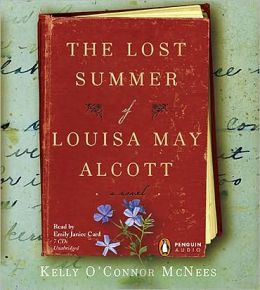
The Lost Summer of Louisa May Alcott by Kelly O’Connor McNees (audio)

louisaThis is a fictionalization of one season in the life of Louisa May Alcott, author most famously of Little Women. Louisa and her family are very like her famous fictional creations in many ways. The eldest daughter, Anna, clearly models for Meg of LW; then there’s Louisa/Jo, then Lizzie/Beth, and then Amy/May. Louisa’s mother Abba does go by Marmee, as in the book; the first glaring departure from Alcott’s novel in her real life is that her father, Bronson, is not away at war. Instead, Bronson was a transcendentalist scholar and friend to the likes of Thoreau and Emerson, disinclined to work for a living (being principally opposed, you see); he founded a Utopian commune in which his family lived for a time, and otherwise they scrimped, borrowed, and got by how they could. [I know this is confusing: I am writing a review of a fictional book, about a real-life woman, who wrote a fictional book, about her real-life family. So far, in these bare details I’ve named, I am referring to the real-life Alcotts as well as the Alcotts represented in Kelly O’Connor McNees’ novel.]

In The Lost Summer of Louisa May Alcott, McNees sets the six Alcotts in Walpole, New Hampshire, living for the summer in a home that belongs to relatives, because they are poor and hungry and have to go where they can. The premise is that Louisa May Alcott – in real-life a confirmed spinster – had a brief love affair that summer that informed the rest of her life. History yields no indication that such an affair took place, so this is where the fiction begins.

The plot is simple and uninteresting, certainly not the strength of this book. The family is new to Walpole; Anna has recently decided that she is interested in getting married (as any good girl of her era would be) and works to make herself presentable to the town’s young men. Louisa is, as ever, hot-headed, passionate, interested mostly in her writing, and does not intend to marry because it would disrupt her freedom (to write, and otherwise). She is firmly a feminist, and deeply interested in her father’s friends Emerson and Thoreau, and in a new book of poetry called Leaves of Grass by somebody named Walt Whitman. Lizzie is sickly and fussed over. May is obnoxiously free from the privation that the rest of the family feels; Marmee is rather frustrated with her lot in life; and Bronson is thoroughly exasperating in his refusal to get realistic and provide for his family. Anna meets a boy. And Louisa meets a boy, and in stock romance-novel style, finds him unbearable right up until she falls in love with him. They are thwarted.

The strengths of The Lost Summer are in its subjects: lovers of Little Women will be charmed by the fictional-real-life models for Meg, Jo, Beth and Amy. The setting is rather charming, as well, and Joseph Singer (Louisa’s love interest) is likeable. But unlike the characters in Little Women, Anna, Louisa, Lizzie and May are underdeveloped. To be fair, it is a shorter book, and spans a much briefer time than its more famous model, so perhaps this should be excused. But I’m not really that forgiving, as I’ve seen masterful character development in mere pages (see: short story masters like Hemingway and de Maupassant). To be further fair, I’m not a fan of romance novels. (Maybe I should never have picked this book up?) That said, I was impatient with the plot line that had Louisa grumpy toward this man she simultaneously felt pulled towards – she went weak in the knees, etc., etc. – and then suddenly sick with love. It’s just too familiar, ho hum. And finally, too many of these characters were unlikeable (May, Bronson, even Marmee; Louisa for her bullheadedness; minor characters Margaret and Catherine, ugh!) for my tastes. I sort of felt that this story had misplaced its heroine.

Of some interest was the opportunity that McNees took to outline Louisa’s feminism and her limited options. I confess I did buy into the romance enough to wish that Joseph and Louisa could be together – could marry, or simply cohabitat – which latter option I realize is my modern-woman’s solution, and wasn’t really available to Louisa at all. Louisa talks and thinks through their options and what they would mean to her: how, for example, marriage would mean endless drudgery and housework for her, and the loss of her ability to write. This is a message that needed communicating, and I found it interesting and instructive to consider the limited options of a woman of this era. So a few points were regained here. However, these musings were only thinly veiled as dialogue or internal thoughts of the characters; I felt I could see McNees holding the strings.

For a quick, superficial, comfortable visit with the beloved Alcotts, come on in to Lost Summer; but if you’re looking for more, look elsewhere.

Audio edition was fine but unremarkable.


Rating: 4 oh-so-important ribbons.

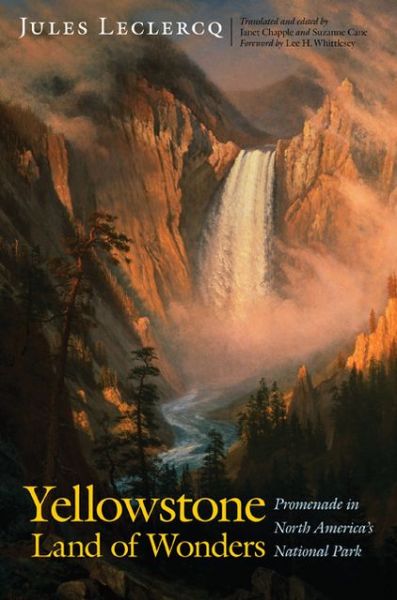
Yellowstone, Land of Wonders: Promenade in North America’s National Park by Jules Leclercq

An unprecedented English translation of a travel narrative from the early years of Yellowstone National Park.

yellowstone
In 1883, a well-traveled French lawyer, writer and judge named Jules Leclercq explored the newly designated Yellowstone National Park on horseback. Three years later, he published a book praising the area’s strange and wondrous marvels–but the book is not simply a lovely appreciation of natural scenery. Leclercq also researched the history of the region and its people in order to write a scholarly study, a snapshot of a place in time. And yet there has never been a complete English-language translation of his original text until Janet Chapple and Suzanne Cane’s Yellowstone, Land of Wonders.

Leclercq is most fascinated by Yellowstone’s geysers: “The mind is so occupied with the extraordinary geological phenomena bursting upon one at every step,” he writes, “that one views the scenery only abstractedly.” He does, however, turn his pen to Yellowstone Lake and Falls; he considers the latter far superior to Niagara. He also includes a chapter on the park’s wildlife, and warns that whole species will be exterminated if hunting continues unchecked.

Leclercq’s narrative is imperfect. He sometimes quotes without attribution from contemporary sources and gets geological details wrong. But Chapple and Cane meticulously keep readers informed on such points. Their translation and editing–with copious notes–is thorough in confirming and expanding Leclercq’s points, offering commentary not just on Yellowstone but on the author and his era. The result has more than just historical value; as Leclercq concludes (and as is still true today), “All this grandeur inspires grave and religious thoughts.”


This review originally ran in the May 10, 2013 issue of Shelf Awareness for Readers. To subscribe, click here, and you’ll receive two issues per week of book reviews and other bookish fun!


Rating: 6 geysers.

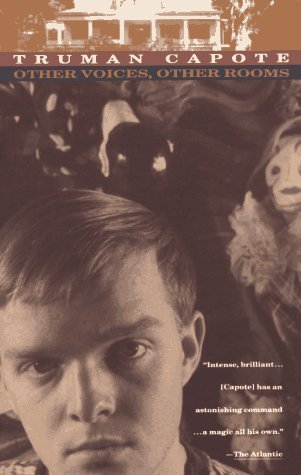
Other Voices, Other Rooms by Truman Capote

othervoicesOther Voices, Other Rooms was Truman Capote’s first novel, and I have picked it up because it was referenced in The Used World. Such is the power of Haven Kimmel.

This is a strange, spooky, sad tale, beginning with an unwanted child: we meet 13-year-old Joel as he’s hitching a ride en route from New Orleans to a crumbling estate in Mississippi. He had been living with his aunt following his mother’s death; now he has been summoned to his father, who he’s never met. Upon arriving at Skully’s Landing, he finds no father, but an odd stepmother and her even odder cousin, Randolph. Approximating friends are a neighbor tomboy named Idabel and a black servant named Zoo. Eventually Joel’s father is revealed, mute, bedridden, and as horrifying as everything and everyone else at the Landing. Among these horrors are a ghostly woman in a window where no woman belongs; a cottonmouth “thick as his leg, long as a whip”; and a mule who hangs himself.

Randolph is clearly gay, and a model for the effeminate Joel to consider, for better or for worse – sexuality aside, Randolph has a dubious moral code. He relates (among other things) the story of how he met Joel’s father, in an episode that rather reminded me of The Sun Also Rises, in which a motley mismatch of characters in a debauched setting (here, New Orleans) are remarkably frank about who wants who sexually. Later, when Joel attends a country fair with Idabel, things turn more towards Alice in Wonderland, in its sinister moments. But Capote is in his own class here, regardless of my literary comparisons. He evokes a startling, ghostly, creepy, sleepy yet stark atmosphere, and for me, that atmosphere was the great accomplishment of this novel.

Plot-wise, Joel’s story is one where not a great deal happens but a major life change takes place, anyway. This is a coming-of-age story, in which Joel starts off decidedly a child but finishes – just a few months later – a young man with a somewhat clearer picture of himself. (But, I think, no happier.) Part of that coming-of-age regards his sexuality, but only in an unstated, amorphous way, which is a fair description of the whole book, really. In fact, I have to admit to some trouble following things, as so much is unstated and wavering and strangely expressed from varying and unreliable viewpoints. That this novel is at least vaguely autobiographical I guessed; that there were themes of understanding one’s sexuality and coming-of-age was clear to me. But the rest was less clear. In fact I was reminded somewhat (to drop another literary name) of Faulkner, a la The Sound and the Fury. I won’t bother regurgitating it for you here – they are not my own interpretations – but even Wikipedia (for example) gets way more out of this story than I got. Go figure.

I think Other Voices, Other Rooms is likely to be another great candidate for a “close reading” with a knowledgeable guide – I picture my high school English teacher, Mrs. Smith – to direct related readings and fill me in on the background. Without such assistance, I still enjoyed a creepy, weird tale of cobwebbed, forgotten Southern grandeur and depravity. Take it as you will. If nothing else, Capote’s talent shines through and foreshadows his future success – but I still prefer In Cold Blood.


Rating: 6 bluejay feathers.

In the City of Bikes by Pete Jordan

A history of Amsterdam’s love affair with the bicycle contained within an American cyclist’s memoir.

cityofbikes
After the close of his first memoir, Dishwasher, Pete Jordan moved to Amsterdam for a semester to study urban planning, with a focus on his passion: bicycles. He never left.

Jordan’s decision to move was rather capricious–he knew almost nothing about Amsterdam–but he found a city packed with bicycles and rich with cycling history. In the City of Bikes is the story of his journey from itinerant dishwasher to settled family man, as well as a thoroughly researched history of the bicycle in Amsterdam. Beginning with the early bikes of the 1800s and cycling’s golden age in the 1890s, when the safety bicycle hit the streets, Jordan moves on to the tire shortages and (in this case, bicycle-related) atrocities of the city’s Nazi occupation before concluding with his own place in modern cycle-crazy Amsterdam.

Joining Jordan are his new wife, Amy Joy, and their son, Ferris, a passenger and later pilot of Amsterdam bicycles since his conception. When Amy Joy becomes proprietor of a local bike shop, the Jordans have truly found their home in the Dutch capital. Considering his reason for going in the first place, Jordan is especially well suited and qualified to tell this story, and he lives up to expectations with a meticulous detailing of Amsterdam’s bikes. Full of personal anecdote, self-deprecating humor, local lore and a history of cycling that positively bursts with enthusiasm, In the City of Bikes is both a memoir and an ode to bicycles.


This review originally ran in the May 3, 2013 issue of Shelf Awareness for Readers. To subscribe, click here, and you’ll receive two issues per week of book reviews and other bookish fun!


Rating: 7 tire-powered light generators.

526395_4403542975615_1825014471_n

Bonus photo I couldn’t resist, of me in the early 2000’s, cycling in Bruges – but it may as well be Amsterdam, and I did ride there too – on a Dutch-style bike. (Hoping this gives me extra reviewer-cred!)

book beginnings on Friday: The Fame Thief by Timothy Hallinan

Thanks to Rose City Reader for hosting this meme. To participate, share the first line or two of the book you are currently reading and, if you feel so moved, let us know what your first impressions were based on that first line.

famethief

Ah, it’s Friday again, kids! I have a new thriller to begin with you this week. A front-cover quotation from the Los Angeles Daily News calls Timothy Hallinan “a modern successor to Raymond Chandler,” which are strong words; we shall see. This book begins:

Irwin Dressler crossed one eye-agonizing plaid leg over the other, leaned back on a white leather couch half the width of the Queen Mary, and said, “Junior, I’m disappointed in you.”

If Dressler had said that to me the first time I’d been hauled up to his Bel Air estate for a command appearance, I’d have dropped to my knees and begged for a painless death.

Some clever over-the-top character sketching there, I’d say. All right, I’ll keep reading.

How are you starting off your reading weekend?

This quotation comes from an uncorrected advance proof and is subject to change.

long weekend

To celebrate our five-year wedding anniversary, both our birthdays, and Cinco de Mayo, Husband and I spent a 4-day weekend in and around Fruita, Colorado, doing stuff like this, this and this:
943306_10201062229306789_1774384214_n
944566_10201051113628904_538245173_n
934628_10201070277387986_1341583516_n
And in between, we did this:
197821_10201070257347485_641106476_n
Ahhh. Lovely. 🙂