belated housekeeping

Just a note to say, yes, I changed the appearance of my blog a little bit last Friday afternoon, and I didn’t warn you first. I’m sorry! All that’s changed is that there’s a new header image up there, and the background is now a (hopefully soothing) solid color. I hope you like it or at least find it un-distracting from the content that you’re really here for. Thanks for your support! Now back to our regularly scheduled programming.

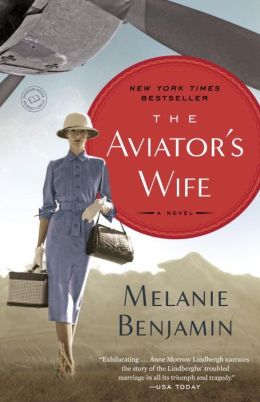
did not finish: The Aviator’s Wife by Melanie Benjamin (audio)

aviatorI was determined to give Melanie Benjamin another try (following Alice I Have Been), and had hopes for this novel of the life of Anne Morrow Lindbergh. I was hoping for something like Loving Frank or The Paris Wife, I suppose – both wonderful books about historical wives. But I was disappointed.

I gave this novel a more than fair chance: I did not give up until partway through track 144 of 209, which is unusual. Generally I will recognize a book that I’m not going to like much earlier than this, and give up on it; if I have made it well over halfway through, then, it’s generally worth finishing. This one was different.

Early on, I was intrigued by Anne’s story, told here in first person, and wanted to know what would happen to her. (I mean, other than the obvious historical points: marry the guy, have the baby, who is then kidnapped.) I did observe to myself that she was awfully boring, but assumed that part would get better. But it didn’t: the Anne Spencer Morrow, later Anne Morrow Lindbergh, that Benjamin presents is hopelessly boring. She has no personality of her own, being first consumed by admiration for her older sister Elisabeth and international hero Lucky Lindbergh himself, and later resigned to serving her famous husband selflessly, if unhappily. She whines about the harassment of the press; she whines about Charles’s heavy-handed, cool approach to marriage; she laments that she is bound to follow him everywhere like a puppy. But she never begins to have a personality of her own.

This unlikeable and uninteresting protagonist is unfortunately accompanied by no one more interesting or likeable than herself. Charles is stiff, and sympathetic toward Hitler and the eugenics movement. The beautiful Elisabeth is unable to accept herself. There was no character in this story that I was able to feel remotely warm towards. And then Charles’s sinister remarks about genetic purity in the Morrow family (Anne feels the need to hide from him her brother’s mental illness and her sister’s sexual identity) escalate to praise of Hitler’s treatment of the Jews, and I became downright disgusted. As the Lindberghs consider moving to Germany in the late 1930’s, Anne acknowledges that something (she can’t quite put her finger on it – !) is wrong, but feels that the protection from the media is worth whatever less-than-wholesome business Hitler might be up to, alongside his repression of the press that so disturbed her family in the States.

These people were so unlikeable, and their politics (Lindbergh’s politics, and Anne’s contented acceptance of those politics when she found herself well served) so repellent, that I suddenly found I couldn’t go any further, and hit the “stop” button midway through a Lindbergh rant about Hitler’s righteousness and the wrongs committed by the Jews. Now, I would like to point out that I am capable of reading about horrible ideas, thoughts, arguments, and actions, when there is something to be gained: a point to be made, or history to be learned. But I didn’t see any of these benefits looming. I felt no redemptive value imminent. If Benjamin accomplished something salutary in the final quarter (or so) of this novel, then it came too late for me.

This also means that I missed the final, juicy bits about Lindbergh’s other women and children born out of wedlock. Ho hum. If you’re interested in the gossip, I’d wager you could read about that stuff without suffering through the rest of this novel.

Sadly, another DNF for me from Melanie Benjamin; I can now feel safe in not trying any more of her work. Generally, I don’t rate books I’ve not finished, but having made it over halfway, I’ll go ahead and make a call on this one.


Rating: 3 nurses.

book beginnings on Friday: Maya’s Notebook by Isabel Allende

Thanks to Rose City Reader for hosting this meme. To participate, share the first line or two of the book you are currently reading and, if you feel so moved, let us know what your first impressions were based on that first line.

maya

Recently, after trying so hard to be patient, I finally gave up on The Aviator’s Wife (more on that next week), and breathed a sigh of relief and pleasure as I hit “play” on this novel by Isabel Allende. Her language is so lovely, rhythmic and perfectly chosen; her sentences, translated from Spanish by Anne McLean, are both short and simple, and lyrical. Also, I am very much enjoying this reading by Maria Cabezas.

The book begins with a quotation that I can’t help but share:

Tell me, what else should I have done?
Doesn’t everything die at last, and too soon?
Tell me, what is it you plan to do
With your one wild and precious life?

–Mary Oliver, “The Summer Day”

And then Allende begins writing, in the voice of 19-year-old Maya Vidal:

A week ago my grandmother gave me a dry-eyed hug at the San Francisco airport and told me again that if I valued my life at all, I should not get in touch with anyone I knew until we could be sure my enemies were no longer looking for me. My Nini is paranoid, as the residents of the People’s Independent Republic of Berkeley tend to be, persecuted as they are by the government and extraterrestrials, but in my case she wasn’t exaggerating…

Isn’t that a wonderful beginning? We have a precipitous moment, as Maya sets off on what is clearly a fraught journey, to an unknown destination; the colorful character of Nini; the suspense of this 19-year-old girl’s “enemies”; and the humor involved with the “People’s Independent Republic of Berkeley.” I’m so happy to be back in Allende’s capable hands.

Last Night at the Blue Angel by Rebecca Rotert

The vivid jazz scene in ’60s Chicago, an unconventional family and an utterly heart-stealing child.

last night

In early 1960s Chicago, 10-year-old Sophia has no friends her own age. Her society is Jim, a photographer in love with her mother; Rita and Sister Eye, her mother’s former roommates; and, occasionally, her mother, Naomi, a lounge singer aspiring to fame. “Mother’s feelings are the curb I walk, trying to keep my balance… when she notices me, all the times she doesn’t notice me get erased.” Rebecca Rotert’s debut novel, Last Night at the Blue Angel, alternates between Sophia’s perspective and that of a younger Naomi, discovering herself and escaping Kansas.

The city’s colorful ’60s jazz scene is a playground for a woman as beautiful and talented as Naomi, and its architecture provides focus for Jim’s photography (when he’s not focused on Naomi), set against the background of segregation and the Cold War. Sophia is precocious, wise beyond her years and profoundly nervous. She keeps lists: of her mother’s conquests, of the many practicalities she’ll need to reinvent after the bomb is dropped. But routine is disrupted when a man resurfaces from Naomi’s past just as she gets her shot at stardom after 10 years of hope and effort. Her final performance at the once-proud jazz club the Blue Angel holds promise, but will come at immense cost for both mother and daughter.

Rotert, an accomplished singer herself, beautifully evokes the vibrancy of this setting. But her true artistry lies in the complex mother-daughter relationship at the center of this story, and the deeply sympathetic, nuanced, heartbreaking character of Sophia, a child in an adult world on the brink of enormous change.


This review originally ran in the July 8, 2014 issue of Shelf Awareness for Readers. To subscribe, click here, and you’ll receive two issues per week of book reviews and other bookish fun!


Rating: 8 radios.

vocabulary lessons: The Fish in the Forest by Dale Stokes

If you’re interested: see other vocabulary lessons as well.


fish forestAs you know, I found the salmon’s story in The Fish in the Forest simply mesmerizing. I also learned a lot – and not just about salmon. Here are some vocabulary words I had to look up.

epiphytes attach to their host plants for support and as a means to reach more sunlight… but are traditionally classified as non-parasitic”: “There are epiphytic plants that grow on trunks and branches high in the forest canopy…”

relict, “a surviving species of an otherwise extinct group of organisms”: “The present salmon populations in the Pacific Northwest stem from relict populations that have been extant since the last ice age…” (I suspected a typo here for “relic” – this being a pre-publication proof edition, typos would not surprise. But no, I learned something new here. “Relict” is perfectly appropriate.)

trophically, “of or relating to nutrition”: “Even when not preying on salmon directly, humpbacks are linked to them trophically because they feed on fishes that compete with salmon for food.” Further explained a little later on within the book itself: “The troph in heterotroph and autotroph implies nourishment…” In other words, what we’re talking about here (in context) is organisms that are linked on the food chain, or the food web. They are trophically linked.(Another that looked like a possible typo; except that “tropically” would have made no sense in context!)

collocate, “to occur in conjunction with something”: “The other two races have overlapping ranges along the coast but seldom interact or collocate.”

semelparous, “reproducing or breeding only once in a lifetime” (or, to put it more bluntly, once they breed, they die): “Their life history of anadromy and semelparity transports millions of tons of salmon flesh into nutrient-poor freshwaters that then shape the entire Salmon Forest.”

gestalt, “the general quality or character of something”: “All living things possess a unique gestalt…”

I had previously come across the concept of anadromy (I don’t recall where) and looked it up (defined: “ascending rivers from the sea for breeding”); but finding it repeatedly in this book made me curious about the pronunciation of anadromous: “…the critical return to freshwater to spawn is called an anadromous life history…”

I like a good vocabulary lesson alongside a fine reading experience – don’t you? Or does reaching for the dictionary frustrate you?

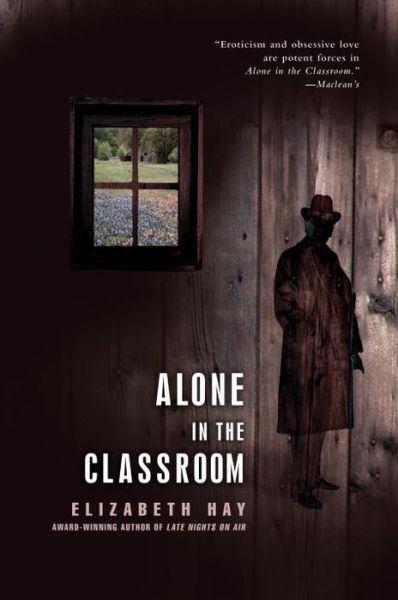
Teaser Tuesdays: Alone in the Classroom by Elizabeth Hay

Teaser Tuesdays is a weekly bookish meme, hosted by MizB of Should Be Reading.

alone

What an intriguingly written, disquieting, riveting tale this is. I’ve only just begun it, but I’m fascinated. The story itself is rather magnetic; and on top of that, I find the writing curious and remarkable. For an example, check out this paragraph of characterization:

Given what Parley Burns did and what happened to him in the end, Connie never tired of mulling over what kind of person he was deep down. He wasn’t handsome, she told me, but he was distinguished and very attractive to lonely women. Something fashionable, almost feminine in his manner unsettled and excited them – a sensitivity channeled into the dry-bed of bachelorhood. Yet he was far from dry. He was an intricately wired man. The smell of eggs turned his stomach.

The smell of eggs!

And no, we don’t yet know what he did. Are you drawn by this, as well?

This quotation comes from an uncorrected advance proof and is subject to change.

The Fish in the Forest by Dale Stokes

The thoroughly engrossing story of the salmon and its science.

fish forest

Seven species of salmon inhabit the Pacific in strikingly diverse ecosystems–ocean, river and stream, forest–in California, Alaska, the Bering Sea, Japan, Korea and Russia. Research oceanographer Dale Stokes calls these territories the “Salmon Forest” in The Fish in the Forest, a loving study of the salmon’s place in our world.

Salmon may strike some readers as a potentially dull subject, but in Stokes’s knowledgeable hands, the singular story of this fish is utterly riveting. Pacific salmon are anadromous and semelparous (born in fresh water, they mature in the salty ocean before swimming back up rivers and streams to breed just once and then die shortly thereafter); they possess an internal compass and map, enabling them to navigate over thousands of kilometers to the waterways of their birth; they are temporally aware, following a timetable for their reproduction and death.

Stokes presents a good deal of hard science (such as the complex cellular interchange of ions that allows them to survive in both salt and fresh water), but all of it is easily understandable. He explains why salmon are a keystone species; their feat of bringing rich marine nutrients well inland and at every point on a complex food web; and the interconnectedness of every resident in the Salmon Forest. Doc White’s 70 color photographs are stunning, focusing not only on fish and forest, but also the species of wolf, bear and eagle that interact with the salmon.

Fans of the Pacific Northwest, trees, water and nature, and readers concerned with ecology or science, will find much to enjoy in this gorgeous and illuminating fish tale.


This review originally ran in the July 1, 2014 issue of Shelf Awareness for Readers. To subscribe, click here, and you’ll receive two issues per week of book reviews and other bookish fun!


Rating: 8 alevins.

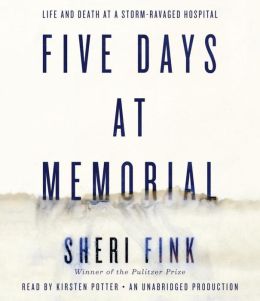
Five Days at Memorial: Life and Death in a Storm-Ravaged Hospital by Sheri Fink (audio)

five daysWell. This one is a lot to tell you about.

Sheri Fink is an award-winning journalist and holds both a PhD and an MD. In Five Days at Memorial, she examines fateful, famous and controversial events at Memorial Hospital in New Orleans in the five days following 2005’s Hurricane Katrina. Forty-five bodies were recovered from the hospital, with about 9 of them (depending on your source) suspected of having been euthanized by hospital staff during evacuations. I had been looking forward to reading this book but was leery going in, because this subject was clearly going to be emotionally fraught, depressing, poignant. I was quickly mesmerized, though: these events, while troubling and difficult to take in, fascinated me deeply. I have been increasingly interested (outside my reading of this book, for some time now) in the subjects of end-of-life, advanced directives, and our culture’s approach to death. And I am always intrigued by ambiguity, situations in which it is clear to see black-and-white or right-and-wrong. If ever there were such a situation, this is it.

Roughly the first half of the book is dedicated to relating the events of these five days, as revealed by Fink’s investigations. (Recall, as I mentioned in my book beginning, that she describes her copious research. I am fairly well convinced of its virtue.) We get to know a number of characters in the story: doctors, nurses, managers and administrators, patients and their family members. We know the ending, in a sense: the hurricane will be far worse than anyone imagined; the hospital will not be evacuated in one, two, three or four days; there will be crimes investigated. But the way the events unfold were unfamiliar to me in their details. Although this is a journalistic account, Fink also imbues it with suspense, which feels very natural: imagine the terror felt by those inside the hospital throughout. Not knowing the whereabouts or well-being of friends and family, isolated by rising floodwaters, without electricity, and plagued by rumor (on which more in a minute), a number of those inside Memorial feared for their lives. And some lost their lives.

The second half of the book describes the investigation of one doctor and (centrally) two nurses. Dr. Anna Pou was eventually called before a grand jury, which (some two years after Katrina) declined to indict her for multiple counts of second degree murder. In this section, we meet new characters, most notably two investigators who work as a comfortable team together. Fink also explores the history of euthanasia as a concept in different cultures and different legal understandings today, and the approach of bioethics, as well as post-Katrina attempts to establish emergency standards for triage, including the allocation of limited resources that will save some lives while ending others.

I was impressed by Fink’s style. I felt, in the end, that she let the facts (as she discovered them) stand alone. Many times throughout it felt like Fink’s voice spoke on one side of this painfully difficult controversy, but pages later she lent that voice to the other side, so that the effect was… shall I say, appropriately discomfiting. The fact is, I strongly feel, that none of us can perfectly know what happened in those five days, what anyone’s real motivation or intention was, and probably that none of us has the right entirely to judge actions taken in such profoundly weird circumstances.

Many questions remain, and I can easily understand and sympathize with divergent views: family members whose loved ones were (allegedly, possibly) euthanized are angry that they weren’t evacuated; hospital workers with no options left to them felt it was better to euthanize than to abandon patients to die slowly, painfully, and alone. I see it both ways. But the details, I think, are lost to me – someone who lived none of it, who’s just read the book. Dr. Pou, it appears, does not find this book’s treatment fair at all. While it’s true that Fink doesn’t exonerate her, I felt that she wasn’t condemned, either. It’s just… so complicated.

One of the more disturbing elements, to me, was the power of rumor and euphemism in the hospital and the accusations bandied about afterward. Doctors and nurses allegedly spoke of “making patients more comfortable,” or said “we won’t leave any living patients behind.” I don’t see how these vague phrases can be used to accuse someone of murder (or euthanasia, or what you like) – what if they literally just meant make someone comfortable? What if they meant that we will evacuate all living patients, thereby leaving none behind? I don’t think these statements necessarily point to killing people – certainly not beyond a reasonable doubt. And then the rumors: New Orleans after the storm saw violent crime and looting, but not (writes Fink) to the extent that it was rumored, within the hospital and more generally. Some of this fear and rumor was racially charged. Such a circumstance serves no one well.

In fact, the most damning evidence in Fink’s book for me was not the evidence that euthanasia had taken place – frankly, my value system allows for euthanasia as a fine option in certain circumstances – but the evidence that other hospitals faced similar challenges (loss of power, rising waters) and functioned better. I can’t recall the name at this moment (and the audiobook format is bad for looking up such things), but there was a hospital under analogous conditions that ran regular shifts – encouraging staff to sleep when not caring for patients – and sternly disallowed the spreading of rumors. (I think the phrase was something like “if you didn’t see it, don’t say it.”) Memorial saw a decidedly higher level of panic, and that was one of its critical failures. This can’t possibly be Dr. Pou’s fault: she’s just one person, incapable alone of preventing or inciting panic. In fact, as Fink presents it, if she did commit certain acts, she wasn’t alone; she was just singled out in investigations.

I can draw no conclusions after reading (listening to) this book, other than to say I think it was well told – visceral – and I am emphatic about the persistent ambiguity of this situation. In other words, I can’t judge, and I think it’s a little outrageous that anyone would try to. But I guess the justice system feels it has to try…

Narrator Kirsten Potter was well up to this task; full credit for the narration. I enjoyed this format for this book, but the major drawback for journalistic work is that I can’t flip back and check names, dates, etc.

Recommended, if you’re up for some tough topics and hearing about suffering.


Rating: 8 sleepless nights.

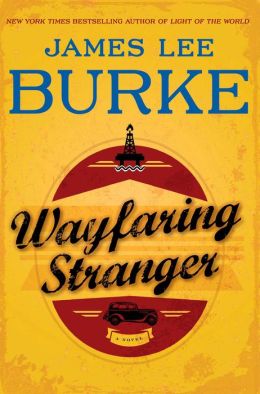
Wayfaring Stranger by James Lee Burke

Beautifully composed and tragic, James Lee Burke’s 35th novel is a sweeping historical epic of war and the American dream.

stranger

James Lee Burke is famous for a long-running mystery series starring detective Dave Robicheaux and Clete Purcel; two series centered on Billy Bob and Hackberry Holland; and stand-alone novels and story collections that all evoke the beauty, heartache and social injustice of Louisiana and Texas (among other locales). His 35th book, Wayfaring Stranger, tells a historical and sometimes fantastical story of the birth of Big Oil, the legacy of World War II and the far-reaching influences of Bonnie and Clyde.

In the opening pages, young Weldon Holland fumes at his grandfather, Hackberry, who was a poor parent to Weldon’s mother and is now poised to have her locked away and electroshocked. It’s the early 1930s, and Weldon’s father is gone, looking for work. Four trespassers in a 1932 Chevrolet Confederate challenge Weldon and Grandfather on their ranch, and the confrontation ends with Weldon firing a shot through the back windshield at Bonnie Parker, Clyde Barrow and two of their associates. This interaction casts a long shadow over the rest of Weldon’s life.

His story resumes in 1944 when he ships out for England as a second lieutenant. Weldon sees action in Normandy, particularly Saint-Lô, and the Ardennes; he digs Sergeant Hershel Pine out of a collapsed foxhole in the snow after an attack, and together they rescue a beautiful Spanish Jew named Rosita from an abandoned death camp. The three walk across enemy territory, lose toes to frostbite, fight tuberculosis, and are eventually separated. After the war, Weldon finds and marries Rosita, and Hershel turns up on Grandfather’s Texas ranch.

Together they establish the Dixie Belle Pipeline Company, using Nazi tank technology, Hershel’s welding skills and nose for oil, and Weldon’s family connections to build a minor empire. But the old money in Houston’s exclusive River Oaks neighborhood is offended–by their success and their humble upbringings, and particularly by Rosita’s heritage. And thus enter two of Burke’s favorite subjects: the evil lurking in the everyday, and the hero’s struggle to repress the evil within himself. Hershel’s wife, Linda Gail, creates more conflict: her actions endanger both business and family success, especially when she gets “discovered” and shipped out to Hollywood.

Burke’s fans will recognize his lyrical strengths regarding the themes of social justice and class struggle, violence set to a stunning backdrop of natural beauty and destruction, and a Gulf Coast region that includes historically accurate details to delight Texas and Louisiana natives. He creates strong and convincing characters on the sides of both right and wrong, and through them writes a compelling American history. Weldon investigates his father’s disappearance, Linda Gail’s unfaithfulness, and the evil forces that have targeted the well-being of his and Hershel’s families; but this is not a mystery. In fact, perhaps more than any of Burke’s previous work, Wayfaring Stranger is a tender love story, proving yet again his versatility and skill in creating gorgeous, luscious, painful stories of the American experience.


This review originally ran in the June 26, 2014 issue of Shelf Awareness for the Book Trade. To subscribe, click here.


Rating: 8 pipe joints.

Maximum Shelf author interview: Marja Mills

Following yesterday’s review of The Mockingbird Next Door, here’s Marja Mills: Making Acquaintances.


Marja Mills is a former reporter and feature writer for the Chicago Tribune, where she was part of the staff that won a Pulitzer Prize for a 2001 series about O’Hare airport entitled “Gateway to Gridlock.” The Mockingbird Next Door is her first book.

Mills was born and raised in Madison, Wis. She is a 1985 graduate of Georgetown University’s School of Foreign Service; a lifelong interest in other cultures led to studies in Paraguay, Spain and Sweden. Mills lives in downtown Chicago and often spends time in Madison and her father’s hometown of Black River Falls, Wis. (pop. 3,500).

marja

Did you have preconceived notions of what Nelle Harper Lee would be like? In what ways did she surprise you?

I didn’t know what to expect. I thought she might be quiet and reserved. Not so. She was gregarious much of the time, and witty. She loved to laugh. When she was telling a story that especially amused her, she’d take her glasses off, tip her head back and just laugh until she could finish what she was saying.

Nelle and her sister Alice–an attorney she calls “Atticus in a Skirt”–loved to get in Nelle’s Buick and explore the back roads. I’d read that the home she shared with Alice when Nelle wasn’t in New York was more modest than one might expect for an attorney and an author of her remarkable and enduring popularity. That was true. They lived simply, didn’t care about material things and had an eclectic group of good friends, from a Methodist minister and a librarian to a hairdresser and a bank president and his wife. Most were retired but still very active.

What about the Southern culture you encountered, in general? Any surprises there?

Being from the Midwest, I was surprised how many words in common usage in Alabama were new to me. Things such as mashing buttons instead of pushing them. Or using a buggy at the Winn Dixie instead of a grocery cart. That was a source of entertainment for the Lees and their friends: watching me learn local expressions. My favorite is an old-fashioned one that Nelle taught me: “journey proud.” It’s the excitement and apprehension before a trip that makes it hard to sleep.

How would you describe Harper Lee as you later came to know her?

My first day living next door in Monroeville, she left a note inviting me to dinner. That touched me. Soon she was calling to have afternoon coffee together, often at McDonald’s.

And of course you can’t know Nelle without knowing her sister Alice. Their lives were entwined and yet quite different, as were their personalities. Miss Alice, as she is known, is 15 years older than Nelle and there was another sister and a brother between them. As I wrote in the book, “even at their ages, it was clear Alice was the steady, responsible older sister, and Nelle Harper the spirited, spontaneous younger one.”

Both gave generously to the Methodist church and various charities. Nelle had been donating large sums, quietly and behind the scenes, for many years. As their Methodist minister friend, Tom Butts, said, she educated many people who had no idea she was their benefactor.

In what ways, if any, do you identify with Harper and Alice Lee?

They got lost in books as children, pulled into another world where you’re not just reading words on the page but living in the story, walking around in it. I was that way, too. Nelle’s eyes would dance, 70 years later, when she talked about being absorbed in the adventures of the Rover Boys.

Aside from many hours spent talking with Nelle and Alice, what research was involved for this book?

Some of the most valuable and enjoyable research I did was around kitchen tables and on porches, interviewing Lee friends and family. There were people I needed to talk to “while they still had their marbles,” as Alice put it. Or “while they’re still above ground,” as Nelle said. These were leisurely interviews but overall there was a sense of urgency, too, that if their stories about the town and the Lees weren’t preserved they would go with them to the grave.

Books were part of the research, too, naturally. I have rows and rows of them at home. Many of the titles were recommended by the Lees, with Alabama history and Southern fiction being two major categories. I enjoyed memoirs by Horton Foote, the playwright who adapted To Kill a Mockingbird for the film, and Wayne Flynt, the Alabama historian.

What was different about the writing process for this book, compared to your past experience as a journalist?

I had the opportunity to really get to know the people and the place I was writing about, to let them reveal themselves over time. That’s a luxury most journalists don’t have. Nelle and Alice did things on their own terms and on their own time. The way this experience unfolded gradually was more compatible with that that. “You let the river run,” was the way Rev. Butts put it.

You allude to the Lees’ approving what went in the book and what didn’t. How much were you asked to hold back?

Not as much as I expected. Much of what they said that was off the record was to spare the feelings of a friend or relative. When I lived next door, we talked about some of the things they especially wanted in the book. They resented Truman Capote’s characterization of their mother, for example. Both sisters described her as a gentle soul. I went over with them stories I wanted to share as well. I was ready to do much more of that but their approach was “use your own judgment.”

Has Nelle or Alice read this book? Any comment from them?

Because of their age and health–neither is able to live at home anymore–I don’t know that they’ll be able to read it but I think they’d enjoy reliving some of the adventures we had together. Age and diminished vision do take their toll. I’ve wondered sometimes how many books each has read in her lifetime. A staggering number; both were avid readers since childhood. Even in her 90s, Alice often had four books going at once. She told me about the time she and Nelle decided they would donate some of their books to the Methodist church.

Nelle set her jaw and tried to keep up her determination to part with some of the books. But then she would have second thoughts and retrieve them from the boxes they were trying to fill. Alice was no better. For all their generosity over the decades, books were hard to give away, even for their church. The evidence of that was the rising tide of books in their house. They had all shapes and sizes of bookcases, crammed where they could find space, and it still wasn’t enough.

In your book you make it clear that the Lees supported this project, but there was some press in 2011 regarding a statement from them indicating the opposite. Can you help us understand these conflicting reports?

I asked Alice Lee about it. Nelle was not living at home; she had a serious stroke in 2007. Alice issued a statement. She said that the first statement had gone out without her knowledge and did not represent her feelings or those of her sister. As far as I know, that put the matter to rest.


This interview originally ran on June 25, 2014 as a Shelf Awareness special issue. To subscribe, click here, and you’ll receive two issues per week of book reviews and other bookish fun!