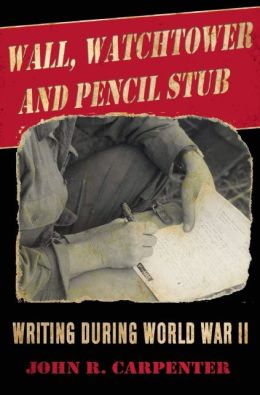
did not finish: Wall, Watchtower and Pencil Stub: Writing During World War II by John R. Carpenter

When is it fair to criticize a galley for its mistakes?

Full disclosure: I was sent a pre-publication galley copy of this book. The errors I am about to complain about may be corrected in the final published product. However, I am doubtful. This is a well-finished, glossy-covered galley, and my observation is that such copies rarely undergo massive revamps, which is what this one would need to satisfy my complaints. [Even when I have received unfinished copies, including typed manuscripts on loose pages, I’ve found far fewer errors than this.] I have found the odd typo in ARCs and galleys I’ve been sent, or the odd note clearly intended for someone in the editorial process (“need caption here” or “photo credit?”). What I see here looks to me like more of a consistent stylistic choice. Still, it’s only fair to point out that the final publication will be different from this one in some ways. I definitely like the concept, so I hope corrections are made… many of them.


pencil stubI read through the preamble, the preface, and chapter 1, which concludes on page 15, and I couldn’t take any more. I found distracting multiple uses of a comma to connect two independent clauses, as in:

The outcome is no longer in doubt, the names of the victors and defeated are well-known.

Correct grammar would demand either a semicolon or a conjunction to connect these two clauses, or alternatively, they could be two sentences entirely.

The outcome is no longer in doubt; the names of the victors and defeated are well-known.

The outcome is no longer in doubt, because the names of the victors and defeated are well-known.

The outcome is no longer in doubt. The names of the victors and defeated are well-known.

A few more:

Hillary was a pilot, in the first chapters of the book he presents himself as arrogant and immature.

Hillary did not survive the war – he died in January 1943 – but he was unequivocal, his whole act of writing and his book were an act of communication with his readers: a call to end delusions.

Again, I read 15 pages, and these are just a few examples I chose out of many.

Other usage oddities:

It could have ended entirely different.

(Differently, I’m sure he means…)

The realization by a civilian he could be treated as an insentient thing often came suddenly.

This is the only one that strikes me as possibly a simple mistake, the omission of a word that would have made the sentence flow easily and understandably, so the reader could pay attention to content and put away her red pen.

I feel like I read this concept somewhere, or maybe I made it up, but it seems a good rule of thumb to me that a galley should not be judged negatively on the basis of a few errors throughout, that one assumes will be corrected in final publication. However, at the point where those errors are prolific enough to be distracting, they must be addressed. After all, publishers send out galleys to promote the upcoming book, don’t they? It would seem to be very counter to that cause to send out a copy so full of errors that I can no longer pay attention to the purpose of the book. That was the case here, and I couldn’t continue.

For those interested in the quite attractive topic of “writing during WWII,” you might still want to check out the final version of this book. But maybe browse its pages first to see if this consistent misuse of commas is corrected. Or maybe you’re less sensitive than I am…

from Orion: “Raptorous” by Brian Doyle

The other day, Pops emailed me:

You MUST read this. It is a work of literary richness in a mere page, informative & inspiring, on a subject you will appreciate. I read it twice – I love his word-use here; would you blog about a single-page essay?

I would, Pops!

He added, “notice who & where he is.” From Orion,

Brian Doyle is the editor of the University of Portland’s Portland Magazine in Oregon. His most recent book is The Plover, from St. Martin’s Press.

And the article in question is here.

I certainly agree with the lovely words. How many times could you happily read “hawk-addled and owl-absorbed and falcon-haunted and eagle-maniacal”? (Many times.) Muscles on their muscles! I thought first about my Husband, who loves birds (and has rescued several in and around our backyard). I think Doyle is right that many of us are addled, absorbed, haunted and maniacal about, particularly, birds of prey; but beyond them, as well, I certainly hope.

I also think it’s interesting to consider the etymology of the words “rapture” and “raptor.” I had never given conscious thought to their link, although it’s obvious at a glance, isn’t it? I think of rapture as having a religious connotation; but there’s much more to it than that. Just a few links here. I had not considered the more sinister connection to rape.

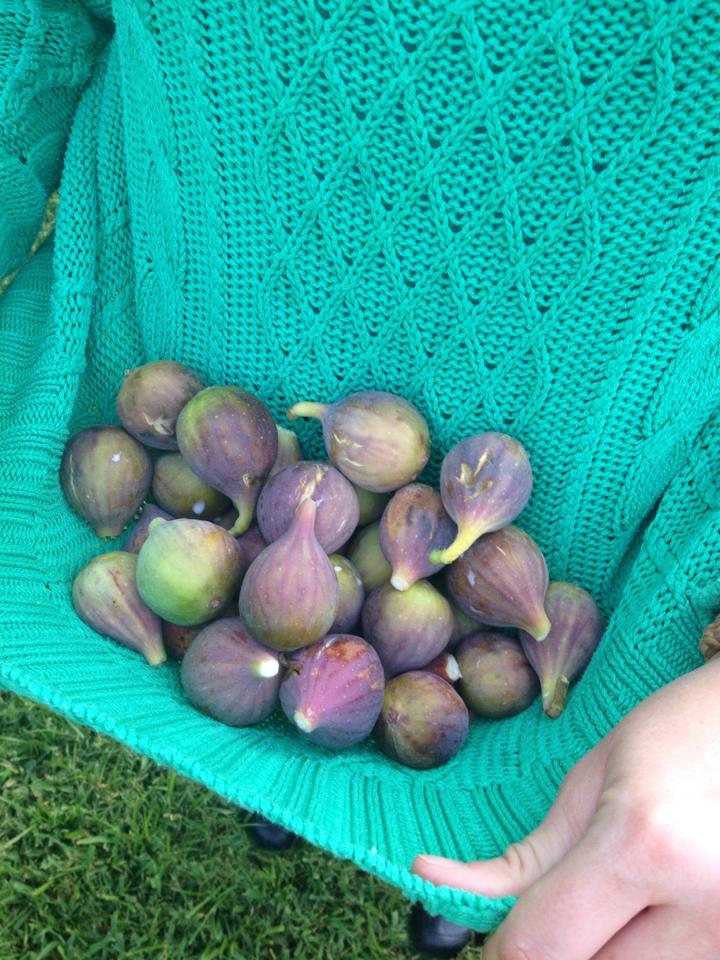
Birds and rapture have a place in my own little bird-world, too. Our backyard has been very active with the birds this summer. Because we’re growing delicious fruits back there, we’ve seen more, and more diverse birds than every before. (The bird bath doesn’t hurt either in dry Houston summers.) We have had lots of grapes growing along the back fence: 10301452_10203853874376171_9205261055523974740_n
and lots of figs:
10453468_10204111061085678_3107840873699884198_n
and a mama with her babies in our young oak tree:
10497046_10204088767568354_5612090893893219405_o
(Of course none of these are birds of prey. I’m being generous in my interpretation of Doyle’s writing, which is clearly about birds of prey specifically. But I think we can appreciate them all… and our little bird farm is encircled by hawks…)

All of this was joined a few years ago by a lovely piece by my aunt Janet, the sculptor. Its title is Rapture, and it was displayed in her home in Austin:
rapture austin
before joining us here in Houston:
rapture houston
to become a part of our backyard landscape (full of birds, although none are pictured here):
10306253_10203808143952939_4179928191057459515_n
(There is a little dog hidden in there, Where’s-Waldo-style, if you look closely.)

Brian Doyle’s ‘raptorous’ writing is well appreciated this season. Thanks, Pops.

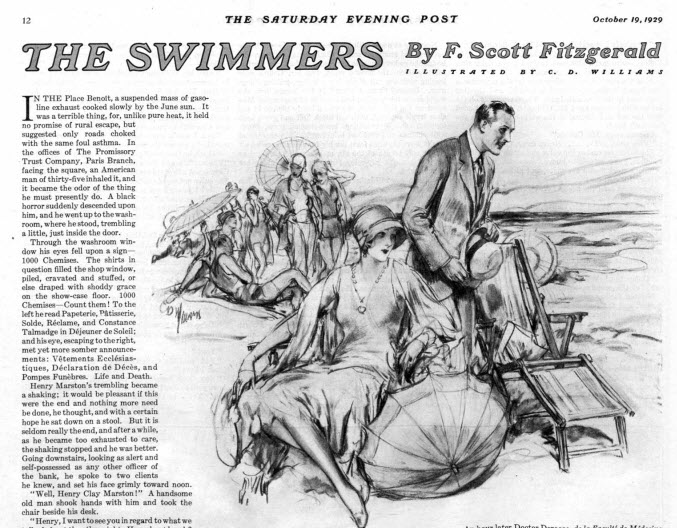
The Swimmers by F. Scott Fitzgerald

My enjoyment of So We Read On (teaser here; review to come) convinced me that I needed to read Fitzgerald’s short story The Swimmers, which Corrigan regularly refers to. So I did. I found it easily enough online.

When we meet him at the opening of this story, Henry Marston is working in a bank and living in France with his two children and his French wife. He could make more money back home in the States, but that’s not what’s important – until it is. A nasty event prompts him to move his family to the U.S., where he is wealthier; but a recurrence of the same unpleasantness spurs him to make changes a second time.

Between the two events he meets a young woman who teaches him to swim. This takes place on a French beach, and the young woman is American; this juxtaposition (symbolism, even, as swimming stands in for Americanism) persists, and it will be his newfound ability and love for swimming that will free him at the end of the story.

The most noticeable element of this story is national differences, epitomized in the final paragraph, which closes out a remarkable last page. Sweeping statements and symbolism are very much at work here, and the language is lovely. Perhaps I’m suggestible after just reading Corrigan’s book which compares The Swimmers so strongly to The Great Gatsby, but I definitely recognized Fitzgerald’s voice as I remember it from his most famous work. There are also some strong statements about class, money, and values, similarly familiar to the Fitzgerald fan. And reference to the lost generation (no capitals here). Finally, I swear I heard shades of Cheever, but surely that’s just the confoundingly similar title to Cheever’s well known story

What can I say? It’s Fitzgerald. I recommend it. I’ll leave you with that final paragraph:

But when, in a moment, he left her he knew that she could never tell him – she or another. France was a land, England was a people, but America, having about it still that quality of the idea, was harder to utter – it was the graves at Shiloh and the tired, drawn, nervous faces of its great men, and the country boys dying in the Argonne for a phrase that was empty before their bodies withered. It was a willingness of the heart.

I’m willing.


Rating: 8 Southerners.

hemingWay of the Day: on the menu

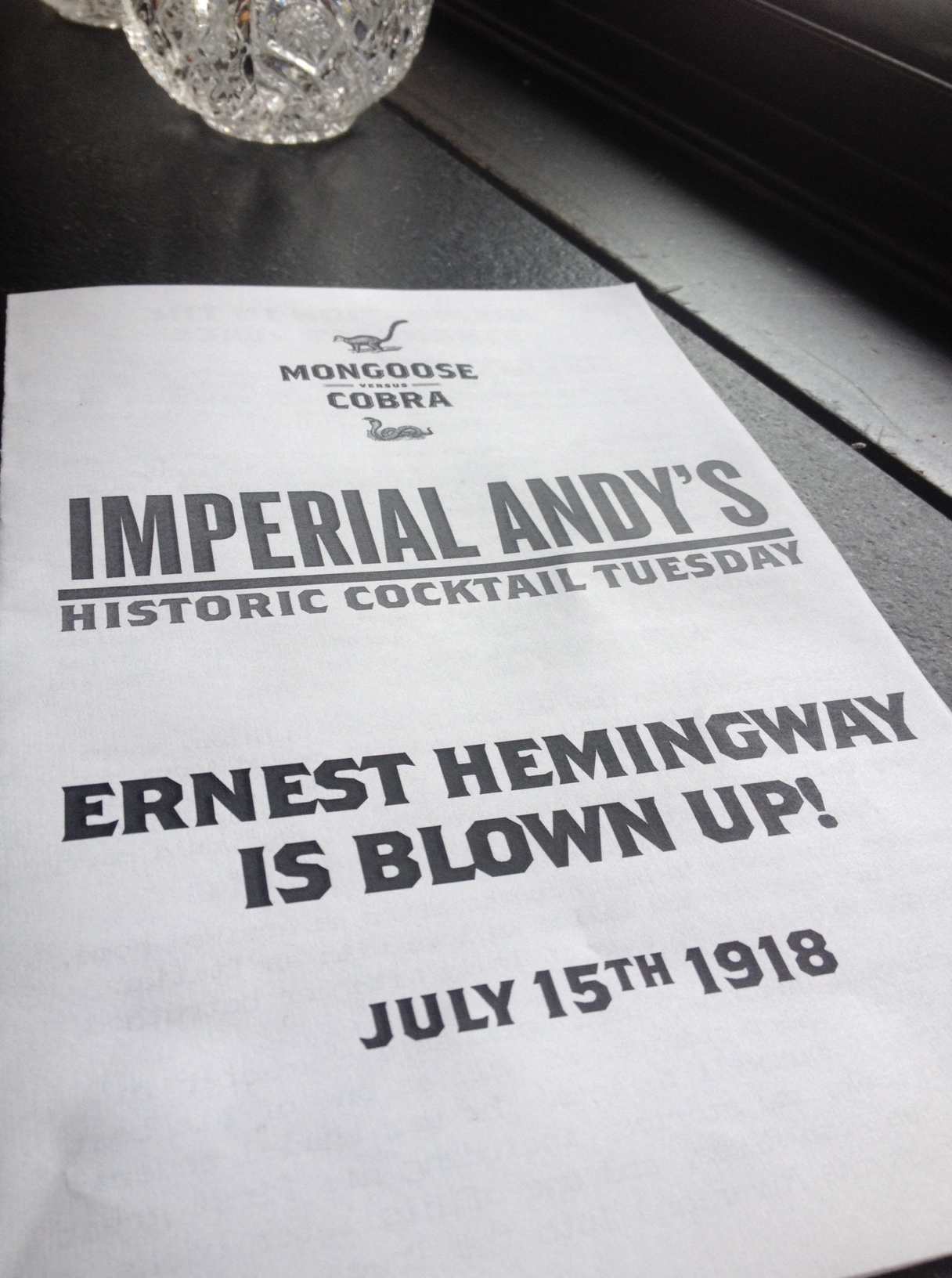
My favorite bar has an every-Tuesday-night event called Imperial Andy’s Historical Cocktail Tuesday. Andy is my friendly British bartender. He finds a historical event coinciding with each Tuesday’s date, makes up four themed cocktails to go with it, and produces a one-off menu telling the story. I have long wanted to be a part of one. Many months ago I used the book my mother gave me (for Christmas?), A Reader’s Book of Days, to find a Hemingway event: July 8, which fell on a Tuesday in 2014, was the day (night) he was injured in WWI, which led to his meeting the nurse he fell in love with, who would jilt him, who would be the model for the novel A Farewell to Arms for which he is so well known. This event would also be a big part of his self-myth. I’ve had my short write-up of this historical event and its significance waiting since maybe January for July to come along so I could cue Andy to do a cocktail list for it. Obviously the possibilities are endless! Well, I ended up having an un-reschedule-able appointment on that Tuesday evening; I was pretty disappointed. But the week before, I dropped my piece of writing off with Andy anyway. He’s become a great friend. I said hey, if you use this, would you just save me a copy of the menu please? He said he would push the historical event back a week if I could make the following Tuesday! Which I could.

On Tuesday, July 15, I walked into the bar and he had his menu ready for me – but it stated the date of Hemingway’s injury as July 15! I said, you didn’t even acknowledge your rewriting of history! Won’t somebody call you on this?? He said, Julia, there’s only one customer I know who would call me on this, and I think I’m safe from that person tonight. Why? It’s YOU, Julia. Oh. Okay. (I’ve made a note to check every Tuesday’s historical event for accuracy from now on.)

I enjoyed the drinks. And while we talked over drinks, we somehow came around to the concept of the green man. I told him Kingsnorth’s story as I remembered it offhand from an article my father sent me some months back (Andy being logically at least a little interested as a historical cocktail man as well as a Brit), and I sent him the link to the article too. And then, just on a whim, I looked up the date of the Battle of Hastings: October 14, 1066. Guess what day of the week October 14 falls on this year. You got it. That will be another Imperial Andy’s Historical Cocktail Tuesday. Too bad that’s not the week my father was planning to be in town… maybe he can reschedule.

photo

Maya’s Notebook by Isabel Allende (audio)

mayaI find it a little hard to believe I’ve read as little Isabel Allende as I have. You will recall that I loved Ines of my Soul as an audiobook; and I recall reading Daughter of Fortune at some point in the more distant (pre-blog) past, although I think I loved it less. Is that really all??

The music of her language reminds me of Sandra Cisneros. As soon as I began this audiobook, immediately following the disappointment of The Aviator’s Wife, I was soothed and grateful to be lulled by such lovely descriptive language (and read beautifully by narrator Maria Cabezas). The rhythm of that language is a central part of the attraction of this novel, although of course there’s more to it than that.

Maya’s Notebook is ostensibly the journal of young Maya Vidal, who turns 20 during the span of this story. That framing element of the journal is rarely referred to, but it does allow the narrative to jump back and forth in time. When the book opens, Maya is traveling from Berkeley, California to the small Chilean island of Chiloé, apparently on the run from an unlikely motley crew of threats including the mob, the Las Vegas police, and the FBI. We follow Maya as she adjusts to her new island home while also flashing back (via her journal) to the events that led her there.

Maya’s Danish mother abandoned her just weeks after birth; her Chilean father works as a pilot and is therefore scarce; but her Chilean grandmother (Nini) and African-American step-grandfather (Popo) are deeply involved, devoted parental figures, so she doesn’t suffer as an abandoned child might. In fact, she has a very happy childhood, until a sudden tragedy occurs when she is in her teens, and Maya rebels violently. I’ll refer vaguely to drugs, sex, crime, organized crime, and… Nini sends her off to Chiloé, where Nini has an old acquaintance who will take Maya in. Despite her storied past, then-19-year-old Maya adjusts well to the very foreign setting of a tiny island stuck in time. Her relationship with her new guardian, Manuel Arias, also develops nicely. These easy conquests are the first of the unrealistic touches that gave me pause.

The parts of Maya’s story that take place on Chiloé are deeply enjoyable, beautiful, and exotic enough to be pleasing and to suspend my disbelief – to quote a review in The New Republic, right to the point: “readers, confronted by fiction set in remote places and eras, are likely to suspend more disbelief than usual.” (I don’t know if it would really be this easy for Maya to win over her new neighbors. Despite being half-Chilean, she has her Danish mother’s coloring and goes locally by “Gringita.” And coloring aside, she is very different culturally from the locals; her easy transition felt very… convenient.) But the street life in Berkeley and (especially) Las Vegas increasingly reminded me of Go Ask Alice, in being simultaneously superlative in its ugliness, and cursory. It didn’t feel real, and Maya’s descent from golden child (literally), well-loved and privileged, to gutter junkie, felt even more cartoonish. This was the chief flaw of Maya’s Notebook. I also feel compelled to point out that even a woman who has played soccer since she was a little girl is unlikely to break a big, strong man’s femur with a well-placed kick.

These flaws were easy to put aside, though. This story made me laugh and cry, I loved Chiloé and its colorful people very much, and Allende’s lyricism is exemplary. There are hints of magical realism. All in all, I thought the New Republic review linked to above was a bit harsh; or maybe it’s just that it picks Maya’s Notebook apart from a standpoint of craft, even literary criticism, where I’m more interested in discussing how enjoyable I found it. I found it flawed, but enjoyable, and I will definitely be back for more.

Maria Cabezas’s reading was beautiful and just what this story deserved. I would like to say something about the translation from Spanish to English being lovely as well, but I am confused: packaging on every audio edition I can find gives translation credit to Anne McLean, but the audio that played in my ear credits Allende herself. Whoever it was, it was clearly outstanding.

Despite some faults, I am pleased.


Rating: 7 photographs.

bookish musings: pressures and impulses to read more, or read less

Just a little general reading for you today. (Ha.)

What’s new: I have been steadily increasing the reading & reviewing I do for Shelf Awareness. (Don’t know if you’d noticed.) I have also taken on reviewing responsibilities for ForeWord, so keep your eyes open for some reviews to come in that publication as well.

What this means: my “required reading” is ever-increasing. I love the work I do for Shelf Awareness; my relationship with my editor, Marilyn, has been excellent, and I am learning new things all the time, which might be the definition of happiness. I am far from complaining; I have sought out this additional work. But the days of my reading books of my own choice seem to be on hold for now. My audiobook time is still by my own choice, but the print books I read are 100% assigned lately.

The thing is, the more good books I read (for example, in the last few days: So We Read On), the more I find I want to read. That is, the more specific titles I discover that I want to put on my shelf. Good reading of the last year or so has yielded, among others, these additions to my shelves:


earthAmerican Earth: Environmental Writing Since Thoreau, edited by Bill McKibben (from my general and increasing interest in nature writings)


forestsFallen Forests: Emotion, Embodiment, and Ethics in American Women’s Environmental Writing, 1781-1924 by Karen L. Kilcup (as above, plus obviously women)


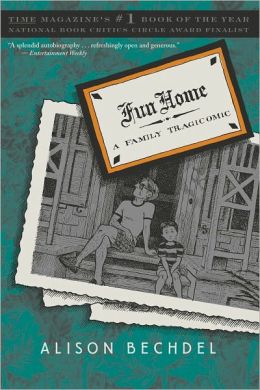
fun homeFun Home: A Family Tragicomic by Alison Bechdel (because Are You My Mother? was so great)


zelda clineZelda Fitzgerald: The Tragic, Meticulously Researched Biography of the Jazz Age’s High Priestess by Sally Cline (after my disappointment with Z, which whetted my appetite


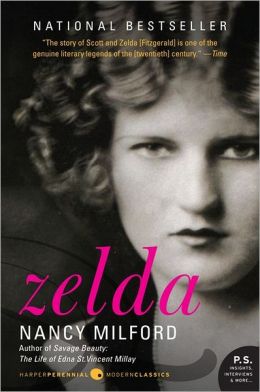
zelda milfordZelda: A Biography by Nancy Milford (and another: Milford’s, I understand, is the authoritative Zelda work)


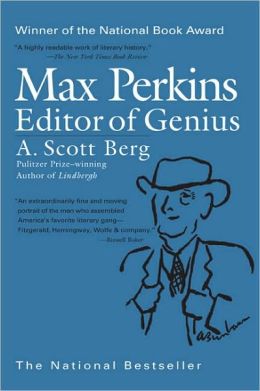
perkinsMax Perkins: Editor of Genius by A. Scott Berg (thanks to So We Read On for the specific recommendation; but of course as a Hemingway fan I was ripe for this suggestion)


To be clear: these are only a few of the books I have obtained in recent months, that now sit physically on shelves in what Husband calls my book room, waiting for me to find time to read them. And this, as my time to read books I choose is ever-decreasing. The more I read, the more I want to read. Good problems to have??

I am simultaneously thrilled to be expanding my book-review work, and sorry to lose my “free” reading time. I have been saying for years that if I ever want to clear my shelves of these books waiting patiently for me to find the time, I will need a 6- or 12-month sabbatical (from the day job as well as the reviewing work)… at least. Stay tuned for how I will work that out… and I will as well.

Maximum Shelf author interview: Michael Pitre

Following yesterday’s review of Fives and Twenty-Fives, here’s Michael Pitre: At Our Most Human.

pitreMichael Pitre is a graduate of Louisiana State University, where he was a double major in history and creative writing. In 2002, he joined the U.S. Marine Corps. He deployed twice to Iraq and attained the rank of captain before leaving the service in 2010 to get his M.B.A. at Loyola University. Pitre lives in New Orleans with his wife. Fives and Twenty-Fives is his first novel.

This novel handles a great deal of trauma, and one assumes you experienced similar trauma during your military service. Was your writing process cathartic, or painful?

My experiences in Iraq were pedestrian compared to those endured by the characters in this story. It’s a book about people I knew and, in some cases, friends for whom I could have done more. That’s the hidden pain of veterans, I think. We always remember the moments when we weren’t brave, occasions when we didn’t measure up, and days when we didn’t give our best.

Catharsis came from a desire to do right by my friends. There were times when I knew exactly what would happen at the end of a paragraph, and I didn’t want to finish it. Yes, it was painful. Had this book been easy to write, it would not have told a true story.

You point out that this is not a memoir, but you have a great deal in common with Lieutenant Donovan. Were the boundaries between fact and fiction always clear to you as you wrote this book? Did those boundaries turn out as you’d intended?

Early on, I was hyper-focused on maintaining a bright line between fact and fiction. Again, I set out to write a story that would honor the people I knew, and I’d hoped to avoid autobiographical details entirely. Of course, writing is a process. What crept into Donovan’s character from my own experiences were mostly his feelings of inadequacy as an officer, and the awkwardness of being a young veteran in graduate school where classmates ask you to tell stories they aren’t prepared to hear.

Are there any misconceptions about the war in Iraq that you felt you had to guard against?

I was eager to shun misconceptions about war in general, particularly when it came to glamour and gallantry. War is work. For the average U.S. service member in Iraq, it was filthy and exhausting, absurd and terrifying, repetitive and boring. That’s why I chose road repair as the principal mission of Donovan and his Marines. It wasn’t a sexy gig, but I don’t know of another task in Iraq that was more dangerous or more necessary.

On the home front, I was wary of the giving the impression that Iraq War veterans are damaged goods. The young men and women who fill the ranks of the U.S. military are devoted professionals.

Though the characters in this story are struggling to reintegrate to civilian life, they aren’t giving up, they aren’t blaming anyone, and they aren’t victims. They’re working through their problems, and in the end, they’re doing it together.

Who is the hero of this story? Or, your hero?

All three narrators are young men placed in impossible circumstances, and none of them come away clean. Even Donovan, who’s all but bestowed with the formal title of hero, knows the truth about himself. The title becomes his burden.

The closest thing this story has to a hero is Sergeant Gomez. I’ve known a few Marines like her. I’d say they’re my heroes.

I’m so glad you said that. She is so much more than the “token female” that she might have been in lesser hands. Her presence as the only woman in the platoon felt very natural. Does your experience bear out her ease in this story?

The short answer is yes, it’s perfectly normal for a female sergeant like Gomez to run a road repair crew. Most Marines wouldn’t give it a second thought. Female service members have been fully integrated into occupational specialties such as military police, combat engineers and logistics for well over two decades, and these groups have spent as much time on the roads of Iraq and Afghanistan as anyone.

In fact, as the American experience in Iraq wore on, female service members became highly valued for cultural reasons. To avoid inflaming the population, male Marines were forbidden to search Iraqi women at security checkpoints. So, a task force of female Marines was assembled, trained in search techniques and deployed to check points throughout western Iraq. This ad hoc solution was eventually formalized into a program called “Lioness,” in which every battalion in theater had to answer its “Lioness tax” by surrendering a number of female Marines for the duration of a deployment.

Lioness was so successful that the program was copied and expanded into Afghanistan. Infantry patrols were reinforced with Female Engagement Teams composed of six to 10 female Marines. While the grunts dealt with the Afghan men outside, the female Marines would take off their helmets, go into the houses and develop relationships with the Afghan wives, mothers and daughters.

I served in Iraq alongside a female sergeant named Sally Saalman, who was perhaps the most feared and respected Marine in our battalion. She’d served on a forerunner of Lioness in 2005, and had been badly wounded in a suicide attack that killed six service members, three male and three female. (Read more about that event here.)

That was her first deployment. We met on her third. When Saalman raised her voice, everyone around would shut the f*** up and listen.

When and why did you decide to switch voices between your three main characters?

From the beginning, I knew the story would require three different perspectives and that one had to be Iraqi. It’s a long-ignored truth of war that warriors often suffer least. This is especially true in counter-insurgency, where the civilian population is the battlefield. The Iraqi people were the mission. I felt that not representing their experience with its own, distinct voice would’ve been narcissistic.

As for Donovan and Pleasant, I thought it important to show how some veterans have opportunities opened for them by their service, while others are left all but ruined by it.

Did you set out to write a book with a message or moral, or is this simply the story that you held inside yourself as a novelist?

I didn’t set out to write a book with a message or a moral. This really was just a story I had to tell. But along the way, as the character of Dodge became very real to me, I stumbled across the idea of people finding each other in their shared frailty. We’re at our most human when we can recognize our dread, and our weakness, in others.

For those who presume they have nothing in common with a kid from Baghdad, I’d hope that they finish this book having discovered that they have everything in common with him.


This interview originally ran on July 23, 2014 as a Shelf Awareness special issue. To subscribe, click here, and you’ll receive two issues per week of book reviews and other bookish fun!

Maximum Shelf: Fives and Twenty-Fives by Michael Pitre

Maximum Shelf is the weekly Shelf Awareness feature focusing on an upcoming title we love and believe will be a great handselling opportunity for booksellers everywhere. The features are written by our editors and reviewers and the publisher has helped support the issue.

This review was published by Shelf Awareness on July 23, 2014.


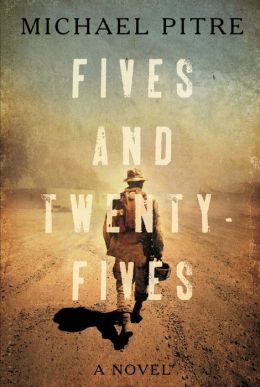
fives and twenty

When a road repair convoy stops to check for roadside bombs, their first duty is to scan five meters in all directions from within the vehicle. A bomb inside this perimeter can penetrate the vehicle’s armor and kill everyone inside. Once five meters are cleared, scouts step outside and sweep an area 25 yards in every direction, before the convoy can move forward. These are the defining dimensions of a road repair platoon’s daily work. Filling potholes in Iraq means clearing bombs.

Michael Pitre’s debut novel, Fives and Twenty-Fives, follows three men from a road repair platoon in Iraq through their lives after their service has ended, alternating among their first-person voices. In disjointed chronology, the story switches between the present, when each man has either returned home or tried to create a new one, and their far more vivid past, in the Iraqi war zone.

Lieutenant Donovan is the platoon’s leader, although he knows he relies overmuch on his highly competent sergeant and corporal. Both his rank and his natural reserve inhibit Donovan’s relationships with the men and women assigned to him. “A real southern college boy, the Lieutenant. Like he was on his way to an outdoor jam band festival one day, took a wrong turn, and somehow ended up in the Marines.” Corpsman Lester “Doc” Pleasant is from the wrong side of the tracks, but discovers a gift for medical work. The platoon’s losses, which he is meant to prevent, hit him hard. Their “terp,” or local-native interpreter, is a Baghdadi university student code-named Dodge (“a dependable car”), who carries a copy of The Adventures of Huckleberry Finn in his back pocket, filled with copious marginalia in both Arabic and English. He is assigned to Donovan’s platoon but not allowed to talk with the Americans about his past–not that he wants to. In the aftermath of their war, the reader watches these three men try to navigate a world that no longer makes sense to them or of them.

In a post-Katrina New Orleans (and vomit-soaked French Quarter) as stark as the wartime Iraqi desert, Donovan goes back to school to pursue a business degree, but his professors don’t feel that officer training should exempt him from coursework in “leadership dynamics and business ethics.” He struggles to find relevance in school and work, and is haunted by the fates of the men and women of his platoon. Doc returns home to Houma, Louisiana, his military service having failed to offer the opportunity he sought. He can’t stop worrying about his father working out in the shed late at night, and still carries his trauma bag everywhere he goes. Dodge is lost to his American friends, his postwar experience known only to the reader.

In flashbacks, the reader witnesses these men and others in their day-to-day work in Iraq: repairing potholes, each and every one of which reliably contains an IED; trying to keep the roads safe for military and civilian travel; balancing humanity against the ugly work of war; and riding out the senselessness of military politics. Relationships grow and fade. Their homes seem very far away, and are rarely mentioned. One exception is Donovan’s phone call to his parents on his birthday, an effort that costs him dearly. Additional members of the platoon are revealed only in these flashbacks. The strong characters of Corporal Zahn and uber-capable Sergeant Gomez, for example, don’t get first-person treatment; the reader has to work a little harder to puzzle out the endings to their stories, with an increasing sense of foreboding.

Meanwhile, in the present-tense sections, Donovan struggles with the social interactions required by work, school and the possibility of dating. He is hailed as a military hero but holds himself responsible for a range of less salutary personal postwar outcomes. Doc is back at the oil-change place where he worked in high school, his society consisting of a father he can hardly speak to and two friends in a band in New Orleans. Dodge inhabits a precarious position in Tunisia, a society teetering at the brink of violent protests and social upheaval; his pleas to come to the United States have been denied.

These young people come home from a deeply traumatic foreign war to a society totally unprepared to understand them. When Doc ventures out with a girl to see the fireworks on New Year’s Eve, he reacts badly to the sounds of explosions and lashes out, wanting to protect those around him; but his companions, who barely know him, judge him to be unstable. Donovan carefully avoids playing the part of the “stereotypical brooding vet.” The experiences of Donovan, Doc and Dodge are heartwrenching in both theaters; it is Pitre’s greatest feat that they remain viscerally real people, not black-and-white cut-outs. From the perspective of his characters, there are perhaps no heroes here.

The quiet pathos of war, its aftermath and the individuals affected by it, and the inability of a tone-deaf society to relate to them, is rendered with poignancy and stark honesty in Fives and Twenty-Fives. Readers will be floored by Pitre’s spare literary style, the authenticity of each of his characters’ three different voices, and those mesmerizing characters themselves, who are not perfect but demand our compassion for their very reality. The story of Fives and Twenty-Fives is sometimes difficult to abide, but is also necessary; we are lucky to have such a fine voice as Pitre’s to tell it.


Rating: 9 potholes.

Come back tomorrow for my interview with Pitre.

Land of Love and Drowning by Tiphanie Yanique

Ghosts, curses, blessings, loves, births, deaths and family in a lush Caribbean setting.

land

Tiphanie Yanique (How to Escape from a Leper Colony) constructs a wide and magical world spanning three generations on the island of St. Thomas in Land of Love and Drowning. In the early 1900s, as the Danish Virgin Islands are poised to transfer to U.S. rule, Owen Arthur Bradshaw divides his love between his wife, Antoinette, who is beautiful but a reluctant mother; his daughter Eeona, still more lovely and also inveterately jealous; and Rebekah, an obeah (sorceress) married to another man. Antoinette gives Owen one more daughter, Annette, just as Rebekah gives him a son, Jacob Esau. The three children grow up relating to one another in unusual ways. War and American influence broaden their world somewhat, and the forces of nature and island magic both influence and are influenced by the disparate forces that are Eeona, Annette and Jacob Esau.

The story begins with Owen Arthur and his women, then follows his children’s and his grandchildren’s lives. Perspective shifts among the voices of the three children, but Annette, who grows up to be a historian, speaks the loudest. Her island patois persists even as Eeona nags her to “use proper English.” As she writes, “is just a story I telling, but put it in your glass and drink it.”

The compelling history of the U.S. Virgin Islands as told through this family’s intimacies is multiethnic, colorful and vital. Yanique’s diverse characters become doctors, architects, teachers, parents, lovers and fighters; their collective story is haunting and exquisite, told with grace, vibrancy and magic.


This review originally ran in the July 18, 2014 issue of Shelf Awareness for Readers. To subscribe, click here, and you’ll receive two issues per week of book reviews and other bookish fun!


Rating: 7 red dresses.

Teaser Tuesdays: So We Read On by Maureen Corrigan

Teaser Tuesdays is a weekly bookish meme, hosted by MizB of Should Be Reading.

so we read on

I am quite over the moon for the latest book about The Great Gatsby, by NPR’s Fresh Air book critic, Maureen Corrigan. It’s called So We Read On. Please note that even the title of this book is a nod to the complexity of language. Presumably if we were to hear Corrigan speak about her book (as, since she works in radio, I hope we will), we would know what I am still wondering: does she say “so we read on,” rhymes with feed, current tense? or rhymes with head, past tense? I love this ambiguity.

But wait! There’s more. In the opening pages, Corrigan shows that she will have a sense of humor even while exhorting her audience about the importance of her topic:

When we make our first chain-gang shuffle into Gatsby, we spend so much time preparing for standard test prompts on the eyes of Dr. T.J. Eckleburg and the color of Gatsby’s car and – above all – the symbol of the green light at the end of Daisy’s dock that the larger point of the novel gets lost. It’s not the green light, stupid; it’s Gatsby’s reaching for it that’s the crucial all-American symbol of the novel.

One main premise of her book (which is very friendly and accessible, by the way) is that most of us, who read Gatsby for the first time in high school or even middle school, are too young or distracted to fully appreciate it on that first try. I rather liked it in high school (I was a pretty enthusiastic English student, believe it or not), but I am absolutely on board with her larger point.

Recommended! Stay tuned.

This quotation comes from an uncorrected advance proof and is subject to change.