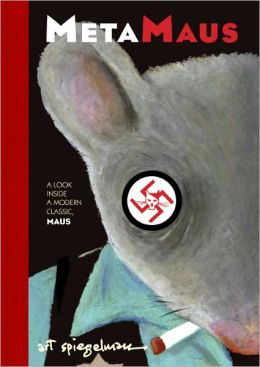
MetaMaus: A Look Inside a Modern Classic, Maus by Art Spiegelman

Begin with Maus I and Maus II. And then move on to MetaMaus, filled with images from the book and discussions with Art, and his wife and two children, about what it all means, his process, his motivations, and the impact these powerful little books have had on all of them.
metamaus
At the outset, let me say, holy magnificent book. MetaMaus asks the questions (according to its back cover), why the Holocaust? why mice? why comics? And of course, the Holocaust is the easiest to answer, to me: the Holocaust because it was what he knew (“write what you know”), except that he didn’t know the Holocaust. He emphasizes that. (And I confess it surprised me, that a survivors’ son could have grown up with such a limited knowledge of what happened so recently, and so centrally to his own personal and family history. I had a fairly decent, basic grasp of the Holocaust in grade school. But then, I grew up a full generation after the author did. Clearly a lot had changed.) Still, it was what arced over him, what oppressed him or at least leaned against him; what else was there? In fact, my surprise was that it wasn’t that obvious – that he wasn’t driven to write (draw) about the Holocaust, at least not that he knew: “What consciously motivated me was the impulse of wanting to do a long comic that needed a bookmark.” He needed to make a full-length comic, as it turned out. Who knew. I am baffled by the visual arts, at least as much as I am stimulated and inspired by the written/verbal ones; most of the visual artistry of Maus escaped me before reading this book, which is part of why I found it so wonderful. Unlike many monographs meant to elucidate the visual arts for us plebeians, this really brought it home to me, exposed so much more, increased my understanding & appreciation.

But the real question I was here for: why mice? Honestly, this was my chief concern (followed by: why cats, why pigs, why dogs…) and all those questions are answered, happily. And of course there are only more questions behind them, much discussion of the imagery and symbolism that belongs to animals in different cultures, for example, and some of that taking-back of the derogatory where Jews were called rats by the Nazis, for example. MetaMaus follows these paths, and lets us get to know the author. I found it very satisfying, after getting to know a version of him and feel him so strongly. We should always be so lucky.

And then the CD! This book is accompanied by a CD with complete images of both of the books; over 7,000 early sketches & studies & the like; video and audio files including recordings of interviews with Vladek; and some of the pamphlets off his mother’s bookshelf that Art used in his research. I think there were about 4 hours of Vladek interviews – the man’s actual voice! – and an hour-long home movie made by Art and Francoise on a visit to Auschwitz. Holy smokes, the CD is chock-full of goodies. I did not exhaustively study it, I confess. There was just so much; and I felt so well-served by the reading of the book itself. I did enjoy listening to Vladek’s voice, though: it brought everything to life, and was an interesting counterpoint to the relative unreality of comics.

Of course another theme of the book is the power and faultiness of memory. I love memoir, and I love that memoir almost inevitably has to confront this obstacle: the ‘mem’ in memoir is unavoidably problematic, at least enough to raise questions. In Maus‘s case, the clearest example comes when Vladek describes leaving Auschwitz and denies that there was an orchestra playing at the gates. As Art has documented, there is substantial support for the existence of this orchestra: there are photographs, and there are eyewitnesses among the Nazis, the Jews, and the musicians. But Vladek is sure there was no orchestra. What to do? I love Art’s discussion of the problem: how he could have represented Vladek’s version, or the official one, or left the whole question out of his story; but he instead elected to show the actual question. There is a panel in which there is an orchestra – followed by Vladek’s denial of the orchestra – followed by a panel in which the orchestra is no longer present, except that if you look closely, you can see the tips and shadows of their presence behind the marching prisoners. This is really something. Of course, when I read the comic, I didn’t catch that visual shadow, just the discussion of the question.

I learned a lot of intriguing details. Who knew the size of these (quite small) comics was so important to Spiegelman? Or more surprising, that he drew the originals in that same small size? And the details about the different reactions to the books in different countries (it’s been translated into some thirty languages) were fascinating to me. I had innumerable little details of the comics pointed out to me and elucidated – things I would never, in 100 readings, have figured out for myself, but value greatly once they were explained to me. But I most enjoyed the feeling of greater intimacy with a very talented, and unique artist. And I remain boggled by the dual artistry of the composition of this book as narrative, next to the visual artistry of the comic aspect. Art Spiegelman is a special man. The two Maus books were special, and should be required reading (for, I don’t know, everyone). And then if you like those – do yourself a favor and immerse yourself in this behind-the-scenes look. If you appreciate art (in any format) and are interested in process, also check this one out. And for those of you who prefer other formats than plain old reading, the CD has a great deal to offer in formats all over the map. Major win!

Additionally, I had to mark many passages for further consideration, so many philosophies I found valuable…

On communication vs. High Arts:

I do like to communicate clearly. It’s a pleasure. And as soon as one is involved with communication, one’s already suspect in the High Arts. A lot of what happens in the more rarefied precincts of art is that the word “communication” gets replaced by “communion,” and one is involved in a kind of religious experience with the artist as shaman. And that’s really different than, “Hey, I’ll tell you a yarn.” Or even “I’ll tell you a parable,” if you want to be didactic. And it’s always been either a skill or a deficiency that I try to make contact with with people.

I appreciate this, because I think High Arts (his phrase, but I like it) can sometimes let us down a great deal when it gets religious, or mysterious, or snooty. I’m not saying everything has to be forever perfectly literal and transparent, and I do enjoy moments of inexplicable beauty. But I think it’s exclusive and elitist to shun honest communication.

On the authenticity of his way of story-telling:

Everything drawn in the so-called past in the story that Vladek is telling is very clearly an attempt by the son to show what the father is telling. And that offered a margin within which to operate authentically. The fact that you’re told that I’m trying to show you what I understand of what Vladek is telling me is built into the fabric of the narrative itself, and allows that narrative to get told.

This reminds me of one of my favorite movies, 2 Seconds. There is an extended sequence where Lorenzo is telling Laurie the story of his professional bike racing career and how it ended. He speaks, and we see the action he is describing – but we see it as imagined by Laurie as she listens – but apparently Lorenzo can see it too, because he corrects it here and there. For example, he’s describing walking down a country road, and we see a young man doing just that, and kind of waddling on his clipless cycling shoes, with the cleats on them. And then we skip back to Lorenzo and Laurie sitting and talking, and he corrects her: “no no, we didn’t waddle, our shoes were soft leather” (I paraphrase). Skip back to the young man walking down the country road, smoothly on his smooth soles. I love love love this effect. In the same way, for example, in the question of the orchestra at Auschwitz, Spiegelman makes it clear that his father is correctly his visualization as they go. And this makes it honest and clear that he is only telling a story as told to him and as he understands it, which I appreciate deeply for its honesty.

On nihilism and ethics:

One night, we’re going down to feed the cats after one of our snooze-and-probe sessions, and he’s carrying those scraps downstairs and he says, apropos of I don’t remember what, that basically he’s a nihilist. And I ask him how this involves getting up in the middle of the night to talk to dying AIDS patients, and being so available to patients way past the point of it being good for his health, and he says something that one might take as just an off-the-cuff remark, but I found profound: “Well, I decided that behaving ethically was the most nihilistic thing I could do.” It delighted me as an idea, as a way of living one’s life.

This quotation launched a lengthy discussion for my father and I of the different meanings of ‘values,’ ‘morals’ and ‘ethics.’

On stories:

[The word ‘story’] comes from medieval Latin historia. It refers to those very early comic strips made before the invention of newsprint: the stained-glass windows that told a superhero story about that guy who could walk on water and turn it into wine. This is how in English, the word ‘story’ has come to mean both story as in stories of a building and story as a narrative. And at that point one is steered toward an architectural model for what a comic is, something very basic about comics narrative. Comics pages are structures made up of panels, sort of the way the windows in a church articulate a story. Thinking of these pages as units that have to be joined together, as if each page was some kind of building with windows init, was something that often happens overtly in Maus, and sometimes is just implicit in the DNA of the medium.

Story as architecture was a little mind-blowing to me, too. Allow these few examples to show how deeply thought-provoking I found this book. It’s a really dense, exciting experience.

So, to sum up: I found each Maus book thrilling and touching it itself. MetaMaus was equally thrilling and touching, increased the experience of both Mauses, and additionally set loose all kind of thought threads for me, that I have listed here as briefly as I could stand so as to not ramble on all day. Clearly I’m a fan. Pick up this book, and keep your notebook handy as you go.


Rating: what the hell, 10 sketches.

book beginnings on Friday: Whipping Boy by Allen Kurzweil

Thanks to Rose City Reader for hosting this meme. To participate, share the first line or two of the book you are currently reading and, if you feel so moved, let us know what your first impressions were based on that first line.

whipping boy

On the opening page, we get these lines.

Confession

You’ve been a menace and a muse. A beacon and a roadblock. My jailer and my travel agent.

Kurzweil writes to his childhood bully here, who the whole book is about. And this gets to the heart of his need to research and write it – that first line, in fact, does it alone: “you’ve been a menace and a muse.” A fine beginning, I think, because it says so much so briefly. It is still worth reading the whole story, though, I assure you.

This quotation comes from an uncorrected advance proof and is subject to change.

Screenplay by MacDonald Harris

An enthralling, time-traveling version of Alice, in dual wonderlands of 20th-century Hollywood.

screenplay

Originally published in 1982, Screenplay by MacDonald Harris (The Balloonist) exhibits remarkable sleight of hand with two parallel versions of Los Angeles. Alys was raised in the late 20th century by fabulously wealthy, unconventional parents and orphaned at age 18. With no personal connections and unlimited money to burn, he amuses himself with unusual old books and music and soulless sexual liaisons. An odd old man shows up at his doorstep and requests to rent a room–though no room has been advertised. He introduces himself as Nesselrode, a film producer, and says he can get Alys into pictures.

Soon Alys’s tenuous link to modern 1980s L.A. falters as he steps through a screen into black-and-white 1920s Hollywood with Nesselrode as a surly, time-obsessed guide. In this alternate world, he falls in love with a beautiful starlet, but can they make a life together in her time? Or in his?

In addition to the unmistakable overarching reference to Alice’s Adventures in Wonderland, Harris’s novel recalls the moral questions of The Picture of Dorian Gray and Alys himself could have stepped from the pages of The Great Gatsby. Even with such classics for comparison, Screenplay is a masterpiece of darkly playful cunning. Harris’s evocative prose, in Alys’s disturbingly clinical, coldly self-indulgent first-person narrative, is both intoxicating and disquieting; the altered reality here is more sinister and sensual, even erotic, than in Carroll’s Wonderland. The tension in this memorable and singular dreamscape builds with perfect pacing to an ending that raises more questions than it answers.


This review originally ran as a *starred review* in the December 30, 2014 issue of Shelf Awareness for Readers. To subscribe, click here, and you’ll receive two issues per week of book reviews and other bookish fun!


Rating: 8 toasters.

You’re Not Lost if You Can Still See the Truck: The Further Adventures of America’s Everyman Outdoorsman by Bill Heavey

Brief doses of amusing, thoughtful and compassionate reflections on outdoorsmanship.

not lost

In his third volume of collected works, You’re Not Lost If You Can Still See the Truck, Bill Heavey (It’s Only Slow Food Until You Try to Eat It) mainly draws from his work in Field & Stream, where he serves as editor at large. Spanning 26 years, these pieces focus largely on fishing, hunting and general outdoor antics, but occasionally touch on more personal subjects, such as fatherhood, divorce, grief, health and family. Self-deprecating humor is clearly Heavey’s greatest strength (especially refreshing, given the hyper-masculine hobbies under consideration), and the bulk of this collection is laugh-out-loud hilarious, but he demonstrates a distinct ability for gravity when called for, which adds a welcome note of complexity. For example, “Can I Tell You Something?” soberly explores the reasons some hunters and fishermen cease to enjoy certain aspects of their sports.

Heavey provides tongue-in-cheek critiques of the outdoor enthusiast’s retail market, tells charmingly and sometimes embarrassingly funny stories of his escapades and generally exhorts the reader (presumably an everyman or -woman like the author) not to take himself too seriously. His satisfyingly personal tone renders him a fully developed figure–a friend, even. The collection is more than the sum of its parts, tracing the arc of an amateur becoming a seasoned outdoorsman (though not an expert, as Heavey would be quick to point out), with examples of his persistent incompetence. Enjoyment of the entertaining result does not require a love of hunting or fishing.


This review originally ran in the December 30, 2014 issue of Shelf Awareness for Readers. To subscribe, click here, and you’ll receive two issues per week of book reviews and other bookish fun!


Rating: 7 packs of Rage Titanium two-blade expandables. (No, I don’t know what that is, either.)

Teaser Tuesdays: Death Comes for the Deconstructionist by Daniel Taylor

Teaser Tuesdays is a weekly bookish meme, hosted by MizB of Should Be Reading.

deconstructionist

There is a lot to recommend this funny little book, a novel about mental illness, academia and philosophy, with a murder mystery thrown in. For example, you know I couldn’t resist this:

So much information in one library, mountain ranges of information, Mariana Trenches of it. Earthly metaphors are insufficient; one has to go galactic to find adequate imagery for the near infinitude of what there is to know – even in this single word palace – and the heartbreaking finitude of my one little brain.

I like a good celebration of libraries, of course, and the imagery used here. Stick around…

This quotation comes from an uncorrected advance proof and is subject to change.

Maus II, A Survivor’s Tale: And Here My Troubles Began by Art Spiegelman

Following Maus I, in a word: every bit as good.

maus iiMaus II picks up Art Spiegelman’s, and his father’s, stories more or less where they left us last. Art continues to have difficulty relating to his dad, but still needs to hear the story, and his father just wants him around at whatever cost. We get the full details of father Vladek’s stay at Auschwitz and Dachau (it is of the latter camp that Vladek gives the line that becomes a subtitle, “and here my troubles began”), and a vague sketching of mother Anja’s time at Auschwitz: she is no longer around to tell her side, and Vladek is a little blurry on that account. Art continues to mourn the loss of her notes on her own wartime experience – destroyed by Vladek in a quest for forgetfulness.

In this book we also get to know Art a little better, as well as his wife Francoise. We meet his therapist, another Holocaust survivor. We see some of the fame earned by Maus I, which was not a force for good in Art’s life.

The art is still amazing. Detailed, and so representative of so much, despite the characters being portrayed not as people but as animals. To review: Jews are mice, Poles are pigs, Germans are cats, and as we see here, Americans are dogs. Maus II opens with an exchange I found charming, where Art worries about how to draw his wife, Francoise: originally a frog, he suggests, since she is French, but she insists she is a mouse, having converted to Judaism to satisfy Vladek’s need for appearances in the marriage. The use of animals for people, and their categorization in this way, is one of the most striking, interesting choices of this book – after, I guess, the choice to make it a comic at all. More on that when I get to MetaMaus.

I digress. The art is still beautiful, impactful, and communicative. The storyline is evocative and strangely universal, even while it is the unique story of a Holocaust survivor and his family; most people have experienced these difficulties relating to their parents, who are loved but hard to understand. The dialog between Art and Vladek is funny, and heartrending, familiar and true, even while it is also disturbingly stereotypical of Jews – a tension that Art and Francoise discuss. They acknowledge that this is how Vladek really is, so this is how he must be portrayed. Okay. I’m good with that, especially after it’s been acknowledged, owned in this way.

This is an astounding book. I am a total amateur at appreciating the visual arts, so I can barely claim to understand that aspect of it, but I like it. And as a work of memoir, love, portrayal, language, and history, I am deeply impressed. Read these books.


Rating: 9 cigarettes.

When Books Went to War: The Stories that Helped Us Win World War II by Molly Guptill Manning

A heartfelt history of Armed Services Edition paperback books that helped save the sanity of many GIs in World War II.

books went

Molly Guptill Manning (The Myth of Ephraim Tutt) opens When Books Went to War by documenting the horrified response in the United States to Nazi Germany’s book burnings, beginning in 1933. Bibliophiles fought back in what was characterized as a “total war” of both military might and ideas.

To supply bored, lonely troops with reading materials, librarians in the U.S. organized the Victory Book Campaign, which collected more than 10 million books. To educate the public, the Council on Books in Wartime recommended relevant, topical titles for readers at home, but it found its stride with Armed Services Editions (ASEs). These pocket-sized, lightweight paperbacks, designed for use in the field, not only provided entertainment, escape and enlightenment to American servicemen, but also revolutionized the paperback book in a market that had previously shunned it, employed struggling publishers and helped to jumpstart the publishing industry after the war. Between 1943 and 1947, more than 120 million copies of more than 1,200 fiction and nonfiction titles were printed and efficiently distributed to American soldiers in every theater.

In her moving history, Manning fervently describes the many GIs who returned from war with a love of reading they hadn’t had when they left home, wrote impassioned letters to authors and council members and attributed their college educations to books they discovered as ASEs. For military and general history buffs and lovers of books and libraries, it is difficult to imagine a more inspirational story than this celebration of reading in a time of war.


This review originally ran in the December 23, 2014 issue of Shelf Awareness for Readers. To subscribe, click here, and you’ll receive two issues per week of book reviews and other bookish fun!


Rating: 7 letters.

Offcomer by Jo Baker

A delicately wrought debut novel about self-identity in a big, rough-edged world.

offcomer

Published in the United States for the first time, Offcomer is the striking first novel by Jo Baker (Longbourn). In Belfast, Claire Thomas is struggling with a messy relationship with an overstressed and self-important academic; a degrading, beer-stained job in a second-rate pub; loneliness; and self-harming. Baker presents Claire’s story in disjointed chronology, beginning mid-crisis, jumping back to when she meets her troublesome philosopher boyfriend, Alan, for the first time, then forward to the aftermath of a minor breakdown, as she travels home to confront her mother about the misrepresented mysteries of their shared past.

Claire, a recent college graduate floundering through early adulthood, is looking for an identity, a place in her world. In the dialect of Lancashire, an “offcomer” is an outsider or a nonlocal. Her family history is shadowy, fractured and geographically unstable; true to her family’s offcomer status, she can’t get comfortable, can’t decide who she is: “Claire saw herself reflected in a hundred different ways, distorted, fragmented, multiplicitous…. She couldn’t begin to resolve… discarded, throw-away ideas of Claire.” One of Offcomer‘s artistic feats is that of perspective. By shifting slightly from Claire’s point of view to Alan’s, for example, Baker subtly asks questions about the truth and nature of their self-images. Claire’s specific trials and disconnected family history are a vital part of her coming-of-age; her story is a universal one made fresh in Baker’s creative hands. Thoughtful, somber and perceptive, Offcomer will resonate with all who have searched for home.


This review originally ran in the December 23, 2014 issue of Shelf Awareness for Readers. To subscribe, click here, and you’ll receive two issues per week of book reviews and other bookish fun!


Rating: 8 bags.

The Little Prince by Antoine de Saint-Exupéry, trans. by Richard Howard

little princeThe Little Prince is a classic children’s book that has been on my list for some time, so imagine my surprise when it appeared as well in a book I recently enjoyed, Hell and Good Company: The Spanish Civil War and the World it Made by Richard Rhodes. I had no idea that Saint-Exupéry played a role in the Spanish Civil War – apparently he volunteered there as a pilot. This helped The Little Prince jump to the top of my list, and here we are.

As it is a children’s book, it was an easy, quick read, just under 90 pages and full of delightful illustrations by Saint-Exupéry himself. These illustrations are an important part of the story: the power of art, and its greater or lesser power to realistically capture appearances. Apparently my edition is a new translation, by Richard Howard, and comes with newly restored illustrations as well. Howard opens with a brief meditation on the important work of translation that I found thought-provoking.

And then the story itself, which concerns our narrator, a pilot crashed and stranded in the African desert, and the little prince he is surprised to meet there. The prince tells us he has come from his own tiny little planet, far away. He is worried about a very special flower he left there. Thus proceeds the story of the little prince, and our pilot’s somewhat clumsy attempt to help; the prince’s departure, and the pilot’s dealing with it.

The morals here are sweet, as one might expect, and as I hadn’t expected, also offer some words about handling grief and loss. The image of one’s departed friend living in the stars and comforting us from afar is familiar and cozy. The Little Prince also comments on the strangeness of the adult world:

If you tell grown-ups, “I saw a beautiful red brick house, with geraniums at the windows and doves on the roof…,” they won’t be able to imagine such a house. You have to tell them, “I saw a house worth a hundred thousand francs.” Then they exclaim, “What a pretty house!”

…That’s the way they are. You must not hold it against them. Children should be very understanding of grown-ups.

Further allegory and comment are provided by the little prince’s bemusement at the confused values of those he meets on his interplanetary travels, before reaching Earth: the king, the vain man, the drunkard, the businessman, the lamplighter, the geographer; and those (considerably wiser) he meets on Earth before the pilot: snake, flowers, and others; and the wisest of all, a fox. It is the fox that teaches him that “anything essential is invisible to the eyes” and that “you become responsible forever for what you’ve tamed.”

A beautiful story, sweetly told and charmingly illustrated, with layers to appreciate on different readings and at different ages: everything a kid’s book should be.


Rating: 7 boas with elephants inside them.

hemingWay of the Day & Teaser Tuesdays: Hell and Good Company by Richard Rhodes

hembut2

Teaser Tuesdays is a weekly bookish meme, hosted by MizB of Should Be Reading. hemingWay of the Day is my own.

hell

I was drawn to Hell and Good Company because of my interest in the Spanish Civil War, which in turn was born of my love of Hemingway, of course. So it’s natural that I’d be drawn to the lines that concern him. Sorry I’m so predictable! Hem is not the main star of this book – far from it – but I had to share these few lines.

About the Hotel Florida:

Its primary attraction was hot water. Such comfort, hardly available anywhere else in Madrid, came at a price: the Florida was directly in the line of fire from the nationalist artillery on Garabitas Hill in the Casa de Campo. Ernest Hemingway recalls people “paying a dollar a day for the best rooms in the front” of the hotel. “The smaller rooms in the back, on the side away from the shelling,” where Hemingway stayed, “were considerably more expensive.”

I like this for its dry humor, but also for its evocation of the strange circumstances of the war in Madrid: that life was carrying on, that Hemingway and others were visiting the front & literally dodging bullets by day and holding champagne parties by night in this hotel, where the best rooms had become the worst but otherwise things were carrying on.

And more about Hemingway, from poet Stephen Spender:

“A black-haired, bushy-mustached, hairy-handed giant,” Spender describes him, adding that in his behavior “he seemed at first to be acting the part of a Hemingway hero.” Spender wondered “how this man, whose art concealed under its apparent huskiness a deliberation and delicacy like Turgenev, could show so little of his inner sensibility in his outward behavior.”

This captures Hemingway nicely, and perhaps what draws me back to him as well: that he is so macho, so obnoxiously obsessed with being his own hero, also has that sensitivity & artistic talent, but feels the need to hide it. There’s nothing so fascinating to me as that interior conflict.

Of course, stay tuned for my review of this book, which I assure you (despite the above) is not nearly as Hemingway-obsessed as this blogger is.

This quotation comes from an uncorrected advance proof and is subject to change.