Tell It Slant: Writing and Shaping Creative Nonfiction by Brenda Miller & Suzanne Paola

tell it slantBrenda Miller and Suzanne Paola are faculty members in at the local university where I live now, and they have written a book about writing creative nonfiction: this was an easy choice for me. Tell It Slant is instructive, and comes in three sections. First, “Unearthing Your Material” is a series of subjects we might write about: the family, spirituality, the arts, nature. These subjects come with brief successful examples of each from established writers like Didion, Dillard and Talese, and writing prompts; we are exhorted to pay attention to scenes, sensory detail, and dialog. The second section is about “The Forms of Creative Nonfiction,” including the personal essay and more experimental forms; it also covers how to do research, and the ethical challenges of the genre. Finally, “Honing Your Craft” discusses what makes for good writing generally, the importance of revision, and writing groups. Each chapter opens with a very brief piece of creative writing by one of the book’s two authors, and these short pieces are the most simply enjoyable part of the reading experience.
This book was published in 2005, and for the most part works as well today as it would have ten years ago: although the examples of successful essays might look a little different now, the examples are still excellent ones. The only section that felt slightly dated was the one concerning research. Or maybe, as a librarian, it just felt a little simplistic to me. The advice to go find yourself an excellent reference librarian to help you along was and remains very fine advice, though!

I think I struggled a little bit with the ordering of the book. It could have used a little more introduction, or maybe beginning with part 2 would have worked better for me, because the subject-oriented part 1 felt rather like jumping right into a laundry list, lacking context. I settled in, though – and part of what helped me to do this was flipping ahead and scanning parts 2 and 3, to see what I had to look forward to. I certainly saw the value of the writing prompts. They won’t all work for every writer, but there are lots to choose from; and responding to a prompt that feels empty is a worthwhile exercise in itself, I grudgingly admit. The list of recommended reading at the back of the book is valuable: of course it would be updated to some advantage today, as I said, but that doesn’t take away from the quality of the essays listed here, either. (Also, we are directed to ways to keep up to date with the best contemporary essays being published, including literary magazines and best-of collections.)

The audience for this book is never explicitly defined, but I think it becomes clear that it’s written for creative writers who hope to have their work read and appreciated by the public. There is an emphasis on producing work that is appealing to a larger audience, so that this is not a manual for people who write for therapy, for fun, for a hobby, etc. Rather, Tell It Slant teaches us to write for general readership.

I didn’t discover anything earth-shattering here, although the authors’ very brief pieces at the start of each chapter were good reading. I would keep these writing prompts around as practice opportunities. This is a fine primer, and valuable in that it is specific to the creative nonfiction genre.


Rating: 6 sensory details in memory.

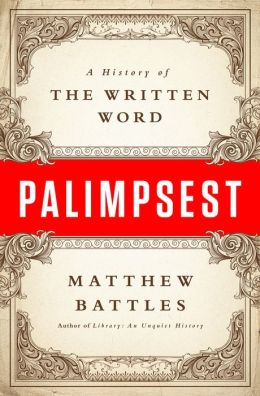
Palimpsest: A History of the Written Word by Matthew Battles

Bibliophiles and historians will be thrilled by this enthusiastic, detailed account of writing throughout history.

palimpsest

Matthew Battles (Library: An Unquiet History) undertakes a mammoth topic with Palimpsest: A History of the Written Word. Rather than an exhaustive chronicle, however, he has composed an extended meditation, a roaming through the centuries. The result is a collection of narrative examinations of writing as a technology, as a means of wielding power, as artistry and as communication. As Battles quotes it, the Oxford English Dictionary defines a palimpsest as a “writing surface on which the original text has been effaced or partially erased, and then overwritten by another.” His imagination is captured by this concept in fact and as metaphor, and Palimpsest is in part a drawn-out consideration of “mind as page” and “page as mind” (the titles of its opening and closing chapters).

Battles’s survey ranges from Mesopotamian cuneiform in the fourth century BCE to early printing, word processing and social media. He explores Thoreau’s views on Confucianism, the clay tablets of The Epic of Gilgamesh, the topology of Chinese hanzi and the fascination with writing in Great Expectations. He is intrigued by the politics of the printing press and various typefaces. Historians, writers, philosophers and anthropologists including Socrates, Claude Lévi-Strauss, Jean-Jacques Rousseau, Emily Dickinson, Ezra Pound and Ralph Waldo Emerson provide context for the philosophical significance of writing. Battles points out that modern computer code is a type of writing as well, “a kind of text that can’t exist on its own. But what other kind of text has ever existed?”

Among other revelations, Palimpsest elucidates the original meaning of “pirated” literature: “not… the unauthorized reproduction of someone else’s work but the use of a printing press without proper license,” and Allen Ginsberg’s modern redefinition of “graffiti,” which originally referred in the Italian to words or ornaments carved in clay forms. How we learn to write changes as our cultural expectations of writing change; thus what Battles calls a “feedback loop” of change in writing technologies perpetuates. In other words, in an increasingly digital age, Battles argues that writing is in flux–as it has been since its beginnings.

Palimpsest returns more than once to an emphasis on writing as art, and Battles’s own writing style is often decorative. The meandering structure of this expansive essay on writing in history, as well as its formal and academic tone, may pose challenges for some readers. However, the reader and writing fan absorbed by writing’s miscellany will find much to love and sink into in Palimpsest.


This review originally ran as a *starred review* in the July 10, 2015 issue of Shelf Awareness for the Book Trade. To subscribe, click here.


Rating: 4 radicals.*

*For my personal reaction to his style, although the quality of writing and research are sure to please other readers.

Lovers at the Chameleon Club, Paris 1932 by Francine Prose (audio)

lovers at theAgain I took way too long to listen to the whole of this audiobook, which might hinder my review a little. But it worked out rather well: Lovers at the Chameleon Club, Paris 1932 is an engaging story, that covers a number of years and is told from a number of perspectives. This might have been confusing when broken up over such a long time as I took with it, but it wasn’t. Instead, it felt like it helped me dip in and out more easily: lots of time passed for the characters too in between my visits to them, so it felt natural, if you see what I mean.

The time and place setting are in the title; or rather, the title of the book is the name of a photograph, taken in 1932. The story remains in Paris (with one brief sojourn to the countryside nearby), covering the years before and during the German occupation. Several characters relate events from different perspectives, including an American writer whose voice is heard through the books and articles he writes about life in Paris at that time; a Hungarian photographer in love with Paris, writing home to his parents; a French girl who is the girlfriend of the writer and then the photographer, writing a memoir which is to be destroyed upon her death; the wealthy French woman who is the photographer’s patroness, writing her own memoir; and a woman, a couple of generations later, writing the biography of the notorious Lou Villars.

Lou is at the center of this novel, although she has no first-person voice: we only know her through the eyes of others. She had an unhappy childhood; was taught to lift weights by the nuns; had a promising athletic career until her coach tried to rape her; worked at the Chameleon, a nightclub for cross-dressers; became a professional racecar driver; met and was awed by the Fuhrer; became a spy for Germany and a torturer for the Gestapo. She is a French cross-dressing lesbian athlete, passionate about France and Joan of Arc, an unhappy woman easily swayed by those who flatter her. She is both a representation of Evil and a complicated question about how a person gets that way.

Prose’s many narrators create interesting questions, too. Are any of them, in the end, reliable? (Questions about the truthfulness of one in particular will be raised in the final pages.) There are many layers to this novel: the beauty and tragedy of Paris before and after the Nazis arrive; the fallibility of human nature; the visual arts (our famous photographer does much of the symbolic work, joined occasionally by Picasso); the challenges faced when any of us seeks to represent the past.

This is a fictional story but based in part on real people. The Hungarian photographer is based on Brassai, who took the picture called “Lesbian Couple at Le Monocle” which is described in the novel under the title “Lovers at the Chameleon Club, Paris 1932” and, obviously, serves as the keystone image of the book. The American writer is based on Henry Miller. The real people are simply starting points, though, along with the powerful, mysterious photograph which titles the novel. The story itself is an imaginative work, deeply intricate in its telling (all those narrators!), and compelling. I was intrigued, and certainly recommend Lovers at the Chameleon Club, Paris 1932 as enjoyable and thought-provoking. The audio version very appropriately uses various narrators for the various voices, complete with accents, and was a great way to experience the book.


Rating: 7 cigarette lighters.

Teaser Tuesdays: The Writing Life by Annie Dillard

Teaser Tuesdays is a weekly bookish meme, hosted by MizB of Should Be Reading.

writing life

Annie Dillard is wonderful. I am glad to be back with her funny, wise but slight self-deprecating voice – and about writing this time! Wonderful. Check out these words of “comfort” to writers disappointed with their slow pace of production.

It takes years to write a book. Between two and ten years. Less is so rare as to be statistically insignificant. One American writer has written a dozen major books over six decades. He wrote one of those books, a perfect novel, in three months. He speaks of it still with awe, almost whispering. Who wants to offend the spirit that hands out such books? Faulkner wrote As I Lay Dying in six weeks. He claimed he knocked it off in his spare time from a 12-hour-a-day job performing manual labor. There are other examples from other continents and centuries, just as albinos, assassins, saints, big people and little people show up from time to time in large populations. Out of a human population of four and a half billion, perhaps 20 people can write a serious book in a year. Some people lift cars, too. Some people enter week-long sled dog races, go over Niagara Falls in barrels, fly planes through the Arc du Triomphe. Some people feel no pain in childbirth. Some people eat cars. There is no call to take human extremes as norms.

This, I feel, is a great example of her voice: funny and filled with factoids while simultaneously being entirely serious, and empathetic. Of course I am enjoying this audio edition. Strangely, since I mention voice, the voice doing the reading is not Dillard’s. I guess I don’t know what her literal voice sounds like, but the reader here is suiting me fine.

Dakota: A Spiritual Geography by Kathleen Norris

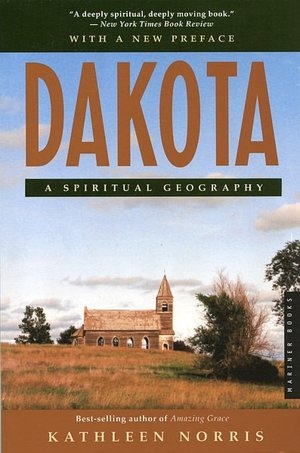
dakotaContinuing in my series of not-new-but-still-important creative nonfiction readings (see The Kiss and The Liars’ Club)… Kathleen Norris’s essay collection, Dakota, is brilliant. I see somewhat where it is dated, discussing for example economic depression and agricultural crisis – because, if anything, things are worse now. But her astute ideas and conclusions are brilliant and in many ways timeless.

You saw my teaser earlier this week, so you know I am impressed. Norris, a poet, of course writes beautifully; it’s worth reading her words for their language alone. But I was really drawn in by the ideas behind them. As her subtitle notes, she is concerned with spirituality and geography. As you might have noted by now about me, I am not attracted to spiritual musings, but I was won over by the geography (in so many senses) and the sense of place which is at the heart of this collection. And I found myself on board for a certain amount of spirituality as well.

My favorite parts of the book were those that characterize place: the physical, biological, climactic characteristics that make “Dakota,” the unique region of both western North and South Dakota that Norris calls home, as well as the cultural and human characteristics of this scarcely populated area. I love thinking about and learning what is definitive about place, in both those senses: the natural, physical, extra-human as well as the human, and the idea of their interconnectedness. (Dakota would doubtless look a little different without people – Las Vegas certainly would – but there is no possibility, I think, of people without place.)

“The Holy Use of Gossip” taught me how gossip can be a good thing, or rather, taught me to recognize as “gossip” (originating, according to the Oxford English Dictionary, from God + sibling) the talking about each other we do in my close group of friends: when we share with each other that one of us is having a bad day, has suffered a loss, needs our help. This is well-intentioned and positive sharing that I’m glad we do. “Gatsby on the Plains” explores how community can lift its members up, or cut itself off from help: Norris writes that

…disconnecting from change does not recapture the past. It loses the future.

Intermittent “Weather Reports” read like short, poetic journal entries of real, specific days, in between more formal essays. They are often not strictly reports on the weather, unless we expand our definitions of weather, which we may well be intended to do.

She writes a good bit about community, how it is formed and how it can be both good and bad for itself. Norris came (back) to Dakota as an adult: her grandparents were of that place, and when she inherited their home there, she and her husband moved in. She is both from there (because the communities knew her grandparents) and not (because she grew up elsewhere, and came in as a traveled, educated, artistic outsider), which made for some interesting challenges for her and her new neighbors. Her 2001 introduction to this edition of the 1993 book discusses her adopted community’s reaction to her work, her publicization of Dakota: in a word, there was both pride and anxiety, but the fact that she stuck around eventually earned her a more thorough local membership.

On the subject of community, I am intrigued by her repeated conflation of the desert, the plains, and even the ocean that once covered this region, with the monastery. She spends quite a few pages throughout comparing the sense of quiet, of great distances increasing mutual support, and contrasting some of the ways in which these communities work. For example, I appreciated the idea (in “Where I Am” – naturally one of my favorite essays) that the monastery is different from small plains towns in that the former has a formal text or rulebook that they agree to live by: in the case of Norris’s central example, Saint Benedict’s Rule, which guides Benedictine monasteries. The small towns often find conflict because they are not all working from one central, agreed upon set of rules or values or ethics.

As an artist, Norris finds that she benefits immensely from the immensity of space in the plains. And she’s got some great stories to tell about sharing art and poetry with her new communities.

I find that prairie people are receptive to a broad range of contemporary poetry, although they’d be unlikely to cross town to attend a poetry reading at a college, were there a college in the vicinity. Their appreciation of the poems I’ve read aloud – from a broad spectrum of contemporary American poets – has given me a new understanding of the communal role of poets, a role poets have mostly abandoned by closeting themselves in academia. Surprises await poets who venture out into the larger community.

I love this idea, that poets (and by extension, many formally educated or academic folks) have quarantined themselves with those like them, and are both failing to share what they have and – more so – failing to learn from others, by locking the doors to the ivory tower.

In a strange counterpoint to this sentiment, though, I found Norris occasionally off-puttingly snobbish about the reading of books: that more prairie people should do it, that they shouldn’t consider themselves well-educated or wise without doing it. Now, don’t get me wrong: clearly I love reading books and find a great deal of value in doing so, and I think books have a lot to offer everyone and everyone should read more. But I also think that people can be very intelligent, wise, and valuable without formal reading; I think that the same prescriptions don’t work for all of us, and I think it’s a shame if she’s found (for example) a great oral storytelling tradition and then laments the lack of book reading. It makes her sound snotty in a way that the rest of the book does not. I like her better than this.

I think it’s just a moment of weakness or misstep, though, because in fact she returns to this subject with more sensitivity in “Status: Or, Should Farmers Read Plato?”

I know as well as anyone that a lot of book learning doesn’t make a person wise (sometimes it simply legitimizes stupidity), but I can’t help but connect the fact that so many Dakotans have been denied access to their culture with the fact that they don’t trust that their own stories are worth much.

The fact of their inhibited access to their own culture and stories is perhaps the best argument for lack of book-reading as a major problem. And she goes on to contemplate what difference it makes to a pig farmer to miss out on Plato, and what Tolstoy and the Brontes can bring to a small-town waitress. I like the nuanced discussion there.

Dakota gets more and more spiritual in its subject matter as it progresses, so that I struggled more toward the end. Discussion of monastic retreats, and Norris’s relationship with the religious communities of Dakota, were often interesting to me; they are in some ways further discussion of community ideals, and I am more or less on board with the spirituality of nature, of relating to wind and sky and plant life. But occasionally there was too much God for my personal tastes. When I encounter the idea of monasteries, and other writers’ productive experiences there, I have found myself tempted sometimes to consider the same; but then I realize what I really need is to just go camping alone.

I found a lot to love and a lot to continue to consider here: about place, about inheritance, about storytelling and relating to one another, about community and about definitions of spirituality. I love Norris’s writing. Although I struggled here and there, or perhaps because I did, this beautiful and thought-provoking book will stay with me and, I think, continue to guide me.


Rating: 8 readings.

Maud’s Line by Margaret Verble

A young American Indian woman’s existential questionings and daily life on an Oklahoma farm will appeal to fans of historical fiction and personal narrative.

maud's line

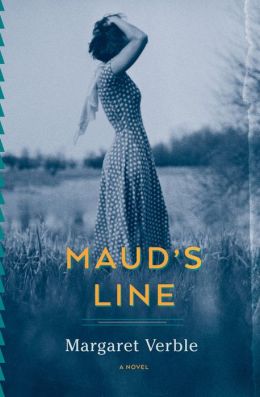
Early in the 20th century, the U.S. government assigned plots of land to the American Indians displaced by Oklahoma’s statehood. Maud Nail’s day-to-day life on her family’s allotment is consumed by guns, dirt and chickens. She cares for her men–a dangerous, unruly father, aptly named Mustard, and a sensitive, thin-skinned brother named Lovely–as well as the extended family whose allotments neighbor hers. They recently survived the flood of 1926-27 that covered Oklahoma and much of the Midwest, but the difficulties don’t stop there. Margaret Verble’s first novel, Maud’s Line, details the year in which Maud makes several large choices that will affect the rest of her life.

A peddler in a brilliantly blue covered wagon first captures Maud’s eye with his good looks and his books. He gives her a copy of The Great Gatsby, and she can’t stop thinking about those bobbed haircuts and dresses above the knee. Though she loves her family, Maud desperately wishes she could move on, live in a different world. But as she begins to be caught up in a nascent love affair, her family’s troubles demand her attention. Two men from the family that has long feuded with hers are murdered, and Mustard has to leave town in a hurry. Lovely falls ill, and then, more troubling still, seems to be losing his mind. And Maud’s occasional, erstwhile boyfriend then makes a claim on her, just as she is struggling with the biggest dilemma of all.

Maud’s Line is filled with evocative glimpses of violence, viscera, yearning and the brusque but communal caring of family. In her unadorned writing style, below the violence and hardship on the surface of Maud’s life, Verble crafts a story filled with nuance and quiet conflict. She exhibits a talent for characterization: each individual is carefully and distinctly fashioned, so that Lovely’s girlfriend and the members of Maud’s extended family, for example, shine brightly in even the briefest of appearances. Maud herself is finely wrought, caught between the values she’s been raised with–and the people she loves–and a hope for a different life, one with electricity and hygiene in place of dust and blood. One of the greatest strengths of Verble’s novel, set on her own family’s land allotment, is the delicate interior conflicts produced by Maud’s deceptively simple life. Propelled by its own momentum, Maud’s Line pulls the reader along until, amid daily privations and small tragedies, Maud has the chance for the first time to choose for herself what her future will hold.


This review originally ran in the June 30, 2015 issue of Shelf Awareness for the Book Trade. To subscribe, click here.


Rating: 7 guns.

The Winter’s Tale by William Shakespeare

I am working on a Maximum Shelf for the first book of Hogarth Shakespeare: The Gap of Time, by Jeanette Winterson. In preparation, naturally, I got myself a copy of The Winter’s Tale, which Winterson retells, so that I could see the connections clearly.

This is one of Shakespeare’s later plays, variously described as a romance, a comedy, or (as Winterson tells it) a play about forgiveness. It is indeed funny at times, although also tragic and pathos-ridden: in an echo of Othello, a jealous royal husband accuses his wife and best friend of being unfaithful together, resulting in deaths and betrayals he will deeply regret. The Winter’s Tale is indeed a more forgiving version, however, as the next generation gets a chance to correct these wrongs and start fresh; in fact, depending on your interpretation, even the jealous king himself gets a second chance.

There is the requisite Shakespearean clown, a lovable character known only as Clown; there is the requisite Shakespearean rogue, who successfully appears to the same people over and over in a variety of disguises. Which leads me to another Shakespearean requisite, the suspension of disbelief, as a father disguises himself successfully from his own son who knows him well, and a lost identity is easily provable after a lapse of 16 years. It’s all in good fun, though: these are accepted devices of the stage.

And fun it is, despite the unhappy scenes along the way. I also enjoyed a strong female character who stands up to the king and does not get damned for it: another shrew, if you will, but less ambiguously represented; this one is clearly a hero. The Winter’s Tale is a pleasing blend of humor and romance in the end, and I am excited to explore Winterson’s take on it. I only wish I could see it performed now that I’ve enjoyed Shakespeare’s telling. He remains a master.


Rating: 7 bears.

The Domino Diaries: My Decade Boxing with Olympic Champions and Chasing Hemingway’s Ghost in the Last Days of Castro’s Cuba by Brin-Jonathan Butler

An amateur boxer’s love affair with Cuba.

domino

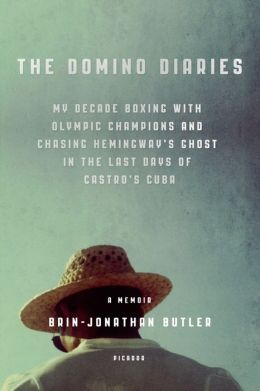
Brin-Jonathan Butler first traveled to Cuba as a teenager, hoping “to find a boxing trainer and to meet the guy from The Old Man and the Sea.” He accomplished both goals and over the years that followed made repeated trips, seeking Cuban boxing, baseball and literary heroes, as well as the mysteries of the sequestered island. Eventually, Butler’s fixation on Cuba inspired a forthcoming documentary, Split Decision, about Cuban athletes’ difficult choices between staying and leaving. In The Domino Diaries, he confesses that the project was partly an excuse to stay, having become “homesick for a place [he] wasn’t born to.” His memoir further unravels the relationship he’s formed with this nation.

His escapades make for fine writing and include a tryst with Fidel Castro’s granddaughter and an interview with boxing legend Teófilo Stevenson that results in Butler’s being banned from Cuba. The Domino Diaries is a memoir of boxing heroes and political strife, a study of Castro’s legacies and Cuba’s “Special Period” of economic crisis, and an ode to the grace, joy and sadness of Cuban culture; it is also the personal story of Butler’s own traumas and his mother’s escape from Hungarian communist rule. These threads necessitate some meandering, but the resulting musing tone Butler employs is elegiac and quite effective. Rather than an exhaustive survey of the large and thorny topic of Cuba’s economy, politics and culture, Butler’s memoir is a rambling exploration, appealingly written in a distinctive voice and peppered with wisdoms phrased with lovely wit.


This review originally ran in the June 26, 2015 issue of Shelf Awareness for Readers. To subscribe, click here, and you’ll receive two issues per week of book reviews and other bookish fun!


Rating: 7 cigars.

Teaser Tuesdays: Dakota: A Spiritual Geography by Kathleen Norris

Teaser Tuesdays is a weekly bookish meme, hosted by MizB of Should Be Reading.

dakotaWarning: rave review coming. Dakota is an amazing feat of essays exploring ethics, community, a sense of place and belonging and the meaning of home, geography, the unique features of the western Dakotas, and yes, spirituality (a subject usually sure to turn me away). This teaser post is just that, a preview of what I love about this book. For example,

The word ‘geography’ derives from the Greek words for earth and writing, and writing about Dakota has been my means of understanding that inheritance and reclaiming what is holy in it.

or, quoting Benedictine monk Terrence Kardong,

We have become as indigenous as the cottonwood trees… If you take us somewhere else, we lose our character, our history – maybe our soul.

I would love to share the entire 16 pages of “Where I Am,” which include the factoid that

the absolutely temperature range record for the Western Hemisphere [was] set in 1936 when a town in western North Dakota registered temperatures from 60 degrees below zero to 121 above within the same year.

or “Rain,” a single-page poetry-in-prose listing of the types of rain experienced there. Mind-blowing, right?

I am very impressed, and hope you’ll go looking for your copy of Dakota, too. My review is coming.

“The Act of Inverting” at You Are Here Stories

Today I am sending you over to You Are Here Stories, for a short piece of creative nonfiction writing of *mine* that they have chosen to publish. Thanks for checking it out! If you have comments, please consider leaving them there instead of (or in addition to) here.