Inventing the Truth: The Art and Craft of Memoir ed. by William Zinsser

I don’t remember when I got this book; I’ve had it for quite some time. (I also have Zinsser’s How to Write a Memoir waiting for me on the massive and daunting to-be-read shelf.) I finally opened Inventing the Truth to read Annie Dillard’s essay, “To Fashion a Text,” that Kim Kupperman assigned me; but I found I couldn’t put it down. I went back to the beginning and read the whole thing through, and I think it’s an excellent collection.

Zinsser approaches “the age of the memoir” beginning with a series of craft talks in 1986. These talks, transcribed, are joined by later additions to form this collection of nine craft essays, all originally delivered orally (whether to an audience or in interview format with Zinsser) by nine writers including Dillard, Toni Morrison, Frank McCourt and Henry Louis Gates, Jr. They talk about what they want to talk about, so the subjects vary somewhat but all address how to write memoir from very different angles. Their delivery, perhaps because originally oral, is consistently enjoyable, and the content is very useful, practical, nuts-and-bolts; it also offers insights into the writing of masterpieces like Beloved. Not to be outdone, Zinsser’s introduction is a lovely piece of prose in itself, and presents a nearly perfect review of what the book in turn contains.

I made a bunch of notes, and am interested in particular in reading Alfred Kazin’s A Walker in the City. A few details that especially fascinated me: that Toni Morrison considers the work of her fiction to be “trying to fill in the blanks that the slave narratives left.” And then the concept that when the straightened Mississippi River “floods” its old path, it’s not really flooding at all, but remembering: where have I heard this before? Lovely! I wonder if these essays–all of them!–struck me so nicely because they were originally delivered orally. I have always been interested in the idea of oral histories or oral storytelling.

This was a deeply enjoyable book, obviously recommended for anyone struggling with the writing of memoir, but actually it should be appealing to general readers, too, especially those impressed by the work of Dillard, Morrison, et al. Perfectly pleasant reading.


Rating: 8 Rorschachs.

The Glass Eye by Jeannie Vanasco

A devoted, tormented daughter eulogizes a beloved father in this thought-provoking and experimental memoir.

Jeannie Vanasco’s The Glass Eye is an intense and unforgettable memoir, as fascinating for its artistry as for its subject matter.

Jeannie was 18 when her father died. Though her mother is beloved and sympathetically portrayed, it was her father who had been her hero, her perfect person. On his deathbed, Jeannie promised him she would write about him. Although there is no sign that he heard, let alone held her to it, this promise would haunt the increasingly troubled young woman for years to come.

Her father had lost his left eye and wore a prosthetic one, which was in fact plastic, “but sometimes I call it glass. Glass implies the ability to be broken.” He lost his left vocal cord, too, and her mother loses hearing in her left ear. “What will be left of me if I lose her?” Jeannie’s father had a daughter before her, from an earlier marriage, who died in a car accident. That daughter was Jeanne; the daughter who promised to write this book is Jeannie, pronounced the same but with an added i. She fills her book with meditations on glass and left.

The Glass Eye is not what the 18-year-old intended to write. In the years after her father dies, Jeannie appears to function at high levels: she receives several degrees and works for prestigious publications. However, she is hospitalized repeatedly, battling mental illness and devastating grief. Everything is about her father–“Of course I hallucinated my eyes had fallen out.” A symptom of bipolar disorder (one of several diagnoses Jeannie receives) is a preoccupation with ” ‘clang associations,’ connections between words dictated by sound rather than meaning,” although for Jeannie, eye and i and I are also connected by meaning.

Vanasco pays compulsive attention to metaphors, and to the project of writing this memoir, which becomes a meta-exercise observing itself. She wonders, “What’s my hindsight perspective? Is this my narrative present?” and plays with plot. She asks the professor in her memoir course, “What if it’s about the promise to write the book?” The Glass Eye is indeed about Vanasco’s promise, as it’s about her father, grief, loss, her dead half-sister and reckoning with her own mental illness. And it’s about itself: both memoir and writing-about-writing.

Lyric, haunted, smart and tortured, this is an obsessive love letter to a dead father as well as a singular work of literature. The Glass Eye will attract memoir fans and readers concerned with mental illness and bereavement, as well as writers concerned with craft.


This review originally ran in the September 15, 2017 issue of Shelf Awareness for the Book Trade. To subscribe, click here.


Rating: 9 dollhouses.

The Essayist’s Dilemma (Occasional Papers on the Essay: Practice and Form, from Welcome Table Press) by Marcia Aldrich, Lucy Ferriss, Kim Dana Kupperman, and E.J. Levy

Disclosure: Kim Dana Kupperman, one of four contributors to this pamphlet and founder of the press, is currently my semester advisor.


This paper is available for free download here.

I expected a rather dry read, a how-to, a craft book(let), in short. Instead I found a brief, punchy discussion, in four voices, of something that matters to me. It was quick and fun to read. I’m so sorry I doubted.

This is such a brief piece of work that I’m in danger of writing more in review than there is to review, but here goes. Marcia Aldrich’s introduction sets up the dilemma: publishers don’t like essay collections; essay is a dirty word; essayists have trouble getting published as such. (Examples given.) Lucy Ferriss responds with “The Parts and Whole”: the idea of needing to group a collection around an idea, to make the whole greater than the sum of the parts, is not such a bad challenge, and one that can yield good results. We should not resist this push. Kim Kupperman, in “An Essayist’s Dilemma,” shares the journey (I just used that word because Kim hates it. Sorry, Kim)… the evolution her book I Just Lately Started Buying Wings experienced on its way to the form in which I read it. As she sums up: “a question, a taking apart and reassembling, a husband’s instinct, a poem’s fever, an editorial directive, and, finally, a return to an original idea.” Finally, E.J. Levy writes “In Defense of Incoherence”: she quite likes a thoroughly disconnected essay collection, thank you, and screw commercial concerns.

It’s all good, useful stuff. I think it’s true, that essay collections are unpopular with publishers, because they are unpopular with the (profitable) general readership. Ferriss’s argument makes perfect sense to me, perhaps because my mind works the same way, or I believe the same thing she seems to: that an overarching and unifying idea (or the dreaded theme) is a good thing. This is very much the concept that Levy argues directly against in her piece. As a reader, I am much more like the profitable general reader than I am like Levy. I prefer unity. In fact, I have long resisted reading essay collections, especially when they are presented as miscellany. I realize how damning an admission this is: I hope to write and even publish essays; but I don’t want to buy or read them. Well, it’s a little less damning than that, because I hope to write and publish a memoir-in-essays, or a decidedly connected collection.

Kim, as I read her, does not take a position on whether connectedness is desirable or no. I loved reading the story of Wings; it was the perfect example to learn from, since I studied this and her later memoir rather closely and have been getting to know the author herself some. (Also, its organization is a little unusual, or complicated, but clearly it has an organization.)

Although I don’t read and think the way Levy does, I enjoyed reading her opinion – especially as she called in Fisher’s Consider the Oyster:

I’m a fan of M.F.K. Fisher’s work, but by the time I’m on the fifth oyster in Consider the Oyster, I’m queasy. It’s nto that such a strategy can’t work, but that it makes me suspect that the essayist was considering something other than the oyster–a check from a publisher maybe, the adorableness of her own conceit.

My first thought was, Levy does not like oysters as much as I do. I’d love the opportunity to discover how many oysters it would take to make me queasy! I haven’t found it yet. Seriously, I see her point; but I guess I also found Fisher’s conceit adorable, enough to be unbothered by it. Maybe it’s just how much I like oysters.

Perhaps the greater point here is that we all, always, still, have different preferences. I agree with the thesis of this pamphlet (as I see it), that a preference for a disconnected miscellany of essays is less universal than an appreciation of connected collections (or books with narrative arcs, like memoirs). And I’m on the side of the majority here. That will make it harder to publish the unconnected. I hope it still happens, because I desire a multitude of options and value the tastes of the minority; but I agree with the majority, taste-wise, and with the problem presented here.

I guess the most optimistic thought I have to offer is: this is why we have Welcome Table Press, Kim Kupperman’s small press that publishes weird little essay things that perhaps no one else wants; and thank goodness for that, and for all the other small presses that publish the minority’s desires. It’s The Long Tail all over again, and I’m in favor of it.


Rating: 9 brief and well-stated arguments.

Still Life with Oysters and Lemon by Mark Doty

I came to this book originally some time ago, from Paul Liscky’s The Narrow Door, though they only subtly name one another. It was a happy continuance when Kim Kupperman recommended it. And, I have a thing about oysters. This book is not terribly much about oysters, mind you, but it still attracted me.

Doty’s Still Life with Oysters and Lemon is a lovely meditation on a single still life painting which shares the book’s title; but it is also a study of still lifes in general, and a thoughtful retrospection ranging through the author’s life and loves by way of a handful of objects, and finally a study on the topic of attention. Doty returns to the idea that we seek both intimacy and independence, both belonging and exploration, both the comfort of home and the risk and excitement of travel. Interesting as ekphrasis, as study of duality, and as biography in objects–even as a lyric list essay, broadly defined. I found it interesting to note all the references he makes to other paintings and other art forms (chiefly poetry). Also lovely writing, although this will surprise no one who knows Doty as a poet.

Another of my continuing obsessions–even more than oysters–is things or stuff. Think Guy Clark’s song “Stuff That Works” or Scott Russell Sanders’ essay “Buckeye.” I really appreciated the attention Doty pays to things in this very short book. It was a rewarding immersion, and I recommend him.


Rating: 8 quinces.

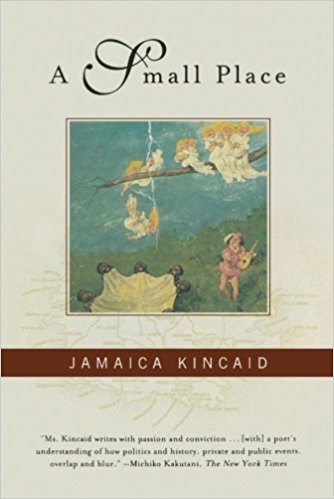
A Small Place by Jamaica Kincaid

A Small Place is a medium-longform essay (81 pages), published here in book form, about Kincaid’s home island of Antigua. Kincaid uses a second-person address to a “you” that stands in for North American or European white people, the unpleasant tourists and descendants of colonialists she observes visiting Antigua. On the surface she is concerned with place–what is Antigua–but the essay is equally concerned with race, empire, and history, and unafraid of long parenthetical asides. I was assigned to read this for its help with writing about place, and so for me the final four-page section describing Antigua as physical place is perhaps most interesting, from a craft standpoint. (Or perhaps I should reconsider what it means that this physical description is the part that seems most place-based to me. What defines a place? Its physicality, or its people and its history?)

It’s also remarkable for Kincaid’s strong, strident voice, and for those long parentheticals. It should go without saying that A Small Place makes a fine introduction to Antigua itself, too.


Rating: 7 brand-new Japanese-made vehicles.

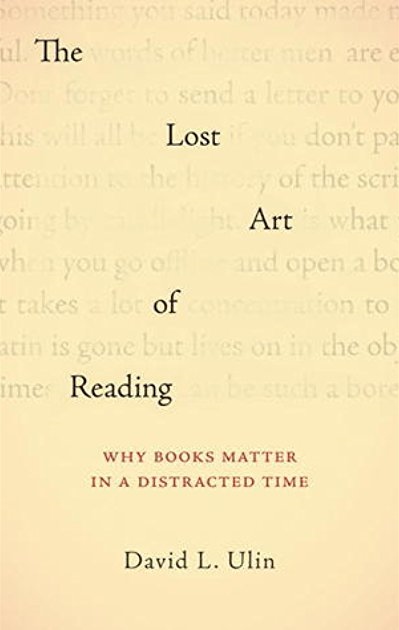
The Lost Art of Reading: Why Books Matter in a Distracted Time by David L. Ulin

This is a longform essay about reading, inspired by Ulin’s son’s struggles to read and annotate The Great Gatsby (for school, naturally). Over its course, Ulin ranges widely over his own book-reviewing career; his relationship with his son; the reading habits of the author and others (including many other writers); studies of brain science and distraction patterns; politics and current events; the nature of memory (in memoir, in Ulin’s personal observation, and in scientific studies); e-readers; and much more. Though it was assigned to me as a craft book–meaning an instructive book about craft–I found an interesting element in Ulin’s own writing: his use of parenthetical quotations from other writers.

This could be a sort of self-referential exercise, too: a longform essay about why it’s so challenging these days to read such things as longform essays. (This book began as an essay in the Los Angeles Times, which was then expanded into the fuller-length version here, at ~150 pages.) I confess I found my attention wandering at times, which could be commentary on many issues, of which only one is Ulin’s talent on the page: distracted times, indeed. Overall I did enjoy the discussion, including the meanderings into the utility of the e-reader and Obama’s popularity ratings, and you won’t be surprised to hear that Ulin and I are in sync on many conclusions about the state of the world and of reading. “It’s harder than it used to be, but still, I read.”


Rating: 7 titles.

The Woman Warrior: Memoirs of a Girlhood Among Ghosts by Maxine Hong Kingston

Kingston’s is a memoir in five longish essays, each of which could, I think, stand alone. A child of Chinese immigrants growing up in Hawaii in a Chinese immigrant community, she blends memoir (meaning personal or family recollections) with Chinese folktales, and ends up commenting on culture at least as much as her own personal experiences. This blend pushes the boundaries of memoir in the direction of imagination, and pushed my personal comfort level somewhat as a reader: I tend to prefer clear lines between fact and fiction, and while I am intellectually open to blurrings, I do notice my discomfort when it happens. I am most interested in the final essay, “A Song for a Barbarian Reed Pipe,” which expands metaphorically on the concept of literal voice. I’m also interested in the structure of this collection of five essays: their number, their varying lengths, their order, and the choice to offer a memoir in parts like this. Obviously the most unusual element, though, is that blending of folktale, imagination–even fantasy–with traditional memoir reporting.

Kingston has a vivid storytelling style, and voice. It is easy to get lost in the story at hand, and there is a dreaminess (in some sections more than in others) that I don’t often see in memoir. The flip side is that it can be harder to mentally pull these parts together into the story-of-a-life that I expect from memoir. But there’s no question that this is an absorbing and entertaining book–not to say that there isn’t emotionally difficult content, of course.

General readers of fiction as well as memoir will find much to enjoy. Students with rather more literal minds may be challenged.


Rating: 7 white tigers.

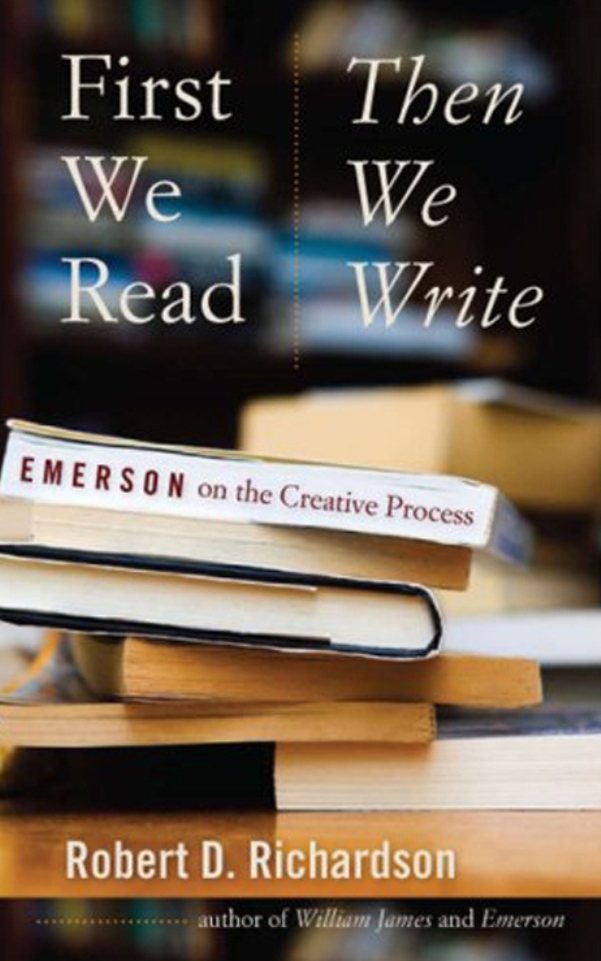
First We Read, Then We Write: Emerson on the Creative Process by Robert D. Richardson

My advisor Kim recommended this book to me as a craft book, although it is not quite a how-to, but rather a contemplation on the reading/writing life.

This short study of Emerson on the subject of writing (by an Emerson expert) is a brief, accessible view on the man. Quotable, but more than a collection of quotations. Richardson portrays a complete man, not simply a set of accomplishments. This Emerson is fascinated with writing as process and lifestyle, philosophic, and committed to exposing his own shortcomings.

I found it worthwhile, and an easy way into Emerson, who I haven’t found terribly approachable before now. I noted several quotations. The part especially intrigued me, in the final pages, where Emerson and Goethe are in some conversation about how intimidating it can be to observe the greats who have come before us… I often feel, when I discover a wonderful, new-to-me writer, both inspired by their achievement and discouraged by how high the bar has been set. And then of course the closing idea that to be a writer is to “abdicate a manifold and duplex life”! Whew.

An easy read, by turns encouraging, thought-provoking, and challenging.


Trivia of which I was unaware: Richardson is married to Annie Dillard. When I read this at the close of his ‘Acknowledgements’ (at the end of the book), I thought, ah! there’s the wisdom. (Some of you may recall that I have a complicated relationship with Annie Dillard–not all love–but enormous respect.)


Rating: 7 white whales.

Consider the Oyster by M.F.K. Fisher

I regret it took me so long to read this slim, delightful collection. M.F.K. Fisher is a very fine essayist, known for her food writing but a clever, funny, thoughtful voice in general. Warning: these delicious little pieces will make you hungry (if you have any taste at all for my favorite bivalve).

Obviously I read this book for my own essay about pearls and oysters which I’ve been working on for years… but it was an absolutely pleasure all around. Consider the Oyster has an original copyright date of 1941, and you can hear its era here and there; but overall, I think it ages really well.

Under 100 pages, and all about oysters. Short essays cover oyster sex; the seasonal nature (or not!) of edible oysters; a great many recipes from throughout history and around the world, with Fisher’s commentary; pearls; the oyster as aphrodisiac; regionalism; and more. Fisher is mostly but not entirely concerned with oysters as eaten by humans. Her writing is pithy, charming, humorous and very smart. She is a real personality, and I am a real fan.

Really, folks. What a short, accessible, but so clever little book this is. You should really pick it up, unless oysters totally disgust you, in which case you still should, because it will educate and probably humor you just the same.


Synchronicity: one of the back-cover blurbs here is credited to Clifton Fadiman, who is himself the subject of one of the next books on my list (for the Shelf), The Wine Lover’s Daughter by Anne Fadiman (author of The Spirit Catches You and You Fall Down, which was one of the first books I personally recognized as “creative nonfiction” as I was beginning to conceive of the genre). Everything is circular. Like a pearl.


Rating: 8 pearls, naturally.

Key Grip by Dustin Beall Smith

Dustin Beall Smith came recommended for his contribution to You. That essay, called “being [t]here,” didn’t particularly grab me (put it up next to Kitchen for being amorphous or abstract, at least too much so for my perhaps overly literal mind). But this book did.

Key Grip is a memoir in essays, in reverse chronological order. The first essay makes up fully a third of the book, followed by eleven shorter ones. The narrator is a risk-taker, a thrill-seeker, with self-destructive behaviors. The book is about those behaviors, about mourning the death of his father, and about art: the lifelong struggle to become a writer, and the decades along the way spent in service to another art form, as a key grip in the movie business. Smith is expert at engaging storytelling, such that the craft appears effortless or invisible. As a classmate once said, the apparently effortless writing is the hardest to achieve. But for me, the most interesting element in this collection was its reverse-chronological organization. That’s what I annotated, for school.

The extra-long opening essay, “Starting at the Bottom Again,” is a hilarious account of a mature Smith (age 57) traveling cross-country with a near stranger, to go on a Lakota vision quest. It is not only hilarious, but also gripping and pathos-ridden, gloriously told. If I have a complaint, it is that we left this absorbing world and did not return to it. I expected to continue chronologically from this point, and perhaps to get sequel vision quests, as Smith’s Lakota spiritual guide suggests to him.

Instead, we go backwards in time, seeing Smith suffer the loss of his father, work as a key grip, get dissipated and wild with drugs etc., become a skydiving instructor, return to childhood. Many of these essays are excellent in their own right. But I remained a little baffled by the departure from that first essay, “Starting.” I think we all generally expect chronological order when we read. We know how to deal with disjointed jumpings around in time; but to start at the end, so to speak, can be a little disorienting.

Nevertheless, once I paid attention to what this backwards-order was doing, I decided I like the way meaning, and characterization of the protagonist, build. For one thing, this is very like how we get to know people in real life: we meet today, in the present, and then (if we get that far) we fill in backstory. We can never know a new acquaintance’s past if we weren’t there for it, but we can listen to the stories.

Smith is a very fine storyteller, and these are amusing, sensational stories he has to tell, always with a note of sadness if not regret. I do recommend his memoir.


Rating: 7 jumps.