






As ever: mild spoilers for earlier books in the series, but not for this one.
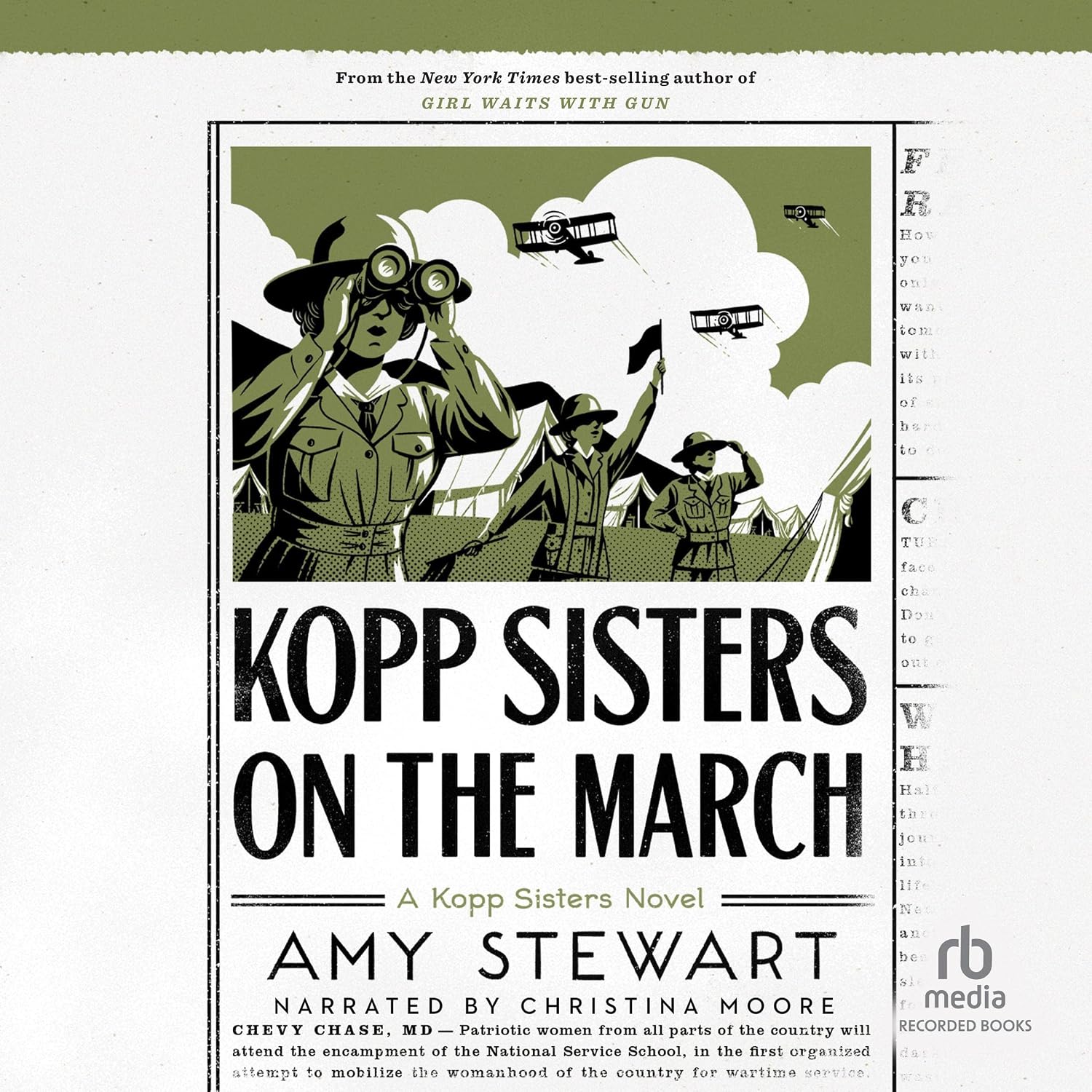 Part of me keeps wanting to say “more of the same, but in a good way (promise)” – but this installment in the Kopp sisters’ adventures does in fact see a change of scenery. Following
Constance’s sad and upsetting dismissal from her work as sheriff’s deputy, she has spent a winter moping. But her country seems on the brink of entering the war in Europe, which will become World War I; Norma is up in arms (nearly literally) about her pigeons’ ability to serve as important wartime messengers; and Fleurette is getting restless as well. They will end up heading as a group to a camp of the National Service School in Chevy Chase, Maryland, where women are to be trained to help in the war effort.
But, as is Amy Stewart’s practice, this novel doesn’t begin with the Kopp sisters, but with a character introduced in this book: Miss Beulah Binford has been living under an assumed name in New York City, but her life has hit a roadblock, once again. She hasn’t been able to use her real name in years, since that name was associated in the national press with a sensational case: a man murdered his wife, and Beulah was identified as one of the girls/women he had known on the side. In distress, she grasps at the idea that she might be sent overseas to France as part of the war effort. And so she winds up in the same camp, and the same canvas tent, as the Kopp sisters (and another young woman named Sarah, who is earnest in her desire to go join her twin brother as an ambulance driver in France).
I think Stewart made an excellent choice in expanding her characters’ world from Hackensack, New Jersey (where options for Constance’s work, and Stewart’s plots, were running low) to this training camp. It’s a fascinating setting and collision of worlds: many of the camp’s attendees are young society women of privilege, on a lark, interested in at most some light sewing and play-acting at marching in lines. But some, like Sarah (or in more eccentric fashion, Norma) hope for harder work and greater discipline. Constance is hoping to hide out from her own past, a little like Beulah (who for her fellow campers identifies as Roxie Collins); but when the camp’s matron is disabled by an accident, the former deputy is back in a position of authority, and it feels so good.
This setting and new cast of characters allows for more of Stewart’s good work with her (well-researched) fictionalization of true history (the camp, and Beulah Binford, were real), as well as an examination of the way different walks of life approached the idea of war service. Central is the idea of what women might have to offer, and you can just imagine how diverse those beliefs are; many of them play out right there in Chevy Chase on these pages. I found it all absorbing. Also, for the first time I think, this audiobook included the author’s note on historical sources and the line between fact and fiction in her work, which I really appreciated (and, it made me realize, I’ve been missing in the earlier books). The short answer is, much is true, and I think Stewart does a good job of spelling out where she’s chosen or been forced to invent.
Christina Moore’s narration is strong as ever – I think she excels at the various voices, and it should go without saying at this point that I could not hear any of these Kopp sisters in any other narrators’ telling. Moving on to book six.
Filed under: book reviews | Tagged: audio, gender, historical fiction, mystery |


Leave a comment