






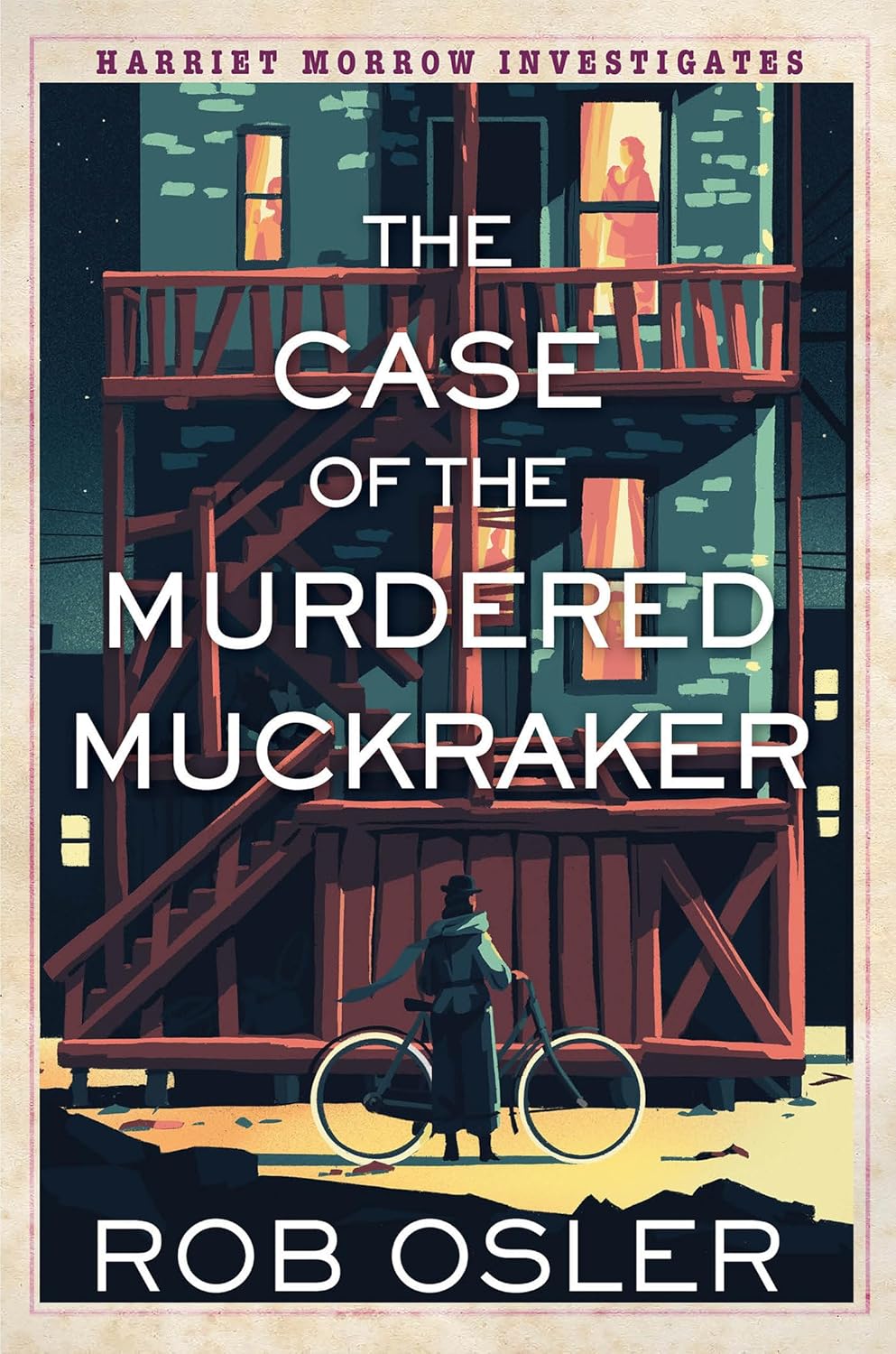
 Following on the events of The Case of the Missing Maid, Harriet Morrow is working on settling in to her job at the Prescott Detective Agency. It is 1898, Chicago. Harriet is an outlier, as a young woman (just twenty-one years old) employed as a detective – a ‘girl detective,’ they call her. She is also an outlier in her preference for unadorned living, hard work, using her bicycle for transport – not particularly ladylike qualities, especially for her time – and she has recently discovered a preference for wearing men’s clothing. She is attracted to women, and in book one, began a romantic involvement with a young woman named Barbara Wozniak, a Polish immigrant. One of the throughlines of this book and this series is Harriet’s search for a place in a world where she mostly feels like she does not belong, does not live up to expectations. In one of the subplots of her investigation, in fact, Harriet will take to full male drag – a disguise, and a false identity as Harry Dunn. This strategy makes sense from an investigatory standpoint, and takes advantage of her large, sturdy frame. It also doubles as an experiment, and allows her to observe that she does not think of herself as a man nor wish she was one. She wishes rather for a version of womanhood that her society doesn’t recognize. Without putting modern labels on Harriet’s 1898 experiences, this nicely parses some aspects of her sexuality and sexual identity.
But ho, this is a mystery novel. The back blurb tells us that “Rob Osler writes traditional mysteries featuring LGBTQ+ main characters.” While I mostly agree, I think these facets of Harriet’s identity are more than a mere twist on the traditional genre. In The Case of the Murdered Muckraker, we do pursue the murderer of the muckraking journalist, and the evidence of political corruption for which he was killed. But the social issues creeping in there – political corruption, wealth and wage disparities, immigrants’ experiences, working and living conditions, and more – I think play a larger role than the ‘framing elements’ in a knitting mystery or a culinary mystery. I think this is a mystery novel inseparable from its historical setting, and concerned with social-political conditions and change. As well as the character arc of a young woman we would definitely call a lesbian in today’s terms.
Harriet is a delight. She is earnest and serious in her work – admittedly a pure amateur at detective work, but committed to the job, to serving justice, and to making her own way in the world. She is a head of household, providing for her sixteen-year-old brother Aubrey since their parents’ death, and did you catch that Harriet is herself just twenty-one? She and Aubrey’s relationship is not always smooth sailing, but it’s written with compassion for both of their circumstances. Her budding romance, though it doesn’t play a huge role in this story, is also told with nuance – I hope that plot thread will continue to play out. She is developing some meaningful friendships, too: the wealthy, older Pearl gives Harriet an important outlet, and then there is her friend and colleague Matthew, who is also queer. Osler is doing a lot of work with Harriet’s story: the mystery plots, the detective agencies, the social-political time-and-place setting which is super rich, and his main character’s own development, as a queer person and just as a person. It all feels pretty ambitious, but he has it all in hand at this point, by my standards. I can’t wait for book three – as yet unannounced, but surely?!
Filed under: book reviews | Tagged: gender, historical fiction, LGBTQ, mystery |


Leave a Reply