






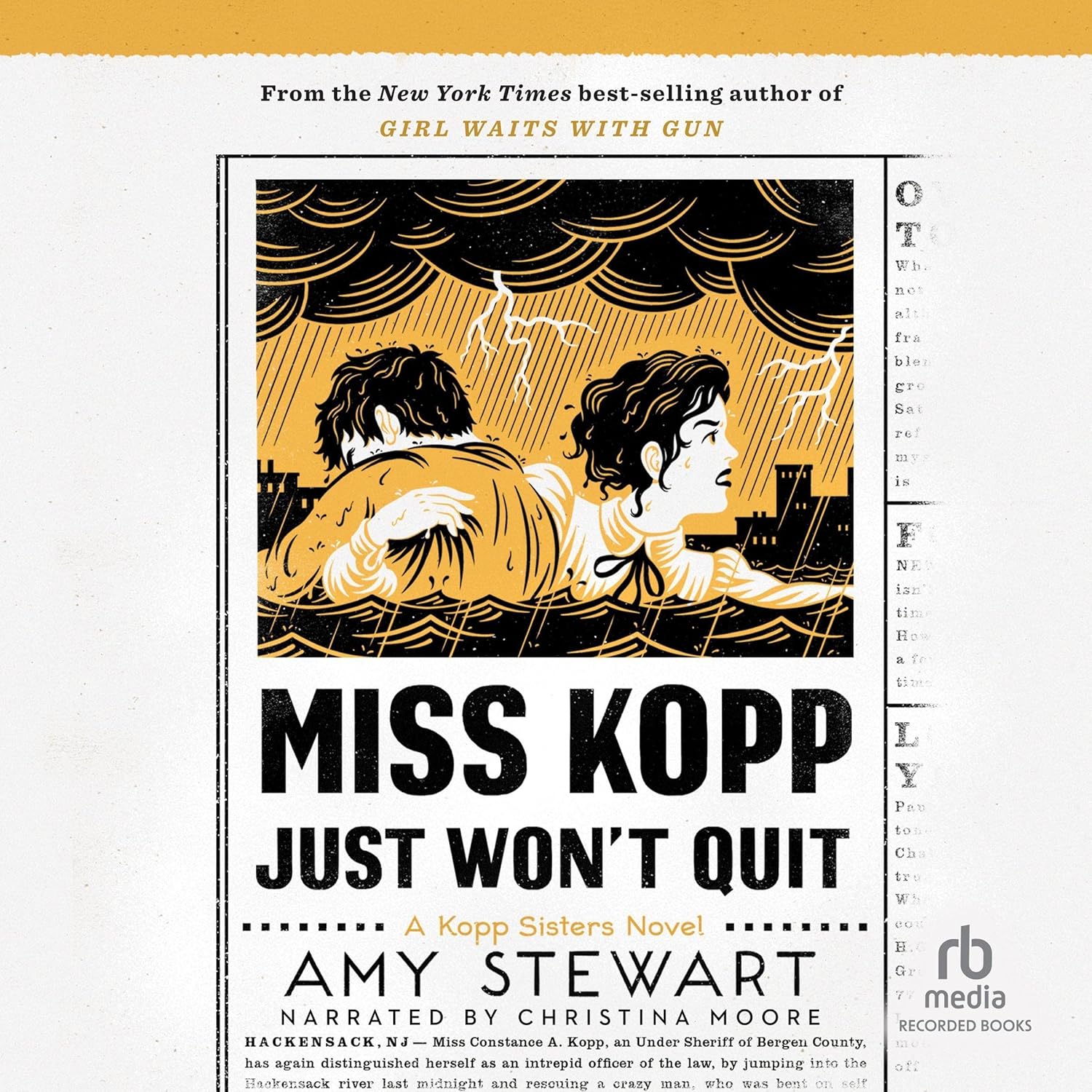
 Here we have book four in the Kopp Sisters series, and I think I’m more and more bought in with each one. There’s a trajectory here. As ever, I’m not sure how much of it is about differences in the books, and how much is me. I always find this a fascinating question, about beers and mountain bike trails and everything else: how much has it changed, and how much is my taste buds / skill level / preferences? We can never know. Thank you for making it through that moment of philosophy, and now the novel.
If anything, Miss Kopp Just Won’t Quit takes a step further from the mystery or puzzle sort of plot, and (while absolutely telling a story about Deputy Kopp and her work) considers the time and time in which it is set.
…the sheriff maintained his posture of unruffled detachment.
I, on the other hand, was the very opposite of unruffled. John Courter was, in every way, a small-minded, petty, vindictive man unworthy of public office. I didn’t care to stand at the edge of a crowd and listen to him hurl insults and lies at us.
What made it worse, though, was that the crowd seemed to love it. It was an uncertain time in Bergen County: there was labor unrest in the factories, a mistrust of immigrants who might be German sympathizers, and the very real fear that a munitions depot might go up like so many crates of firecrackers at the hands of secret agents of the Kaiser. And most of all, there was the absolute terror of war – a war we surely couldn’t avoid much longer.
These people were looking for an enemy, and John Courter had one on offer.
Constance has been at work as a sheriff’s deputy for a while now. She’s been involved in investigations and arrests, including wrestling in the streets with male criminals (she would be affronted that that even needs pointing out). She’s cared for the female inmates at the jail, which includes basic food-and-shelter sort of needs as well as something we might call counseling, and questioning. She has pioneered a system of probation that (with the help of a friendly judge) allows women whose crimes are minor, or that shouldn’t count as crimes at all, to keep their freedom, work, and contribute to society. In a world that still isn’t sure women should do this sort of work, she has not only had some real successes, she’s also gotten to contemplate and enact improvements in the system. She’s the breadwinner for her household of three adult women, with her sister Norma and her ‘sister’ (biological daughter) Fleurette. And in that last role, she has also undertaken some thoughtful changes and modernizations. All of this is arguably made possible by her supportive boss, Sheriff Heath.
Thus the great conflict of this novel: the sheriff is an elected position, and Heath is term-limited. A change is coming for Constance either way, but the two men running for election offer rather different outcomes for her: bad and worse. The shift away from police work and into politics pleases no one – not Sheriff Heath, not Deputy Kopp, and not the reader. But here we are. Constance loves her work, and has found a comfortable place in the world, where she feels good about what she can contribute. In a nutshell, Miss Kopp Just Won’t Quit is about what she’ll do when continuing on that path is no longer an option. It’s terribly sad, but it’s also heartening to see her come to terms. Not all reviewers agree with me, but I really liked the ending, and I can’t wait to see what she’ll do in book five.
Filed under: book reviews | Tagged: audio, gender, historical fiction, mystery |


Leave a Reply