






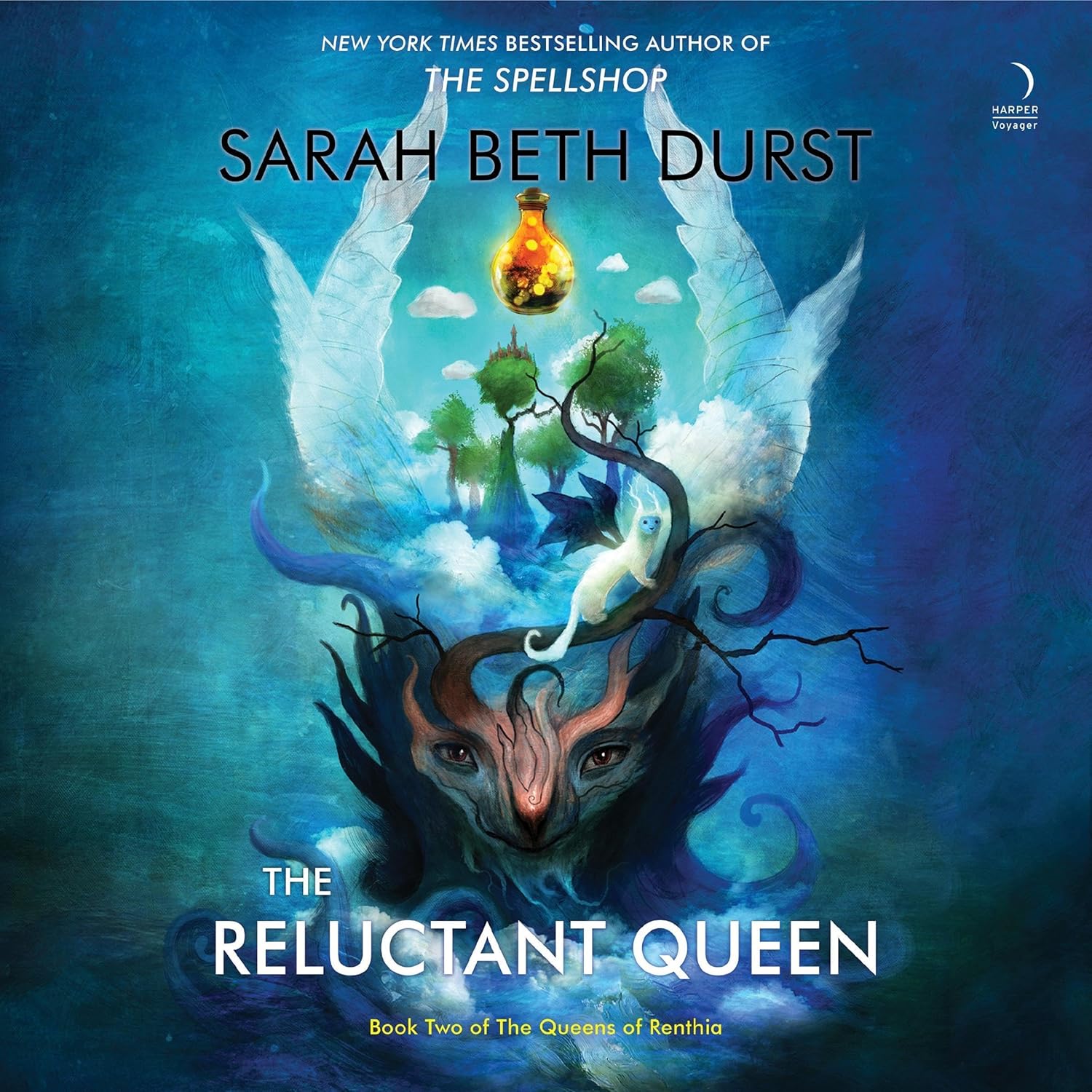
 Following The Queen of Blood is The Reluctant Queen, at center position in this trilogy. I continue to admire Durst’s worldbuilding and characters, imagination, and the hard choices and moral gray areas she presents. On the other hand, the sedate pacing that I felt worked in the Spellshop series is getting a little less effective here.
I fully expected the title to refer to Queen Daleina, who took the crown at, I think, nineteen years old. Not the strongest heir to the throne – in fact, she might be the weakest in terms of pure magical power – she is the only survivor of the massacre in the coronation grove, and therefore the new Queen of Renthia. She was decidedly reluctant… but is not the titular character. Instead, here comes a big plot twist and a spoiler but from quite early in this novel: Daleina is sick, soon to die, and therefore Renthia needs a new heir on standby, stat – but, let’s review again from book one, all the other heirs were killed when Daleina became queen. So, unusually, there ensues a great big scramble for one. Here we learn that, before the academies where Daleina and her peers were trained, Renthia used to find its women and girls of power – its heirs – in an older way: the champions traveling the villages, looking for regular citizens. And so that’s what Champion Ven does here.
And he finds a gem. Naelin is a woodswoman, a wife (to a pretty worthless husband) and a mother to two young children. She has always kept her power hidden, believing it will only get her killed, as it did her mother before her. But when Ven discovers her, he finds that she is the most powerful woman he has ever known, even in her raw, untrained form. She is also staunchly opposed to taking on responsibility beyond her family unit. It takes much of the book to convince her that the sense of duty she feels toward her own children may need to expand to the entire land.
One thing this book kept me thinking about was the tension between ego and chest-thumping, and a true sense of service. I already said that Daleina struck me as a pretty reluctant queen in her own right; by contrast to Naelin, she was there on purpose, training with the specific goal of maybe becoming queen, but not because she thought she deserved it or was owed it or wanted the glory. She struck me as being always clear that it would be a burden, a responsibility, and it was about keeping people safe, not about promoting herself – in contrast to the previous queen, and to some of her classmates at the academy (one in particular). Naelin is even more reluctant, resistant to helping anyone she did not birth herself – at a level that eventually felt pretty selfish to me, in fact. I felt a little impatient with her slowness to realize that queendom is not a prize, but a responsibility; and in turn, those around her who were in a position to advise, never took this tack directly enough for my tastes.
Some of this is due to the classic need, in storytelling, to hold back the revelation of certain details. Some of this is due to an accurate portrayal of human nature. But I sometimes felt like we could have moved things along a little more quickly than we did. Durst excels in painting a picture, a scene, and an inner turmoil. Sometimes she may indulge in a little more of that than serves her story. Especially when we got into some really high-stakes action episodes, I think we could move past the inner monologue, and especially when the inner monologues were reviews of character elements already very well established throughout the book.
I’m still stoked on these characters and the stakes of their world, and excited about where Durst chose to leave the plot hanging for book three – I’m genuinely invested in finding out what our queens will do next about the tricky situation we’ve left them in. So, a little impatient with pacing sometimes, but still in.
Filed under: book reviews | Tagged: audio, fantasy, horror |


[…] hardships and sorrows, but ends on a surprisingly hopeful note. The Queen of Blood was Daleina, and The Reluctant Queen was Naelin; this third titular queen is Naelin again, facing new challenges. Thematically, to some […]