






In June 1973, Minnie Lee and Mary Alice Relf, sisters aged twelve and fourteen, were sterilized without their consent in Montgomery, Alabama, by a federally funded agency. Outraged by this terrible violation, their social worker, Jessie Bly, reported it to a local attorney. Eventually, the case went to federal court in Washington, DC. The lead lawyer for the plaintiffs was Joseph Levin Jr. of the Southern Poverty Law Center. This case is considered a pivotal moment in the history of reproductive injustice, as it brought to light the thousands of poor women of color across the country who had been sterilized under federally funded programs.
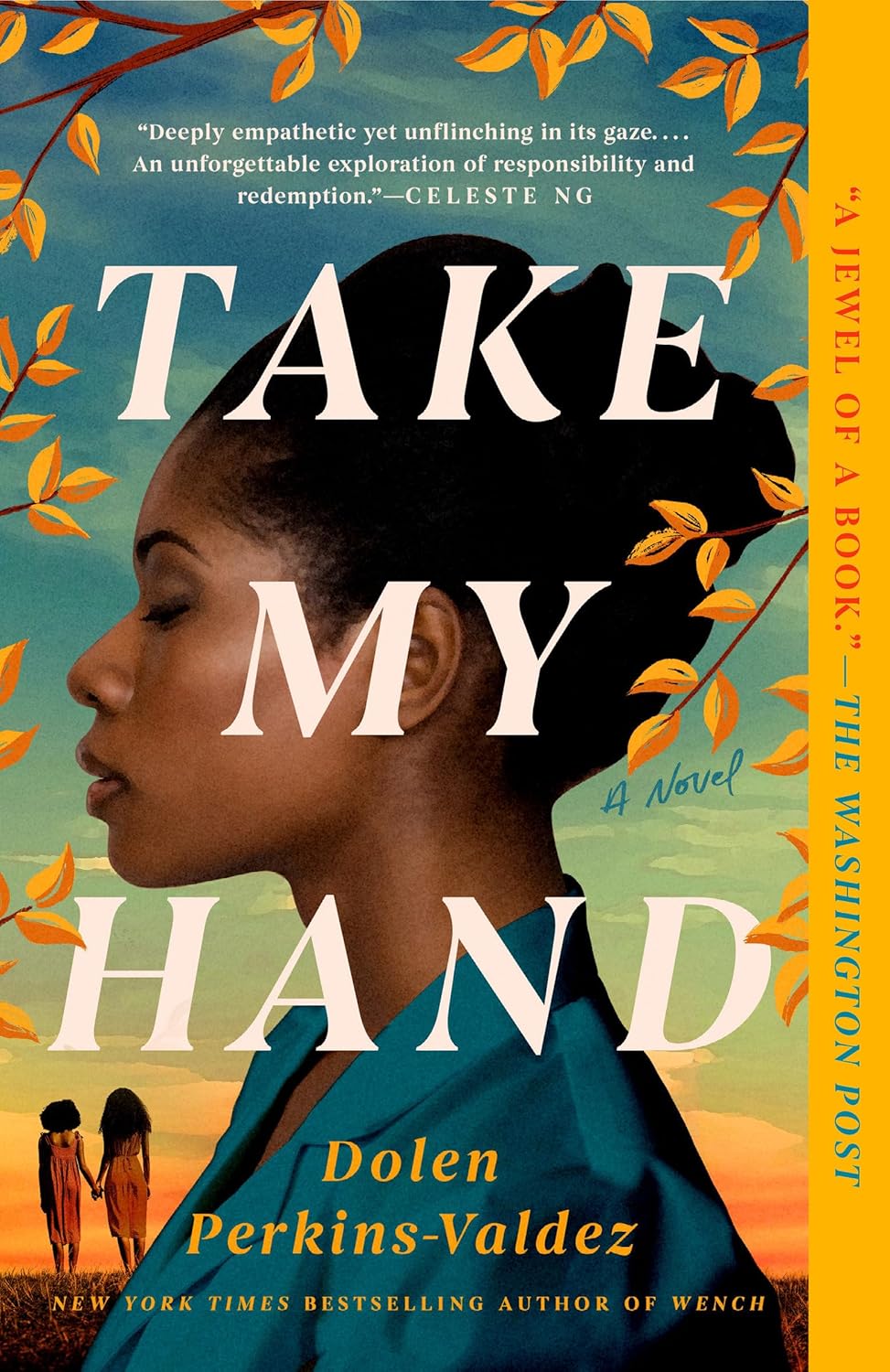 Take My Hand is fiction, not a retelling of these events (Perkins-Valdez is quick to remind us), but an imagining of “the emotional impact of this moment and others like it.” The novel is told from the point of view of Civil Townsend, who is writing, decades after these events, to her adopted daughter, Anne. Anne is now twenty-three, the same age Civil had been when she’d gone to work at the Montgomery Family Planning Clinic in her hometown.
Twenty-three years old. Eager to prove my daddy wrong. Anxious about my mother’s illness. Longing for love. Hoping to make a mark on the world. Young Civil, smiling shakily and unsurely but with all the awareness of a future that remains to be lived.
It is an interesting retrospective. Civil is now a doctor, but she began her medical career as a nurse, feeling that that’s where the work needed to be done (and rebelling against her father, who wished for her to be a doctor like him and like Civil’s grandfather too – a rare inheritance for a young Black woman in the 1970s). The novel flips back and forth between the 2016 journey that Civil makes from her newer home in Memphis, back to Montgomery to visit people she used to know, and Montgomery in 1973. In that earlier timeline, Civil narrates: she went to work at the clinic. She met her first home-visit case, the sisters Erica and India Williams, aged thirteen and eleven years old. We meet the other players in Civil’s life: her father, a doctor in their upper-middle-class Black community; her mother, a painter with mental health issues; her lifelong best friend, Ty, with whom things have gotten complicated; her new friend, Alicia, a fellow nurse at the clinic. Civil’s friends and family support her wish for the Williams family to have better chances, but none commit to it like Civil herself does. From our perspective, it is easy to see that she has terrible boundaries, moving far too deep into the Williamses’ orbit, involving herself in their lives far beyond the role of nurse at a community clinic. But when Erica and India are sterilized without consent, she does her best to seek justice for them, too.
This is a story of reproductive injustice, medical ethics, and racism. It is also the story of a young woman’s coming-of-age, learning about relationships and making her way in the world. It is based on the bare facts of a true court case, which immediately followed the uncovering of the horrifying Tuskegee experiment, and it is true to 1970s Alabama in broad terms. Civil herself is a fictional character – Perkins-Valdez sought but did not find accounts of the nurses at the clinic, so she imagined one. I am impressed by the emotional work of the Civil character, and, perhaps even more tricky, the complexity of certain other characters. There are no pure villains or heroes. The white nurse who heads up the clinic is initially someone Civil admires; then, when she directs the girls’ sterilization, becomes an enemy; but Civil winds up questioning the impulses of everyone involved. Who among us, believing in our own good intentions, does no harm?
I occasionally stopped to consider the way that especially Civil and her age-group peers, Alicia and Ty and others, talk to each other: it can feel a little stilted, a little explain-y, and I wondered if that dialog could have been written more naturally. But then again: these are college-age activists out to change their world. Didn’t we all deliver stiff speeches in that part of life? I think that dialog might have been realistic after all.
Take My Hand is a well-written, thought-provoking book about some of our lesser-known history, that I would strongly recommend. That doesn’t mean it’s always easy to read. Perkins-Valdez has done remarkable work in imagination, in execution, and in faithful reporting, and I think it’s an important book.
Filed under: book reviews | Tagged: historical fiction, race |


Leave a Reply