






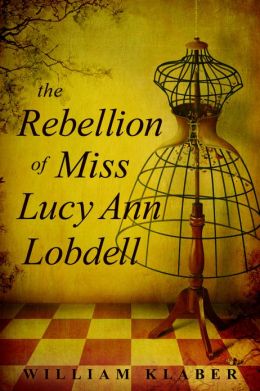
 I am absolutely charmed by Lucy Ann Lobdell.
The backstory to this novel is an attractive little plot in itself. Journalist moves into an old farmhouse in upstate New York. Years later, he sits down with a local historian and hears the story of Lucy Ann Lobdell, who inhabited the area and is even linked to journalist’s own farmhouse. The aging local historian has searched and searched for Lucy’s memoir but never found it; he is now too tired to pursue her story further, but hands over his significant research to the younger journalist to follow. Journalist is likewise unable to find the memoir; but sensing the power in Lucy’s story, he writes it in novel form instead. And here it is.
Backtrack a little over 100 years. Lucy Ann Lobdell has had a difficult youth, and is entirely frustrated by the lack of options for women in the mid-1800’s, especially a young woman like herself with a daughter and whose no-good husband has run off on her. She runs away from home, leaving her daughter behind with her disapproving family, to put on men’s clothing and seek work as a man. Lucy works as a man can work (earning what a man can earn – and this references a problem that is somewhat ameliorated, but not solved, today) and lives independently – choosing her own company, holding her own hours, answering to no one. And thus she learns how much she has gained, and vows not to return to womanhood, where she will be manhandled, abused, underpaid, and never allowed to make her own choices. She dreams of having her daughter join her own day in her new life, but worries over what form that might take. What might she, as Joseph Lobdell (a name borrowed from her grandfather), be to the young Helen? Not a father; an uncle, perhaps?
Klaber’s novel, told in Joseph’s own first person voice, follows him as he works different jobs in different towns, moving around, facing various challenges. He’ll repeatedly be found out. He will eventually marry a woman named Marie – not the first with whom he’s had a romantic connection, but the first who has known his secret. Marie will accompany him through some of his roughest times, when he suffers from some form of mental illness. Of course, his conservative contemporaries will ascribe this to his sexuality, sexual preference, sexual identity – none of which terms were available to Joseph in the late 1800’s.
Here you see that I have switched pronouns; I’d like to note the brief statement that author Klaber makes, that “just which of the modern labels of sexual orientation or gender should be applied to the historic Lucy is something I will leave for others.” He notes that he honors Lucy/Joseph’s person journey. This strikes me as an appropriate stance for him to take. Such labels are fluid, and as none were open to “the historic Lucy,” I think we should take her as she presents herself. Of course, Klaber’s presentation of her or him are not her or his own; but we take what we have.
It’s easy to see what a an easy character Lucy can be to commiserate with. She is high-spirited, refuses to accept society’s limitations on her sex, and instead demands more. Her struggles are very sympathetic; not that it’s easy today, to figure out one’s sexual identity or sexuality, but how much more difficult in her time, with no role models or examples of what she might be. (Klaber cites one historian who claims the first use of “lesbian” in its current meaning was in reference to Lucy.) A theme running through her life, as told here, is the question of the extent to which she is a woman, or a man; only late in life she will come across the writings of Margaret Fuller, who proposes that we are all on a continuum between the two. Naturally Lucy/Joseph appreciates this concept.
We would like to know a little more accurately what happened to the historic Lucy/Joseph. Lacking that option, I’m glad Klaber chose to share with us as he could. He does invent dialogue, and it’s not clear to me how much of this might have come from the historical record. So as always with historical fiction, take a grain of salt. But her story is told feelingly. And as you know, I always have a weakness for women in history fighting uphill battles; her obscurity makes her rather more interesting still.
I’m glad I accepted this copy for review.
Full disclosure: I received my copy of this book from a publicist in exchange for my honest review.
Filed under: book reviews | Tagged: gender, historical fiction |
 pagesofjulia
well done!
Sounds fascinating! But the use of ‘wolves’ in the rating caught my eye – was that in re “in sheep’s clothing,” or for some other reason that I missed?
Great question, Kate! I often get tricky with my ratings like this. These wolves are real wolves, that Joseph had to defend himself against one night!
Thanks! I enjoy the rating standards you pick, and most of them I find easily related to the review; this one slipped by me somehow.
I am sometimes mysterious 🙂
fooled me too; I figured you were referring to homo sapien wolves stalking Lucy Ann!
so cryptic! we should have a game to see who can solve the ratings system.
I like it 🙂 As I’m reading a review, I remember that the ratings are individualized to each book, and start to wonder what the choice will be. It adds a little interest instead of being another letter grade or star system.
Well thank you so much, Kate! I think it’s fun to come up with a unique descriptor for each book. Stars are so boring; and the fabulous Raych already took caterpillars.
Well, you’ve sold me. I bought the book immediately on reading this post. 🙂
I like stories that play with gender like this (I was complaining recently on another blog that, because of gendered pronouns, it’s very difficult to write characters without revealing their sex, except sometimes in first person). I really liked the movie Orlando, too.
This is great!! I hope you like it, Anthony. Do share.