A Spark of White Fire by Sangu Mandanna

A very fun sci fi novel and first in a trilogy. Aimed at younger readers, it still has plenty of plot and character to engage us kids-at-heart.

I’d call this ‘light’ sci fi in that the science isn’t ‘hard’ and doesn’t contribute crucially to any plot points. You might call it speculative fiction instead: political and familiar intrigues, with coming-of-age issues and romance, set in a world that is not quite like our own. Esmae has grown up in the spaceship kingdom of Wychstar, but she belongs on Kali. By winning an archery contest, and therefore winning a gods-blessed undefeatable warship, she is able to return to the home she’s never known; but reuniting her fractured family and putting the rightful heir back on the throne may be a bigger job than she’s realized.

Esmae is a teenager who’s lived most of her life appearing as an unremarkable orphan, although she also enjoys the close friendship of Wychstar’s youngest prince Rama. He’s a true and lovely friend. Secretly, she has also enjoyed training under a famous warrior named Rickard, who is bound to teach no one but the offspring of Kali’s late king. Rickard and the gods are the only ones who know Esmae’s true identity at the novel’s start.

So, like I said: speculative fiction, at the juncture of fantasy and sci fi, with political intrigue and the challenges of coming of age. Esmae’s troubles winning a kingdom may be outside the experiences of most young readers, but exploring the larger world and finding one’s place in it, struggling to find one’s truest identity, making friends and feeling attraction and navigating conflicting loyalties – all these are absolutely universal. I think it’s a very accessible story for young readers.

I read this book for my own pleasure, absolutely, but also because I was hoping to pass it on to my favorite almost-12-year-old, and for that reason I paid more attention than usual to anything that might cause concern for the younger set. There’s some very mild bloodshed, and some intro-to-sexual content: basically a quick but passionate kiss, and some reference to wanting hands on one’s body and feelings of warmth. By my standards, this is plenty appropriate for a middle schooler. I pointed these passages out to my friend’s parent, and we agreed that she’d be fine. (You know I’m not inclined to censorship, and I was reading far spicier stuff at a younger age. And sometimes confused by it! I also appreciate that this kid is doing other reading about bodies, and doing a fair amount of reading with her parents. All solid.)

Fully invested in books two and three. I’ll read more by this author, too.


Rating: 7 birds of feathers and buttons.

Ellie’s Story by W. Bruce Cameron

Another one from my young friend. I knew this was a risky book for me, because dogs are my kryptonite, or my Achilles’ heel, if you will. My young friend does not know this. I read the book anyway, but I knew it would hurt me, and it did.

It’s a good book, and I enjoyed it in some ways, but an important part of this review is to say that it hurt me.

Librarians I have known have a shorthand code for a way to talk about whether books will hurt us. We say, does the dog die? This is generally metaphoric – there may not even be a dog – but you get the idea; if ‘the dog dies,’ the story takes a tragic turn that might make readers cry. In this book, the dog does not literally die, but I did still cry. (Note that I am an especially messy reader on the topic of dogs. Your mileage as always may vary. But if you have a soft spot like I do, beware.)

The title dog Ellie narrates her story from birth. Cameron does a good job with this voice: not only a voice of innocence but a canine one, Ellie tells what she sees and hears around her, her comprehension gradually growing, but the reader mostly understands more than she does. (She is, in a strange turn, able to relate human dialog, which we understand but she does not.) A German shepherd puppy, she’s chosen by a police officer out of her litter, and trained to be a search-and-rescue dog. She bonds with this owner/handler, Jakob, but he is injured in a shooting and she’s reassigned to a new handler, Maya. Ellie is an especially talented search-and-rescue dog, and continues to do excellent work with Maya. Ellie’s Story entails several great, heroic events, culminating in one I’m going to call pretty unlikely; but it’s a very impactful tale, emotional and moving (obviously), and with some fun educational info about search-and-rescue dogs built sneakily in. I also like that this edition includes discussion questions and activities both for the family at home (warning: this book has your family signed up for some significant work!) and for the classroom. Solid.

A good book, but risky for some of us. I’ll steer clear of more like it, myself.


Rating: 7 socks.

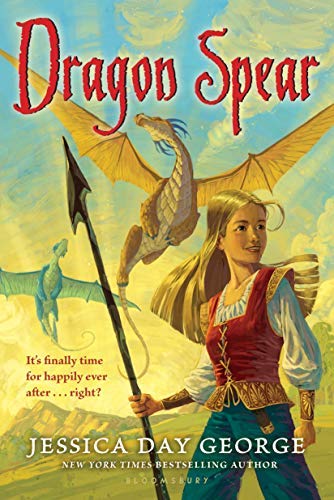
Dragon Spear by Jessica Day George

Dragon Spear is the final volume in the Dragon Slippers trilogy, and I remain glad I was handed that first book by a young friend. These have been entirely fun, with positive messaging and enough grit and humor to keep me engaged. The dragon characters are as sweet and diverse as the human ones, and the women and girls, and female dragons, tend to be both clever and strong. It’s very appealing material for this age group, and I found it perfect, easy reading while on a recent trip to see family.

In this episode, once again, we think the dragons are safe until they aren’t. This time something’s different: the threat comes from other dragons, under their own power and not that of malicious humans. In fact, these dragons enslave humans. And there are some young ones at stake–as well as Creel’s wedding dress, as her union with the younger prince approaches. We lose track of Marta, which is a shame, but get a new human buddy: Creel’s brother Hagen has shown up. He’s an interesting new feature. Dragon friends, and the prince Luka, remain steadfast.

It seems like faint praise to say that this one offers nothing especially new. But I truly feel comforted by knowing what to expect, especially at this reading level. This one is faithful to the series in pleasing ways.

A final strong recommendation. And I’m a little bit considering looking into George’s other works.


Rating: 7 holes.

Girls with a Voice and Girls with Courage by Ann Turnbull and Adèle Geras

Another loan from my favorite 11-year-old, this is a pair of historical novels linked by location. Girls with a Voice, by Ann Turnbull, is about a 12-year-old girl named Mary Ann who travels from London to a boarding school in the nearby village of Chelsea in 1764. She is excited to study singing and the harpsichord there, because she wants to perform as an opera singer onstage (an ambition her family is not especially supportive of). She makes good friends, not only with her fellow pupils, but with a maid in the large house where the school is located. The maid, Jenny, also has a fine singing voice, but because of her class, cannot have the same training as Mary Ann. Jenny sings ballads in the streets for money, however, which Mary Ann finds extraordinary. When circumstances change for Mary Ann’s family, she has to get creative in problem-solving to continue following her dream.

In Girls with Courage, set in 1857, Adèle Geras tells us about Lizzie, also 12, who is on a journey from her home in the country into London, to stay with family in their large, impressive home on Chelsea Walk. This is the same home that housed Mary Ann’s boarding school nearly 100 years earlier; what was then an outlying village is now part of the city, and Lizzie, a country mouse, is awed by the bustle. Lizzie’s father died when she was young, and her beloved mother Cecily is now remarried to a dour man who has suggested Lizzie go away for a spell, as Cecily is pregnant. Lizzie will stay with her father’s brother’s family: uncle, aunt, three cousins including a boy her own age, another uncle who has been injured in the Crimean War, and a grandmother, as well as several servants. Compared to her spare country upbringing, this life strikes Lizzie as grand and luxurious, although also limiting: she enjoyed learning about plants and trees from a local orchardist, and now is forced to do needlework that she finds very tedious. Cut off from her late father’s books by the mean stepfather, she now yearns to learn the math and science that her cousin Hugh gets to study. She misses her mother terribly–and when something seems to have gone amiss back home, Lizzie will have to be brave to help.

As you can tell from these summaries, both stories are a bit sweet and instructive. While I like these protagonists, they are earnest and simple and good-hearted in a way that leaves off the grit and snark and fun I like in all my reading, children’s and young adult of course included. Compared to the Dragon Slippers trilogy this same young friend introduced me to, Girls is less delightful. That said, I passed a pleasant enough day-and-a-half here, and have no argument with the messaging about girls following their passions – whether in music or botany – and standing up for themselves (and their mothers). This messaging is not exactly radical, but still solid. And I’m glad my young friend is interested in history. I look forward to hearing what she loved about the book, and will continue reading anything she brings me.


Rating: 6 walnuts.

Dragon Flight by Jessica Day George

Book two in the trilogy that began with Dragon Slippers is at least as good – my young friend who recommended them to me prefers the first book but I think this one might be better. Creel, in her late teens, is now an entrepreneur, running a dress shop in King’s Seat along with her best (human) friend and business partner, Marta. Marta is engaged to marry Tobin, former bodyguard to the younger prince, Luka; Creel is less secure in her relationship, but the reader can see that Luka himself is smitten with her, commoner or no. Because this is the Dragon Slipper series, trouble quickly arises: a distant country is poised to invade with an army of soldiers riding dragons. We know that dragons are not hostile by nature, so something funny (probably of the alchemical variety, as in book one) must be afoot.

One thing I love about Creel is her genuine devotion to her dragon friends. Her first friend, really, was a dragon, while she definitely has some good human ones. She is adamant in her defense of the misunderstood dragons, anxious both to protect their reputations and keep them safe. The humans also need dragons to keep them safe, and Creel is the liaison between the two groups.

I love the friendships among and between humans and dragons. I love Creel’s (and Marta’s) innovations and puzzling through problems, and their bravery. The romances are sweet, but what I love most about the pairings is that Creel and Marta are outright heroes while their respective beaus just follow along, supportive but a little bumbling, good-natured about their partners’ impressive accomplishments. (I considered sharing this observation with the 11-year-old who recommended these books to me, then realized I’d actually rather she live in a world where this was unremarkable.)

Charming, daring, whimsical, loveable, endearing. I’m in for book three.


Rating: 7 scales.

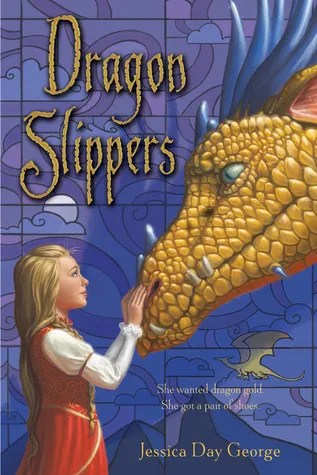
Dragon Slippers by Jessica Day George

My favorite 11-year-old saved this book especially to loan to me, and I was so excited to be given the assignment. And I quite enjoyed it! Rated for grades 5-6, Dragon Slippers has engaging action, humor, sweet friendships, a hint of romance, and snappy pacing. It’s also got some good messaging, which I approve of. It’s the first in a series and I thought I’d walk away after just one, but the surprise ending (and the sample chapters of book two!) got me.

In poverty and desperation, with a hint of a Hansel & Gretel dynamic, Creel’s aunt decides she should be abandoned to the rumored local dragon, in hopes that a noble knight will rescue her and uplift the whole family. (“Why should anyone be rewarded for defeating a dragon by being saddled with a dowryless, freckled wife and well over a dozen daft and impoverished in-laws?” Creel wonders, but nobody asked her.) This device gets Creel in the company of a dragon that no human has seen in generations, and she quickly learns that their hoards of gold and treasure are a false rumor – this one prefers shoes – and that they’re not terribly motivated to kill humans. She makes a friend, gains a beautiful pair of blue slippers that fit just right, and heads off to the city of King’s Seat hoping to make her own living rather than return to an aunt who tried to feed her to a dragon. Creel is a talented maker of what her late mother called fancywork: embroidery, weaving, and (if necessary) sewing. In the city, she is repeated called a country bumpkin. Events move quickly: she falls afoul of a visiting princess; meets a friendly prince (no relation); gets a job in a dressmaker’s shop; and finds herself embroiled in a few messes. One, working for a boss involves the kind of exploitation anyone in our present, real capitalist system will recognize. Two, her coworkers range from friend material to backstabber. Three, the prince’s attentions and the princess’s hostility somehow manage to entangle Creel in political intrigue and matters of state that also – surprise – turn out to involve her dragon friends.

(Following an early whiff of Hansel & Gretel, the slippers and the prince definitely recall Cinderella. Just echoes.)

I asked my favorite 11-year-old what she liked about the book, and she started with the initial meeting with the first dragon. (Dragons are one of her two favorite animals.) She also mentioned Creel: she likes her strength and her unwillingness to take any crap. She identifies with that. We talked about the friendships in the book, and the pacing. She said she wanted me to read it because she thought I would like Creel, and she was right.

If Creel’s interest in pretty gowns, sashes, and slippers is a bit prissy for me, she is on the other hand a highly practical feminist entrepreneur, with a dangerous habit of speaking her mind even to royalty, and a strong sense of her own powers. I love the urge to make her own way in the world. She’s brave. And she’s a good friend to a handful of dragons as well as humans, and might just turn out to be a hero. I appreciate the positive messaging, and the imaginative world of dragons. There were a few very minor plot holes that I think would likely be tolerated (or missed) by many adult readers, and certainly by younger ones. And as I said, I was hooked by a surprise finish. All in all, my young friend gave a good recommendation.


Rating: 7 collars.

Odder by Katherine Applegate, illus. by Charles Santoso

I fell in love with this book as reviewed by a colleague of mine at Shelf Awareness (here), and bought it for the six- and ten-year-old sisters who are my friends. But when it arrived I couldn’t let it go and so I read it first.

It’s every bit as delightful as it sounds in the above review, and I’m so glad I picked it up, and glad that I have young friends to inspire me. I loved the storytelling style: easy-reading, brief, free verse poems that speak plainly but also with lyricism (Odder’s front paws when she was just a pup were “dream-busy / small and soft as / a toddler’s mittens”). I loved Odder, of course, her name and her personality and frank responses to the world. What do I know about sea otters? but this story and characterization felt true to the natural world, and at the same time, offered many lessons applicable to other life forms. “Why simply dive when she could dazzle?” The ocean isn’t about morality, and there are no villains here; after a shark attack, Odder doesn’t blame the shark. “She’s seen enough to know / that this is how life is, / and this is how death comes.” (Spoiler alert: death has not come for Odder yet.) There are some excellent how-to poems: “how to rescue a stranded otter” offers important points about not rushing in; there are two versions of “how to say goodbye to an otter,” for both humans and otters. There’s a neat little poem called “keystones” that teach the meaning of ‘keystone species’ succinctly, which is a fine example of how Odder gives both naturalist lessons and broader ones.

I’m charmed, and so happy I spent some time with this book. Definitely recommend.


Rating: 9 clams.

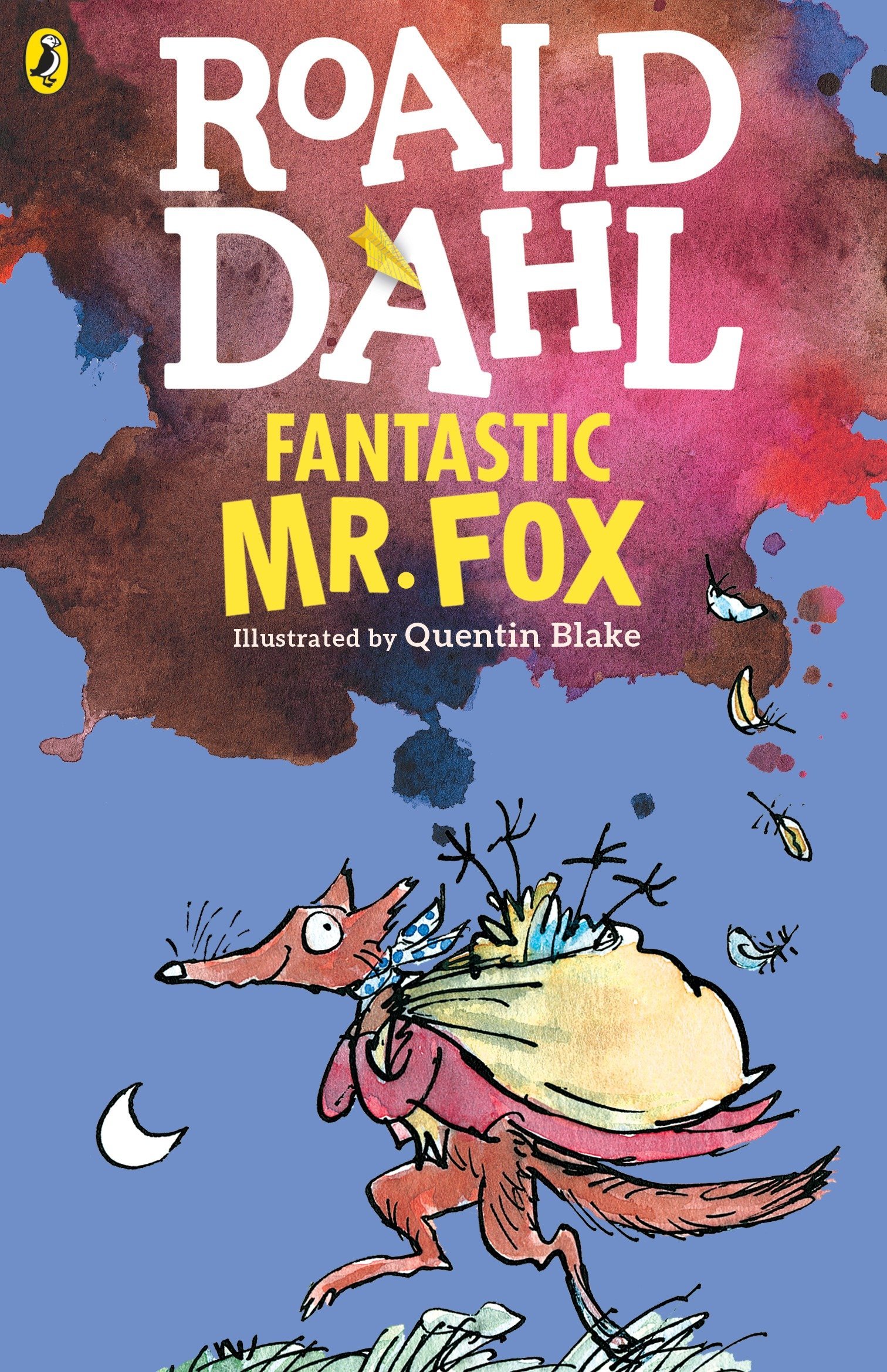
Fantastic Mr. Fox by Roald Dahl

This randomly appeared in my mailbox, and it was a perfectly lovely revisiting of some iconic features of one of my all-time favorite authors. We’re missing one familiar element, which is childhood–instead we root for the clever Mr. Fox, his loving wife Mrs. Fox, and four Small Foxes. Our antagonists are appropriately comical and ridiculous: Farmers Boggis, Bunce, and Bean, whose farms respectively produce chickens, ducks and geese, and turkeys and apples. (Bean, the turkey-and-apple farmer, exists entirely on very strong cider.) The wealthy ruling class has too much but still begrudges Mr. Fox the odd poultry to feed his family. Mr. Fox’s wit is generally enough to keep him out of trouble, until the mean farmers band together and trap his family in their den under siege; then our hero will have to turn twice as crafty to save the day, not only for the Fox family but for the other digging critters of the neighborhood (the families Badger, Mole, Rabbit, and Weasel). There is tension and suspense and a final joyous comeuppance for the bad guys. There is a moral lesson: when Badger worries about stealing, Mr. Fox retorts, “My dear old furry frump… do you know anyone in the whole world who wouldn’t swipe a few chickens if his children were starving to death?” Who, indeed? There are also illustrations by Quentin Blake, whose visions of Dahl’s work have always defined my experience of this author, so that’s perfect.

Thanks, Pops. You were right. This was a treat.


Rating: 8 carrots.