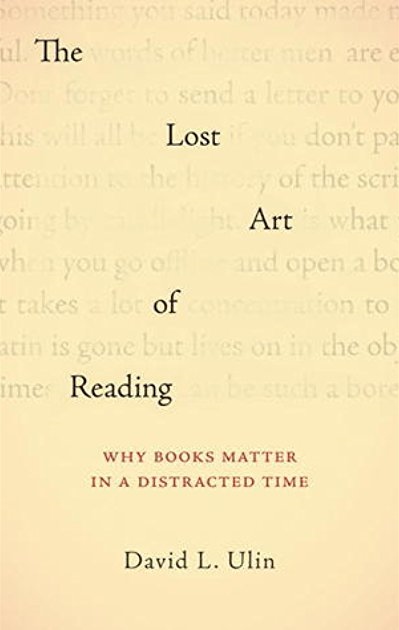
The Lost Art of Reading: Why Books Matter in a Distracted Time by David L. Ulin

This is a longform essay about reading, inspired by Ulin’s son’s struggles to read and annotate The Great Gatsby (for school, naturally). Over its course, Ulin ranges widely over his own book-reviewing career; his relationship with his son; the reading habits of the author and others (including many other writers); studies of brain science and distraction patterns; politics and current events; the nature of memory (in memoir, in Ulin’s personal observation, and in scientific studies); e-readers; and much more. Though it was assigned to me as a craft book–meaning an instructive book about craft–I found an interesting element in Ulin’s own writing: his use of parenthetical quotations from other writers.

This could be a sort of self-referential exercise, too: a longform essay about why it’s so challenging these days to read such things as longform essays. (This book began as an essay in the Los Angeles Times, which was then expanded into the fuller-length version here, at ~150 pages.) I confess I found my attention wandering at times, which could be commentary on many issues, of which only one is Ulin’s talent on the page: distracted times, indeed. Overall I did enjoy the discussion, including the meanderings into the utility of the e-reader and Obama’s popularity ratings, and you won’t be surprised to hear that Ulin and I are in sync on many conclusions about the state of the world and of reading. “It’s harder than it used to be, but still, I read.”


Rating: 7 titles.

The Woman Warrior: Memoirs of a Girlhood Among Ghosts by Maxine Hong Kingston

Kingston’s is a memoir in five longish essays, each of which could, I think, stand alone. A child of Chinese immigrants growing up in Hawaii in a Chinese immigrant community, she blends memoir (meaning personal or family recollections) with Chinese folktales, and ends up commenting on culture at least as much as her own personal experiences. This blend pushes the boundaries of memoir in the direction of imagination, and pushed my personal comfort level somewhat as a reader: I tend to prefer clear lines between fact and fiction, and while I am intellectually open to blurrings, I do notice my discomfort when it happens. I am most interested in the final essay, “A Song for a Barbarian Reed Pipe,” which expands metaphorically on the concept of literal voice. I’m also interested in the structure of this collection of five essays: their number, their varying lengths, their order, and the choice to offer a memoir in parts like this. Obviously the most unusual element, though, is that blending of folktale, imagination–even fantasy–with traditional memoir reporting.

Kingston has a vivid storytelling style, and voice. It is easy to get lost in the story at hand, and there is a dreaminess (in some sections more than in others) that I don’t often see in memoir. The flip side is that it can be harder to mentally pull these parts together into the story-of-a-life that I expect from memoir. But there’s no question that this is an absorbing and entertaining book–not to say that there isn’t emotionally difficult content, of course.

General readers of fiction as well as memoir will find much to enjoy. Students with rather more literal minds may be challenged.


Rating: 7 white tigers.

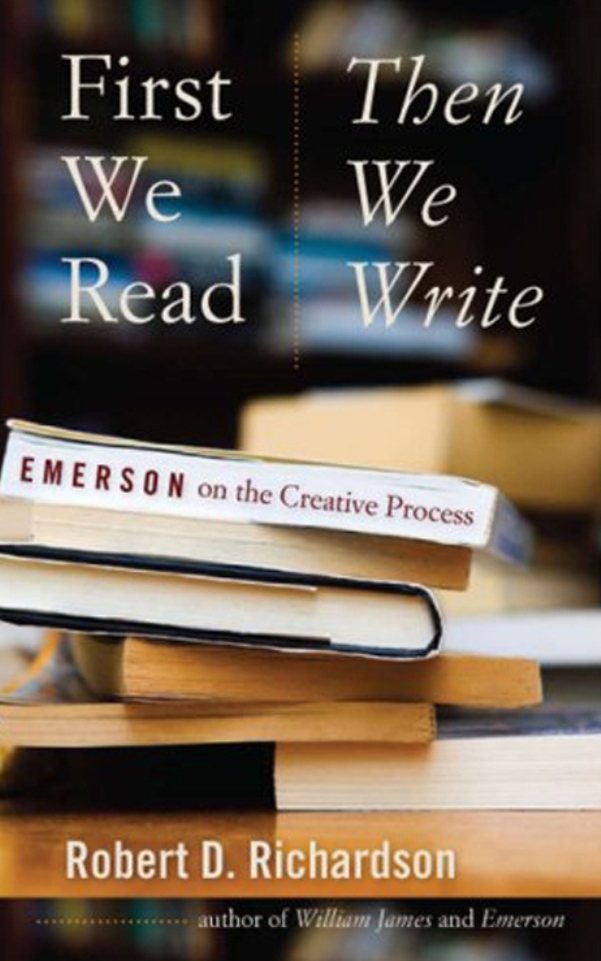
First We Read, Then We Write: Emerson on the Creative Process by Robert D. Richardson

My advisor Kim recommended this book to me as a craft book, although it is not quite a how-to, but rather a contemplation on the reading/writing life.

This short study of Emerson on the subject of writing (by an Emerson expert) is a brief, accessible view on the man. Quotable, but more than a collection of quotations. Richardson portrays a complete man, not simply a set of accomplishments. This Emerson is fascinated with writing as process and lifestyle, philosophic, and committed to exposing his own shortcomings.

I found it worthwhile, and an easy way into Emerson, who I haven’t found terribly approachable before now. I noted several quotations. The part especially intrigued me, in the final pages, where Emerson and Goethe are in some conversation about how intimidating it can be to observe the greats who have come before us… I often feel, when I discover a wonderful, new-to-me writer, both inspired by their achievement and discouraged by how high the bar has been set. And then of course the closing idea that to be a writer is to “abdicate a manifold and duplex life”! Whew.

An easy read, by turns encouraging, thought-provoking, and challenging.


Trivia of which I was unaware: Richardson is married to Annie Dillard. When I read this at the close of his ‘Acknowledgements’ (at the end of the book), I thought, ah! there’s the wisdom. (Some of you may recall that I have a complicated relationship with Annie Dillard–not all love–but enormous respect.)


Rating: 7 white whales.

Consider the Oyster by M.F.K. Fisher

I regret it took me so long to read this slim, delightful collection. M.F.K. Fisher is a very fine essayist, known for her food writing but a clever, funny, thoughtful voice in general. Warning: these delicious little pieces will make you hungry (if you have any taste at all for my favorite bivalve).

Obviously I read this book for my own essay about pearls and oysters which I’ve been working on for years… but it was an absolutely pleasure all around. Consider the Oyster has an original copyright date of 1941, and you can hear its era here and there; but overall, I think it ages really well.

Under 100 pages, and all about oysters. Short essays cover oyster sex; the seasonal nature (or not!) of edible oysters; a great many recipes from throughout history and around the world, with Fisher’s commentary; pearls; the oyster as aphrodisiac; regionalism; and more. Fisher is mostly but not entirely concerned with oysters as eaten by humans. Her writing is pithy, charming, humorous and very smart. She is a real personality, and I am a real fan.

Really, folks. What a short, accessible, but so clever little book this is. You should really pick it up, unless oysters totally disgust you, in which case you still should, because it will educate and probably humor you just the same.


Synchronicity: one of the back-cover blurbs here is credited to Clifton Fadiman, who is himself the subject of one of the next books on my list (for the Shelf), The Wine Lover’s Daughter by Anne Fadiman (author of The Spirit Catches You and You Fall Down, which was one of the first books I personally recognized as “creative nonfiction” as I was beginning to conceive of the genre). Everything is circular. Like a pearl.


Rating: 8 pearls, naturally.

Key Grip by Dustin Beall Smith

Dustin Beall Smith came recommended for his contribution to You. That essay, called “being [t]here,” didn’t particularly grab me (put it up next to Kitchen for being amorphous or abstract, at least too much so for my perhaps overly literal mind). But this book did.

Key Grip is a memoir in essays, in reverse chronological order. The first essay makes up fully a third of the book, followed by eleven shorter ones. The narrator is a risk-taker, a thrill-seeker, with self-destructive behaviors. The book is about those behaviors, about mourning the death of his father, and about art: the lifelong struggle to become a writer, and the decades along the way spent in service to another art form, as a key grip in the movie business. Smith is expert at engaging storytelling, such that the craft appears effortless or invisible. As a classmate once said, the apparently effortless writing is the hardest to achieve. But for me, the most interesting element in this collection was its reverse-chronological organization. That’s what I annotated, for school.

The extra-long opening essay, “Starting at the Bottom Again,” is a hilarious account of a mature Smith (age 57) traveling cross-country with a near stranger, to go on a Lakota vision quest. It is not only hilarious, but also gripping and pathos-ridden, gloriously told. If I have a complaint, it is that we left this absorbing world and did not return to it. I expected to continue chronologically from this point, and perhaps to get sequel vision quests, as Smith’s Lakota spiritual guide suggests to him.

Instead, we go backwards in time, seeing Smith suffer the loss of his father, work as a key grip, get dissipated and wild with drugs etc., become a skydiving instructor, return to childhood. Many of these essays are excellent in their own right. But I remained a little baffled by the departure from that first essay, “Starting.” I think we all generally expect chronological order when we read. We know how to deal with disjointed jumpings around in time; but to start at the end, so to speak, can be a little disorienting.

Nevertheless, once I paid attention to what this backwards-order was doing, I decided I like the way meaning, and characterization of the protagonist, build. For one thing, this is very like how we get to know people in real life: we meet today, in the present, and then (if we get that far) we fill in backstory. We can never know a new acquaintance’s past if we weren’t there for it, but we can listen to the stories.

Smith is a very fine storyteller, and these are amusing, sensational stories he has to tell, always with a note of sadness if not regret. I do recommend his memoir.


Rating: 7 jumps.

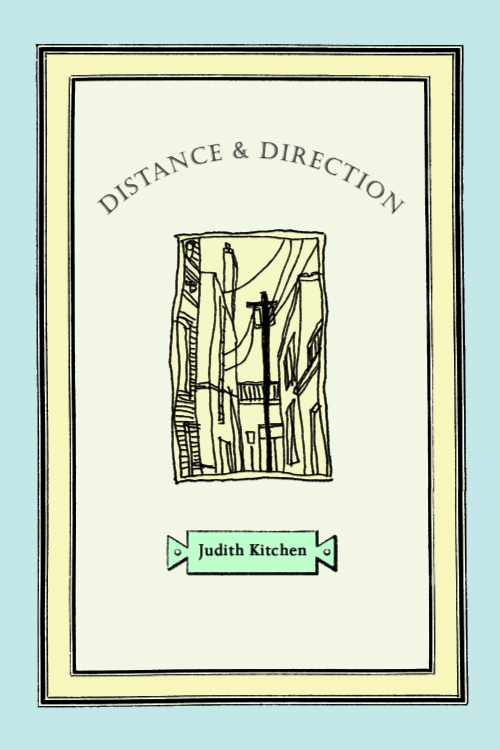
Distance and Direction by Judith Kitchen

I remain perplexed by Judith Kitchen. Actually, as I reread my review of Half in Shade, I am tempted to say: this, again, but with different subjects.

Kitchen’s meditations on distance and direction vary from very short lyric pieces to longer essays, and range geographically from Ireland to Brazil, across the United States, and more. They are about connections to place and people; and while she covers many topics, she is perhaps primarily concerned with mourning and remembering her father. Interesting for many craft elements: pronoun-switching, the use of objects, and wide-ranging subjects cohering. She is such a poet, with her words that don’t make literal sense next to one another. But the lines are lovely, and what meaning she does make speaks to me.

This collection as a whole leaves me unsure of what to say. I can best make sense of this art on a sentence level, or at best an essay level. Luckily, that is what I have to annotate (for school): a single element in a single essay, mostly. (There is always the option to annotate a book-level element, such as organization, which is what I did with Dustin Beall Smith’s Key Grip. Review to come.) For Kitchen, I annotated her pronoun-switching in the title essay “Distance and Direction.” While most of the book is written in first person, this essay is told in third person until the final paragraph, when a first-person I comes in to comment on what the she (earlier version of the self) does. This is an unusual use of POVs, and I found it interesting and very effective, although I think it takes a Kitchen-level expert to pull off such a trick.

Despite my attempt to articulate this craft element, I am left with the persistent feeling that Kitchen is not for me; she is too much a poet–too abstract–or perhaps simply too smart for me.


Rating: 7 skulls of horses.

The Triggering Town: Lectures and Essays on Poetry and Writing by Richard Hugo

A delightful, short, rich book about writing, deserving of (literal) pocketing alongside Strunk & White’s The Elements of Style.

This book is subtitled “lectures and essays on poetry and writing,” but I found it as intriguing as a creative work in itself as it is a wise craft book. On the surface, it appears aimed at poets, but I think all writers can benefit. Hugo has a refreshingly irreverent attitude and I wish I could have known him–he died the year I was born.

His self-effacing, humorous, but somehow also very serious approach to writing makes perfect sense to me, and his ideas about practice and luck mirror things I’ve been thinking for some time: that all the “bad” work we put in makes room for the good, and that practice allows for luck. (See the title essay, “The Triggering Town.”) There are some lovely essays in this book, as pieces of craft in themselves. How do we count a craft book? I considered annotating either of the last two, “Ci Vediamo” and “How Poets Make a Living” (that is, writing a craft essay for school about one of these essays). The line between craft books and creative works can be broad and fuzzy, can’t it. Recall again Strunk & White, which is such lovely, humorous, personality-rich writing. I’ll be returning to this one for encouragement and warm feelings. And maybe I’ll get around to annotating some, even.


Rating: 9 cartons of cigarettes from Spinazzola.

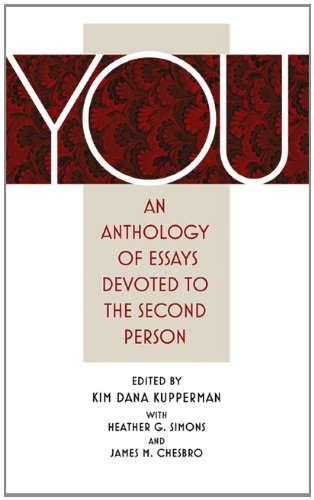
You: An Anthology of Essays Devoted to the Second Person edited by Kim Dana Kupperman

Disclosure: lead editor on this book, and founder of the publisher Welcome Table Press, is my faculty advisor for this semester of graduate study.


What a lovely collection.

These essays are collected for their second-person point of view, and include many I have already known and loved as well as some new to me. Put together like this, and with Kim Kupperman’s brief but artful introduction, they highlight the versatility of the second person, which can address the narrator herself (or an earlier version of the self); a specific individual; or a generalized “you.” It’s a diverse collection; but if there is a common thread, it is the intimacy of this POV, bringing the reader close to the narrator.

I have already admired and (in some cases) written about: Rebecca McClanahan’s “Interstellar,” Kupperman’s “Full Green Jacket,” Amy Leach’s “You Be the Moon,” and Sonja Livingston‘s “The Ghetto Girls’ Guide to Dating and Romance.” There were other authors I was familiar with too: Brenda Miller, Paul Lisicky, Molly Prentiss. I guess it’s comforting, and exciting, to begin to feel like I “know” these names. But the learning never ceases, and thank goodness.

I guess it should go without saying that not every essay in this collection appealed to me. But most did; and I appreciated the diversity of approaches to the second person, and results from it, in terms of my emotional response and what I felt was communicated, and the tone. Intimacy may be a constant, but intimacy can feel like a few different things for the reader: she can be upset, touched, amused, thoughtful or entertained, in various combinations. I was especially excited about a few of them: Kim Adrian’s “Questionnaire for My Grandfather”; Amy Leach’s “You Be the Moon”; Sonja Livingston’s “The Ghetto Girls’ Guide to Dating and Romance”; Rebecca McClanahan’s “Interstellar”; and Becca Lee Jensen Ogden’s “Nothing Good Happens after Forty-One Weeks.”

It’s remarkable that there’s a collection like this in the world. Or is it remarkable that this (published in 2013) is the first of its kind? What a wild and wonderful world of essays, literature, art in all its forms. I feel so lucky to be a student–of this, of life.


Rating: 8 disgusting essays about love.

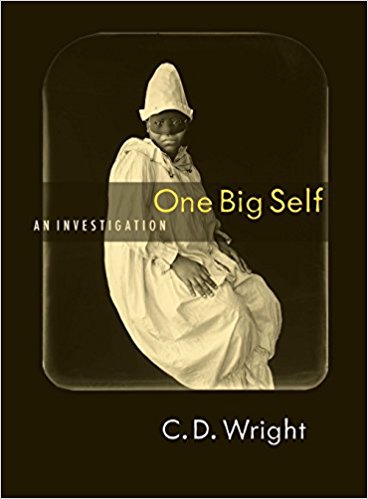
One Big Self by C.D. Wright

One Big Self is a poetry collection inspired by, and meant to record, visits to three Louisiana prisons. C.D. Wright accompanied photographer Deborah Luster on a few of the latter’s trips, and the poems in this collection borrow heavily from the speech of inmates–their vernacular, their direct quotations and their concerns–as well as from signage and other found text. Some of the words on the page are Wright’s, but some are collected. Themes include family ties; the trauma and damage caused by incarceration; and the boom of the for-profit prison industry. Of course much of the subject matter refers to violence, crime, faith, and local culture.

Especially because these are offered to me as persona poems, I am very curious to know how much is transcribed directly as found speech and how much it has been manipulated. Unlike the other persona poems I’ve just read (Patricia Smith’s “Skinhead,” Shara McCallum’s “Calypso,” Ted Hughes’ “Hawk Roosting”), these do not read to me as being about one persona per poem, but rather the collective–the persona of the incarcerated mother, say–by a series of individual contributions. This concept is in the book’s title, One Big Self.

It’s hard for me to see from here who said what. Sometimes individual lines are attributed, but often I’m left wondering. Which lines are quotations, which paraphrases? Why skip the quotation marks, which would have made clear where the speaker stops and the poet begins? And what does each choice contribute–the inmate’s words, against those of other inmates, or against Wright’s?

Sometimes the references or language hint towards Wright. This is my bias at work: when I have to look up a word or a name, I suspect that it’s a decorated poet and not a prison inmate speaking. I looked up terms like cicatrix; the Heisenberg principle; Gramsci; Fila Brasileiro; metonymy; Cioran. Cultural references like these, that go outside of Angola, Louisiana, feel external to the personas in focus here. On the other hand, certain repeated phrases fit our expectations of the setting and scenario: “She was a slab of a woman.” “That’s the tattoo that says Real Men Eat Pussy.” Mostly, I’m guessing whose speech is whose. And perhaps this guessing game, this blurring of the lines between poet/recorder and inmate, is what’s really being got at by Wright’s project, and by her title, “one big self.”

I can only close by repeating my usual lines about poetry. This was pleasant and thought-provoking to read. I like it. I don’t understand it.


Rating: 7 plastic soapdishes.

best of semester 1

Today I am traveling north and east to West Virginia for the residency that begins my second semester in WVWC’s MFA program. All semester, I’ve been posting reviews of the books I read for school (along with the odd Shelf Awareness review). So, you’ve been seeing these books as they come; but I wanted to make a note, for your information and my own records, of what I loved most this semester. As always, these are only my personal reactions.

The best (and most useful to me) craft books I read were

I had less success with The Art of Subtext, The Situation and the Story, and The Art of Attention (which I did not finish and therefore did not review). In fact, I’m beginning to fear that Graywolf’s The Art of series is not for me (recall also The Art of History), which is a shame, because I’m generally a fan of Graywolf Press, and I love the idea of these succinct pocket-sized craft books.

The memoirs/essay collections I loved most, and found most useful, were

I hadn’t realized until I made this list that five of these six books were written by women. Interesting, and perhaps not surprising.

What I am able to take from these talented writers and make my own is another question. Having reviewed books for a number of years now (see my first review for Shelf Awareness!), I feel fairly comfortable pointing to what I appreciate, and articulating why. (Most of the time.) But making it my own, that’s a newer challenge I’m still working to master.

And so, into semester 2.