A Field Guide to Getting Lost by Rebecca Solnit

Another book that came to me at just the right time thanks to Jessie van Eerden. I know of Rebecca Solnit, of course, but I think this is the first of her writing that I’ve read. I really enjoyed it in several aspects: its subject matter is very much in line with that of my thesis (that I’m currently writing); its structure is of interest and also has something to offer my own; the writing is lovely; the content it approaches is wide-ranging, and (as Jessie said early in this semester as we did a manuscript review), “I like to learn stuff.”

That said, it’s not an easy book to sum up. These collected essays are connected, but far from telling a narrative. Solnit is exploring the idea of getting lost and what it has to offer us; and that is ‘getting lost’ in several senses, geographic (I got off the trail and I was lost) and metaphoric (after my mother died I was lost, or I lost several years). Also the sense in which we lose both things and people: lose your keys, lose your mother (to death), lose a boyfriend (when you break up). She sees value in getting lost – sometimes it’s how we find ourselves – and notes that we don’t get lost much anymore. Late in the book, she looks at old maps with their ‘Terra Incognita,’ and observes that we don’t have terra incognita on our maps anymore. We know it all! Right? (Of course, we’ve thought we knew it all before, and been proven wrong.)

I’m using the sense of place tag here although it’s not quite right, which is perhaps a design flaw in my tag. By ‘sense of place,’ I have tended to mean a strong attachment to a certain place; so Jesse Donaldson’s writing about Kentucky, James Lee Burke’s New Iberia, Michael Connelly’s Los Angeles, or Mary Karr’s southeast Texas. That is not what I found with Solnit, so much as a strong feeling about the importance of wandering, losing and finding oneself, in place and in other senses. Place plays an important role here. This book feels like it fits that tag, even though it doesn’t fit the tag as I originally conceived it. (This blog will be eight years old next month. Expect some scope creep.)

Structure-wise: there is a chapter-title refrain, with the heading The Blue of Distance (italicized, where the others aren’t) taking every other place between differently-titled essays. These are not the same essay over and over, but they all meditate on blue and its role in our observation of distance, beginning with the literal meaning (that is, that the sky and deep water both look blue for scientifically observable reasons) and moving through less-literal ones. Distance, it seems, is an inextricable part of one’s ability to get lost. My 600-square-foot house would be much harder to get lost in (tell that to my geriatric dog) than a 20-something room mansion would be. I really appreciated this design, the repeated title for very different essays; it was a succinct cue to the way in which they’re linked.

Another item I found interesting to note was Solnit’s references, the other thinkers she turns to. Some were perhaps unsurprising, as writers cite other writers: Fitzgerald, Nabokov, Katherine Anne Porter, Virginia Woolf, Joseph Conrad. These are joined by Johnny Cash, Patsy Cline, Bobbie Gentry, Yves Klein, Plato, Álvar Núñez Cabeza de Vaca, and Alfred Hitchcock (among many others). A huge number of minds contributed to Solnit’s own thought processes here – which are of course her own – and I was fascinated by the twists and turns. Again (and again), this is something I need in my own writing and that appeals to me. I can’t wait to tell Jessie how right-on she was with assigning me this book.

Obviously this Field Guide‘s usefulness to me is just beginning. You will like it, too, if you like far-ranging considerations of the human condition and where each of us as an individual might be or should be headed, if we’re thinking about it. I found it an engaging and curiously winding path, and I recommend it.


Rating: 8 shades of blue.

On Homesickness: A Plea by Jesse Donaldson

Our temples are made of logs in Kentucky so be careful with the flame.

This is a book very much after my own heart, even though its narrator doesn’t care much for the city that has my heart; we both share a love for home, even though our homes are different.

On Homesickness is a collection of fragments, none longer than one page, and that’s an important design feature, because each spread follows a pattern. The left-hand page names a Kentucky country, its date of establishment, and a small representation of its shape on a map. The right-hand page offers a fragment, sometimes expressly referring to the corresponding county but more often not. It’s possible that fragments and counties match up better than I know, and a Kentuckian might know better, but I’m not really all that concerned. These super-short pieces of prose make a neatly paced, lyric form for what is essentially a wandering wanting. Donaldson yearns for his home and can’t figure out how to get there. Meanwhile we learn as well that he and his beloved partner have a pretty good life in Oregon, a place he finds beautiful but not quite home. His partner is uninclined to pick up and move to Kentucky. Donaldson flubs a job interview that might have moved his family home; his wife gets pregnant, and in a lovely piece near the end, “…I realize that for our daughter, this place will be home. And I want her to love it like I did mine.”

That is the narrative arc, such as it is (and it ends beautifully), but the narrative bones of this book are spare. Along the way, Donaldson also mines Kentucky history, myth, and cultural references (that Colonel’s sour mash), creating as much mood as story. Again, yearning is absolutely the dominant feeling, coming across loud and clear. Also very present is the unnamed partner, the wife in Oregon. This is a love story as much for a woman as for a place. “A place can’t love me. Not like you.”

I find this book interesting for its form, its bravery in sparsity and what it communicates so succinctly. Its themes are so much my own that it aches a little, and I recognized almost every line as I read. Even the references felt uncannily personal (Janus, Cleanth Brooks, Houston). Is that because I’m so truly the right reader for this book? Or because it’s designed to appeal to every reader in this personal way? Probably a little of both. Either way, a good study in minimalist, lyric prose; mood over plot; and a decent way to learn about Kentucky, not from an academic historian but from a lover. I liked it very much.


Rating: 8 love stumps.

Bonus material/synchronicity: I was originally sent this book in galley form for a Shelf Awareness review, but I didn’t get around to it. I kept the book, though, because I thought I might be interested someday. When I worked with Jeremy Jones last semester, I learned that his “In Place” series from WVU‘s Vandalia Press had debuted with this book as its first release. Meant to be. Part of me wishes I’d gotten to it sooner (and written that review for the Shelf!), but part of me thinks I found it at the right time.

movie: The Gleaners and I (2000)

Recommended by the fabulously talented Jessie van Eerden. Writing my thesis with her this semester is a dream.

However, first thoughts on this movie were “wow, this is weird, why am I watching this?” and then I got into the groove. For one thing, it’s an interesting work of narrative nonfiction. Ostensibly, director Agnès Varda is concerned with an external subject: the longstanding tradition of gleaning, or collecting the leftovers of a harvest. She enters this subject via art – the paintings of Millet and Breton – but among and in between this external material, Varda looks back at herself. The moments that become personal make the whole thing work, for me. Which is not to say that I wish the whole thing had been personal, or I spent the rest of the movie waiting to learn more about our narrator, you understand. I’m just voicing again my preference for a present narrator. I appreciate external material that is commented upon by a personal voice. In fact, I pretty much require it, as a personal preference. Perhaps this is on my mind now because I’m working on my thesis, that book-length project “of publishable quality”… and I am appreciating that Jessie shares my feeling of being an essayist, of commenting on outside material from a personal perspective, rather than simply airing all my own thoughts and feelings. Personal essay, not memoir, if you will.

And that is what I’m getting out of this movie: the narrative stance. As well as the subject matter: not gleaning in particular, but the entry through art into a larger subject (I am writing about the Drive-by Truckers, Jason Isbell, Guy Clark, and Dominique de Menil, among others), as well as its metaphoric possibility. I really lit up when Varda noted the new, metaphoric uses of ‘gleaning’:

On this type of gleaning, of images, impressions, there is no legislation, and gleaning is defined figuratively as a mental activity. To glean facts, acts and deeds, to glean information. And for forgetful me, it’s what I have gleaned that tells where I’ve been. From Japan, I brought back in my case souvenirs I had gleaned.

She does a lot of using one hand to film the other hand, which is an interesting statement about art, right? (All that commentary about the memoir as navel-gazing!)

The Gleaners and I is a piece of art, concerned in part with art – the original paintings as inspiration; the artists Varda meets who create out of the refuse they scavenge – as well as several meanings of gleaning. The people in the French countryside consider gleaning in its old sense, bending down to pick up leftover crops lying on the ground after a harvest. Some see a difference between this act and picking, which is picking fruit or nuts or whatever off of trees, vs. bending to take off the ground. Then there is urban scavenging, dumpster diving and combing through curb leavings. And finally that metaphoric sense, in which I watch this movie and take with me – figuratively – the parts that are of most value to me.

Varda interviews a “painter and retriever” who picks up other people’s discards from the curbs to make art, not unlike a dear friend of mine: he says, “what’s good about these objects is that they have a past, they’ve already had a life, and they’re still very much alive. All you have to do is give them a second chance.” (I also love that he points out that the city council puts out maps of where this not-junk is going to be, and Varda responds that really, aren’t the maps so that the people can put out their junk? And he sort of chuckles and says yes, well, I read the maps in my own way.)

I’m really fascinated though at the assumption throughout – never challenged! – that this food is all “wasted” if people don’t eat it. One guy did say about unharvested grapes that otherwise “the wild boars and the birds will get them.” So… how is that a waste? No human got it, but it didn’t go to waste. Even the fruit that rots on the ground contributes to a system. Even if we’re compelled to make it about us: dirt is necessary for people to live, for everything to live, and rotting grapes help make dirt. I wrote to my artist-scavenger friend about this movie, and he responded: “There is an edict in the Old Testament about leaving behind a percent of crops for the animals. Old wisdom makes sense sometimes.” This seemed like a gaping hole to me. After all, we didn’t invent grapes. They grew on their own, for their own purposes: the purpose of the grape, and the bird and the wild boar. Shades of Amy Leach here…

The film is in French, with subtitles, and it’s dated. (It was released in 2000, but the narrative voice is very much “what is this new millennium nonsense” – filmed in the 90s, of course.) It’s also arty, a little slow-paced and introspective, which could contribute to its being a little less than accessible – it worked that way for me, early on. It had a little bit of the tone of Sherman’s March, but not nearly so off-putting for this viewer!

All in all, I was a touch slow to get involved but Varda’s Gleaners ended up being fascinating, thought-provoking, and memorable. It’s been haunting my thoughts. There’s a lot going on here, and I do recommend it, if you’re at all interested in… trash, food, the end of the world, reuse, art, or narrative perspectives. So, good for all thinking souls.


Rating: 8 cages interesting like boats, like violins.

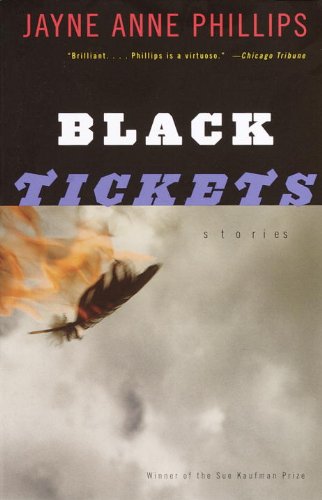
Black Tickets by Jayne Anne Phillips

I read this book for its structure: a short story collection with some longer pieces, of as many as 20 pages, but a number of shorter ones, just a page or two. With my advisor this semester, Jessie van Eerden, I am considering a similar structure for my thesis: interstitial pieces in among long ones. (I also read Jessie’s own thesis from her MFA program, which was awfully wonderful and I wish I could review it here for you! Also with the interstitial pieces, and so lovely. But as it’s not published, I guess I’ll leave it at that.) I was also glad to read Jayne Anne Phillips because she is important to West Virginia’s literary legacy. And she is from Buckhannon, where my own West Virginia Wesleyan College is located.

This is a beautiful and impressive collection in its effect. I found myself lost and involved in each story, one of those reading experiences where you forget where you are, look up baffled by the everyday world around you, thinking you were really in a dark bar in El Paso or walking the streets of an unnamed town decades ago. This effect makes it hard for me to analyze the craft of the book itself, but it is certainly to be admired. While these stories are, I think, unconnected, they share themes: the types of characters and the types of settings are all rough-hewn and struggling. Dwight Garner’s review in The New York Times calls these “lush, violent, elegiac and sexually charged worlds,” and he writes that this book “would help light the landscape of the so-called dirty realists (Raymond Carver, Bobbie Ann Mason, Richard Ford, Phillips and others), though the adhesive has pretty much come off that label.” I am turning to Garner’s words in part because this book so challenged me, and in part because I love that idea, the adhesive coming off the label.

Here is menace, violence, and sex, a good amount of it menacing and violent sex. It’s about loneliness and despair and the odd, quiet contentment. I’m not sure what to think, actually. And as to my original reason for reading Black Tickets – to examine its structure – I’m a bit lost, too. I would say the shorter stories contributed to the overall themes, tone, impression that make this book so strong. So did the longer ones.

How different is a story collection from an essay collection? What explains my difficulty here? If I find out, I’ll let you know.


Rating: 7 Ripple bottles.

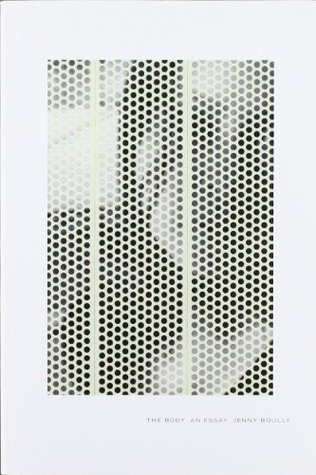
The Body: An Essay by Jenny Boully

The Body is an essay in footnotes. Footnotes to a body text which is absent. Just the footnotes.

Pages are often more blank than not, with a line demarcating the footnote section of the page, and then (in rather small font) the text below. Some footnotes are nothing more than Ibid., with a page number. Does this sound infuriating? Yes.

Some of the footnotes are long enough and weird enough to get lost in, themselves; when I consider them poetry and dwell in the moment, there is something to be enjoyed. But overall, not a concept that works for me. Other, better-known writers and readers than I have found much to value here. A meditation on the concept of absence, loss or disappearance, etc. But it was too weird for this reader. I was here for the body, if you will, and not its leavings.

For me a fail, but I’m certainly interested to know if you are differently minded. If any of my readers have enjoyed this book? Please explain.


Rating: 4 quotations.

The Poetics of American Song Lyrics ed. by Charlotte Pence

This book took me an inordinately long time – weeks – to finish, but not because I didn’t love it. I loved it. It’s just dense, and took a lot of mental energy. And being a collection of discrete pieces, it was easy to take breaks. And it hit just at the end of a wonderful but wearying semester, so my mind was fatigued. [Post about the semester wrap-up to come.]

I’m going to let editor Charlotte Pence introduce this book to you as she did to me.

Not many editors can pinpoint the exact moment a specific project began, but I can say for certain that it was September 12, 2003, the day Johnny Cash died. I was living in Nashville, teaching composition and poetry writing at Belmont University where 27 percent of the entering freshmen are part of the Mike Curb College of Entertainment and Music Business. The university sits on a hill that hovers at the end of Music Row, those legendary two streets that Nashville record labels and studios call home. When students miss class at Belmont, the reason often involves the words “touring schedule.” Essentially, the music business is an extension of the campus, and there I was teaching poetry and having students ask if they could bring their guitars to class for backup as they read their “poems” for the class to critique.

She goes on: when Johnny Cash died, Tennessee senator Lamar Alexander gave a speak on the Senate floor in which he wondered why Tennessee English professors (“including those at Belmont specifically”) didn’t teach lyrics alongside poetry. Pence acknowledges their “differing politics,” but answers the call nonetheless, to explore this question. Poetry professors have a number of quick-and-easy answers to the question of how poetry and song lyrics are different – I’ve had this conversation with my own favorite poetry professor, Doug Van Gundy, who among others things (like citing a lovely quotation from Glyn Maxwell’s On Poetry) recommended this book to me. But Pence understood that it remains a question in many minds, Lamar Alexander’s and her own undergraduates’, and created a course investigating the issue. In seeking assigned readings for this course, she quickly realized that there was a major shortage of articles analyzing the content and techniques of song lyrics. Long story short, this book was born to answer that shortage.

Pence has more than this to say in her introduction, which I read with great interest. She explains the mix of contributors she’s pleased to present: poets and teachers of poetry; literature professors; and music scholars. They write on a wide range of musicians: Johnny Cash, Sam Cooke, Bob Dylan, Michael Stipe, Bruce Springsteen, Okkervil River, Magnolia Electric Co., Leonard Cohen, and a litany of country and rap artists. They generally depart, I venture, from the more standard poetry professor’s position that music and poetry are too different to share the same conversation. Obviously, here they share the room.

Each essay, naturally, varied in how it worked on me. There were a few I ended up skimming past or not finishing; but only a few. Unsurprisingly, many of them tempted me to stop and listen to an album or four before continuing (I mostly did not indulge in this further slowing of my reading, although I found a few single tracks online to aid me). Some of them made points that surprised me or opened my mind.

A few highlights, for me personally:

Pence’s own contribution, “The Sonnet Within the Songs: Country Lyrics and the Shakespearean Sonnet Structure,” was a good discussion of the traditions of a particular poetic form, accessible to my level of knowledge coming in. And it was exciting to see poetry and lyrics lining up.

“Gangsta Rap’s Heroic Substrata: A Survey of the Evidence,” by John Paul Hampstead, was another thrilling example of traditions of one form recognized in another, apparently very different form. Hampstead considers ancient and medieval heroic poetry (Homer, Virgil, and ninth and tenth century Anglo-Saxons) alongside Lil Wayne, Notorious B.I.G., Short Dawg, and a number of others. He finds five common threads: feasting, raiding, treasure, misogyny, and fatalism. I do mean thrilling: it gives me a thrill to see connections like this made.

Pat Pattison’s “Similarities and Differences between Song Lyrics and Poetry” serves as a good overview discussion of, well, the similarities and differences between song lyrics and poetry, and concludes that they are indeed different beasts: a view held in common with my friend Doug and the Maxwell quotation. It’s well defended here but also pulled apart.

I enjoyed David Kirby’s “The Joe Blow Version,” about the various versions of Otis Redding’s song “I’ve Got Dreams to Remember,” and the richness offered by variability, as opposed to a single, definitive, correct version of a song, poem, play, etc. He quotes a textual scholar, Anne Coldiron, who says “The nineteenth century in particular was an age of canon founding,” the establishment of definitive texts; but the Bible, Shakespeare’s plays, Auden’s poetry, and Brecht’s music are all examples of work with variations. Kirby offers that “Some of the songs that get under our skin the most aren’t written so much as assembled,” that differing versions “remove the mystery and, in so doing, heighten the pleasure.” This essay, by the way, is itself a lovely work of art: Kirby’s arguments are packaged within a narrative of his travels in Macon, Georgia, researching a book on Little Richard and visiting with Otis Redding’s widow and daughter. It is a finely crafted essay and a beautifully executed argument about the value of variation in art, and of the transparency of the creative process.

I also responded to essays studying Okkervil River and Magnolia Electric Co. (the latter a band I’m just discovering through a friend, which is a story unto itself, and a synchronicity that strengthens the reading experience). Those essays are by Stephen M. Deusner and Jesse Graves, respectively. And while the two essays studying Michael Stipe and R.E.M. appealed to me less in their particular subject matter, I was enchanted by the idea of “investigat[ing] the assumption that lyrics should provide literal meanings… ultimately inviting listeners to co-create rather than simply receive meaning from the lyrics.” (Jeffrey Roessner’s “Laughing in Tune: R.E.M. and the Post-Confessional Lyric.”)

I’ll stop there for now. I found The Poetics of American Song Lyrics a stirring and challenging read. For one thing, I lack an enormous amount of the vocabulary and background required for literary criticism of poetry; many of the terms confused me at least a little, and although there is a glossary, it didn’t solve all my problems. Maybe I’m holding myself to an unnecessarily high standard, but I don’t feel qualified to fully appreciate the criticism and in-depth critique in these pages. I felt like I was missing a fair amount. However, the most exciting part is that these essays do the kind of work I dream of doing for some of my own favorite musicians and lyricists: Jason Isbell, Guy Clark, Patterson Hood. I’m not much closer to being able to do that work myself, but I can see now that it’s possible to do such work, and that is exhilarating.


Rating: 9 fading trails.

What It Is by Lynda Barry

This is an interesting piece. Coffee-table-sized, all done in graphic format, and for a number of pages I wasn’t sure there was anything like a narrative here. Four pages of the first 24 involve narrative storytelling; the rest are collage, often with text in comic-style boxes, but not necessarily linear or related text.

None of this is un-fun, but it’s not what I was expecting. The drawing style is fun and quirky and consistent enough throughout that I gradually got to know the artist; and the collage, which involves materials other than Barry’s own creations, is an interesting way to look at the world and her vision, too. There are nearly limitless possibilities to interpret text that’s been all jumbled up together. I kind of enjoyed that. But my narrative-driven, literal, logical-progression-type mind–the mind that struggles with poetry–missed having a thread to grab onto.

There is a narrative, as it turns out. It starts in earnest on page 25. It comes and goes, interspersed with the collage-pages, which come to hold together a bit more as the narrative and themes become clearer.

Lynda Barry tells the story of her childhood, with its devotion to imagination and play, and her childhood delight in stories and pictures, and then the adolescence that stole these delights, chiefly when two questions came to her that refused to leave again. The questions are, is this good? and does this suck? She continues on, to show us how a certain art teacher in college helped her find her own way, release those outside considerations (at least temporarily; they do creep back in) and find the joy and the imagination and the inspiration again.

The latter third of the book is more craft book or how-to (although keeping the graphic format; this is my first graphic craft book!), with plenty of exercises, and a few whimsical characters to help us along. Whimsy does not mean the tone is light, however. Barry is serious about the difficulties of artistic work (writing, drawing, or otherwise), those two questions always threatening to intrude again.

It’s a different take than I’m used to; and I am not personally big on exercises. But it was visually very interesting, and good practice for the brain to take on something different. I respect Barry’s multiple talents, and I appreciate her view on what it takes to make art, and her idea that we tap into something a bit unconscious, or a different consciousness, to do it. I’m intrigued.


Rating: 6 sea monsters.

Handling the Truth: On the Writing of Memoir by Beth Kephart

This craft book has things in common with both Family Trouble and Fearless Confessions. Like the former, it addresses in part the difficulties in writing about real people, especially those we love. Like the latter, it takes a certain rah-rah tone, encouraging aspiring writers to go for it, you can do it, and don’t be bothered by all those nasty critics disparaging the genre that is memoir. I don’t mean to condescend, and I appreciate the support that Silverman and Kephart offer. It is a tiny bit peppier in tone than my personal preference would call for. But it’s valid support that I need and appreciate, and it’s backed up by both writing chops (publications) and a secure knowledge of craft.

So this is not a *perfect* book, for me, but a very good one. I really enjoyed Kephart’s boiling-over enthusiasm for the genre, and I’m inspired by her apparently wild success as (in her own words) an “entirely unschooled” writer. I love her annotated appendix of memoirs to read, categorized by subject (grief, childhood, “unwell,” “mothers, fathers, children,” and more): there are so many such lists out there, but I eat them up every time, looking out for the title that I’ve never encountered before (and there were several here!), for the different perspective. Kephart does a good job, introducing this appendix, of pointing out the subjectivity of such lists, the value a book may hold for one reader/writer and not for another, and the value in a book a reader doesn’t love.* Then she goes ahead and lists–with some discussion/description, which is great. Here, the title I picked up on was Nothing to Declare: Memoirs of a Woman Traveling Alone by Mary Morris. I went ahead and ordered myself a copy on Biblio.

In the body of the book, Kephart offers discussions of what memoir is and what it is not (not revenge, not tone-deaf, not therapy, but rather making the “me” work for “us,” making one’s story universal). A number of short chapters offer prompts, or reminders to include weather, place, food, and sensory detail. Final thoughts on how to turn scraps of writing into a book; and exhortations to always work from and toward empathy, to not make stuff up. I appreciate that one of the central pillars of memoir writing, for Kephart, is the idea of making a story speak to the human condition. That my story is not interesting because of its particular, but becomes interesting when I make the unique universal, make the personal stand in for shared experience, draw conclusions, find meaning. (See Gornick’s The Situation and the Story–though it’s not my favorite articulation of this idea, Kephart appreciates it.)

There is much to love here, especially for hesitant writers new to memoir, or those without the benefit of an MFA program–though I am in a program I love and still found lots to appreciate!


Rating: 7 porcelain dogs.

*I am totally tickled when she writes, “You will blog about my inevitable injustice,” when I the reader find my favorite memoir left off her list. Here I am, blogging! But she listed several I love, by Kimmel, Bechdel, and Bragg; Dillard, Williams, Offutt; titles I haven’t read but have faith in by Sanders and Thomas; craft books by Klaus, King, Lamott; and Doty’s Heaven’s Coast, which I am anxious to get to. Sometimes she chose my second-favorite title by a given author. But I am certainly not here to blog about any injustices, no.

did not finish: Three Kinds of Motion: Kerouac, Pollock, and the Making of American Highways by Riley Hanick

I’m sure this is a good book, but not for me at this time.

The idea is definitely intriguing: three creations, linked by place and certain themes. Jack Kerouac’s On the Road; Jackson Pollock’s Mural; and Eisenhower’s development of the interstate highway system. Riley Hanick is in Iowa. Just four years after Peggy Guggenheim commissioned Pollock’s mural for her Manhattan townhome (where “the narrow width of [her] hallway would have made [proper viewing of the painting] impossible”), she gave it to the University of Iowa Museum of Art. Later, Kerouac’s first draft of On the Road, on a single long scroll of paper, will be on display in the same museum. This museum will flood, and the art will itself end up on the road, in transit.

An interesting concept, to weave these three threads together, three movements. Jeremy recommended it to me in part because I was writing about Houston’s Menil Collection, and traveling home to visit it (after Hurricane Harvey, no less, with notes on what precautions the Menil took). This was a wise recommendation for obvious reasons. But as it turns out… Hanick’s style is sketched, abstract, sometimes taking the form of very short chunks, and conflating his two Jacks until I was often unsure of whom we were talking about. His pronouns run from ‘he’ to ‘they’ to ‘we’ to ‘I’ and I was frequently lost. It was nearly 100 pages in when he first quoted Gertrude Stein, and I thought, aha! that is my problem here: there is too much of the Stein here.

As I put this book down, I remain slightly interested, and in another world, one where I have lots of free reading time, I’d fantasize about picking it back up again. But in this life, when I have too much reading to do that will help me (as a student, as a writer, as a book reviewer) and that I can understand, Three Kinds of Motion is not for me.


I’m forgoing the rating this time.

Family Trouble: Memoirists on the Hazards and Rewards of Revealing Family ed. by Joy Castro

Family Trouble is a delightful collection about the challenges of writing nonfiction about family. I loved the wide range here: of experiences related by these established (published) writers; of the advice they have to offer; and in the writers, themselves, who are of diverse ethnicities and backgrounds, sexualities, gender expressions, and life experiences. Editor Castro contributes a pure-gold introduction, which incorporates quotations and references to all her contributors but also manages to offer her own perspective. I was on page 7–yes, in the introduction–when I found my first epiphany.

Essays are sorted into sections by outlook or strategy: “Drawing Lines,” “The Right to Speak,” “Filling the Silence,” “Conversations of Hope.” I have read some of the contributors before: Paul Lisicky, Alison Bechdel, Robin Hemley, Dinty W. Moore, Richard Hoffman, Sue William Silverman (and have attended classes with Karen Salyer McElmurry). Others I knew by reputation: Susan Olding, Susan Ito, Sandra Scofield, Lorraine M. López, and more. I did have favorites, sure, but I emphasize, I most appreciated the interplay, the sum of parts: these diverse voices and perspectives playing off each other. The anecdotes from experiences are valuable (and often entertaining or humorous, although there is much pain here, too). The writing is lovely. It’s a hell of a collection.

Here are a few of my most treasured lessons.

“Good writing must do two things,” contends Vivian Gornick in The Situation and the Story: The Art of Personal Narrative (2001). “It must be alive on the page, and it must persuade the reader that the writer is on a voyage of discovery.” Writing The Truth Book, I truly was on a genuine voyage of discovery, and these two driving questions* helped shape the memoir, guiding my choices about what to disclose and what to omit. If an incident, detail, or family story contributed in some way to the answering of one or both of those questions, then it went onto the page. If it didn’t, I didn’t even draft it.

From Castro’s introduction; and she mentions the *two driving questions earlier in the paragraph, but I submit that they don’t even matter here, for the purpose of the lesson she offers. I’ll try and recapture it: the memoirist must be driven to tell a story in pursuit of discovery or of answering a question or questions. The issue of whether to include certain material (which, I’ve said elsewhere, is a central issue in crafting memoir) then becomes simply an issue of whether it pursues the main question(s), the desired discovery. …This assumes that we know why we’re writing, and I don’t, always. Sometimes I just want to write a thing, without knowing what the burning issue is. So this becomes a multipart problem: figuring out why a story needs writing (what’s the burning question?), and then mindfully allowing that question to sort what needs inclusion and what does not.

This seems, now that I’ve thought it out, plenty obvious. But I had to get there, and Castro helped.

I also really appreciated the concept that the idea of family stories exists on a spectrum, with the immediately, intimately personal (individual) on one end, and a global human community on the other. From Aaron Raz Link:

A writer working with family materials stands in a liminal space where my story meets your story, meets the reader’s story, and becomes our story. Before I became a writer, I was a historian working in public museums. As a result, I see that family assembles our individual stories together to become the fabric we call culture and history. This process gives each of us some sense of belonging to a larger world.

Richard Hoffman’s first memoir helped put the man who raped him in childhood away in prison, and therefore offers a particularly stark example of personal or family stories having larger ramifications. He contributes to the same idea:

The trouble with the view put forth in dozens of books about family “dysfunction,” some of them interesting and helpful, is that it tries to understand the family without its community, without its culture and class, without its history and the relation of that history to–well, History.

Somehow, I feel like this relates back to some comments I made near the end of this post, about interdisciplinarity. Seeing the connections feels like some of the most important learning we can do, ever.

I loved that some essays took different forms, like Susan Olding’s contribution, “Mama’s Voices,” with its stop/play/fast-forward organization, involving tape recordings. I appreciated the far-reaching context and concerns of Faith Adiele’s “Writing the Black Family Home.” And I enjoyed and marveled at Ariel Gore’s “The Part I Can’t Tell You,” in which she does tell us. Or does she?

Much to be admired, and probably of interest to a fan of memoir as well as a hopeful writer of same.


Rating: 8 mournful duets about two people who never should have broken up.