book beginnings on Friday: The Delicacy and Strength of Lace, letters between Leslie Marmon Silko and James Wright

Thanks to Rose City Reader for hosting this meme. Participants share the first line or two of the book we are currently reading and comment on any first impressions inspired by that first line.

And so begins graduate school: with advanced reading to prepare for the winter residency I’ll be attending in West Virginia in just a few weeks. I chose to begin with this collection of letters, which will inform a seminar entitled “Another Voice at the End of the Line: Correspondence Between Writers.”

Here’s a confession: I’ve never read any Silko or Wright before.

the delicacy and strength of laceWe begin:

Misquamicut
Rhode Island
August 28, 1978

Dear Mrs. Silko,
I trust you won’t mind hearing from a stranger.

And so began a strong friendship. I’ve really been enjoying this, actually, although I wasn’t sure at first that there would be enough to grasp onto, between two writers I was not familiar with. I’m also looking forward very much to this seminar, which I think speaks to some of the challenges of being a writer, let alone in a low-residency program; and it is taught by a faculty member I very much enjoyed meeting last summer, Doug Van Gundy. Plenty to go on there.

Happy Friday, friends.

The Art of History: Unlocking the Past in Fiction & Nonfiction by Christopher Bram

A succinct survey of history in both fiction and nonfiction offers advice for writers and readers.

the art of history

Christopher Bram takes on the broad subject of what history has to offer literature–and vice versa–with The Art of History: Unlocking the Past in Fiction & Nonfiction.

Beginning with memories of a high school English teacher, Bram celebrates the interest and value of reading and writing history. His thesis is that history need not be written in dry, textbook form: in both fiction and nonfiction, a talent for storytelling and a keen eye for just the right details, in the right quantity, can render the near and distant past in enthralling fashion. “Details,” he says, “are the raisins in the raisin bread.” He examines works including Gabriel García Márquez’s Love in the Time of Cholera, David McCullough’s The Path Between the Seas and Leo Tolstoy’s War and Peace, and topics ranging through war, slavery in the United States, comedic perspectives and the blending of lines between fiction and nonfiction. An author in both disciplines, Bram does not claim objectivity: he is clear about his love for Toni Morrison’s Beloved and his disregard for Hilary Mantel’s Wolf Hall, among others.

Books in “The Art of” series inspect craft from a perspective seemingly for writers and critics, and Bram offers good advice: “In both fiction and nonfiction, writing well means knowing what to leave out.” But The Art of History works for readers as well, as in an appendix of Bram’s recommended reading. Exploration, appreciation and instruction combine in this slim, accessible study of literary history and historical literature.


This review originally ran in the July 5, 2016 issue of Shelf Awareness for Readers. To subscribe, click here, and you’ll receive two issues per week of book reviews and other bookish news.


Rating: 6 details.

The Mindful Writer by Dinty W. Moore

This expanded second edition of the popular title about writing from a Buddhist perspective is a small book with big ideas.

mindful writer

Dinty W. Moore (Dear Mister Essay Writer Guy) is often asked to explain how Buddhism influences his writing practice. In struggling to answer this question articulately, he found himself shaping “The Four Noble Truths of the Writing Life.” From these musings was born 2012’s The Mindful Writer, a slim volume of very short, koan-like chapters offering writing advice and formed from quotations by other writers.

In its expanded second edition, The Mindful Writer offers a new introduction and for the first time includes writing prompts that follow the same concepts and quotations as its chapters. Words of wisdom from William Faulkner, Gustave Flaubert, Dorothy Parker, Stephen King and many more pose opportunities to ruminate on how to see and observe, how to work, how to think and live like a writer. Moore examines the sources of creativity as well as the plain hard work of writing, and “the freedom and importance of lousy first drafts.” Refreshingly, he reminds his reader that his advice “should be taken in the spirit of suggestion, not edict… it is not a good idea to cling too fiercely to the advice of others.” Moore is, as usual, funny but also takes his subject seriously. Its short chapters and encouraging prompts make this a guide to keep close at hand, for regular reference.

Its neatly packaged bits of wisdom mean that writers from beginners to experts equally will find inspiration and new perspectives in Moore’s unassuming manual of writerly mindfulness.


This review originally ran in the June 21, 2016 issue of Shelf Awareness for Readers. To subscribe, click here, and you’ll receive two issues per week of book reviews and other bookish news.


Rating: 7 moments.

Teaser Tuesdays reprise: The Mindful Writer by Dinty W. Moore

Teaser Tuesdays is a weekly bookish meme, hosted by MizB of Books and a Beat.

Teaser

mindful writerI know, I know: we just had a teaser from this book last week. I couldn’t help myself. Anyway, these are not Dinty Moore’s words, precisely. They are words chosen by him.

If you are a poet, you will see clearly that there is a cloud floating in (every) sheet of paper. Without a cloud, there will be no rain; without rain, the trees cannot grow; and without trees, we cannot make paper. The cloud is essential for the paper to exist.

From Vietnamese monk Thich Nhat Hanh, as quoted by The Mindful Writer, in suggesting mindfulness and the awareness of connections, seeing past the surface of things. And a lovely image & concept to keep in mind, I think.

This quotation comes from an uncorrected advance proof and is subject to change.

Teaser Tuesdays: The Mindful Writer by Dinty W. Moore

Teaser Tuesdays is a weekly bookish meme, hosted by MizB of Books and a Beat.

Teaser

mindful writerI always enjoy reading Dinty W. Moore. This is a re-release of a 2012 book, with a new introduction and writing prompts. I love its super-brief-chapter format, and its wisdom.

What a strange world where people will snicker at you for wanting to work on your writing for four hours but will often be totally accepting if you tell them you are planning to spend an entire day watching football on television.

Ah, Dinty. Truth.

Bonus: this observation follows a perceptive Harry Crews quotation. I still want to get around to reading Harry Crews.

This is a slim little book, but a powerful one.

This quotation comes from an uncorrected advance proof and is subject to change.

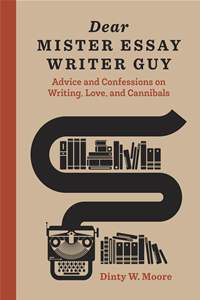
Dear Mister Essay Writer Guy: Advice and Confessions on Writing, Love, and Cannibals by Dinty W. Moore

Finely crafted short essays masquerading as self-effacing jokes about writers and writing, in q&a form.

dear mister essay writer guy

Dinty W. Moore (Between Panic and Desire), the editor of Brevity, solicited respected contemporary essayists for questions regarding the form, so he could answer them in Dear Mister Essay Writer Guy: Advice and Confessions on Writing, Love, and Cannibals. An essay riffing on the question at hand accompanies each q&a. The resulting collection of self-deprecating humor includes bits of writing advice as a bonus.

Cheryl Strayed has concerns about her predilection for the em dash: Moore assures her that “em dashes can replace commas, semicolons, colons, the large intestine, and parentheses.” Brenda Miller worries that Facebook “is like one big communal personal essay”; Moore answers with a selection of his status updates over a period of months, which are as sage and instructive as they are hilarious. Roxane Gay wonders about the value of writers writing about writing. Other seekers of wisdom include Judith Kitchen, Phillip Lopate, Brian Doyle and Lee Gutkind. Moore makes room to share a “found essay” left on his voicemail by Mike the Tree Guy, and to list the side effects of memoir, including “nausea, sleep problems, constipation, gas, and swelling of the navel.”

Moore is rarely serious and keeps his tongue in his cheek throughout, but the result is enlightening as well as entertaining. With fewer than 200 pages, Dear Mister Essay Writer Guy is a quick and enjoyable read, to be taken in pieces as small as the reader prefers. Its witty, modest tone belies the artistry of the essays contained, which are exemplars of the short form.


This review originally ran as a *starred review* in the August 28, 2015 issue of Shelf Awareness for Readers. To subscribe, click here, and you’ll receive two issues per week of book reviews and other bookish fun!


Rating: 7 polar bears, naturally.

The Writing Life by Annie Dillard (audio)

From Dillard’s website:

The Boston Globe called it “a kind of spiritual Strunk & White, a small and brilliant guidebook to the landscape of a writer’s task.

Recalling how I felt about Strunk & White, and my admiration for Dillard, this is promising.

writing lifeThe Writing Life is brief, and very enjoyable. Her voice as read by Tavia Gilbert feels just right for Dillard’s tone, which is knowing, wry, funny, and serious, by turns and often simultaneously (as I believe I noted in my recent teaser).

As fine as this audio version was, however, it left me wishing I’d had more time to peruse and mull. I have already ordered a print version to keep. For one thing: the format is a series of essays, and this format was a little lost on me in audio form. The transitions felt abrupt sometimes. (Perhaps I could have been paying closer attention to signals of transition. A failure of the medium, or of mine? No matter, the point is it didn’t work perfectly for me.) But I let go and just listened. Don’t be fooled by the title: this is neither the story of Dillard’s life as a writer, nor an instruction on how to live it, ourselves. It’s a bunch of musings and meditations. There are pieces of advice, and stories too, mixed in. But it’s a buffet, lots of things at once. It was fabulously enjoyable when allowed to wash over me. Next time, I will study it more closely, in print.

For the Bellingham local in me – and I recommend it to my father for this reason – there are a few wonderful references to this place, including the inspired story of the Bellingham-based stunt pilot. (Other reviewers seem to find this the best chapter of the book. It was certainly among them.) For the place-obsessed me, there were excellent reflections on various places, including islands in the Puget Sound; Roanoke, Virginia; and Cape Cod. About writing, I enjoyed hearing Dillard’s ideas about where to write (“appealing workplaces are to be avoided”) and how to write: I loved the idea that, paradoxically, writers need to live less in order to create the time and isolation necessarily to write about that life which they have somewhat backed away from. There is less firm advice than encouragement – mixed in with discouragement, but of a collegial type.

Reviews out there in the world are mixed, and seem (according to my brief survey) to base their criticism on the idea that this book is made up of wonderful parts, mixed in with less wonderful parts, that fail to make a single, wonderful whole. I guess that might be born out by my struggles with the audio form. But actually, a bunch of wonderful parts is no failure at all, and I was left feeling enchanted. For that matter, I recall that Pilgrim at Tinker Creek had uneven effects on me, too – I can hardly believe that I gave it only 6 mushrooms, because I remember it so strongly and positively, but that shows how much I struggled with some parts of it, too. But really, I say again, we could do worse than many thought-provoking and wondersome components, which is what I found here.

It’s Annie Dillard, y’all. It’s good reading. The audio is good listening, although you may struggle to find it cohesive in that form. But that is the big criticism of this book anyway. So read, or listen, don’t worry about cohesion, and enjoy. I did.


Rating: 8 moths to a candle flame.

Tell It Slant: Writing and Shaping Creative Nonfiction by Brenda Miller & Suzanne Paola

tell it slantBrenda Miller and Suzanne Paola are faculty members in at the local university where I live now, and they have written a book about writing creative nonfiction: this was an easy choice for me. Tell It Slant is instructive, and comes in three sections. First, “Unearthing Your Material” is a series of subjects we might write about: the family, spirituality, the arts, nature. These subjects come with brief successful examples of each from established writers like Didion, Dillard and Talese, and writing prompts; we are exhorted to pay attention to scenes, sensory detail, and dialog. The second section is about “The Forms of Creative Nonfiction,” including the personal essay and more experimental forms; it also covers how to do research, and the ethical challenges of the genre. Finally, “Honing Your Craft” discusses what makes for good writing generally, the importance of revision, and writing groups. Each chapter opens with a very brief piece of creative writing by one of the book’s two authors, and these short pieces are the most simply enjoyable part of the reading experience.

This book was published in 2005, and for the most part works as well today as it would have ten years ago: although the examples of successful essays might look a little different now, the examples are still excellent ones. The only section that felt slightly dated was the one concerning research. Or maybe, as a librarian, it just felt a little simplistic to me. The advice to go find yourself an excellent reference librarian to help you along was and remains very fine advice, though!

I think I struggled a little bit with the ordering of the book. It could have used a little more introduction, or maybe beginning with part 2 would have worked better for me, because the subject-oriented part 1 felt rather like jumping right into a laundry list, lacking context. I settled in, though – and part of what helped me to do this was flipping ahead and scanning parts 2 and 3, to see what I had to look forward to. I certainly saw the value of the writing prompts. They won’t all work for every writer, but there are lots to choose from; and responding to a prompt that feels empty is a worthwhile exercise in itself, I grudgingly admit. The list of recommended reading at the back of the book is valuable: of course it would be updated to some advantage today, as I said, but that doesn’t take away from the quality of the essays listed here, either. (Also, we are directed to ways to keep up to date with the best contemporary essays being published, including literary magazines and best-of collections.)

The audience for this book is never explicitly defined, but I think it becomes clear that it’s written for creative writers who hope to have their work read and appreciated by the public. There is an emphasis on producing work that is appealing to a larger audience, so that this is not a manual for people who write for therapy, for fun, for a hobby, etc. Rather, Tell It Slant teaches us to write for general readership.

I didn’t discover anything earth-shattering here, although the authors’ very brief pieces at the start of each chapter were good reading. I would keep these writing prompts around as practice opportunities. This is a fine primer, and valuable in that it is specific to the creative nonfiction genre.


Rating: 6 sensory details in memory.

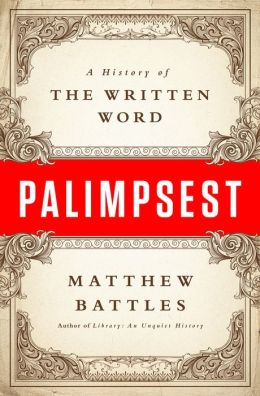
Palimpsest: A History of the Written Word by Matthew Battles

Bibliophiles and historians will be thrilled by this enthusiastic, detailed account of writing throughout history.

palimpsest

Matthew Battles (Library: An Unquiet History) undertakes a mammoth topic with Palimpsest: A History of the Written Word. Rather than an exhaustive chronicle, however, he has composed an extended meditation, a roaming through the centuries. The result is a collection of narrative examinations of writing as a technology, as a means of wielding power, as artistry and as communication. As Battles quotes it, the Oxford English Dictionary defines a palimpsest as a “writing surface on which the original text has been effaced or partially erased, and then overwritten by another.” His imagination is captured by this concept in fact and as metaphor, and Palimpsest is in part a drawn-out consideration of “mind as page” and “page as mind” (the titles of its opening and closing chapters).

Battles’s survey ranges from Mesopotamian cuneiform in the fourth century BCE to early printing, word processing and social media. He explores Thoreau’s views on Confucianism, the clay tablets of The Epic of Gilgamesh, the topology of Chinese hanzi and the fascination with writing in Great Expectations. He is intrigued by the politics of the printing press and various typefaces. Historians, writers, philosophers and anthropologists including Socrates, Claude Lévi-Strauss, Jean-Jacques Rousseau, Emily Dickinson, Ezra Pound and Ralph Waldo Emerson provide context for the philosophical significance of writing. Battles points out that modern computer code is a type of writing as well, “a kind of text that can’t exist on its own. But what other kind of text has ever existed?”

Among other revelations, Palimpsest elucidates the original meaning of “pirated” literature: “not… the unauthorized reproduction of someone else’s work but the use of a printing press without proper license,” and Allen Ginsberg’s modern redefinition of “graffiti,” which originally referred in the Italian to words or ornaments carved in clay forms. How we learn to write changes as our cultural expectations of writing change; thus what Battles calls a “feedback loop” of change in writing technologies perpetuates. In other words, in an increasingly digital age, Battles argues that writing is in flux–as it has been since its beginnings.

Palimpsest returns more than once to an emphasis on writing as art, and Battles’s own writing style is often decorative. The meandering structure of this expansive essay on writing in history, as well as its formal and academic tone, may pose challenges for some readers. However, the reader and writing fan absorbed by writing’s miscellany will find much to love and sink into in Palimpsest.


This review originally ran as a *starred review* in the July 10, 2015 issue of Shelf Awareness for the Book Trade. To subscribe, click here.


Rating: 4 radicals.*

*For my personal reaction to his style, although the quality of writing and research are sure to please other readers.

Teaser Tuesdays: The Writing Life by Annie Dillard

Teaser Tuesdays is a weekly bookish meme, hosted by MizB of Should Be Reading.

writing life

Annie Dillard is wonderful. I am glad to be back with her funny, wise but slight self-deprecating voice – and about writing this time! Wonderful. Check out these words of “comfort” to writers disappointed with their slow pace of production.

It takes years to write a book. Between two and ten years. Less is so rare as to be statistically insignificant. One American writer has written a dozen major books over six decades. He wrote one of those books, a perfect novel, in three months. He speaks of it still with awe, almost whispering. Who wants to offend the spirit that hands out such books? Faulkner wrote As I Lay Dying in six weeks. He claimed he knocked it off in his spare time from a 12-hour-a-day job performing manual labor. There are other examples from other continents and centuries, just as albinos, assassins, saints, big people and little people show up from time to time in large populations. Out of a human population of four and a half billion, perhaps 20 people can write a serious book in a year. Some people lift cars, too. Some people enter week-long sled dog races, go over Niagara Falls in barrels, fly planes through the Arc du Triomphe. Some people feel no pain in childbirth. Some people eat cars. There is no call to take human extremes as norms.

This, I feel, is a great example of her voice: funny and filled with factoids while simultaneously being entirely serious, and empathetic. Of course I am enjoying this audio edition. Strangely, since I mention voice, the voice doing the reading is not Dillard’s. I guess I don’t know what her literal voice sounds like, but the reader here is suiting me fine.