The Essayist’s Dilemma (Occasional Papers on the Essay: Practice and Form, from Welcome Table Press) by Marcia Aldrich, Lucy Ferriss, Kim Dana Kupperman, and E.J. Levy

Disclosure: Kim Dana Kupperman, one of four contributors to this pamphlet and founder of the press, is currently my semester advisor.


This paper is available for free download here.

I expected a rather dry read, a how-to, a craft book(let), in short. Instead I found a brief, punchy discussion, in four voices, of something that matters to me. It was quick and fun to read. I’m so sorry I doubted.

This is such a brief piece of work that I’m in danger of writing more in review than there is to review, but here goes. Marcia Aldrich’s introduction sets up the dilemma: publishers don’t like essay collections; essay is a dirty word; essayists have trouble getting published as such. (Examples given.) Lucy Ferriss responds with “The Parts and Whole”: the idea of needing to group a collection around an idea, to make the whole greater than the sum of the parts, is not such a bad challenge, and one that can yield good results. We should not resist this push. Kim Kupperman, in “An Essayist’s Dilemma,” shares the journey (I just used that word because Kim hates it. Sorry, Kim)… the evolution her book I Just Lately Started Buying Wings experienced on its way to the form in which I read it. As she sums up: “a question, a taking apart and reassembling, a husband’s instinct, a poem’s fever, an editorial directive, and, finally, a return to an original idea.” Finally, E.J. Levy writes “In Defense of Incoherence”: she quite likes a thoroughly disconnected essay collection, thank you, and screw commercial concerns.

It’s all good, useful stuff. I think it’s true, that essay collections are unpopular with publishers, because they are unpopular with the (profitable) general readership. Ferriss’s argument makes perfect sense to me, perhaps because my mind works the same way, or I believe the same thing she seems to: that an overarching and unifying idea (or the dreaded theme) is a good thing. This is very much the concept that Levy argues directly against in her piece. As a reader, I am much more like the profitable general reader than I am like Levy. I prefer unity. In fact, I have long resisted reading essay collections, especially when they are presented as miscellany. I realize how damning an admission this is: I hope to write and even publish essays; but I don’t want to buy or read them. Well, it’s a little less damning than that, because I hope to write and publish a memoir-in-essays, or a decidedly connected collection.

Kim, as I read her, does not take a position on whether connectedness is desirable or no. I loved reading the story of Wings; it was the perfect example to learn from, since I studied this and her later memoir rather closely and have been getting to know the author herself some. (Also, its organization is a little unusual, or complicated, but clearly it has an organization.)

Although I don’t read and think the way Levy does, I enjoyed reading her opinion – especially as she called in Fisher’s Consider the Oyster:

I’m a fan of M.F.K. Fisher’s work, but by the time I’m on the fifth oyster in Consider the Oyster, I’m queasy. It’s nto that such a strategy can’t work, but that it makes me suspect that the essayist was considering something other than the oyster–a check from a publisher maybe, the adorableness of her own conceit.

My first thought was, Levy does not like oysters as much as I do. I’d love the opportunity to discover how many oysters it would take to make me queasy! I haven’t found it yet. Seriously, I see her point; but I guess I also found Fisher’s conceit adorable, enough to be unbothered by it. Maybe it’s just how much I like oysters.

Perhaps the greater point here is that we all, always, still, have different preferences. I agree with the thesis of this pamphlet (as I see it), that a preference for a disconnected miscellany of essays is less universal than an appreciation of connected collections (or books with narrative arcs, like memoirs). And I’m on the side of the majority here. That will make it harder to publish the unconnected. I hope it still happens, because I desire a multitude of options and value the tastes of the minority; but I agree with the majority, taste-wise, and with the problem presented here.

I guess the most optimistic thought I have to offer is: this is why we have Welcome Table Press, Kim Kupperman’s small press that publishes weird little essay things that perhaps no one else wants; and thank goodness for that, and for all the other small presses that publish the minority’s desires. It’s The Long Tail all over again, and I’m in favor of it.


Rating: 9 brief and well-stated arguments.

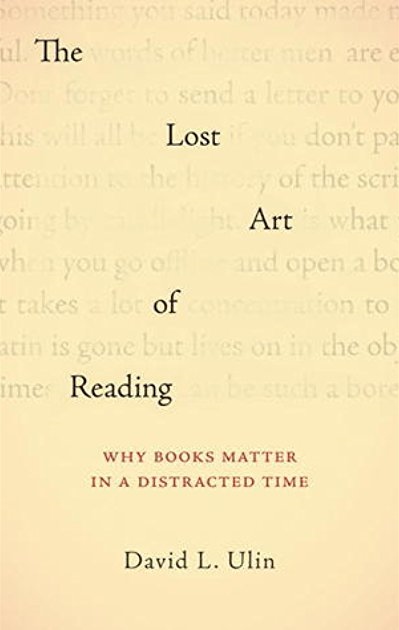
The Lost Art of Reading: Why Books Matter in a Distracted Time by David L. Ulin

This is a longform essay about reading, inspired by Ulin’s son’s struggles to read and annotate The Great Gatsby (for school, naturally). Over its course, Ulin ranges widely over his own book-reviewing career; his relationship with his son; the reading habits of the author and others (including many other writers); studies of brain science and distraction patterns; politics and current events; the nature of memory (in memoir, in Ulin’s personal observation, and in scientific studies); e-readers; and much more. Though it was assigned to me as a craft book–meaning an instructive book about craft–I found an interesting element in Ulin’s own writing: his use of parenthetical quotations from other writers.

This could be a sort of self-referential exercise, too: a longform essay about why it’s so challenging these days to read such things as longform essays. (This book began as an essay in the Los Angeles Times, which was then expanded into the fuller-length version here, at ~150 pages.) I confess I found my attention wandering at times, which could be commentary on many issues, of which only one is Ulin’s talent on the page: distracted times, indeed. Overall I did enjoy the discussion, including the meanderings into the utility of the e-reader and Obama’s popularity ratings, and you won’t be surprised to hear that Ulin and I are in sync on many conclusions about the state of the world and of reading. “It’s harder than it used to be, but still, I read.”


Rating: 7 titles.

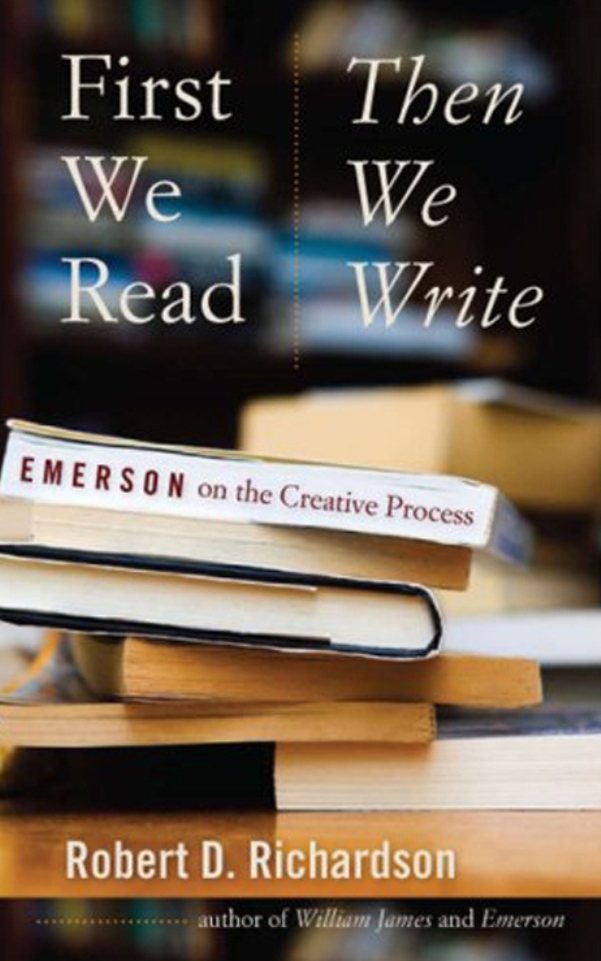
First We Read, Then We Write: Emerson on the Creative Process by Robert D. Richardson

My advisor Kim recommended this book to me as a craft book, although it is not quite a how-to, but rather a contemplation on the reading/writing life.

This short study of Emerson on the subject of writing (by an Emerson expert) is a brief, accessible view on the man. Quotable, but more than a collection of quotations. Richardson portrays a complete man, not simply a set of accomplishments. This Emerson is fascinated with writing as process and lifestyle, philosophic, and committed to exposing his own shortcomings.

I found it worthwhile, and an easy way into Emerson, who I haven’t found terribly approachable before now. I noted several quotations. The part especially intrigued me, in the final pages, where Emerson and Goethe are in some conversation about how intimidating it can be to observe the greats who have come before us… I often feel, when I discover a wonderful, new-to-me writer, both inspired by their achievement and discouraged by how high the bar has been set. And then of course the closing idea that to be a writer is to “abdicate a manifold and duplex life”! Whew.

An easy read, by turns encouraging, thought-provoking, and challenging.


Trivia of which I was unaware: Richardson is married to Annie Dillard. When I read this at the close of his ‘Acknowledgements’ (at the end of the book), I thought, ah! there’s the wisdom. (Some of you may recall that I have a complicated relationship with Annie Dillard–not all love–but enormous respect.)


Rating: 7 white whales.

The Triggering Town: Lectures and Essays on Poetry and Writing by Richard Hugo

A delightful, short, rich book about writing, deserving of (literal) pocketing alongside Strunk & White’s The Elements of Style.

This book is subtitled “lectures and essays on poetry and writing,” but I found it as intriguing as a creative work in itself as it is a wise craft book. On the surface, it appears aimed at poets, but I think all writers can benefit. Hugo has a refreshingly irreverent attitude and I wish I could have known him–he died the year I was born.

His self-effacing, humorous, but somehow also very serious approach to writing makes perfect sense to me, and his ideas about practice and luck mirror things I’ve been thinking for some time: that all the “bad” work we put in makes room for the good, and that practice allows for luck. (See the title essay, “The Triggering Town.”) There are some lovely essays in this book, as pieces of craft in themselves. How do we count a craft book? I considered annotating either of the last two, “Ci Vediamo” and “How Poets Make a Living” (that is, writing a craft essay for school about one of these essays). The line between craft books and creative works can be broad and fuzzy, can’t it. Recall again Strunk & White, which is such lovely, humorous, personality-rich writing. I’ll be returning to this one for encouragement and warm feelings. And maybe I’ll get around to annotating some, even.


Rating: 9 cartons of cigarettes from Spinazzola.

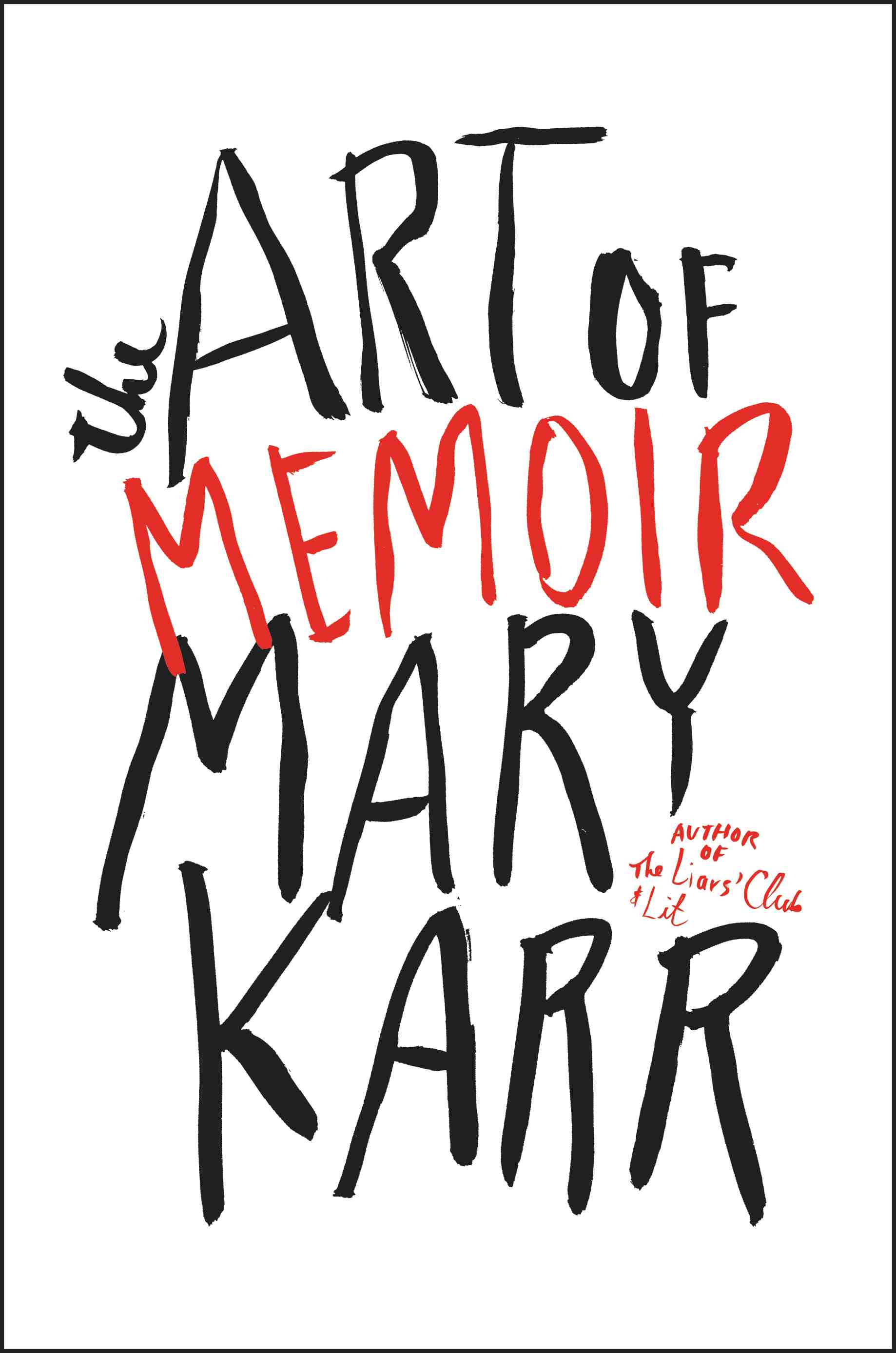
The Art of Memoir by Mary Karr

Another gem from Mary Karr. As a craft book, this one has it all (that is, all the things I like): a friendly, approachable, authentic-feeling voice; lots of references to other books with succinct, clear commentary; a balance between practical advice, appreciation, and commiseration; a humble, self-deprecating approach from a well-respected author. Also, I just really like Mary Karr.* Her on-the-page personality comes through so clearly and feels so much like someone I’d like to know. (Our hometowns, though very different, are less than 100 miles apart. My affinity for place makes me wonder how much this contributes to my feeling of kinship.)

The Art of Memoir is just over 200 pages long, including a 6-page, densely-packed reading list* (always exciting, and intimidating!). It begins with Karr’s “Caveat Emptor,” a disclaimer in which she writes, “no one elected me the boss of memoir.” One of the recurring concepts in this book is Karr’s reluctance to take up the mantle of expert; but she does acknowledge her “fifty-plus years of reading every memoir I could track down and thirty teaching the best one (plus getting paid to bang out three)”. She then takes us through a study of some of her favorite memoirists–Nabokov, Harry Crews, Maxine Hong Kingston, Kathryn Harrison, Michael Herr–and, with apologies (“if I didn’t have to pay out the wazoo to quote from better books than my own, I’d have way more Nabokov in here”), her own work. She offers chapters with titles like “Why Not to Write a Memoir” and “How to Choose a Detail,” and focuses on carnality (“sensory impressions, not sexual ones”), lies, individual talents, how to deal with loved ones, blind spots and false selves, exaggeration, and so much more. Unsurprisingly, she places early and heavy significance on the subject of voice, and there may be no writer more qualified. It’s one of the things Karr does best, in my opinion.

Perhaps for that reason, I was especially charmed at what she had to say about Harry Crews’ A Childhood: The Biography of a Place:

At the time I came across A Childhood, I was an academically uncredentialed former redneck Texan trying to pass myself off as a poet in hyperliterary Cambridge. Crews had lost time trying to hide his own cracker past, and then he’d written about that milieu in a book that would serve as my lodestar. How good it is, I can no longer gauge. But it helped to guide me out from my biggest psychological hidey-holes. Reading Crews, I found the courage to tell the stories I’d been amassing my whole life. I include so much of him here to underscore how mysterious a single influence can be if he shares a novice’s foibles. Were I a tattoo-getting individual, I’d owe him some fleshly real estate.

That kind of enthusiasm is catching, of course, and I was convinced to go straight to Crews; in fact, I had to put this book down to read that one (for reasons of school schedules). In case you missed my review of that book, here it is. And directly after, I turned back to Karr for a reread of The Liars’ Club. (Fresh review coming up on Friday.) I have yet to find my way to her acclaimed memoirs Cherry and Lit, but I think they’ll be on the list.

Like the best craft books, this one makes good reading in itself.* It’s not a manual. Karr’s personality on the page is worth spending time with, and she makes the appreciation of good writing more accessible. She writes for general readers (and warns them, when things are about to get technical, that they might skip the next few pages). There are also passages specifically for writers: a list of “old-school technologies for the stalled novice,” for example, that does not rely on writing exercises. In short: there is much to love here. Not least, Mary Karr herself.


Rating: 8 inner enemies.

*These are all things I could have written about Stephen King’s On Writing as well, and they would have been equally true. It’s no coincidence that I enjoyed both of these books. If you like one, do go find the other.

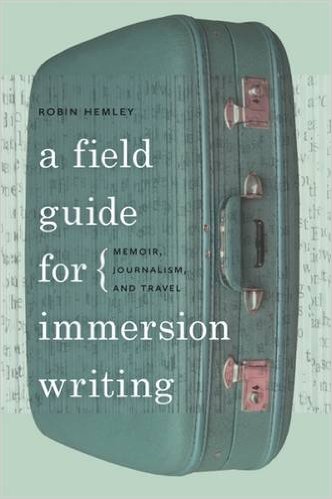
A Field Guide for Immersion Writing: Memoir, Journalism and Travel by Robin Hemley

field-guide-for-immersion-writingThis is the fourth “craft” book I’ve read this semester, and it’s one of the better ones. The Art of Subtext was an intriguing read, but so thoroughly geared toward fiction writing that it was less useful to me. The Situation and the Story felt a little wandering and indistinct. On Writing was of course wonderful – as an insight into King the man and the writer, as well as for his writing advice, which is largely on the sentence/language level and therefore applicable to nonfiction as well as the fiction that King specializes in.

By contrast, A Field Guide for Immersion Writing is specific in terms of the writing it addresses. I really appreciated Robin Hemley’s breaking down of immersion genres: first into travel, memoir, journalism, and then into quest, experiment, investigation, reenactment, and infiltration. (All of this makes sense in his thorough discussion. And there are examples.) I also really appreciate that he recognizes these as fluent: “The categories are meant to be useful, not binding.” He then works methodically through his categories and sub-categories of (nonfiction) immersion writing, addressing their fluid boundaries throughout, and offering advice about how to do both the immersion, the living and interviewing and learning, and the writing. He also speaks to the practical side of the writer’s life: how to pitch proposals, how to fund travel and research, that kind of thing.

Perhaps one of the most important things that made this book work for me was that I liked Hemley’s voice – which is to say first of all that he had a voice, that he let some feeling for his personality live in this book. (He was referring to immersive travel writing and not writing about craft, but see this line: “To me, it’s an act of generosity to introduce yourself, to say, This is who I am and why this story is important to me, and these are the people I met along the way.” [emphasis his] I hear this as an echo of something I’ve long believed: to not let oneself come into one’s writing is sort of dishonest. We know you’re there, so show yourself.) Hemley shows himself; and I liked, felt like I got along with, the person I met there. So I was primed to take advice from him. Also (as in the above parenthetical quotation) I found that we had some principles and opinions in common, again making me interested in following him. The point here I think is that our reactions as readers are subjective and personal (duh, right?), so if I vastly preferred Hemley’s craft book to Gornick’s, that doesn’t mean you’ll feel the same way.

That said, I do think that this “field guide” offers a wonder of practical advice, specifically geared towards a certain type of writer. Its specificity is definitely one of its greatest strengths (if you’re in that group of writers – see again The Art of Subtext), and it offers a huge number of examples of immersion writing that work in various ways. So, plenty of reading there.

More wisdom: Hemley writes, “Book projects are protean: you start out thinking you’re writing about one thing, but the book you write almost never turns out to be the book you set out to write.” This echoes something I’ve heard from a number of other students (and graduates, and faculty) in my MFA program, and it’s something I find intriguing, and both promising and scary.

I liked this book, and I liked the author enough that I intend to (someday) read his Nola: A Memoir of Faith, Art, and Madness, about his sister. That’s an endorsement.


Rating: 8 suitcases.

The Art of Subtext by Charles Baxter

the-art-of-subtextCharles Baxter is the editor of Graywolf Press’s The Art of series as well as the author of this installment. This is the second in the series that I’ve read (see The Art of History), and I’ll be reading two more this semester (Donald Revell’s The Art of Attention and Mary Karr’s The Art of Memoir).

The first thing to note about this book of writing craft advice is that it is strongly geared toward fiction. Where the others tend to cross genres (well, I suppose the Memoir one won’t), Baxter refers to fiction throughout, and takes his examples from the fiction of Dostoyevsky, Melville, Edward P. Jones and others. While this made for interesting reading, it did not suit my personal needs as a nonfiction writer very well. (I was disappointed, especially as excerpts from Baxter-edited The Business of Memory have appealed to me.) I was drawn to the topic of subtext because I aim for subtext, or subtle themes, in my own writing. Subtext means something a little different to Baxter in this book.

He calls it in his introduction “the unspoken soul-matter,” and divides his thoughts into 6 sections. “Staging” refers to dramatic placement of characters in scene (as in stage directions). “The subterranean” refers to the difference between what characters truly want, and what they say they want. This is an interesting concept to ponder for characters in nonfiction as well, although all of Baxter’s examples come from fiction. “Unheard melodies” inspects how fictional characters fail to pay attention: think about short attention spans and the way we “uh-huh” each other without really listening. This kind of ignored dialog, he argues, is a great place for subtext. “Inflections” and tonal shifts mark a movement from the literal to the suggestive; and he makes the point here that tone is sometimes everything. Example: the phrase “you’re really something” could be spoken in disgust or adulation. On the page, the reader needs tonal cues.

“Creating a scene” refers to the way that phrase is used in everyday life and not by writers: that is, not writing “a scene” (action taking place in time and space) but in the sense that arguing in public is called “making a scene.” Baxter asserts that fiction writers must have their characters make scenes in order to get their conflicts out into the open, or in other words, to pose the central conflict of their plot. Finally, he writes about “loss of face,” or the use (or choice not to use) characters’ literal faces to communicate through gesture or appearance. He makes a curious argument that the description of faces has fallen away in modern fiction writing, which is another interesting claim to investigate, although not one I’m particularly invested in at this time. (Please report back.)

My single favorite line of this book, and one I can easily take into my own work:

In truly wonderful writing, the author pays close attention to inattentiveness, in all its forms.

That one I will carry forward and ponder. Within it there may be an opportunity to ponder the differences (for craft purposes) between fiction and nonfiction in general.

In short, an involving little book of lit crit focusing on fiction, and thus not outside my interests; but not terribly useful for my own writing. Your mileage may vary.


Rating: 6 Chekhov stories.

MFA readings: a selection

Perhaps predictably, my rate of reading & writing for school threatens to outpace my work on this blog; and school is my priority, of course. Here I thought I’d just offer a quick rundown of what I’ve been reading lately and how it struck me. (Titles are bolded.) There may be more selection or digest-style posts to come.

My program director, Jessie Van Eerden (a most impressive woman & writer), put together a packet of portrait essays for a seminar she’s taught in the past, and shared this packet & her notes with me. I had a variety of reactions to these essays, which is totally okay: some will be more useful to my studies than others, and these reactions are all subjective.

I was most intrigued by

  • “Tracks and Ties” by Andre Dubus III;
  • “A Mickey Mantle Koan” by David James Duncan;
  • “Interstellar” by Rebecca McClanahan;
  • “The Passions of Lalla” by Michael Ondaatje; and
  • “A Good Day” by Jessie van Eerden,

and did some close readings especially of “A Good Day” and “Interstellar,” two profiles of the authors’ mother and sister respectively that include some autobiographical detail as well, and take certain organizing principles to help them tell the story of a whole person or a whole life in just a few pages: what a skill. I feel like maybe I’ve read “A Mickey Mantle Koan” before. It examines a beloved brother through a single object, one he never held in his hands, and integrates the language of both baseball and Buddhism, and lets the author do some more existential musing as well: ambitious, but executed. “Tracks and Ties” is another hyper-compressed profile, and “The Passions of Lalla” is especially interesting because it tells the life story of a person the author (apparently) never knew, through research, family mythologies and speculation. I hope to find time to go back to that one.

Of “Bessie Harvey’s Visions” by Will Woolfitt, Jessie writes, “Technically, this is a poem, but Woolfitt first wrote it as a lyric essay (same material sans line breaks).” I enjoyed reading it, and found the imagery and atmosphere involving, but I couldn’t see so clearly how to make this experience useful to my own writing.

Similarly, I was engaged by three longer profile essays –

  • “Present Waking Life: Becoming John Ashbery” by Larissa MacFarquhar;
  • “Notes on Pierre Bonnard and My Mother’s Ninetieth Birthday” by Mary Gordon; and
  • “Fuller” by Albert Goldbarth,

at least two of which have in common that they conflate or compare/contrast two very different subjects: Gordon swims between the art of Pierre Bonnard and her mother, as Goldbarth floats between Marie Curie and the dancer Loie Fuller. MacFarquhar more subtly lets her own character (herself) enter her examination of the poet John Ashbery. These again are worthy of study but didn’t feel right for my uses at this time.

By contrast, there were two essays in this packet that I just failed to enter at all. “The Shape of a Pocket” by John Berger and “Decreation: How Women Like Sappho, Marguerite Porete and Simone Weil Tell God” by Anne Carson felt too cerebral, too much work to wade through. This is not where I’m interested in going. In the latter case, the problem may be that I’m not drawn to the question of how these women “tell God”: and is Carson’s failure to bring me in despite my feelings about the subject matter her shortcoming, or a simple, blameless lack of connection? I may not be the right person to answer that last one.


up-in-the-old-hotelAs a separate project, I read essays from Joseph Mitchell’s Up in the Old Hotel, a big fat book I’ve had on my shelf for years. Saint Mazie and Joe Gould’s Teeth both refer to Mitchell’s work. He is famous for his decades of work for The New Yorker, and his portrait essays in particular.

I enjoyed every word I read–including the Mazie portrait, which I recognized from its reflection in Attenberg’s novel–but I settled on the title essay, “Up in the Old Hotel,” for my craft annotation. All of the essays I read showcased a seemingly neutral and nearly invisible narrator, and let the subjects portray themselves by use of dialog and speech, as well as physical descriptions, anecdotes and settings. The “Old Hotel” was remarkable because it told a lot more story than some of the straight portraits did; and its subject is not a person (although the central character Louie is very central) but a building, the old hotel. I focused in particular on the middle 12 pages of the piece, which offer a nearly uninterrupted monologue given by Louie, with minimal paragraph breaks and a wildly digressive style. Writers are warned against such techniques; but they work beautifully here. I think that’s because Louie’s voice is so strong and engaging; his style is so conversational that the reader buys into the delivery method completely; and because of Mitchell’s few but very strategic interruptions (Louie stops to make change, answer a customer’s question).

I recommend reading Mitchell if you get a chance.


the-situation-and-the-story
Finally, for craft, I read Vivian Gornick’s The Situation and the Story: The Art of Personal Narrative. This one didn’t work for me: in a word I’d say her succinct introduction and conclusion do the work her book wants to do, while the fatty middle part (two sections, on the essay and the memoir) read to me like wandering lit crit, and had little to offer me in thinking about my own work. Gornick has received plenty of positive response for this book, but my reaction was tepid. Her analysis of a number of essays and memoirs would have been more interesting to me if we had more reading in common, of course. But I am reminded of Christopher Bram’s The Art of History, which spent a lot of time giving negative or positive reviews that I did not always agree with, and which seemed so subjective that I was a little turned off. Yes, I see the irony as I give this negative, subjective review. But note that I am not here to sell you writing advice. By this point in the lifetime of pagesofjulia, I figure my readers know what we’re doing here together. (Thanks for sticking around.) If you loved The Situation and the Story or found it very useful for your writing, I’d love to hear your explanation of that experience. Not to argue, but to learn.

That’s my long post for today–now back to the program!

On Writing by Stephen King

on-writingThis book is required reading for all Stephen King fans, whether they aspire to be writers or no.

On Writing takes an interesting format. This is a “craft” book – instruction for writers – and the first of that category that I’m reading for the semester (though not the first I’ve read). But it’s not all craft; or at least not explicitly. Mine is a 2010 edition of a 2000 book, and it contains sections: first the First, Second, and Third Forewords; then a C.V., which is a sort of memoir but only about the writing or storytelling parts of King’s life. This spans some 80 pages and includes some writing advice along the way (including a little bit of marked-up early work). Next, “What Writing Is” (“telepathy, of course”) and “Toolbox” (as in, the writer’s, but with a nice metaphor referring to a real one). Now we get to the section called “On Writing,” which begins on page 141.

King’s rules are relatively simple: things like “read a lot, write a lot,” and some thoughts on how to separate writing from editing (get it all down on paper as quickly as possible, then leave it alone for a while til you can come back with an objective eye). He despises adverbs as much as the next wise reader/writer, especially when tied to speech tags. He touches on dialog and theme. Language is very important to King: this book is dedicated to Amy Tan, who told him it was okay to concentrate on that aspect of craft. (Some of us are thinking, duh.)

Even this writing-advice section is (perhaps necessarily) filled with details from King’s personal life, and his personal work style. This is why I say this book is an excellent read for anyone who loves King, whether they wish to write or not: it’s filled with the man, and the writer, himself, not to mention his characteristic storytelling style, even when giving advice. He writes characters, and the details of character and scene, so richly it’s almost multimedia; and yet we never realize we’re reading (yawn) exposition.

The next section of the book is “On Living: A Postscript,” and if you are indeed a King fan, you’ll notice that this book’s original pub date in 2000 immediately follows a certain 1999 event, when he was hit by a van while walking the back roads of Maine and nearly died. He relates this incident and his recovery in some detail here, and it makes a riveting story, of course, even though his reader knows the general outcome beforehand (the writer lives to write about it). The point here – though not belabored – is that living is an important part of writing. And, “Writing did not save my life–Dr. David Brown’s skill and my wife’s loving care did that–but it has continued to do what it always has done: it makes my life a brighter and more pleasant place.”

There are three “Furthermore” sections, to match the three forewords that started the book. These appendix-type bits are an example of a story before and after editing; a recommended reading list (totally unscientific, just what King has enjoyed reading), and a second reading list as addendum in this 2010 edition.

I haven’t even mentioned some of the writing advice I found most helpful here; for example, the concept of a piece of work as a found thing, a fossil, which then needs just excavation and polish, is especially applicable I think to nonfiction. (King admittedly concentrates on fiction – his genre – throughout, but that doesn’t mean there’s not plenty here for other writers.) And I loved his reverse of the gun rule:

There’s an old rule of theater that goes, “If there’s a gun on the mantel in Act I, it must go off in Act III.” The reverse is also true; if the main character’s lucky Hawaiian shirt plays a part at the end of a story, it must be introduced early. Otherwise it looks like a deus ex machina (which of course it is).

The best of Stephen King is here, and with some good writing advice to boot. Don’t miss this one.


Rating: 9 Very Important Books.

The Delicacy and Strength of Lace, letters between Leslie Marmon Silko & James Wright, ed. by Anne Wright

the delicacy and strength of laceAs I wrote in my beginning, I enjoyed this book more than I expected to. I struggle with poetry, and the snippets included here out of context (it seemed to me) challenged me. I was not familiar with the protagonists. But quickly their voices and personalities revealed themselves; and the story of James Wright’s death, and the introduction to this book by his wife, add a poignancy. There’s something about knowing the sad ending to a story before you read it.

I found many lovely lines (naturally) and scraps of wisdom here. My instinct is to just begin sharing those with you.

I enjoyed Wright’s lines,

I hope you don’t mind post cards. They are a way of sharing something, some place or other delight, and they can also, when written and sent truly, offer small wavelets, so to speak, to the rhythm of a correspondence.

and perhaps even more, that he wrote so instructively, so consciously of this – that he felt the need, and the meta-quality of explaining one’s correspondence. They were still kind of new to each other, you see.

From Silko,

I always resented Shakespeare’s use of the delayed messenger in Romeo and Juliet, maybe because such things are so ordinary and so possible, and so much can be lost for two people that way.

which is both amusing, and profound, and a little confusing – why resent the use of something ordinary and enormous, and isn’t that what we do as writers? Hm.

And then,

I believe more than ever that it is in sharing the stories of our grief that we somehow can make sense out – no, not make sense out of these things… But through stories from each other we can feel that we are not alone, that we are not the first and the last to confront losses such as these.

and I think of the impulse we all seem to share to tell our stories in response to one another. This can be selfish. One person shares something personal and painful, and the response is “well I…” or “my…” as if to turn it back to the speaker every time. But Silko has a point, that there is a function to this return-to-me, and that in the right setting & relationship it’s how we perform empathy. I think about this in conversation sometimes, the effort to not always “me” everything. But it can be well done.

And very pertinently to nonfiction writers in particular, Silko again –

Memory is tricky – memory for certain facts or details is probably more imaginative than anything, but the important this is to keep the feeling the story has. I never forget that: the feeling one has of the story is what you must strive to bring forth faithfully.

This is the trick, or the puzzle, and the much-discussed central problem, with creative nonfiction or with memoir: the tension between strict “fact” (which is what, exactly?) and the richness of imaginative memory. See also Sejal H. Patel’s “Think Different” in issue 58 of Creative Nonfiction (I reviewed here), where she and other memoirists explore the use of technologies to aid memory.

Finally, and perhaps most centrally to the question of correspondence in general and especially between writers:

With you to write to, I go through the day with a certain attention I might not always have. I look for things you might want to see for yourself, but I can’t seem to get them into a letter.


I enjoyed reading this slim epistolary collection, and I think I got a lot out of it. But what was I supposed to get out of it? Despite a few classes taken early this year, I feel rusty at reading literature with a class in mind, and I am so curious about what the seminar that assigned this book will hold. Most of all, I’m excited. So thank you, school and world, for that.


Rating: 8 roosters.