art museums: Intersections, The Infinity Machine, and the Surrealists

I made my first trip to Europe with my then-boyfriend, who had an art degree. We went to Brussels and therefore to the Musées Royaux des Beaux-Arts de Belgique. We spent 8 or 9 hours there, and I have felt an aversion to art museums ever since. (I will say that the Mauritshuis in den Haag is a nice, small art museum filled with classics, including Girl With a Pearl Earring, which is easy to get through fairly quickly and is worth the time.) Despite this aversion, on a recent visit back to Houston, I went with my mother and my “other parents” (old family friends) to a few art museums on a Friday afternoon.

We started with Intersections, by Anila Quayyum Agha, at the Rice University Art Gallery. The piece is a six-and-a-half-foot cube of laser-cut wooden cube, suspended, with a bright bulb inside, so that the pattern cut out of the cube is projected onto ceiling, floor and walls. That pattern is a complex tessellating geometric design, and a short and very worthwhile video explains that Anila Quayyum Agha was inspired by the Alhambra. As a Muslim woman in Pakistan, she was not allowed into mosques (men only) and had few experiences with their interiors, but was struck by the extraordinary beauty and creative power in the Alhambra (which she was permitted to enter as a tourist.) She also spoke of the construction of this beauty by Muslims, Christians and Jews working together, and called it a “gem” of both artistry and unity between peoples. This was the inspiration for Intersections, whose tessellations echo the tile designs at the Alhambra.

Intersections, Anila Quayyum Agha (with Karen, Susan and Bob)

Intersections, by Anila Quayyum Agha. (With Karen, Susan and Bob). Click to enlarge.

It is a work of light and shadow, geometry and projection. The images on the ceiling and floor (closer to the cube) are crisper than those on the walls (which are further away), so the effect is variable. The cube itself is a work of art (although watch out for that ~600-watt bulb within), and the shadow/light-show another layer of it. People entering the room participate, because the shadows are cast on them (us) too. It was striking and meditative, and free at the University. Good stuff.

Next, after lunch, we went to the Menil campus, and walked first over to the Byzantine Fresco Chapel to see The Infinity Machine, by Janet Cardiff and George Bures Miller. This was an excellent counterpoint to Intersections: another room-sized installation playing with light and, in this case, reflection. Many mirrors are suspended on wires and rotate – around as one large constellation, and also in some cases individually. The room is very dark; a docent escorted us in with a flashlight to seat us on a bench until our eyes adjusted. A few lights lit the solar system of mirrors, and we suspect those lights dimmed and brightened or shut off completely or changed colors. It is hard to say, because the effect is disorienting. I had the odd feeling that different mirrors were present upon each rotation: clearly this is not the case, but the view was ever-changing and, I felt, never repeating. It was kind of intense. A soundtrack played, of NASA recordings of solar wind. Perhaps because we had just lunched at the Hobbit Cafe (always a treat), I said it sounded like the Eye of Sauron. I also thought of calling it “dark noise”: like white noise, but darker, spooky. At one point I thought Sauron was coming to get us on a train, with that characteristic clack-clack and growing whoosh. Where Intersections was light, crisp, patterned, and explicitly called for unity, The Infinity Machine was a little foreboding, even threatening – although I was very happy to experience it, and don’t mean that as a criticism. It was fascinating.

We finished with the Menil Collection building, about which I was most ambivalent, but there was a Dalí exhibit! I was enchanted by some of the artifacts in the Arctic Art collection, including a tiny statue of a bust (of a man?) with toddler on its shoulders; it was less than the height of one of my (cut-short) fingernails, and a fraction the width. I quickly browsed the “frottages and rubbings” exhibit. And then surrealism: lots of Victor Brauner and Max Ernest, several Joseph Cornell boxes (an exhibit of whose work first took me to the Menil, in high school), a few Picassos, and oh, Rene Magritte. I love him – although I didn’t feel he fit perfectly in this collection. His images are so crisp and hyper-real, even if they do float in the wrong places. Dalí’s Eggs on a Plate Without the Plate centered this exhibit, which was entitled “The Secret of the Hanging Egg.” But my favorite piece was The Hunted Sky by Yves Tanguy, which transfixed me. I wish I had a full-size print of that in my home to continue to consider, because I feel like I need more time. (You can look it up online but those images do no justice.)

Still, overall and by comparison, I moved through the Menil Collection quickly; I think the room-sized installations are more generally my speed than rooms filled with paintings. But this was a remarkable experience all around. I normally make it into an art museum every year or so, or less often, and generally at my mother’s side (I try to be good-natured about it, she doesn’t drag me). Today’s visit was at least as rewarding as any I can recall. If you find yourself in the neighborhood of either of these big installations, definitely check them out. Everything we saw was free, too (great job, Houston!), so take advantage!


Rating: 9 reflected or projected tones of light.

Teaser Tuesdays: Thunder & Lightning by Lauren Redniss

Teaser Tuesdays is a weekly bookish meme, hosted by MizB of Should Be Reading.

thunder lightning

This is a lovely, gorgeous art book, you guys, and isn’t weather fascinating? Clear win all around, and I can’t wait to share my review with you. For now, I couldn’t help but indulge in these lines, which cracked me up, in a men-Mars-women-Venus sort of way.

Look at men’s and women’s boots. The first chill in the air in September or October, women’s boot sales go right through the roof. Now, the weather’s still nice at that time of year in a lot of the U.S. Men’s boot sales don’t budge. Men’s boot sales move much later in the season, in late October or November when it’s really cold and really wet and men’s socks are getting wet.

(From a lengthy quotation by Frederick Fox, CEO of Planalytics.)

Even with intriguing and whimsical text, the visual art is the best part. Sign up for your copy now.

This quotation comes from an uncorrected advance proof and is subject to change.

Lovers at the Chameleon Club, Paris 1932 by Francine Prose (audio)

lovers at theAgain I took way too long to listen to the whole of this audiobook, which might hinder my review a little. But it worked out rather well: Lovers at the Chameleon Club, Paris 1932 is an engaging story, that covers a number of years and is told from a number of perspectives. This might have been confusing when broken up over such a long time as I took with it, but it wasn’t. Instead, it felt like it helped me dip in and out more easily: lots of time passed for the characters too in between my visits to them, so it felt natural, if you see what I mean.

The time and place setting are in the title; or rather, the title of the book is the name of a photograph, taken in 1932. The story remains in Paris (with one brief sojourn to the countryside nearby), covering the years before and during the German occupation. Several characters relate events from different perspectives, including an American writer whose voice is heard through the books and articles he writes about life in Paris at that time; a Hungarian photographer in love with Paris, writing home to his parents; a French girl who is the girlfriend of the writer and then the photographer, writing a memoir which is to be destroyed upon her death; the wealthy French woman who is the photographer’s patroness, writing her own memoir; and a woman, a couple of generations later, writing the biography of the notorious Lou Villars.

Lou is at the center of this novel, although she has no first-person voice: we only know her through the eyes of others. She had an unhappy childhood; was taught to lift weights by the nuns; had a promising athletic career until her coach tried to rape her; worked at the Chameleon, a nightclub for cross-dressers; became a professional racecar driver; met and was awed by the Fuhrer; became a spy for Germany and a torturer for the Gestapo. She is a French cross-dressing lesbian athlete, passionate about France and Joan of Arc, an unhappy woman easily swayed by those who flatter her. She is both a representation of Evil and a complicated question about how a person gets that way.

Prose’s many narrators create interesting questions, too. Are any of them, in the end, reliable? (Questions about the truthfulness of one in particular will be raised in the final pages.) There are many layers to this novel: the beauty and tragedy of Paris before and after the Nazis arrive; the fallibility of human nature; the visual arts (our famous photographer does much of the symbolic work, joined occasionally by Picasso); the challenges faced when any of us seeks to represent the past.

This is a fictional story but based in part on real people. The Hungarian photographer is based on Brassai, who took the picture called “Lesbian Couple at Le Monocle” which is described in the novel under the title “Lovers at the Chameleon Club, Paris 1932” and, obviously, serves as the keystone image of the book. The American writer is based on Henry Miller. The real people are simply starting points, though, along with the powerful, mysterious photograph which titles the novel. The story itself is an imaginative work, deeply intricate in its telling (all those narrators!), and compelling. I was intrigued, and certainly recommend Lovers at the Chameleon Club, Paris 1932 as enjoyable and thought-provoking. The audio version very appropriately uses various narrators for the various voices, complete with accents, and was a great way to experience the book.


Rating: 7 cigarette lighters.

Paris Red by Maureen Gibbon

The model for a famous Manet nude is exquisitely fictionalized as a young woman voracious for experience.

paris red

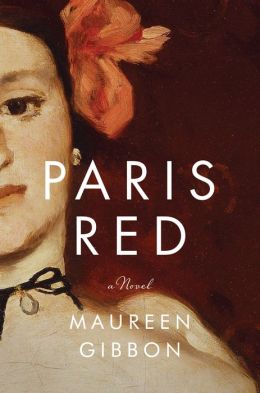
“That day I am seventeen and I am wearing the boots of a whore.” So begins Maureen Gibbon’s Paris Red, a novel of art, love, sex and survival in 1860s Paris. Victorine, the red-haired narrator, is not a whore herself; the boots were a gift. She works instead as a brunisseuse–silver burnisher–along with her best friend and roommate, Nise. The two sometimes pick up men, though, and this new one, Eugène, is different from the others: he wants them both. Unlike Nise, Victorine pursues experience headlong, wanting to feel it all, and it is she who wins Eugène’s devotion. In the process she puts ambition above friendship, losing Nise, choosing instead a position as Eugène’s model and muse. She purchases oils and pastels for him, poses for sketches and paintings, and luxuriates in the role of his lover.

Paris Red is a sensual, luscious novel, filled with tastes, smells and sounds, as well as colors. Eugène is actually Édouard Manet, strolling the streets under a false name, but Gibbon’s focus here is Victorine, the real historical model for Manet’s Olympia. She finds a home for her passion for color in his studio, and plays model-actor in Eugène’s world, while also learning about–and never losing–herself.

In powerful, vivid prose, Gibbon (Thief) pulls her reader into a sensory Paris that cuts across class lines, painting a strikingly intense and intelligent young woman in Victorine. The overall effect is erotic, but also clever and perceptive, a remarkable glimpse into a moment of art and time. Readers will never view Olympia the same way again.


This review originally ran in the May 8, 2015 issue of Shelf Awareness for Readers. To subscribe, click here, and you’ll receive two issues per week of book reviews and other bookish fun!


Rating: 8 apple fritters.

The Wild Party by Joseph Moncure March, illustrated by Art Spiegelman

What?! I found time to read a book just ’cause I wanted to? I know! It was amazing. I’ve read a lot of truly astonishing good books this year that I got assigned to read; but there’s nothing like choosing one myself.

wild partyIt was from MetaMaus that I first learned about this slim book, and it is worth tracking down, friends. The Wild Party is a book-length story-poem originally published in 1928 but banned far and wide for its explicit content. (Tame by our standards today: there are references to sex and a fistfight or two. And lots of booze.) It is the narrative of a party, in the jazzy, profligate 1920’s. Queenie and Burrs live together, but their relationship does not run smoothly; in the opening stanzas they threaten each other’s lives, and then make a very tentative peace by deciding to throw a party that night. Everybody comes: and the descriptions of their guests are lovely, vivid, ghoulish and grand. The party itself does not run smoothly, either. It is a great orgy of drink, music, betrayals and sex. It’s awesome.

I loved Art Spiegelman’s introduction, in which he points out that he doesn’t normally do poetry (thus reassuring the rest of us, likewise). William S. Burroughs gave confirmatory acclaim to March’s work by reciting a good portion to Spiegelman at their first meeting. And of course I loved Spiegelman’s illustrations of the poem, which conform perfectly to March’s words. There’s nothing like a literary work that is evocative of pictures… unless it is those pictures also perfectly composed.

A quick read of, I don’t know, under two hours, this narrative poem takes the reader on a wild ride, and Spiegelman paints it beautifully. Do check it out.


Rating: 8 unnamed drinks.

Travels in Vermeer by Michael White

A poet’s quiet, beautifully composed, powerful story of self-healing by viewing the paintings of Vermeer will be a balm to troubled minds as well as satisfying to lovers of art and memoir.

travels

Poet Michael White’s unusual and riveting memoir, Travels in Vermeer, opens in the midst of a nasty divorce and custody battle. White lost his first wife to cancer, but counts this second marital tragedy as a “total loss,” of faith as well as of his partner. Reeling, he flies to Amsterdam (“all I’d wanted was an ocean behind me”), and heads to the Rijksmuseum to see Rembrandts. But what he sees instead is The Milkmaid, a tiny painting by Johannes Vermeer. The maid evokes a “tingling at the back of [his] scalp,” and this knee-buckling discovery inspires a plan, hatched on the museum grounds, to devote his breaks from teaching university-level creative writing to traveling the world viewing all the Vermeers he can. For the next 14 months, he chases the life-changing insights and soothing, healing effect provided by the Dutch master’s small-scale, intuitive paintings, in which he sees expressions of love.

White studies biographies and art criticism about Vermeer, while visiting museums in The Hague, Washington, D.C., New York City and London. The reader shares in this lucid examination of Vermeer’s remarkable lighting techniques, occasional trompe l’oeil and the solitary women who feature in his work (alongside a few group scenes and landscapes). White sheds light as well on his difficult childhood, including a scene when his mother dumps him unannounced at his father’s apartment, following their divorce: unlike White’s own daughter, he was an apparently unwanted son. While Vermeer occupies the bulk of this brief, eloquent book, a few scenes from White’s battle with alcoholism and his tentative success with Alcoholics Anonymous round out a self-portrait sketched with great feeling in few words. Only a poet could communicate so economically, in language deserving of contemplatively paced reading.

White’s descriptions competently guide even the most unfamiliar or untrained reader through an appreciation of the mechanics and mysticism of Vermeer’s art. Readers will regret the lack of reproductions of the paintings under consideration; but as he observes upon meeting Girl with a Pearl Earring, “reproductions are useless.”

Travels in Vermeer is a thoroughly user-friendly piece of art education, but it is even better as a thoughtful, spare memoir of pain and recovery, unusually formatted and exquisitely moving. For a companion piece, consider White’s previously published book of poetry inspired by the same journey, entitled Vermeer in Hell.


This review originally ran in the February 27, 2015 issue of Shelf Awareness for the Book Trade. To subscribe, click here.


Rating: 9 daubs.

Hell and Good Company: The Spanish Civil War and the World it Made by Richard Rhodes

The Spanish Civil War, and its medical, military and artistic contributions to modernity.

hell

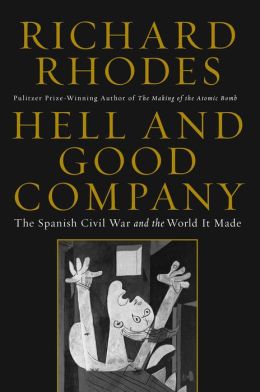
The Spanish Civil War was a precursor to World War II, and served as a practice field where medical and military leaders experimented with new technologies and refined strategies. Creative minds from around the world drew inspiration and horror from the conflict, yielding Picasso’s Guernica, Hemingway’s For Whom the Bell Tolls, Miro’s El Segador and Orwell’s Homage to Catalonia. In Hell and Good Company, Richard Rhodes (The Making of the Atomic Bomb) examines the Spanish Civil War not in exhaustive chronology or complex international intrigue–although both are present–but in its gifts, good and bad, to the world that followed.

As Germany and Italy begrudgingly contributed to the Spanish nationalist (fascist) side, and the Soviet Union just as reluctantly supplied the republicans, new military technologies met old. Advances in aircraft were matched by new strategies, including “carpet bombing,” a term used for the carnage at Guernica. In response, doctors and nurses from Spain and abroad innovated as well: while reliable blood typing and preservation for blood banking had been under development since World War I, safe transfusions in the field were born in the Spanish Civil War, as was the autochir (a mobile, sterile surgical unit).

Rhodes follows various individuals, famous (Hemingway, Picasso) and less so (volunteer doctors, nurses and soldiers from around the world), providing a vivid, wrenching view of war, art and love. While it scrutinizes world-changing new technologies and ways of life, Hell and Good Company is also a fine, accessible introductory history of the Spanish Civil War, and an evocative human story.


This review originally ran in the February 6, 2015 issue of Shelf Awareness for Readers. To subscribe, click here, and you’ll receive two issues per week of book reviews and other bookish fun!


Rating: 7 bombs.

writing about the visual arts, in Travels in Vermeer by Michael White

travelsWhen I read about the visual arts in My Grandfather’s Gallery or Lisette’s List or Hell and Good Company, I can always tell that the writer is well-intentioned, but I can rarely recognize the painting being described after having read the description. And these words leave me with the impression that I can’t even begin to appreciate the art without knowing a great deal beforehand. When I encounter really good writing-about-art, as here in Travels in Vermeer, I do find my enjoyment is increased by what I know, it’s true. But I chafe at the idea that these High Arts (as Spiegelman called them) are inaccessible to me without my having a background in art history, art criticism, what have you. It seems so snotty, exclusionary, elitist. Surely not what Picasso et al intended? (Do I care what they intended?) This is the first writing-about-art I’ve encountered that both amplifies the art, and leaves me free to love it from my beginning point of plebeian ignorance. Maybe White – a poet – is the right one to introduce me to poetry, too, another form I often find intimidating and opaque.

Look out for this book. It’s a special one – for reasons beyond those I’ve just named.

MetaMaus: A Look Inside a Modern Classic, Maus by Art Spiegelman

Begin with Maus I and Maus II. And then move on to MetaMaus, filled with images from the book and discussions with Art, and his wife and two children, about what it all means, his process, his motivations, and the impact these powerful little books have had on all of them.
metamaus
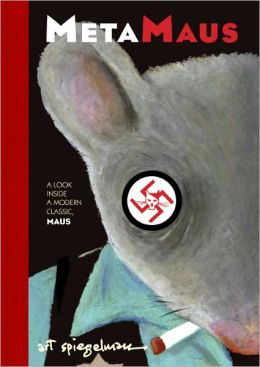
At the outset, let me say, holy magnificent book. MetaMaus asks the questions (according to its back cover), why the Holocaust? why mice? why comics? And of course, the Holocaust is the easiest to answer, to me: the Holocaust because it was what he knew (“write what you know”), except that he didn’t know the Holocaust. He emphasizes that. (And I confess it surprised me, that a survivors’ son could have grown up with such a limited knowledge of what happened so recently, and so centrally to his own personal and family history. I had a fairly decent, basic grasp of the Holocaust in grade school. But then, I grew up a full generation after the author did. Clearly a lot had changed.) Still, it was what arced over him, what oppressed him or at least leaned against him; what else was there? In fact, my surprise was that it wasn’t that obvious – that he wasn’t driven to write (draw) about the Holocaust, at least not that he knew: “What consciously motivated me was the impulse of wanting to do a long comic that needed a bookmark.” He needed to make a full-length comic, as it turned out. Who knew. I am baffled by the visual arts, at least as much as I am stimulated and inspired by the written/verbal ones; most of the visual artistry of Maus escaped me before reading this book, which is part of why I found it so wonderful. Unlike many monographs meant to elucidate the visual arts for us plebeians, this really brought it home to me, exposed so much more, increased my understanding & appreciation.

But the real question I was here for: why mice? Honestly, this was my chief concern (followed by: why cats, why pigs, why dogs…) and all those questions are answered, happily. And of course there are only more questions behind them, much discussion of the imagery and symbolism that belongs to animals in different cultures, for example, and some of that taking-back of the derogatory where Jews were called rats by the Nazis, for example. MetaMaus follows these paths, and lets us get to know the author. I found it very satisfying, after getting to know a version of him and feel him so strongly. We should always be so lucky.

And then the CD! This book is accompanied by a CD with complete images of both of the books; over 7,000 early sketches & studies & the like; video and audio files including recordings of interviews with Vladek; and some of the pamphlets off his mother’s bookshelf that Art used in his research. I think there were about 4 hours of Vladek interviews – the man’s actual voice! – and an hour-long home movie made by Art and Francoise on a visit to Auschwitz. Holy smokes, the CD is chock-full of goodies. I did not exhaustively study it, I confess. There was just so much; and I felt so well-served by the reading of the book itself. I did enjoy listening to Vladek’s voice, though: it brought everything to life, and was an interesting counterpoint to the relative unreality of comics.

Of course another theme of the book is the power and faultiness of memory. I love memoir, and I love that memoir almost inevitably has to confront this obstacle: the ‘mem’ in memoir is unavoidably problematic, at least enough to raise questions. In Maus‘s case, the clearest example comes when Vladek describes leaving Auschwitz and denies that there was an orchestra playing at the gates. As Art has documented, there is substantial support for the existence of this orchestra: there are photographs, and there are eyewitnesses among the Nazis, the Jews, and the musicians. But Vladek is sure there was no orchestra. What to do? I love Art’s discussion of the problem: how he could have represented Vladek’s version, or the official one, or left the whole question out of his story; but he instead elected to show the actual question. There is a panel in which there is an orchestra – followed by Vladek’s denial of the orchestra – followed by a panel in which the orchestra is no longer present, except that if you look closely, you can see the tips and shadows of their presence behind the marching prisoners. This is really something. Of course, when I read the comic, I didn’t catch that visual shadow, just the discussion of the question.

I learned a lot of intriguing details. Who knew the size of these (quite small) comics was so important to Spiegelman? Or more surprising, that he drew the originals in that same small size? And the details about the different reactions to the books in different countries (it’s been translated into some thirty languages) were fascinating to me. I had innumerable little details of the comics pointed out to me and elucidated – things I would never, in 100 readings, have figured out for myself, but value greatly once they were explained to me. But I most enjoyed the feeling of greater intimacy with a very talented, and unique artist. And I remain boggled by the dual artistry of the composition of this book as narrative, next to the visual artistry of the comic aspect. Art Spiegelman is a special man. The two Maus books were special, and should be required reading (for, I don’t know, everyone). And then if you like those – do yourself a favor and immerse yourself in this behind-the-scenes look. If you appreciate art (in any format) and are interested in process, also check this one out. And for those of you who prefer other formats than plain old reading, the CD has a great deal to offer in formats all over the map. Major win!

Additionally, I had to mark many passages for further consideration, so many philosophies I found valuable…

On communication vs. High Arts:

I do like to communicate clearly. It’s a pleasure. And as soon as one is involved with communication, one’s already suspect in the High Arts. A lot of what happens in the more rarefied precincts of art is that the word “communication” gets replaced by “communion,” and one is involved in a kind of religious experience with the artist as shaman. And that’s really different than, “Hey, I’ll tell you a yarn.” Or even “I’ll tell you a parable,” if you want to be didactic. And it’s always been either a skill or a deficiency that I try to make contact with with people.

I appreciate this, because I think High Arts (his phrase, but I like it) can sometimes let us down a great deal when it gets religious, or mysterious, or snooty. I’m not saying everything has to be forever perfectly literal and transparent, and I do enjoy moments of inexplicable beauty. But I think it’s exclusive and elitist to shun honest communication.

On the authenticity of his way of story-telling:

Everything drawn in the so-called past in the story that Vladek is telling is very clearly an attempt by the son to show what the father is telling. And that offered a margin within which to operate authentically. The fact that you’re told that I’m trying to show you what I understand of what Vladek is telling me is built into the fabric of the narrative itself, and allows that narrative to get told.

This reminds me of one of my favorite movies, 2 Seconds. There is an extended sequence where Lorenzo is telling Laurie the story of his professional bike racing career and how it ended. He speaks, and we see the action he is describing – but we see it as imagined by Laurie as she listens – but apparently Lorenzo can see it too, because he corrects it here and there. For example, he’s describing walking down a country road, and we see a young man doing just that, and kind of waddling on his clipless cycling shoes, with the cleats on them. And then we skip back to Lorenzo and Laurie sitting and talking, and he corrects her: “no no, we didn’t waddle, our shoes were soft leather” (I paraphrase). Skip back to the young man walking down the country road, smoothly on his smooth soles. I love love love this effect. In the same way, for example, in the question of the orchestra at Auschwitz, Spiegelman makes it clear that his father is correctly his visualization as they go. And this makes it honest and clear that he is only telling a story as told to him and as he understands it, which I appreciate deeply for its honesty.

On nihilism and ethics:

One night, we’re going down to feed the cats after one of our snooze-and-probe sessions, and he’s carrying those scraps downstairs and he says, apropos of I don’t remember what, that basically he’s a nihilist. And I ask him how this involves getting up in the middle of the night to talk to dying AIDS patients, and being so available to patients way past the point of it being good for his health, and he says something that one might take as just an off-the-cuff remark, but I found profound: “Well, I decided that behaving ethically was the most nihilistic thing I could do.” It delighted me as an idea, as a way of living one’s life.

This quotation launched a lengthy discussion for my father and I of the different meanings of ‘values,’ ‘morals’ and ‘ethics.’

On stories:

[The word ‘story’] comes from medieval Latin historia. It refers to those very early comic strips made before the invention of newsprint: the stained-glass windows that told a superhero story about that guy who could walk on water and turn it into wine. This is how in English, the word ‘story’ has come to mean both story as in stories of a building and story as a narrative. And at that point one is steered toward an architectural model for what a comic is, something very basic about comics narrative. Comics pages are structures made up of panels, sort of the way the windows in a church articulate a story. Thinking of these pages as units that have to be joined together, as if each page was some kind of building with windows init, was something that often happens overtly in Maus, and sometimes is just implicit in the DNA of the medium.

Story as architecture was a little mind-blowing to me, too. Allow these few examples to show how deeply thought-provoking I found this book. It’s a really dense, exciting experience.

So, to sum up: I found each Maus book thrilling and touching it itself. MetaMaus was equally thrilling and touching, increased the experience of both Mauses, and additionally set loose all kind of thought threads for me, that I have listed here as briefly as I could stand so as to not ramble on all day. Clearly I’m a fan. Pick up this book, and keep your notebook handy as you go.


Rating: what the hell, 10 sketches.

Maus II, A Survivor’s Tale: And Here My Troubles Began by Art Spiegelman

Following Maus I, in a word: every bit as good.

maus iiMaus II picks up Art Spiegelman’s, and his father’s, stories more or less where they left us last. Art continues to have difficulty relating to his dad, but still needs to hear the story, and his father just wants him around at whatever cost. We get the full details of father Vladek’s stay at Auschwitz and Dachau (it is of the latter camp that Vladek gives the line that becomes a subtitle, “and here my troubles began”), and a vague sketching of mother Anja’s time at Auschwitz: she is no longer around to tell her side, and Vladek is a little blurry on that account. Art continues to mourn the loss of her notes on her own wartime experience – destroyed by Vladek in a quest for forgetfulness.

In this book we also get to know Art a little better, as well as his wife Francoise. We meet his therapist, another Holocaust survivor. We see some of the fame earned by Maus I, which was not a force for good in Art’s life.

The art is still amazing. Detailed, and so representative of so much, despite the characters being portrayed not as people but as animals. To review: Jews are mice, Poles are pigs, Germans are cats, and as we see here, Americans are dogs. Maus II opens with an exchange I found charming, where Art worries about how to draw his wife, Francoise: originally a frog, he suggests, since she is French, but she insists she is a mouse, having converted to Judaism to satisfy Vladek’s need for appearances in the marriage. The use of animals for people, and their categorization in this way, is one of the most striking, interesting choices of this book – after, I guess, the choice to make it a comic at all. More on that when I get to MetaMaus.

I digress. The art is still beautiful, impactful, and communicative. The storyline is evocative and strangely universal, even while it is the unique story of a Holocaust survivor and his family; most people have experienced these difficulties relating to their parents, who are loved but hard to understand. The dialog between Art and Vladek is funny, and heartrending, familiar and true, even while it is also disturbingly stereotypical of Jews – a tension that Art and Francoise discuss. They acknowledge that this is how Vladek really is, so this is how he must be portrayed. Okay. I’m good with that, especially after it’s been acknowledged, owned in this way.

This is an astounding book. I am a total amateur at appreciating the visual arts, so I can barely claim to understand that aspect of it, but I like it. And as a work of memoir, love, portrayal, language, and history, I am deeply impressed. Read these books.


Rating: 9 cigarettes.