Magnum Cycling by Guy Andrews

Stunning photographs of bike racing across disciplines and decades, succinctly narrated, provide a compelling historical perspective.

magnum cycling

From Magnum Photos, one of the world’s oldest and most prestigious photo agencies, comes a collection of historic and iconic images of bike racing. Arranged and with accompanying text by Guy Andrews, Magnum Cycling is visually stunning and insightful.

Chapters are organized by themes, times and places, and photographers. The photographs of Robert Capa and Harry Gruyaert each fill a whole chapter, focusing on the 1939 and 1982 Tours de France, respectively. Guy le Querrec’s work covers “winter and spring,” including cyclocross racing in Belgium and France, and the Renault-Elf pro team’s winter training program in 1985. Chapters also address the velodrome, including six-day racing and the Paralympics, and the spectacle of the spectators. Henri Cartier-Bresson and John Vink join an impressive list of featured photographers. Along the way, Andrews explores the history of the Tour de France, national differences in spectator traditions and the legacy of figures like Bernard Hinault, Laurent Fignon and Lance Armstrong. His tone combines awe with humor when he calls cyclocross “simply bonkers… akin, perhaps, to bull-running in Pamplona or cheese-rolling in Gloucestershire.”

The balance of text to photographs is perfect: Andrews’s narrative and captions inform and elucidate, and then get out of the way of the extraordinary images that are the heart of this beautiful book. More than 200 gorgeous, intimate photographs in black-and-white and vibrant color present a view of a sport that is adrenaline-filled, fast-paced and deeply, tenderly human. Magnum Cycling is a superior collection of art, history and emotion.


This review originally ran in the June 1, 2016 issue of Shelf Awareness for Readers. To subscribe, click here, and you’ll receive two issues per week of book reviews and other bookish news.


Rating: 8 moments.

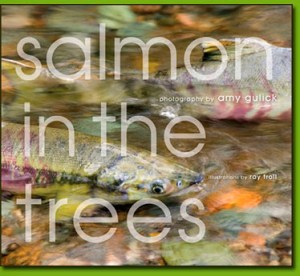
guest review: Salmon in the Trees by Amy Gulick, from Pops

salmon in the trees

I just finished reading Salmon in the Trees, recommended by a friend in response to my Edfro Creek “Fish in the Forest” essay, and this one belongs right up there with the other fish/forest books. Beginning with her own wonderful introductory essay, photographer Amy Gulick assembled a crew of nine contributors to help narrate the photo-format (with maps!) and it’s a masterful and lyrical collaboration, from writers Carl Safina and Richard Nelson to Alaska “writer laureate” John Straley, a couple of biologists and others. Its narrative focus: “Southeast” (Alaska), 80% of which is Tongass National Forest (largest in the US, 3 times the size of the next largest, 1/3 of Earth’s temperate rainforest but only 1/2 forest, 85% intact, more shoreline than 48 states, more than 5000 islands, more than 10,000 tribal population out of 70,000, approx. 1/2 of its old growth remaining); and the many ways it is special, yet largely overlooked by a US public that should champion its preservation in the face of continued threats. Along the way it depicts a world in itself, including three Salish tribes (Haida, Tlingit and Tsimshian) and their resilient white neighbors who together comprise

a vibrant, sensual brew… a place assembled of mystery & mistakes… wild & also messy… a place where people live with salmon in their streets and bears in their backyards… the big old trees still standing, the bugs, the fish, the bears, and the flawed & saintly people… the modern world has arrived and hasn’t yet broken the circle of life… [but] it may just be a matter of time.

I learned of the ANCSA (Alaska Native Claims Settlement Act) that partly restores land rights, including Sealaska, a tribal land corporation; the Haida tale that explains their recurring recessive gene for red hair; the special role of pockmarked sandstone karst in forest ecology; that alder as a nitrogen-fixer rivals salmon for forest nutrients; and yet more about bears & fish in the forest. Gulick does for this region what McAllister does in Great Bear Wild.

Who Shot Sports: A Photographic History, 1843 to the Present by Gail Buckland

Disclosure: I read an uncorrected advance proof sent to me as a review copy.

who shot sportsI’m sorry not to love this book. I love the concept: a coffee-table style art book of sports photography, beginning with the first known “sports photograph” in 1843 (a portrait of an unknown tennis player), and including nearly 300 images. In the final publication, 120 of these photographs will be printed in color. My galley copy has just a few pages of full color, but I can tell the end result will be visually impressive.

The pictures are great. And the history is fairly well done: there is some discussion of technological advances (geared toward the layperson, not the professional photographer), and trends and values. The text itself, however, is very uneven. It started to bother me at about halfway through, as it began to repeat itself: in particular, Dr. Harold Edgerton’s feat in pioneering stroboscopic photography is noted over and over again, at different points in the book but also repeatedly on the same page. Who Shot Sports is organized thematically, with chapters like “Fans and Followers” and “Vantage Point”; within these chapters are photos that fit into that theme, from different eras. The surrounding text profiles the photographers rather than the athletes, and one of the express goals of the book is to highlight those often still unknown men and women (but mostly they are men, even now). These bios vary widely in length and quality, and often feel more like lists of facts than composed or relevant narratives.

But the line that stopped me and wouldn’t let me go was, “Banning African Americans, who were such talented athletes, was especially cruel and malicious.”

This is a racial stereotype that has not served African Americans well historically, and anytime we assume something to be true of an entire population, we look silly and find ourselves in some cases wrong. I read another 20-30 pages past this point, but couldn’t move on in my mind.

I will point out again that I read an uncorrected proof, meaning that this book is likely to see another round of editing before publication. They may catch this line in time. But they also sent this copy out for review, and should expect to be held accountable for its contents. Typos and formatting problems are common issues with galleys; images may be missing or shown in poor resolution, with the understanding that the finished copy will include the real thing. But tone-deaf racial profiling I can’t help but note.

This will clearly be a beautiful volume of photography. I think the text might be worth, at best, skimming. Unless of course you are as bothered by that one line as I was.


Rating: 9 light sources for photos, 3 for text. Draw your own conclusions (always).

Maximum Shelf: Tuesday Nights in 1980 by Molly Prentiss

Maximum Shelf is the weekly Shelf Awareness feature focusing on an upcoming title we love and believe will be a great handselling opportunity for booksellers everywhere. The features are written by our editors and reviewers and the publisher has helped support the issue.

This review was published by Shelf Awareness on February 10, 2016.


tuesday nights
It is New Year’s Eve, 1979. In Buenos Aires, a woman named Franca is raising her son alone. The country is in the midst of the turmoil called the Dirty War; kidnappings are on the rise, and Franca is frightened: she has been baking cakes for an underground group that records the names of the “disappeared.” In New York, a man named James Bennett has had a harder time than most finding his way in life: his synesthesia always made him exceptionally strange, as he refers to colors, sounds and smells no one else sensed. But he’s finally made it, as an art critic for the New York Times. Also in the city, Raul Engales works night and day at his art, painting in poached studio space at New York University, a school he does not attend. He knows his work is better than any of what’s being sold in the big galleries. If he could only get someone important to look at it.

Molly Prentiss’s striking first novel, Tuesday Nights in 1980, covers one year, from December 31, 1979, through the final days of 1980. Says an art dealer with more influence than she perhaps deserves: “I’ve always found Tuesdays so charming, haven’t you? I do everything on Tuesdays.” The action tends to take place on Tuesdays, which sounds like a cumbersome and effortful device, but in fact flows smoothly and almost invisibly, following the lives of a few individuals in a city and an art scene big enough to swallow them. Tuesday Nights in 1980 is a sweepingly large and profound story about art, love and actualization, cleanly and beautifully composed.

The lives of Engales and James form the two main threads of story, with their fortunes rising and falling as precipitously as anything in 1980s’ New York. James’s success is born of the impressions other people’s work makes on him: de Goya and Picasso’s blue period both sound a bold, steady drumbeat; Bill Rice gives him a “nocturnal mood” and a headache; the paintings of Louise Fishman smell strongly of shampoo. “He felt gushes of wind and crawling ants, tasted burnt sugar and gazed at skies’ worth of stars.” Marc Chagall’s work gives him a hard-on. Writing these impressions for a public audience gives him immense satisfaction and a little money, and helps him to accumulate a legendary and sought-after collection of “the pieces that made him hear beautiful music.” Meanwhile, Engales sees the glimmering beginnings of the attention his work deserves. He finds a community: the grouchy woman at his art studio, the fellow creatives at “the squat” where he spends his free time and finally, crucially, a muse. Lucy is an innocent from Idaho who believes in omens, who steps out of a taxicab into a world of promise and finds what she thinks she is looking for in the artist. Then James and Engales each suffer a drastic, shattering loss that changes their respective abilities to create. And a small boy from Argentina appears in their lives, offering new varieties of pain, love and responsibility.

Tuesday Nights in 1980 portrays the arts scene as inspired and genius, and fraught with tension between creativity and the question of “selling out.” James’s weird and enchanting perceptions allow Prentiss to paint the visual arts colorfully, as well as fragrantly, noisily, brilliantly, tenderly and roughly. A central theme is the beauty of damage. “Wounds and deformities and cracks and boils and stomachs: this was the stuff that moved Engales… He could hear his father saying: The scratches are what makes a life.” This is not a concept invented by Prentiss, but her characters struggle with and embody it in moving, new ways.

While always told from a third-person perspective, the focus changes from chapter to chapter among Prentiss’s diverse cast: primarily James, Engales and Lucy, but supported by a number of equally fascinating and colorful associates. James’s wife, Marge, is a woman who presents to him as a deep and glorious red, whose own creative career has been sacrificed to enable his. Arlene is a curmudgeonly painter friend to Engales, given to unconventional sartorial choices: a “long fish skirt and a coat that was somehow both puffy and flowy” or “a flowy dress with an outrageous pattern on it… eccentric cowboy boots and a trench coat of sorts, with many, many pockets.” Prentiss’s talent for characterization is prodigious, and matched by her delightful turns of phrase. The art collector who loves Tuesdays has “the kind of hair that was popular that year, a curtain revealing only the first act of her face: a queenly nose, confusingly colored eyes (were they violet?), cheekbones for days” and “a voice as simultaneously regal and flighty as her hair.” She laughs “like a pretty horse.”

A plot with multiple storylines involving so many characters is easily followed, because the people and events who form them are so memorable–but not to the point of caricature. No, James Bennett and Raul Engales and the rest are only as bizarre as their time and place, which Prentiss evokes perfectly: SoHo on the brink of devastating gentrification; artistic genius on the brink of commercialization or self-destruction, or both; and the insane, everyday choices made by regular people seeking love, identity and community but fearing to make the wrong move. Tuesday Nights in 1980 is a beautiful, poetic novel of ambitiously profound considerations, a large-scale drama in a series of small, perfectly rendered moments.


Rating: 8 shades of astonished gray.

Come back tomorrow for my interview with Prentiss.

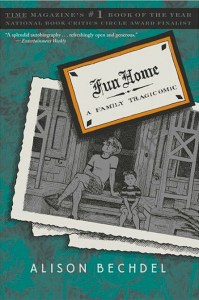
Fun Home: A Family Tragicomic by Alison Bechdel

fun homeFun Home won awards and got more attention than Bechdel’s later Are You My Mother?, which I loved, so this was an obvious choice and yes, I will add my praise to the chorus.

This is a memoir centering around Bechdel’s father Bruce, her own discovery that she is a lesbian and her coming out to her parents, which is immediately followed by the discovery that her father is gay, too, shortly before he kills himself just weeks later. (The evidence is inconclusive, but she makes a good argument for her conviction, that it was suicide.) The title is a reference to the family business, which is a small-town funeral home that they call ‘Fun Home.’ That’s a lot, right? It is also a memoir in graphic form, and I am crazy about Bechdel’s technique, which combines dialog (speech boxes for the characters in her panels) with a voiceover-style narrative in different boxes that sort of caption those same panels. It’s astonishing how much can be communicated in pictorial form.

Despite the often heavy subject matter, Bechdel is often laugh-out-loud funny, while also taking her material seriously. She beautifully evokes the absurdity of many different elements of her story. Bruce is a passionate restorer of historic homes, down to all the details, the bizarrely frothy, lacy, heavy decor. This is both hilarious and pathological. He “treated his furniture like children, and his children like furniture.” Bechdel and her father are most intimate when they share books and reading (note that this is an intimacy with decided remove). Bruce works as an English teacher as well as a funeral director; and two thematic elements of the book are death and books. Bechdel is best able to understand and characterize her parents when viewing them through the lens of literature: her father as Icarus, then Daedalus, then a character from Fitzgerald; her mother one from Henry James. “I employ these allusions to James and Fitzgerald not only as descriptive devices, but because my parents are most real to me in fictional terms.” On the other end of the cultural spectrum, as a child Bechdel confused her family with the Addams family.

The reader has a different experience of the story than she does, because we find out earlier than she does the big reveal – that her father has had relationships with men and boys. But she still has us share in mixed feelings of relief, shock, perplexity.

The story is weird, fascinating, and moving; Bechdel has a gimlet eye for the psychological struggle in each chapter of it; the structure of this book – the disordered chronology and release of facts – is a smart puzzle. But the art is what completes the perfection: I’m still reeling from, and trying to comprehend, how precisely she uses visual images (with those careful text additions) to communicate. I can’t adequately articulate it, but this is a special, a uniquely wonderful way to tell a uniquely interesting story. One to study.


Rating: 9 books, of course.

book beginnings on Friday: Fun Home by Alison Bechdel

fun home

Thanks to Rose City Reader for hosting this meme. To participate, share the first line or two of the book you are currently reading and, if you feel so moved, let us know what your first impressions were based on that first line.

I loved Are You My Mother?, and don’t know why it took me so long to pick up Fun Home, her earlier work and sort of a partner to Mother. She is still hilarious, insightful, and smart.

Because this is a graphic memoir, I’ll have to do this beginning a little differently. Here is an image of the whole first page.

fun home start

That reference to Icarus was when I knew (not that I doubted) that we were going in a good direction. I can’t wait to spend some more time with Bechdel and her wacky family and amazing mind.

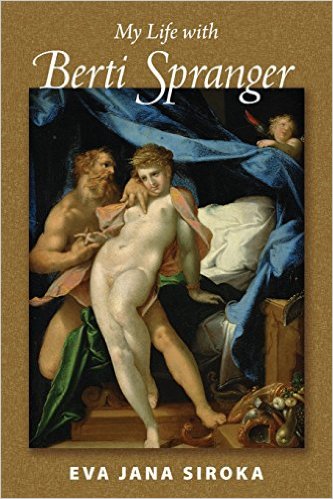
My Life With Berti Spranger by Eva Jana Siroka

An intriguing plot and engaging story highlight this tale of love and art.

berti spranger

My Life with Berti Spranger, a novel by art historian and artist Eva Jana Siroka, stars an art collector who discovers a memoir by sixteenth-century erotic painter Bartholomaeus Spranger. This brings him into contact with a student of history, and Spranger’s titillating art and writing help to prompt the modern pair to romance. This intriguing plot concept is poorly served by disjointed writing, but the glimpses of Spranger’s life in the Flemish court are captivating.

…Click here to read the full review.


This review was published on December 3, 2015 by ForeWord Reviews.

5 hearts


My rating: 5 pieces of disjointed dialog.

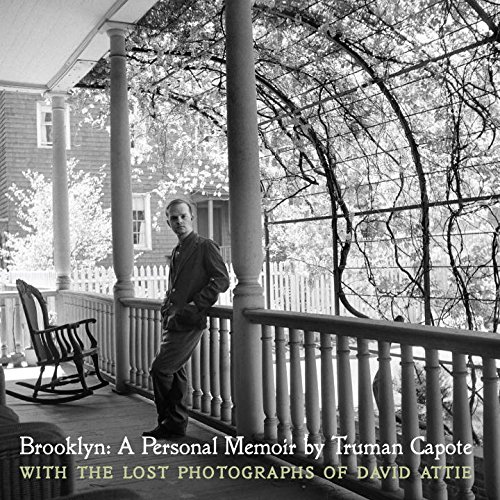
Brooklyn: A Personal Memoir: With the lost photographs of David Attie by Truman Capote

A superb Capote essay with never-before-seen photographs originally commissioned to accompany it make an ideal match–and a great story.

brooklyn

Truman Capote’s essay about Brooklyn Heights, N.Y., filled with clever observations in his familiar style, was first published by Holiday magazine in the 1950s. It was reprinted in 2001, with a foreword by George Plimpton, which is included here. However, the singular contribution of Brooklyn: A Personal Memoir: With the Lost Photographs of David Attie is those photographs, discovered in 2014 by the late photographer’s son in dusty wooden boxes. The story Eli Attie tells in his afterword is as compelling as Capote’s witty and winning portrait of Brooklyn. Capote’s career was distinctly tied to Attie’s when the latter was hired to photo-illustrate Breakfast at Tiffany’s for its scheduled appearance in Harper’s Bazaar, which Eli learned only decades after his father’s death.

Capote’s essay is of course brilliant in its scenes, characters and language. “Sunstruck scraps of reflected river-shine” and the lovely alliteration of “plenipotentiaries from the pearl-floored palace of Poseidon or mariners merely” exhibit his decorative, evocative way with words. The historic contribution of this glimpse at a place in time is significant; and the same must be said of Attie’s documentary photographs, which perfectly complement Capote’s text. Since Harper’s Bazaar ultimately cut the novella, the included images went unpublished, including several of a young Capote, framed against the “beautiful staircase floating upward in white, swan-simple curves to a skylight of sunny amber-gold glass” in the house where Capote lived (in the basement).

This marriage of Capote’s glimmering words with Attie’s harmonizing photographs is perfected by the younger Attie’s narrative, in this unparalleled addition to the Capote canon.


This review originally ran in the November 17, 2015 issue of Shelf Awareness for Readers. To subscribe, click here, and you’ll receive two issues per week of book reviews and other bookish fun!


Rating: 8 local institutions.

Thunder & Lightning: Weather Past, Present, Future by Lauren Redniss

Superb illustrations accompany fascinating tidbits about weather and the world in this lovely, distinctive book.

thunder lightning

Lauren Redniss (Radioactive) offers a gorgeously rendered and singular piece of work with Thunder & Lightning: Weather Past, Present, Future. Her original artwork is stunning, dreamy and evocative, the perfect complement to facts about weather and carefully selected interview excerpts and quotations.

Redniss’s “Note on the Art” describes her media: copper plate photogravure etchings and photopolymer process prints, hand-colored, and a few drawings in oil pastel. She comments on the artistic tradition that inspired her: artist/scientists whose devotion to precision and accuracy have historically paired with “a sensation of strangeness, wonder, terror.” Her work is certainly worthy of that tradition; drawings of wildfires recall Picasso’s Guernica, and the chapter entitled “Sky” contains only striking illustrations and no text. These drawings are both otherworldly and very much of our world.

Redniss’s text, based on scientific research and cultural traditions, riffs on weather phenomena rather than offering a comprehensive study. Her chapters cover conditions (cold, rain, heat, fog) as well as concepts (dominion, war, profit), and span the planet and various peoples throughout history. She considers weather that has been blamed on witches or credited to gods; the use of cloud seeding as a weapon by the United States against Vietnam; and weather derivatives and insurance. Redniss’s subjects are quirky and entertaining; her chapter “Forecast” is as concerned with the Old Farmer’s Almanac as with the National Oceanic and Atmospheric Administration. That tone of marvel and whimsy, plus exquisite illustrations, make Thunder & Lightning both remarkably beautiful and pleasingly informative.


This review originally ran in the November 10, 2015 issue of Shelf Awareness for Readers. To subscribe, click here, and you’ll receive two issues per week of book reviews and other bookish fun!


Rating: 8 gorgeous interpretive hand-colored prints.

art museums: Intersections, The Infinity Machine, and the Surrealists

I made my first trip to Europe with my then-boyfriend, who had an art degree. We went to Brussels and therefore to the Musées Royaux des Beaux-Arts de Belgique. We spent 8 or 9 hours there, and I have felt an aversion to art museums ever since. (I will say that the Mauritshuis in den Haag is a nice, small art museum filled with classics, including Girl With a Pearl Earring, which is easy to get through fairly quickly and is worth the time.) Despite this aversion, on a recent visit back to Houston, I went with my mother and my “other parents” (old family friends) to a few art museums on a Friday afternoon.

We started with Intersections, by Anila Quayyum Agha, at the Rice University Art Gallery. The piece is a six-and-a-half-foot cube of laser-cut wooden cube, suspended, with a bright bulb inside, so that the pattern cut out of the cube is projected onto ceiling, floor and walls. That pattern is a complex tessellating geometric design, and a short and very worthwhile video explains that Anila Quayyum Agha was inspired by the Alhambra. As a Muslim woman in Pakistan, she was not allowed into mosques (men only) and had few experiences with their interiors, but was struck by the extraordinary beauty and creative power in the Alhambra (which she was permitted to enter as a tourist.) She also spoke of the construction of this beauty by Muslims, Christians and Jews working together, and called it a “gem” of both artistry and unity between peoples. This was the inspiration for Intersections, whose tessellations echo the tile designs at the Alhambra.

Intersections, Anila Quayyum Agha (with Karen, Susan and Bob)

Intersections, by Anila Quayyum Agha. (With Karen, Susan and Bob). Click to enlarge.

It is a work of light and shadow, geometry and projection. The images on the ceiling and floor (closer to the cube) are crisper than those on the walls (which are further away), so the effect is variable. The cube itself is a work of art (although watch out for that ~600-watt bulb within), and the shadow/light-show another layer of it. People entering the room participate, because the shadows are cast on them (us) too. It was striking and meditative, and free at the University. Good stuff.

Next, after lunch, we went to the Menil campus, and walked first over to the Byzantine Fresco Chapel to see The Infinity Machine, by Janet Cardiff and George Bures Miller. This was an excellent counterpoint to Intersections: another room-sized installation playing with light and, in this case, reflection. Many mirrors are suspended on wires and rotate – around as one large constellation, and also in some cases individually. The room is very dark; a docent escorted us in with a flashlight to seat us on a bench until our eyes adjusted. A few lights lit the solar system of mirrors, and we suspect those lights dimmed and brightened or shut off completely or changed colors. It is hard to say, because the effect is disorienting. I had the odd feeling that different mirrors were present upon each rotation: clearly this is not the case, but the view was ever-changing and, I felt, never repeating. It was kind of intense. A soundtrack played, of NASA recordings of solar wind. Perhaps because we had just lunched at the Hobbit Cafe (always a treat), I said it sounded like the Eye of Sauron. I also thought of calling it “dark noise”: like white noise, but darker, spooky. At one point I thought Sauron was coming to get us on a train, with that characteristic clack-clack and growing whoosh. Where Intersections was light, crisp, patterned, and explicitly called for unity, The Infinity Machine was a little foreboding, even threatening – although I was very happy to experience it, and don’t mean that as a criticism. It was fascinating.

We finished with the Menil Collection building, about which I was most ambivalent, but there was a Dalí exhibit! I was enchanted by some of the artifacts in the Arctic Art collection, including a tiny statue of a bust (of a man?) with toddler on its shoulders; it was less than the height of one of my (cut-short) fingernails, and a fraction the width. I quickly browsed the “frottages and rubbings” exhibit. And then surrealism: lots of Victor Brauner and Max Ernest, several Joseph Cornell boxes (an exhibit of whose work first took me to the Menil, in high school), a few Picassos, and oh, Rene Magritte. I love him – although I didn’t feel he fit perfectly in this collection. His images are so crisp and hyper-real, even if they do float in the wrong places. Dalí’s Eggs on a Plate Without the Plate centered this exhibit, which was entitled “The Secret of the Hanging Egg.” But my favorite piece was The Hunted Sky by Yves Tanguy, which transfixed me. I wish I had a full-size print of that in my home to continue to consider, because I feel like I need more time. (You can look it up online but those images do no justice.)

Still, overall and by comparison, I moved through the Menil Collection quickly; I think the room-sized installations are more generally my speed than rooms filled with paintings. But this was a remarkable experience all around. I normally make it into an art museum every year or so, or less often, and generally at my mother’s side (I try to be good-natured about it, she doesn’t drag me). Today’s visit was at least as rewarding as any I can recall. If you find yourself in the neighborhood of either of these big installations, definitely check them out. Everything we saw was free, too (great job, Houston!), so take advantage!


Rating: 9 reflected or projected tones of light.