Destiny of the Republic: A Tale of Madness, Medicine and the Murder of a President by Candice Millard (audio)

destinyJames A. Garfield was the 20th president of the United States, and served one of our shortest terms: after being shot by assassin Charles J. Guiteau, he lived over two months before dying in September of 1881. Destiny of the Republic is the story of Garfield’s short presidency. As expressed in the subtitle, it is also the story of Guiteau’s madness and the medical era in which Garfield was unsuccessfully treated. What is left out of the title is the story of Alexander Graham Bell, who worked on a metal detector that was related to his recent invention, the telephone, with the intention of locating the bullet lodged in Garfield’s torso. So, to recap: this is the story of Garfield the President, Giteau the assassin, Bell the inventor, and a Dr. Bliss, who headed up the President’s medical team.

I knew next to nothing about Garfield, although I had a vague sense of his dying journey to the sea, passing by train through crowds of Americans gathered to honor him. I assume I’m not alone in my ignorance; he’s a long-dead president who (necessarily, by virtue of his short service) made no historical contributions sufficient to bring him to a modern layperson’s consciousness. So, I’ll fill in a little more. Garfield is painted in the opening chapters as a very sympathetic man: he did not aspire to the White House, but rather was nominated against his will by a post-Civil-War Republic Party that could not agree on any of the more favored candidates for nomination (Ulysses S. Grant, James G. Blaine and John Sherman). He was humble. In this book, he is a likeable character (more on that to follow).

Interspersed with descriptions of Garfield, his very humble past as a poverty-stricken and fatherless child, and his marriage to Lucretia (“Crete” ), are descriptions of Guiteau. Guiteau is, briefly, delusional. I don’t know what his diagnosis would be in today’s mental health establishment, but he would be diagnosed. He believes he deserves great things and the world owes him; he is a chronic petty criminal, and because he once wrote a speech (never delivered) stumping for Garfield, he believes upon Garfield’s election that he deserves a lucrative posting, preferably to Paris. (One of the hot political issues of this age was the spoils system.) In his diseased mind, Garfield’s failure to honor him becomes a crime punishable by death; and/or it’s God’s will that Garfield be killed; and/or Vice President Chester Arthur needs to be President for the sake of the country, etc. Thus the assassination.

Also interspersed are some of the thinkers of the era. Alexander Graham Bell has just invented the telephone, which although not ubiquitous, is beginning to change communications for some of the population, and will have great future impact; in the meantime Bell works feverishly on that and other inventions. Also contemporary is the British Joseph Lister, pioneer of the concept of antisepsis, or sterilization of medical (especially surgical) equipment. Medical minds of the day did not generally believe in germs, because they could not see them, and practiced surgery on the second patient with the blood of the first still wet on their hands (not to mention pus and general dirt). Lister tried to convince American doctors of the lifesaving power of sterilization, but in the case of Garfield’s Dr. Bliss, failed.

So the action of the story follows Garfield’s nomination, election, and early days in office; Guiteau’s descent into madness, and his shooting of the President; Bell’s laboratory work, including work on a machine to locate the bullet lost inside the President; and the medical community’s thoughts on antisepsis. Dr. Bliss is an unsympathetic character. He successfully bluffs a small crowd of other doctors, several better qualified, and at least one more open to the idea of sterile surgery, out of the White House, taking over Garfield’s care himself. He is imperious, intolerant, and unpleasant; it also turns out that he had the wrong medical ideas, with the knowledge we have now. Garfield suffers in the White House for some two months after being shot, with a bullet lodged near his liver. During this time he is endlessly poked and prodded with filthy fingers and probing implements, deep into his wound. We know now – indeed, they mostly understood upon his autopsy – that it was not the gunshot that killed him, but the massive infection caused by unsterilized instruments. And then, we hear of the First Lady’s mourning, and the trial and hanging of Guiteau. In the epilogue, we also follow Bell, Bliss and Lister through to their eventual ends.

I found this story fascinating, as perhaps is clear from my lengthy synopsis. I liked that Millard sketched the political background of the United States in the decades after the Civil War, the lingering divisiveness of North vs. South, the corruption of the spoils system and the conflict between VP Arthur and Garfield’s presidency. I found the characters interesting, compelling, and real. This history is told relatively briefly and at a quick pace: I think reluctant readers of nonfiction will be pleased, and yet I don’t have reason to think it was dumbed down or oversimplified. Destiny of the Republic is good, readable history for the mainstream reader, and I recommend it.

I do have one concern. Garfield is portrayed in a wholly sympathetic light. I don’t know enough to criticize him; but I’m always suspicious of such a glowing picture of a historical figure. Surely he wasn’t all good? I worry about so much praise, as I said in my review of Team of Rivals.

I really enjoyed getting a glimpse of the medical thinking of this era, which I thought was well handled, although in brief. The conceptual leap to believing in invisible germs and the risk of infection has to be one of the more important in the history of medicine, and I can understand how people like Bliss who thought they knew what they were doing would be skeptical, although it’s hard to sympathize with him in this story of the huge consequences of his skepticism (coupled with his egotism and nasty personality, of course). There was another angle I wish had been explored as well, regarding Bliss’s very imposing nature, the bossiness with which he took over Garfield’s care, and his unwillingness to let either the President or the First Lady choose a doctor or make medical decisions. This is another area of medical practice in which change has occurred much more recently: the authority of doctor versus patient. We’re still working this one out, but today, no doctor would be so likely to barge in and tell the wife of an unconscious man which doctor would be treating him; and if she called in the doctors of her choosing and fired the first, her decision would stand. Now, Mrs. Garfield never tried to “fire” Bliss – it wasn’t done. But that’s my point: the concept of who holds the power in that relationship, doctor vs. patient (& family/caregiver) has changed drastically. As someone who works in a hospital setting with patients and family members, not to mention some of the decisions I’ve seen made in my own family, my mind jumped at this part of Garfield’s story. He had no advocate to protect him against the failures of the medical establishment; no second opinions were allowed; the patient and his family were allowed no part in the decision-making process. Not only would antisepsis have made the difference to Garfield, but, I submit, patient advocacy and empowerment would likely have made a major change as well: if he had still died, at least he might have been much more comfortable, and I think quality of life even at the end of life should not be discounted. If I had written this story (with my perspective as a medical librarian), I would have added this facet to Garfield’s story as well.

Minor quibbles aside, I really enjoyed Destiny of the Republic and found it an easy, engaging, quick read that I would recommend to anyone. The audio production, read by Paul Micheal, was entertaining and gave the varying voices to the story that I think it needed. Well done.


Rating: 8 propaganda-ridden medical bulletins.

The Honored Society by Petra Reski

An intriguing and sensational, but not sensationalist, study of the Italian Mafia through character sketches.

Petra Reski had covered the Mafia as an investigative journalist in Germany for years, to the minimal interest of her editors and readers, who considered it an Italian problem. Then, in 2007, six Calabrians were executed in the town of Duisburg, and suddenly the German public was interested in the Mafia.

In The Honored Society, Reski composes character studies of various players both within the Mafia and fighting against it, based on her reminiscences of meetings and interviews. In addition to mafiosi and police investigators, her subjects include public prosecutors, defense lawyers, priests, fellow journalists and Mafia wives and daughters. Accompanied by her cabbie, Salvo, and her photographer, Shobha (as well as Shobha’s mother, a famous anti-Mafia photographer in her own right), Reski travels the streets of Italy and recalls the personalities she’s known. Her sketches of these “bad guys” and their adversaries are intimate and contemplative, rooted in years of experience. Even while excoriating the actions and influence of the Mafia, she seems to feel respect, even affection, toward certain individuals, revealing a conflicted relationship much like the one she describes between the Italian public and its famous criminal organization.

Generally, Shaun Whiteside’s translation of Reski’s work (from the German original of 2008) reads as straightforward, simple prose; but a quiet poetry lurks in certain turns of phrase and carefully crafted images. The Honored Society is an unusually structured view into the strange and powerful world of the Italian Mafia.


This review originally ran in the January 15, 2013 issue of Shelf Awareness for Readers. To subscribe, click here, and you’ll receive two issues per week of book reviews and other bookish fun!


Rating: 6 expensive handbags.

Teaser Tuesdays: The Honored Society by Petra Reski

Teaser Tuesdays is a weekly bookish meme, hosted by MizB of Should Be Reading. Anyone can play along! Just open your current read to a random page and share a few sentences. Be careful not to include spoilers!

honoredsociety

This is an interesting book. Its subject is the Italian Mafia and its global role; and most of the prose is straightforward. But it occasionally meanders into fancy, even poetry, as here:

In the middle of Piazza Marina there’s a huge magnolia fig tree that has grown into a vast and magical forest. The trunk is reddish brown, like the Sicilian soil, and has transformed itself into some fabulous creature that consists of knotted, frozen snakes, dragons half hidden in the ground, and elongated elephants. Every time I turn my back on this tree I half expect it to stretch out its arms and grab me.

I am charmed. And the Mafia bits are fine, too. 🙂

This quotation comes from an uncorrected advance proof and is subject to change.

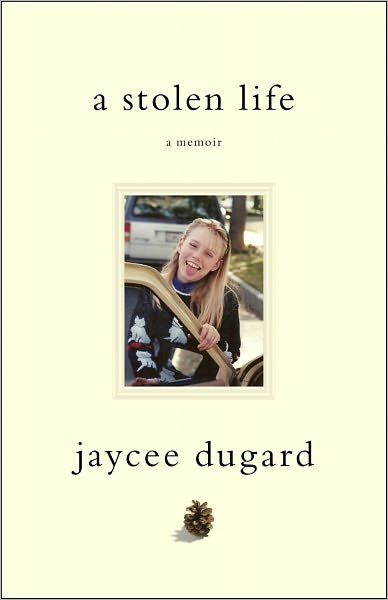
A Stolen Life by Jaycee Dugard

Jaycee Lee Dugard was kidnapped while walking to school in 1991. She was 11 years old. She was held by her captor, Phillip, and his wife Nancy, for 18 years, until 2009, when she was discovered very much by accident. By this time she had two daughters, products of Phillip’s repeatedly raping her while she was in captivity. This is her memoir.

She begins with her childhood, briefly; she grew up in California and then moved to Tahoe with her mother, new stepfather, and baby (half-)sister. Then she was kidnapped. Phillip was a sex offender on parole; he had two small sheds, and eventually a series of tents, built in a “secret” backyard, hidden by fencing and foliage, where he kept Jaycee and her daughters. Nancy was complicit in his crime. Jaycee was so young when she was kidnapped, lived with Phillip for so many of her formative years, that she was very confused – some would say “brainwashed” I suppose. She knew he was bad, that he hurt her, that what he did was wrong, but she was also convinced that he was trying to protect her and her girls, that the world out there was bad and frightening. In her increasing freedom, she may have been able to escape or to ask for help from the outside world, but she was confused and scared. When she was finally rescued and her true identity known, it took quite a bit of adjustment and therapy to help rebuild her family (her mother, sister, and aunt were very supportive when finally reconnected) and adjust to the larger world. She always loved animals, placing great store in pets – and she was eventually allowed to keep a small menagerie in Phillip’s backyard. Now, she has established a foundation (the JAYC Foundation, which stands for “Just Ask Yourself to Care”) to help families recover from trauma, using animal therapy.

Jaycee’s memoir is, most obviously, heart-wrenching and horrific and tragic; I don’t need to explain that aspect to you. It is also very raw and real. Jaycee has only a 5th grade education, and this book appears to have gone straight to print from her own rough writing. It is full of run-on sentences, fragments, ramblings that change tense throughout, grammatical errors, etc. I found this distracting at first, but ultimately I can’t help but respect how fully and authentically she’s put herself out there. The decision to publish her memoir must have been a difficult one. She speaks of wanting to publicize the bad things that Phillip and Nancy did, to not let them get away with it (or get away with thinking it was okay, or that Phillip was a victim – ugh). Also, some proceeds from the sale of the book go to the JAYC Foundation.

She tells her story very candidly and discusses her feelings very candidly. It has rather a different feeling than most memoirs you’ll find; it reads like a journal, unpolished. But again, once you get used to it, it makes for a unique experience.

What led me to pick this book up, you ask? I’m still wondering, myself. I felt a little weird reading it: voyeuristic, prurient, icky. I guess it’s the same as the train wreck you can’t look away from. My heart certainly goes out to Jaycee. She works very hard to stay positive and hopeful, and states that she doesn’t harbor hatred for the people who’ve done this to her; she doesn’t have time for hate, it’s wasteful, she wants to move forward and live and think positively. Good for her. She’s definitely still innocent, inexperienced, and lacking in formal education. But I’m impressed with her attitude, and she seems to have a really excellent support system in place; her family sounds great. I think she’ll be okay; she certainly has my best wishes.

This was a quick and easy read, and good for helping us be grateful for what we have in life (to put it mildly).

In Cold Blood by Truman Capote (audio)

Truman Capote captured my undivided attention with this medium-largeish* book in remarkable fashion. My first issue for this review: is this fiction, or non? It is most commonly referred to as a “nonfiction novel,” a term I have a lot of trouble with. The story is either based very closely on, or is, the true story of the quadruple murder of the Clutter family in small-town Kansas, and the investigation, arrest, and eventual execution of the two perpetrators. (My library’s OCLC listing calls it “postmodern fiction.”) Capote himself said, “I wanted to produce a journalistic novel, something on a large scale that would have the credibility of fact, the immediacy of film, the depth and freedom of prose, and the precision of poetry.” So, fiction or non? I’m going with fiction, but clearly this is one of those areas where the line blurs. More on that in a bit.**

I came across this book recently in several blogs, which is curious because it’s not new; it was first published serially in Life magazine in 1965, and in book form in 1966. I already had the book on my radar, but these fine fellow bloggers definitely solidified my interest. In telling you about the story, and the book constructed about the story, I’m going to be fairly spoilery, because this is history. If you want to read it yourself and be surprised, I’m not your top-choice review.

So. The subtitle reads, “A True Account of a Multiple Murder.” On the night of November 15, 1959, the Clutter family was bedding down on their farm in Kansas, just outside the small town of Holcomb, itself a suburb of Garden City. Herbert Clutter, the patriarch, was a respected member of the community and devout Methodist; his wife Bonnie had been suffering from depression and had been in and out of hospital, but at this time was home. Sixteen-year-old Nancy, the belle of local society, sweet, talented, generous, and universally beloved, had just sent her boyfriend Bobby home and was getting ready for bed. Fifteen-year-old Kenyon was slightly socially awkward but friendly and respected as a member of a well-liked and important family. The two older Clutter daughters were living on their own outside the home – one married, one about to be.

Meanwhile, two paroled convicts of the Kansas state prison system were on the road. Perry Edward Smith and Richard Eugene “Dick” Hickock had been cellmates and although very different in temperament, had teamed up for an endeavor that Dick described as being the perfect crime. As you’ve already guessed (or already knew), these six characters converge when Dick and Perry kill the Clutters in the night and make off almost as perfectly as Dick imagined. They spend months traveling, living briefly in Mexico where Perry hoped to become a successful treasure hunter, and then roaming the US again until they were apprehended in Las Vegas. They were tried in Kansas, convicted, and finally hanged in April of 1965.

Capote follows both groups of characters – the Clutters, and Perry & Dick – alternately in the days leading up to the night of the murder. Then he follows Perry and Dick in their roaming, and then through their imprisonment and trial, and right up to the hangings. His voice is omnipotent third person, and he quotes extensively from letters, documents, and trial proceedings, as well as from his interviews with various players and especially Dick and Perry themselves. Capote was on the case (so to speak) well before they became suspects, and published after they were killed, so his perspective and the timeline of his coverage is pretty extensive.

But, perhaps not entirely objective. The Clutters are painted in admirable detail, in lovely little vignettes. But their role is minor and short-lived (ouch, pun not intended). And of the two killers, Perry Smith is treated far more sympathetically and examined more deeply. I was pondering this as I listened to the book, wondering if this was all Capote’s apparent subjectivity, or if Perry was inherently more sympathetic; in other words, would I have found him so if I had been researching this case myself? There are a few fairly easy markers for this, at least for me: for one, Dick liked to rape little girls. Perry apparently stopped him from raping Nancy (by both their accounts). Dick ran over stray dogs with his car for fun, which Perry found revolting (as do I, obviously). Perry’s childhood was patently rough, while Dick’s is characterized as fairly normal. Perry seems to more clearly have a mental illness or defect that “causes” his criminal and violent tendencies. But, I’m not sure we get all of Dick’s story; Capote looks much more closely into Perry’s past. So what I’m trying to say is, I think there may be a bias in favor of poor Perry the murderer, having been manipulated by evil Dick. Apparently, it was alleged that Capote in fact had a sexual relationship with Perry while he was imprisoned, although obviously I can’t speak to that. This is not a criticism. I just want to point out that perhaps Capote is not entirely impartial with regards to his two main characters.

I found this book incredibly powerful. Capote has a fine sense of drama and of timing. Scenes and people are sketched artfully, sometimes quickly and with broad strokes that paint a pretty complete picture just briefly, and sometimes in painstaking detail. The stories of the Clutters’ deaths and Dick and Perry’s adventure and executions are fascinating and engrossing, yes. But it’s Capote’s rendering that makes this book, more than his subject matter. (I guess this is always the case.) I was blown away by the emotional effect of this story. I couldn’t get enough; I wanted more of the inside of Perry’s head, of Dick’s (ew, how creepy), of the small-town life of Holcomb and Garden City. This is my first experience with Truman Capote, and I’m a fan.


Also, as Marie said at The Boston Bibliophile, Scott Brick’s narration is excellent. I recommend this book on audio if you’re so inclined. (I also picked up a paperback, though, to have on hand. I never did reference it while listening but I think I’d like to have it for future use.)


*My audio version is 12 cd and 14.5 hours; my paperback edition is just under 400 pages.

**Back to the fact vs. fiction question. It does seem that Capote behaved like a journalist in putting this book together: gathering facts, interviewing key players, confirming dates. It could pass as “true crime,” a genre which itself may have trouble with fact vs. fiction. The biggest place where Capote appears to leave the realm of nonfiction behind is in dialogue; he has recreated a great many pieces of dialogue, mostly between Perry and Dick, that were unrecorded. He has relied upon Perry and Dick themselves in this recreation, I think, but memory being what it is, some creativity definitely come into play. I did note that on the night of the Clutters’ deaths, Capote has not tried to recreate their experience or any dialogue, except in the accounts shared by Perry and Dick in their confessions. This seems to show a reluctance to just “make things up,” and a respect for the question that (I think) still remains: did Perry kill the two male Clutters and Dick the two women, as Perry originally claimed? Or did he Perry kill all four, as he amended his story to say, and as Dick claimed all along? Capote doesn’t answer this question for us – presumably because he respects the fact that he can’t answer it authoritatively. (I do wonder what he thought, though, considering that he apparently was very close to Perry in particular.)

The Devil in the White City by Erik Larson

THIS is how I like my nonfiction! See, Castaneda? Like this! I can’t exactly explain the difference. There’s just something very narrative, conversational, interesting about this. Similarly, Dethroning the King, Janet Malcolm, Annie Londonderry, etc. It’s not sensationalist; it’s just exciting. Written like a thriller or like a work of fiction, but no less serious a work of nonfiction for it. How to explain? Let me quote a very average paragraph for you, from page 27:

Each man recognized and respected the other’s skills. The resultant harmony was reflected in the operation of their office, which, according to one historian, functioned with the mechanical precision of a “slaughterhouse,” an apt allusion, given Burnham’s close professional and personal association with the stockyards. But Burham also created an office culture that anticipated that of businesses that would not appear for another century. He installed a gym. During lunch hour employees played handball. Burnham gave fencing lessons. Root played impromptu recitals on a rented piano. “The office was full of a rush of work,” Starrett said, “but the spirit of the place was delightfully free and easy and human in comparison with other offices I had worked in.”

See, that second sentence is long and convoluted and uses biggish words, but it flows and communicates; it doesn’t impede communication, and what it certainly doesn’t do is brag.

All right, rant aside, this is an excellent book! I started it Friday night and finished it Sunday afternoon. Not to repeat the back-of-the-book blurbs, but this work of nonfiction absolutely reads like a thriller; it’s difficult to put down. Very enjoyable. After years (literally) on my TBR shelves, I picked it up because I had such a groove going, after Annie Londonderry and Clara and Mr. Tiffany, two books set in the same era with overlapping locations – Annie in New York, Boston, and Chicago as well as all around the world, and Clara in New York, with the Chicago World Fair playing a role as well. I enjoyed both of these books so much, and especially the extra immersion in time-and-place I got by reading them back-to-back, that I wanted to go straight into The Devil and the White City next. And I’m so glad I did.

The story is this: Daniel H. Burnham, along with a huge cast of other talents and characters and against all odds, pulled together the World’s Columbian Exposition of 1893, better known to us as the Chicago World Fair. Concurrently, a man named Herman Webster Mudgett but known by his most-used alias, Dr. H.H. Holmes, murdered an unknown number of people, at least 27 but estimated as high as 200, in Chicago on the very edge of the fair grounds. Larson tells the story of the fair, of the serial murders, and of a larger time-and-place from the points of view of these two men, mostly, with side journeys into several other lives.

The World’s Fair is a character unto itself, as is the city of Chicago. Larson gives us the styles and morals of the time, and helps us to understand how it was that dozens of people, mostly young women experiencing a freedom unknown to their parents’ generation, could disappear into Holmes’ grasp. We see the wonder and beauty and ambition and angst of those who worked to produce the landmark event that was the White City, as the fair was known. We see the everyday struggles that allowed Holmes to methodically go about his evil pleasures.

Larson walks a fine line in trying to enter the heads of historical figures, especially the elusive Holmes, and still call his book nonfiction; but he’s got me convinced. He points out that everything in quotation marks is attributable, and defends the two murder scenes he chooses to portray with the evidence available to him in his research. In fact, as an aside, I enjoyed his “Notes and Sources,” and the brief story of his research there. He even mentions, in some cases, in which library or rare book room he found a particular elusive source. Further, also from Notes and Sources, page 395-6:

I do not employ researchers, nor did I conduct any primary research using the Internet. I need physical contact with my sources, and there’s only one way to get it. To me every trip to a library or archive is like a small detective story.

I know all of us booklovers (and librarians) enjoy that.

This is an engaging, riveting read. The historical value is vast. I’m always amazed by how the pieces of our history fit together. Am I the only one? I feel like there are so many names, personalities, and events in our history, but we learn them as individual bits; it’s always a little thrill when they come together in ways I don’t expect. For example, reading that Elias Disney worked as a carpenter and furniture-maker in the building of the fair, and went home to tell his sons, including little Walt, stories of the “magical realm beside the lake.” Isn’t that a charming little anecdote? Several of these connections are left in suspense, too; if your history is a bit weak in the right places, as mine was, you get these happy little surprises. I like that.

I found this book captivating, and I recommend it as a pleasurable read that may sneak some learning in on you. I invite readers of thrillers and evocative nonfiction to enter this fantastic, glittering, magical, and deadly – and true – world.

Iphigenia in Forest Hills: Anatomy of a Murder Trial by Janet Malcolm

So, Janet Malcolm is a journalist and writes for the New Yorker as well as having published a number of acclaimed works of nonfiction and biography. I have been interested for some time in reading The Silent Woman (biography of Sylvia Plath), and actually own Two Lives (of Gertrude Stein and Alice B. Toklas), although I have not yet read it. Her latest release is Iphigenia in Forest Hills, and I was interested enough to buy it at once, for the library, and to take it to lunch with my on the day of its arrival to start reading it.

First impressions: I guess the cover is boring to you here in image form, but I find it striking and respectable in its simplicity. I wish more books would try this style of straightforwardness; not that I don’t appreciate beautiful, elegant, well-designed covers that involve color and images, but this slim, simple, black book is very eye-catching in a world of graphics.

It starts off very strong. I’ve said before, my kind of nonfiction is narrative style; this is just right for me. Malcolm has a voice in her own story, including occasionally referring to herself: how she would have reacted to a certain question in the jury selection process, for example. Or, later in the book, how she interacted with the families in question during interviews; or her discussion of the different journalists and their interactions during the trial. I like that Malcolm plays a part in the book. It seems more realistic that way. Who can help being a part of the story she writes, especially in a case such as this? Malcolm followed the case for many months. She couldn’t have helped but be involved on some level.

The story is this. NYC is home to a community of Bukharan Jews in a neighborhood called Forest Hills, in Queens. Boy meets girl; they marry, and have a baby girl. Four years later, husband Daniel is murdered while handing off daughter to ex-wife. She stands trial for his murder, along with the man who allegedly fired the gun, as her hired hit man.

There are accusations that Daniel physically abused his wife and sexually abused their young daughter. There is a heated custody battle and suspicions of emotional neglect and attempts to turn her against one parent or another. The event that allegedly pushes the wife to have the husband killed, is that a custody judge chooses to remove the child from her mother’s care and place her with her father. This looks like a crazy decision, since the child barely knows her father and he was not asking for custody, merely visitation rights. There is questionable evidence; both the prosecuting and defense attorneys come in confident of victory. There are issues of culture. I learned a lot about the Bukharan sect of Jews, which I knew nothing about before reading this book.

Iphigenia in Forest Hills reads a little bit like a courtroom-procedural novel of criminal intrigue. Our questions, however, are not finally answered, as they almost certainly would be in a novel. Malcolm is not sure whether Mazeltuv Borukhova did, in fact, hire Mikhail Mallayev to kill her ex-husband Daniel Malakov. (Her title, by the way, is part of what initially attracted me to this book, along with Malcolm’s excellent reputation as an author of biographical nonfiction. It references the story of Agamemnon and his family, which I know best, and love, as told by Aeschylus. Of which, more below.*) I love that Malcolm interviews and interacts with both families and both sides involved in the legal battle, while noting her personal reactions including any bias she sees herself develop. She recognizes and gives weight to emotional reactions and personalities. It’s not a sterile treatment – because our legal justice system is far from sterile. In the end, she doesn’t tell us what really happened, because she doesn’t know. The blurb inside the front cover begins with the defining quotation of the book:

She couldn’t have done it and she must have done it.

So there you have it. A story of ambiguities and questions, beautifully and insightfully told, from myriad angles. My first Malcolm read has come far too late, and I’m more eager than ever to get into more of hers.


*The Oresteia by Aeschylus is a trilogy of ancient Greek tragedies: The Agamemnon, The Libation Bearers, and The Eumenides. I could go on all day; I love ancient Greek drama. But I’ll try to be brief. Iphigenia’s story:

As the Greeks prepare to sail to Troy (to lay seige, in the Trojan War, to recover Helen, wife of Agamemnon’s brother, stolen by Paris), the winds are against them; to appease an angry goddess, they choose to sacrifice Agamemnon’s daughter, Iphigenia. She is brought to the harbor in a wedding dress, believing she will marry Achilles, but instead is killed by her father, who then sails for Troy. Upon Agamemnon’s triumphant return ten years later, his wife (Iphigenia’s mother), Clytemnestra, along with her new lover, entrap and kill Agamemnon.

Thus, Malcolm’s title suggests that the mother in this story, Borukhova, is so angered by the “theft” of her daughter (through custody court, not sacrificial slaughter) by the girl’s father that she has him killed (by a man implied to be her new lover). As I said, I was drawn in by this allusive title. I find the allegory a bit weak in the end: the daughter in Malcolm’s story is not murdered (although there is some question that she might have been raped!); and the title’s implication suggests a bias that Malcolm generally does not profess in the body of the book. But still, it is a dramatic title, one that got my attention; and it makes a larger point, that this tale is one of epic tragedy and does no one good in the end. There is no victor; no one’s lot is improved by these sordid events (as the victim’s father points out repeatedly), regardless of whether Daniel Malakov was a good man and doctor or a deplorable and sick abuser.

I recommend Janet Malcolm’s Iphigenia in Forest Hills; and I also recommend Aeschylus!!

vacation reading.

Hello! I’m home early from my vacation; some bad weather ran us off the trails at Tyler 😦 and it was so beautiful, too. I got plenty of reading done, though, and now I’m here to tell you about it.

I finished The Cases That Haunt Us by John Douglas and read Bridge to Terabithia by Katherine Paterson, The Reversal by Michael Connelly, and Look Again by Lisa Scottoline. (I also picked up a copy of J.D. Robb’s Fantasy in Death at a big-box store in Louisiana but didn’t need it since we came home early.) And I listened to about half of Ian McKellen’s reading of the Odyssey in the car. So, you’ll have to forgive this long post!

In order:

I finished The Cases That Haunt Us, which I’ve been taking in bits and pieces for some time now. Because it’s a compilation of Douglas’s notes about various cases, it reads well this way. I got a little impatient with his style occasionally, but to be fair, this is not a professional writer, but a criminal profiler. I found his analyses very interesting and it was well worth my time. I now have a longer list of serial killers that I want to look up and read about. Is that weird? Thanks Douglas for interesting stories and facts. I’m not sure why this subject is so fascinating to me!

I picked up a copy of Bridge to Terabithia on impulse, having read about it somewhere. This children’s read is not a new book, either, but I think stories like this one stay current. It reminded me of the 1991 movie My Girl with Macaulay Culkin, in which a girl full of her own issues and problems has her perspective widened by the death of her best friend. Bridge to Terabithia involves a 5th-grader short of friends and positive moments in his life, who makes a new best friend and loses her in an accident in which he feels some responsibility. I think it’s an age-old story about friendship, society/rejection (so important especially to kids), and loss. It’s a coming-of-age story, too, because we grow a little bit older when we experience tragedy. I’m not involved with any kids’ reading choices, so this was just a diversion for me… but even an adult can enjoy a quick-read high-quality kids’ story like this one.

Then the main event: Connelly’s latest release, The Reversal. I think I can handle this one without any spoilers, staying within the bounds of the blurb you’ll find online or on the dust jacket. In this book, we have a convergence of characters: defense attorney Mickey Haller teams up with his prosecutor ex-wife Maggie McPherson (“McFierce”) to work for the people this time, and they take Harry Bosch on as their case investigator. I find it exhilarating to have these three in the same room! And we get their daughters together, too, which several of us besides Haller have been looking forward too. As expected, family connections further develop the characters on a personal level. Earlier in the series, Bosch was much more “just” a police detective, but all this personal-life-material has really developed him into a full and complete human. I love it. This is what I read Connelly for.

As expected, we get a full dose of Hollywood society and L.A. setting in this high-profile case. Also, as I’ve come to expect from the Haller books, we get extra courtroom-procedural drama; I especially like the jury selection and analysis. (Here I find a parallel to the criminal profiling I also like.) The case is interesting and convoluted, of course; that’s not optional. But to me, the personal connections and family drama amongst our 3 chief characters is what really makes the book.

I have to file one complaint: I found the ending to be a little anti-climactic and unsatisfactory. I was looking for more answers, just like Harry Bosch was. I guess maybe this is realistic; maybe this is the way cases like this do end. It’s also not the first time Connelly has done this to me, and I still love him and will keep reading. But I guess it ended a little bit abruptly for me. Maybe I’ll come back and reconsider this later, more fully, when others have read the book. If there’s any interest shown. (Chime in here.)

This is where I ran out of reading material, gasp, and stopped off at the above-mentioned big-box store in Ruston, LA. (That’s an experience.) I picked up the J.D. Robb that I never got to (maybe that’s next) along with Lisa Scottoline’s Look Again. I’ve never read her, but I’ve read about her work and it sounds interesting.

Look Again is about a reporter in Philadelphia named Ellen who gets a missing-child postcard in the mail. As she goes to throw it away, she’s stopped by the face on the card: it is, uncannily, the face of her three-year-old adopted son, Will. Amidst drama at her tenuous place of employment, Ellen takes off work and flies to Miami to investigate a two-year-old abduction, and look into her adoption. We get a number of surprises, but not perhaps where Scottoline wanted them: I found the major plot revelation to be completely predictable, while the late-book romance and brief gory, graphic violence caught me off-guard. I wasn’t bothered, but I was surprised by the change in tone, after spending so much time on family and babies. Despite all this, I enjoyed the book. It was fast-paced, kept me involved and interested even as I predicted our big “surprise”, and I really cared about Will’s fate. I’d recommend it to someone who wanted a fast-paced, exhilarating suspense-mystery about family and children, even a little romance, in which setting is important (more on this in a moment) and the ending is fully satisfying (unlike Connelly, hmph). It was a quick, easy, satisfying read.

I observed in reading the Scottoline book that significant sense of place is important to me. I really like how Connelly uses the city of L.A. (and sometimes Vegas or other locales) almost as a character; the place is realistic and very important to the action of the book. For this quality, definitely look to James Lee Burke and his depiction of small-town New Iberia, Louisiana, as well as New Orleans and occasionally other places including Galveston, TX. (His main detective character has a lot in common with Harry Bosch, too.) I’ve only read one Nevada Barr book (starring Anna Pigeon): Deep South, set in Mississippi if I recall correctly. I got the same satisfying sense of place from her, and it’s my impression that this is true of all her books. I like it. I liked that Philadelphia and Miami were well characterized in Look Again. When I read Elizabeth George and Martha Grimes, I get a pretty good sense of place too, but their mysteries are set in Great Britain, and I have much less sense of their settings; I can’t judge how hackneyed or evocative their settings are for myself, if that makes any sense. Even though I’ve never been to Miami, I feel more at home in the U.S. settings mentioned here. So, I’m just still making observations about what’s important to me in a good murder-mystery. Sense of place. Wonder if there are any good ones set in Houston out there. I have read some Susan Wittig Albert; hers are set in small-town Texas not far from Austin. But they’re a bit cute and cozy for me.

Sorry about the rambling there – moving on: the Odyssey audiobook. I was excited about hearing it read aloud to me for the first time, after many readings. This work was composed in oral form before the invention of writing, so it’s really meant to be heard and not read off the page. And Ian McKellen seemed like an excellent selection for reader (he’s Gandalf in the Lord of the Rings movie trilogy in case you don’t know). The translation makes a big difference, of course, and forgive me for being picky but I prefer Fitzgerald’s to the Fagles one read here, which is still excellent.

It’s been a few years since my last reading of the Odyssey, and one of the first things to grab me was the use of repetition. Homer helps us keep track of who’s who and where’s where by use of repeated phrases: in the Fagles translation (from memory I paraphrase), “when they’d put aside desire for food and drink, they set their mind on other pleasures” and the epithet of dawn, “young dawn with her rose-red fingers” (Fitzgerald uses “rose-fingered Dawn” and maybe just because I was raised on it I find this more satisfying somehow). I enjoyed this repetition, and of course, the poetry of this beautiful work. McKellen does a beautiful, powerful, emotional job of reading. Although I’m not sure why we need a British accent to make poetry beautiful!

On the other hand, I was a little disappointed at some of the pacing issues. Maybe I’ve been pacing myself differently on the page all these years: maybe I skim more quickly over the repetitious or descriptive parts and rush towards the action (I’ve been guilty of this before). They’re such great stories, as well as being beautiful poetry. Maybe on different days and in different readings I prioritize these two aspects differently. The beauty of reading it myself off a page is that the power is mine to rush or linger. Or maybe I was just concerned, once I got the Husband in the car, about keeping his interest – I think for him, the action definitely needed to be prioritized. You can’t speed Sir Ian up.

Maybe I’m just not sold on the audiobook format. I’ve never been a listener as much as I am a reader. And I’ll stick with “real” books over the Kindle/Nook/etc. for now, thanks. 🙂

So, the vacation may not have gone perfectly (rain in Tyler, boo) but the reading was excellent and hopefully I’ve preserved the bulk of my thoughts long enough to get them online for you. 🙂 Thanks for checking in on me. What are YOU reading these days?

TV tie-in

I hate to do it! I was not brought up to be a television person, but I guess I’ve become one, in a manner of speaking. (Like most of us who weren’t brought up on television, I have a hard time ignoring one that’s been turned on.) One of my favorite television shows recently is Criminal Minds – I have a penchant for crime drama (CSI, NCIS, Law and Order SVU), which I guess matches up with my liking for murder mystery novels. Anyway. Criminal Minds is about the FBI’s criminal profiling unit, the BAU (Behavioral Analysis Unit). Well, somehow I got drawn to a book called The Cases That Haunt Us, by John E. Douglas and Mark Olshaker. John Douglas founded the original incarnation of what is now the BAU, and just about invented the field of criminal profiling. This is a compilation of his analyses of unsolved crimes including those of Jack the Ripper, JonBenet Ramsey, and the Lindbergh baby, among others.

So I’m a little ashamed to admit that this book interest was piqued by television, but so be it.

I’m well into Jack the Ripper, and scared myself proper last night and had to be comforted by the Husband. (The Husband is responsible for my newfound ability to, gasp, read with the television on.) All I can say so far is that I’m hoping to be a more well-educated watcher of Criminal Minds, which may be the wrong reason to read, except that there’s never a wrong reason to read.