



No Ordinary Bird: Drug Smuggling, a Plane Crash, and a Daughter’s Quest for the Truth by Artis Henderson

A daughter’s study of her father’s life and death artfully reveals intrigue, astonishing slices of world history, and a loving but flawed man.
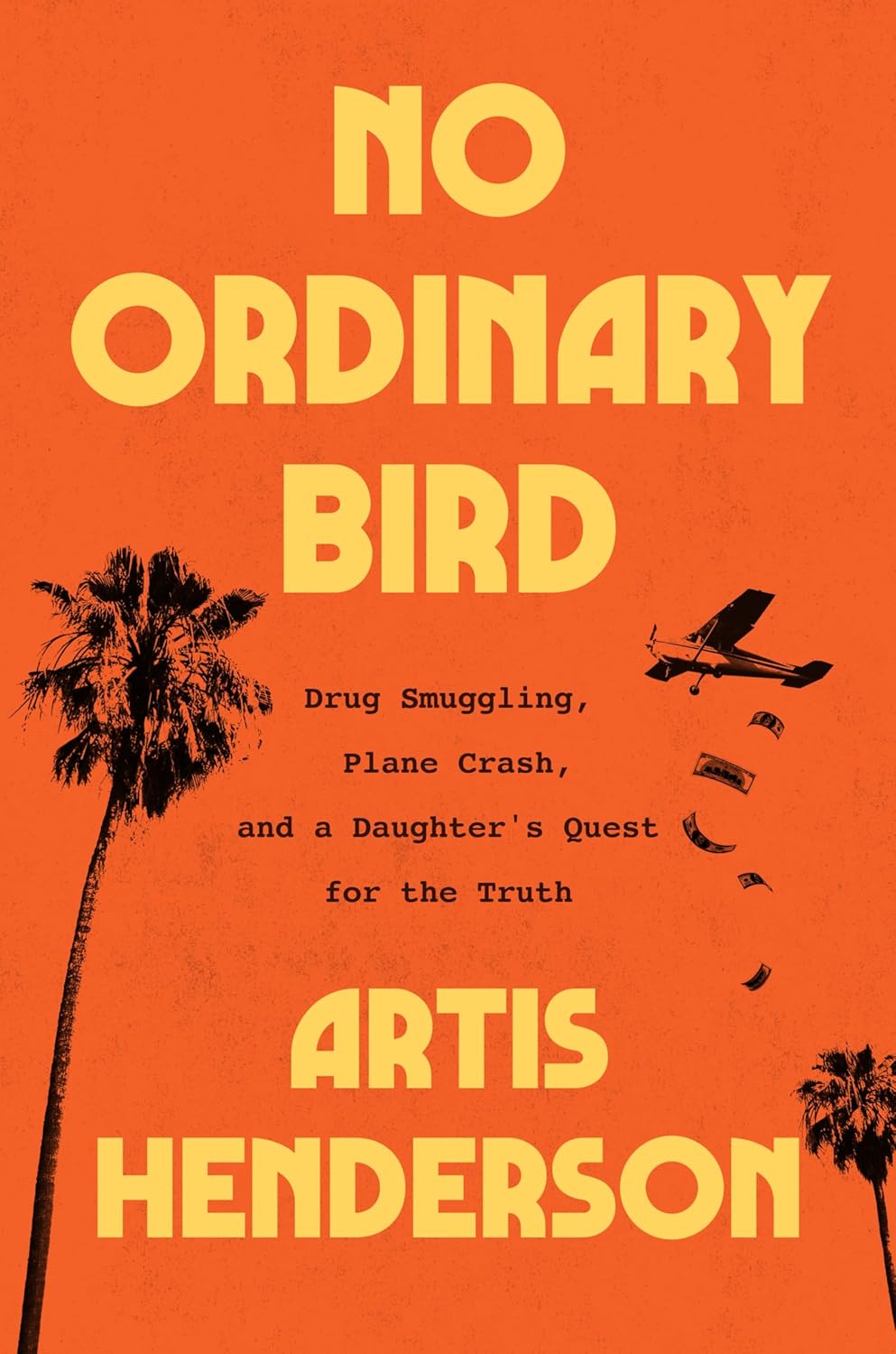
In June of 1985, a small private plane, a Piper Cub, crashed on its owner’s property in northern Georgia. The pilot, Lamar Chester, was killed. His only passenger, his five-year-old daughter, AJ, sustained severe injuries but lived. In death, Lamar escaped prosecution as a marijuana smuggler. His widow, hoping to protect her child, removed the young AJ from the life she’d known, isolating them from family and friends who had been involved in the smuggling business. AJ grew up to be Artis Henderson (Unremarried Widow), who spent decades turned away from her father’s story, interpreting her mother’s silence as shame. Her eventual readiness to examine the truth of her father’s life, their brief but loving relationship, and his end has resulted in No Ordinary Bird: Drug Smuggling, a Plane Crash, and a Daughter’s Quest for the Truth, which combines investigation and personal excavation in a searing, moving memoir.

In their few years together, Lamar made a strong impression on his youngest child, one that has been enriched by her later research. She remembers him as a loving and beloved father, and deeply charismatic, although his attitudes toward women in particular appear problematic through a modern lens. Henderson is thoughtful about such judgments, and careful in considering her father’s upbringing as a factor in his life. And a wild life it was, with an early marriage yielding three surviving children and one lost; divorce and remarriage; and a colorful career as a pilot, smuggler, and ostentatious party boy in 1970s Miami. Increasing profits and outward success allowed Lamar to acquire ever-more-impressive possessions, and he became involved in ever-more-risky ventures, until he faced federal prosecution and the plane crash that killed him.

Henderson’s work is both investigatory and personal: “I’m grappling with this story as much as I’m reporting it.” She loved her father, sympathizes with the demons he faced, and remembers a childhood of “uncomplicated happiness. My father made me feel safe and protected.” She trusts that there was a time when, “to him, the line between the good guys and the bad guys was still very clear,” but also realizes that he made choices that endangered his family and, she concludes, led to his own death. No Ordinary Bird is a loving portrait that benefits from the nuance of understanding that, as Lamar liked to say, “you can’t tell the good guys from the bad guys.” It is both research-based inquiry–involving travel to Miami, Georgia, Colombia, Nicaragua, Iran, and beyond–and also a memoir of family, love, and risk. Henderson excels at the subtlety required by such a story, and her telling is intriguing, painful, and cathartic.


This review originally ran in the July 18, 2025 issue of Shelf Awareness for the Book Trade. To subscribe, click here.


Rating: 8 bear claws.

The Rent Collectors: Exploitation, Murder, and Redemption in Immigrant LA by Jesse Katz

Street gangs and street vendors in L.A.’s MacArthur Park, a pair of botched murders, and a number of criminal trials shed light on social ills in this sensitive study.

Jesse Katz (The Opposite Field), longtime Los Angeles journalist, tackles a true story featuring a daunting number of characters and spanning years and tragedies in The Rent Collectors: Exploitation, Murder, and Redemption in Immigrant LA. With admirable clarity and compassion, Katz unravels a complex narrative that has no easy answers.

In the MacArthur Park neighborhood of L.A. in 2007, a teenaged gang member under orders fired five shots at a street vendor, in retaliation for the vendor refusing to pay “rent” to the gang. The intended victim was badly wounded by four bullets; the fifth bullet struck and killed a nearby 23-day-old infant. The shooter, Giovanni Macedo, was in turn the victim of a botched murder attempt at the hands of fellow members of his gang, the Columbia Lil Cycos, as punishment for his error. Giovanni eventually testified and helped put many gang members behind bars, receiving a sentence of 51 years for his crimes.

Katz’s thorough account details Giovanni’s personal and family history; the history of MacArthur Park; the cultural and economic predicament of L.A.’s immigrant street vendors; the background of the Columbia Lil Cycos, the larger 18th Street alliance, and the Mexican Mafia; the lives of Giovanni’s victims; and California’s law enforcement, judicial, and prison systems. It’s a sprawling story, but riveting and propulsive in this telling. The Rent Collectors deftly probes systemic ills. A large population of undocumented immigrant street vendors is squeezed between L.A. enforcement and street gangs: “MacArthur Park strained under the exigencies of that shadow population, a virtually permanent subclass left to invent its own opportunities, to improvise its own survival.”

Giovanni’s family background leaves him with a shortage of options and a desperate desire to belong to something bigger than himself. Immigration, legal, and prison systems fail, frustratingly often, to reward behaviors society deems “good” or to address adequately the “bad.” Giovanni is the protagonist of this story, drawing near a parole hearing at the time of this book’s publication; Katz portrays him with sensitivity and an eye to the complexities that led to his crimes. Giovanni is an imperfect symbol of redemption, but Katz shows that the marginalized teen was at the mercy of inexorable and deeply problematic societal forces. Abstaining from painting heroes or villains, Katz offers instead a plethora of thoughtful, nuanced profiles and a zoomed-out view of immigrant L.A., its street vendors, its gangs, and its intricacies. The result is relentless, multi-faceted, and incisive.


This review originally ran in the May 10, 2024 issue of Shelf Awareness for the Book Trade. To subscribe, click here.


Rating: 7 pairs of earrings.

The Talented Mrs. Mandelbaum: The Rise and Fall of an American Organized-Crime Boss by Margalit Fox

In the late 1800s, a female crime boss ruled New York City, as colorfully detailed in this exhilarating narrative history.

Margalit Fox (Conan Doyle for the Defense; The Riddle of the Labyrinth) brings a lively storytelling style and a flair for conveying personalities to a history that’s stranger than fiction with The Talented Mrs. Mandelbaum: The Rise and Fall of an American Organized-Crime Boss.

“‘You are caught this time, and the best thing that you can do is to make a clean breast of it,’ one of the Pinkertons… advised Mrs. Mandelbaum as she was led away. In reply, Fredericka Mandelbaum–upright widow, philanthropic synagogue-goer, doting mother of four, and boss of the country’s most notorious crime syndicate–whirled and punched him in the face.” To the modern mind, attuned to Scarface-style organized crime, Mandelbaum was an unlikely candidate for her role: Jewish, female, an immigrant, penniless upon her arrival in the United States in the mid-1800s. But through shrewd business practices and motivated by her desire for her family’s survival and comfort, the woman known as Ma, Mother, and Marm Mandelbaum established what would become a multi-million-dollar empire. She backed her staff of shoplifters, pickpockets, and bank burglars with training, supplies, project funding, bail money, and lodging–indeed, mothering them while setting a standard for criminal organization, including a highly specialized school for safebreakers.

Fox successfully tells this story by letting colorful characters stand out. “About six feet tall and of Falstaffian girth (she was said to have weighed between 250 and 300 pounds), pouchy-faced, apple-cheeked and beetle-browed, [Mandelbaum] resembled the product of a congenial liaison between a dumpling and a mountain.” She is pursued less by the New York police departments (multiple, corrupt, and at odds with one another) and more by the detectives of the nascent Pinkerton Agency who were hired to bring her down in a changing world. Both police and Pinkertons provide memorable characters to boot, on top of the regular and freelance lawbreakers Mandelbaum employed. Fox has a sharp eye for humor: “At the interment, it was reported afterward, some mourners deftly picked the pockets of others. Whether they did so in tribute to their fallen leader or simply from occupational reflex is unreported.” And she sets this wild narrative in the context of its time, Gilded Age America, aglitter and crooked and facing massive economic and social change. The world of Herbert Asbury’s Gangs of New York both provided the long shot for a Jewish matron, and punished her for her nerve.

With copious notes and research, Fox offers a tale as madcap and thrilling as it is illustrative of American history and culture. The Talented Mrs. Mandelbaum is riveting for fans of both history and entertaining storytelling.


This review originally ran in the April 16, 2024 issue of Shelf Awareness for the Book Trade. To subscribe, click here.


Rating: 7 diamond stickpins.

Dear Sister: A Memoir of Secrets, Survival, and Unbreakable Bonds by Michelle Horton

The heartbreaking story of a woman incarcerated for killing her abuser, told by her sister, highlights systemic wrongs and the resilience of a family in trauma.

Dear Sister: A Memoir of Secrets, Survival, and Unbreakable Bonds is a harrowing story, a call to action, and a love letter between sisters.

In their 20s, Michelle Horton and her sister, Nikki, were very close, working together to raise Nikki’s two children and Horton’s son. Horton thought she knew everything about her sister’s life, and so was entirely caught off guard by the emergency call. Her niece and nephew’s father was dead. Nikki had killed him. He had been abusing her horrifically for years, and many members of the community had known it, had been working actively to get Nikki out. Horton was told to come and pick up her sister’s children, ages two and four, immediately.

In the months and years that followed, Horton’s life was consumed by the work of single-parenting three children while raising money for her sister’s legal defense, becoming an amateur expert on criminal law and the psychology of abuse, and advocating for survivors’ rights. The high-profile 2019 case of Nikki Addimando resulted in her conviction of second-degree murder and a sentence of 19 years to life in prison. Despite extensive evidence, the judge concluded that Nikki was not a victim of abuse.

Horton’s narrative (with supporting evidence) is available elsewhere, but she additionally brings to her memoir a close, personal account of Nikki’s trauma and that of the three children involved, the deep connection between sisters, and the continuing failure of the legal system adequately to handle abuse victims when they appear as criminal defendants. Horton delves into the sisters’ childhood, including earlier instances of abuse, and the culture in which so many–including the author–failed to recognize the signs of Nikki’s suffering. Keeping silent about her abuse did not serve Nikki in the end, but Horton observes that other victims will not be encouraged by Nikki’s experience to speak up.

The stories Horton relates are heartbreaking. She does not shy away from graphic descriptions of the brutal abuse Nikki experienced, which some readers will find difficult to read. These details do not feel gratuitous, but rather central to the painful but necessary account Horton offers. Her concern extends beyond her own family, to other victims of intimate partner violence who enter the justice system as criminals. Dear Sister is not only Horton’s story and Nikki’s story, but also an urgent appeal for reform. Heartfelt, disturbing, but ultimately hopeful, this memoir is an important part of an ongoing conversation, and a tribute to sisterhood.


This review originally ran in the November 20, 2023 issue of Shelf Awareness for the Book Trade. To subscribe, click here.


Rating: 7 half-tubes of toothpaste.

Among the Bros: A Fraternity Crime Story by Max Marshall

This investigative narrative of fraternity members turned drug dealers–and worse–exposes unsavory aspects of college life.

Among the Bros: A Fraternity Crime Story is Max Marshall’s investigation into the series of arrests and criminal charges related to fraternities at the College of Charleston in South Carolina and the individuals involved. A press conference during the College of Charleston’s 2016 summer break caught the attention of Marshall, a journalist, recent college graduate, and fraternity member himself. Mug shot photos showed five fraternity members and three friends. “They looked like guys who put in time at the gym, and maybe at the beach, and definitely at the putting green,” Marshall writes. These eight young men were accused of selling a variety of controlled substances, including Xanax, which, as police chief Greg Mullen put it, seemed to be “a drug of choice right now.” According to authorities, this case was also related to the recent murder of another fraternity member. Intrigued, Marshall follows the story of those eight arrests and the changing cultural identity of Greek organizations in the United States.

Among the Bros focuses on Mikey Schmidt, a Kappa Alpha, to whom Marshall spoke via a series of contraband cell phones as Mikey served 10 years without parole. Age 21 at the time of his arrest, Mikey is one of the flashiest characters in the story Marshall unearths, and he receives the most serious sentence of the group. He and his best friend, Rob Liljeberg III (also a Kappa Alpha), form the backbone of Marshall’s reporting. They put human faces on an investigation into the intersection of Greek life, drug dealing, and criminal activity by a particularly privileged and overwhelmingly white male demographic.

Over the course of four years, Marshall consulted police files, court transcripts, and other documents, and conducted more than 180 interviews with 124 sources. The narrative he presents is sad, deeply disquieting, and often sordid. The fraternity members he interviews all deny using date-rape drugs but allow that others around them do. He meets with one fraternity alumnus who describes mixing gin, Mountain Dew, Xanax, and cocaine–and then tries to sell Marshall his financial planning service. “When I asked an SAE [Sigma Alpha Epsilon] what his friends did the weekend after the Mother Emmanuel killings, he said, ‘Things just aren’t going to stop…. As insensitive as it sounds, it’s still Friday.'” The portrait these anecdotes paint is not flattering, but Marshall remains compassionate, sympathizing with the pull of belonging, and the promise of like-minded friends.

Among the Bros finishes without moral lessons or final conclusions, instead aiming to clearly report events that will disturb most readers. Combining excellent journalism and deftly paced storytelling, this chilling tale lifts a veil on a decadent and troubling lifestyle.


This review originally ran in the September 8, 2023 issue of Shelf Awareness for the Book Trade. To subscribe, click here.


Rating: 7 brand names I had to look up.

In the Mouth of the Wolf: A Murder, a Cover-Up, and the True Cost of Silencing the Press by Katherine Corcoran

The unsolved murder of a Mexican journalist has implications for the free press and free society everywhere in this in-depth investigation.

In the Mouth of the Wolf: A Murder, a Cover-Up, and the True Cost of Silencing the Press is American journalist Katherine Corcoran’s first book, focusing on the murder of Mexican journalist Regina Martínez in 2012, its aftermath and implications for the free press in Mexico and beyond. Corcoran details the years she spent investigating Martínez’s death, without the satisfaction of a final conclusion; the case remains unsolved, along with many other cases of slain journalists.

“To the foreigner, Mexico charms, cajoles, and seduces. There are so many Mexicos: so many climates, cultures, foods, and languages; contiguous, concentric, stacked; native and colonial; current and past; invisible yet present.” With this same attention to multiplicity, Corcoran relates the complicated nature of a single murder case and all that it represents. Already familiar with Mexican culture, politics and journalism, Corcoran, as Associated Press bureau chief in Mexico City, had also received threats to her staff by the time that Martínez was brutally killed in the bathroom of her own home in Xalapa, Veracruz. Killings of journalists had been on the rise, but this case was different, not least because Martínez was nationally known: “Everyone, including me, knew she was beyond reproach. I had tried to hire her once.” Martínez was known for covering potentially dangerous subjects, frequently including the connection between government corruption and organized crime. No one in her tight-knit circle of journalist friends could say what she’d been working on when she was killed, and the official line quickly became that she had been the victim of a crime of passion–something none of her friends believed, but a difficult theory to disprove.

Into a mess of stories and theories, and still under threat of surveillance and violence years later, steps Corcoran, with archival research and hundreds of interviews with a dizzying cast of characters (helpfully listed in the front of the book) from the media, politics, organized crime, and Martínez’s family and friends. She brings a journalist’s careful accounting of where truth meets speculation, where the author has chosen between versions of the same story, where corroboration has been impossible. In the Mouth of the Wolf offers the results of this research, numerous unconfirmed theories and the personal story of a journalist chasing an elusive truth. By its finish, Corcoran has become alarmed by the state of the free press in the United States as well as in Mexico, and concludes that Martínez’s unsolved murder–and so many like it–have chilling effects not only on the freedom of the press but on society itself, all over the world. This compelling, carefully researched investigation is a sobering clarion call.


This review originally ran in the August 26, 2022 issue of Shelf Awareness for the Book Trade. To subscribe, click here.


Rating: 7 vests.

Cults: Inside the World’s Most Notorious Groups and Understanding the People Who Joined Them by Max Cutler, Kevin Conley

This shocking study by the creator of the podcast Cults recounts and dissects the leaders, followers and histories of 10 extreme cults.

“Everyone wants to believe in something or someone: a higher ideal, a god on earth, a voice from heaven…. When this appetite for belief combines with the need to belong, great things can happen…. But what about those rare moments when the dark side of human nature takes hold?” The shocking Cults, based on the Parcast podcast of the same name, surveys some of the most famous and disturbing examples of small, extremist, ill-fated sects. Parcast founder Max Cutler is joined by Kevin Conley (Stud; The Full Burn) in writing this roundup of frighteningly charismatic leaders and their followers.

Ten chapters cover 10 cults chosen for their impacts on the world’s imagination, beginning (naturally) with Charles Manson and his “family.” Cutler’s focus is both narrative, detailing the story of the leader’s upbringing and the cult’s rise and fall, and also probing: Cults is interested in motivations and, to the extent possible, diagnoses. “With so many cult leaders who died suddenly or violently, any diagnosis of psychological disturbance is purely speculative,” but the temptation is strong. “Cult leaders make such good case studies: because the gruesome facts of their biographies are both widely known and easy to connect to a psychological disorder.” Cults are labeled in the table of contents by the root cause Cutler has identified for each leader’s actions. According to this system, Manson was motivated by shame, as was Adolfo de Jesús Constanzo, whose Narcosatanists were responsible for at least 16 deaths in Mexico in the 1980s.

Jim Jones of the Peoples Temple was driven by exploitation, taking advantage of his followers financially and sexually until the deaths of 908 Americans (including Jones) in what was called “Jonestown” in Guyana. Likewise exploitative was the bizarre Bhagwan Shree Rajneesh, whose ashrams in India and then Oregon supported his desire for both nitrous oxide and Rolls Royces (he owned 93 at one point), and who laced Oregonian salad bars with salmonella in a bid for local political control. Pathological lying, megalomania, sadism, escape and denial of reality cover the remaining cults: Claude Vorilhon’s Raëlism, Roch Thériault’s Ant Hill Kids, David Koresh’s Branch Davidians, Keith Raniere’s NXIVM, Credonia Mwerinde’s Movement for the Restoration of the Ten Commandments of God, and Marshall Applewhite’s Heaven’s Gate. Manipulative, self-aggrandizing, compelling and lacking in empathy, these characters (in every sense) are by turns laughable, inexplicably strange and chillingly, brutally cruel. Not for the faint of heart but absolutely for the true-crime junkie, Cults is packed with details and unafraid to posit theories to explain these superlatively weird and scary stories.


This review originally ran in the April 22, 2022 issue of Shelf Awareness for the Book Trade. To subscribe, click here.


Rating: 5 mixtures containing applesauce.

Memorial Drive: A Daughter’s Memoir by Natasha Trethewey

A former U.S. Poet Laureate remembers her mother, and wrestles with her brutal murder, in compelling and feeling style.

Natasha Trethewey, two-term United States Poet Laureate, forges a serious, poignant work of remembrance with Memorial Drive: A Daughter’s Memoir. Trethewey’s mother, Gwen, is the focus of this book: the daughter’s memories and what she’s forgotten, and, pointedly, the mother’s murder at the hands of her second ex-husband. The murder took place just off Memorial Drive in Atlanta, Ga.; the aptly named thoroughfare runs from downtown to Stone Mountain, monument to the Confederacy, “a lasting metaphor for the white mind of the South.”

Trethewey is the daughter of an African American mother and a white Canadian father. Their marriage was illegal; she was born just before the Loving v. Virginia Supreme Court case that struck down laws banning interracial marriage. Memorial Drive begins with her upbringing in Mississippi with her doting extended maternal family, necessarily recounting her early understanding of race and racism. This happy period ends abruptly with mother and daughter’s move to Atlanta, when Trethewey’s parents divorce. Atlanta has its strengths, such as a vibrant African American community, but very quickly, Gwen meets the man who will become her second husband. From the beginning, Joel is a sinister figure. Twelve years later, 19-year-old Trethewey returns to Atlanta from college to clean out her mother’s apartment after Joel brutally murders Gwen.

While this central event is harrowing, Memorial Drive does not focus only there. Trethewey ruminates on memory and forgetfulness, and recalls her developing love for and skill with metaphor, language, writing. Back home in Mississippi, her great-aunt “would appear each day at the back door, singing my name through the screen, her upturned palm holding out toward me three underripe figs… she was teaching me the figurative power of objects, their meaningful juxtapositions.” During the painful retelling of her stepfather’s physical abuse of her mother, Trethewey resorts to the second person, a whole chapter delivered to her younger herself. Concluding: “Look at you. Even now you think you can write yourself away from that girl you were, distance yourself in the second person, as if you weren’t the one to whom any of this happened.” Memories of her mother often appear as images, offering symbolic interpretations of the 12-year gap left by trauma. While Trethewey does pursue forensic exploration (transcripts of recorded phone calls between Gwen and Joel, as well as a visit to a psychic), this memoir is more introspection than true-crime investigation. And it is gracefully and gorgeously rendered, as befits a poet of Trethewey’s stature.

Trethewey declines to offer a neat conclusion, but she succeeds in making meaning from pain. Memorial Drive is loving and elegiac, disturbing and incisive.


This review originally ran in the June 18, 2020 issue of Shelf Awareness for the Book Trade. To subscribe, click here.


Rating: 7 lost records.

did not finish: Not a Gentleman’s Work: The Untold Story of a Gruesome Murder at Sea and the Long Road to Truth by Gerard Koeppel

I quit just over halfway through this work of history/investigative writing/true crime. In 1896, a small sailing ship left Boston headed for Argentina with a cargo of lumber. There were twelve people aboard: the captain and his wife, a paying passenger, and a small crew. Within the first week, three of the twelve had been hacked to death with an axe. One of the crew was convicted and served time and was later pardoned. Koeppel leans heavily toward the paying passenger as the true murderer: a silver-spoon Harvard dropout and drunk with some odd behaviors. But in the end, the ‘long road to truth’ remains unfinished; we don’t know what really happened on board the Herbert Fuller.

It sounded up my alley, but this slim history threw me in a couple of ways. Koeppel’s tone varies from the meticulously detailed chronology to the sensationalist crowing of what can only have been. Here is neither Erik Larson’s novelistic telling of well-documented histories, nor the measured and transparent speculations of literary writers like Kushner, Kupperman, Monroe, and Wood.

Koeppel’s standard of proof is not my own. For my money, he puts rather too much faith in the eyewitness accounts of discombobulated sailors, chicken-scratched down by their fellows, none of whom spoke English as a first language, and now viewed at a distance of more than a century. Eyewitness testimony is notoriously inaccurate in any case. To point to inconsistencies in records such as these and claim them as proof of dishonesty seems unreasonable. I was bemused by a preoccupation with who had children and whether they in turn had children: the continuing line of the key players seems important to Koeppel in a way I don’t comprehend.

As usual, your mileage may vary, but this is not for me.


No rating.

The Third Rainbow Girl by Emma Copley Eisenberg

A keen, thoughtful inquiry into relationships, place and the forces that contributed to a 1980 crime.

In The Third Rainbow Girl: The Long Life of a Double Murder in Appalachia, Emma Copley Eisenberg offers a true crime story as well as a painful look at misogyny and estrangement; a gorgeously rendered memoir of human relations; and a sensitive, perceptive profile of a misunderstood region.

In 1980, two young women were hitchhiking to a Rainbow Gathering (one of a series of events that attracted as many as 20,000 hippies) when they were killed and left in a remote clearing in southeast West Virginia’s Pocahontas County. A third young woman had parted ways with her hitchhiking companions just before they died. Eisenberg’s title points toward her fascination with this character: the one who, apparently by a stroke of luck, lived. Locals told conflicting stories about what had happened. More than a dozen years later, a local man was tried and convicted, then later won his freedom in a new trial. An imprisoned serial killer claimed responsibility, but was considered a less-than-reliable source and was never tried for these crimes.

The Third Rainbow Girl is an incisive, thoroughly researched work of true crime reporting. Eisenberg visits those close to these events–the accused, witnesses to the trial, lawyers, police investigators and local bystanders–and forms her own loose theories, while acknowledging how much will never be known. The book’s mastery, however, is in how much more it accomplishes. “If every woman is a nonconsensual researcher looking into the word ‘misogyny,’ then my most painful and powerful work was done in Pocahontas County. It could have been done in any other place, because misogyny is in the groundwater of every American city and every American town, but for me, it was done here.” Importantly in this region that is oft maligned, Eisenberg lived in Pocahontas County for a time, forging relationships and grappling with her place in the world; she begins to bridge the differences between Appalachian insider and outsider. Part of her work is indeed to study misogyny, the relationships between genders and the responsibilities and challenges of those, like herself, who wish to enter a troubled place and “do good.” This book is as much about gender and political and social relations as it is about a specific crime. In brief sections, it also contains an outstanding account of the historical forces that shape present national attitudes toward Appalachia.

Eisenberg’s gaze is unflinching, whether turned on a traumatized community, an unlikeable but probably innocent man or upon herself and her own tendencies. Her prose is incandescent, precise, descriptive and often lyrical: a medical examiner testifying at trial has “a face so pink it looked slapped” and her first time spent
working in West Virginia at a camp for girls is “dense and crackling.” The narratives of the murders, of the investigations and trials and of the author’s Appalachian life intertwine and comment on one another. The result is a subtle, steadfast examination of the sources of pain and trauma.


This review was written for Shelf Awareness for the Book Trade, but is published for the first time here.


Rating: 9 music nights.

One of the things I appreciated here is that Eisenberg was sensitive to the local perspective and her position as outsider (because even after months or years here, you go easy declaring yourself to be an insider). Unlike Ramp Hollow, this book cites sources from within the community (like Sugar Run!).