The Bones Beneath My Skin by TJ Klune

Just out from TJ Klune, The Bones Beneath My Skin is a standalone adult novel with loneliness, yearning, darkness, sweetness, queer love and sex, and discovery of new forms of family. There is a bit of a formula here in terms of the combination of those elements, but I don’t intend any of the negative connotation that often accompanies the idea of a formula. I appreciate that I can turn to Klune for a familiar blend of heartbreak and happy ending with characters who are messy but also the kinds of people I’d like to call friends.

In his Author’s Note, Klune calls this an ‘action movie in book form.’ A former publisher accused this manuscript of being different and weird: “but then, I’m the guy who made a socially anxious vacuum cleaner named Rambo into a main character” (check it out).

Nate Cartwright is on the road. The reader learns gradually: that he is driving the old truck recently inherited from his father, to the cabin recently inherited from his mother, both of whom just died of a murder-suicide after a lengthy estrangement from Nate, who they disowned when they discovered he was gay. He has lost his job and everything else that mattered to his old life in Washington, D.C. (not much); he’s headed to the cabin, lakeside in rural Oregon, without much of a plan but to unplug and regroup. But when he arrives at Herschel Lake, the cabin is not unoccupied. Instead, he finds a huge, intimidating man with a huge gun, accompanied by a tiny, lovely, friendly, extremely strange little girl. The man is Alex. The little girl is Art, short for Artemis Darth Vader. Nate tells her that’s not a real name. She corrects him.

This odd trio joins up. Art and Alex have already bonded firmly as allies, against long odds; Nate is late to the party, but fits in, as a lonely oddball with a tendency toward deeply felt loyalties. In a series of extremely unlikely events, Nate learns that his new… friends?… may not be all that they appear. But still he chooses to go all in.

With hints of Men in Black and ET, Nate, Alex, and Art go rocketing across the country, fleeing shadowy government forces and conspiracy theorists, harboring secrets beyond the theorists’ imagining, wanting only to be safe and together with those they love. Klune’s website calls it “a supernatural road-trip thriller featuring an extraordinary young girl and her two unlikely protectors on the run from cultists and the government.” I love Klune’s rather trademark focus on protecting kids as a central, undeniably wholesome focus, even amid some very adult concerns (and passions). As with other recent novels of his that I’ve enjoyed, this one left me looking for more featuring these flawed but loveable characters. I really loved the ending. Still following this author anywhere.


Rating: 8 slices of bacon.

Somewhere Beyond the Sea by TJ Klune

Here it is: the long-awaited sequel to The House in the Cerulean Sea, which I found lovely and transcendent. Somewhere Beyond the Sea continues in that vein in fine form. We pick up Arthur, Linus, and their endearingly and massively weird household with six magical children – originally an orphanage, but now building into a family and a home – more or less where we left them. Linus has left his employment with the Department in Charge of Magical Youth to be with Arthur, and the two men are working on adopting their six charges. Theodore, a wyvern with an obsession with buttons. Talia, a garden gnome, a lovely girl with a lovely beard and a way with plants. Phee, a forest sprite. Sal, the eldest, a shifter who spends some of his time as a Pomeranian and is developing strong leadership skills. Chauncey, a “biologically unique” green blob and bellhop. And Lucy, short for Lucifer, the seven-year-old son of devil, who has his murderous tendencies but also a pretty standard seven-year-old sense of mischief, and a good heart. These pages will add to the mix David, a teenaged yeti, who is slow to trust his new household but also inclined to fit right in. He’d like to submit that fear is not always a bad thing: humans watch scary movies for fun, right? What’s the harm in a little good-natured roar now and then?

Pitted against this evolving family, of course, is the government, in the form of the Departments in Charge of Magical Youth and Adults, who would like to see everyone involved put in their place, under lock and key and with what some less enlightened folks still feel is an appropriate amount of shame. Arthur, himself a former magical youth – he is a phoenix, possibly the last living one of his kind – has come a long way from his trauma at the hands of DICOMY and his defensive isolation with his six orphaned charges. With the love and support of Linus, their dear friend (and island sprite) Zoe, and Zoe’s girlfriend Helen, mayor of the nearby village, Arthur and the children now regularly venture into town and mingle with humans and magical folks there. And when the book opens, Arthur is set to testify before the government about the abuse he suffered as a child and his work with his own children; he is hoping to help build a better world, and through adoption, formalize his family. But the close-knit family is up against some truly formidable villains with all the power in the world.

Like Cerulean, this sequel plays in several registers. The antics of the kids are sweet, silly, hilarious; there is lots of good fun and humor and also wholesome good lessons about mutual love and support. The continuing romance between Arthur and Linus is equally wholesome and feel-good. In inviting David in to their family, the household faces some new challenges in how to build trust and honor the newcomer’s need for distance.

Trust, Arthur knew, was a treasure effortlessly stolen, often without rhyme or reason. And this particular treasure was a fragile thing, a piece of thin glass easily broken. But here was David, surrounded by strangers in an unfamiliar place, attempting to pick up his pieces and put them back into a recognizable shape. Whatever else he was, David’s bravery in the face of seemingly insurmountable odds proved yet again what Arthur had always believed: magic existed in many forms, some extraordinary, some simple acts of goodwill and trust, small though they might be.

I think this illustrates some of the book’s larger themes: trust, fragility, vulnerability, bravery, and how these elements can help form family and community. The concept that even those in power – in government or in families – need to have the ability to acknowledge when they have been or done wrong. Arthur must navigate a misstep when he encourages David to be whatever he wants to be, including a “monster”, while having told Lucy that he should be less monstrous. (David’s monstrosity is less threatening. But should Lucy’s right to self-realization be any less?) This is still and again about trust: how Lucy can trust a father whose rules change; how a father or fathers should trust their child’s judgment as they grow and mature. Change requires flexibility; growth can be painful. But this loving family is very strong, perhaps because they challenge each other. And the letting-in of the village has been a good move: under the influence of Arthur and Linus’s household, the human inhabitants have learned greater tolerance, and magical visitors (and their tourist dollars) have begun to transform what was a typically mistrustful community into a more welcoming one. It will take a whole village in the end to defend what’s right.

A beautiful novel about family, trust, community, recovery from abuse and trauma, and systemic ills, all leavened by mischievous humor and filial and romantic love. Same-sex couples abound in the book, and Klune’s Acknowledgements prioritize defending trans people’s rights, but I’d say the metaphor at work in this world – where magical people are hidden away, poorly understood, and discriminated against by a larger population which will benefit from their inclusion – works for any disadvantaged minority. It’s great reading, sweet and funny, with great messaging. I can’t wait for more like it from this fine author.


Rating: 9 fish named Frank.

In the Lives of Puppets by TJ Klune

In the Lives of Puppets is TJ Klune’s third adult standalone novel, in a similar vein to The House in the Cerulean Sea and Under the Whispering Door. These are the only three of his I’ve read, although there are more, and I may still get to those.

I said about Whispering Door that Klune excels at “the juncture of sweetness, fantasy, profundity, inclusivity, wisdom and pure silliness.” Puppets continues in that style. Rather than magical orphans or a magical afterlife, here we have a decidedly sadder challenge. The story begins with a lovely forest. A man (“who wasn’t actually a man at all”) approaches an old, falling-down house in the forest. He builds a life there, a crazy network of add-on treehouses and laboratories a la Swiss Family Robinson. He has a son, Victor. Flash-forward: we meet adult Victor with his two companions, a nurse-robot named Nurse Ratchet (that’s an acronym for Nurse Registered Automaton To Care, Heal, Educate, and Drill, and yes, think One Flew Over the Cuckoo’s Nest) and a vacuum-robot named Rambo. Victor’s father Giovanni is still around, and much-beloved; they have a happy family, although Victor is the only human member of it. Like Giovanni, he is an inventor, builder, creator. He spends many of his days combing through the Scrap Yards, where the Old Ones deposit their detritus, some of which turns out to be useful to Victor’s little forest-dwelling family. It’s where he found Nurse Ratchet and Rambo, both of whom he’s patched up to become the wacky friends they are today. (Nurse Ratchet is forever hoping to murder someone or something, slowly, and document their agony. Rambo is crippled by anxiety, restlessness, and his ceaseless need to clean. He loves the old movie Top Hat.) One day, at the Scrap Yards, Victor finds a new potential friend, one who will change everything.

This book assailed me with literary allusions, some of them less obvious than the two I’ve named already. Epigraphs refer to Pinocchio; Victor’s first name and some other plot elements remind of me Frankenstein; the goofy-sidekick robots make me think of R2D2 and C3PO from Star Wars as well as The Wizard of Oz. Which is to say, Klune is not working with brand-new material here (nor does he think he is). The world of robots gets a decided Klune twist, though: sweet, silly, romantic, hopeful. There are a few big reveals I won’t name here. As I already mentioned, this world feels a bit less hopeful to me than the worlds of Whispering Door and Cerulean Sea. The romance felt a full step less believable to me, somehow, although I can’t quite say why – it’s not like the pairings-off in those first two novels made perfect sense in any real world, but this is fantasy. Something about this one just didn’t go off the same, for reasons I can’t articulate. Possibly (is this too obvious?) it is that difficult to write robots (or androids) as relatable humanish characters. Maybe it’s as simple as where we were left with this love affair.

I really enjoyed this read: I was absorbed, engaged, tickled, and concerned for the characters I’d come to love. It is a good book. I just think it’s less awesomely good than the two previous ones by this author that I’ve read. I will certainly buy the next standalone novel he publishes in this same vein.


Rating: 7 butterflies.

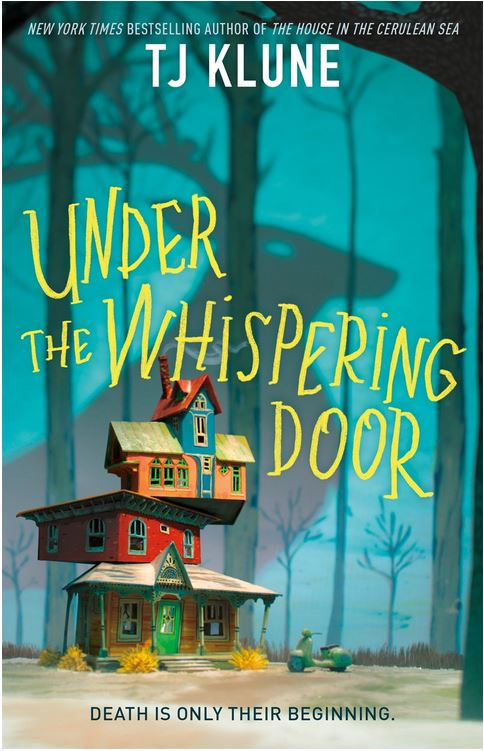
Under the Whispering Door by TJ Klune

TJ Klune is my comfort food reading these days. Under the Whispering Door has all the charm of The House in the Cerulean Sea but a new focus: end of life, death, grief and grieving, and the questions of whether one lived as fully as one might have, and what redemption might be possible. This material has a personal resonance for the author, who lost his partner at an impossibly young age. Despite that heaviness, and the heaviness that we presume, culturally, will accompany these topics, this is still a TJ Klune novel. Death is a new beginning – not one that is all flowers and sunshine, of course; it is accompanied by much pain and trauma, depending on circumstances. But there is hope, even hope for romance, and that romance happens to be between two men, in a beautiful, whimsical, hilariously misfit tea shop that is also a waystation for the recently deceased.

“You’re awfully strange.”

He heard the smile in her voice. “Thank you. That might be the nicest thing you’ve ever said to me. You’re awfully strange too, Wallace Price.”

Where Cerulean featured magical orphans and a socially awkward but well-meaning orphanage inspector, our little built family this time includes a few dead (one a sweet, goofy dog), a few living, and an initially deeply unlikeable lawyer. Three of the five central characters, Klune notes in his Acknowledgements, are people of color, while the author is white, and he emphasizes the important contributions of his sensitivity readers. I found all of these characters delightful, because if there is one thing Klune does well it is delightful, wacky, loveable, flawed characters (even dead people and dogs). Even the comedic villainess here is sort of a joy. As a YA book about death, this is just charming as can be, and I think truly helpful for those suffering a loss; but it is also never saccharine, which is an easy pit to fall into. In short, I am in for wherever Klune wants to take me next, at the juncture of sweetness, fantasy, profundity, inclusivity, wisdom and pure silliness. Strongly recommended.


Rating: 8 cups of tea, obviously.

The House in the Cerulean Sea by TJ Klune

“This book is very close to perfect,” says the front-cover blurb by Seanan McGuire, and I confess I raised my eyebrows. But I just finished this book, and I agree.

I’m going to take an unusual step and repost my colleague’s review of this book as published by Shelf Awareness (on March 2, 2020), because I think it’s an excellent review and it’s why I purchased this book. (Which is not my typical fare.) My comments follow. Thanks, Jaclyn, for your good work!

A repressed orphanage inspector takes a stand for six magical children and their charismatic caretaker in this humorous, inclusive love story.

In this sparkling romantic fantasy, TJ Klune pits a mild-mannered paper pusher against the forces of discrimination, inhumane bureaucracy and precocious children, with hilarious and inspiring results.

“Make sure the children are safe… from each other, and themselves,” Extremely Upper Management of the Department in Charge of Magical Youth (DICOMY) instructs 40-year-old Linus Baker. Linus’s thankless task is inspecting orphanages that house magical children. He blanches at the children’s powers but treats them kindly and believes his work supports their welfare. His quiet life with his old Victrola and “thing of evil” cat Calliope gets interrupted when administration dispatches him to remote Marsyus Island Orphanage, home of six especially unusual children.

Though no stranger to telekinesis or witchcraft, Linus balks at the group: a distrustful forest sprite, a button-hoarding wyvern, a female garden gnome who swings a mean shovel, a boy who turns into a Pomeranian when frightened, a green blob who likes to play bellhop and “Lucy,” the six-year-old son of the Devil. However, their gentle, unflappable caretaker, Arthur Parnassus, unsettles Linus most of all. He exhibits no intimidation at parenting the magical equivalent of a nuclear warhead, and Linus, “a consummate professional,” finds himself attracted to the orphanage’s master in a most unprofessional manner.

However, his reservations about the children fade as Linus gets to know them and sees Arthur’s commitment to giving them a thoughtful, loving upbringing. The intention of remaining detached and going home in one piece evaporates when Linus learns that the island’s non-magical inhabitants have threatened the children. Nevertheless, Arthur Parnassus is more than he seems and, sooner or later, Linus will have to choose between remaining safe but complicit in an oppressive system or standing up for the people he has come to love.

Stuffed with quirky characters and frequently hilarious, this inclusive fantasy is quite possibly the greatest feel-good story ever to involve the Antichrist. Klune, who has previously won the Lambda Literary Award for Best Gay Romance (Into this River I Drown), constructs a tender, slow-burn love story between two endearingly flawed but noble men who help each other find the courage to show their true selves. Charged with optimism and the assertion that labels do not define people or their potential, The House in the Cerulean Sea will delight fans of Seanan McGuire’s Wayward Children series and any reader looking for a burst of humor and hope.

Jaclyn Fulwood, blogger at Infinite Reads

It started just a hair slow for me, perhaps because the style and genre weren’t what I’d been involved with lately (or much ever), but soon the magnetism of the story took hold. Linus is frustratingly meek; it took me a minute to get invested in his future. But there is certainly magic here, not only in the fun, quirky, vulnerable children, but in Klune’s imagination and the lovely house in the sea. By the end, I cried. This book is just deeply sweet, and sometimes we need that. It’s also got some powerful messages about acceptance, authenticity, honesty, and the value of a built or chosen family; and those messages are nicely couched in a story that is sweet but not precious. I found it most moving; TJ Klune has a new fan. I’m so glad I stepped away from my standard reading material. We all need that sometimes.


Rating: 9 buttons.