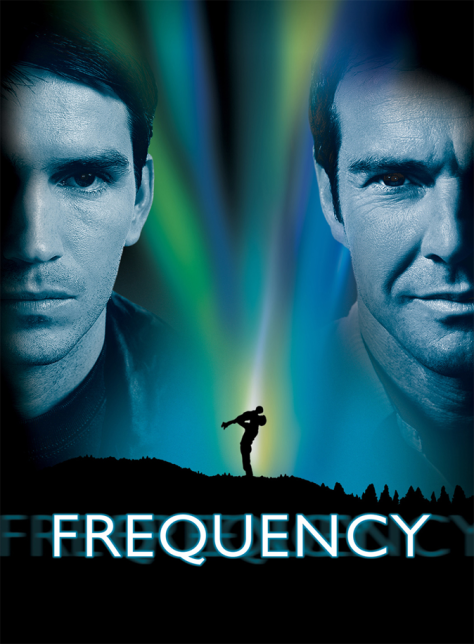
movie: Frequency (2000)

Another firefighter flick. (I can’t remember where I got this list.)

As the movie opens, Dennis Quaid is a hunky firefighter, Frank, in 1960s Queens. He has a good marriage with Julia, and a six-year-old son, John. Flash-forward some 30 years, and John (Jim Caviezel) has grown up to be a cop. He’s close to his mother. They both mourn his long-dead father.

Until the return of the rare (especially in NYC) aurora borealis, which shows up in both 1969 and 1999, coinciding with adult John’s discovery of his father’s old HAM radio. In a sci-fi twist, this allows Frank and adult John to talk to each other across the years. (There is mention of string theory and multiple dimensions to lend this mystery a touch of possibility.) It takes a bit of convincing, especially for Frank, to believe what’s happening, but the play-by-play John is able to give of the 1969 World Series (the Amazing Mets) clinches it. (That World Series will continue to signify throughout the movie.) You can guess what comes next: John is able to warn his father about the warehouse fire in which the latter dies. Now he doesn’t die. Hooray! Except… cue the butterfly effect.

Frank’s survival gives John a whole new set of memories in which his father was there for his adolescence and young adulthood. He’s kept the other memories, too: “I remember both. At the same time. It’s like waking up from a dream and you’re not sure what’s real. I remember you being here, but I also remember when you weren’t.” And now, of course, things start changing in John’s present. His girlfriend doesn’t know him. His mother is not at the phone number he has for her. John the homicide detective gets a new case that matches an old case, and the news just keeps getting worse. He and Frank, across the years and via nightly talks on the HAM radio, undertake to catch a serial killer, but as Frank points out, he’s a firefighter, not a cop. It’s possible that whatever they try will make things worse.

This movie is kind of sappy, but I quite loved it. Seeing the father and the son be open and emotional with each other was darling, actually, even if a bit cheesy. Frequency‘s plot is not unfamiliar (think elements of Back to the Future, Sixth Sense, Ghost, It’s a Wonderful Life), and it uses some fairly transparent tools to manipulate my emotions, but I’m here for it: with a little willing suspension of disbelief, the tension was convincing, and the plot twists intriguing. There’s a bad guy, and there are a couple of clear good guys, and enough disturbance to put them in danger along the way. Most importantly, there are compelling relationships, and maybe that’s key to my enjoyment here. I found a user review on IMDB that says it perfectly: “There have certainly been better action/suspense/serial killer movies (the action scenes weren’t amazing, the story has some holes, and I thought the ending was a little cheesy), but the heart of the film is the relationship between Frank and John. I bought into that relationship fully, and that’s why I liked this film as much as I did.” Well put, UnclePaul.

Solidly worth the time. Also Dennis Quaid is hunky.


Rating: 7 cigarettes.

Tiamat’s Wrath by James S. A. Corey (audio)

Tiamat’s Wrath is a terrific addition to the trilogy of trilogies that comprise The Expanse which, though never less than entertaining, have waxed and waned in their proximity to greatness since the publication of Leviathan’s Wake. (from Tor.com)

I concur: Tiamat’s Wrath is one of the better installments in an uneven but generally scintillating series. (Also, bonus at Tor.com: I learned a new word in the author bio. “Niall Alexander is the manager of an extra-curricular education centre, and also, increasingly occasionally, a reader and a writer. He lives with about a bazillion books, his better half and a certain sleekit wee beastie in the central belt of bonnie Scotland.” I love learning new words.)

Several decades after the end of Persepolis Rising, James Holden remains a prisoner of High Consul Winston Duarte, emperor of all the known worlds. Chrisjen Avasarala has recently died. Naomi lives in isolation in a shipping container, surrounded by tech, where she plays an important advisory role in the Resistance but rarely sees another human. Bobbie captains the captured ship Storm (also Resistance), with Alex as her pilot. Clarissa is no more (see previous book); Amos went on a high-stakes mission years ago, deep in enemy territory, and has never been heard from again. It’s a very somber opening.

Our beloved central characters are getting gray, but those living are still fighting, in their various ways, dispersed across galaxies. Aside from the core, we see Elvi Ocoye return (from Cibola Burn), performing on Duarte’s scientific team but having already, by the time this book begins, figured out she’s on the wrong team. And a new addition to the perspectives that tell this story is Teresa Duarte, the High Consul’s only child, at fourteen his protégé and, well, a teenager pushed to rebel.

A little hint here: it helps to have read The Churn before this book.

The science seems to matter a little more here than usual, or maybe it’s just that it makes more sense? At any rate, I was able (and motivated) to follow it more than I’ve been in a couple of books, and I found that rewarding. One relevant detail is that Duarte has been made immortal by protomolecule technology and with the help of sociopath Dr. Cortázar. But one thing about poorly understood technologies is that you don’t always know what you’ve signed up for.

My engagement with the science part of the science fiction helped me enjoy this book even a bit more than usual. But even more so, I think the plot and the action were at their best. And still more, separating our characters out into their own mini-stories (something that doesn’t always reengage fans, ahem, The Walking Dead) – with only Alex and Bobbie remaining a team – was a great choice here, in my opinion. We got to see each protagonist take on their own challenges, make their own choices, redefine their own values and belief systems. Naomi, in particular, had to expand her self-conception in the best of ways. I love love loved seeing everybody operate on their own, against a bare background if you will.

Our team – the Rocinante‘s crew, even if she’s in long-term storage – experiences surprising losses and surprising gains in this book. We are heading into the final novel of the series from here. I already feel a sense of loss that it will be over (although there are still several novellas and short stories for me to track down). But I also feel like the massive scale, physical, narrative, and moral, that have been undertaken by this series is being honored here in the penultimate installment, and that feels good. Boy, I’m exhausted just thinking about it.

Fan til the end here, me.


Rating: 8 whining dogs.

Gods of Risk by James S. A. Corey (audio)

Another novella in The Expanse series, this one only glancingly including one of our main characters. David Draper is sixteen years old, a gifted chemistry student working long hours in the lab waiting to find out what career/study path he’ll be placed on next. He’s also gotten himself involved with some less savory types, manufacturing illicit drugs in his spare lab time, for spending money but even more for the connections and sense of belonging. One connection he makes will end up getting him into a boatload of trouble, of course. And when things really get serious, surely you can guess who will be there: his Aunt Bobbie, who’s mostly been present in his life as an annoyance, hanging out in his house watching the news feed and lifting weights. (This novella falls between the timelines of Caliban’s War and Abaddon’s Gate.)

Gods of Risk is not one of Corey’s greatest works, but it’s an absorbing short tale, and it was amusing to see Bobbie through the eyes of someone who doesn’t know how to value her. I listened to the whole thing (read by Erik Davies, but less annoyingly than usual) on the way to and from a bike ride, in a single day, and it held my attention; it’s not much of a contribution to the larger world of The Expanse, but that’s okay. David is a convincing teenager, making poor choices and underestimating certain adults, worshiping the wrong gods, if you will; but his heart is essentially in the right place, as a (slightly over-sappy) final talk with Aunt Bobbie points out. This novella also gives us a bit more background into one of the Martian worlds. Worth the time? Of course! if you’re a completist series fan like me. I’m glad for every bit of this world that I can get, as I head into the eighth novel (for now, the last full-length edition in the series).


Rating: 7 issues with mass transit.

The Churn by James S. A. Corey (audio)

Holy smokes, this is the one I’ve been looking for through all these episodes in the world of The Expanse: Amos’s backstory! I’m super excited.

This audiobook was read not by Jefferson Mays but by that other guy, Erik Davies, whom you recall I did not appreciate in Cibola Burn. He did the same plodding job here, but it’s to the credit of The Churn that I didn’t even care. (Also, he got Amos’s voice right so that it was recognizable, even under – slight spoiler – a different name.)

We are back in Baltimore, and Amos (under a different name) is just “a boy,” although quite a big, strong one – a young man, I’d say, although if his age is ever given, I missed it. He’s got a new job in a criminal organization; he’s just feeling his way, although it’s clear from the start that his calm comfort with violence is already a feature. Also that amiable, puzzling smile. This is the origin story I’ve been wanting all along, although I still have some questions about his sex life.

“The Churn” refers to a cycle of violence where the security forces crack down on the criminal element; things get crazy for a while, but they’ll cycle back to the status quo. This “churn” is only different in that it offers Amos a vital choice that will propel him (pretty literally) into space, and start that other career that eventually leads him to the Rocinante. It also introduces Lydia, whose memory we see again in Nemesis Games. It reveals much, but never quite enough, because I love Amos.

I don’t want to give any more away here. If you are remotely a fan, make The Churn a top priority. Don’t wait.


Rating: 9 bites of ginger beef.

Persepolis Rising by James S. A. Corey (audio)

Book seven in The Expanse!

Jim and Naomi and the crew of the Rocinante – Amos, Alex, Bobbie, and Clarissa – are aging. With the expansion of the known world(s), Earth and Mars are no longer the superpowers that they once were. The Transport Union, composed of those who were once known as Belters, are more or less in control of the 1,300 new worlds in the Ring System. Much has changed. But much has not changed: like human nature, the will to rule. And James Holden hasn’t changed much, in his drive to get involved in sticky situations, his need to do the right thing at all costs, and his tendency to dive blindly in. On the other hand, maybe he’s changed more than we think: early in this novel, Naomi is able to talk him into retirement, which quite catches me off guard. (The Roci‘s crew less so. They’ve been seeing him age all these years, when I just took a short break since book six.) Retirement doesn’t mean that Jim and Naomi will be any less involved in the next major historical event, however.

In this episode, a military superpower invades Medina Station, and the Roci‘s crew ends up working with former OPA factions as part of a small resistance band. Amos is asked to practice diplomacy; we can imagine how well that goes over. Perhaps I’ll leave my plot summary there.

Alex and Bobbie have become fast friends over the years, closer than ever, and the same goes for Amos and Clarissa. Neither of these alliances is romantic, but both are almost mystically deep, and one will rupture before this story is over. Naomi and Jim have a heartwarmingly constant romance, but old problems still plague, and certain practicalities are left up in the air. In other words, like all the others before it, Persepolis Rising is about people above all else. I admire Corey’s gifts: not only mind-expanding (ha) world-building, but the ability to follow this world through over many decades (not to mention the past centuries that brought us here). This volume broadens my sense of what is possible for this series, while also limiting it: if our core characters die, is there any Expanse left?

In this book perhaps more than some others, I zoned out on the technical details. I really don’t care, and am happy to just trust that people can be in places when the story says they can be, etc. Was there more of that stuff than usual, or was it just the effect of a very long drive (West Virginia to Texas) that let me drift off? No matter; I enjoyed the overall effect – that human story – as much as ever, and I’m quite looking forward to finding out what happens in the end. I’m also worried. I think book eight is recognized as the last one. There are just a few more novellas to track down; and then what? (Things don’t look good for Holden, in this light.)

I’m rambling now. These books thrill me, and I am entirely converted to the concept of sci fi, if done this way: people first.


Rating: 7 bombs.

Strange Dogs by James S. A. Corey (audio)

The Expanse series: Leviathan Wakes, Caliban’s War, Abaddon’s Gate, Cibola Burn, Nemesis Games, Babylon’s Ashes. Then there was The Vital Abyss, an extra novella, like this one. Strange Dogs falls between Babylon’s Ashes and Persepolis Rising.

The day after the stick moons appeared, Cara killed a bird.

And a strange one it is. Like The Vital Abyss, this installation stars different characters and takes place in a different setting than the main thread of The Expanse, but in the same general world (in the sense of worldbuilding, universe, galaxy, although none of these are accurate terms in the “world” of The Expanse). These extra novellas are digressions from the central storyline, but in the same way that each novel also enters new subplots and introduces new characters; the difference there is that the novel then returns to Holden et al, where these novellas live and die in the otherworld.

Here we are on Laconia, one of the “new worlds” opened by the ring gates, and we center on a young girl named Cara. I believe she is eight year old. She was born on Earth but taken by her parents to Laconia as an infant; it’s the only world she’s ever known. While this novella forgoes the first person perspective taken by The Vital Abyss, its close third person means that we see Laconia through her eyes, which I think is a useful way to learn about both the planet and the girl, and the blind spots and confusions natural to her experience: her misunderstandings of Earth and the two worlds’ differences, for example.

In a nutshell, this is a retelling of Pet Sematary. While spending a day down at the pond like she likes to, Cara encounters some (yes) strange dogs she’s never seen before; but when she tells them to leave, they do so. She offers bread to a sunbird (something like a duck), because she saw a woman do just this in a book, from Earth. (Please note: bread is bad for ducks on Earth, too!) This kills the bird. Cara is distressed. Against her mother’s wishes, she then steals the family drone to try and save the ducklings she has orphaned. Cara accidentally breaks the drone as well: Mama Bird and drone, both broken. But lo, the strange dogs return and bring Mama Bird back to life, and they fix the drone as well. When Cara’s little brother is hit by a car and killed, guess what she thinks to do with him.

I find it a little odd how closely this book rips off Stephen King, but I’m not upset about it; there’s nothing new under the sun. Picasso said “good artists copy; great artists steal.” And if you’re going to steal, by all means King is a great source. There’s only so much mystery, for me, involved in the outcome of bringing little brother back to life; but the events that follow do leave some questions, and the novella ends with these questions unresolved. I’m curious; I hope we’ll learn more in future books, and it sounds like we will. (I spent a little time reading reviews on Goodreads, and reactions vary widely, of course. In fact, a better discussion lives here.)

If this book is an obvious rip-off of Pet Sematary, that doesn’t mean it’s not a creative retelling, well constructed and imaginative. Recall the adage, again, that there are only two stories in the world: a person goes on a journey, or a stranger comes to town. (Other versions have a few more stories in the world, but the point is their finite number.) If there are only a few stories, it’s about how we tell and retell them, right? Corey engaged me with this one. Cara’s difficulty parsing the two worlds – the one she knows, and the one her parents come from – is an intriguing problem. The foreign flora and fauna of Laconia are at the heart of this book’s conflict, and raise concerns that later books (I’m sure) will continue to deal with. We are reminded of the “new world” problems of Cibola Burn. And the ending, which some reviewers have taken issue with, I found thought-provoking and appropriately teasing.

Ready for more, always!


Rating: 8 complexly jointed legs.

The Vital Abyss by James S. A. Corey (audio)

The Expanse series: Leviathan Wakes, Caliban’s War, Abaddon’s Gate, Cibola Burn, Nemesis Games, Babylon’s Ashes. This novella falls between Abaddon’s Gate and Cibola Burn.

Just a quickie, this novella takes places entirely within a prison of sorts, a single large room accommodating about three dozen of the research scientists from Thoth Station – the ones who helped orchestrate the massacre at Eros starring the Protomolecule. It’s told in the first-person perspective of a Dr. Cortazar, a nanoinformatics researcher who agreed to undergo a ‘procedure’ which, let’s say, burned away his compassion and empathy and allowed him to undertake this genocidal work. In the present-tense of the novella, we’re between Abaddon’s Gate and Cibola Burn, as I’ve said; but Cortazar’s flashbacks take us through the development and the events at Eros themselves, too, from a perspective we haven’t seen before.

It’s a hell of an interesting ambition, this little book, in several ways. For one thing, the protagonist is not going to be a sympathetic character; he’s part of a massive mass murder, and feels not the least guilt. For another, the present of the story mostly takes place in this single large room, with the petty dramas and extreme boredom of the captives. It’s a story in which not much happens, in the present at least – more happens in flashbacks, but even the Eros events are rather offscreen. Cortazar’s background previous to these events is the more interesting episode, in my opinion.

This novella will engage the series fan, not least with the familiar voice of Jefferson Mays. I think its greatest contribution to the larger body of work is in the curious sociopathy of Cortazar and his fellow researchers (this is the note on which it ends, which is not giving away much). I enjoyed seeing the worldbuilding minds of Corey applied to a new storyline: that of Cortazar as a youngster, his mother’s illness and his own academic studies, and so on. It’s more of the same good stuff. It’s a minor offshoot of the series as a whole, with I think minimal impact on the whole, but it was entertaining and absorbing. And who knows? Maybe Cortazar will return as a player and I’ll be wrong about the minimal impact here.

Well worth the time.


Rating: 7 pills.

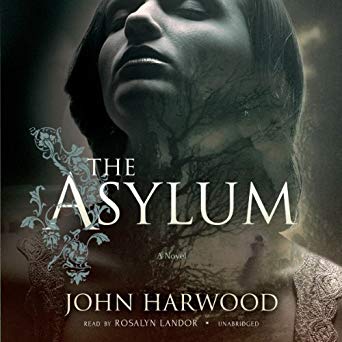
The Asylum by John Harwood (audio)

This is a Victorian gothic mystery/psych thriller, and how it ended up in my iPod is another mystery which I cannot explain. I hit ‘play’ on it on a whim, and listened to the tracks from disc 1 and then there were no more. I was involved enough that I then went and paid for the audiobook (which I never do), and now I’m left unsatisfied with my purchase.

Georgina Ferrars wakes up in an asylum (a madhouse, she surmises, although the doctor in charge demurs at the term), with no memory of the past several weeks. She’s told she checked in under the name Lucy Ashton; her L.A.-monogrammed valise supports that claim. When Dr. Straker telegrams her uncle, the reply comes immediately: Georgina Ferrars is here at home. Your patient is an imposter.

It’s an engaging enough opening, and what unfolds from here continues to intrigue. It seems Miss Ferrars has a double, a new friend (or long-lost something-or-other?) named Lucia Ardent (note the initials), and the two look just alike. The question now is which is whom? Miss Ferrars is missing her two prized possessions: a dragonfly brooch that was a gift from her father to her mother; and a writing case, with her journal inside. If that journal could only be found, we might learn what happened in the missing weeks…

Solid plot so far, then. I found it a little bit exasperating to listen to the distraught young lady who (how Victorian) is wont to become faint at every shock, but okay, it’s part of the period setting. When the diary is located, we start learning more about the Ferrars/Ardent/Ashton history; here connections and plot lines get increasingly twisted, and I’m afraid Harwood got his threads a little entangled. There is a major reveal that just did not follow for me – I didn’t see how we made the logical leap – and, because I was listening to the audiobook while driving, I wonder if it was my fault, if I just missed a crucial moment. But I did go back and re-listen to some parts. And, too, a number of other readers on Goodreads were left confused as well. I’m inclined to think that if a larger portion of your readership missed something, maybe it’s on the writer and not the readers. (I have experienced this as a writer – I put the fact in, but everybody missed it – and even though I put the fact in, if they all missed it, I didn’t do my job properly.)

At any rate, the final third or so of the book – the protracted denouement – was far less compelling, and less believable, than what came before. Our heroine is alternately the fainting Victorian weakly woman, and a surprisingly scrappy, clever one; these quick shifts back and forth and back again did not ring true. The quickly complicating plot threads got too incredible for me. The final action scene, followed by the final proposal and answer, topped out the ridiculousness; it was a major letdown. Oh, and – spoilers in white text here; highlight to read – there’s a lesbian incest thread, for good measure.

Full credit for that first disc’s worth of tracks pulling me in; and more than half the book kept me engaged. After that, I was just hanging on out of increasingly incredulous curiosity about how this silliness would wrap up. Not particularly recommended. As I learned on Goodreads, Harwood has his fans, and some of them loved this book; some would recommend others of his over this one. I won’t be trying him again, but you’re welcome to.


Rating: 6 windows.

Babylon’s Ashes by James S. A. Corey (audio)

The Expanse series: Leviathan Wakes, Caliban’s War, Abaddon’s Gate, Cibola Burn, Nemesis Games, and now book six, Babylon’s Ashes.

I realize I keep going light on plot summary with these books, and I’m going to continue that trend here – you can get synopses elsewhere (as usual, Tor.com does a good job), and I feel pretty strongly that that’s not the point for me, with this series in particular. I’m here for the people. And they are delightfully developed in each episode. This book is delicious in its continuing development of everyone in turn. I feel that we’re consolidating our cast of characters, swelling the ranks of the Rocinante‘s crew to include Bobbie and Clarissa, and keeping up with Fred Johnson, Avasarala, Marco and Filip, and even (in prologue and epilogue) checking in with Anna Volovodov. Michio Pa is back with a still larger role to play; and Praxidike Meng, like Anna, plays a smallish role, but the presence of each of these returning characters would seem to indicate that they’ll have more to contribute in future books.

As the title indicates (and I have to say this is the first time I’ve found the title even glancingly related to the book’s contents!), the world is changing irrevocably; the question now is simply whether humanity will survive the coming years. Naturally, it is only thanks to the Rocinante‘s crew – well, with some help – that they have a chance at all.

I’m a little surprised it took me this long to notice a habit: all the characters in The Expanse consistently push their food away before they’ve finished it. All the foods, it seems, coagulate or degrade quickly into something pasty. (Almost all of these foods are made from a finite list of ingredients, things like mushrooms and yeast, and they tend to get gummy.) Sometimes it’s because something sad or bad happens and the character is suddenly no longer hungry. But whatever the reason, I’m not sure I’ve seen a character finish a meal yet – I typed, before getting to the epilogue, where Anna’s daughter Nami remarkably does so. Still, there’s a pattern. They’re always pushing the bowl away or putting it in the recycler. Funny what we notice. Funny the habits of a writer (or in this case, writers): the Corey team seems unable to let our folks eat to satiation.

Also, whoever it was that said that all science fiction is really set in the present (my buddy CT thinks it was Ursula Le Guin) was not wrong. This series’s new world is different in many of its details – including some pretty basic building blocks of life, like food, and travel, and the air we breathe – but all that is just so much window dressing, when it comes down to it. The essential problems in this world are the same old ones: how humans get along with each other. Power grabbing, greed, the needs of the disenfranchised to eat and breathe up against the “needs” of some selfish jerk or another to control everything. Racism now follows what part of the solar system a person comes from; ethnicity seems to be a non-issue, but really the discrimination has just shifted its focus. I deeply appreciate this new lens on an old problem: when I say that this is just the same story set in a different world, or that its details are window dressing, I don’t mean to be dismissive. I think it’s extraordinary. And sometimes we need new backdrops to recognize old problems in a fresh new way. If certain problem presidents were in a book club, maybe they could read this series; I don’t know.

Deep, complex characters, entertaining dialog (Corey is back on their stride after some hiccups), a racing plot, and the big questions about capital-H Humanity: I love this stuff as much as ever. You can expect more reviews to follow. Hooray!


Rating: 8 rocks.

The Darwin Affair by Tim Mason

Playwright Tim Mason’s first adult novel, a rousing mystery set in Victorian England, has it all: thrills, engrossing characters, taut pacing and historical interest.


Playwright Tim Mason’s first adult novel, The Darwin Affair, is a rousing mystery set in Victorian England. In 1859, the publication of Charles Darwin’s On the Origin of Species poses a menace to the powers that be, and some of society’s upper echelon want him squelched. Amid the conspiracy lurks a tall, shadowy man with deep-set eyes; death seems to follow wherever he goes. The dogged Chief Detective Inspector Charles Field is on the case, although his findings are not necessarily welcomed by all. Field tracks his suspect from meat market to tavern to the royal court, from England to Germany, and even to the high-profile Wilberforce-Huxley debate on evolution at Oxford. Scenes of crashing action and adventure include a racing carriage on a collision course with a speeding train. With cameos by Charles Darwin, Charles Dickens, Karl Marx and a variation on Typhoid Mary rounding out the peripheral cast, this is a wild tale that engulfs the reader from start to finish.

Satisfyingly plot-driven, then, The Darwin Affair also offers very engaging characters: approachable Albert, Prince Consort; Queen Victoria, haughty but not humorless; a comic Marx; and a gracious, gentle Darwin.

But Mason’s less famous hero definitely steals the show. Field has difficulties with authority that will be familiar to fans of contemporary fictional detectives like Harry Bosch and Dave Robicheaux. Mason’s playwriting skills are evident in realistic dialogue and well-constructed, easily envisioned scenes. Readers of historical fiction, murder mysteries, action/adventure and thrillers will be equally entertained and perhaps edified: beneath the excitement lie thought-provoking questions about class and order, the interplay of science and religion and intellectual curiosity. The Darwin Affair has it all: thrills, engrossing characters, taut pacing and historical interest.


This review originally ran in the June 21, 2019 issue of Shelf Awareness for Readers. To subscribe, click here, and you’ll receive two issues per week of book reviews and other bookish news.


Rating: 7 monkeys.