This interview was published by Shelf Awareness here in an abridged format due to space constraints. This is the full interview.
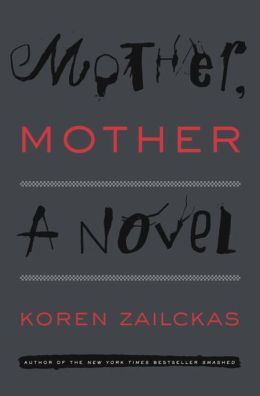
Following Monday’s review of Mother, Mother, then, here’s the lovely Koren Zailckas!
Koren Zailckas: On Mothers
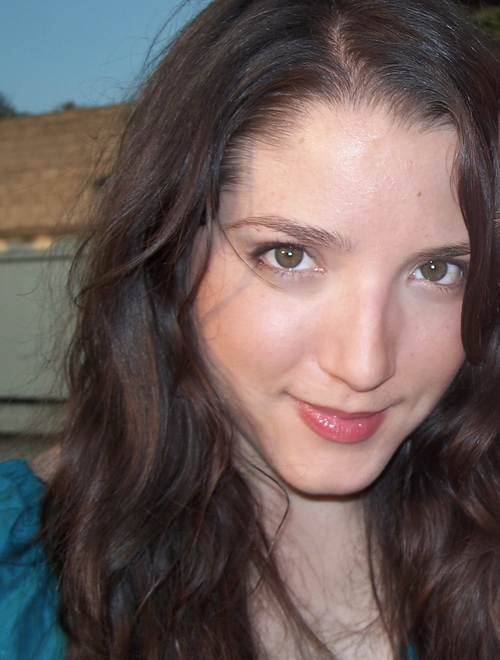
Koren Zailckas is the author of two memoirs, Smashed and Fury, and lives in New York’s Hudson Valley with her husband and three children. Mother, Mother is her first novel. She recently tweeted: “33 with 3 books and 3 kids. #birthdaysymmetry.”
Where did you get the idea for this distressing mother figure?
 I really wanted to challenge the cultural assumption that all mothers are inherently selfless. We’re living in an era of baby-bump obsession, in a don’t-speak-badly-of-your-momma culture. Read an Angelina Jolie profile or watch TLC and you’d think women enter delivery rooms as laboring heffalumps and exit as Battista Salvi’s Madonna and Child. But the word “mother” isn’t synonymous with Mother Theresa, and having a child doesn’t make a woman a mom any more than owning a paintbrush makes her Frida Kahlo.
This idea that all mothers are naturally patient, forgiving and self-sacrificing isn’t just sappy-sweet, it’s callous. It’s dangerous. It discounts experiences by those of us who were raised by women whose genetics and early life traumas permanently altered their brains and made them incapable of empathy.
Here’s the sick truth: Some mothers aren’t naturals. I’d always suspected that as a kid, but I learned it for certain when I moved from Brooklyn to the Catskills. Last lambing season, I was in a New Paltz knitting supply shop, surrounded by beautiful, hand-dyed yarn, when the farmer clomped inside in rubber overalls and announced her sad morning. “The ewes gave birth last night,” she said, darkly. “And two of them just weren’t naturals. They left their newborns to freeze to death on the side of the barn.” Some mothers, no matter how well intentioned, just can’t see their kids as anything other than tools, hindrances or extensions of themselves. Other mothers can’t consider their children at all.
Mother, Mother’s Josephine Hurst isn’t just a critical or controlling mom. She’s a narcissistic mother, and she’s in good company. Loads of women–one out of ten Americans, according to new studies–have Narcissistic Personality Disorder, which many shrinks consider untreatable. Medication rarely helps. Therapy doesn’t do much either.
I hope Josephine will give shivers of recognition to anyone out who grew up with a narcissistic mother. I hope those readers will recognize her neediness, her manipulative nature, her grandiose sense of self-importance, her tendency to play favorites between her children and pit her family against one another, and I hope they seek some small comfort in it. Maybe that sounds crazy, but I really mean it. I hope Josephine puts a name–NPD–to longstanding patterns of maternal chaos. I hope some readers have a light-bulb “this is a syndrome!” moment. (You see: also in the narcissistic mother’s repertoire is “gaslighting.” They’re great at making their victims doubt themselves and question what’s real.)
As for those lucky folks who grew up with the mother of Mother’s Day Cards, I hope Mother, Mother gives them at least a glimmer of the fear that resides in the hearts of kids like Will Hurst. As humans, we are born utterly helpless–dependent on our mothers much longer than any other species on Earth. If mothers are our first teachers, then having a narcissistic mother teaches you that the world is a fucking terrifying place, where the rules change constantly and punishment is the only constant.
You wrote two memoirs before this novel. Was this your first try at fiction?
Yep, this was my first attempt at fiction. Mother, Mother brought me back to Smashed in that way. Smashed was my first prose. Before that, I’d only poetry and interoffice memos.
And how was it different?
 Fiction required a lot more restraint than memoir. By design, memoir is an exercise in over-sharing. You’re giving the reader way too much information to begin with, confiding things you wouldn’t tell to just the casual stranger while you’re waiting side-by-side for a bus: “Warm today, isn’t it?… Let me tell you about that time I staggered, drunk, lost and naked down the halls of a fraternity.” You wouldn’t do that. No emotionally healthy person would do that.
I think I gravitated to memoir because I had my fair share of damage. I grew up in a family a lot like the Hursts, where you weren’t allowed to express emotion, speak openly, talk about why your mom is a radically different person in public, talk about why Dad lives in another state for weeks and months at a time. You bottle all that stuff up over a long period of time and it eventually just explodes all over some poor, unsuspecting victim, no matter who they are, no matter how briefly you’ve happened to know them. I think, to begin with, I wrote Smashed and Fury because I was suffering from what Zbignew Herbert called “suffocation from formlessness.” I was smothering under the weight of all the memories I hadn’t put into words. When I was finally ready to name those experiences (addiction, anger over ongoing family dysfunction) the stories came out, fast, in reams.
In my memoirs, I’ve always tried to best to be as self-aware as I can. To own my shadows. To be ten-times harder on myself than I am on anyone else in the story. But no matter how you slice it, it’s still exhibitionistic. It’s still a bit like being a trench-coat flasher: “Here I am, all at once! Here are my stories! I know they’re flabby in some parts, but I can’t change them–they’re real!”
Maybe the cheap analogy would be: fiction feels like a strip tease. But it’s more than that. Fiction feels like real intimacy. Especially when it comes to psychological thrillers, suspense stuff. You reveal things slowly to the reader, over the course of your time together. Not every character has to be hyper self-aware all the time, owning every character flaw, aware of their deeper motivations. You can gently fold in a hint, here and there. Teaspoon of backstory. Foreshadowing, to taste.
I still find that really difficult from time to time. My husband’s pet name for me is “Spoiler Alert.” He always tells me I say way too much when I’m making movie or book recommendations. My brother-in-law will never forgive me for ruining the grand finale of The Sopranos for him.
I might well have told you how the Hursts end up in Mother, Mother’s first chapter were it not for my long-suffering editor. She probably has carpal tunnel from all the times she went back to the manuscript to slash out obvious clues.
Did you do research into Asperger’s syndrome in order to get it exactly as right as you got it? Did any other aspects of this novel require research?
I did a little bit of research. But mostly, I manifested Will’s Aspergers in a way I could relate to.
Will’s intense focus, his “Aspie interest,” is language. He’s like a collector of rare and precious objects, and in this case, those objects are unusual and arcane words. Autotonsorialist: one who cuts their own hair. Misodoctakleidist: someone who hates practicing piano. Awkwardness ensues whenever Will uses them in spoken conversation, but he just can’t help himself. He’s addicted.
Over the course of Mother, Mother, I think Will’s relationship to language changes. Words stop being a mode of connection. Instead, they become more like trophies, accolades. He trots them out to impress, intimidate or prove his worth. It’s a really narcissistic use of language. It worsens Will’s social functioning, heightens his loneliness and drives him deeper inside himself.
Aspergers? Maybe. The side effect of a dysfunctional family? Possibly. Or maybe, for Will, it really is a burgeoning writer thing. As a writer, you spend so much time alone, trying to think of funny and fresh ways to describe every day things. Then, when it’s time to go out into public, you forget that you don’t have to agonize over word choices. When you’re chatting about weather with your neighbors at the farm stand, you can just say, “It’s pouring.” People look at you funny when you go all Du Maurier and say, “Can you believe this lashing, pitiless rain?”
Two of your main characters share similar experiences but head in very different directions towards the end. Did they always go that way, or did you have to go along for the ride to learn the fates of your characters?
I think I knew from the first word that Violet and Will had very divergent ideas about their family. Any therapist will tell you, siblings can be raised by the exact same people and still have totally different mothers and fathers.
This is especially true in narcissistic families, where the narcissist picks one kid to be the golden child (the person who earns added prestige for the narcissist) and another to be the scapegoat (the person the narcissist projects her own negative self-image onto).
In the Hurst’s case, I think Will is quite genuine in his confusion over his sister. He doesn’t have any clue why Violet’s so angry. Her drug use, her rebelliousness… It seems really irrational to him, especially with his mother right there in his ear, telling him, “Your sister’s crazy.”
And for her part, Violet doesn’t understand why Will is so fearful and reserved. He seems to have his mother’s unconditional approval. Josephine’s love seems to come so naturally to him.
With that dynamic in place, I think I did go along for the ride. When I began, I didn’t quite know what would happen to Will or Violet.
Will, in particular, shocked the hell out of me. It was kind of thrilling to watch him unfold. Especially because he’s at this very pivotal year. He’s twelve when the book begins and really on the brink of adolescence. A transformation happens. One I never saw coming.
Transformations fascinate me, especially where psychology is concerned. That’s what everyone who’s hooked on psychology wants to know: How does change occur? How do good people turn evil? Or, how do kids grow up?
Can you tell me how there came to be humor in such a very dark book? How would you characterize your style of humor?
I suppose I’ve always had a touch of gallows humor. That self-lacerating, inverted kind. Also, a bit of that bone-dry, stuff-your-feelings, British humor too. (Maybe that’s why I married an Englishman.) Also factor in a little bit of defeatist attitude. I’ve always related to that George Bernard Shaw quote: “If you can’t get rid of the family skeleton, you might as well make it dance.”
I’m glad you think this book is funny. I think it’s really important for dark, scary books to be funny. Every few pages, I really wanted there to be at least a restorative chuckle, something to lighten the mood from jet-black to slate.
I think the biggest laughs in life are usually tinged with relief. They’re a kind of collective, hissing sigh: “Wheew, look at us, joking about this really delicate, uncomfortable, offensive topic! We’re really skating on thin ice here, aren’t we? But it’s fun! Hold my hand. Did that sound like a crack?”
Some of the creepiest ladies in the history of literature are also the funniest. Shirley Jackson is fucking hilarious. I wish she were still around today, if not only so her mommy-memoirs could be optioned for a self-starring reality show. Take Life Among the Savages… Beginning each morning with the very real fear that you will slip on a Matchbox car or doll’s broken arm and break your neck on the stairs is morbidly priceless.
In my experience, once you become a mother everything is doubly terrifying and laughable. It only seems natural to mix the two together. (Although, that could just be the sleep deprivation talking.)
The dual first-person perspectives are very unsettling (in a good way). How did you choose that format?
I think sheer panic drove me to tell the story from two perspectives. When I first started thinking about fiction, many years ago, I told Crown’s Molly Stern, “I’m going to write a first-person, one-perspective novel.” Just like that. All fresh-faced bravado. Molly wasn’t discouraging, but she reminded me just how tricky that is. It’s hard to keep the plot constantly pounding when you have just one protagonist.
Initially, with Mother, Mother, I thought (quite cowardly) that I’d hedge my bets between Will and Violet. I thought: double the characters, double the action. Never a dull moment. From there, it became a much more strategic, much more about how “family,” as a concept, is a bit like “car crash.” Everyone experiences it from a different perspective. So why not let the reader get two points of view on the Hursts?
Since you came from writing memoirs, I wonder how present you are in Mother, Mother. Did you have to fight putting yourself in this book, or was it a relief?
I think there are snippets of myself and my childhood all over this book. That said, the Hursts are a prime example of writing what you know, then taking it to a level that is psycho-extreme.
For instance, I always felt like my mom was a little possessive of me when I was a kid, and I tried to go to friend’s houses as opposed to bringing them home to mine, where my mom talked down to them and slated them behind their backs. I was in my thirties when I got a Facebook message from a woman I used to play with when I was seven. “I was sooo afraid of your mom!” She wrote. “She used to call us brats and hooligans. We were only allowed one juice box no matter how thirsty we were!” I think I sort of exorcised some of that in Mother, Mother, and took it to a scarier extreme. I mean, Josephine homeschools Will because she’s so keen to have him to herself.
I’ve been reading Eric Booth’s The Everyday Work of Art, and he has a great line about how the word “art” in its infancy was a word that meant “to put things together.” And the process of writing Mother, Mother really felt like that. Marrying personal experience to the psychological profile of narcissistic mothers. Piecing together recurring nightmares with irrational fears, Frankenstein-ing in ordinary scenes from a modern, American, family life.
You know, it was a relief. I feel like doctors should prescribe thriller-writing to anyone with anxiety or PTSD. You get to be in charge of your fear. And of course, you get to change the outcome. In real-life dysfunctional families, roles shift, but there’s not much change.
What have you read and loved lately?
This is really the golden age of women’s psychological fiction, and for the past few years I’ve been gobbling up everything by Tana French, Gillian Flynn, Laura Lippman, Megan Abbott, Kelly Braffet. It’s just too exciting to look away.
That said, I have three children under four, so I’ve also have Mo Willems on heavy rotation. That’s my life at the moment: Murder and The Pigeon Finds a Hot Dog.
Don’t you just love how very funny she is? Thanks, Koren, for taking the time to share so much with us. I certainly enjoyed it!
This interview originally ran on June 26, 2013 as a Shelf Awareness special issue. To subscribe, click here, and you’ll receive two issues per week of book reviews and other bookish fun!
Filed under: interviews | Tagged: Maximum Shelf, psych drama, Shelf Awareness, thriller | Leave a comment »













 pagesofjulia