NBC’s The Wiz Live! (2015)

I missed round one, but got to see NBC’s encore showing of the remake of The Wiz, a 1974 retelling in turn of The Wonderful Wizard of Oz, set in an urban and African-American cultural context. It has been much talked about and enjoyed, and I’d heard a little bit about Shanice Williams, who plays Dorothy: she’s just 19 and has never been involved in anything this big before, which is its own underdog story. And who doesn’t love that story?

wiz

First, let me admit that I am unfamiliar with the 1974 show (though pretty familiar with the 1900 original), so I can make no comparisons there. I approached this as a happily enjoyable, entertaining remake on a well-loved classic, with a twist, and with a young new star. It was all of those things. There were some changes made for the stage – like, Toto is only present in the opening and closing scenes, in Kansas, and doesn’t make it to Oz. I guess it was too hard to get a dog’s cooperation for the whole. The journey from the house-dropping scene in Munchkinland to the Emerald City was much compressed, and I was sorry about that. The magical slippers are returned to silver, which is how L. Frank Baum wrote them, rather than Hollywood’s red. There was a new mini-storyline, wherein Dorothy is actually from Omaha, only recently living with Aunt Em after her parents’ deaths. Thus, in her searching for home she has to parse which of these places really is home, which I thought was a nice addition for depth, and which I identified with personally, too. The original story is very much about a concept of home, but even more complexly so in this rendition. I approve. Oh, and of course: the Wiz is a woman this time around! “His” false public character is still male, but the ballooned-in accident from Omaha is female. I found this a welcome twist.

Overall it was far from a flawed performance, though. There were some rough spots: imperfect synchronization of effects, the Wiz tripping on “his” robe. Though star-studded, the acting was a little uneven. I thought the Tin Man (Ne-Yo) was genius; the Lion (David Allen Grier) was a little underplayed, a little blank. The Scarecrow (Elijah Kelley) actually became a little unlikeable to me, as a character, for the first time ever. Queen Latifah as the Wiz was a great casting idea, but fell a little short: it felt like the songs she had to sing were a little below her usual register, and she didn’t get to belt out like we know she can do so well. Once she stepped out of her Wiz costume, though, and became the woman behind the mask, she hit just the right notes – in portraying her character, that is. I did appreciate Stephanie Mills as Aunt Em – and also appreciated the nod to her role as the original Dorothy in 1974. Shanice Williams herself is beyond complaint, though. I found her engaging and heartfelt, fully committed to song, dance and acting.

As a filmed stage production, I found The Wiz thoroughly disappointing, but that’s because National Theatre Live has got me so spoiled. The work NT Live does is unparalleled excellence: I actually remember myself as being at those shows, rather than in a movie theatre. The camera angle changes: it shows the whole stage (including the front edge, so we can see it’s a stage), different parts in medium-close-up, and close-up angles on individual characters. We see all the set changes (no commercials), so we get the feeling for a real, live stage show. The Wiz clearly took a very different approach. We saw no stage settings (commercial breaks!), and the angle never cut so widely as to give a feeling for the stage itself. For that matter, NT Live shows shots of the audience before and after the show and during intermission, so that I feel like I’m with that crowd in London (or wherever). It remains unclear to me whether there was an audience present for The Wiz. And if not, what a shame for the players. Filming of a stage show is clearly not NBC’s strong suit here.

Uneven performances (but some of them were stellar!), some very fine singing and a classically loveable story make for a pleasing experience, if you didn’t expect too much coming in.


Rating: 7 winged warriors.

National Theatre Live presents Jane Eyre (2015)

Pops suggested this stage production of Jane Eyre to me, and I confess that I was at first hesitant. Jane Eyre is not among my favorite novels. Perhaps in juxtaposition to Wuthering Heights, I at some point developed some rather negative feelings about it. (Recall my discussion with Erin Blakemore, here.) But it was an intriguing concept, this adaptation to the stage; and I have been nothing but impressed with past National Theatre Live performances (Treasure Island; A View From the Bridge). So we went.

The Lincoln Theatre in Mount Vernon (a town about 30 minutes south of where I live now) is always a treat, and we found a tiny hole-in-the-wall Thai place beforehand that was worthwhile, too. And I had rearranged my mindset by the time we got there. It has been years since I read Jane Eyre. And I love the stage. This will be great, I thought. Of course it was!

JaneEyre

As we have seen at past NT Live shows, the set design was innovative and well done: so extraordinarily simple, just a few platforms and levels of planking, with lots of stairs and ladders throughout, so that the players create the impression of distance covered by sort of doing laps. And because there was no decor, any space could be anyplace at all. Same with the actors: I believe it was a crew of about six who played every character in the story, by simple costume changes and adjustments in accent and attitude; we never had trouble following along. Another less-is-more approach, which is always a clear winner with me. I think I’m done with elaborate costuming and set design. (She says, until the next beautifully elaborate production comes along.)

I was taken with the way they put together this adaptation, too. The company did it cooperatively, through improvisation: they all read the book, got up and freestyled. There’s a great clip, Devising Jane Eyre – and you get a glimpse of some of the actors there. (Then check out the trailer.) It’s a stripped-down version this way, purified if you will. This is not the Jane Eyre I remember. I remember Jane Eyre being a rational, thinking woman’s novel, almost austere, where Wuthering Heights was all passion; but this play was steeped in passion, as well as that groundbreaking feminist thought that we recall Jane for. She still makes (the same) choices of self-deprivation, but they are made with passion. I loved this woman. This company made of Bronte’s work something different – and, for me, better. (I can hear the novel’s fans gasping. They’re just personal reactions, folks.)

The acting was magnificent, and I will say that this version of Rochester was a heartthrob (also something I do not recall from the novel). But all the acting was magnificent. The woman who played Jane’s friend from boarding school, and later played the pastor Rivers who proposes, was perfect in every role; and the woman who played Jane’s mother, then the maid, then Rochester’s girlfriend, was stunning. Even Rochester’s dog, Pilot, is a joy to watch, played by a man (great fun). The communication of Jane’s inner thoughts – always a problem in adapting books to screenplays or stage plays – is solved with pure genius: a group of (I think) 4 actors gather round her, all talking at once, like a Greek chorus inside her head. She dialogues with them. Pops and I were both mesmerized by this inventive and entertaining solution.

Another unique angle we observed was gender- and race-bending (if you will). There were two black actors who fit right into the story without comment or need for explanation; we both liked that introduction, a modernization if you will, since historically Jane Eyre’s mother was decidedly not black; but we were happy to see it fit right in. And during Jane’s stay as a student at Lowood Institution, a boarding school for girls, all the same actors played her classmates – including two men, one of them bearded. But we understood: in this scene, these are all little girls. I think we were both tickled by these new angles, and happy to play along.

The cues used to switch us from Jane as newborn baby, to Jane as young girl, to teacher, to governess, to bride, etc. were simple but effective. She never left the stage, I don’t think, in the whole performance; she made tiny costume changes onstage, not hidden but as part of the action. Her Greek chorus helped her changed into her wedding dress and then back again into the costume of her lower social standing, and this was a symbolic and important part of the story. I liked this new way of signalling changes in time, place and action. Again, minimalist but effective.

The stark simplicity of stage and costuming, and even in the number of actors involved, and the distillation of the novel to its most powerful, moving, and passionate elements, was supremely successful. I regret my hesitation: I will see anything produced by National Theatre Live. And on that note, let me point out that all those fine folks in the Bristol audience paid a lot more money than I did to see this play in person; but I got close-up shots and all the right angles. The invisible element to the National Theatre Live format is cinematography. They claim, and it is true, that each of us at the Lincoln Theatre in Mount Vernon, Washington had the best seat in the house. What a deal.

And now the question of whether to reread. When I try a beer again after years, that I used to love, and I no longer like it: have my tastes changed, or my very taste buds; or have they changed the recipe on the beer? When your professionally-fit bicycle no longer feels right, has the bike changed? No, your body has aged. I wonder if I would appreciate the novel more today because of my age, maturity, life experience then I did when I was… I think I read this as a teen and again in my early twenties. Or is it just this production that worked so well for me? What do you think?

Not in question is my rating of this theatre experience. Go find yourself some NT Live: it’s worth it.


Rating: 10 fires burning brightly.

iDiOM Theater presents Clown Bar

I had a romping and hilarious good time seeing the iDiOM Theater’s production of Clown Bar with my Husband and parents. This was my first time at the iDiOM Theater, a tiny, intimate place with just three rows of seats in my section, which allows or necessitates that the players use the audience as part of their stage: awesome.

photo from the Herald

photo from the Herald: click to enlarge

Clown Bar is a work of clown noir, in which a man named Happy – who retired from the funny business to go straight and become a cop – is forced to go back down into the seedy clown underworld to search for his brother’s killer. The play takes place in Clown Bar, a business run by the sinister BoBo. Other literally colorful characters include Petunia (who sidelines as a sex worker), Shotgun (whose name references two meanings of the word), helpful Twinkles, straight-faced Giggles, the terrifying Popo, and of course the unforgettable Blinky Fatale. Also the unfortunately unfunny character Timmy (actually very funny as played), the murdered brother, who we meet in flashback scenes. This is not a play for the whole family: drugs, violence, sexual content including a thoroughly effective burlesque scene (wow!) make for adult entertainment, thank you very much.

I thought this was wonderful stuff. The story is engaging, and I love how it was played: the characters mostly face the audience, making eye contact and interacting with us in lively fashion even as they address one another. They really used the intimate setting. The clown frame was explored not just in fun costumes – although absolutely those – but with mannerisms and theme music. (The music was central, and because this is a small town, we recognized our electrician’s assistant playing the bass.) I jumped off my seat a few times in alarm during this dark and murderous show; but more often I laughed out loud at the antics. Husband and I discussed our favorite characters: I listed pretty much all of them, though, so that is unhelpful.

I commented to Grammy just the other week, when we saw In Your Arms in San Diego, that living in a smaller town means seeing events that are often less polished, less professional Broadway-level work than you see in Houston (or San Diego). And I confess that it was impressive to see In Your Arms, one of those top-level professionally produced plays. But the fact is I really enjoy community-level theatre a great deal, too. Even without the tiny theatre that lets you actually touch the actors, it feels more intimate to see your talented neighbors engaged in a passion that is so entertaining to watch. And I want to be clear: this was not messy amateur work; this was absolutely talented acting, in every role in this play. The fact that it was born closer to home just made it all the more enjoyable to me.

iDiOM Theater has got the goods. I’ll be back. And Clown Bar is worth the time if you can track it down.


Rating: 8 mixed drinks.

The Old Globe presents In Your Arms

I was so lucky last week to get to accompany my Grammy to this outstanding theatre production, which is a little hard to describe, but of course I’ll try.

photo by Buck Lewis, courtesy of New York Stage and Film & Vassar's Powerhouse Theater

photo by Buck Lewis, courtesy of New York Stage and Film & Vassar’s Powerhouse Theater

In Your Arms is a dance-musical production with very little dialog. It is a series of shorts, mostly unconnected, but with a theme of romantic relationships. These vignettes range through time and geography, sometimes implied and sometimes explicit, as with “The Lover’s Jacket,” in which dates and locations (Spain in 1939 and Argentina in, I’m pretty sure, 1940) are projected against the wall. This is one of the finest and most communicative pieces of nonverbal storytelling throughout the whole, although all of them were impressively clear in their messages and emotions despite being mostly wordless. Details might be blurred, of course, but the feeling and action of each piece was perfectly plain.

The exception was Carrie Fisher’s contribution, “Lowdown Messy Shame,” which is voice-overed by Fisher as she is seated off to one side at a typewriter, composing the action we see played out across the stage. The players act out Fisher’s imaginings but also comment upon them, in a cute innovation. One review found this one overly wordy – and indeed it was almost the only spoken theatre of the evening – but I enjoyed it as much as any other, despite its differences. (“The Dance Contest” also uses some voiceover.)

As I said, these shorts had a shared theme, but remained distinct. I loved the survey over time, space and culture. And then they are tied together by opening and closing pieces featuring a singer expressing nostalgia for loves past. Here I agree with the Union-Tribune (link above) that less song would have been fine; but I think these scenes served well nonetheless to emphasize the loose links between all the pieces. Overall, this nearly-wordless hour-and-forty-five-minutes of music, dance and theatre was profoundly emotional and moving, over a wide range of topics but centered around affairs of the heart. I was deeply impressed; it’s the best thing I’ve seen in a long time.

I was further pleased by stage settings and costume. No set stands out in my memory as being particularly complex or elaborate, but each was distinct and evocative, and the transitions were smooth and easy; I love seeing a change of just one or two elements transform a stage and introduce a new setting with perfect clarity. I think that kind of subtle-but-clear set design is more impressive than elaborately complete stage dressings. A unique element here, too, was the use of shadow and projection throughout; the time-and-place cues in “The Lover’s Jacket” were projected on the screen, and shadows were a major feature in “A Wedding Dance,” while projected home movies were central to “Life Long Love.” The costumes were great fun, too, and well designed for showcasing the dance as well as helping to tell the story. I liked the protagonist’s costume in “Life Long Love” for what it emphasized and revealed, while also looking demure at the appropriate moments.

I do want to say briefly that I wasn’t sure about the racial tones in “A Wedding Dance”, which tells the story of an African couple’s immigration or… kidnapping? I don’t have enough information to be certain whether this was a well-told realistic story, or an ugly appropriation of stereotypes. Likewise “White Snake,” which tells the story of a white businessman who reads comic books and fantasizes about his Asian assistant. It was a great piece of theatre and movement, combining dance and martial arts and a lovely representation of the blurry line between fantasy and reality. But I wasn’t sure how much fun we should be having with certain stereotypes there, as well. I haven’t worked out what’s okay here, in part because of the lack of details in wordless theatre. Just something I wanted to note. On the other hand, the same-sex couple in “Artists and Models, 1929” was represented with sensitivity and realism and I found them delightful. I want to say that this was one of my favorite pieces, but gosh, I want to say that about nearly all of them.

Finally, I must note that this event took me back to San Diego’s Old Globe theatre, where I saw what I’m pretty sure was my first Shakespeare production, in 1992, when I was 10 years old. The theatre and surrounding park still felt familiar, and it was such a treat to be there again with my Grammy, thoroughly aside from the quality of the show.

If you have a chance, definitely make a point to see In Your Arms. It was a rare treat for me. There are rumors it might be Broadway-bound, so maybe a larger audience will get an opportunity at it.

Thanks, Grammy, this was so special.


Rating: 9 memories.

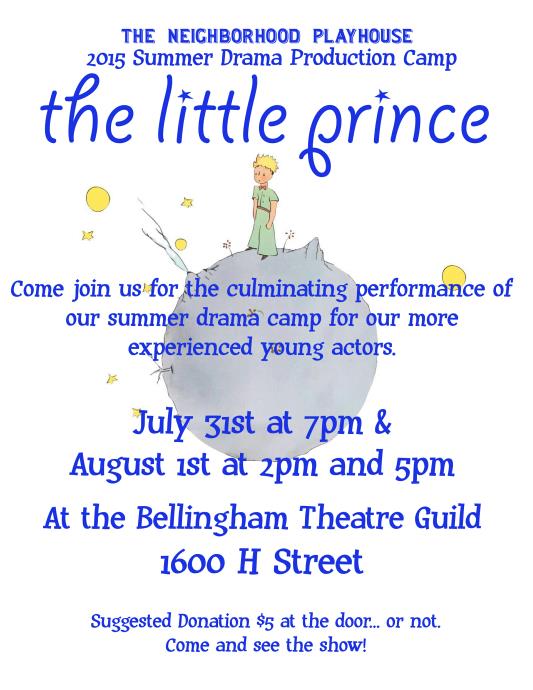
The Neighborhood Playhouse presents The Little Prince

little princeThe Little Prince is a magical tale, and I was immediately sold on the idea of a local production, performed by young people no less. The Neighborhood Playhouse Summer Drama Camp culminated in this production after less than two weeks; the ability of these teens to stand up with confidence and memorized lines after such brief prep is impressive enough, even if the play hadn’t been beautifully and feelingly done, which it was. Wow.

This was a musical production, and as I said about The Drowsy Chaperone, there were moments of less than perfect polish: these actors (whether youth or adult) are not professionals. But that’s okay! In fact, like when I go to watch college or adult-league sports, it’s part of the charm: I can see that these are “just” real people, like me, pursuing a passion. And I’m not criticizing. The level of performance here was very high – just not Broadway.

There were several very strong singers up there, especially the young lady who played the flower, but they all played their parts well. I felt the magic of St. Exupery’s original work, as these young actors communicated all the emotion of the pilot – his frustration, his regrets – and the prince, whose innocence is part of his appeal. I felt happy and lucky to be in the small audience. Thank you, Neighborhood Playhouse, and to the kids: bravo.


Rating: 7 snakebites.

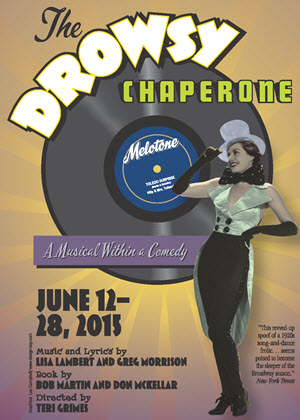
Bellingham Theatre Guild presents The Drowsy Chaperone

drowsyOn a rainy night, with a sprained ankle, I set out on my bicycle with Pops to see a local amateur production at a neighborhood theatre. In a word, the production was indeed amateur (which is to say, unpolished), but heartfelt and charming; and the play borders on too silly but was ultimately fun.

The narrator is a middle-aged, socially awkward man, sitting in the darkness of his apartment and dreaming about another world. He speaks directly to the audience about the strengths and downfalls of musical theatre, and puts on a record, the soundtrack to a musical of the 1920’s called The Drowsy Chaperone. The action comes to life in his living room, as the original cast performs the play, interrupted by our host’s interjected comments on the show.

The musical is your standard comedy of errors, involving a wedding that not everyone is supportive of, and includes mistaken identities and the beginnings of new romances. It was pretty cheesy, particularly in its song and dance (even more so than your standard musical!), although the tap dancing was a great addition. But as the story developed, I was more tuned in to the pathos of the narrator and more on board with the general silliness of the show-within-the-show. So while it started a little questionably, by the end I had let myself go into the world of the theatre, and it was rewarding. The performances were less than perfect, but again, this is local, amateur, community theatre: adjust your expectations a little, and be prepared for a good time. I left feeling uplifted by the fun, and will be looking for more Bellingham Theatre Guild performances in the future. Thanks, neighbors.


Rating: 6 gimlets.

Brian Doyle at Chuckanut Radio Hour

You will of course remember my glowing review of Brian Doyle’s most recent novel, Martin Marten, which remains the best book of 2015 to date (and may well make it through: I rarely award more than one *10* in a year). The same week that that review published over at Shelf Awareness (and my teaser posted here), he came to my little city to speak at a local event, the Chuckanut Radio Hour.

The Chuckanut Radio Hour is edited and aired on local radio a few times afters its live production, and it costs $5 per person (plus fees, naturally) to be part of that live audience. My parents and I went to see this edition, because Brian Doyle! I hadn’t been before (my parents had). The show describes itself as

…a radio variety show that began in January 2007. Each Chuckanut Radio Hour features a guest author and includes guest musicians, performance poet Kevin Murphy, Cascadia Weekly columnist Alan Rhodes, an episode of “The Bellingham Bean” serial radio comedy, and some groaner jokes by hosts Chuck & Dee Robinson and announcer Rich Donnelly.

(Chuck and Dee are the owners of Village Books, our local top-shelf independent bookstore.) I have wholesale stolen that quotation because it’s quite accurate, although in this edition we missed Alan Rhodes and instead took an extra musical number by guest artists 3-Oh. The band was good, and funny, with covers and originals; the spoken-word/poetry was good; “The Bellingham Bean” was quite funny (and guest-starred the versatile Brian Doyle to boot). The hosts’ jokes were, yes, groaners. But of course we were there for the author. Brian Doyle turns out to be a falling-down fine comedian in his own right, who knew? Also a very good storyteller, although that is less surprising. He didn’t really need an interviewer – just a microphone and a stage, and free rein. He monologues quite cheerfully, energetically, happily, and oh so funnily. He then continued this performance after the show was wrapped up, as we lined up to get our books signed (did I cheat by having him sign my galley?) and talk with him: the line was long because Doyle was so generous with his time and attentions, and I am grateful.

That’s two very good author-talk experiences in a row. If you get a chance to see Brian Doyle live, do! And for now, go get yourself a copy of the new Martin Marten: it’s outstanding and unique. And join me in investigating his earlier work, too, which includes two novels (The Plover and Mink River) as well as a bunch of essays. Here’s to local theatre etc.!

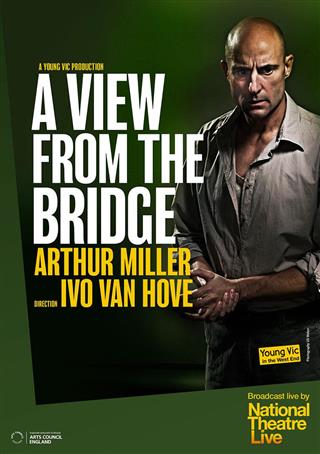
National Theatre Live presents A View From the Bridge (2015)

I recently reviewed A View From the Bridge in preparation for this performance, which like Treasure Island was performed onstage in London, recorded, and then screened at the Lincoln Theatre where I saw Romeo and Juliet (whew).

view bridge

It was outstanding, a truly special experience. The screening opened with a short video incorporating interviews with some of the behind-the-scenes folks involved: the director, set designer, and art director, if memory serves; and scenery video of London (where the theatre is) and Amsterdam (where the director lives). My father, who was my date for this show, commented that it made him miss both cities. We learned a little about the theatre, the director, and the concept for this show: to find a way to surprise the audience even with a play that audiences are expected to know fairly well. I shall avoid spoiling both the play and this production, and only say: they surprised me.

This production was mind-blowingly good, and expertly suited to Miller’s original work. They did deviate from his set design tips: there were no furnishings, just a stark white vinyl floor and wall with a floating glass bench wrapped around the three remaining sides. Costumes were nondescript, neutral or earth tones, and there were few costume changes: Katie changed her shirt when she stood up to Eddie and grew up; and the immigrants changed upon their arrival. This ultra-minimalist lack of color, furniture and set decor left just the actors to carry the story, which they did. The acting was unspeakably good. And the cinematography did it justice: I don’t even recall noting cinematic choices in Treasure Island, which mostly held back and provided panoramic views of the stage – a fine choice, since the stage set in that case was so impressive; but here we relied heavily on close-ups, and the framing really caught my eye. Many shots were close-up of actors’ faces, or scenes involving a few people, say, waist-up; these scenes were then framed by the borders of the white stage set, or framed around one or two props (the chair Marco holds aloft, for example). The whole thing was artistically very fine.

Miller’s humor shone through, but most notably the tension, sexual and violent. There was a percussive gong employed in a few scenes, a slow-paced, low, metronome-like sound that ramped up the tension beautifully, like the tick… tock… of a clock in a silent, anxious room. Somebody in the pre-show video (sorry, I can’t recall who) made an excellent analogy about the play itself: he said that it was like we are watching two cars approach each other at high speed, knowing what is going to happen and then… boom. That is a great description of Miller’s work. It is the story of an inescapable tragedy that we all see coming but are powerless to halt. (This is emphasized further by Mr. Alfieri, the lawyer who acts as chorus, and his foreknowledge and sense of foreboding throughout.)

All in all, in my reading and my watching of this play, I’m deeply impressed: with Miller’s original*, and with this production. If you have a way to access National Theatre Live, don’t miss it. This is some of the finest theatre I’ve ever seen.


Rating: 10 pillowcases.

*I slightly misspeak: as it turns out, Miller’s original was a one-act play. The two-act version that we know best today was actual a reworking, according to Wikipedia.

National Theatre Live presents Treasure Island (2015)

The Pickford Film Center regularly offers this format: live-taped broadcasts from the National Theatre in London, of plays performed on the stage there. I was originally skeptical about the concept; would it translate? The answer is yes, and I will be seeking out more.

treasureI was interested because I have fairly recently read (listened to) Robert Louis Stevenson’s Treasure Island. This adaptation for the stage by Bryony Lavery was astoundingly good – on which more to come; this is mostly a rave review – but I don’t know why I’m always so surprised at how much they change from the original. (This is why they call it an ‘adaptation.’ I know the compression/acceleration is necessary, but I’m always taken aback and disappointed. When will I learn?) In this case, most notably from the start: Jim is parented not by his mother but by a grandmother, both of his parents being dead; and Jim starts out as a gender-bending youth, and then becomes clearly a girl. The former, the grandmother for the mother, remains inexplicable to me. She provided some comic relief; maybe the mother from the original, rather a serious, even dour character, was deemed too sober. But I didn’t find the grandmother so much better as to justify making the change.

Jim as a girl, though, was totally amusing and fun, and provided another element. She’s every bit as boyish as the Jim we know and love; it is mainly just a poke at the original, and an inclusion. I dug it. And the gender-bending confusion here and there is good fun. Maybe it’s strange, that the apparently huge change of the protagonist’s sex bothers me less than the substitution of one female relative for another, but there it is.

This format, of stage-on-film? Completely outstanding. I loved that it captured the best of both worlds: the theatricality of the stage with the informality, convenience, and affordability of the big screen. The music & sound effects were great. And the set! My word, this is the finest set I’ve ever seen onstage: the stage itself was round, and the set lifted up from a flat to a multi-story, and also rotated on demand, so that there was no need for darkened figures hurrying to replace scenery while the audience was distracted: they simply turned the stage around, the actors meanwhile performing in our view, and changed what was behind (or took it underground to change it there). Transitions were perfectly seamless, adding to the drama rather than taking away from the momentum of the play, because there was such a sense of movement, of action. I am blown away.

Jim herself, portrayed by Patsy Ferran, was possibly even more astounding than the astounding set. She was delightfully expressive and sort of puckish, and pulled off that gender confusion early on. Lavery’s adaptation keeps Jim as the narrator of the story, so she speaks directly to the audience lots throughout. I loved the emotion and delivery: action, drama, adventure, humor.

As for some complaint about the “feminist twist”: I have to disagree with the Spectator blog. I don’t feel that the play was feminized aside from the change of Jim’s gender; she goes on no feminist tirades; she’s not a particularly feminine girl by any means. It was more of a nod than anything else, and takes nothing away from Stevenson’s original. The tone of that original is unchanged, except in that this version is a little funnier – which has nothing to do with Jim’s nominal gender. If we’re going to take issue with the fact that the play is not precisely the original novel, I think we have bigger beefs than Jim’s gender, frankly: the ending is changed, for example.

This play was even better than the original book, to which it is not completely faithful – for the best.


Rating: 8 apples.

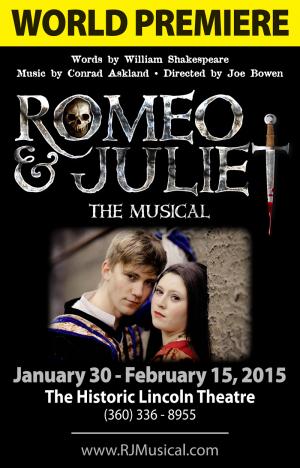
The Lincoln Theatre presents Romeo and Juliet, the musical

lincolnThe Historic Lincoln Theatre in a town near mine advertised a new musical version of Romeo and Juliet, and I needed little convincing. My parents and I drove down for one of the last productions.

The theatre is beautiful, an old movie house with ornately painted walls, a small lobby and an “art bar” in an adjoining alcove. An orchestra was seated at audience level off to one side of the stage. The music was well performed, and as far as design, it was often a benefit to the play, and sometimes not. The group scenes were fun with the addition of song and dance (the choreography was quite good, playing up the bawdy bits). There were definitely times as well when Shakespeare’s script would have been better spoken than sung – the musical format a little bit forced, you know. Especially in his back-and-forth dialog, his repartee, Shakespeare is pretty near perfect on his own, and those lines should have been left alone. So for the music, a mixed score; but honestly, you’d have to do a lot more than this to mess up Shakespeare, so my criticisms are slight and good-natured; it was great fun to see.

A bigger problem was what I’ll call technical difficulties: our seats were in the second row, with the orchestra curling up along one side of us and the players right in front. They had microphones, but the speakers were behind us. The balance between instrumental music and actors’ voices was badly off: we often couldn’t hear what they were saying or singing at all. (Luckily we know the play well, and the acting makes much clear.) At intermission halfway through we moved well back in the theatre, and the sound quality was so drastically improved – quite good now! – that I’m only sorry we waited that long. We partly missed the balcony scene in that first half. Once the sound issues were resolved by our reseating, I have little to nitpick.

The acting was quite good. Mercutio was outstanding; Juliet’s nurse was great fun; and Romeo and Juliet themselves were, as one would hope, the stars of the show. The actors represented a wide age range, which is again as it should be: Juliet was played by a senior in high school, and though Romeo is listed as a college graduate, he felt plenty youthful for his role. Tybalt is a mere child at 14! But a pretty burly 14, and pulled off the impetuosity required. While Juliet was wonderful – and a fine singer, once I could hear her – I admit Romeo was my favorite actor. He was handsome, dreamy-eyed, romantic and passionate; it was just right.

This play (and so much of Shakespeare) stands the test of time. It was written more than 400 years ago, and I’ve seen it repeatedly, but it’s still so fresh and affecting: every time I ache for Romeo to wait just a little bit longer, for Juliet to wake up in time, for Tybalt to listen to Romeo’s pleas, for Mercutio to recover. And although I had considered myself a little too jaded for this, I admit the romance got to me again, and clearly will the next time I see this play performed. It’s just too good. Shakespeare has his audience wrapped up; the romance and the tragedy are every bit as alive in 2015 as when he wrote these lines in the 1590’s.

There is comedy here, too. I don’t know the histories so well and so won’t comment; but even in his tragedies there is bawdy, physical humor or wordplay. Different interpretations can play these lines up more or less; this one inserted a few pelvic thrusts to good comedic effect.

I don’t want to be too harsh on the musical adaptation; it was often fine and only occasionally the merest bit heavy-handed, but the play as presented by talented actors was outrageously fun and moving and I’d see it again. But I’d sit further back.


Rating: 9 vials for Shakespeare, 8 for the production, 7 for sound.