reread: Pieces of White Shell by Terry Tempest Williams

This is one of a few rereads and re-reviews, as I work my way into this semester’s project: my critical essay about the use of material things in Mark Doty’s Still Life with Oysters and Lemons, Terry Tempest Williams’s Pieces of White Shell, and a handful of Scott Russell Sanders’s essays. Original review here.


The importance of this book to me can hardly be overstated, as I’ve read it many times since my childhood. It offers many possible annotation subjects: the dreamy quality of the stories Williams tells; the line between fact and fiction; the liberal use of other writers’ words to compile her own impressions; the interplay between Mormon and Navajo traditions; her study of storytelling as communication and education across generations. But here I am most interested in her use of objects as an organizing principle.

Williams’s chapters are organized by the items she keeps in a leather pouch on her desk at the Utah Museum of Natural History, where she works as museum curator. The prologue opens: “Out of my pouch falls a sprig of sage.” This prologue is different from the rest of the book in that it is set in Williams’s family home and tradition, while the rest of the book stays with the Navajo and her work life. Sage backgrounds her home. Chapter one, “Curator,” presents the pouch. Its first two paragraphs read,

I am a collector. On my desk sits a small leather pouch, weatherbeaten, full of mementos of the desert. I have carried it with me everywhere in Navajoland. It is my link with the Diné, as they call themselves. I am shy. The people are shy. The objects inside give us courage to speak.

I shake the objects out of their pouch and spread them across my desk. What stories they tell: a sprig of sage; rocks, sand, and seeds; turquoise, obsidian, coral; pieces of white shell; yucca; a bouquet of feathers bound by yarn; coyote fur; a bone from Black Mountain; deerskin; wool; a potshard and some corn pollen. Wait–something is missing. I shake the pouch four more times and from the bottom of the bag rolls out the Storyteller, a clay figurine from Jemez.

This list of objects forms the rest of the chapter titles. The prologue is subtitled “A Sprig of Sage,” and the rest following chapter 1, “Curator,” proceed: “Rocks, Sand, and Seeds,” “Turquoise, Obsidian, and Coral,” etc. down the list. “Storyteller” is followed by “Home,” and then an epilogue, acknowledgements, notes, and bibliography. With just a few exceptions, the pouch’s contents neatly form the table of contents. As a writer who has always struggled with titles, this neatness appeals to me.

Within each chapter, the object or objects offer entry into stories, folklore, natural history, and personal musings. The connections between object and story are often tenuous: they make sense to Williams, and she is content to leave them sketched. My first impression is that she follows her mind where it wanders without much explicit mapping of those wanderings for her reader. Let me look closer at how each chapter title describes its contents.

The sprig of sage is the Utah landscape that Williams and her family and her Mormon culture belong to; it leads her to family stories. The rocks, sand, and seeds are the geography of Navajoland (the Colorado Plateau), and this chapter lets her tell the story of that land both through the science of geography and through Navajo mythology. Turquoise, obsidian, and coral are colors: of the desert, and of Navajo mythology again. Pieces of white shell are vestiges of the ocean that once covered Navajoland, and this leads her to an old world and old traditions, again accessed in part through myth. Yucca is soap, tradition, and the traditional ceremony surrounding a Navajo woman’s first menses.

A bouquet of feathers bound by yarn is classic Terry Tempest Williams: her obsession with birds, and their place in the myth and culture and ecology of the region. Here she tells stories of communing with a great horned owl, and of attending a powwow. Coyote fur is also obvious, allowing a way in to Coyote/Trickster stories. A bone from Black Mountain is a storytelling opportunity: Williams picks up a bone and dreams, imagines herself shrinking to Flea and listening in on the storytelling of the animals on the mountain. The chapter ends with a lesson about the nature of storytelling.

Deerskin begins the reentry of Williams’s own family, as her father’s and brothers’ hunting traditions meet the Navajo Deerhunting Way. Wool is a connection to the Navajos’ sheepherding tradition. A potshard and some corn pollen lets Williams imagine her way into the ancient world of the Anasazi, the Navajos’ precursors in the region. The Storyteller reminds her of two women in particular that she’s known; the reader recognizes that Williams is herself a storyteller, as well, with all the ritual and roles associated. The outlier final chapter, “Home,” re-grounds Williams back in the present, in her office at the Utah Museum of Natural History.

I can see now that these objects each lead Williams into history, myth, place, and culture, associatively. In fact, it’s a more consistent, standard strategy than it immediately appeared to me–almost a formula, but with a feeling more intuitive and natural than that implies.

Within chapters there is an organization to admire, too. Many chapters both start and end with an image, or with the object itself, circular. This keeps the reader grounded in the objects and the images and associations they call up. It is part of what makes my overall impression of this book as both simple and profound: the pattern brings the reader back around, always, so that she remembers the objects that brought us here. Williams deals in concepts that ask her reader to stop and think, but she grounds them in easily grasped things. The chapter titled “A Bouquet of Feathers Bound by Yarn” begins with the word “birds” and ends with “birds burst into song”; the title phrase occurs in both the next-to-first and next-to-last sentences.

As a writer intimidated by both titles and the conclusion and tying-up of essays, this structure appeals to me very much as a strategy to make my own work easier to organize. I appreciate that the effect on me as reader was not of a formula but of an artful form. I think there may be a shortcut here for me. In my critical essay, there are several aspects of Pieces of White Shell that I hope to mine for my own work: overall organization of a collection, the theming of individual chapters or essays, and things standing in for stories or concepts, as ways in.


Rating: 9 coyotes return.

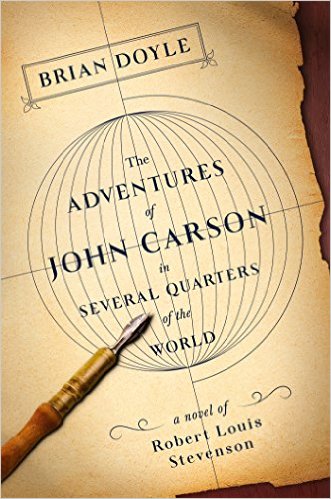
The Adventures of John Carson in Several Quarters of the World: A Novel of Robert Louis Stevenson by Brian Doyle

With enthusiasm and verve, in the style his fans love, Brian Doyle re-creates a novel Robert Louis Stevenson intended to write.

john-carson

In a novel with layers of authors, Brian Doyle (The Mighty Currawongs; Martin Marten) honors the art of storytelling. The Adventures of John Carson in Several Quarters of the World is firmly based in fact: Robert Louis Stevenson boarded for some months at the home of Mrs. Carson in San Francisco while waiting to marry his love, Fanny. He conceived of a novel based on the tales of his landlady’s husband, but never wrote it. Doyle imagines what stories Mr. Carson might have told, and the style in which Stevenson might have written them. Doyle calls upon other published accounts of Carson’s and Stevenson’s acquaintances, including Mark Twain and scientist Alfred Russel Wallace.

In Doyle’s imagination, Stevenson sits by the fire with Mr. Carson as the latter recounts his voyages around the world as a seaman and his experience as a Union solider in the Civil War. This talented storyteller takes Stevenson (and Doyle’s reader) through the jungles of Borneo, over the rocky hills of Irish islands, from coast to coast of Canada in winter, to Australia’s Sydney Harbor and to the battlefield at Gettysburg. Mrs. Carson turns out to be as fine a narrator as her husband, and both have a knack for ending on a cliffhanger just as dinner is ready. As he recounts the Carsons’ feats, Stevenson also explores the sights, smells and steep hills of 1880 San Francisco, and touches on his romance with Fanny Osbourne, herself a worthy, headstrong character.

Doyle’s characteristic prose style is effusive, wry, highly descriptive and always passionate about his subjects. Throughout this story of stories runs a thread of commentary on the value and nuances of the storytelling art. Stevenson constantly refers to his ambition and makes notes for future works: “Hyde would be a lovely name for a character,” he muses, and imagines a novel in which a “sudden shocking kidnapping would set the prose to sprinting.” In several passages, Doyle-as-Stevenson extols the power of storytelling, the universal need for tales of adventure, the urgency of getting them out–he even worries what the “disconsolate reviewers” might say. Readers hungry for more stories-upon-stories will delight in Doyle’s “Afterword” and “Thanks & Notes,” which are filled with recommendations for further reading (what he calls “homework”).

Stevenson’s rollicking zest for adventure blends happily and seamlessly with Doyle’s unrestrained love of words and life. Adventures offers daring exploits, romance and emotional highs and lows, but perhaps most of all, a celebration of stories. Doyle’s signature style expresses this joyousness perfectly.


This review originally ran in the March 2, 2017 issue of Shelf Awareness for the Book Trade. To subscribe, click here.


Rating: 8 stories, of course.

On Writing by Stephen King

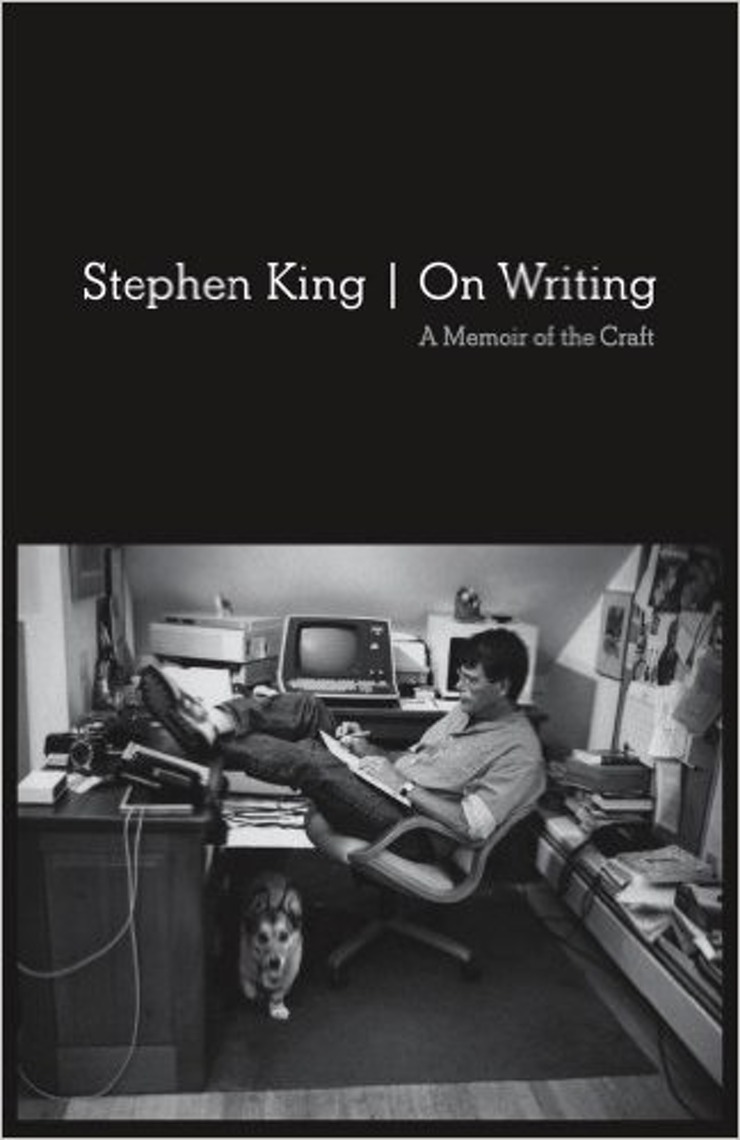
on-writingThis book is required reading for all Stephen King fans, whether they aspire to be writers or no.

On Writing takes an interesting format. This is a “craft” book – instruction for writers – and the first of that category that I’m reading for the semester (though not the first I’ve read). But it’s not all craft; or at least not explicitly. Mine is a 2010 edition of a 2000 book, and it contains sections: first the First, Second, and Third Forewords; then a C.V., which is a sort of memoir but only about the writing or storytelling parts of King’s life. This spans some 80 pages and includes some writing advice along the way (including a little bit of marked-up early work). Next, “What Writing Is” (“telepathy, of course”) and “Toolbox” (as in, the writer’s, but with a nice metaphor referring to a real one). Now we get to the section called “On Writing,” which begins on page 141.

King’s rules are relatively simple: things like “read a lot, write a lot,” and some thoughts on how to separate writing from editing (get it all down on paper as quickly as possible, then leave it alone for a while til you can come back with an objective eye). He despises adverbs as much as the next wise reader/writer, especially when tied to speech tags. He touches on dialog and theme. Language is very important to King: this book is dedicated to Amy Tan, who told him it was okay to concentrate on that aspect of craft. (Some of us are thinking, duh.)

Even this writing-advice section is (perhaps necessarily) filled with details from King’s personal life, and his personal work style. This is why I say this book is an excellent read for anyone who loves King, whether they wish to write or not: it’s filled with the man, and the writer, himself, not to mention his characteristic storytelling style, even when giving advice. He writes characters, and the details of character and scene, so richly it’s almost multimedia; and yet we never realize we’re reading (yawn) exposition.

The next section of the book is “On Living: A Postscript,” and if you are indeed a King fan, you’ll notice that this book’s original pub date in 2000 immediately follows a certain 1999 event, when he was hit by a van while walking the back roads of Maine and nearly died. He relates this incident and his recovery in some detail here, and it makes a riveting story, of course, even though his reader knows the general outcome beforehand (the writer lives to write about it). The point here – though not belabored – is that living is an important part of writing. And, “Writing did not save my life–Dr. David Brown’s skill and my wife’s loving care did that–but it has continued to do what it always has done: it makes my life a brighter and more pleasant place.”

There are three “Furthermore” sections, to match the three forewords that started the book. These appendix-type bits are an example of a story before and after editing; a recommended reading list (totally unscientific, just what King has enjoyed reading), and a second reading list as addendum in this 2010 edition.

I haven’t even mentioned some of the writing advice I found most helpful here; for example, the concept of a piece of work as a found thing, a fossil, which then needs just excavation and polish, is especially applicable I think to nonfiction. (King admittedly concentrates on fiction – his genre – throughout, but that doesn’t mean there’s not plenty here for other writers.) And I loved his reverse of the gun rule:

There’s an old rule of theater that goes, “If there’s a gun on the mantel in Act I, it must go off in Act III.” The reverse is also true; if the main character’s lucky Hawaiian shirt plays a part at the end of a story, it must be introduced early. Otherwise it looks like a deus ex machina (which of course it is).

The best of Stephen King is here, and with some good writing advice to boot. Don’t miss this one.


Rating: 9 Very Important Books.

The Song Poet: A Memoir of My Father by Kao Kalia Yang

In celebrating a father’s traditional Hmong song poetry, this memoir records the painful history of a loving family and a people.

song poet

In The Latehomecomer: A Hmong Family Memoir, Kao Kalia Yang related her family’s immigrant experience. With The Song Poet: A Memoir of My Father, she focuses on the life and art of Bee Yang: “my father raps, jazzes, and sings the blues when he dwells in the landscape of tradition Hmong song poetry.” The storytelling and emotional communication of that art form was a defining element of Bee’s contribution to his family and his culture, from their home in Laos to a refugee camp in Thailand and, finally, in the United States. When his mother died, Bee stopped singing, and Yang considers the significance of that silence as well.

As its title suggests, The Song Poet is lyrical and beautifully composed, with themes of loss and love, realistic and raw, but enriched by gentle metaphor. It is divided into “Side A” and “Side B,” the first told in Bee’s first-person perspective and the second in Yang’s. These points of view offer immersion in a Hmong culture that values family, and shares a complex system of spiritual celebrations and a way of life centered on the day-to-day necessity of growing and harvesting food. War and violence drive the family to Minnesota, where Bee and his wife do hard, dangerous labor, and are poorly equipped culturally to battle racism and exploitation. But they retain their reverence of family and tradition. The Song Poet is a message of love and thanks to a father who sacrificed for his children’s future, and a memorial to his art.


This review originally ran in the May 17, 2016 issue of Shelf Awareness for Readers. To subscribe, click here, and you’ll receive two issues per week of book reviews and other bookish news.


Rating: 8 flip-flops.