The Shining by Stephen King (audio)

Another masterpiece by Stephen King! Probably my favorite yet. Spellbinding.

I suspect the storyline of The Shining is familiar to us all, so I will sketch it very briefly. Jack Torrance is a recovering alcoholic; his family has been made unstable, financially and otherwise, by his drinking. He takes a job at the Overlook Hotel in the Colorado mountains as winter caretaker, which involves moving his wife Wendy and son Danny in for some 6 months, for most of which they will be snowbound and cut off from the world. Danny has a unique gift for seeing things: the past, the future, dead people. The Overlook has a uniquely grotesque history.

The Shining is a masterful book in several ways. Perhaps the most obvious is the atmosphere: King’s pacing, building of tension as the story unfolds, and foreshadowing, are precisely designed to spook his reader. Danny’s gift – his “shine” – provides the perfect vehicle for this foreshadowing. The character development is finely done as well. Jack is a conflicted character; he loves his wife and son and wants to do well by them, but he battles inner demons, particularly alcoholism, and this internal conflict is well done. He feels like a real person. Wendy, too, struggles with what’s right for her family; she has considered leaving Jack before and continues to deliberate. And Danny is a sweet child, not inappropriately aged (the way gifted children sometimes are in fiction) – at least not to my limited childless knowledge. He can see more than he can understand.

The hotel has a will of its own and is a character unto itself. Place, or building, as willful force of evil is a device we’ve encountered before, Rebecca being one of the best examples. The Overlook is another. I love how Jack’s research into the hotel’s history seems to feed its power to harass him. I love that the Overlook preys on Jack’s weaknesses. It is truly, deeply creepy in the most delicious way.

And while we’re discussing characters – how about my very favorite, the hotel’s summertime cook, Dick Hallorann? Hallorann befriends Danny, shares his strange gift (although it shines more strongly in Danny), puts the name “the shining” to it for him, and comes to the family’s aid late in the book. Dick is a lovely, colorful character, full of personality and, again, very human conflicts. I like him very much.

The Overlook Hotel’s evil finds an outlet through Jack Torrance. His struggle with alcoholism and growing cabin fever make him a good target; but it remains clear that Jack is an essentially good man. Even in the worst of times, he experiences some personal growth. Wendy, too, learns about her son and their relationship is left looking stronger than ever as the story comes to a close.

I found this book exciting; suspenseful; rich; engaging; filled with people I cared about. Oh, and the audio! Campbell Scott’s narration is divine. I loved his voices for all the characters, and he contributed significantly to the atmosphere which is probably The Shining‘s finest quality. If you haven’t enjoyed this book yet, I strongly recommend that you get the audio book read by Campbell Scott if at all possible! This has been one of my most enjoyable audio reads this year to date.


Rating: 8 roque mallets.

Movie review to come. Briefly: not as good as the book (who’s surprised?), and really only vaguely related to it. EDIT: movie review here.

book beginnings on Friday: The Shining by Stephen King

Thanks to Rose City Reader for hosting this meme. To participate, share the first line or two of the book you are currently reading and, if you feel so moved, let us know what your first impressions were based on that first line.

Ooh, I’m excited about this one! Remember when I listened to that first chapter of his future release, Doctor Sleep? That’s the sequel to The Shining, due in 2013, and I loved it. So now I’m back to reading the first one. I’ve never seen the movie, either, although I’ve seen some images from it (Jack Nicholson’s face through that busted-up door is rather iconic) and have a vague impression. This audio version, read by Campbell Scott, came recommended (by Natalie), so here we go. It begins:

Jack Torrance thought: Officious little prick.

Ullman stood five-five, and when he moved, it was with the prissy speed that seems to be the exclusive domain of all small plump men.

I think that is fine imagery. I’m loving this book so far, and yes, Scott’s reading does seem to be letting me inside the head of the disturbing (disturbed?) Jack Torrance. Husband is pleased that I’m reading this book, too, although he was disappointed to hear that I will probably not be done with it by Halloween – he wants to watch the movie then, but I think November will have to do just as well.

preview chapter: Doctor Sleep by Stephen King (audio)

As noted yesterday, there is a teaser chapter at the end of Stephen King’s The Wind Through the Keyhole for his upcoming book, Doctor Sleep. I am giving this one chapter its own post here because it grabbed me hard. Good job, Mr. King, you have me salivating for a book that’s not out til 2013. Thanks.

Doctor Sleep will be a sequel to King’s huge 1977 hit, The Shining, upon which was based the 1980 Stanley Kubrick / Jack Nicholson movie by the same name. I have neither read nor watched The Shining, but after listening to King’s reading of the first chapter of Doctor Sleep, I will. I have a copy of the audiobook (sadly, not read by King) on its way to me now. I got the storyline of both the book and the movie, and the differences between the two, off Wikipedia. I won’t regurgitate what I read; if you too need the background, go read up (bookmovie).

Doctor Sleep opens with Danny Torrance seeing dead people again, a few years after the death of his father and other frightening events at the Overlook Hotel. Dick Hallorann comes to town to help him deal with the trauma and the apparently very real risk of the ghosts (are they ghosts? these decaying corpses?) doing him bodily harm. Dick arms young Danny with a tool to protect himself, but the chapter ends with a sort of “and then they were safe… or were they?” moment. Oh the suspense!

Here I am pimping Stephen King, I suppose, and I don’t think he needs my help. But just the one chapter held my interest so thoroughly that it began to eclipse the wonderful Wind Through the Keyhole that I had just finished. I am impressed, am I intrigued, I am seeking out more Stephen King. Check him out.

The Wind Through the Keyhole by Stephen King (audio)

Edit – Update! I’ve just linked up to The Stephen King Project blog, where we’re being encouraged to read King (or listen!) and share our reviews. Thanks Natalie for the reminder. I didn’t join on purpose with a plan or anything, but I’m happy to be here now. …and back to the book review.

My word, this is lovely. I have never been disappointed in Stephen King, but this is definitely my favorite of those I’ve read. The Wind Through the Keyhole is part of the Dark Tower series, to which I am new, and therefore I appreciates the introductory remarks, in which King notes that it is not necessary to have read others in the series, but it would help to know a few facts about MidWorld, which he then relates. It’s true: I didn’t have any trouble following the action or keeping track of the rules of this alternate world.

King employs the story-within-a-story format here, and puts it inside another story for good measure. I got so immersed in the innermost story, about young Tim and his frightening journey into the forest in the starkblast, that when it ended I expected the book to end! I suppose it might have been jarring to then return to the story of young Bill and the skinman (which is in turn being told to the characters of the outermost story), but it wasn’t. I was just relieved that there was more to hear.

Stephen King reads this audiobook himself, and does it beautifully. I have listened to a handful of author-narrated audiobooks, and they have all been great. The actors, or professional narrators, are often wonderful as well, but some of these authors do amazing jobs too. Barbara Kingsolver’s reading of The Lacuna was extremely impressive, because of all the different accents necessary. It makes me marvel that a person can be such a talented artist in two different media! But I’m getting off track. Stephen King does a great narration, everything felt very real, and I was comforted knowing that the names of his imaginary lands and people were pronounced just as the author imagined them in his head.

So what is this book about? It opens with Roland Deschain and his traveling companions, chatting on the road to who-knows-where (presumably this is part of a larger storyline that I would know if I were reading the series). A particularly strange and threatening storm called a starkblast is coming, and they seek shelter, and find themselves up all night in the howling wind; so Roland agrees to tell them a story. This is where we leave the outermost story and enter the middle-layer story.

Roland is a young man and a novice gunslinger. I quote Stephen King’s foreward: a gunslinger is “one of a small band that tries to keep order in an increasingly lawless world. If you think of the gunslingers of Gilead as a strange combination of knights errant and territorial marshals in the Old West, you’ll be close to the mark.” He has just lost his mother – killed her, in fact, in an obviously traumatic incident that is only alluded to in this book – when he takes a trip with fellow youngster gunslinger, Jamie, to solve a mysterious series of bloody murders in a small mining town. It is theorized that the murders are being committed by a skinman, a shapeshifter. Roland befriends a young boy, Bill, who has witnessed his father’s murder, takes pity on him, and sits down to tell him a story Roland’s mother used to tell him when he was a little boy. This is the innermost story, and it is called – what do you know – The Wind in the Keyhole.

Once upon a time, in an ironwood-logging town called Tree, Big Ross is killed by a dragon in the woods. His partner, Big Kells, marries Ross’s widow Nell, and becomes stepfather to the boy Tim. Tim’s story is an adventure and sort of a dark and frightening fairy tale. He finds out a sinister secret about his stepfather and takes a journey deep into the treacherous forest where his father was killed; he encounters strange creatures, dragons, fairies, tigers, good magic and bad magic. This innermost story is the one we spend the most time with, and is set in a marvelous otherworldly world, fully developed, filled with creatures and characters and conventions and rules, fascinating and glorious and strange and scary, but also rather sweet.

Roland concludes the telling of The Wind Through the Keyhole to Bill, and then concludes the telling of Bill’s story to his companions, so that we close the stories we’ve opened and finish back with the elder Roland and his companions weathering the starkblast. There is a sense of circularity, and completeness.

The outermost story, of Roland and his fellow travelers, is engaging and also set in another world (MidWorld) I found interesting and would like to hear more about. The middle-layer story, of the young Roland seeking the skinman, involves some good old-fashioned detective skills and has a satisfying conclusion. But the story of young Tim and his quest through the forest was clearly the star. I was entranced, and sorry it was over. I shall be searching out more King, without a doubt! And I appreciated his narration, as I said earlier; I hope he’ll continue to narrate his audiobooks.

Stay tuned: tomorrow I’ll tell you about the teaser chapter for an upcoming book that was included at the end of this one.


Rating: 7 puppy dogs.

11/22/63 by Stephen King

Wow. What can I say? This book was a thrill, a wild joyride, emotional and tender, thoughtful, had me on the edge of my seat. I guess I’ve not bothered to seek out Stephen King (aside from one book I read for the horror section of my genre fiction class in grad school, From a Buick 8, and a short audiobook for a car trip, Stationary Bike) because I don’t have much use for horror; but of course he does more than horror, doesn’t he. There are reasons why he’s a mega-bestseller, and this book illustrates several of those reasons very well.

I’ll back up a bit and give you the premise. Jake Epping is an English teacher in small-town Maine in 2011. His alcoholic wife has just divorced him in favor of a man she met at AA meetings when Al, of the local Al’s Diner, calls him up. Al has aged 10 years overnight and is clearly dying, like right now, but how can this be when Jake just saw him yesterday looking healthy if chubby? We’re thrown into the weirdness immediately as Al sends Jake through his diner’s pantry, and through the rabbit hole, into 1958. This strange loophole through time always takes a visitor back to the same moment in 1958, and no matter how long one stays, he’s always gone just 2 minutes in 2011. Al has returned from 1962 with terminal cancer. He tried to make it to 1963 to stop the Kennedy assassination, thinking to prevent as well the assassinations of Bobby Kennedy and Martin Luther King, the tragedy of the Vietnam War, and – why not? – all the bad since then, too. But now Al is out of the game, and with very little instruction, Jake is in it.

I’ll go ahead and tell you that Jake takes on the challenge, because I don’t feel it’s much of a spoiler. (This book runs over 800 pages; something had to happen.) But I won’t tell you much more. This is a suspenseful ride through time and history with the most serious of potential consequences. It’s awesome. Jake is an awfully likeable character, very human, fairly well developed, with good intentions but human weaknesses as well. There is definitely some humor in his preordained knowledge of the past; and before you go thinking he can see everything’s future as he travels through 1958, and onward, across the United States, remember (as Jake will remind us) that he’s an English teacher, not a history teacher. In particular, the regular people he meets are beyond his future-sight, as he didn’t study up on them beforehand. And it’s the little people, the regular folks he comes to know in the Land of Ago, that will turn out to be important to Jake. How could it not be so? He’s just a regular folk himself.

As my mother (who read this book first and prompted me to do so; thanks Mom) pointed out, King is not terribly poetic or lyrical in his writing style. (For the exception that proves the rule, see my recent Teaser Tuesday.) But not all books have to be poetic, and this one loses nothing for it’s more straightforward style. What King does right is build characters, make us care, paint the world of the late 50’s and early 60’s so completely that we taste and smell it. The storyline is fabulous, and this book is a page-turner; if only I had started it sooner during my week off work I might have tried to do it in one or two sittings!! As it was I stayed up past my bedtime on a work night to finish it.

The history and culture of the past is great fun; the characters are engaging; the action is suspenseful. This book is fun and exhilarating and I highly recommend it! Go ahead and add it to my Best of 2011 list. (See, I knew I was jumping the gun…)

Teaser Tuesdays: 11/22/63 by Stephen King

Teaser Tuesdays is a weekly bookish meme, hosted by MizB of Should Be Reading. Anyone can play along! Just open your current read to a random page and share a few sentences. Be careful not to include spoilers!

My mother ran right through this over-800-page book in a few days, and I’m looking like I’m going to do the same; my first day got me nearly 300 pages. I don’t often jump on the hot-new-book bandwagon, but this one grasped me: JFK’s assassination, dreams of a more perfect world, time travel, and Stephen King? Okay. Here are a few lines I liked:

I liked writing, and had discovered I was good at it, but what I loved was teaching. It filled me up in some way I can’t explain. Or want to. Explanations are such cheap poetry.

And I like the poetry of that final line. So tell me: what are you reading?

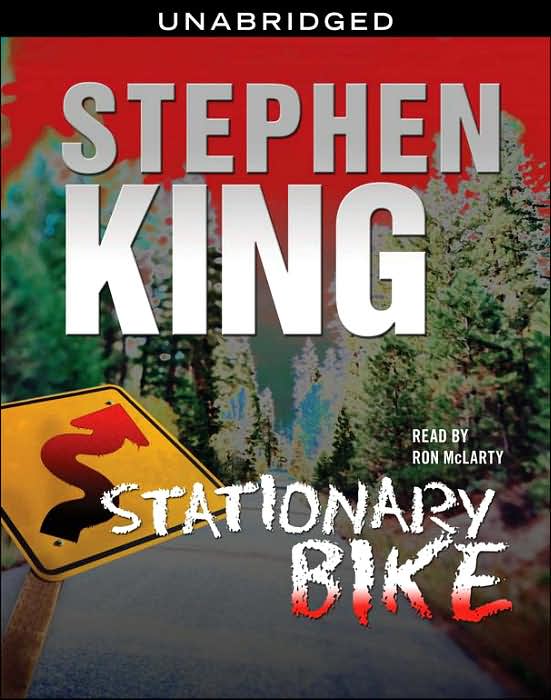
Stationary Bike by Stephen King (audio)

I’m going to call this one a short story, at only an hour and a half, unabridged. It made for a nice short entertaining story during our drive up for a bike race a few weeks ago.

Richard Siftkitz is a freelance commercial artist, making his living by drawing and painting commissioned works for advertisements, pamphlets, movies posters, record covers, and the like. He’s 38 years old when the story opens, and his doctor is concerned about his cholesterol level (Richard likes to eat a lot of fast food). The doctor explains the issue with a metaphor: he tells Richard that there is a little team of workmen, of the hardhat-and-work-boots variety, living inside his body, working hard to keep his arteries clear of the junk Richard is putting into them. If they are made to work too hard for too many years, they’ll get tired, start doing sloppy work, and eventually quit or be overcome.

Richard takes this concern to heart, and goes out and buys… that’s right, a stationary bike. He sets it up in the basement of his apartment building and paints a mural on the wall, of a road through a forest. This road represents both the road he pretends he’s riding down, and one of the roads that his little tiny interior metaphorical workmen are keeping cleared for him. He pins up maps on the wall and considers himself to be riding down real roads in upstate New York, eventually achieving the Canadian border and riding onward deep into the Canadian forests. Richard’s very active imagination simultaneously creates full lives for the team of four men he envisions working inside his body. He gives them names and backgrounds and families.

Without ruining too much for you, I will say that Richard’s imagined workmen take on lives of their own, and his imaginary ride through the Canadian woods takes on proportions larger than he meant for it to have. He finds himself in danger.

I found this short audiobook entertaining and spooky. The tension built nicely. There were little clips of music that played in between chapters; it started off sort of Musak-ish, but as the story got creepier, the music got creepier, growing with the mood. It was well done. Luckily (since I’m not real good with horror!) it wasn’t unbearably scary but it did give us some creeps. I liked it.