A Garden of Marvels: How We Discovered that Flowers Have Sex, Leaves Eat Air, and Other Secrets of Plants by Ruth Kassinger

A charmingly accessible history of botany, full of the strange and wondrous, for readers intimidated by science.

garden of marvels

Ruth Kassinger (Paradise Under Glass) was frustrated by the kinds of mishaps with which many amateur gardeners are familiar: failures to thrive, unexplained deaths, mysterious midseason droopings. So she did what any reasonable science writer would do: research. How do plants really work? In hunting for a simple, layperson’s guide to botany, however, she came up short. Particularly in seeking “the story of the first discoverers of the basic facts of plant life”–that is, a history of botany–she could find only scholarly texts for which “Botany 101 is definitely a prerequisite.” From these frustrations was born the masterful, engaging A Garden of Marvels.

Kassinger’s greatest strength is unquestionably her quirky, conversational tone. She begins with a murder mystery (spoiler: the victim is a kumquat tree) and from these delightful opening lines, even the most science-averse reader will be hooked. While A Garden of Marvels does contain the odd gardening tip, it is more concerned with Kassinger’s travels: she visits farms, conservatories and laboratories around the nation, encountering diverse and eccentric characters she describes with humor and skill.

Her research into human history is likewise revealing: she points out that religious and societal philosophies caused our ignorance of and lack of interest in botany until very recently, and highlights those few pioneering minds whose experiments, observations and strange machineries caught us up. Darwin gets a chapter, and is accompanied by myriad little-known early scientists, all brought to life by Kassinger’s enthusiasm. A handful of relevant illustrations by Eva Ruhl assist along the way.

Kassinger is properly amazed at the science she discovers in nature, as well as the men (“and they were all men”) in history who broke ground with their scientific studies. For some readers, though, she may be a trifle overenthusiastic about the possibilities of genetic modifications of plant life and dismissive of concerns regarding these technologies–although the genetic possibilities in the simple garden petunia are positively mind-boggling.

Topics like plant sex, the history of scientific exploration and the fundamentals of genomics are all equally accessible in Kassinger’s capable hands. That she makes botany so approachable is a feat; that she makes it downright enthralling is almost as miraculous as an adorable photosynthesizing sea slug.


This review originally ran as a *starred review* in the February 24, 2014 issue of Shelf Awareness for the Book Trade. To subscribe, click here.


Rating: 9 different fruits on one tree.

Rosarito Beach by M.A. Lawson

A sexy renegade DEA agent’s past resurfaces at the worst possible moment in a new series from (a barely disguised) Mike Lawson.

rosarito

Mike Lawson, creator of the Joe DeMarco thrillers (House Odds et al.), uses the pen name M. A. Lawson to launch a new series, Rosarito Beach, with a new protagonist: DEA agent Kay Hamilton. Hamilton brings a take-no-prisoners attitude to her investigations, and though it’s clear she makes a better field agent than supervisor, she’s assigned to lead a team in Southern California investigating Caesar Olivera, the boss of a major Mexican drug cartel. After arresting the kingpin’s little brother, Tito, Hamilton’s main concern becomes keeping him locked up. Even after Tito is transferred to the brig of a vast Marine base, however, Caesar’s army threatens.

Hamilton dislikes authority figures, enjoys a drink or four, picks fights with every other law enforcement agency in town and knows exactly how to use her good looks and hot body to her advantage. She follows her own personal code, pleased to be beholden to no one except herself, involved with her career and personal pursuits–mainly her sex life–until a mystery from her distant past resurfaces. This new addition to her short list of concerns reorders Hamilton’s priorities and drives her to actions, and crimes, she never thought possible. The DEA fights to keep Tito locked up, the cartel arms itself for action and Hamilton rejects protocol in an accelerating race toward the end game, which concludes with all the fireworks and upheaval a thriller fan craves.


This review originally ran as a *starred review* in the January 3, 2014 issue of Shelf Awareness for Readers. To subscribe, click here, and you’ll receive two issues per week of book reviews and other bookish fun!


Rating: 5 stiletto heels.

To expand a bit on my review, above: this thriller was suspenseful, had pace and momentum, and kept me interested and engaged. Its fault (and the reason my rating isn’t higher) relates to the caricatures of the characters. Hollywood-style, they were all beautiful, had smokin’-hot bods, and dressed like magazine spreads. Similarly, the hero’s coldly detached interest in sex without strings struck me as unrealistic and a little stereotyped – career-obsessed woman not interested in relationships but able to seduce her way into the most highly-guarded yadda yadda. There was a cartoon element to it, is what I’m saying. On the other hand, though, I stayed up late reading avidly to see what would happen next. So I may have rolled my eyes, but Lawson gets the win in the end.

The Investigator: Fifty Years of Uncovering the Truth by Terry Lenzner

An investigator’s caseload over the decades offers a captivating glimpse of the intersection of politics, celebrity and money in the U.S.

investigator

Terry Lenzner’s career began in the Justice Department’s Civil Rights Division in the 1960s, and has ranged from the Senate Watergate Committee through private legal practice to his own company, Investigative Group International. A lawyer by training, he found his passion in research and sleuthing. The Investigator reads like a Forrest-Gump-style catalogue of cases that have caught the public eye–from the murders of three civil rights workers in Mississippi, to the Harrisburg 7’s federal case for antiwar activism, to Watergate, the Unabomber, Monica Lewinsky and the death of Princess Diana.

Lenzner’s clients include governments, politicians, businessmen and celebrities; the resulting wide-ranging subject matter in this memoir accounts in part for its appeal. Even the tedious financial fact-checking of an investigation into the Trans-Alaska Pipeline is brought to life by Lenzner’s passion. He gives character sketches of public figures he’s known, debunks public perceptions of certain events and offers investigative tips along the way. He is concerned with the truth, not satisfying the client at any price, and shares anecdotes in which the two goals were irreconcilable.

Impressively, this seasoned investigator is also a fine writer. His story opens compellingly, giving background while simultaneously jumping right into the action. Although “this isn’t meant to be a history book,” Lenzner writes, The Investigator is an absorbing and intelligent sampling of American history, told in puzzles and–sometimes–solutions.


This review originally ran as a *starred review* in the October 22, 2013 issue of Shelf Awareness for Readers. To subscribe, click here, and you’ll receive two issues per week of book reviews and other bookish fun!


Rating: 7 witnesses.

The Handoff: A Memoir of Two Guys, Sports, and Friendship by John “JT the Brick” Tournour

An earnest remembrance of a friend and the wisdom he passed on to a sports talk radio anchor.

handoff2

After a fun-filled, full-speed youth as president of his fraternity and, later, working as a professional cold-calling stockbroker, John Tournour finds his true calling: sports talk radio. He starts out as a listener calling in, then gets his own show but has to pay for airtime, gradually working his way up until one day he gets a fateful call. Andrew Ashwood mentors John, now known on the air as “JT the Brick,” through an ascending career, and they become the closest of friends. When Andrew is diagnosed with cancer, JT naturally gets the call to be his chemo buddy and “main go-to guy.”

Though The Handoff begins with JT’s childhood, we know from the beginning that Andrew will be its focal point. JT failed to take notes on Andrew’s every word in those final months, realizing only in hindsight that he was not only modeling how to live–and how to die–but also sharing all his life lessons, on and off the air.

JT may be macho and manly–this is smack-talk sports radio, after all–but he is heartfelt and emotional in relating his love for Andrew and his appreciation of everything his friend had to offer. Although sports radio is JT’s passion and the background for his friendship with Andrew, his readers need not know or even much care about sports (or radio) to empathize. The Handoff is a memoir of life and loss, but foremost of friendship.


This review originally ran as a *starred review* in the August 23, 2013 issue of Shelf Awareness for Readers. To subscribe, click here, and you’ll receive two issues per week of book reviews and other bookish fun!


Rating: 6 callers.

Junius and Albert’s Adventures in the Confederacy by Peter Carlson

Adventure, suspense, and a dash of romance make for a highly readable–and absolutely true–Civil War story.

junius
Peter Carlson’s Junius and Albert’s Adventures in the Confederacy opens with the capture of its titular subjects near Vicksburg in 1863, then rewinds to show how they landed in such a predicament. Albert Richardson, an enterprising journalist for the New York Tribune, had decided to travel south as an undercover correspondent, and naturally chose his best friend and fellow newspaperman Junius Browne to accompany him. The stakes were high if they were discovered–the Tribune was reviled as a liberal abolitionist paper–but the two young men were game for adventure. After their capture, they spent nearly two years in a series of Confederate prisons before escaping, half-starved and freezing, to trek overland toward Union lines in December 1864.

Despite the serious and frequently tragic nature of Albert and Junius’s story, the book’s title signals the often playful tone that Carlson (K Blows Top) employs. The descriptions of Confederate prisons like Libby, Castle Thunder and Salisbury are horrific, but there is also the occasional scene of mirth–as when prisoners put on a variety show to celebrate the 4th of July. Besides Junius and Albert, the other colorful personalities in Carlson’s history include a larger-than-life “Union pilot” skilled at guiding refugees over the mountains to freedom, and a beautiful young Southern horsewoman who rescues them during a perilous moment. With eccentric and likeable characters like these, Carlson’s history successfully masquerades as an entertaining adventure story.


This review originally ran as a *starred review* in the June 4, 2013 issue of Shelf Awareness for Readers. To subscribe, click here, and you’ll receive two issues per week of book reviews and other bookish fun!


Rating: 7 weary months.

Defiant Brides: The Untold Story of Two Revolutionary-Era Women and the Radical Men They Married by Nancy Rubin Stuart

Parallel profiles of two wives on opposite sides of the American Revolution.

defiant

Margaret “Peggy” Shippen Arnold and Lucy Flucker Knox have traditionally been treated as historical footnotes in relation to their more famous husbands, Benedict Arnold and Henry Knox. Nancy Rubin Stuart (The Muse of the Revolution) remedies this neglect in Defiant Brides, a double biography that examines these two women as individuals as well as influential players in the American Revolution.

Peggy was a beautiful blonde belle of Philadelphia society, from a family that favored the British. Lucy was from a well-to-do, firmly Loyalist Boston family. The Shippens reluctantly admitted the political expediency of Peggy’s marriage to military hero Benedict Arnold; the Fluckers disowned Lucy for the sin of matrimony with patriot Henry Knox. Lucy supported her husband’s military and political careers in relative poverty and socialized with George and Martha Washington, even as she fretted over Knox’s long absences and missed the opulence of her youth. Peggy staunchly championed her husband through his treason and banishment and their subsequent financial difficulties in England and Canada; her part in Arnold’s betrayal at West Point, and her own possible role as a spy, remain controversial.

Stuart’s thoughtful research and consideration brings each woman forward into her own spotlight, reflecting on the flaws and strengths that Peggy and Lucy brought to their marriages and to the events of their time. Defiant Brides is an effortless read and a fresh perspective on the American Revolution, featuring two women who defied their parents to marry into a conflict that shaped a nation.


This review originally ran as a *starred review* in the April 23, 2013 issue of Shelf Awareness for Readers. To subscribe, click here, and you’ll receive two issues per week of book reviews and other bookish fun!


Rating: 7 degrees of loyalty.

Ramblers: Loyola Chicago 1963: The Team that Changed the Color of College Basketball by Michael Lenehan

A dynamic, emotional study of one college basketball team’s role in the civil rights movement.

ramblers
Michael Lenehan’s Ramblers chooses one college basketball team, and one season, to illustrate a sea change in the sport–and in the United States. The Loyola Chicago team of 1963 was not the first to send black and white players out on the court together, but Lenehan makes an excellent case for the significance of this particular team’s actions at a key moment in the national struggle for civil rights. He examines their competition over the course of the season, focusing on two teams in particular: Mississippi State, whose players had to sneak out of state due to a ban on playing teams with nonwhite members, and Cincinnati, which was also an integrated team, but one with an increasingly antiquated playing style.

Relying on primary sources and interviews to study a handful of individual players, coaches and administrators, Ramblers passionately evokes the beauty of a great game in a time of great change, and works as a metaphor for changes taking place across the nation as well. Lenehan handles the game with an ease and comfort that indicate his expertise, and Ramblers combines his passion for basketball with an intimately detailed history–including a deeply moving digression into the 1962 riots at Oxford, Miss. Lenehan eventually follows each of his subjects through to the present (or the ends of their lives), giving Ramblers a feeling of completeness. Throughout, he maintains a sense of fun appropriate to a book that’s ultimately about the antics of college kids.


This review originally ran as a *starred review* in the March 19, 2013 issue of Shelf Awareness for Readers. To subscribe, click here, and you’ll receive two issues per week of book reviews and other bookish fun!


Rating: 7 fast breaks.

The Lady and Her Monsters by Roseanne Montillo

A spirited investigation of the bizarre times that inspired Mary Shelley’s Frankenstein.

monsters

On its surface, Roseanne Montillo’s The Lady and Her Monsters is an exploration of the genesis of Mary Shelley’s Frankenstein. But Montillo clearly rejoices in meandering through the volatile times that gave life to Shelley’s gothic classic, and her multifaceted literary study expands to include discussions of anatomy and alchemy, suicides, ghoulish dissections of men not quite dead and the dramatic death of Percy Shelley at sea.

In the early 19th century, Europe grew increasingly fascinated with life, death and man’s ability to control nature. Grave robbers known as “resurrectionists” provided subjects for human dissections that were conducted both in medical schools and for the general public’s entertainment. Scientists and imposters experimented with the capacity of electricity to restore life. Into this environment, Mary Shelley was born to Mary Wollstonecraft (A Vindication of the Rights of Woman) and William Godwin, a famous reformer of the day. Percy Bysshe Shelley was her lover and eventual husband; her sister was lover to Lord Byron. The foursome were traveling in Italy, telling the ghost stories with which Percy Shelley was obsessed, when–as Mary Shelley and legend have it–a human monster appeared to Mary in a waking dream. It was also in Italy that she may have first heard the surname Frankenstein, tied to the inspiration for Bram Stoker’s Dracula, as well as to Sir George (he who killed the dragon). In Montillo’s enthusiastic prose, such diverse and macabre subjects make for a lively survey, not only of Shelley’s masterpiece, but of an odd and colorful time in European history.


This review originally ran as a *starred review* in the February 8, 2013 issue of Shelf Awareness for Readers. To subscribe, click here, and you’ll receive two issues per week of book reviews and other bookish fun!


Rating: 5 volts.

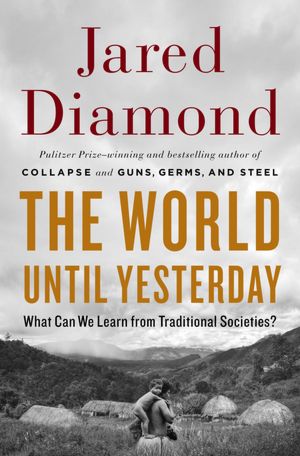
The World Until Yesterday by Jared Diamond

An ambitious but effective–and charming–exploration of the salutary lessons offered by traditional societies.

For many decades, Pulitzer Prize-winner Jared Diamond (Collapse; Guns, Germs and Steel) has split his time between his native United States and the traditional societies of New Guinea. In The World Until Yesterday, he compares traditional ways of life with “WEIRD” (“Western, educated, industrialized, rich, democratic”) methods of problem-solving. Recognizing the daunting breadth of such a subject, he selects a few areas for examination, including dispute resolution, child-rearing, elder care, religion and the connection between lifestyle and non-communicable diseases like Type II diabetes. In each area, he compares traditional practices with modern ones, considering the evidence from angles both strictly scientific and personal.

Diamond supplements his extensive fieldwork with substantial research to draw credible conclusions and posit plausible theories. But he writes conversationally, using the first person liberally as he meanders across disciplines such as anthropology, sociology, geography, statistics and evolutionary biology. This disarmingly personal tone is one of the greatest strengths of the book. Diamond also discusses preconceived notions that he and the reader may have, then moves on to new theoretical ground. While acknowledging aspects of traditional societies to which we do not wish to return–cyclical violence, infanticide, frequent starvation–he identifies certain strengths as well, like negligible rates of heart disease and restorative justice systems. “What can we learn from traditional societies?” Diamond asks in his subtitle; his plan to discover the wisdom and experimentation of more than 10,000 years of human society is well-executed.


This review originally ran as a *starred review* in the January 4, 2013 issue of Shelf Awareness for Readers. To subscribe, click here, and you’ll receive two issues per week of book reviews and other bookish fun!


Rating: 8 yams.

Encounters from a Kayak: Native People, Sacred Places, and Hungry Polar Bears by Nigel Foster

One man’s reminiscences of flora, fauna and miscellanea encountered while paddling the globe.

For decades, Nigel Foster has been kayaking the world’s oceans, lakes and canals–as well as teaching the skill, designing the equipment and writing about his experiences. Encounters from a Kayak collects more than three dozen of his articles in a single volume, many of them never previously published. Each examines a moment in time in which Foster–sometimes alone, sometimes with fellow enthusiasts–interacts with the natural world and its inhabitants from his small craft. It is one of the strengths of the collection that not even the oldest pieces (extending as far back as the early 1980s) feel dated.

The stories are organized thematically around creatures, people, places, and flotsam and jetsam; the diversity and scope of Foster’s contacts in all these categories are impressive. In his encounters with historic artifacts in Scotland, local police in Shanghai and monkeys in the Florida Keys, Foster brings a sense of humble wonder to his environment. Naturally, he considers issues of ecology and conservation in his travels, but he never lectures. Rather, in unadorned prose, he delivers the experiences themselves: the glow of bioluminescence, the ordeal of a Dutchman’s flight from Nazi occupation by kayak, the history of a sleepy Minnesota town and the real-life Scylla and Charybdis of Scarba and Corryvreckan, just off the Scottish coast. Foster’s unassuming consideration of his surroundings is charming, simple and occasionally poetic. Natural history, human history, birds, jellyfish, thunderstorms and more come together to entertain and educate in Encounters from a Kayak.


This review originally ran as a *starred review* in the December 14, 2012 issue of Shelf Awareness for Readers. To subscribe, click here, and you’ll receive two issues per week of book reviews and other bookish fun!


Rating: 5 campfires.