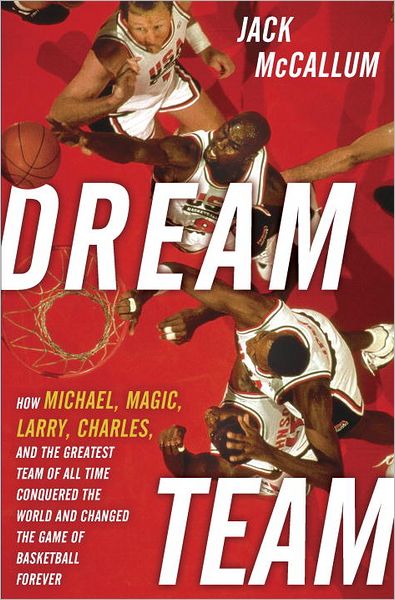
Teaser Tuesdays: Dream Team by Jack McCallum

Teaser Tuesdays is a weekly bookish meme, hosted by MizB of Should Be Reading. Anyone can play along! Just open your current read to a random page and share a few sentences. Be careful not to include spoilers!


I have a fabulous basketball book to tease you with today. Dream Team: How Michael, Magic, Larry, Charles and the Greatest Team of All Time Conquered the World and Changed the Game of Basketball Forever comes out in mid-July. I had trouble choosing a teaser for you because I enjoyed so much of this book! But I picked a (hopefully appropriate) quotation about the skills involved in the game itself.

“You’d be ready to win, and all of a sudden – I’m not making this up – Larry would throw up a shot that would not only knock your ball away from the basket but would also go in itself,” says [Quinn] Buckner [former teammate of Larry Bird]. “The man could play pool and basketball at the same time.”

[Brackets mine.] This quotation describes a shooting game called Knockout, in which everybody gets to shoot at once, if that makes things any clearer. It’s an exciting, funny book about some major personalities. Stay tuned for my review to come.

This quotation comes from an uncorrected advance proof and is subject to change.

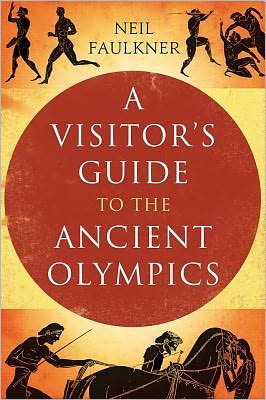
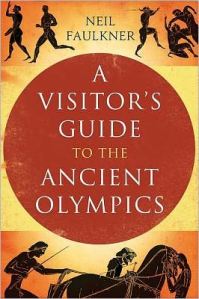
A Visitor’s Guide to the Ancient Olympics by Neil Faulkner

What an odd mix of genres this book is. It sets itself up as a travel guide: eat here, sleep here, don’t forget to pack this – but to a destination that would require time travel. As Faulkner says in his introduction, this is necessarily (by its fantastical nature!) not an entirely academic book; but he does have an academic background, and rather than wildly making things up, he does follow history & research. He just uses his imagination where it makes sense to do so, and in a way that makes sense: he makes educated guesses. (As he points out in the intro, again, he has to pick a day for each event; it is unrealistic that a guide to an Olympic festival would be unable to say when the footraces would be held.) So, note my tags for this post: travel guide; sports; historical fiction; nonfiction. It is a puzzle. A uniquely styled book.

And an enjoyable one, too. At just under 250 pages, it’s an easy read. The sections are short. There is an emphasis for most of the book on ancient Greek culture in general, and on what the Olympic Games represent in that culture (in a nutshell: this is a religious festival; sport is merely a form of religious ritual). The sport itself comes in only late in the book, and I confess that this was a slight disappointment to me: that section of the book that describes the athletic contests was very interesting to me and I wanted more of the same. But the detail on ancient Greece was intriguing, too; I have an interest in ancient Greek mythology & literature, and there were plenty of references that I was pleased to connect.

This book is probably most successful as a travel guide, which is a little awkward since as much as one might wish to, it is in fact impossible to attend the Olympic Games of 388 BC. Faulkner does a good job of elucidating the issues a person would face in attending these Games if she could. Again in a nutshell: there is no lodging, transport is difficult to arrange and expensive, food is odd and limited, and the Olympic Village would be teeming with refuse, stink, and insect activity. It would be hard to see the events on display as there are no stands; spectators 100,000 strong merely shove each other around for a view. In other words, he might have talked me out of the trip if I were planning on it. As a view into the life of ancient Greeks and especially the role of professional athletes in their society, this book was informative and fascinating. Its unique format, too, added special interest. I am bemused and intrigued. Recommended, but probably for a fairly distinct audience. I was well entertained, with my intersecting interests in sport and ancient Greece, and my tolerance for an odd format.


I read an uncorrected advance proof.

Rating: 6 events.

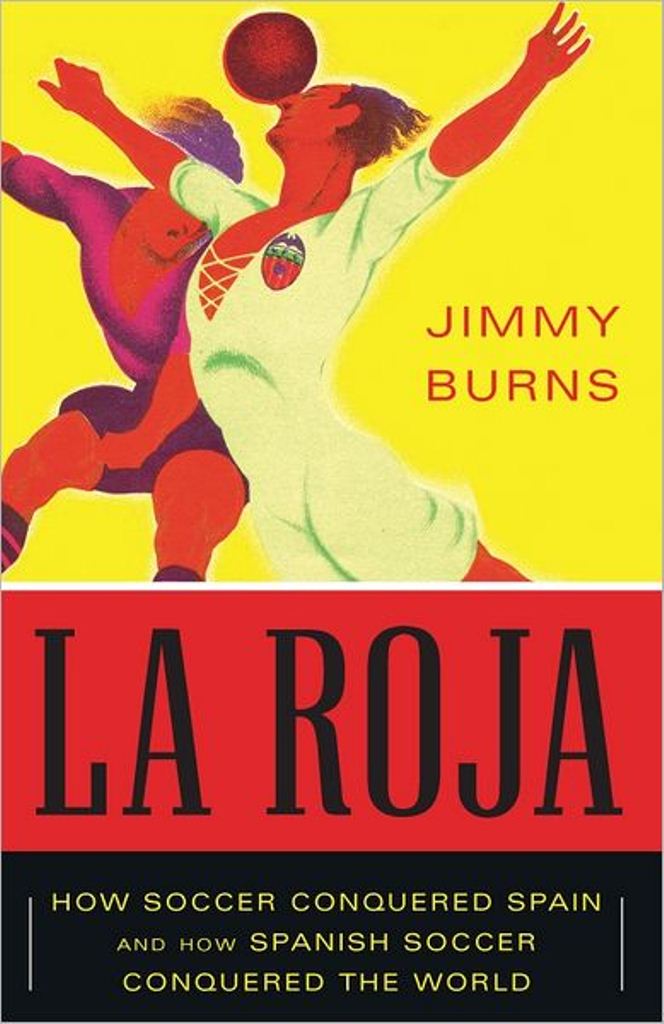
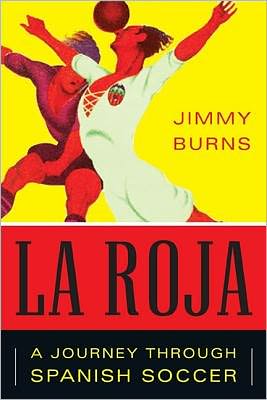
La Roja: How Soccer Conquered Spain and How Spanish Soccer Conquered the World by Jimmy Burns

An examination of Spanish history through the filter of a beautiful game.

Jimmy Burns has an emotional relationship to the soccer teams and the legacy of his native Spain. He’s written several books on the sport, culminating in La Roja, which sets out to tell the story of Spanish soccer, from the moment when the British introduced the nation to the sport in the 1880s to the present day, when the sport has become ubiquitous. Soccer acted as a major propaganda tool in the Spanish Civil War; Franco used it to maintain control of local populations, installing loyal political figures as club presidents and managers. During his rule, Spanish club teams fought fiercely amongst themselves, with regional politics playing a heavy role; in international play, Franco’s politics were at the forefront of every interaction. These were underachieving, frustrating years for Spanish soccer. Only in the late 20th century did Spain begin to come into its own, winning Olympic gold in 1992 and, finally, the pinnacle of a World Cup championship in 2010.

Burns relates nearly 150 years of Spanish soccer history, capturing its roots, the regionalism, the racism, the politics, the bullfighting connections and even a cultural reminiscence of Don Quixote. He portrays personalities, rivalries, strong emotions–including his own–and moments of shining success for a much-beset nation. Often heavier on history than on sport, La Roja is a window into Spain and its component cultures, regions and histories as well as a celebration of soccer and its most recent champions.


This review originally ran in the June 1, 2012 issue of Shelf Awareness for Readers. To subscribe, click here, and you’ll receive two issues per week of book reviews and other bookish fun!


Rating: 5 soccer balls.

Teaser Tuesdays: Racing Through the Dark by David Millar

Teaser Tuesdays is a weekly bookish meme, hosted by MizB of Should Be Reading. Anyone can play along! Just open your current read to a random page and share a few sentences. Be careful not to include spoilers!

David Millar is a veteran professional bike racer who has raced in all the biggest events – the Vuelta, the Giro, the Olympics, and the Tour de France where he’s worn the yellow leader’s jersey. This memoir tells the story of his childhood discovery of the sport he loves, his journey upwards through the professional ranks, and his eventual bust for doping – and then his comeback to the sport, as a “clean” racer. It’s an emotional and unfortunately relevant topic for any fan of professional road racing. Here’s a teaser for you.

After winning Denmark, it would have been reasonable for me to think that I didn’t have to go to Italy, that if I worked hard and put my head down and believed in myself, I could win the Vuelta prologue – clean.

Perhaps if I’d had people – somebody – around me whom I could have talked to about it, then that might have been the conclusion I’d have come to and I’d have canceled the trip to Tuscany.

This is an example of the problem Millar describes as a lack of support for those racers trying to stay clean. He stops short of blaming his decision to dope on pressure from the sport or his team; in fact, he receives very little direct pressure. But the culture surrounding him, so nonchalantly accepting of doping, as he portrays it, makes it difficult for him to resist at a certain point, and no one supports his attempt to stay clean. There is definitely a discussion point here about the meaning and power of peer pressure, alongside the ever-looming question of “clean” competition vs. doping in sports and cycling in particular… I will say for now that Millar never struck me as making excuses. Review to come after this book’s US publication date. [Note: this book has been out in the UK for almost a year. US pub is this June.]

This quotation comes from an uncorrected advance proof and is subject to change.

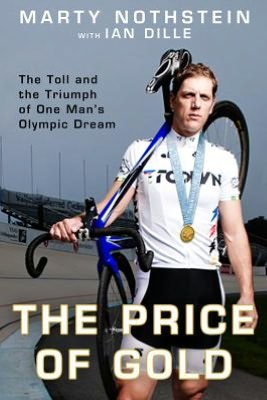
Teaser Tuesdays: The Price of Gold by Marty Nothstein and Ian Dille

Teaser Tuesdays is a weekly bookish meme, hosted by MizB of Should Be Reading. Anyone can play along! Just open your current read to a random page and share a few sentences. Be careful not to include spoilers!

In The Price of Gold, Marty Nothstein, generally accepted to be the most accomplished American track (cycling) sprinter of the modern era, joins Ian Dille, Austin(TX)-based cyclist and journalist, to tell the story of his journey to greatness and Olympic gold, and what it cost him. I am enjoying this immensely: it kept my heart rate raised just about the entire time! Here’s a teaser for you:

“Never wear sandals to a bike race,” Whitehead chastises Gil one time. “You always bring sneakers. You never know when we’ll need to fight our way out of here.” These are the bike racers I aim to emulate.

I like this one because it’s a characteristic portrayal of what makes Nothstein, and really all track sprinters, sort of controversial: the aggression. I find it fascinating stuff. Look for my review a little closer to this book’s June publication date.

This quotation comes from an uncorrected advance proof and is subject to change.

To the Last Breath by Francis Slakey

What begins as a self-satisfied adventure story becomes an account of personal transformation.

Francis Slakey was a physics professor at Georgetown University who paid more attention to his blackboard than he did to his students. He described himself as withdrawn and considered it a good thing. Then, as he tells it in his memoir, To the Last Breath, a chip on his shoulder sends him hunting a world record. His goal–to climb the highest peak on every continent and surf every ocean–was intended to be a physical test, a self-absorbed, even narcissistic pursuit of excellence in sport.

Along the way, though, Slakey experiences many cultures, flirts with spiritual enlightenment and comes to suspect that seeming coincidences along the way mean something. The physical challenge turns out to be the least significant aspect of his journey, as the threat of guerrilla warfare becomes as real as the fear of falling off a cliff. Slakey ends up changing his ideas about what matters most in life; his experiences with the power of nature and the power of human contact turn his world upside down–for the better.

Slakey brings a scientist’s matter-of-fact treatment to a tale of international travel and cultural interaction. He transports his reader to Yosemite, Kilimanjaro and Everest (as well as Antarctica), encounters violence in Indonesia and terrifying driving habits in Morocco and returns home more intact than he began. A love story, an athletic journey, an introspective process of discovery, To the Last Breath is Slakey’s evolution.


This review originally ran as a *starred review* in the May 22, 2012 issue of Shelf Awareness for Readers. To subscribe, click here, and you’ll receive two issues per week of book reviews and other bookish fun!


Rating: 5 mountains scaled.

Critical Wit Podcast interview: Ian Dille, coauthor of The Price of Gold

Another author interview posted over at Critical Wit Podcast the other day. In this episode, I interview Ian Dille, coauthor with Marty Nothstein of The Price of Gold: The Toll and Triumph of One Man’s Olympic Dream. Nothstein holds two Olympic medals – one gold – and is one of the most highly decorated athletes of all time in the match sprint event in track cycling. That is, racing bicycles on a banked track called a velodrome. This is a sport I have competed in myself, which made the book especially exciting for me; Marty’s name was well-known around the Houston track where I’ve spent a good deal of time. And Ian is a Texas bike racer as well as a journalist, so I was enthused at the chance to chat with him, too. Don’t forget to check out his website here. And now the interview!

me

Ian

did not finish: The Bar Mitzvah and the Beast by Matt Biers-Ariel

I tried to read this on my trip to Ireland and gave up. Just a few brief notes as to why.

Backstory: the author’s son, at twelve, states that he will not be having a bar mitzvah because he is an atheist. The author still wants him to have a coming-of-age event, and suggest a cycling trip cross-country. Mom, Dad and both sons (the younger is 8 and will ride on the back of his dad’s tandem) start planning, and undertake a cause to attach to the trip: they will ride to Washington, D.C. gathering signatures on a petition to do something about global warming. My interest, of course, is in the cycling angle.

But Biers-Ariel failed to make me care about his admittedly heartfelt and well-meaning journey. The hope for anti-global-warming legislation is sympathetic, but a bit naive. Prosaic prose, simplified concepts, and jokes that fell flat wore on me; I read 53 pages, didn’t care what happened next, and was annoyed by author’s voice, but I wish him well. Did the family make it? You’ll have to read the book to find out for yourself.

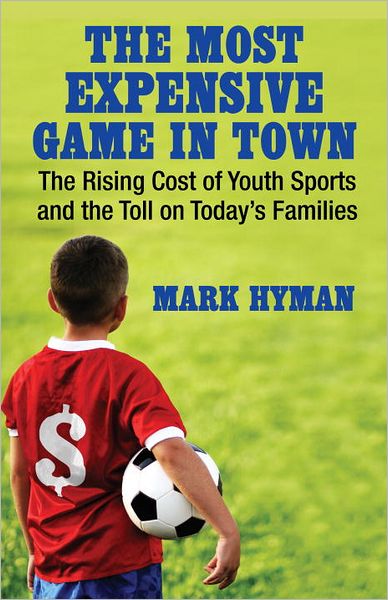
The Most Expensive Game in Town: The Rising Cost of Youth Sports and the Toll on Today’s Families by Mark Hyman

An impassioned argument that the mass commercialization of youth sports is not healthy for kids.


Mark Hyman’s first book, Until It Hurts, dealt with our national obsession with youth sports and its negative consequences for our children. The Most Expensive Game in Town expands on that theme by following the money. His research includes interviews and discussions with parents and grandparents, coaches, corporate sponsors and entrepreneurs–all of them spending and making money from youth sports in the United States. His conclusion: money can have adverse effects on the kids that sports programs are supposed to benefit in the first place, even when many of the parties involved have only the best intentions.

Hyman’s case studies include visits with parents who became unintended entrepreneurs because they saw a way to improve their kids’ experience as well as parents disturbed by the costs of supporting their kids. He looks at the big business of marketing through children–such as youth tournament sponsorships–and the promises made that kids will have a heightened chances of playing college sports or landing an athletic scholarship.

It’s difficult to grasp the size of the ill-defined youth sports industry, but Hyman makes it clear that the amounts involved are shocking. Finally, he examines the plight of kids in inner cities (and others affected by poverty) whose access to the obvious benefits of sport, participation and competition is limited. Hyman’s arguments are well-researched yet very readable, bringing home an issue that is perhaps underexamined but of great importance to parents and concerned citizens.


This review originally ran in the March 27, 2012 issue of Shelf Awareness for Readers. To subscribe, click here, and you’ll receive two issues per week of book reviews and other bookish fun!


Rating: 5 soccer balls.

book beginnings on Friday: La Roja: How Soccer Conquered Spain and How Spanish Soccer Conquered the World by Jimmy Burns


Thanks to Rose City Reader for hosting this meme. To participate, share the first line or two of the book you are currently reading and, if you feel so moved, let us know what your first impressions were based on that first line.

I found us a funny teaser for today:

He briefly embarked on a new career as a referee but found the profession lacking excitement. He was saved from growing old and bitter by an early death.

Ha! That’s one way to look at it. Sort of a different approach than that old quip about aging: that it beats the alternative.

So far this book is more Spanish history than soccer, per se, but it’s early yet. And there’s nothing wrong with Spanish history, for that matter.

What are you reading this week?

This quotation comes from an uncorrected advance proof and is subject to change.


Be advised: I’m out of town, so you’re viewing pre-scheduled posts until April 9. I love your comments and will respond when I return! But I’ll be out of touch for a bit. Thanks for stopping by!