Maximum Shelf: The World’s Strongest Librarian by Josh Hanagarne

Maximum Shelf is the weekly Shelf Awareness feature focusing on an upcoming title we love and believe will be a great handselling opportunity for booksellers everywhere. The features are written by our editors and reviewers and the publisher has helped support the issue.

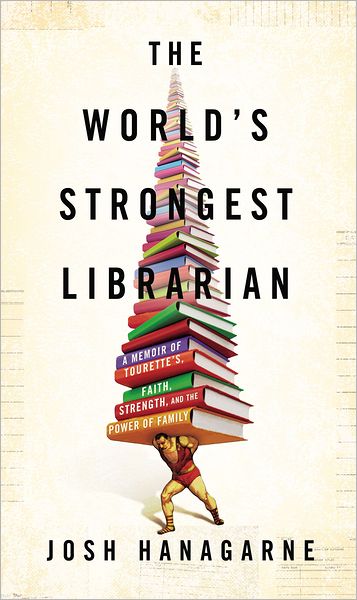
My editor recently asked me if I’d like to put together my first Maximum Shelf for them, and said she had just the book in mind for me: The World’s Strongest Librarian: A Memoir of Tourette’s, Faith, Strength, and the Power of Family, by Josh Hanagarne. (My father found this a hilarious expression of what my editor thinks of me. I’ll let you work that one out. I haven’t.) I was thrilled; and I loved the book. Because this would make for an extra long blog post, I’ve split the Max Shelf issue into two posts for you, so please enjoy my review today and my interview with the gracious & funny Josh tomorrow.

worldsstrongest

Josh Hanagarne, blogger at The World’s Strongest Librarian, “might be the only person whose first three-hundred-pound bench press was accompanied by the Recorded Books production of Don Quixote.” This is just one of his remarkable singularities. A gentle giant who tears phone books for fun, at 6’7″ he tends to catch the eye at the Salt Lake City Public Library, even when his Tourette Syndrome is not acting up. His memoir explores these contradictions and oddities, and his remarkable journey from idyllic childhood to painfully jerky young adulthood to a contented family and work life.

Hanagarne had a happy childhood, beloved by his mother, an incorrigible prankster and devout Mormon, and his devoted, irreverent bear of a father. He grew up in libraries, a passionate bookworm disturbed only by the tics that began in first grade but would go undiagnosed until high school (although his father suspected Tourette’s from the beginning). By young adulthood, they were not only embarrassing but violent and debilitating. He would eventually suffer a hernia from the force of his involuntary shouting tics, and his larger movements resulted in injury to himself and chaos in his immediate surroundings. After high school he spent years trying numerous cures, in and out of college, working various jobs and struggling with depression. Lifting weights at the gym stilled the tics somewhat, and for a while he got regular Botox injections in his vocal cords to quiet the shouts and whoops. During that time he met and married a lovely Mormon folklorist named Janette. For the first eight months of marriage, he couldn’t speak to her above a whisper.

Although deeply in love, the atmosphere of Josh and Janette’s story early in their marriage remains clouded. For years they try to get pregnant. Janette suffers two miscarriages and they are harshly rejected by the Mormon Church as adoptive parents. Josh continues to tussle with Tourette’s. For a short time, he finds a position as assistant special educator quite satisfying, not least because his tics become unremarkable in a room full of special needs. But he soon leaves that job, because he seeks challenge: crucially, he aspires to overcome Tourette’s, to beat his tics into submission. Pondering what might present the greatest challenge to a man who can’t keep quiet, Josh is drawn to the quietest place he knows, a place that has always offered succor and delight. He gets a job as a clerk in the library and begins a master’s program in library science. And a key piece of marital bliss is finally achieved when Janette delivers a healthy baby boy named Max.

Josh continues to battle Tourette’s in the gym, discovers kettlebell lifting along the way, and makes a new friend in Adam Glass, a former Air Force tech sergeant and strongman: he bends wrenches and horseshoes and tears decks of cards and phone books. Josh’s story takes an inspiring turn as the twitchy librarian and the foul-mouthed strongman gradually develop a friendship; as Adam helps Josh build strength, together they also begin to understand and subdue the tics. He finds Adam a little strange, and the explanation for his social awkwardness is also what makes him the perfect mentor for overcoming Tourette’s: Adam is autistic.

The adult Josh Hanagarne who relates his story is content and stable, happily married, thrilled to be a father to four-year-old Max, and working full-time at the Salt Lake City Public Library. As he relates his stranger-than-fiction story, he intersperses present-day anecdotes from a workplace that he wryly notes is rife with strange and occasionally smelly patrons and events. He muses eloquently and powerfully about the role of libraries in society, and their future possibilities. Throughout his life and this book, Josh struggles with his Mormon faith, as he sets off on the expected mission and faces myriad challenges in school, work, marriage and parenthood. In telling a story about family, church and Tourette Syndrome, he always circles back to libraries and to books, in many charming literary references. And always central to Josh’s story is his love of family. From his loving parents and exceptionally close siblings through the clear delight Josh finds in marriage and fatherhood, he stresses the inestimable gift of a loving family.

Josh’s memoir is thoughtful, heartfelt, often hilarious– and unsparingly honest. He is not proud of every moment in his own past, but he shares nonetheless. The image of the man today who wrote this book and who works in a large branch of a public library in a large city is that of a serious yet funny, mature, loving family man, and this image is only partly at odds with the earlier, less secure young man we come to know in these pages. The younger Josh was unsure and unstable, and the author is more comfortable in his own skin. But both have tics, and stories to tell.


This review originally ran on April 9, 2013 as a Shelf Awareness special issue. To subscribe, click here, and you’ll receive two issues per week of book reviews and other bookish fun!


Rating: 9 minutes of calm.

Tomorrow: I interview The World’s Strongest Librarian.

Ramblers: Loyola Chicago 1963: The Team that Changed the Color of College Basketball by Michael Lenehan

A dynamic, emotional study of one college basketball team’s role in the civil rights movement.

ramblers
Michael Lenehan’s Ramblers chooses one college basketball team, and one season, to illustrate a sea change in the sport–and in the United States. The Loyola Chicago team of 1963 was not the first to send black and white players out on the court together, but Lenehan makes an excellent case for the significance of this particular team’s actions at a key moment in the national struggle for civil rights. He examines their competition over the course of the season, focusing on two teams in particular: Mississippi State, whose players had to sneak out of state due to a ban on playing teams with nonwhite members, and Cincinnati, which was also an integrated team, but one with an increasingly antiquated playing style.

Relying on primary sources and interviews to study a handful of individual players, coaches and administrators, Ramblers passionately evokes the beauty of a great game in a time of great change, and works as a metaphor for changes taking place across the nation as well. Lenehan handles the game with an ease and comfort that indicate his expertise, and Ramblers combines his passion for basketball with an intimately detailed history–including a deeply moving digression into the 1962 riots at Oxford, Miss. Lenehan eventually follows each of his subjects through to the present (or the ends of their lives), giving Ramblers a feeling of completeness. Throughout, he maintains a sense of fun appropriate to a book that’s ultimately about the antics of college kids.


This review originally ran as a *starred review* in the March 19, 2013 issue of Shelf Awareness for Readers. To subscribe, click here, and you’ll receive two issues per week of book reviews and other bookish fun!


Rating: 7 fast breaks.

book beginnings on Friday: The World’s Strongest Librarian by Josh Hanagarne

Thanks to Rose City Reader for hosting this meme. To participate, share the first line or two of the book you are currently reading and, if you feel so moved, let us know what your first impressions were based on that first line.

worldsstrongest

I have discovered a strange and wonderful new book: a memoir by a Mormon strongman librarian with Tourette’s Syndrome.

Today the library was hot, humid, and smelly. It was like working inside a giant pair of glass underpants without any leg holes to escape through. The building moved. It breathed. It seethed with bodies and thoughts moving in and out of people’s heads. Mostly out.

To me, this beginning establishes the author’s voice, which will be evocative as well as irreverent. One of Hanagarne’s strengths is that he communicates often serious content with a wry twist that sometimes had me giggle out loud. Aside from which, the opening setting of this book is a library, and I am a sucker for that, as I bet are some of you.

I’m sorry to tell you that this book won’t be out until May! But be sure to look out for it then.

This quotation comes from an uncorrected advance proof and is subject to change.

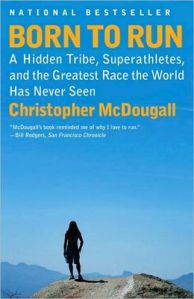
guest review: Born to Run by Christopher McDougall, from Pops

Pops joins us again today to write about a book firmly within his area of expertise: running. We’ve all heard something about Born to Run, I believe. I’ve certainly heard good things; but have never been strongly inclined to pick it up. Pops may change my mind, though.

borntorunI am writing to make a public apology to myself for not reading this book three years ago; and to make a few personal comments for what they’re worth. It’s not coincidence that I pulled it from the shelf soon after reading Ayers’ The Longest Race; that book reminded me that McDougall’s work might contain some of the same magic, which I had (indeed!) delayed for too long. That instinct was accurate; there are similarities between the two that I really appreciated: inspiring depictions of running, fascinating science & history and a wonderful (though different) voice.

Much has already been written about this book, mostly positive and in great thoroughness. I won’t add much to that effort. Another place to look for insight would be McDougall’s website where you can peruse selected readers’ comments; this book has literally changed lives and inspired people. There are also some wonderful photos, which illustrate that this really is non-fiction, as absurd as that may seem while reading it.

I have mentioned before that I collect books about running, particularly in an often frustrating search for good fiction. This is one of the best running books I have ever read. In spite of its connection to reality, it reflects some of fiction’s best elements: humbly heroic characters who are larger than life; a compelling story that defies reality; a romantic adventurous heart; a witty rollicking storyteller’s voice; and sexy women running hard & kicking ass.

I knew bits & pieces about many of the characters in this story, about the ultra running culture and community, about the barefoot running revolution it stimulated and about the Tarahumara Indians. None of that prepared me for such a fun, informative, exciting and ultimately poignant journey. It is always risky to compare writers or books, but I must say that McDougall’s work reminded me in some ways of both Tom Wolfe and Hunter S. Thompson. I kept stopping to think “I know this is based on fact, but it’s so wild and so much fun I can’t believe it!”

Arnulfo Quimare, “elite” Tarahumara runner

Arnulfo Quimare, “elite” Tarahumara runner


The poignant part of the story actually arrives outside the book, sharply in the realm of real life but in some ways as hard to believe. This probably qualifies as a spoiler so stop right now if you want to read the book first; but for me it is an important part of the tale. It’s almost like McDougall should write the sequel.

Here is a relevant quote from the book that sets up the surrealistic “real life” conclusion. The main character in the book, Caballo Blanco, is speaking (he worshiped Geronimo as a kid and retained great respect for the Apache warrior.)

“When I get too old to work, I’ll do what Geronimo would’ve if they’d left him alone… I’ll walk off into the deep canyons and find a quiet place to lie down.”

The author then comments: “There was no melodrama or self-pity in the way Caballo said this, just the understanding that someday, the life he’d chosen would require one last disappearance.”

In March of this year (2012) Caballo was visiting southwest New Mexico so he could run the rugged mountain trails in the Gila Wilderness. One day he planned an easy solo run of 12 miles or so – and he never returned. The Forest Service began a search, and many of his friends (including the author and many characters from the book) arrived from around the country to join the hunt by running the trails. On search day 5, it was a group of Caballo’s running friends who found him off an obscure trail near a stream, dead from heart failure apparently unrelated to any disease or abnormality. He was 58 years old.

(This is also a curious “synchronicity” for blog readers who remember our family fixation with Fire Season, which is set only a few miles away from where Caballo met his end.)

You can read more about this sorrowful ending on the author’s web site, various other online sources, or this NY Times story. The author told his own version of this ending in a piece for Outside Magazine.

Caballo Blanco, RIP.

Caballo Blanco, RIP.

Thanks for another solid review, Pops. You make a strong case. Narrative nonfiction (aka “creative nonfiction”) about exciting, culturally diverse, outdoorsy, unbelievable experiences is right up my alley.

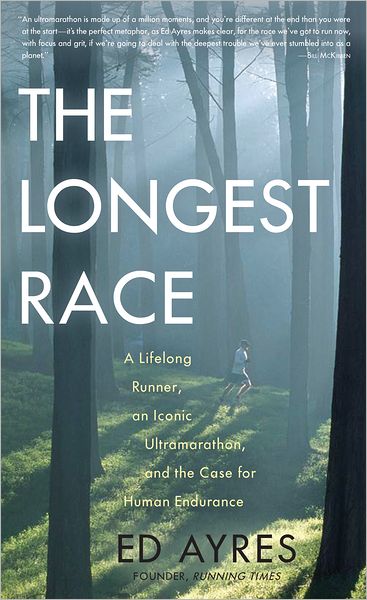
guest review: The Longest Race by Ed Ayres, from Pops

As I read The Longest Race, I thought of my father throughout. He is a marathon runner and a trail runner, and has been contemplating issues of climate change, sustainable living, and humans’ place in nature quite a bit recently. I thought this would be a perfect book for him in its combination of themes, which you can read about in my review. Here, he responds. [His page numbers come from my advance review copy.]

Julia has already done her usual commendable job reviewing this book; my personal interest in Ayres’ two main themes – running, and human degradation of our earthly habitat – compel me to comment further (as she knew it would.) At the same time, I want to parse her use of “metaphor” to describe how running and human development are related in Ayres’ story. While he does often employ metaphor, I believe in many cases he is saying that running actually is part of human development and does have an impact on how we relate to the world. Such is the hubris that plays a part in his tale.

For the above reasons, I really enjoyed this read. That doesn’t mean I found it uniformly superb or satisfying, but the book’s strengths were more than enough to keep me going.

Using a 50-mile ultra to structure his narrative worked better than I expected. There were few threads about his race that required following intently, and those were not lost as we periodically reconnect to that story. The more esoteric subjects he contemplates along the way vary greatly – just as would one’s thoughts during the hours of such an endurance event. In fact, that is an example of the athletic authenticity I found throughout. While I was only familiar with Ayres generally as editor of the early magazine “Running Times,” his deep experience as a lifelong runner shows through. His mental meanderings during a 50-miler – and their sometimes-questionable lucidity – are a familiar element of “running long.”

I was not familiar with Ayres’ background in the themes of human impact on the earth; he worked for the Worldwatch Institute and describes how this commitment evolved from a Quaker upbringing and through a lifetime’s experience. Along the run, we gather bits of his own back-story and “meet” such characters as Mohammed Ali, Mikhail Gorbachev and Ted Taylor (nuclear weapon physicist); such moments are fun and interesting – and chilling, as with his quotation from Taylor evoking the cold war’s nuclear terror (p.94). Also chilling is Ayres’ observation that for those who study the science of ecology, the survival of modern human society is “not just an abstract, academic concept;” it is very immediate.

We learn with him on his journey; e.g. Jared Diamond’s observation that agriculture is “in many ways a catastrophe from which we have never recovered” (p.102) – or “anthropomorphism as a major root cause of the ecological crisis” as noted by many literary luminaries over the years (p.106) – or the 1992 consensus-scientists’ dire & explicit climate change declaration so long ago (p.163) – or a reminder that the regressive “progress” of a suburban lifestyle model may prove to be a mere 2-generation phenomenon. We also meet such authorities as Paul Shepard, Rachel Carson and Wendell Berry along the way.

Similarly, Ayres has much to offer about running itself – not just practical stuff, but history and science as well. He met and/or learned from such names as Joan Benoit, Ted Corbitt and George Sheehan. He cites a Joe Henderson article that I know I read at the same time 25 years ago. Ayres is not the namedropper – that’s my doing throughout here – but rather all these names simply arise as part of his story.

His introduction to the JFK ultra event’s origin unwinds into a period piece on the Kennedy Physical Fitness campaign (which I too experienced), including analysis of JFK’s civic motivation and his 1960 column in Sports Illustrated (who knew?!). I loved learning of David Carrier’s fascinating theory of primitive “persistence hunting,” where humans demonstrated the superior endurance trait that we runners still attempt to conjure (Ch.4). In fact, the role of endurance running throughout early history is compelling – including the Chasquis, the Inca runner-messengers.

Chasqui runner

Chasqui runner


The brief 23 page Appendix, “Notes for an Aspiring Ultrarunner,” is an worthy overview but any really interested reader will do well to research the many other references available.

All together, I enjoyed the blending of themes, emotions and ideas in Ayres’ book. Here is a single passage where Ayres is so nicely able to blend his heritage, running and science:
“The last sounds of the spectators faded, and, after a period of silence that could have been either five minutes or the hundred years it takes for a Quaker kid to sit through Sunday meeting, I found myself glancing left and right, the way I’d been taught as a teenager to drive a car – keep your eyes moving, don’t get fixated on the road ahead. Maybe that was a vestige of the hunter-gatherer’s need to read his surroundings.”

While it is different in some ways, a reader drawn to Ayres book may also appreciate Long Distance, by Bill McKibben. Here you would find a foremost climate change writer who instead writes about his experience pursuing an endurance goal (cross-country skiing) and the lessons he derives for surviving in our every day lives. (Interestingly, the one promotional blurb on the cover of Ayres’ book is a McKibben quote.)

Finally, I must note two of my own favorite observations about running, which he mentions along the way. One is the uncanny and almost inexplicable way that a seasoned trail runner, moving quicker than the eyes seem to process, can cover rough ground dense with rocks & roots – and yet every footstep survives the gauntlet (“almost inexplicable” because there is a scientific story, of course); this phenomenon is well-captured in the exclamation “do my feet have eyes of their own?!” (p.58)

The other fave comes after he has related the many challenges that can test a runner’s resolve and motivation, all the aches & pains & setbacks – which are all so easily overcome by the most sublime moments (or preferably hours!) This he also captures with a mere phrase: “When running is good, there is nothing like it.” (p.98) Alas, as we age, it becomes harder to remember that lesson – but after 35 years it can still be good, and there is still nothing like it.

So glad you liked it, Pops. Thanks for sharing.

The Longest Race: A Lifelong Runner, an Iconic Ultramarathon, and the Case for Human Endurance by Ed Ayres

An ultramarathon, run by a master of the sport, becomes a metaphor for the race for human sustainability we are all running.

Ed Ayres has been running competitively for more than half a century. On a professional basis, he’s also studied climate change, sustainability and a variety of issues facing the future of the human race and our planet. The Longest Race is the story of his 2001 run at the JFK 50 Mile, the United States’ oldest ultramarathon. As Ayres attempts, at age 60, to set a new age-group course record, he contemplates the relationship of human endurance to the sustainability of human life in a fast-changing world.

Ayres’s recollections a decade later are heavy on metaphor. The ultramarathon is a symbol not just for his life, but for any man or woman’s life, and ultimately for the lifespan of humanity. The attributes that work toward sustainability at an individual level are equally valuable in a large society, Ayres says, and today’s “sprint culture” would do well to reconsider the concept of pacing. He also touches on the atom bomb, human evolution, the U.S. crisis in physical fitness and the reasons for following a vegetarian diet. But for all its peripatetic allegory, The Longest Race is always the story of one epic 50-mile race in all its technical and visceral elements, and also a celebration of the sport of running and of our ability to keep running in changing times. For those readers inspired by his story, the appendix offers practical advice to the aspiring ultrarunner.


This review originally ran in the October 19, 2012 issue of Shelf Awareness for Readers. To subscribe, click here, and you’ll receive two issues per week of book reviews and other bookish fun!


Rating: 8 miles to go.

EDIT: See also my father’s glowing review of same.

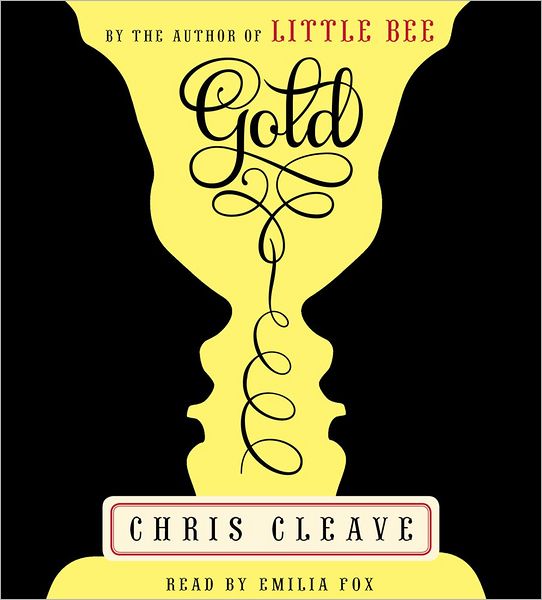
did not finish: Gold by Chris Cleave (audio)

You might recognize Chris Cleave’s name from the significant success of his 2009 bestseller, Little Bee. I did not read that one. But his new book, Gold, appealed to me: for starters and most obviously, it stars two female Olympic track cyclists. This is a rather obscure sport (particularly in the US) that I have competed in. Also it came recommended to me personally. Of course I was going to give it a go.

Hm. I wanted to like this book, for its subject matter if for nothing else. But there are two flaws in that thinking: first, subject matter alone rarely makes for an enjoyable read. Just because a book is about baseball won’t necessarily do it for a baseball player or fan. Secondly, as it turns out, I was too close to this sport. I’m sure Cleave did some research – he had some terms and concepts down, certainly – but he made several errors of inaccuracy that I believe are due to track cycling’s obscurity, and the public’s low awareness. These errors will go unnoticed by a large percentage of the average readership. In this respect I’m far from the ideal reader: I’m so close to the sport that I spot the errors and to me they are egregious. They rankled.

Unfortunately that’s not all that bothered me about this book. I found the characters to be a little one-dimensional (all good, all bad) and unbelievable. Really, the Olympic gold medalist is also model-gorgeous and could make a living posing for photographs?? Come on. (Okay, I guess there’s always Lolo Jones…) And the dialog was stiff, too. Particularly the parent-child dialog: every conversation was a heart-to-heart. I don’t think children really open up and get earnest and profound every time they talk to their parents (at any age). It didn’t feel real, because there were no mundane moments. And here’s the final kicker, fair warning to any who may be sensitive to such things: there is a (fairly central) little girl with cancer. That was a bit much for me personally, considering that I work full-time at a cancer hospital and therefore see enough of this. Just a personal reaction.

I made it a little better than halfway through this book, which sort of surprises me. I was certainly frustrated, annoyed, exasperated with it much earlier than that: in fact, I can pinpoint it for you. I was impatient with the first chapter’s interactions between Zoe and her coach, Tom; but I was really annoyed for the first time on page 11, when Jack relates that Zoe has won her first sprint and he has to get off the phone because her second is starting. The second ride of gold-medal round sprints should follow the first by more than an hour; putting them right back-to-back like that is completely unrealistic and was the first sign that the reality of track cycling would not be taken too seriously in this book.

But I made it past halfway. Why? I’m not sure. I was hoping it would get better? I cared what happened to the characters? But I didn’t, really; I’ve walked away not knowing the outcome of OH so many dramas, and that’s okay. Cleave failed to make me invest in his characters because he failed to make them fully human.

I didn’t read Little Bee; maybe it’s better than this. But Gold didn’t work for me at all.


Minor redemptive points: Emilia Fox’s audio narration was fine. And the only character I liked, related to, felt was human, was the coach. Some of his moments of self-doubt and retrospection felt real. More people like Tom in my fiction, please.

Dream Team: How Magic, Michael, Larry, Charles and the Greatest Team of All Time Conquered the World and Changed the Sport of Basketball Forever by Jack McCallum

A funny, respectful, expert, complete–and literary–examination of 1992’s Olympic Dream Team and its permanent effects on basketball.


The U.S. Olympic basketball team of 1992 was known as the Dream Team because it included the game’s biggest stars, including Magic Johnson, Larry Bird, Charles Barkley and Michael Jordan.

Sports Illustrated‘s Jack McCallum (Seven Seconds or Less, Unfinished Business) brings these colorful personalities to life as he recounts the creation of the Dream Team and its path to Olympic gold. When a meat inspector from Belgrade came up with the idea of rescinding the amateurs-only clause of Olympics competition, it made it possible for the U.S. men’s basketball team, traditionally made up of college players, to become a squad of NBA All-Stars, characterized by outrageous and iconic players and an unusual vision of the game. As McCallum tells it, this team took its ambassadorial role seriously, as the superstars relinquished their playing minutes to the greater goals of victory, teamwork and honor in a manner arguably absent from today’s game.

Dream Team‘s tone is occasionally reverent, but just as McCallum begins to speak in mythic terms, he reminds us that these men were only human, tapping into their personal lives and private sides (when his shared history with them allows). McCallum is nothing if not opinionated, but always fair in his analyses, and the quotations and one-liners that pepper his text are pure gold in terms of entertainment as well as illumination of the fine sport of basketball.


This review originally ran as a *starred review* in the July 17, 2012 issue of Shelf Awareness for Readers. To subscribe, click here, and you’ll receive two issues per week of book reviews and other bookish fun!


Rating: 7 points.

Racing Through the Dark by David Millar

The unexpectedly inspirational story of a pro cyclist’s “clean” return to the sport after doping.


David Millar was an avid bicycle road racer in his teens, and after he turned pro at age 22, he raced in all the big European events, including the Tour de France, where he wore the yellow leader’s jersey. He resisted doping for years, but not forever; he was eventually busted for the illegal use of performance-enhancing drugs. His story was, perhaps, not highly remarkable in a sport already ridden with doping scandals, but it became noteworthy when he spoke out about his experiences, took a strong anti-doping stand and returned to the sport as a high-profile–and still highly accomplished–“clean” racer. Racing Through the Dark is his story.

Millar’s memoir begins in childhood and follows through rocky years on the pro circuit, the painful decision to dope after abstaining for years, the details of his bust and the raging alcoholic haze of his ban before returning to the sport. It includes anecdotes featuring many of pro cycling’s biggest names, including Mark Cavendish, Stuart O’Grady and Lance Armstrong. Millar’s voice is appealingly open and artless. He takes full responsibility for his poor decisions even as he criticizes pro cycling’s traditional code of silence that overlooks or condones widespread use of illegal drugs. While Millar excoriates the culture of doping, he doesn’t use it as an excuse. He comes across in the end as a surprisingly honorable figure, whose continuing professional career offers a final theme of redemption.


This review originally ran in the July 3, 2012 issue of Shelf Awareness for Readers. To subscribe, click here, and you’ll receive two issues per week of book reviews and other bookish fun!


Rating: 5 skinny tires.

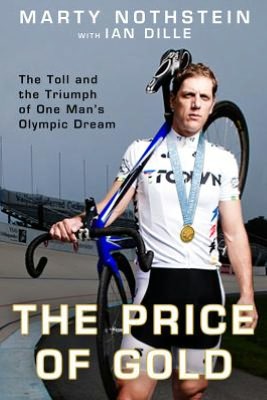
The Price of Gold by Marty Nothstein and Ian Dille

A story of competition and commitment that will raise readers’ heart rates as it brings the antagonistic world of velodrome racing to life.

Marty Nothstein’s athletic accomplishments include dozens of national championships and several world championships. His event is the relatively obscure match sprint in track cycling, and he is the most accomplished American sprinter of the modern era. The Price of Gold details his journey from childhood to Olympic gold and silver, with serious injuries, deep disappointments and unimaginable intense training along the way.

The story begins with Nothstein’s silver medal at the 1996 Atlanta Olympics, then backtracks to a sleepy Pennsylvania town where a bored teenager seeks an outlet for his aggression. Nothstein’s natural talent, powerful physique and hostile, hyper-competitive spirit perfectly suit him for track sprinting. This sport combines cunning tactics with raw power, and Nothstein would become an exemplar of its reputation for ruthlessness. Relationships are built and sometimes broken, but the intense drama is blunted by a surprisingly sweet note, as Nothstein’s wife, Christi (herself an elite junior racer), provides constant and complete support.

Cycling fans familiar with Nothstein’s reputation for belligerence may be surprised at the thoughtful tale he has to tell here and will be tickled to recognize many cycling greats threading through his story. The Price of Gold focuses on hard work, competition and achievement, pulling no punches in conveying the rough edges, but also communicating great emotion.


This review originally ran in the June 12, 2012 issue of Shelf Awareness for Readers. To subscribe, click here, and you’ll receive two issues per week of book reviews and other bookish fun!


Rating: 7 laps.